Proceedings of the 2019 Conference on Empirical Methods in Natural Language Processing and the 9th International Joint Conference on Natural Language Processing, pages 1173–1178,
1173
Commonsense Knowledge Mining from Pretrained Models
Joshua Feldman∗, Joe Davison∗, Alexander M. Rush
School of Engineering and Applied Sciences Harvard University
{joshua feldman@g, jddavison@g, srush@seas}.harvard.edu
Abstract
Inferring commonsense knowledge is a key challenge in natural language processing, but due to the sparsity of training data, previ-ous work has shown that supervised methods for commonsense knowledge mining under-perform when evaluated on novel data. In this work, we develop a method for generat-ing commonsense knowledge usgenerat-ing a large, pre-trained bidirectional language model. By transforming relational triples into masked sentences, we can use this model to rank a triple’s validity by the estimated pointwise mutual information between the two entities. Since we do not update the weights of the bidirectional model, our approach is not bi-ased by the coverage of any one common-sense knowledge base. Though this method performs worse on a test set than models ex-plicitly trained on a corresponding training set, it outperforms these methods when mining commonsense knowledge from new sources, suggesting that unsupervised techniques may generalize better than current supervised ap-proaches.
1 Introduction
Commonsense knowledge consists of facts about the world which are assumed to be widely known. For this reason, commonsense knowledge is rarely stated explicitly in natural language, mak-ing it challengmak-ing to infer this information with-out an enormous amount of data (Gordon and Van Durme,2013). Some have even argued that machine learning models cannot learn common sense implicitly (Davis and Marcus,2015).
One method for mollifying this issue is directly augmenting models with commonsense knowl-edge bases (Young et al., 2018), which typically contain high-quality information but with low cov-erage. These knowledge bases are represented as a graph, with nodes consisting of conceptual
entities (i.e. dog, running away, excited, etc.) and the pre-defined edges representing the nature of the relations between concepts (IsA, UsedFor, CapableOf, etc.). Commonsense knowledge base completion (CKBC) is a machine learning task motivated by the need to improve the coverage of these resources. In this formulation of the prob-lem, one is supplied with a list of candidate entity-relation-entity triples, and the task is to distin-guish which of the triples express valid common-sense knowledge and which are fictitious (Li et al.,
2016).
Several approaches have been proposed for training models for commonsense knowledge base completion (Li et al., 2016; Jastrzebski et al.,
2018). Each of these approaches uses some sort of supervised training on a particular knowl-edge base, evaluating the model’s performance on a held-out test set from the same database. These works use relations from ConceptNet, a crowd-sourced database of structured common-sense knowledge, to train and validate their mod-els (Liu and Singh,2004). However, it has been shown that these methods generalize poorly to novel data (Li et al.,2016;Jastrzebski et al.,2018).
Jastrzebski et al. (2018) demonstrated that much of the data in the ConceptNet test set were simply rephrased relations from the training set, and that this train-test set leakage led to artificially inflated test performance metrics. This problem of train-test leakage is typical in knowledge base comple-tion tasks (Toutanova et al.,2015;Dettmers et al.,
2018).
In particular, we use a masked language model to estimate point-wise mutual information between entities in a possible relation, an approach that differs significantly from fine-tuning approaches used for other language modeling tasks. Since the weights of the model are fixed, our approach is not biased by the coverage of any one dataset. As we might expect, our method underperforms when compared to previous benchmarks on the Con-ceptNet common sense triples dataset (Li et al.,
2016), but demonstrates a superior ability to gen-eralize when mining novel commonsense knowl-edge from Wikipedia.
Related Work Schwartz et al.(2017) andTrinh and Le (2018) demonstrate a similar approach to using language models for tasks requiring com-monsense, such as the Story Cloze Task and the Winograd Schema Challenge, respectively (Mostafazadeh et al.,2016;Levesque et al.,2012).
Bosselut et al. (2019) and Trinh and Le (2019) use unidirectional language models for CKBC, but their approach requires a supervised training step. Our approach differs in that we intentionally avoid training on any particular database, relying instead on the language model’s general world knowl-edge. Additionally, we use a bidirectional masked model which provides a more flexible framework for likelihood estimation and allows us to estimate point-wise mutual information. Although it is be-yond the scope of this paper, it would be interest-ing to adapt the methods presented here for the re-lated task of generating new commonsense knowl-edge (Saito et al.,2018).
2 Method
Given a commonsense head-relation-tail triple x= (h, r,t), we are interested in determining the validity of that tuple as a representation of a com-monsense fact. Specifically, we would like to de-termine a numeric scorey∈Rreflecting our
con-fidence that a given tuple represents true knowl-edge.
We assume that heads and tails are arbitrary-length sequences of words in a vocabulary V
so that h = {h1, h2, . . . , hn} and t = {t1, t2, . . . , tm}. We further assume that we have
a known set of possible relationsRso thatr∈ R. The goal is to determine a functionf that maps relational triples to validity scores. We propose decomposing f(x) = σ(τ(x)) into two sub-components: a sentence generation function τ
which maps a triple to a single sentence, and a scoring modelσwhich then determines a validity scorey.
Our approach relies on two types of pretrained language models. Standard unidirectional models are typically represented as autoregressive proba-bilities:
p(w1, w2, . . . , wm) = m Y
i
p(wi|w1, . . . , wi−1)
Masked bidirectional models such as BERT, pro-posed by Devlin et al. (2018), instead model in both directions, training word representations con-ditioned both on future and past words. The mask-ing allows any number of words in the sequence to be hidden. This setup provides an intuitive frame-work to evaluate the probability of any word in a sequence conditioned on the rest of the sequence,
p(wi|w1:0 i−1, wi0+1:m)
wherew0 ∈ V ∪ {κ}andκis a special token indi-cating a masked word.
2.1 Generating Sentences from Triples
We first consider methods for turning a triple such as (ferret, AtLocation, pet store) into a sentence such as “the ferret is in the pet store”. Our approach is to generate a set of candidate sen-tences via hand-crafted templates and select the best proposal according to a language model.
For each relation r ∈ R, we hand-craft a set of sentence templates. For example, one template in our experiments for the relation AtLocation is, “you are likely to find HEAD in TAIL”. For the above example, this would yield the sentence, “You are likely to find ferret in pet store”.
Because these sentences are not always gram-matically correct, such as in the above example, we apply a simple set of transformations. These consist of inserting articles before nouns, con-verting verbs into gerunds, and pluralizing nouns which follow numbers. See the supplementary materials for details and Table 1 for an exam-ple. We then enumerate a set of alternative sen-tencesS ={S1, . . . , Sj}resulting from each
tem-plate and from all combinations of transforma-tions. This yields a set of candidate sentences for each data point. We then select the candidate sen-tence with the highest log-likelihood according to a pre-trained unidirectional language modelPcoh.
S∗= arg max
S∈S
Candidate SentenceSi logp(Si)
“musician can playing musical instrument” −5.7
“musician can be play musical instrument” −4.9
“musician often play musical instrument” −5.5
“a musician can play a musical instrument” −2.9
Table 1: Example of generating candidate sen-tences. Several enumerated sentences for the triple (musician, CapableOf, play musical instrument). The sentence with the highest log-likelihood according to a pretrained language model is selected.
We refer to this method of generating a sen-tence from a triple as COHERENCY RANKING. Coherency Ranking operates under the assump-tion that natural, grammatical sentences will have a higher likelihood than ungrammatical or unnat-ural sentences. See an example subset of sen-tence candidates and their corresponding scores in Table 1. From a qualitative evaluation of the selected sentences, we find that this approach produces sentences of significantly higher quality than those generated by deterministic rules alone. We also perform an ablation study in our experi-ments demonstrating the effect of each component on CKBC performance.
2.2 Scoring Generated Triples
Assuming we have generated a proper sentence from a relational triple, we now need a way to score its validity with a pretrained model that con-siders the relationship between the relation enti-ties. We therefore propose using the estimated point-wise mutual information (PMI) of the head hand tailtof a triple conditioned on the relation r, defined as,
PMI(t,h|r) = logp(t|h, r)−logp(t|r)
We can estimate these scores by using a masked bidirectional language model, Pcmp. In the case where the tail is a single word, the model al-lows us to evaluate the conditional likelihood of a single triple componentp(t|h, r)by computing Pcmp(wi =t|w1:i−1, wi+1:m)for the tail word.
In practice, the tail might be realized as a j -word phrase. To handle this complexity, we use a greedy approximation of its probability. We first mask all of the tail words and compute the proba-bility of each. We then find the word with highest probabilitypk, substitute it back in, and repeat j
times. Finally, we calculate the total conditional likelihood of the tail by the product of these terms, p(t|h, r) =Qjk=1pk.
The marginalp(t|r)is computed similarly, but in this case we mask the head throughout. For example, to compute the marginal tail probability for the sentence, “You are likely to find a ferret in the pet store” we mask both the head and the tail and then sequentially unmask the tail words only: “You are likely to find aκh1in theκt1 κt2”. If κt2 = “store” has a higher probability than κt1 = “pet”, we unmask “store” and compute “You are likely to find aκh1in theκt1store”. The marginal likelihoodp(t|r) is then the product of the two probabilities.
The final score combines the marginal and con-ditional likelihoods by employing a weighted form of the point-wise mutual information,
PMIλ(t,h|r) =λlogp(t|h, r)−logp(t|r)
whereλis treated as a hyperparameter. Although exact PMI is symmetrical, the approximate model itself is not. We therefore average PMIλ(t,h|r)
and PMIλ(h,t|r)to reduce the variance of our
es-timates, computing the masked head values rather than the tail values in the latter.
3 Experiments
To evaluate the Coherency Ranking approach we measure whether it can distinguish between valid and invalid triples. For our masked model, we use BERT-large (Devlin et al., 2018). For sentence ranking, we use the GPT-2 117M LM (Radford et al.,2019). The relation templates and grammar transformation rules which we use can be found in the supplementary materials.
We compare the proposed method to several baselines. Following Trinh and Le (2018), we evaluate a simple CONCATENATION method for
generating sentences, splitting the relationr into separate words and concatenating it with the head and tail. For the triple (ferret, AtLocation, pet store), the Concatenation approach would yield, “ferret at location pet store”.
Model Task 1 Task 2
Unsupervised
CONCATENATION 68.8 2.95±0.11
TEMPLATE 72.2 2.98±0.11
TEMPL.+GRAMMAR 74.4 2.56±0.13
COHERENCYRANK 78.8 3.00±0.12
Supervised
DNN 89.2 2.50
FACTORIZED 89.0 2.61
[image:4.595.73.289.64.226.2]PROTOTYPICAL 79.4 2.55
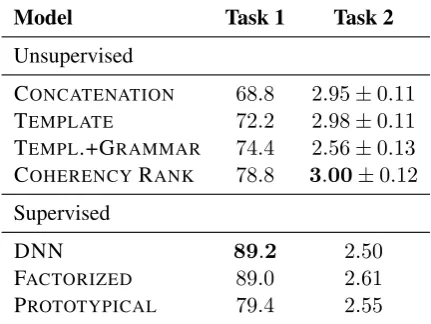
Table 2: Main results for Task 1: Commonsense knowledge base completion (test F1 score) and Task 2: Wikipedia mining (quality scores out of 4). Re-sults are included from the sentence generation meth-ods of simple concatenation, hand-crafted templates, templates plus grammatical transformations, and co-herency ranking. DNN, Factorized, and Prototypical models are described inJastrzebski et al.(2018).
would become “You are likely to find ferret in pet store” using the template “you are likely to find HEADinTAIL”.
Next, we extend the Template method by ap-plying deterministic grammatical transformations, which we refer to as the TEMPLATE+ GRAMMAR
approach. Like the full approach, these trans-formations involve adding articles before nouns, converting verbs into gerunds, and pluralizing nouns following numbers. The Template + Gram-mar approach differs from Coherency Ranking in that all transformations are applied to every sen-tence instead of applying combinations of trans-formations and templates, which are then ranked by a language model. Returning to our exam-ple, the Template + Grammar method produces “You are likely to find a ferret in a pet store”. While this sentence is grammatical, applying this method to (star, AtLocation, outer space) yields “You are likely to find a star in an outer space”, which is incorrect.
We compare our results to the supervised mod-els from the work of Jastrzebski et al. (2018) and the best performing model from Li et al.
(2016). Jastrzebski et al. (2018) introduce FAC
-TORIZED and PROTOTYPICALmodels. The Fac-torized model embeds the head, relation, and tail in a vector space and then produces a score by tak-ing a linear combination of the inner products be-tween each pair of embeddings. The
Prototypi-cal model is similar, but does not include the in-ner product between head and tail.Li et al.(2016) evaluate a deep neural network (DNN) for CKBC. They concatenate embeddings for the head, rela-tion, and tail, which they then feed through a mul-tilayer perceptron with one hidden layer. All three models are trained on 100,000 ConceptNet triples.
Task 1: Commonsense Knowledge Base Com-pletion Our experimental setup followsLi et al.
(2016), evaluating our model with their test set (n = 2400) containing an equal number of valid and invalid triples. The valid triples are from the crowd-sourced Open Mind Common Sense (OMCS) entries in the ConceptNet 5 dataset (Speer and Havasi,2012). Invalid triples are gen-erated by replacing an element of a valid tuple with another randomly selected element.
We use our scoring method to classify each tu-ple as valid or invalid. To this end, we use our method to assign a score to each tuple and then group the resulting scores into two clusters. In-stances in the cluster with the higher mean PMI are labeled as valid, and the remainder are labeled as invalid. We use expectation-maximization with a mixture of Gaussians to cluster. We also tune the PMI weight via grid search over 90 points from λ ∈ [0.5,5.], using the Akaike information crite-rion of the Gaussian mixture model for evaluation (Akaike,1974).
Table2shows the full results. Our unsupervised approach achieves a test set F1 score of78.8, com-parable to the 79.4F1 score found by the super-vised prototypical approach. The Factorized and DNN models significantly outperformed our ap-proach with F1 scores of 89.2 and 89.0, respec-tively. Our grid search found an optimalλvalue of1.65for the Concatenation sentence generation model and1.55for the Coherency Ranking model. The Template and Template + Grammar methods found lambda values of 1.20 and 0.95, respec-tively.
method to evaluate these 3000 triples. Using the approach described by Speer and Havasi (2012), and followed by Li et al. (2016) and Jastrzebski et al.(2018), two human annotators manually rate the 100 triples with the highest predicted score on a 0 to 4 scale: 0 (Doesn’t make sense), 1 (Not true), 2 (Opinion/Don’t know), 3 (Sometimes true), and 4 (Generally true). We tunedλby mea-suring the quality of the 100 triples with the high-est predicted score acrossλ∈ {1,2, . . . ,9,10}.
The top 100 triples selected by our model were assigned a mean rating of 3.00 (λ = 4) with a standard error of 0.11 under the Coherency Rank-ing approach, well exceedRank-ing the performance of current supervised methods (Table 2). Standard errors were calculated using 1000 bootstrap sam-ples of the top 100 trisam-ples. The ratings assigned by the two human annotators had a0.50 Pearson correlation and0.23 kappa inter-annotator agree-ment. Rater disagreements occur most frequently when triples are ambiguous or difficult to inter-pret. Notably, if we bucket the five scores into just two categories oftrueandfalse, this disagreement rate drops by 50%. To give a sense of the types of commonsense knowledge our models struggle to capture, we report the top 100 most confident predictions that receive an average score below 3 in the supplementary material. Notably, some of the top 100 triples our model identified were indeed true, but would not be reasonably con-sidered common sense (e.g. (vector bundle, HasProperty, manifold)). This suggests that our approach may be applicable to mining knowl-edge beyond common sense.
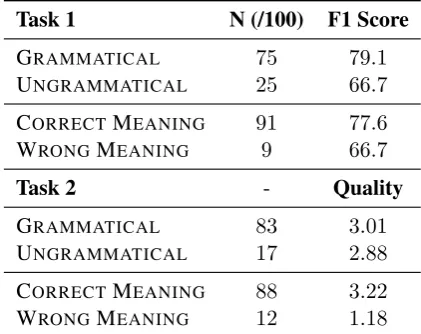
Analysis: Sentence Generation In order to measure the impact of sentence generation on our model, we select a sample of 100sentences and group the results by a) whether the sentence con-tained a grammatical error, and b) whether the sentence misrepresented the meaning of the triple. For example, the triple (golf, HasProperty, good)yields the sentence “golf is a good”, which is grammatically correct but conveys the wrong meaning. On both Wikipedia mining and CKBC, we find that misrepresenting meaning has an ad-verse impact on model performance. In CKBC, we also find that grammar has a high impact on the resulting F1 scores (Table3). Future work could therefore focus on designing templates that more reliably encode a relation’s true meaning.
Task 1 N (/100) F1 Score
GRAMMATICAL 75 79.1
UNGRAMMATICAL 25 66.7
CORRECTMEANING 91 77.6
WRONGMEANING 9 66.7
Task 2 - Quality
GRAMMATICAL 83 3.01
UNGRAMMATICAL 17 2.88
CORRECTMEANING 88 3.22
WRONGMEANING 12 1.18
Table 3: Test results examining the effect of sen-tence meaning and grammaticality on task perfor-mance. Scores are shown for a sample of100 triples split by whether the generated sentence is grammati-cal and whether it conveys the correct meaning of the triple.
4 Conclusion
We introduce a robust unsupervised method for commonsense knowledge base completion using the world knowledge of pre-trained language mod-els. We develop a method for expressing knowl-edge triples as sentences. Using a bidirectional masked language model on these sentences, we can then estimate the weighted point-wise mutual information of a triple as a proxy for its valid-ity. Though our approach performs worse on a held-out test set developed by Li et al. (2016), it does so without any previous exposure to the Con-ceptNet database, ensuring that this performance is not biased. In the future, we hope to explore whether this approach can be extended to min-ing facts that are not commonsense and to gen-erating new commonsense knowledge outside of any given database of candidate triples. We also see potential benefit in the development of a more expansive set of evaluation methods for common-sense knowledge mining, which would strengthen the validity of our conclusions.
Acknowledgments
[image:5.595.310.521.63.230.2]References
Hirotugu Akaike. 1974. A new look at the statistical model identification. InSelected Papers of Hirotugu Akaike, pages 215–222. Springer.
Antoine Bosselut, Hannah Rashkin, Maarten Sap, Chaitanya Malaviya, Asli C¸ elikyilmaz, and Yejin Choi. 2019. COMET: commonsense transformers for automatic knowledge graph construction.CoRR, abs/1906.05317.
Ernest Davis and Gary Marcus. 2015. Commonsense reasoning and commonsense knowledge in artificial intelligence. Commun. ACM, 58(9):92–103.
Tim Dettmers, Pasquale Minervini, Pontus Stenetorp, and Sebastian Riedel. 2018. Convolutional 2d knowledge graph embeddings. In Thirty-Second AAAI Conference on Artificial Intelligence.
Jacob Devlin, Ming-Wei Chang, Kenton Lee, and Kristina Toutanova. 2018. Bert: Pre-training of deep bidirectional transformers for language understand-ing. arXiv preprint arXiv:1810.04805.
Jonathan Gordon and Benjamin Van Durme. 2013. Re-porting bias and knowledge acquisition. In Proceed-ings of the 2013 workshop on Automated knowledge base construction, pages 25–30. ACM.
Stanisław Jastrzebski, Dzmitry Bahdanau, Seyedar-ian Hosseini, Michael Noukhovitch, Yoshua Ben-gio, and Jackie Chi Kit Cheung. 2018. Common-sense mining as knowledge base completion? a study on the impact of novelty. arXiv preprint arXiv:1804.09259.
Hector Levesque, Ernest Davis, and Leora Morgen-stern. 2012. The winograd schema challenge. In Thirteenth International Conference on the Princi-ples of Knowledge Representation and Reasoning.
Xiang Li, Aynaz Taheri, Lifu Tu, and Kevin Gimpel. 2016. Commonsense knowledge base completion. In Proceedings of the 54th Annual Meeting of the Association for Computational Linguistics (Volume 1: Long Papers), volume 1, pages 1445–1455.
Hugo Liu and Push Singh. 2004. Conceptneta practi-cal commonsense reasoning tool-kit. BT technology journal, 22(4):211–226.
Nasrin Mostafazadeh, Nathanael Chambers, Xiaodong He, Devi Parikh, Dhruv Batra, Lucy Vanderwende, Pushmeet Kohli, and James Allen. 2016. A cor-pus and evaluation framework for deeper under-standing of commonsense stories. arXiv preprint arXiv:1604.01696.
Alec Radford, Jeffrey Wu, Rewon Child, David Luan, Dario Amodei, and Ilya Sutskever. 2019. Language models are unsupervised multitask learners. OpenAI Blog, 1:8.
Itsumi Saito, Kyosuke Nishida, Hisako Asano, and Junji Tomita. 2018. Commonsense knowledge base completion and generation. In Proceedings of the 22nd Conference on Computational Natural Lan-guage Learning, pages 141–150, Brussels, Belgium. Association for Computational Linguistics.
Roy Schwartz, Maarten Sap, Ioannis Konstas, Leila Zilles, Yejin Choi, and Noah A. Smith. 2017. The effect of different writing tasks on linguistic style: A case study of the ROC story cloze task. CoRR, abs/1702.01841.
Robert Speer and Catherine Havasi. 2012. Represent-ing general relational knowledge in conceptnet 5. In LREC, pages 3679–3686.
Kristina Toutanova, Danqi Chen, Patrick Pantel, Hoi-fung Poon, Pallavi Choudhury, and Michael Gamon. 2015. Representing text for joint embedding of text and knowledge bases. In Proceedings of the 2015 Conference on Empirical Methods in Natural Lan-guage Processing, pages 1499–1509.
Trieu H. Trinh and Quoc V. Le. 2018. A sim-ple method for commonsense reasoning. CoRR, abs/1806.02847.
Trieu H. Trinh and Quoc V. Le. 2019. Do language models have common sense?