Proceedings of the 2019 Conference on Empirical Methods in Natural Language Processing and the 9th International Joint Conference on Natural Language Processing, pages 4799–4809,
4799
Reconstructing Capsule Networks for Zero-shot Intent Classification
Han Liu1∗ Xiaotong Zhang1∗ Lu Fan1∗ Xuandi Fu1 Qimai Li1 Xiao-Ming Wu1† Albert Y.S. Lam2
Department of Computing, The Hong Kong Polytechnic University, Hong Kong S.A.R.1 Fano Labs, Hong Kong S.A.R.2
{cshliu,csxtzhang,cslfan}@comp.polyu.edu.hk
{csxfu,csqmli,csxmwu}@comp.polyu.edu.hk, [email protected]
Abstract
Intent classification is an important building block of dialogue systems. With the bur-geoning of conversational AI, existing sys-tems are not capable of handling numerous fast-emerging intents, which motivates zero-shot intent classification. Nevertheless, re-search on this problem is still in the incipi-ent stage and few methods are available. A recently proposed zero-shot intent classifica-tion method, IntentCapsNet, has been shown to achieve state-of-the-art performance. How-ever, it has two unaddressed limitations: (1) it cannot deal with polysemy when extract-ing semantic capsules; (2) it hardly recog-nizes the utterances of unseen intents in the generalized zero-shot intent classification set-ting. To overcome these limitations, we pro-pose to reconstruct capsule networks for zero-shot intent classification. First, we introduce a dimensional attention mechanism to fight a-gainst polysemy. Second, we reconstruct the transformation matrices for unseen intents by utilizing abundant latent information of the la-beled utterances, which significantly improves the model generalization ability. Experimental results on two task-oriented dialogue datasets in different languages show that our proposed method outperforms IntentCapsNet and other strong baselines.
1 Introduction
With the advent of conversational AI, task-oriented spoken dialogue systems are becoming ubiquitous, e.g., chatbots deployed on differen-t applicadifferen-tions, or modules indifferen-tegradifferen-ted in differen-the pop-ular virtual personal assistants like Apple Siri or Microsoft Cortana (Chen et al., 2017). To im-prove business effectiveness and user satisfaction, accurately identifying the intents behind user
ut-∗
Equal contribution. †
Corresponding author.
terances is indispensable. However, it is extreme-ly challenging not onextreme-ly because user queries are sometimes short and expressed diversely, but al-so because it may continuously encounter new or unacquainted intents popped up quickly from var-ious domains. Conventional intent classification methods (Hu et al.,2009;Tur et al.,2012;Xu and Sarikaya,2013;Ravuri and Stolcke,2015;Liu and Lane,2016;Nam et al.,2016) typically train a su-pervised learning model on large amounts of la-beled data, and are not effective in recognizing e-merging unseen intents.
Several zero-shot learning approaches attempt-ed to address the challenges for classifying intents whose instances are not present during training. One common idea is to utilize some external re-sources (Ferreira et al.,2015a,b;Yazdani and Hen-derson, 2015; Kumar et al., 2017; Zhang et al., 2019) such as label ontologies or manually defined attributes. However, such external resources are usually unavailable, as they require substantial ex-tra time and expensive human labour to produce. To implement zero-shot intent classification more easily and intelligently, recent works rely more on the word embeddings of intent labels, which can be easily pretrained on text corpus. Methods proposed byChen et al. (2016) and Kumar et al. (2017) utilize neural networks to project intent la-bels and data samples to the same semantic space and then measure their similarity. However, learn-ing a good projection function is usually difficult due to the diversity of user expressions, especially in some complex domains such as medical queries (Zhang et al.,2016).
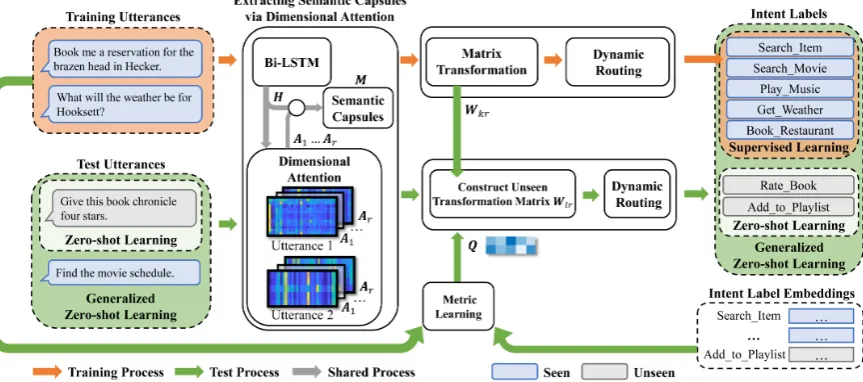
Figure 1: Illustration of our framework ReCapsNet-ZS.In the training process, labeled utterances are first en-coded by Bi-LSTM. Then, a set of semantic capsules are extracted via the dimensional attention module. Finally, these semantic capsules are fed to a capsule network to train a model for predicting the seen intents.In the testing process, to predict the unseen intents, a metric learning method is trained on labeled utterances and intent label embeddings to learn the similarities between the unseen and seen intents. Then, the learned similarities and the transformation matrices for the seen intents trained by capsule networks are used to construct the transformation matrices for the unseen intents. When a test utterance arrives, it is first encoded into semantic capsules by the trained Bi-LSTM and dimensional attention module. There are two settings for intent classification. (1) Zero-shot intent classification: only utterances of the unseen intents participate in testing, so each utterance needs to be clas-sified to one of the unseen intents. In this case, only the transformation matrices for the unseen intents are used for prediction. (2) Generalized zero-shot intent classification: test utterances may come from both the seen and unseen intents, so each utterance needs to be classified to either a seen or an unseen intent. In this case, the transformation matrices for the seen and unseen intents are all used for prediction.
classification tasks, it has two unaddressed limi-tations. (1) The self-attention module of Intent-CapsNet cannot handle polysemy, which weakens the representation capacity of semantic capsules. (2) For the generalized zero-shot classification set-ting where newly arrived utterances come from both seen and unseen intents, the method of In-tentCapsNet for constructing the prediction vec-tors can easily cause the model to completely fail in detecting unseen intents, which is clearly unde-sirable and inadequate for real dialogue systems.
In this paper, we propose to reconstruct cap-sule networks for zero-shot intent classification (ReCapsNet-ZS), which effectively addresses the limitations of IntentCapsNet and adapts well to the generalized zero-shot intent classification tasks. As illustrated in Figure1, ReCapsNet-ZS consists of two components. First, it introduces a dimen-sional attention module to alleviate the polysemy problem, which helps to extract semantic features for capsule networks. Second, it computes the similarities between unseen and seen intents by u-tilizing the rich latent information of labeled
utter-ances, and then constructs the transformation ma-trices for unseen intents with the computed simi-larities and the trained transformation matrices for seen intents, which greatly improves the general-ization ability to unseen intents.
To verify the effectiveness of the proposed ReCapsNet-ZS for zero-shot intent classification, we conduct extensive experiments on two re-al task-oriented dire-alogue datasets in English and Chinese respectively. The empirical study vali-dates our proposals and shows promising results of ReCapsNet-ZS, which are significantly better than state-of-the-art methods, especially on the gener-alized zero-shot intent classification tasks.
2 Related Works
vision (Ba et al., 2015; Xian et al., 2016) and natural language processing (Sappadla et al., 2016;Zhang et al.,2019).
Zero-shot intent classification is an importan-t and challenging importan-task for many naimportan-tural language understanding applications (Hu et al., 2009; Li-u and Lane, 2016; Nam et al., 2016; Xu and Sarikaya,2013), in which new intents emerge con-stantly and they cannot be easily recognized. Sev-eral methods have been proposed to tackle this problem.Ferreira et al.(2015a,b) andYazdani and Henderson(2015) utilize external resources such as label ontologies or manually defined attributes to find the relationship between seen and unseen intent labels. However, the external resources are usually difficult to obtain, as collecting them is labor intensive and time consuming. Chen et al. (2016) and Kumar et al.(2017) project the utter-ances and intent labels to a same semantic space and then compute the similarities between utter-ances and intent labels (Chen et al.,2016;Kumar et al., 2017). However, diverse user expression-s may make it difficult to learn a good projection function and thus affect the classification perfor-mance. Recently, Xia et al. (2018) extend cap-sule networks for zero-shot intent classification by transferring the prediction vectors from seen class-es to unseen classclass-es. However, there are some key issues left to be resolved, including how to deal with polysemy in word embeddings and how to improve the model generalization ability to unseen intents in the generalized zero-shot intent classifi-cation setting.
Capsule Networks. Capsule Networks (Sabour et al., 2017) were first proposed to address the shortcomings of convolutional neural networks (CNN) in the domain of computer vision. It al-lows the networks to learn part-whole invariant relationships consecutively. Recently, some stud-ies have attempted to apply capsule networks in the domain of natural language processing (Yang et al., 2018;Geng et al., 2019; Xia et al., 2018) and obtained promising results.Yang et al.(2018) first extend capsule networks for text classifica-tion. Geng et al. (2019) successfully combine the dynamic routing algorithm with some meta-learning framework for few-shot text classifica-tion. However, their model still requires some la-beled samples for each class.Xia et al.(2018) pro-pose a model based on capsule networks for zero-shot intent classification and has achieved
state-of-the-art performance, but as mentioned above, their model has some intrinsic limitations remained to be addressed.
3 Preliminaries
3.1 Problem Formulation
Given the set of all intent labelsY = YsS
Yu, where Ys = {ys
1, ys2, . . . , yKs } and Yu = {y1u, y2u, . . . , yLu}are the sets of seen and unseen intent labels respectively. There is no overlap be-tween Ys and Yu, i.e., YsT
Yu = ∅, and K
and L are the numbers of seen and unseen in-tent labels respectively. The embeddings of the seen and unseen intent labels are denoted byEs =
{es1,es2, . . . ,esK}andEu = {eu1,eu2, . . . ,euL} re-spectively. Each embedding is a d-dimensional vector. For all the seen and unseen intent label-s, their associated embeddings are available. The sample (utterance) sets for the seen and unseen in-tent labels are denoted byXs={xs1, xs2, . . . , xsns} andXu = {xu1, xu2, . . . , xunu}respectively, where
ns is the number of instances of the seen labels andnu is the number of instances of the unseen labels.
Zero-shot Intent Classification. For this set-ting, the training set isXtr ={Xs, Ys}, andXu
is not available for training. In the test phase, the goal is to assign an unseen intent labely ∈Yu to a given utterance.
Generalized Zero-shot Intent Classification.
For this setting, the training procedure is the same as above, while the difference is in the test phase, where the goal is to assign an intent label y ∈
YsS
Yuto a given utterance.
In this paper, we aim to reconstruct capsule net-works for handling both of the two settings of zero-shot intent classification.
3.2 Limitations of IntentCapsNet
Limitation 1. The self-attention module of In-tentCapsNet cannot handle the polysemy problem, which limits the representation capacity of seman-tic capsules.
Typically, a word is represented by a multi-dimensional embedding. Since a word can have different meanings in different contexts, some in-teresting recent studies (Shen et al., 2018; S¸enel et al., 2018) suggest that different dimensions of a word embedding may tend to represent differ-ent semantic meanings. For example, the word “book” has different meanings in the two utter-ances: “Book a restaurant in Michigan for 4 peo-ple” and “Give 4 out of 6 points to this book”. For the embedding of the word “book”, it is hy-pothesized that some dimensions may be more in-dicative for the first meaning – ”reserve”, while some other dimensions may be more indicative for the second meaning. Apparently, the self-attention mechanism cannot pay more attentions to the di-mensions that best describe the specific meaning of a word in a given context, as it assigns the same attention score for all the dimensions, which sig-nificantly limits the representation capacity of se-mantic capsules and undermines the performance of capsule networks.
Limitation 2. For the generalized zero-shot classification setting, the method of IntentCapsNet for constructing the prediction vectors is highly likely to cause the model to lose generalization a-bility to unseen intents.
Here, we provide an analysis of IntentCapsNet for predicting an unseen intent in the generalized zero-shot classification setting. In IntentCapsNet, the probability of a test utterancexbelonging to a seen intent labelkis computed as:
Pk =k R X
r=1
ckrpk|rk=k R X
r=1
gk,rk, (1)
where k · k is the L2-norm of a vector, R is the number of semantic capsules, pk|r is the predic-tion vector for ther-th semantic capsule with re-spect to the seen intentk, andckris the weight of ther-th semantic capsule with respect to the seen intentk, which is computed by the dynamic rout-ing algorithm of capsule networks.gk,r =ckrpk|r is called ther-th vote vector for the seen intentk. By Eq. (1), we have a tight upper bound forPk:
Pk 6 R X
r=1
kgk,rk. (2)
IntentCapsNet computes the probability of x
belonging to an unseen intent labellas:
Pl=k R X
r=1
clrul|rk=k R X
r=1 clr
K X
k=1
qlkgk,rk, (3)
where ul|r is the prediction vector for the r-th semantic capsule with respect to the unseen in-tent l, and clr is the weight of the r-th seman-tic capsule with respect to the unseen intent l, which is determined by the dynamic routing al-gorithm. ul|r =
PK
k=1qlkgk,r, where K is the
number of seen intents, gk,r is the r-th vote vec-tor for the seen intent k, and qlk is the similarity between an unseen intentylu ∈ Yuand a seen
in-tentys
k ∈ Ys. qlk =
exp(−d(es k,eul)) PK
k=1exp(−d(esk,eul)
, where
eskandeul are the embeddings of the seen and un-seen intents respectively, and d(esk,eul) is the s-caled squared Euclidean distance betweenesk and
eu
l. Sinceqlk ∈(0,1),clr ∈(0,1),PKk=1qlk = 1 andPR
r=1clr = 1, we have a tight upper bound
forPl:
Pl6 R X
r=1 clr
K X
k=1
qlkkgk,rk6kgk,rkmax, (4)
where kgk,rkmax is the maximum among kgk,rk, ∀r∈ {1,2, . . . , R}and∀k∈ {1,2, . . . , K}.
By Eq. (2) & (4), it can be seen that the up-per bound ofPk is much larger than Pl, indicat-ing that for any utterancex, it is highly likely that
P(y∈Ys|x)is larger thanP(y ∈Yu|x). Hence, for generalized zero-shot classification, with high probability IntentCapsNet will classify a test utter-ance to the seen intents, which is also verified by our experiments in section5.
4 The Proposed Approach
To overcome the limitations of IntentCapsNet, we propose to reconstruct capsule networks for zero-shot intent classification. In particular, we intro-duce two modules to capsule networks: (1) a di-mensional attention module that helps to extrac-t more represenextrac-taextrac-tive semanextrac-tic capsules and (2) a new method for constructing the transformation matrices to improve the model generalization abil-ity to unseen intents.
wt ∈ Rdw is the word embedding of the t-th
word and can be pretrained by the skip-gram mod-el (Mikolov et al.,2013). Each word can be further encoded sequentially using a recurrent neural net-work such as bidirectional LSTM (Hochreiter and Schmidhuber,1997), i.e.,
− →
ht=LSTMf w(wt, − →
ht−1),
←−
ht=LSTMbw(wt, ←−
ht+1),
(5)
where LSTMf w and LSTMbwdenote the forward and backward LSTM respectively, and−→ht ∈Rdh
and←h−t ∈ Rdh are the hidden states of the word wt learned from LSTMf w and LSTMbw respec-tively. The entire hidden state ofwtis represented by concatenating−→htand
←−
ht, i.e.,ht= [ − →
ht, ←−
ht], and the hidden state matrix of the utterance is
H = [h1,h2, . . . ,hT]∈R2dh×T.
4.1.1 Extracting Semantic Capsules with Dimensional Attention
In general, an utterance is composed of multiple semantic features, and these semantic features col-lectively contribute to a more abstract intent la-bel. For example, an utterance “I want to know the temperature of Hong Kong” is composed by mul-tiple semantic features such as get action (want to know), weather (temperature), and city name (Hong Kong), and these semantic features col-lectively reflect the intent label “Get Weather”. Capsule networks provide a hierarchical reasoning structure for modeling semantic features for intent classification. First, the primary capsules in cap-sule networks can properly match multiple seman-tic features of an utterance. Second, the dynam-ic routing mechanism of capsule networks can be used to automatically learn the importance weight of each semantic feature and aggregate them into a high-level intent label.
It is assumed that a high-level semantic feature of an utterance is largely generated by some of it-s wordit-s that have it-similar it-semantic meaning (Xia et al., 2018). To extract the semantic features of an utterance, the key problem is to learn the im-portance weight of each word for a semantic fea-ture. IntentCapsNet (Xia et al.,2018) utilizes the self-attention mechanism to extract the semantic features (capsules) of each utterance. However, self-attention cannot effectively deal with polyse-my. Inspired by the work ofShen et al.(2018), we propose to use the dimensional attention mecha-nism to alleviate the polysemy problem in
extract-ing semantic features. Dimensional attention can automatically assign different attention scores to different dimensions of a word embedding, which not only helps to solve the polysemy problem to some extent, but also expands the search space of the attention parameters, thus improving model flexibility and effectiveness.
Assume each utterance hasRsemantic features. We propose to learn a dimensional attention ma-trixAr ∈ R2dh×T that encodes the dimensional
attentions of theT words with respect to ther-th semantic feature by:
Ar=softmax(F2ReLU(F1H)), (6)
whereF1 ∈ Rda×2dh andF
2 ∈ R2dh×da are the
trainable parameters, andAr(i, j)(the element of Ar in the i-th row and j-th column) means the importance weight of thei-th dimension of thej -th word embedding to -the r-th semantic feature. Compared with self-attention, dimensional atten-tion can help to choose the appropriate dimensions of a word embedding that can best express the spe-cific meaning of the word in a given context.
After obtaining Ar, the r-th semantic feature mr∈R2dhis computed by:
mr= X
row(ArH), (7)
whereis element-wise multiplication, andP
row
is an operator that sums up elements of each row. The entire semantic features for each utterance is
M = [m1,m2, . . . ,mR]∈R2dh×R.
4.1.2 Improved Max-margin Loss
The semantic features of the utterance can then be fed into a capsule network to learn the intent. First, we transform each semantic featuremr of the ut-terance to a prediction vector with respect to each intent as:
pk|r =Wkrmr, (8) wherepk|r∈Rdpis the prediction vector of ther -th semantic feature wi-th respect to -thek-th intent, andWkr∈Rdp×2dhis the associated
transforma-tion matrix.
In training, there areK output capsules, corre-sponding toK seen intents. Thek-th output cap-sule ok is the weighted sum of all the prediction vectorspk|r(r∈ {1, . . . , R}),
ok= R X
r=1
Algorithm 1Dynamic Routing Algorithm
Procedure Dynamic Routing(pk|r, nroute)
for all semantic capsulerand intent capsulek:bkr←0.
fornrouteiterationsdo
for all semantic capsuler:cr←softmax(br). for all intent capsulek:ok←PRr=1ckrpk|r. for all intent capsulek:vk←squash(ok). for all semantic capsulerand intent capsulek:
bkr←bkr+pk|r·vk.
end for returnvk.
whereckris the coupling coefficient representing the contribution degree of the r-th semantic fea-ture to thek-th intent, which can be computed by the dynamic routing algorithm (Algorithm1).
Then, a squashing function squash(·)is applied onok, and the final output capsule of thek-th in-tent is:
vk=squash(ok) =
kokk2
1 +kokk2 ok kokk
. (10)
Now, the probability of the existence of the k-th intent can be represented as the length of the out-put capsulevk. The computation procedure ofvk is shown in Algorithm1, wherepk|r·vkdenotes the inner product betweenpk|randvk.
To train the dimensional attention capsule net-work, we propose an improved max-margin loss function consisting of two parts.
The first part is the max-margin loss on each la-beled utterance, which is the original loss function of capsule networks (Sabour et al.,2017):
L1=
K X
k=1
{ykmax(0, m+− kvkk)2
+λ(1−yk) max(0,kvkk −m−)2}, (11)
where yk = 1 if the utterance is of intent label
k andyk = 0 otherwise, λis a down-weighting parameter, andm+andm−are the margins.
The second part is to ensure the diversity of the semantic capsules, i.e., different semantic capsules are likely to be generated by different words in an utterance. The importance weight of each word to ther-th semantic capsule can be represented by the average value of each column of the dimen-sional attention matrixAr, i.e.,
sr=
1 2dh
X
colAr, (12)
where sr ∈ R1×T and Pcol is an operator that
sums up elements of each column. Denote byS =
[s>1,s>2, . . . ,s>R] ∈RT×Rthe importance weight matrix of each word to all theRsemantic capsules. To ensure the diversity of the semantic capsules, a natural idea is to constrain the columns ofSto be orthogonal with the following loss function:
L2=kS>S−Ik2F, (13) wherek · kF is the Frobenius norm of a matrix.
Combining Eq. (11) and Eq. (13), the overall loss function of the proposed dimensional atten-tion capsule network is:
Ltotal =L1+βL2, (14)
where β is a trade-off parameter. By minimiz-ingLtotalwith gradient descent methods, all mod-el parameters including F1, F2 and Wkr can be learned.
4.2 Zero-shot Intent Classification
To solve zero-shot intent classification with cap-sule networks, two key problems need to be ad-dressed. (1) How to find the relationship between unseen and seen intents? (2) How to make predic-tions for unseen intents?
Measuring Intent Relations. To tackle the first problem, we propose to learn a Mahalanobis dis-tance metric to measure the relationship between unseen and seen intents. Specifically, given the embeddings of an unseen intentland a seen intent
k, their squared Mahalanobis distance is given by:
dM(eul,eks) = (eul −esk) >
Ω−1(eul −esk), (15) where Ω is a learnable covariance matrix which models the correlation between dimensions of the embedding. Note that IntentCapsNet (Xia et al., 2018) also tries to use Eq. (15) to model the rela-tionship between unseen and seen intents, but it ig-nores the correlation between dimensions and sim-ply setsΩ=σ2I(σis a scaling hyper-parameter), which is actually a scaled squared Euclidean dis-tance.
training set. Inspired by the work ofYing and Li (2012), we propose to learn the Mahalanobis dis-tance metric by optimizing the objective:
max
Ω (i,jmin)∈DdM(z s i,zjs),
s.t. X
(i,j)∈S
dM(zis,zjs)61,
(16)
where D and S respectively denote the pair set-s in which utteranceset-s belong to different claset-sset-s- class-es and the same class. For an utterance i, zis
denotes the average sum of all the word embed-dings. As shown by Ying and Li (2012), opti-mizing Eq. (16) with respect to Ω is equivalen-t equivalen-to solving an efficienequivalen-t eigenvalue opequivalen-timizaequivalen-tion problem. With the learned metricΩ, we can have the relationship between any unseen and seen in-tents by substituting it into Eq. (15). Furthermore, we can compute the similarity between them by
qlk = exp (−α·dM(eul,esk)), whereα is a scal-ing parameter.
Constructing Transformation Matrices. Intu-itively, if an unseen intent is similar to a seen in-tent, their corresponding transformation matrices should also be similar. Based on this, to solve the second problem, we propose to derive the transfor-mation matrices of unseen intents using the trans-formation matrices of seen intents and the simi-larities between unseen and seen intents, and then make predictions for unseen intents with the trans-formation matrices. Specifically, given a matrix
Q ∈ RL×K that encodes the similarities between unseen and seen intents, for an unseen intent l, we propose to construct the transformation matrix
Wlrfor ther-th semantic capsule with respect to thel-th unseen intent by:
Wlr= K X
k=1
qlkWkr, (17)
whereqlkis the element in thel-th row and thek -th column ofQ,Wkris the transformation matrix for ther-th semantic capsule with respect to thek -th seen intent. By Eq. (17), the transformation ma-trices for all unseen intents can be obtained. When a test utterance arrives, it can be directly fed into the trained dimensional attention capsule network for intent prediction.
Dataset SNIPS-NLU SMP-2018
Vocab Size 11641 2682
Number of Samples 13802 2460 Average Sentence Length 9.05 4.86 Number of Seen Intents 5 24 Number of Unseen Intents 2 6
Table 1: Dataset statistics.
Dataset dw dh da dp R nroute
SNIPS-NLU 300 16 10 10 3 3
[image:7.595.318.516.177.218.2]SMP-2018 300 32 30 10 8 3
Table 2: Network structure hyperparameters.
5 Experiments
5.1 Datasets
We evaluate our model on two real task-oriented dialogue datasets in different languages. Table1 summarizes the dataset statistics.
SNIPS-NLU. Following (Xia et al., 2018), we use the SNIPS-NLU (SNIPS Natural Language Understanding) benchmark dataset (Coucke et al., 2018). SNIPS-NLU is an open-source single-turn English corpus, which contains crowdsourced queries evenly distributed in 7 intents.
SMP-2018. It is a real Chinese dialogue corpus released in SMP 2018 (The China National Con-ference on Social Media Processing) for user in-tent classification tasks in Chinese (Zhang et al., 2017). The dataset is provided by the iFLYTEK Corporation, and it can be divided into two part-s: chit-chat dialogues and task-oriented dialogues. Here, we only use the task-oriented dialogues.
Dataset Splitting. For zero-shot intent classifi-cation, we take all the samples of seen intents as the training set, and all the samples of unseen tents as the test set. For generalized zero-shot in-tent classification, we randomly take 70% samples of each seen intent as the training set, and the re-maining 30% samples of each seen intent and all the samples of unseen intents as the test set.
5.2 Baselines
suit-Method
SNIP-NLU SMP-2018
Seen Unseen Overall Seen Unseen Overall
Acc F1 Acc F1 Acc F1 Acc F1 Acc F1 Acc F1
DeViSE 0.9481 0.6536 0.0211 0.0398 0.4215 0.3049 0.8040 0.6740 0.0270 0.0310 0.5030 0.4250
CMT 0.9755 0.6648 0.0397 0.0704 0.4438 0.3271 0.8314 0.7221 0.0798 0.1069 0.5398 0.4834
CDSSM 0.9549 0.7033 0.0111 0.0218 0.4234 0.3194 0.6653 0.5540 0.1436 0.1200 0.4864 0.4052 Zero-shot DNN 0.9432 0.6679 0.0682 0.1041 0.4488 0.3493 0.7323 0.6116 0.0590 0.0869 0.5013 0.4316 IntentCapsNet 0.9741 0.6517 0.0000 0.0000 0.4200 0.2810 0.8850 0.7281 0.0000 0.0000 0.5375 0.4423
ReCapsNet-ZS-Dim 0.9743 0.6580 0.0000 0.0000 0.4201 0.2837 0.8952 0.7360 0.0000 0.0000 0.5437 0.4470 ReCapsNet-ZS-TM 0.9663 0.6845 0.0981 0.1534 0.4724 0.3824 0.7863 0.7390 0.1896 0.1537 0.5521 0.5092
[image:8.595.77.521.63.192.2]ReCapsNet-ZS 0.9664 0.6743 0.1121 0.1764 0.4805 0.3911 0.8230 0.7450 0.1720 0.1526 0.5674 0.5124
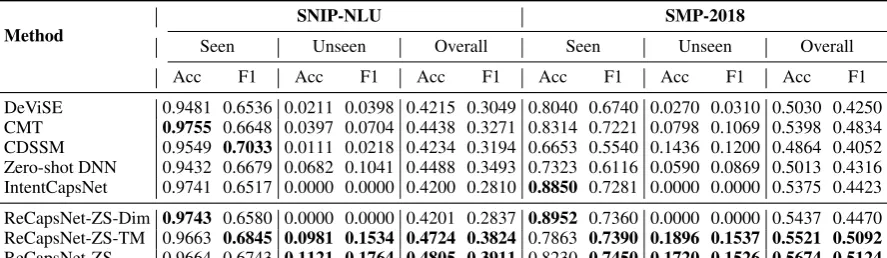
Table 4: Results of generalized zero-shot intent classification. “Seen”, “Unseen” and “Overall” respectively denote the performance on the utterances from seen intents, unseen intents, and both seen and unseen intents.
Method SNIPS-NLU SMP-2018
Acc F1 Acc F1
DeViSE 0.7447 0.7446 0.5456 0.3875 CMT 0.7396 0.7206 0.4452 0.4245 CDSSM 0.7588 0.7580 0.4308 0.3765 Zero-shot DNN 0.7165 0.7116 0.4615 0.3897 IntentCapsNet 0.7752 0.7750 0.4864 0.4227
ReCapsNet-ZS-Dim 0.7868 0.7859 0.5005 0.4501 ReCapsNet-ZS-TM 0.7860 0.7837 0.5315 0.4630
ReCapsNet-ZS 0.7996 0.7980 0.5418 0.4769
Table 3: Results of zero-shot intent classification.
able for intent classification, we use a multi-head self-attention Bi-LSTM model to encode the utter-ances and then feed the final hidden states to their zero-shot learning models. In addition, we con-duct ablation study to evaluate the contribution of each module of our ReCapsNet-ZS. “ReCapsNet-ZS-Dim” refers to the model that only uses the di-mensional attention mechanism, and “ReCapsNet-ZS-TM” refers to the one that only uses the pro-posed transformation matrix construction method.
5.3 Implementation Details
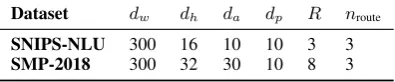
Parameter Settings. For SNIPS-NLU, we use 300-dim embeddings pre-trained on English Wikipedia (Bojanowski et al., 2017). For SMP-2018, we use 300-dim Chinese word embeddings pre-trained byLi et al.(2018). The main network structure hyperparameters are shown in Table 2. In addition, for the zero-shot classification setting, we set α to 1 for SNIPS-NLU and 10 for SMP-2018 respectively. For the generalized zero-shot classification setting, we set α to 1 for SNIPS-NLU and5for SMP-2018 respectively. To avoid overfitting, we use dropout with 0.5 dropout rate on the input of the attention layer. For the loss
function, we setλ = 0.5,m+ = 0.9,m− = 0.1,
β = 0.001, and use the Adam optimizer (Kingma and Ba,2015) with initial learning rate 0.01.
Evaluation Metrics. We adopt two widely used metrics: accuracy (Acc) and micro-average F1-measure (F1) to evaluate the classification perfor-mance. Both metrics are computed with the aver-age value weighted by the support of each class, where the support means the sample ratio of the corresponding class.
5.4 Result Analysis
Zero-shot Intent Classification. Table 3 sum-marizes the average results over 10 runs, where the top 2 results are highlighted in bold. The baseline results on SNIPS-NLU are taken fromXia et al. (2018). The results show that ReCapsNet-ZS out-performs all the baselines, demonstrating its su-periority in tackling zero-shot intent classification. We can also see that ReCapsNet-ZS performs bet-ter than either ZS-Dim or ReCapsNet-ZS-TM, which shows the effectiveness of both of the dimensional attention mechanism and the transformation matrix construction method.
Generalized Zero-shot Intent Classification.
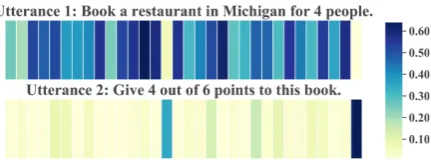
explain-Figure 2: Comparison of the dimensional attentions of the word “book” in different contexts.
s why they perform much worse in detecting un-seen intents. 3) ZS and ReCapsNet-ZS-TM perform much better than others in de-tecting unseen intents, whereas IntentCapsNet and ReCapsNet-ZS-Dim both have 0% Acc and F1. This verifies that the proposed transformation ma-trix construction method has much better gener-alization ability in detecting unseen intents. 4) Overall, ReCapsNet-ZS consistently performs the best, which further demonstrates the superiority of ReCapsNet-ZS on the generalized zero-shot intent classification tasks.
5.5 Visualization
Dimensional Attentions. Figure 2 visualizes the attention score for each dimension of the same word “book” in two different utterances (contexts) by heatmaps. The utterances are “Book a restau-rant in Michigan for 4 people” and “Give 4 out of 6 points to this book”, which are taken from SNIPS-NLU. It can be seen that for the two utter-ances the attention values of the word “book” ex-hibit completely different patterns, which makes sense as it contains different meanings in differ-ent contexts. Furthermore, for each utterance, the attention scores of “book” on different dimensions are also quite different. This shows that the dimen-sional attention mechanism can effectively capture the semantic differences of the same word in dif-ferent contexts and encode more useful informa-tion than the tradiinforma-tional self-atteninforma-tion method, and thus helps to alleviate the polysemy problem.
Similarity Scores. Figure3 visualizes the sim-ilarity scores between the unseen intent “movie” and the seen intents learned via metric learning by IntentCapsNet and ReCapsNet-ZS respectively on SMP-2018. It can be seen that IntentCapsNet can only discover few connections between the unseen and seen intents. In contrast, ReCapsNet-ZS can detect a lot more connections between them. Fur-ther, though the similarity scores of
ReCapsNet-Figure 3: Comparison of the similarity scores between the unseen intent “movie” and the seen intents learned by IntentCapsNet and ReCapsNet-ZS (ours).
ZS may introduce some noise (e.g., “contacts”), they can capture many more positive relations be-tween “movie” and the seen intents (e.g., “nov-el”, “video”, “schedule”, and “datetime”), which is beneficial for detecting unseen intents.
6 Conclusion
In this paper, we have proposed a novel frame-work to reconstruct capsule netframe-works for zero-shot intent classification and demonstrated empirically that it compares favourably with existing methods on some real dialogue datasets. The performance gains of our method come from two aspects: the introduction of a new dimensional attention mod-ule to capsmod-ule networks for feature extraction and the proposal of a new transformation scheme for detecting unseen intents.
There are several directions of the future works. One is to customize our model for few-shot intent classification. Another is to extend our framework to deal with multiple-intent classification. We also plan to apply our model in dialogue systems for low-resource languages such as Cantonese.
Acknowledgments
We would like to thank the anonymous reviewers for their helpful comments towards improving the manuscript. This research was supported by the grant HK ITF UIM/377.
References
Lei Jimmy Ba, Kevin Swersky, Sanja Fidler, and Rus-lan Salakhutdinov. 2015. Predicting deep zero-shot convolutional neural networks using textual descrip-tions. In IEEE International Conference on Com-puter Vision (ICCV), pages 4247–4255.
[image:9.595.75.291.61.141.2] [image:9.595.307.527.61.149.2]Associa-tion for ComputaAssocia-tional Linguistics (TACL), 5:135– 146.
Yun-Nung Chen, Asli C¸ elikyilmaz, and Dilek Hakkani-T¨ur. 2017. Deep learning for dialogue systems. In
Annual Meeting of the Association for Computation-al Linguistics (ACL), pages 8–14.
Yun-Nung Chen, Dilek Z. Hakkani-T¨ur, and Xiaodong He. 2016. Zero-shot learning of intent embeddings for expansion by convolutional deep structured se-mantic models. InIEEE International Conference on Acoustics, Speech and Signal Processing (ICAS-SP), pages 6045–6049.
Alice Coucke, Alaa Saade, Adrien Ball, Th´eodore Bluche, Alexandre Caulier, David Leroy, Cl´ement Doumouro, Thibault Gisselbrecht, Francesco Calt-agirone, Thibaut Lavril, Ma¨el Primet, and Joseph Dureau. 2018. Snips voice platform: an embedded spoken language understanding system for private-by-design voice interfaces. arXiv, abs/1805.10190.
Emmanuel Ferreira, Bassam Jabaian, and Fabrice Lef`evre. 2015a. Online adaptative zero-shot learn-ing spoken language understandlearn-ing uslearn-ing word-embedding. In IEEE International Conference on Acoustics, Speech and Signal Processing (ICASSP), pages 5321–5325.
Emmanuel Ferreira, Bassam Jabaian, and Fabrice Lef`evre. 2015b. Zero-shot semantic parser for spo-ken language understanding. InAnnual Conference of the International Speech Communication Associ-ation (INTERSPEECH), pages 1403–1407.
Andrea Frome, Gregory S. Corrado, Jonathon Shlens, Samy Bengio, Jeffrey Dean, Marc’Aurelio Ranzato, and Tomas Mikolov. 2013. Devise: A deep visual-semantic embedding model. In Advances in Neu-ral Information Processing Systems (NIPS), pages 2121–2129.
Ruiying Geng, Binhua Li, Yongbin Li, Yuxiao Ye, Ping Jian, and Jian Sun. 2019. Few-shot tex-t classificatex-tion witex-th inductex-tion netex-twork. arXiv, ab-s/1902.10482.
Sepp Hochreiter and J¨urgen Schmidhuber. 1997. Long short-term memory. Neural Computation, 9(8):1735–1780.
Jian Hu, Gang Wang, Frederick H. Lochovsky, Jian-Tao Sun, and Zheng Chen. 2009. Understanding user’s query intent with wikipedia. In Internation-al Conference on World Wide Web (WWW), pages 471–480.
Diederik P. Kingma and Jimmy Ba. 2015. Adam: A method for stochastic optimization. InInternational Conference on Learning Representations (ICLR).
Anjishnu Kumar, Pavankumar Reddy Muddireddy, Markus Dreyer, and Bj¨orn Hoffmeister. 2017. Zero-shot learning across heterogeneous overlapping do-mains. In Annual Conference of the
Interna-tional Speech Communication Association (INTER-SPEECH), pages 2914–2918.
Hugo Larochelle, Dumitru Erhan, and Yoshua Bengio. 2008. Zero-data learning of new tasks. In AAAI Conference on Artificial Intelligence (AAAI), pages 646–651.
Shen Li, Zhe Zhao, Renfen Hu, Wensi Li, Tao Liu, and Xiaoyong Du. 2018. Analogical reasoning on chi-nese morphological and semantic relations. In An-nual Meeting of the Association for Computational Linguistics (ACL), pages 138–143.
Bing Liu and Ian Lane. 2016. Attention-based recur-rent neural network models for joint intent detection and slot filling. InAnnual Conference of the Interna-tional Speech Communication Association (INTER-SPEECH), pages 685–689.
Tomas Mikolov, Kai Chen, Greg Corrado, and Jeffrey Dean. 2013. Efficient estimation of word represen-tations in vector space. InInternational Conference on Learning Representations (ICLR).
Jinseok Nam, Eneldo Loza Menc’ia, and Johannes F¨urnkranz. 2016. All-in text: Learning documen-t, label, and word representations jointly. InAAAI Conference on Artificial Intelligence (AAAI), pages 1948–1954.
Mark Palatucci, Dean Pomerleau, Geoffrey E. Hinton, and Tom M. Mitchell. 2009. Zero-shot learning with semantic output codes. In Advances in Neural In-formation Processing Systems (NIPS), pages 1410– 1418.
Suman Ravuri and Andreas Stolcke. 2015. Recurrent neural network and lstm models for lexical utterance classification. InAnnual Conference of the Interna-tional Speech Communication Association (INTER-SPEECH), pages 135–139.
Sara Sabour, Nicholas Frosst, and Geoffrey E. Hin-ton. 2017. Dynamic routing between capsules. In
Advances in Neural Information Processing System-s (NIPS), pages 3859–3869.
Prateek Veeranna Sappadla, Jinseok Nam, Eneldo Loza Menc’ia, and Johannes F¨urnkranz. 2016. Us-ing semantic similarity for multi-label zero-shot classification of text documents. InEuropean Sym-posium on Artificial Neural Networks (ESANN).
L¨utfi Kerem S¸enel, Ihsan Utlu, Veysel Y¨ucesoy, Aykut Koc, and Tolga Cukur. 2018. Semantic structure and interpretability of word embeddings. IEEE/ACM Transactions on Audio, Speech, and Language Pro-cessing, 26(10):1769–1779.
Richard Socher, Milind Ganjoo, Christopher D. Man-ning, and Andrew Y. Ng. 2013. Zero-shot learning through cross-modal transfer. InAdvances in Neural Information Processing Systems (NIPS), pages 935– 943.
Gokhan Tur, Li Deng, Dilek Hakkani-Tr, and Xi-aodong He. 2012. Towards deeper understanding: Deep convex networks for semantic utterance clas-sification. InIEEE International Conference on A-coustics, Speech and Signal Processing (ICASSP), pages 5045–5048.
Congying Xia, Chenwei Zhang, Xiaohui Yan, Y-i Chang, and PhY-ilY-ip S. Yu. 2018. Zero-shot user Y- in-tent detection via capsule neural networks. In Con-ference on Empirical Methods in Natural Language Processing (EMNLP), pages 3090–3099.
Yongqin Xian, Zeynep Akata, Gaurav Sharma, Quyn-h N. Nguyen, MattQuyn-hias Hein, and Bernt ScQuyn-hiele. 2016. Latent embeddings for zero-shot classifica-tion. InIEEE Conference on Computer Vision and Pattern Recognition (CVPR), pages 69–77.
Puyang Xu and Ruhi Sarikaya. 2013. Convolutional neural network based triangular CRF for joint inten-t deinten-tecinten-tion and slointen-t filling. In IEEE Workshop on Automatic Speech Recognition and Understanding (ASRU Workshop), pages 78–83.
Min Yang, Wei Zhao, Jianbo Ye, Zeyang Lei, Zhou Zhao, and Soufei Zhang. 2018. Investigating cap-sule networks with dynamic routing for text classifi-cation. InConference on Empirical Methods in Nat-ural Language Processing (EMNLP), pages 3110– 3119.
Majid Yazdani and James Henderson. 2015. A mod-el of zero-shot learning of spoken language un-derstanding. In Conference on Empirical Method-s in Natural Language ProceMethod-sMethod-sing (EMNLP), pages 244–249.
Yiming Ying and Peng Li. 2012. Distance metric learn-ing with eigenvalue optimization. Journal of Ma-chine Learning Research, 13:1–26.
Chenwei Zhang, Wei Fan, Nan Du, and Philip S. Yu. 2016. Mining user intentions from medical queries: A neural network based heterogeneous jointly mod-eling approach. In International Conference on World Wide Web (WWW), pages 1373–1384.
Jingqing Zhang, Piyawat Lertvittayakumjorn, and Yike Guo. 2019. Integrating semantic knowledge to tackle zero-shot text classification. arXiv, ab-s/1903.12626.