Two-stage Method for Large-scale Acquisition of
Contradiction Pattern Pairs using Entailment
Julien Kloetzer∗ Stijn De Saeger† Kentaro Torisawa‡ Chikara Hashimoto§ Jong-Hoon Oh¶ Motoki Sanok Kiyonori Ohtake∗∗
Information Analysis Laboratory,
National Institute of Information and Communications Technology (NICT), Kyoto, Japan
{∗julien, †stijn, ‡torisawa, §ch, ¶rovellia, kmsano, ∗∗kiyonori.ohtake}@nict.go.jp
Abstract
In this paper we propose a two-stage method to acquire contradiction relations between typed lexico-syntactic patterns such asXdrug
prevents Ydisease and Ydisease caused by
Xdrug. In the first stage, we train an SVM classifier to detect contradiction pattern pairs in a large web archive by exploiting the exci-tationpolarity (Hashimoto et al., 2012) of the patterns. In the second stage, we enlarge the first stage classifier’s training data with new contradiction pairs obtained by combining the output of the first stage’s classifier and that of anentailmentclassifier. We acquired this way 750,000 typed Japanese contradiction pattern pairs with an estimated precision of 80%. We plan to release this resource to the NLP com-munity.
1 Introduction
The ability to detect contradictory information in text has many practical applications. Among those, Murakami et al. (2009) pointed out that a contra-diction recognition system can detect conflicts and anomalies in large bodies of texts and flag them to help users identify unreliable information. For ex-ample, many Japanese web pages claim that agari-cus prevents cancer, where agaricus is a species of mushroom found in a variety of commercial prod-ucts. Although this has been accepted by many Japanese people, by Googling keywords ”agaricus”, ”promotes” and ”cancer”, we can find pages claim-ing that ”agaricus promotes cancer”, some of which point to a study authorized by the Japanese Min-istry of Health, Labour and Welfare1 reporting that 1 http://www.mhlw.go.jp/topics/bukyoku/iyaku/syoku-anzen/qa/060213-1.html
a commercial product containing agaricus promoted cancer. Obviously, the existence of these pages casts serious doubt on the ability of agaricus to prevent cancer and encourages readers to dig more about this subject.
The above example suggests that recognizing contradictory information can guide users to atrue
fact. Likewise, we believe that contradiction recog-nition is also useful when dealing with non-factual information that occupy most of our daily lives. For instance, there is a big controversy recently whether Japan should join an economic partnership agree-ment called theTrans Pacific Partnership (TPP), and quite serious but contradictory claims are plentiful in the mass media and on the web, e.g.,TPP will wipe out Japan’s agricultural businesses and TPP will strengthen Japan’s agricultural businesses. Neither of these are facts; they arepredictionsthat can only be realized or disputed after the underlying decision-making is done: joining or refusing the TPP.
Furthermore, after reading documents including contradictory predictions, one should notice that each of them is supported by a convincing the-ory that has no obvious defect, e.g., “Exports of Japan’s agricultural products will increase thanks to the TPP” or “A large amount of low-price agricul-tural products will be imported to Japan due to the TPP”. Even if one of these predictions may just hap-pen to be true because of unexpected reasons such as minor fluctuations in the Japanese yen, we must sur-vey such theories that support contradictory predic-tions, conduct balanced decision-making, and pre-pare counter measures for the expected problems af-ter examining multiple viewpoints. Contradiction recognition should be useful to select documents to be surveyed.
Figure 1: Method workflow
We have developed a method for recog-nizing pairs of contradictory binary patterns such as h“X promotes Y”,“X prevents Y”i and
h“X will wipe out Y”,“X will strengthen Y”i. To solve the problem described above, we can easily develop a system that can find contradictory text fragments from the web like “agaricus promotes cancer” and “agaricus prevents cancer” from the discovered contradictory pattern pairs.
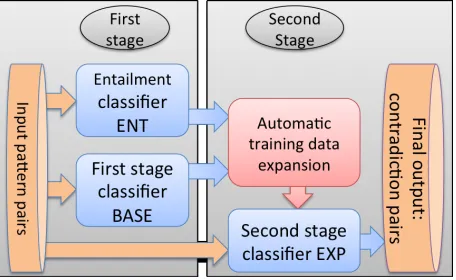
Our method is a two-stage procedure with three supervised classifiers (Fig. 1). In the first stage, we build a classifier BASE to recognize contradic-tions between binary patterns, and a classifierENT
to recognize entailment. In the second stage, we combine the contradiction pairs recognized byBASE
and the entailment pairs recognized byENT to
ex-pand BASE’s training data and train a new contra-diction classifier, EXP. This expansion using en-tailment is one key idea of this work: we acquired 750,000 contradiction pairs with80%precision us-ing the expanded trainus-ing data, more than doublus-ing the 285,000 pairs acquired at the same precision level without expansion. We also demonstrate that this result is not trivial by showing that our method outperforms an alternative one based onInteger Lin-ear Programminginspired by the successful entail-ment recognition method of Berant et al. (2011).
As another technical contribution of this work, we exploit the recently proposed semantic polarity of
excitation(Hashimoto et al., 2012) to recognize con-tradictions between binary patterns. Hashimoto et al. (2012) previously showed that excitation polari-ties are useful to recognize contradictions between phrases that consist of a noun and a predicate, such as “promote cancer” and “prevent cancer”. While
it is trivial to extend this framework to contradic-tions betweenunary patterns such as “promote X” and “prevent X” by replacing the common nouns in each pair with a variable, the information rep-resented in unary patterns is often vague, and it is unlikely that a contradiction between unary patterns directly leads to the discovery of unreliable infor-mation to be flagged or to a meaningful survey of complex problems. As exemplified by theagaricus
andTPP examples, contradictions between binary
patterns that include two variables such as “X pro-motes Y” or “X will wipe out Y” are more useful than those between unary patterns. We also show that it is not trivial to recognize contradictions be-tween binary patterns using contradictions bebe-tween unary patterns.
Most works dealing with contradiction recogni-tion up till now (Harabagiu et al., 2006; Bobrow et al., 2007; Kawahara et al., 2008; Kawahara et al., 2010; Ohki et al., 2011) focus on recognizing contradictions between full sentences or documents, not text fragments that match our relatively short patterns (survey in Section 5). We expect that the contradictory pattern pairs we acquired can be used as building blocks in such full-fledged contradiction recognition for full sentences or documents, simi-larly to antonym pairs in Harabagiu et al. (2006).
Also, we should emphasize that our method focuses on the most challenging part of contra-diction recognition according to the classification of De Marneffe et al. (2008). Since we discard patterns with negations, an evident source of contra-dictions like h“X causes Y”,“X does not cause Y”i, most of our output are non-trivial contradic-tions related to high-level semantic phenomena, e.g., contradiction pairs related to antonyms like h“XがYを上げる”,“XがYを下げる”i (h“X increases Y”,“X decreases Y”i), lexical contra-dictions like h“XがYに勝つ”,“YがXに勝つ”i (h“X wins against Y”,“Y wins against X”i), or contradictions due to common-sense knowledge
like h“XがYを安心させる”,“XがYを裏切る”i
(h“X reassures Y”,“X betrays Y”i). We believe acquiring such contradictions in a large scale is a valuable contribution.
Sec-Figure 2: Detailed data flow
tion 4 details our features set, and Section 5 related work. Section 6 provides a conclusion.
2 Proposed method
As showed in Figure 1, our method consists of three supervised classifiers. Classifiers BASE and EXP recognize contradiction relations between bi-nary patterns, and ENTrecognizes entailment rela-tions between binary patterns. The contradiction pairs recognized by BASE and the entailment pairs recognized by ENT are combined to generate new contradiction pairs, part of which are then added to
BASE training data to train the EXPclassifier. Our final output is the set of all binary pattern pairs re-garded as contradictions byEXP. Since the
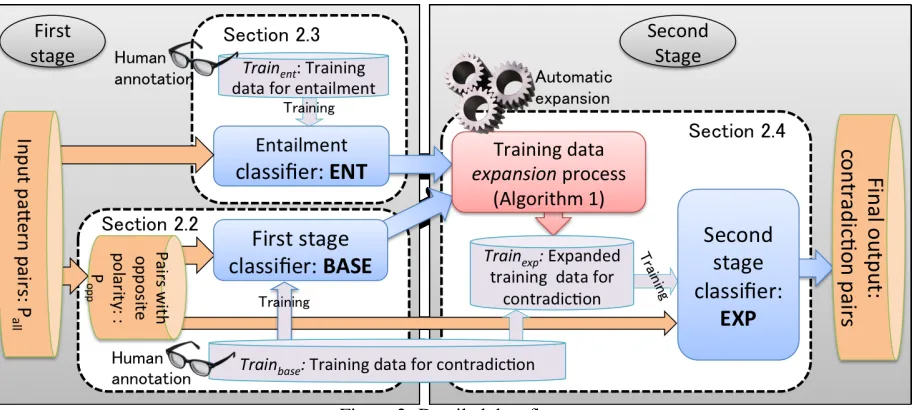
depen-dencies between these three classifiers, their distinct sets of training data, and the two data sets to be clas-sified (we describe those in the two sections below) is a bit complex, we show a complete description of the whole process in Figure 2.
The key idea is in the scheme that expands the training data. Logically speaking, patterns pandr
are contradictory if there exists a patternqsuch that
pentailsq andq contradictsr. For example, since “X causes Y” entails “X promotes Y” and “X pro-motes Y” contradicts “X prevents Y”, then “X causes Y” contradicts “X prevents Y”. Hence, by combin-ing entailment and contradiction pairs, we can ob-tain more contradiction pairs.
Following this property of contradiction relations, we collect a set of pattern pairs {hp,ri}for which
there exists a patternqsuch thatENTrecognizes that pentailsqandBASErecognizes thatqcontradictsr. Then we rank these pairs based on a novel scoring function calledContradiction Derivation Precision (CDP)and expandBASEtraining data by adding to it the top-ranked pairs according to CDP in order to trainEXP. This ranking scheme selects highly
accu-rate contradiction pairs and prevents errors caused byBASEandENTfrom being propagated toEXP.
In the following, after defining the patterns for which we acquire contradiction relations, we de-scribeBASE,EXP,ENT, and our expansion scheme.
2.1 Patterns
In this work, a binary pattern is a word sequence on the path of dependency relations connecting two nouns in a syntactic dependency tree, like “X causes Y”, and we say a noun pairco-occurs witha pattern if the two nouns are connected by this pattern in the dependency tree of a sentence in the corpus.
We focus on typed binary patterns, which place semantic class restrictions on the noun pairs they co-occur with, e.g., “Yorganization is in Xlocation”.
[image:3.612.80.538.59.264.2]algo-rithm presented in Kazama and Torisawa (2008), and clustered one million nouns into 500 rela-tively clean semantic classes, including for example classes ofdiseasesand ofchemical substances.
The binary patterns and their co-occurring noun pairs were extracted from our corpus of 600 mil-lion Japanese web pages dependency parsed with KNP (Kurohashi and Nagao, 1994). We restricted our patterns to the most frequent 3.9 million pat-terns of the form “X-[case particle] Y-[case parti-cle] predicate” such as “X-ga Y-ni aru” (“X is in Y”) which do not contain any negation, number, symbol or punctuation character. Based on our observation that patterns in meaningful contradiction and entail-ment pairs tend to share many co-occurring noun pairs, we used as input to our classifiers the setPall
of 792 million pattern pairs for which both patterns share three co-occurring noun pairs.
2.2 BASE: First stage Classifier for Contradiction
Below, we detail BASE: its training data and input data to be classified, and some experimental results. Our first stage classifier for contradictions,BASE, is an SVM that uses commonsensical surface and lexical resources based features, such as n-grams ex-tracted from patterns, which will be detailed in Sec-tion 4. An important point to be stressed here is that we restricted the pattern pairs to be classified by BASE by exploiting their excitation polarity, a semantic orientation proposed by Hashimoto et al. (2012). Excitation characterizes unary patterns as
excitatory, inhibitory, or neutral. Excitatory unary patterns, such as “cause X” or “increase X”, entail that the function, effect, purpose, or role of their ar-gument’s referent is activated or enhanced, and in-hibitory unary patterns, such as “prevent X” or “X disappears”, entail that the function, effect, purpose, or role of their argument’s referent is deactivated or suppressed. Neutral unary patterns like “close to X” are neither excitatory nor inhibitory.
We exploited excitation to restrict the input of
BASE. Based on the result of Hashimoto et al. (2012) showing that two unary patterns with op-posite polarity have a higher chance to be a con-tradiction, we extracted from set Pall the set Popp
of binary pattern pairs that contain unary patterns with opposite excitation polarities as sub-patterns.
h“Y cause X”,“Y prevent X”i is an example of such a pair since the unary sub-patterns “cause X” and “prevent X” are respectively excitatory and in-hibitory. We used here 6,470 excitation unary terns hand-labeled as either excitatory (4,882 pat-terns) or inhibitory (1,588 patpat-terns). SetPopp
con-tains 8 million pattern pairs with roughly 38%true
contradiction pairs, and is the input to BASE. We
will show in experiments at the end of this section that this restriction is necessary to obtain good per-formance forBASE. We also tried to add the
excita-tion polarities inBASE’s feature set and classifyPall,
but the performance was worse.
Training Data Another key feature of BASE is
that it is distantly supervised. We did not use training samples that are directly manually anno-tated. Instead we automatically generated training data from a smaller set of (non-)contradiction unary pattern pairs. We first prepared a set of roughly 800 unary pattern pairs hand-labeled by three human annotators as contradictions (238 pairs) and non-contradictions (558 pairs) using majority vote. The inter-annotator agreement was0.78(Fleiss’kappa). Inspired by Hashimoto et al. (2012), we selected these unary pattern pairs among pairs with high dis-tributional similarity, with and without restricting them to having opposite excitation polarity, such as to get a fair distribution of contradictions and non-contradictions.
We then extracted from set Pall all 256,000
pat-tern pairs containing a contradictory unary patpat-tern pair, and all 5.2 million pattern pairs containing a non-contradictory unary pattern pair, which we re-spectively used as positive and negative training data (estimated 79% and 73% accuracy from 200 hand-labeled samples). Table 1 shows some examples.
The optimal composition of training data for
train-Table 1: Examples of training samples forBASEobtained from unary pattern pairs
Binary pattern pair (the unary pattern pair that extracted it is underlined) Unary pattern pair label YもXが悪い(X is bad in Y too) - YでもXが良い(X is good even in Y) contradiction YもXに向かう(Y too heads toward X) - YもXを出る(Y too comes out of X) contradiction XにYを 加える(add Y to X) - XをYに 入れる(insert X into Y) non-contradiction YもXに来る(Y too comes to X) - YとはXに行く(go to X with Y) non-contradiction
Figure 3: Effect of the restriction using excitation
ing data (25,000 positives and 200,000 negatives; the difference from the optimal setting was 2.3% in average precision). The optimal training data set,
T rainbase, consists of 12,500 positives and 100,000
negatives samples as described above and is the one we use in our experiments below and in Section 3.
Since BASE input for classification data is Popp
we also tried sampling T rainbase from Popp. We
obtained 56.27% average precision for our classi-fierBASE, and 52.99% when restricting the source of training data to pairs inPopp. We believe that the
difference lies in the size of the sets from which we sampled our training data: while there are 5.46 mil-lion binary pattern pairs inPall with a hand-labeled
unary pattern pair in Pall, there are only 237,000
pairs inPopp. We believe this much smaller
sam-ple source lead to a lower performance because it included much less variations of the patterns.
To train BASE and other classifiers mentioned in this paper, we used the SVM tool TinySVM2 with a polynomial kernel of degree 2, the setting which showed the best performance during our preliminary experiments.
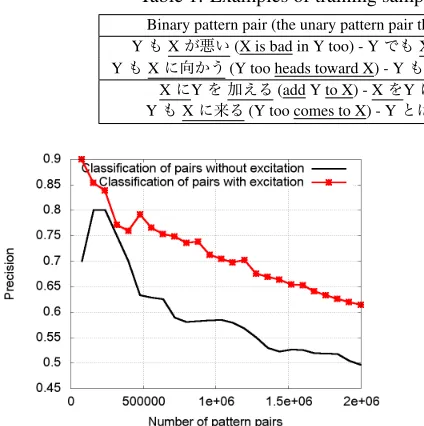
Effect of Excitation Polarities We also empiri-cally examined the effect of the restriction on the patterns using excitation polarities. We used our test set (2,000 manually annotated samples described in
2
http://chasen.org/˜taku/software/TinySVM/
Section 3.1) and 250 manually annotated samples (majority vote from 3 annotators) from top ranked pairs ofPallto draw precision curves forBASEover
the top 2 million binary pairs from both Popp and Pall. In each case we assumed that pairs were
dis-tributed uniformly (i.e., with a constant interval) in the ranked list of pairs ofPopp andPall, and
com-puted precision accordingly. Since the pairs sets are reasonably large and were sampled randomly we thought this was a reasonable hypothesis. The pre-cision overPopp is higher than that over Pall with
a large margin, suggesting that the restriction using excitation polarities is beneficial.
2.3 ENT: First stage Classifier for Entailment
ENTis an SVM classifier for entailment trained
us-ing 27,500 hand-annotated binary pattern pairs (set
T rainent, 45% of positive entailment pairs) created
for some previous work (Kloetzer et al., 2013). It es-sentially uses the same feature set as that forBASE
with the addition of several distributional similar-ity measures (see Section 4 below for more details). This classifier is given all pairs ofPall as input and
scores each of them. For this study, we considered the 44.5 million pattern pairs with a positive SVM score as entailment pairs. Manual annotation of 200 random samples revealed that the precision of these pairs was 63% and that the top 7.1 million pairs had 80% precision (result interpolated from the top16%
of the annotated samples).
2.4 Second stage: Training Data Expansion and ClassifierEXP
Below, we show how we combineBASE’s top output
(hereafterC) andENT’s top output (hereafterE) in the second stage of our method to expandT rainbase
and train a new classifier,EXP.
[image:5.612.72.284.77.290.2]Table 2: Examples of tripletshp,q,riwherepentailsq,qcontradictsr, and hencepcontradictsr
Patternp Patternq Patternr X/Y examples SV M Score(p, r) CDP(p, r) YからXが消える YからXが無くなる YがXに満ちる 怒り/眼
0.3 0.98
X disappears from Y X vanishes from Y Y is full of X anger/eye YにXを停止する YにXを終える YからXを始める 4月/活動
-0.3 0.61
stop X in Y finish X in Y start X in Y April/activity
XはYを示す XがYを持つ XはYを失う チーム/自信
0.07 0.45
X shows Y X have Y X loses Y team/confidence
Algorithm 1Training data expansion: C is the top 5% output ofBASE, E is the top output ofENT(score>0)
1: procedureEXPAND(C, E)
2: Compute the set of expanded pairs C0 = {hp,ri |
∃q : hp,qi∈E,hq,ri∈C}. 3: Rank the pairs inC0usingCDP.
4: Add theN top-ranked pairs inC0\Cas new positive samples toT rainbase.
5: Remove incoherent negative training samples using
negative cleaning. 6: end procedure
causes Y” (patternp) entails “X promotes Y” (pattern
q) and the latter contradicts “X prevents Y” (pattern
r), we conclude that “X causes Y” (p) contradicts “X prevents Y” (r). We call the former contradic-tionhq,ria sourcecontradiction pair, and the later pairhp,rianexpandedcontradiction pair. Based on this idea, we combineC andE to aggressively ex-pand T rainbase. This process is described in
Al-gorithm 1, and Table 2 shows examples of triples
hp,q,riobtained in our experiments.
Expanding pairs fromCandEcompounds the er-rors made byBASE and ENT, hence it is crucial to select a highly precise subset of the expanded pairs. Taking the top pairs according to their SVM score would achieve this, but sinceBASEalready handles correctly such pairs, they should not help much as new training data. We therefore propose a new scor-ing function for selectscor-ing highly precise expanded pairs:Contradiction Derivation Precision(CDP).
CDP was designed according to the following assumption: a source contradiction pair that derives
correctexpanded pairs with a highprecisionshould bereliable. Probably,allthe expanded pairs derived from such a reliable source pair will becorrectand should be included in the new training data .
In our formulation ofCDP, correctness of an ex-panded pair is judged according to the pair’s SVM score using BASE. In other words, we regard an
expanded pair that has an SVM score above some thresholdαas atruecontradiction. A source contra-diction pair that derivestruecontradiction pairs with a highprecisionis regarded as areliablesource con-tradiction pair. CDP, which is defined over a ex-panded pairs, is the maximum precision among that of the source contradiction pairs that derive a given expanded pair.
We first defineCDP sub(q, r)over a source con-tradiction pairhq,ri as the ratio of expanded pairs obtained from hq,ri whose SVM score is above thresholdα. This ratio corresponds to theprecision
of the expanded pairs derived from the source con-tradiction pairhq,ri.
CDP sub(q, r) =|{hp, ri ∈Ex(q, r)|Sc(p, r)> α}|
|Ex(q, r)|
HereEx(q, r)is the set of expanded pairs derived from a source pairhq,ri, andScis the SVM score given byBASE. In our experiments, we setα= 0.46
such that pattern pairs for whichBASEgives a score
overαcorresponds to the top5%ofBASE’s output.
CDP(p, r)over an expanded pair is defined as fol-lows, whereSource(p, r) is the set of source con-tradiction pairs that were derived into the expanded pairhp,ri.
CDP(p, r) =maxhq,ri∈Source(p,r)CDP sub(q, r)
We then expand the top 5% contradictions of
BASE’s output (setC) and pattern pairs scored pos-itively byENT(setE), rank all expanded pairs not already inC according to CDP, and add the topN
pairs with the highestCDP values as positives to
T rainbase to train EXP. The value of N shall be
determined empirically in later experiments using a development set. Note that, sinceCDP(p, r) is independent of hp,ri’s SVM score, even pairs that were assigned a negative score byBASEcan become
and be added to trainEXP, hence we expectEXPto learn something new from these pairs.
Finally, after the addition of expanded pairs, we remove incoherent training samples. We propose to remove from thenegativetraining samples of EXP
any pattern pair that may conflict with the newly added positives; we call this stepnegative cleaning. Intuitively, since the content word pairs in a pattern pair should present some of the strongest evidence for determining the patterns (non-)contradiction sta-tus, we remove any negative sample that shares a content word pair with one of the added expanded pairs. The final training data forEXP, setT rainexp,
consists of the following: (1)positive samples from
T rainbase, (2) (positive) expanded pairs, and (3)
negative training samples from T rainbase, cleaned
usingnegative cleaning. We confirmed in our exper-iments thatnegative cleaningwas necessary to train a strongEXPclassifier (details omitted for reason of space).
After training EXP with T rainexp, we classify Popp with EXP to produce the final output of the
whole method. Note that while this expansion pro-cess can be re-iterated withEXP’s output, our exper-iments failed to show any improvement with subse-quent iterations.
3 Evaluation
This section presents our experimental results. We describe first how we constructed test and develop-ment data, and then report comparison results be-tween our method and others includingBASEand an Integer Linear Programming-based (ILP) method.
3.1 Development and Test Data
We asked three human annotators to label 3,000 bi-nary pattern pairs randomly sampled fromPopp as
[image:7.612.316.505.63.203.2]contradiction or non-contradiction to be used as de-velopment (1,000 pairs) and test (2,000 pairs) sets. We considered a pattern pair as a true contradic-tion relacontradic-tion if at least two out of the three annota-tors marked it as positive. The inter-rater agreement score (Fleiss Kappa) was 0.523, indicating moderate agreement (Landis and Koch, 1977). As a definition of contradiction, we used the notion of incompati-bility(i.e., two statements are extremely unlikely to be simultaneously true) proposed by De Marneffe et
Figure 4: Precision of all the compared methods
al. (2008). We then say binary patterns such as “X causes Y” and “X prevents Y” are contradictory if the above definition holds for any noun pair that can instantiate the patterns’ variables in the provided se-mantic class pair.
Because our semantic classes are obtained by au-tomatic clustering and have no meaningful labels, we followed Szpektor et al. (2007) and provided the annotators with three random noun pairs that co-occur with the patterns as a proxy for the class pair. The annotators marked a given pattern pair as posi-tive if the contradiction relation between the patterns held for all three noun pairs presented.
3.2 Experimental Results
Here we show how our proposed method outper-forms baseline methods. We compare the following four methods:
• PROPOSED: our proposed method. N, the
number of newly added positive training sam-ples during the training data expansion pro-cess, was set to 6,000 according to preliminary experiments using the development set. We tried 50 different values ofN from 1,000 up to 50,000, adding 1,000 each time, and chose the
N value giving the highest average precision against our development set (1,000 samples).
• BASE: our first stage classifier.
• PROP-SCORE: same asPROPOSEDexcept for the use ofBASE’s SVM score instead ofCDP. N was set to 30,000 in the same way we setN
forPROPOSED.
• HAS: an adaptation of the contradiction
(2012). For a binary pattern pair we first extracted its unary pattern pair with opposite polarity (or one at random in case there are two) and scored it based on our implementa-tion of Hashimoto et al. (2012); the score is based on the distributional similarity between unary patterns and an excitation score obtained using a minimally supervised method based on the spin model. We then scored the binary pat-tern pair by the score of this unary patpat-tern pair. We ranked the pattern pairs of our test set (2,000 random pairs from setPopp) based on the score
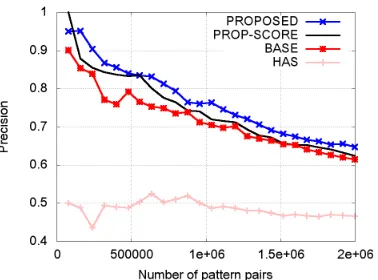
pro-duced by each method. For each tested method we assumed that pairs in the test set were distributed uniformly like explained in Section 2.2. The pre-cision curves we obtained are shown in Figure 4.
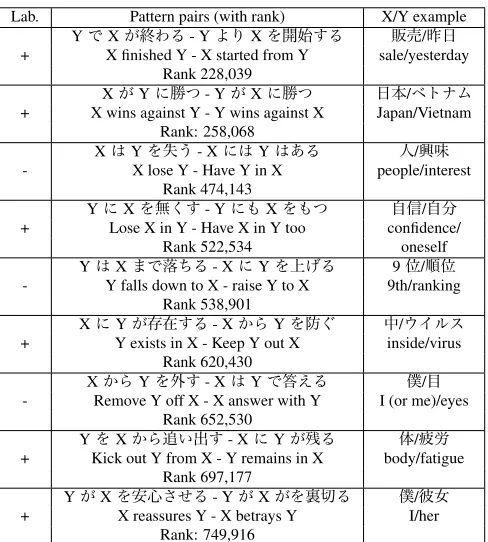
PROPOSED clearly outperformed BASE and ac-quired around 750,000 contradiction pattern pairs with an estimated precision of 80%, out of which some examples are shown in Table 3. These pairs cover 26,941 content word pairs and reduce to 272,164 untyped pairs, showing that PROPOSED
does not just acquire a handful of contradictions in many different class pairs. Also, when matching these pairs against an antonyms database (extracted from the dictionary of the morphical analyzer JU-MAN) we found that only 100,886 of these pattern pairs contain an antonym pair, which means that most of the extracted pairs’ contradictions are due to more complex phenomena than simple antonymy. With the same precision,BASEandPROP-SCORE
acquired only 285,000 pairs (covering 11,794 con-tent word pairs) and 636,000 pairs respectively. This implies that our two-stage method can more than double the number of highly precise contradiction pairs we acquire as well as increasing their vari-ety, and that ranking expanded pairs using our scor-ing function CDP is better than with SVM score, though even PROP-SCORE performs better than
BASE in our setting. Finally, the poor performance of HAS suggests that extending the Hashimoto et
al.’s framework to recognition of binary patterns is not a trivial task.
As to why adding only 6,000 top pairs ranked by CDP performs better than adding 30,000 pairs ranked by SVM score, the pattern pairs added in
PROP-SCOREhad high SVM scores given byBASE
[image:8.612.314.558.92.363.2]and as such are already handled nicely by BASE.
Table 3: Examples of pairs acquired byPROPOSED: con-tradiction (label +) and non-concon-tradiction (label -)
Lab. Pattern pairs (with rank) X/Y example YでXが終わる- YよりXを開始する 販売/昨日 + X finished Y - X started from Y sale/yesterday
Rank 228,039
XがYに勝つ- YがXに勝つ 日本/ベトナム + X wins against Y - Y wins against X Japan/Vietnam
Rank: 258,068
XはYを失う- XにはYはある 人/興味 - X lose Y - Have Y in X people/interest
Rank 474,143
YにXを無くす- YにもXをもつ 自信/自分 + Lose X in Y - Have X in Y too confidence/
Rank 522,534 oneself
YはXまで落ちる- XにYを上げる 9位/順位 - Y falls down to X - raise Y to X 9th/ranking
Rank 538,901
XにYが存在する- XからYを防ぐ 中/ウイルス + Y exists in X - Keep Y out X inside/virus
Rank 620,430
XからYを外す- XはYで答える 僕/目 - Remove Y off X - X answer with Y I (or me)/eyes
Rank 652,530
YをXから追い出す- XにYが残る 体/疲労 + Kick out Y from X - Y remains in X body/fatigue
Rank 697,177
YがXを安心させる- YがXがを裏切る 僕/彼女 + X reassures Y - X betrays Y I/her
Rank: 749,916
Hence, we think the effect of adding a new sam-ple fromPROP-SCOREis smaller than that inPRO -POSED, because inPROPOSEDwe add to the train-ing data pattern pairs with both high and low (possi-bly negative) SVM scores.
Finally, while the quality of the entailment pairs plays a very important role in the assumption that was the base ofCDP, these results show that even a simple rule such as “Use entailment pairs with SVM score over 0 to expand contradictions before ranking them withCDP” is sufficient to make the method work. Though it may be possible to design a more complexCDP formula which takes entail-ment score into account, we did not explore this di-rection in this work.
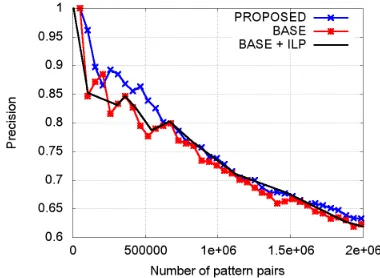
Figure 5: Comparison between PROPOSED, BASE and
BASE+ILPon a restricted test set (1,306 samples)
(1) G=argmax∑
p6=q
(e(p, q)−β)∗Epq+ (c(p, q)−β)∗Cpq
(2) s.t.∀p,q,rEpq+Cqr−Cpr≤1
(3) ∀p,qEpq+Cpq≤1
(4) ∀p,qEpq∈ {0,1} (5) ∀p,qCpq∈ {0,1}
The objective in Equation (1) is a sum over the weights of every pair of patternshp,qi, whereEpq
indicates whether a pairhp,qiis an entailment pair (Equation (4)), andCpqindicates whether it is a
con-tradiction pair (Equation (5)).e(p, q)andc(p, q)are the score given respectively byENTandBASE, and
β is a prior defining the weight of a pair as neither entailment nor contradiction that shall be set before any experimentation. Equation(2) states the tran-sitivity relation which is the basis of our expansion method. Finally, Equation (3) states that a given pat-tern pair cannot be a contradiction pair and an entail-ment pair at the same time. Since our patterns are class-dependent, we solved separate ILP instances for each semantic class pair.
We drew a precision curve for each of BASE,
PROPOSEDandBASE+ILP. To draw the curve for BASE+ILP, we incrementally raised the sample’s non-contradiction non-entailment priorβ(more de-tails in Berant et al. (2011)). Because of the com-putational difficulty of ILP (NP-complete) and the size of our data, the computation for the ILP-based method ran out of memory on a 72GB machine for 116 class pairs out of the 1,031 that our test set cov-ers. For this reason, we only used the 1,306 samples of the test set covered by the remaining 915 class pairs. We also measured the performance ofBASE
andPROPOSEDon the same restricted test set. Figure 5 shows that under these conditions the ILP-based method performance resembles BASE
and is worse than PROPOSED on all data points.
PROPOSED performs slightly worse in this setting
compared to when classifying the whole of Popp,
but this only means that its performance is good for the 116 class pairs we ignored in this experiment. While this comparison is only made in a restricted setting, our expansion method still outperforms ILP and is clearly more scalable. The ILP results could be improved by adding more constraints ( contradic-tion is symmetric,entailment is transitive), but this would also make the problem even more intractable in terms of computational costs.
4 Features
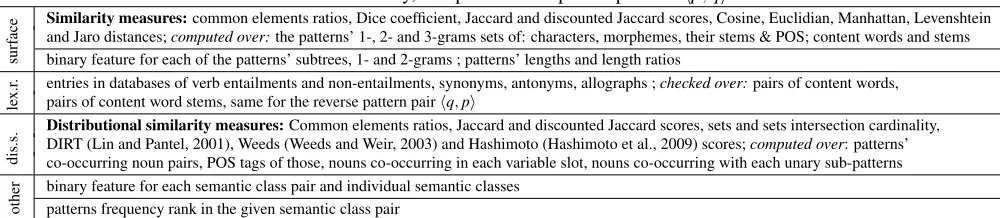
In this section we present the features used in our classifiers, which are mainly categorized into three: surface features (i.e., those reflecting the patterns’ content itself), features based on external lexical re-sources, and distributional similarity based features; all features are listed in Table 4. ENT uses all the features whileBASEandEXPuse all except for the
distributional similarity based ones. The optimality of the feature sets was confirmed through ablation tests using the development set (results omitted for the sake of space).
Since patterns with a contradiction or entailment relation are often superficially similar, for instance, in case structure or inflection, we use a number of
surfacefeatures based on string similarity measures, extending the feature sets used by Malakasiotis and Androutsopoulos (2007) for entailment recognition. They include bag-of-words features such as n-grams and similarity scores concerning the bag-of-words such as their Euclidian distance.
To complement the surface features with knowl-edge about the content words, we used lexi-cal databases including such as antonymy, syn-onymy, entailment, or allography. The presence of such word pairs is usually a good indicator of (non-)contradiction or (non-)entailment at the pat-tern level. More specifically, for any word pair
hwp,wqi taken from a pattern pair hp,qi we mark the presence ofhwp,wqi in each of the lexical re-sources as a binary feature. We used the Japanese lexical resources distributed by the ALAGIN Fo-rum3: the verb entailment database (117,000 verb
3
Table 4: Features summary, computed over a pair of patternshp,qi
surf
ace
Similarity measures:common elements ratios, Dice coefficient, Jaccard and discounted Jaccard scores, Cosine, Euclidian, Manhattan, Levenshtein and Jaro distances;computed over:the patterns’ 1-, 2- and 3-grams sets of: characters, morphemes, their stems & POS; content words and stems binary feature for each of the patterns’ subtrees, 1- and 2-grams ; patterns’ lengths and length ratios
le
x.r
. entries in databases of verb entailments and non-entailments, synonyms, antonyms, allographs ;checked over:pairs of content words, pairs of content word stems, same for the reverse pattern pairhq,pi
dis.s.
Distributional similarity measures:Common elements ratios, Jaccard and discounted Jaccard scores, sets and sets intersection cardinality, DIRT (Lin and Pantel, 2001), Weeds (Weeds and Weir, 2003) and Hashimoto (Hashimoto et al., 2009) scores;computed over: patterns’ co-occurring noun pairs, POS tags of those, nouns co-occurring in each variable slot, nouns co-occurring with each unary sub-patterns
other
binary feature for each semantic class pair and individual semantic classes patterns frequency rank in the given semantic class pair
pairs; Alagin ID A-2), the databases of synonyms, antonyms and meronyms (respectively 111,000, 5000 and 2500 pairs; Alagin ID A-9), and the al-lographic word database (2.7 million pairs; Alagin ID A-7). We also used the information concerning allographic words in the dictionary of the morpho-logical analyzer JUMAN4.
Distributional similarity values between patterns are based on the idea that patterns that appear in similar contexts tend to have similar meanings and as such are useful to recognize entailment (Lin and Pantel, 2001). We computed as features several dis-tributional similarity measures on the sets of each pattern’s co-occurring noun pairs and their POS tags, of nouns co-occurring in each variable slot, and with each of the pattern’s unary sub-patterns.
We also added a few more uncategorizable fea-tures. See Table 4 for more details.
5 Related Work
A number of previous work dealt with the recogni-tion of contradicrecogni-tions between sentences. Harabagiu et al. (2006) proposed a contradiction detection method that focuses on negation, antonymy and some discourse information. Kawahara et al. (2010) also used negations and antonyms to extract con-trastive/contradictory statements from the web to present users with a bird’s-eye view of statements about a given topic. Bobrow et al. (2007) showed a method using logical forms with relatively precise results. Ohki et al. (2011) proposed a method to rec-ognizeconfinment, a novel semantic relation related to both entailment and contradiction. While we do not deal ourselves directly with sentences, we expect that the binary pattern pairs we acquire can play a role similar to that of basic linguistic resources such
4
http://nlp.ist.i.kyoto-u.ac.jp/EN/index.php?JUMAN
as antonyms and negations in these works. Closer to our work, Ritter et al. (2008) presented a method for detecting contradictions betweenfunctional re-lations like “X was born in Y”, but these constitute only a part of the semantic relations expressed by the binary patterns we deal with in this paper.
Other works analyzed contradictions from lin-guistic/semantic viewpoints. Voorhees (2008) ana-lyzed the contradiction recognition-task of the RTE3 contest. Magnini and Cabrio (2010) examined rela-tions between contradicrela-tions and textual entailment samples. De Marneffe et al. (2008) presented a typology of contradictions, and showed that con-tradictions can arise from a multitude of phenom-ena. They showed contradictions based on lexical or world knowledge are challenging and require a high-level understanding of language and/or the world. As stated in the introduction, these are the types of contradictions our method focuses on.
6 Conclusion
This paper showed how to acquire a large number of contradiction pairs between lexico-syntactic binary patterns by exploiting (1) the interaction between contradiction and entailment, and(2)excitation po-larities. In the end, we could acquire 750,000 typed contradiction pattern pairs with an estimated 80% precision. The resulting contradiction pairs cov-ered ones deeply related to world knowledge such as the pairh“X reassures Y”,“X betrays Y”i. We ex-pect our work to lead to a high level analysis of textual information, such as flagging unreliable in-formation or identifying important documents to be surveyed for understanding complex social prob-lems. We plan to release the data we acquired to the NLP community through theALAGIN Forum5.
5
References
J. Berant, I. Dagan, and J. Goldberger. 2011. Global learning of typed entailment rules. InProceedings of ACL 2011, pages 610–619.
D. G. Bobrow, C. Condoravdi, R. Crouch, V. De Paiva, L. Karttunen, T. H. King, R. Nairn, L. Price, and A. Zaenen. 2007. Precision-focused textual inference. InProceedings of the ACL-PASCAL Workshop on Tex-tual Entailment and Paraphrasing, page 16―21. M.-C. De Marneffe, A. N. Rafferty, and C. D. Manning.
2008. Finding contradictions in text. Proceedings of ACL 2008, page 1039―1047.
S. De Saeger, K. Torisawa, J. Kazama, K. Kuroda, and M. Murata. 2009. Large scale relation acquisition us-ing class dependent patterns. InProceedings of ICDM 2009, page 764―769.
S.M. Harabagiu, A. Hickl, and V.F. Lacatusu. 2006. Negation, contrast and contradiction in text process-ing. InProceedings of AAAI 2006, pages 755–762. C. Hashimoto, K. Torisawa, K. Kuroda, S. De Saeger,
M. Murata, and J. Kazama. 2009. Large-scale verb entailment acquisition from the web. InProceedings of EMNLP 2009, volume 3, page 1172―1181. C. Hashimoto, K. Torisawa, S. De Saeger, J.-H. Oh, and
J. Kazama. 2012. Excitatory or inhibitory: A new se-mantic orientation extracts contradiction and causality from the web. InProceedings of EMNLP 2012. D. Kawahara, S. Kurohashi, and K. Inui. 2008.
Grasp-ing major statements and their contradictions toward information credibility analysis of web contents. In
Proceedings of WI-IAT 2008, volume 1, page 393― 397.
D. Kawahara, K. Inui, and S. Kurohashi. 2010. Iden-tifying contradictory and contrastive relations between statements to outline web information on a given topic. InProceedings of COLING 2010, page 534―542. J. Kazama and K. Torisawa. 2008. Inducing gazetteers
for named entity recognition by large-scale clustering of dependency relations. Proceedings of ACL 2008, page 407―415.
J. Kloetzer, S. De Saeger, K. Torisawa, M. Sano, C. Hashimoto, and J. Gotoh. 2013. Large-scale acqui-sition of entailment pattern pairs. InInformation Pro-cessing Society of Japan (IPSJ) Kansai-Branch Con-vention.
S. Kurohashi and M. Nagao. 1994. KN parser: Japanese dependency/case structure analyzer. In Proceedings of the Workshop on Sharable Natural Language Re-sources, page 48―55.
J. R. Landis and G. G. Koch. 1977. The measurement of observer agreement for categorical data. Biometrics, page 159―174.
D. Lin and P. Pantel. 2001. Dirt - discovery of inference rules from text. InProceedings of the ACM SIGKDD Conference on Knowledge Discovery and Data Min-ing, pages 323–328.
B. Magnini and E. Cabrio. 2010. Contradiction-focused qualitative evaluation of textual entailment. In Pro-ceedings of the Workshop on Negation and Speculation in Natural Language Processing, page 86―94. P. Malakasiotis and I. Androutsopoulos. 2007. Learning
textual entailment using SVMs and string similarity measures. InProceedings of the ACL- PASCAL Work-shop on Textual Entailment and Paraphrasing, page 42
―47.
K. Murakami, E. Nichols, S. Matsuyoshi, A. Sumida, S. Masuda, K. Inui, and Y. Matumoto. 2009. State-ment map: assisting information crediblity analysis by visualizing arguments. InProceedings of the 3rd workshop on Information credibility on the web, page 43―50. ACM.
M. Ohki, S. Matsuyoshi, J. Mizuno, K. Inui, E. Nichols, K. Murakami, S. Masuda, and Y. Matsumoto. 2011. Recognizing confinement in web texts. In the Pro-ceedings of the Ninth International Conference on Computational Semantics, page 215―224.
A. Ritter, D. Downey, S. Soderland, and O. Etzioni. 2008. It’s a contradiction—no, it’s not: a case study using functional relations. InProceedings of EMNLP 2008, pages 11–20.
S. Schoenmackers, O. Etzioni, D. S Weld, and J. Davis. 2010. Learning first-order horn clauses from web text. InProceedings of EMNLP 2010, page 1088―1098. I. Szpektor, E. Shnarch, and I. Dagan. 2007.
Instance-based evaluation of entailment rule acquisition. In
Proceedings of ACL 2007, volume 45, page 456―463. E. M. Voorhees. 2008. Contradictions and justifications: Extensions to the textual entailment task. In Proceed-ings of ACL 2008, page 63―71.