Proceedings of the 2018 EMNLP Workshop SCAI: The 2nd Int’l Workshop on Search-Oriented Conversational AI, pages 67–73
67
Embedding Individual Table Columns for Resilient SQL Chatbots
Bojan Petrovski†1, Ignacio Aguado‡1, Andreea Hossmann‡, Michael Baeriswyl‡, Claudiu Musat‡ †School of Computer and Communication Sciences, EPFL, Switzerland
‡Artificial Intelligence Group - Swisscom AG firstname.lastname@{epfl.ch, swisscom.com}
Abstract
Most of the world’s data is stored in relational databases. Accessing these requires special-ized knowledge of the Structured Query Lan-guage (SQL), putting them out of the reach of many people. A recent research thread in Nat-ural Language Processing (NLP) aims to alle-viate this problem by automatically translating natural language questions into SQL queries. While the proposed solutions are a great start, they lack robustness and do not easily general-ize: the methods require high quality descrip-tions of the database table columns, and the most widely used training dataset, WikiSQL, is heavily biased towards using those descrip-tions as part of the quesdescrip-tions.
In this work, we propose solutions to both problems: we entirely eliminate the need for column descriptions, by relying solely on their contents, and we augment the WikiSQL dataset by paraphrasing column names to re-duce bias. We show that the accuracy of ex-isting methods drops when trained on our aug-mented, column-agnostic dataset, and that our own method reaches state of the art accuracy, while relying on column contents only.
1 Introduction
Recent developments in Natural Language Under-standing (NLU) have led to a big proliferation of text- and speech-based bot interfaces. Home ap-pliances, such as smart speakers and chatbots, rely mostly on a well-structured knowledge base or an external Application Programming Interface (API) to provide the desired response. This limits the us-ability of such systems in a context where the data is stored in a (local) relational database.
This constraint led to the development of text to Structured Query Language (SQL) systems, also known as SQL bots. Given a question, in natural
1equal contribution
language, pertaining to a certain database table, these bots will automatically generate the corre-sponding SQL query and return the requested data. Considering the vast usage of relational databases on the internet and in private companies, SQL bots are a simple new interface that enables non-technical people to access data.
The first approaches in the field relied on parsers and pattern-matching rules to understand the question and produce appropriate answers (Androutsopoulos et al., 1995). Later develop-ments introduced semantic grammar systems and intermediate language systems (Androutsopoulos et al., 1995). More recently, new NLU meth-ods, such as pointer-networks, pushed the state-of-the-art results in several domains, including pars-ing (Vinyals et al.,2015). Current state-of-the-art models are based on sketches and have primarily two inputs: the question and the descriptions of the table columns (i.e., the column names).
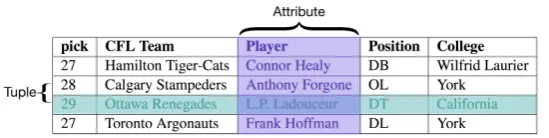
Relying on the column names is limiting, since the whole model is based on several strong premises: (a) the names are high quality and de-scriptive enough; (b) the names do not change; (c) the names are known to the user of the bot. These are very strong assumptions: often, column names do not even exist (i.e., the generic col1, col2, etc. are used instead). Moreover, if as we observe in Figure1, a column contains the names of colleges, just changing the column name form ”College” to ”School” does not make the content any less informative. The expectation from a bot is that their quality is not sensitive to cosmetic changes to the underlying table. Finally, users do not necessarily know the structure of the table, let alone the column names.
Figure 1: Part of a table from the WikiSQL dataset with the contexts within a relation (table) we can model
we construct a column embedding vector space, where we embed the columns. This embedding is then used as a substitute for the encoding of the column descriptions (headers) in a state of the art sketch-based model.
In addition, to empirically show the value of using ICE, we generate a new, column-agnostic dataset based on the widely used WikiSQL dataset (Zhong et al., 2017). In WikiSQL, a substantial bias towards the inclusion in the question of the column name is built-in. For instance more than 79% of questions contain the name of the column that needs to be selected. Additionally around 59% contain the names of all columns form the SQLwhereclause. With ICE, we are eliminating the strong assumption that the users have access to the table structure. Hence, we also need a less bi-ased dataset to show the value of our method.
We thus create an open source data augmen-tation tool to paraphrase part of the questions in WikiSQL: where the column names are present, we replace them with similar expressions (e.g., synonyms), removing some of the built-in bias.
We train and test our ICE-based model on both the original WikiSQL dataset and our column-agnostic version of the dataset. We show that we maintain the same accuracy on both datasets with all three tasks: aggregation, column-selection and where clause generation. We also train the orig-inal SQLNet (Zhong et al., 2017) model on the column-agnostic dataset and find a 7% accuracy drop in thewhereclause generation task.
In a nutshell, the most important contribution of this work is that we improve the model re-silience by limiting its reliance on arbitrary de-scriptions of the data within the tables. In addi-tion, we expand the applicability of SQL bots to users who do not know the internal structure of the databases they are trying to access. By elimi-nating the need to encode the column headers, we alsoreduce the overall complexity of the model. This is achieved by removing the LSTM networks used to generate unique column header encodings
for the aggregation prediction, selection prediction andwhereclause generation.
The paper is organized as follows: Section 2 presents the related work for translating sentences to SQL and for vector space embeddings. In Sec-tion3, we describe ICE – our method for column content embeddings. In the next section, we in-troduce our column-agnostic model for translating sentences to SQL. We present the evaluation re-sults in Section5and finally conclude in Section6.
2 Related Work
2.1 Related work in Sentences to SQL
im-plements a reinforcement learning policy to opti-mize for execution correctness and uses a mixed loss function.
SQLNet (Xu et al., 2017) improved upon SEQ2SQL by eliminating the need for reinforce-ment learning by using a sketch-based approach. (Bornholt et al.,2016;Solar-Lezama et al.,2006) In the where clause section SQLNet introduces a sequence-to-set model. It first picks a set of columns which will be used in the clause. Subse-quently, for each column, it determines a compari-son operator using a classifier and picks a compar-ison value using a printer network. Additionally, this model implements a column attention mech-anism which together with sequence-to-set model improves the accuracy over SEQ2SQL by 9% to 13%.
2.2 From Word to Table Embeddings
The most basic form of word embeddings is the bag of words model. It can be augmented by statis-tics such as TF-IDF, however, such vector space captures very little of the words semantics, mor-phology, hierarchy and context. Word2vec, intro-duced by (Mikolov et al.,2013) is one of the first popular neural embedding models. It comes in two general implementations: a continuous bag of words (order in window irrelevant) and a contin-uous skip gram (weight in window based on dis-tance from current word). The objective function of Word2vec causes words that appear in a simi-lar context to cluster together in the vector space, based on cosine distance. This method was mod-ified by the introduction of global word represen-tation which aims to capture the meaning of the word within the whole corpus (Pennington et al., 2014) and the use of subword information to cap-ture the morphology of the words (Joulin et al., 2016).
With the addition of simple techniques, such as a trained weighted average, word-embedding al-gorithms were further extended to embed whole sentences (Pagliardini et al.,2018) and whole doc-uments (Le and Mikolov,2014). Such techniques have also recently been used to get the embedding of whole tables for the purposes of table classifi-cation (Ghasemi-Gol and Szekely,2018).
3 ICE: Individual Column Embeddings
To understand the context and the hierarchy of a table we will use the formal definition of a
rela-tion: ”a set of tuples (d1, d2, ...,dn), where each elementdj is a member ofDj, thej−thdata do-main.” Tuples, relations and attributes are graphi-cally depicted in Figure1. We observe that there are two contexts in which an element, or cell,dj appers either within a tuple (row) or within a data domain (column).
To embed the whole table we need to look at both contexts. This complexity is not necessary in the context of individual column embeddings, where the latter context is sufficient. TabVec uses deviation from the median for table vectors to cap-ture the noise (Ghasemi-Gol and Szekely,2018), as the final table vector incorporates information from cells that are not conceptually similar. This is not the case for individual column embeddings, as for ICE we assume that the cells within a col-umn are conceptually similar. For instance, if the column is about locations, all the cells are likely to represent location names. This property allows us to simplify the aggregation and use the median vector of all cells as the column representation.
Table cells are not semantic atoms and can con-tain multiple words, for example in Figure 1 all Team names contain at least two words. Thus, given a vector space model for words, we compute the individual cell embedding (ICE) as the average of the word embeddings and the individual column embedding as the median of its cells.
To sum up, let a column Dcontain cells ci ∈
C(D), with each cell consisting of a sequence of
niwords (wi1, ...,wij, ...,wini). Given a function
E that computes a word embedding, the ICE of theDis defined as:
E(D) =medianci( 1
ni ni
X
j=0
E(wij)), ci∈C(D)
3.1 Table Word Embeddings.
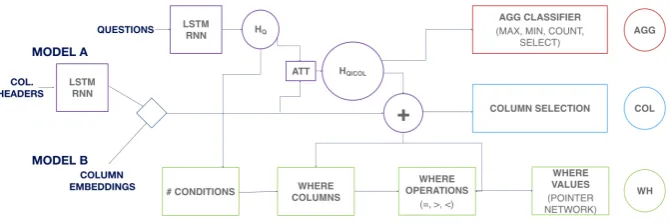
Figure 2: The general network architecture of SQLNet. Model A represents the original model, while Model B represents our model.
SkipGrams with a window of 5 to generate the em-bedding model.
We first construct a data corpus of synthetic sen-tences, corresponding to columns. We define a sentence as all the cells in one table column con-catenated. Furthermore, we make the assump-tion that the order of the cells within a column is not important. For the table in Figure 1, a sample sentence would be Calgary Stampeders Ottawa Renegades Toronto Argonauts Hamilton Tiger-Cats. We generate 10 random cell shuffles of each column. Using this corpus we train a word2vec model with the Gensim toolkit (Reh˚uˇrekˇ and Sojka,2010).
4 Individual Column Embedding for Bot Resilience
Our work builds upon the SQLNet (Xu et al., 2017) sketch-based approach. To generate a SQL statement, each component of the query is gener-ated individually:the aggregation, thecolumn se-lection and the where clauses. The task is thus akin to slot filling (Xu et al.,2017). The process is graphically depicted in Figure 2. The input or the SQLNet and previous models (Xu et al.,2017) consists of a representation of the question and a representation of each table column header.
We believe this assumption represents one of the most important drawbacks of the approach, as knowledge about the column headers may not ex-ist in real world conditions. The reason this knowl-edge was used in previous work is that the dataset itself was biased towards explicitly including the column names in the question formulation. In this section we show how to build a dataset that alle-viates this bias. We then use the new dataset to create a model that relies on the column content , not on the column headers.
[image:4.595.132.467.70.182.2]Column type Train Test Dev Selection col. 79.0% 79.0% 79.65% Where col.>= 1 68.0% 67.6% 68.4% All where col. 58.9% 58.5% 59.2%
Table 1: The percentages in the table show the pro-portion of questions that contain the specific column header in the different data partitions.
4.1 Column-agnostic WikiSQL
The wikiSQL dataset was crowdsourced using ta-bles from Wikipedia. Workers on Amazon Me-chanical Turk1 were presented with a table and a generated SQL query and were asked to ask a question that matched the query. This method in-troduces an inherent bias in the dataset as demon-strated in Table1. Almost 80% of questions con-tain the column name that is retrieved in the se-lection step and 68% of questions contain at least one of the column names from the where clause. In total, only 11% of the questions do not contain exact matchesof the column names, as shown in Figure1. As the workers were shown the whole ta-ble with column names, in a large number of cases they copied the column name in the question.
We paraphrase questions that contain a column name to make the dataset more realistic, as de-scribed in Algorithm 1. We create candidate ques-tions by replacing the names with synonyms that share the syntactic and semantic properties of the original names.
The original question and the candidate ques-tions are then embedded in vector space with sent2vec (Pagliardini et al., 2018). Using these vector space representations we compute the co-sine similarity between the original question and
the potential replacements and choose the most similar candidate. This procedure yields a suit-able rephrasing for 20% of the dataset, as we did not find synonyms for all questions contain-ing column names. For instance, the orginal ques-tionsWhat is thelength (miles)of endpoints west-lake/macarthur park to wilshire/western?, which contains the column header length (miles), be-comes What is the distance (miles) of endpoints westlake/macarthur park to wilshire/western?.
Figure 3: Proportions of the modified dataset
Data: Question and column header Result:Replacement candidate questions Tokenize and pos tag question;
forword in column headerdo Get word tag in question; Get word synonyms using tag; ifsynonyms list>0then
append synonyms to rephrase list; end
end
forphrase in rephrase listdo
iflength of phrase == length of header then
replace column header in question with phrase;
append new question to candidate list; end
end
Algorithm 1:Generating replacement candidate questions
4.2 Integrating Individual Column Embeddings
We compute the embeddings for the entire table column corpus as described in chapter3. This is necessary since the embeddings are required dur-ing inference both durdur-ing traindur-ing and testdur-ing. Due to model size constraints, we keep the individual
column embeddings constant during both training and testing. We create a dictionary to link each column to its embedding vector and feed it to the model (Model B) in Figure2. An attention mech-anism has the embeddings as inputs and the result contributes to the aggregation, selection and where clause modules. The column vectors are generated with the same dimensions that we use for the ques-tion encoding.
As we replace the column headers with column content embeddings, our model is completely ag-nostic to the headers. We thus remove the LSTM used to encode the column headers in the three model components: aggregation, selection and where clause generation. This leads to a signifi-cantreduction in the complexity of the model.
5 Evaluation
5.1 Original WikiSQL Evaluation
The evaluation on the full original WikiSQL dataset determines whether the individual column embeddings are suitable replacements for headers when the column name appears in the question. Table2summarizes the results of our model SQL-Net+ICE and compares them with the results of two baselines: SQLNetandSeq2SQL. We portray the accuracy values on the development and test sets for the three slots we fill in the sketch: Ag-gregation function, Column Selection andWhere clause generation.
We observe that SQLNet+ICE performs simi-larly to the original SQLNetmodel in both cases and superior to Seq2SQL. This result shows that we can build an equally performing model that is resilient to changes to the DB schema or complete absence of knowledge about it.
We note that the accuracy of the aggregation function also changes. This happens because the aggregation classifier has either the column or header embeddings as inputs, as shown in2. There is a small decrease of accuracy for the Aggrega-tion and Where clauses, while the accuracy on the Column Selection performs slightly better. These results are expected, as the queries strongly rely on the direct column names mentions.
5.2 Column-agnostic WikiSQL Evaluation
Dev Set Accuracy Test Set Accuracy
Aggregation Selection Where-clause Aggregation Selection Where-clause
Seq2SQL 90.0% 89.6% 62.1% 90.1% 88.9% 60.2%
SQLNet 90.1% 91.5% 74.1% 90.3% 90.9% 71.9%
SQLNet + ICE 89.7 % 92.4 72.2% 89.3 % 91.8 71.1%
Table 2: Model accuracies on the Original WikiSQL Dataset
Dev Set Accuracy Test Set Accuracy
Aggregation Selection Where-clause Aggregation Selection Where-clause
SQLNet 90.1% 87.5% 63.4% 90.3% 87.1% 63.1%
SQLNet + ICE 89.7 % 88.4 70.1% 89.3 % 87.9 69.4%
Table 3: Model accuracies on the Column-agnostic WikiSQL Dataset
[image:6.595.70.533.62.133.2]Rephrased Test Set Accuracy Agg. Sel. W.-clause SQLNet 89.5 % 81.3% 43.2% SQLNet + ICE 88.9 % 83.2 61.3%
Table 4: Model accuracies on the paraphrased ques-tions only on Aggreation, Selection and Where-clause tasks.
parts of the query, especially in the case of the where clause generation. This drop in the accu-racy is expected, since the where clause predictor is the most complex part of the model. Without the original dataset bias where the column names were present in the questions, the column names are not descriptive enough.This leads to a drop of 10.7% on the validation and 8.8% on test dataset.
On the other hand, our model is capable of over-coming this situation and find the queries with a much smaller drop of accuracy. Although the performance is also worse than with the orig-inal dataset, the accuracy obtained using SQL-Net with individual column embeddings in the where clauses is only 2.1% lower in validation and 1.7% in test. Using individual column embeddings makes the SQLNet model more versatile, as it can address the scenario where the user is not aware of the table structure.
Focusing on rephrased questions. To bet-ter understand our results on the Column-agnostic WikiSQL dataset we run the evaluation just with questions that have been rephrased, which repre-sent around 20% of the whole data set, as shown in Figure3. Table4summarizes these results, with SQLNet is the original model described in (Xu et al., 2017). The previously seen drop in SQL-Netaccuracy on the column selection and
where-clause predictions is exacerbated - showing that indeed the paraphrasing is indeed the root cause. This effect is comparatively mild in SQLNet + ICE.
6 Conclusion and Future Work
In this paper, we proposed a new approach to build SQL chatbots without relying on the database ta-ble schema. Previous work built around the Wik-iSQL dataset take advantage of the dataset bi-ases and use the column names to improve perfor-mance. This reliance on the schema inhibits their generalization capacity to cases where schema knowledge is absent. Our model, built on SQLNet by adding Individual Column Embeddings SQL-Net + ICE, does not suffer from these limitations.
We provide a way to create Individual Col-umn Embeddings, different from the ColCol-umn Em-beddings in prior art (Ghasemi-Gol and Szekely, 2018). Furthermore, we publish a method to para-phrase WikiSQL questions to alleviate the dataset bias.
The results of our model on the paraphrased WikiSQL are very similar to the ones obtained on the original dataset, while the SQLNet models struggles to deal with the paraphrasing.
References
Ion Androutsopoulos, Graeme D. Ritchie, and Pe-ter Thanisch. 1995. Natural language interfaces to databases - an introduction. CoRR, cmp-lg/9503016.
James Bornholt, Emina Torlak, Dan Grossman, and Luis Ceze. 2016. Optimizing synthesis with metas-ketches. In Proceedings of the 43rd Annual ACM SIGPLAN-SIGACT Symposium on Principles of Programming Languages, POPL ’16, pages 775– 788, New York, NY, USA. ACM.
Majid Ghasemi-Gol and Pedro A. Szekely. 2018. Tab-vec: Table vectors for classification of web tables.
CoRR, abs/1802.06290.
Armand Joulin, Edouard Grave, Piotr Bojanowski, and Tomas Mikolov. 2016. Bag of tricks for efficient text classification. CoRR, abs/1607.01759.
Quoc V. Le and Tomas Mikolov. 2014. Distributed representations of sentences and documents. CoRR, abs/1405.4053.
Tomas Mikolov, Ilya Sutskever, Kai Chen, Greg S Cor-rado, and Jeff Dean. 2013. Distributed representa-tions of words and phrases and their composition-ality. In C. J. C. Burges, L. Bottou, M. Welling, Z. Ghahramani, and K. Q. Weinberger, editors, Ad-vances in Neural Information Processing Systems 26, pages 3111–3119. Curran Associates, Inc.
Matteo Pagliardini, Prakhar Gupta, and Martin Jaggi. 2018. Unsupervised Learning of Sentence Embed-dings using Compositional n-Gram Features. In
NAACL 2018 - Conference of the North American Chapter of the Association for Computational Lin-guistics.
Jeffrey Pennington, Richard Socher, and Christo-pher D. Manning. 2014. Glove: Global vectors for word representation. InIn EMNLP.
Radim ˇReh˚uˇrek and Petr Sojka. 2010. Software Frame-work for Topic Modelling with Large Corpora. In
Proceedings of the LREC 2010 Workshop on New Challenges for NLP Frameworks, pages 45–50, Val-letta, Malta. ELRA. http://is.muni.cz/
publication/884893/en.
Armando Solar-Lezama, Liviu Tancau, Rastislav Bodik, Sanjit Seshia, and Vijay Saraswat. 2006. Combinatorial sketching for finite programs. SIG-PLAN Not., 41(11):404–415.
Ilya Sutskever, Oriol Vinyals, and Quoc V. Le. 2014. Sequence to sequence learning with neural net-works. CoRR, abs/1409.3215.
Oriol Vinyals, Meire Fortunato, and Navdeep Jaitly. 2015. Pointer networks. In C. Cortes, N. D. Lawrence, D. D. Lee, M. Sugiyama, and R. Garnett, editors,Advances in Neural Information Processing Systems 28, pages 2692–2700. Curran Associates, Inc.
Xiaojun Xu, Chang Liu, and Dawn Song. 2017. Sql-net: Generating structured queries from natural language without reinforcement learning. CoRR, abs/1711.04436.
Victor Zhong, Caiming Xiong, and Richard Socher. 2017. Seq2sql: Generating structured queries from natural language using reinforcement learning.