Automatic Paragraph Identification:
A Study across Languages and Domains
Caroline SporlederSchool of Informatics University of Edinburgh
2 Buccleuch Place Edinburgh EH8 9LW, UK
Mirella Lapata
Department of Computer Science University of Sheffield Regent Court, 211 Portobello Street
Sheffield S1 4DP, UK
Abstract
In this paper we investigate whether paragraphs can be identified automatically in different languages and domains. We propose a machine learning ap-proach which exploits textual and discourse cues and we assess how well humans perform on this task. Our best models achieve an accuracy that is significantly higher than the best baseline and, for most data sets, comes to within 6% of human per-formance.
1 Introduction
Written texts are usually broken up into sentences and paragraphs. Sentence splitting is a necessary pre-processing step for a number of Natural Lan-guage Processing (NLP) tasks including part-of-speech tagging and parsing. Since sentence-final punctuation can be ambiguous (e.g., a period can also be used in an abbreviation as well as to mark the end of a sentence), the task is not trivial and has consequently attracted a lot of attention (e.g., Rey-nar and Ratnaparkhi (1997)). In contrast, there has been virtually no previous research on inferring paragraph boundaries automatically. One reason for this is that paragraph boundaries are usually marked unambiguously by a new line and extra white space. However, a number of applications could bene-fit from a paragraph detection mechanism. Text-to-text generation applications such as single- and multidocument summarisation as well as text sim-plification usually take naturally occurring texts as input and transform them into new texts satisfying specific constraints (e.g., length, style, language). The output texts do not always preserve the struc-ture and editing conventions of the original text. In summarisation, for example, sentences are typ-ically extracted verbatim and concatenated to form a summary. Insertion of paragraph breaks could im-prove the readability of the summaries by indicating topic shifts and providing visual targets to the reader (Stark, 1988).
Machine translation is another application for
which automatic paragraph detection is relevant. Current systems deal with paragraph boundary in-sertion in the target language simply by preserv-ing the boundaries from the source language. How-ever, there is evidence for cross-linguistic variation in paragraph formation and placement, particularly for languages that are not closely related such as En-glish and Chinese (Zhu, 1999). So, a paragraph in-sertion mechanism that is specific to the target lan-guage, instead of one that relies solely on the source language, may yield more readable texts.
Paragraph boundary detection is also relevant for speech-to-text applications. The output of auto-matic speech recognition systems is usually raw text without any punctuation or paragraph breaks. This naturally makes the text very hard to read, which can cause processing difficulties, especially if speech recognition is used to provide deaf stu-dents with real-time transcripts of lectures. Further-more, sometimes the output of a speech recogniser needs to be processed automatically by applications such as information extraction or summarisation. Most of these applications (e.g., Christensen et al., (2004)) port techniques developed for written texts to spoken texts and therefore require input that is punctuated and broken into paragraphs. While there has been some research on finding sentence bound-aries in spoken text (Stevenson and Gaizauskas, 2000), there has been little research on determining paragraph boundaries.1
If paragraph boundaries were mainly an aes-thetic device for visually breaking up long texts into smaller chunks, as has previously been suggested (see Longacre (1979)), paragraph boundaries could be easily inserted by splitting a text into several equal-size segments. Psycho-linguistic research, however, indicates that paragraph boundaries are not purely aesthetic. For example, Stark (1988)
1There has been research on using phonetic cues to segment
asked her subjects to reinstate paragraph bound-aries into fiction texts from which all boundbound-aries had been removed and found that humans are able to do so with an accuracy that is higher than would be expected by chance. Crucially, she also found that (a) individual subjects did not make all their paragraphs the same length and (b) paragraphs in the original text whose length deviated significantly from the average paragraph length were still iden-tified correctly by a large proportion of subjects. These results show that people are often able to identify paragraphs correctly even if they are excep-tionally short or long without defaulting to a simple template of average paragraph length.
Human agreement on the task suggests that the text itself provides cues for paragraph insertion, even though there is some disagreement over which specific cues are used by humans (see Stark (1988)). Possible cues include repeated content words, pro-noun coreference, paragraph length, and local se-mantic connectedness.
In this paper, we investigate whether it is possi-ble to exploit some of these textual cues together with syntactic and discourse related information to determine paragraph boundaries automatically. We treat paragraph boundary identification as a classi-fication task and examine whether the difficulty of the task and the utility of individual textual cues varies across languages and across domains. We also assess human performance on the same task and whether it differs across domains.
2 Related Work
Previous work has focused extensively on the task of automatic text segmentation whose primary goal is to divide individual texts into sub-topics. De-spite their differences, most methods are unsuper-vised and typically rely on the distribution of words in a given text to provide cues for topic segmenta-tion.2 Hearst’s (1997) TextTiling algorithm, for ex-ample, determines sub-topic boundaries on the basis of term overlap in adjacent text blocks. In more re-cent work, Utiyama and Isahara (2001) combine a statistical segmentation model with a graph search algorithm to find the segmentation with the maxi-mum probability. Beeferman et al. (1999) use su-pervised learning methods to infer boundaries be-tween texts. They employ language models to de-tect topic shifts and combine them with cue word features.
2Due to lack of space we do not describe previous work in
text segmentation here in detail; we refer the reader to Utiyama and Isahara (2001) and Pevzener and Hearst (2002) for a com-prehensive overview.
Our work differs from these previous approaches in that paragraphs do not always correspond to sub-topics. While topic shifts often correspond to para-graph breaks, not all parapara-graph breaks indicate a topic change. Breaks between paragraphs are often inserted for other (not very well understood) reasons (see Stark (1988)). Therefore, the segment granular-ity is more fine-grained for paragraphs than for top-ics. An important advantage for methods developed for paragraph detection (as opposed to those de-veloped for text-segmentation) is that training data is readily available, since paragraph boundaries are usually unambiguously marked in texts. Hence, su-pervised methods are “cheap” for this task.
3 Our Approach
3.1 Corpora
Our study focused on three languages: English, German, and Greek. These languages differ in terms of word order (fixed in English, semi-free in German, fairly flexible in Greek). Greek and Ger-man also have richer morphology than English. Ad-ditionally, Greek has a non-Latin writing system.
For each language we created corpora represen-tative of three domains: fiction, news, and parlia-mentary proceedings. Previous work on the role of paragraph markings (Stark, 1988) has focused ex-clusively on fiction texts, and has shown that hu-mans can identify paragraph boundaries in this do-main reliably. It therefore seemed natural to test our automatic method on a domain for which the task has been shown to be feasible. We selected news texts since most summarisation methods today fo-cus on this domain and we can therefore explore the relevance of our approach for this application. Fi-nally, parliamentary proceedings are transcripts of speech, and we can examine whether a method that relies solely on textual cues is also useful for spoken texts.
For English, we used the whole Hansard section of the BNC, as our corpus of parliamentary proceed-ings. We then created a fiction corpus of similar size by randomly selecting prose files from the fiction part of the BNC. In the same way a news corpus was created from the Penn Treebank.
For German, we used the prose part of Project Gutenberg’s e-book collection3as our fiction corpus and the complete Frankfurter Rundschau part of the ECI corpus4as our news corpus. The corpus of par-liamentary proceedings was obtained by randomly
3http://www.gutenberg.net/ For copyright reasons,
this web site mainly contains books published before 1923.
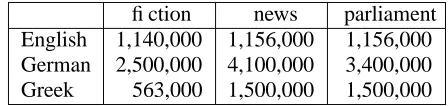
fiction news parliament English 1,140,000 1,156,000 1,156,000 German 2,500,000 4,100,000 3,400,000 Greek 563,000 1,500,000 1,500,000
Table 1: Number of words per corpus
selecting a subset of the German section from the Europarl corpus (Koehn, 2002).
For Greek, a fiction corpus was compiled from the ECI corpus by selecting all prose files that con-tained paragraph markings. Our news corpus was downloaded from the WWW site of the Modern Greek newspaper Eleftherotypia and consists of fi-nancial news from the period of 2001–2002. A cor-pus of parliamentary proceedings was again created by randomly selecting a subset of the Greek section of the Europarl corpus (Koehn, 2002).
Parts of the data were further pre-processed to insert sentence boundaries. We trained a publicly available sentence splitter (Reynar and Ratnaparkhi, 1997) on a small manually annotated sample (1,000 sentences per domain per language) and applied it to our corpora. Table 1 shows the corpus sizes. All corpora were split into training (72%), development (24%) and test set (4%).
3.2 Machine Learning
We used BoosTexter (Schapire and Singer, 2000) as our machine learning system. BoosTexter was orig-inally developed for text categorisation and com-bines a boosting algorithm with simple decision rules. For all domains and languages our training examples were sentences. Class labels encoded for each sentence whether it was starting a paragraph or not.
The features we used fall broadly into three dif-ferent areas: non-syntactic features, language mod-elling features and syntactic features. The latter were only applied to English as we did not have suit-able parsers for German and Greek.
The values of our features are numeric, boolean or “text”. BoosTexter applies unigram models when forming classification hypotheses for features with “text” values. These can be simply words or anno-tations such as part-of-speech tags.
We deliberately did not include anaphora-based features. While anaphors can help determine para-graph boundaries (parapara-graph initial sentences tend to contain few or no anaphors), anaphora structure is dependent on paragraph structure rather than the other way round. Hence, in applications which ma-nipulate texts and thereby potentially “mess-up” the
anaphora structure (e.g., multi-document summari-sation), anaphors are not a reliable cue for paragraph identification.5
3.2.1 Non-syntactic Features
Distance (Ds, Dw): These features encode the
dis-tance of the current sentence from the previous para-graph break. We measured distance in terms of the number of intervening sentences (Ds) as well as in
terms of the number of intervening words (Dw). If
paragraph breaks were driven purely by aesthetics one would expect this feature to be among the most successful ones.6
Sentence Length (Length): This feature encodes the number of words in the current sentence. Aver-age sentence length is known to vary with text posi-tion (Genzel and Charniak, 2003) and it is possible that it also varies with paragraph position.
Relative Position (Pos): The relative position of a sentence in the text is calculated by dividing the cur-rent sentence number by the number of sentences in the text. The motivation for this feature is that paragraph length may vary with text position. For example, it is possible that paragraphs at the begin-ning and end of a text are shorter than paragraphs in the middle and hence a paragraph break is more likely at the two former text positions.
Quotes (Quotep, Quotec, Quotei): These features
encode whether the previous or current sentence contain a quotation (Quotep and Quotec,
respec-tively) and whether the current sentence contin-ues a quotation that started in a preceding sentence (Quotei). The presence of quotations can provide
cues for speaker turns, which are often signalled by paragraph breaks.
Final Punctuation (FinPun): This feature keeps track of the final punctuation mark of the previous sentence. Some punctuation marks may provide hints as to whether a break should be introduced. For example, in the news domain, where there is hardly any dialogue, if the previous sentence ended in a question mark, it is likely that the current sen-tence supplies an answer to this question, thus mak-ing a paragraph break improbable.
Words (W1, W2, W3, Wall): These text-valued
fea-tures encode the words in the sentence. Wall takes
the complete sentence as its value. W1, W2and W3
encode the first word, the first two words and the first three words, respectively.
5This is also true for some of the other features we use
(e.g., sentence length) but not quite to the same extent.
6One could also use the history of class labels assigned to
3.2.2 Language Modelling Features
Our motivation for including language modelling features stems from Genzel and Charniak’s (2003) work where they show that the word entropy rate is lower for paragraph initial sentences than for non-paragraph initial ones. We therefore decided to ex-amine whether word entropy rate is a useful feature for the paragraph prediction task. Using the train-ing set for each language and domain, we created language models with the CMU language modelling toolkit (Clarkson and Rosenfeld, 1997). We exper-imented with language models of variable length (i.e., 1–5) and estimated two features: the prob-ability of a given sentence according to the lan-guage model (LMp) and the per-word entropy rate
(LMpwe). The latter was estimated by dividing the
sentence probability as assigned by the language model by the number of sentence words (see Genzel and Charniak (2003)).
We additionally experimented with character level n-gram models. Such models are defined over a relatively small vocabulary and can be easily con-structed for any language without pre-processing. Character level n-gram models have been applied to the problem of authorship attribution and ob-tained state-of-the art results (Peng et al., 2003). If some characters are more often attested in para-graph starting sentences (e.g., “A” or “T”), then we expect these sentences to have a higher probability compared to non-paragraph starting ones. Again, we used the CMU toolkit for building the character level n-gram models. We experimented with mod-els whose length varied from 2 to 8 and estimated the probability assigned to a sentence according to the character level model (CMp).
3.2.3 Syntactic Features
For the English data we also used several features encoding syntactic complexity. Genzel and Char-niak (2003) suggested that the syntactic complex-ity of sentences varies with their position in a para-graph. Roughly speaking, paragraph initial sen-tences are less complex. Hence, complexity mea-sures may be a good indicator of paragraph bound-aries. To estimate complexity, we parsed the texts with Charniak’s (2001) parser and implemented the following features:
Parsed: This feature states whether the current sentence could be parsed. While this is not a real measure of syntactic complexity it is probably cor-related with it.
Number of phrases (nums, numvp, numnp, numpp):
These features measure syntactic complexity in terms of the number of S, VP, NP, and PP
con-stituents in the parse tree.
Signature (Sign, Signp): These text-valued
fea-tures encode the sequence of part-of-speech tags in the current sentence. Sign only encodes word tags, while Signpalso includes punctuation tags.
Children of Top-Level Nodes (Childrs1, Childrs):
These text-valued features encode the top-level complexity of a parse tree: Childrs1 takes as its
value the sequence of syntactic labels of the children of the S1-node (i.e., the root of the parse tree), while Childrsencodes the syntactic labels of the children
of the highest S-node(s). For example, Childrs1may
encode that the sentence consists of one clause and Childrs may encode that this clause consists of an
NP, a VP, and a PP.
Branching Factor (Branchs, Branchvp, Branchnp, Branchpp): These features express the average
number of children of a given non-terminal con-stituent (cf. Genzel and Charniak (2003)). We com-pute the branching factor for S, VP, NP, and PP con-stituents.
Tree Depth: We define tree depth as the average length of a path (from root node to leaf node).
Cue Words (Cues, Cuem, Cuee): These features
are not strictly syntactic but rather discourse-based. They encode discourse cues (such as because) at the start (Cues), in the middle (Cuem) and at the
end (Cuee) of the sentence, where “start” is the first
word, “end” the last one, and everything else is “middle”. We keep track of all cue word occur-rences, without attempting to distinguish between their syntactic and discourse usages.
For English, there are extensive lists of discourse cues (we used Knott (1996)), but such lists are not widely available for German and Greek. Hence, we only used this feature on the English data.
4 Experiments
English German Greek
feature fiction news parl. fiction news parl. fiction news parl.
Bd 60.16 51.73 59.50 65.44 59.03 58.26 59.00 52.85 66.48
Bm 71.04 51.44 69.38 75.75 68.24 66.17 67.57 53.99 76.25
Dists 71.07 57.74 54.02 75.80 68.25 66.23 67.69 57.94 76.30
Distw 71.02 63.08 65.64 75.80 67.70 67.20 68.31 59.76 76.30
Length 72.08 56.11 68.45 75.75 72.55 67.10 67.52 60.84 76.55 Position 71.04 49.18 38.71 75.68 68.05 66.35 67.57 56.52 76.35 Quotep 80.84 56.25 30.62 72.97 68.24 66.23 72.80 58.00 76.30 Quotec 80.64 54.95 31.00 72.35 68.24 66.17 71.03 53.99 76.25 Quotei 71.04 51.44 30.62 75.75 68.24 66.17 67.57 53.99 76.25 FinPun 72.08 54.18 71.75 73.15 76.36 69.53 73.33 59.86 76.55
W1 72.96 57.74 82.05 75.43 73.87 75.25 67.05 67.41 76.81
W2 73.47 58.51 80.62 75.80 74.77 76.74 66.37 68.22 78.48
W3 73.68 59.90 80.73 75.60 74.50 76.79 67.63 67.88 78.43
Wall 73.99 61.78 75.40 75.60 73.03 76.20 67.78 67.88 77.26 BestLMp 72.83 55.96 69.66 75.93 71.39 67.40 67.57 61.64 76.50 BestLMpwe 72.16 52.21 69.88 75.90 69.24 66.98 67.83 56.29 76.40 BestCMp 72.70 57.36 69.49 75.88 73.37 67.53 67.68 61.68 76.51 allns lcm 82.45 70.77 82.71 76.55
[image:5.595.85.530.70.327.2]
79.28 79.17 78.03 76.31 79.35
Table 2: Accuracy of non-syntactic and language modelling features on test set
4.1 The Influence of Non-syntactic Features
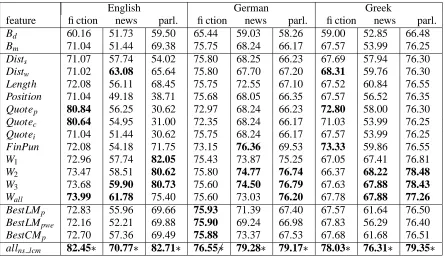
In the first set of experiments, we ran BoosTexter on all 9 corpora using non-syntactic and language modelling features. To evaluate the contribution of individual features to the classification task, we built one-feature classifiers in addition to a classifier that combined all features. Table 2 shows the test set classification accuracy of the individual features and their combination (allns lcms). The length of the
lan-guage and character models was optimised on the development set. The test set accuracy of the opti-mised models is shown as BestLMpand BestLMpwe
(language models) and BestCMp (character
mod-els).7 The results for the three best performing one-feature classifiers and the combined classifier are shown in boldface.
BoosTexter’s classification accuracy was further compared against two baselines. A distance-based baseline (Bd) was obtained by hypothesising a
para-graph break after every d sentences. We estimated d in the training data by counting the average number of sentences between two paragraphs. Our second baseline, Bm, defaults to the majority class, i.e.,
as-sumes that the text does not have paragraph breaks. For all languages and domains, the combined models perform better than the best baseline. In or-der to determine whether this difference is signifi-cant, we appliedχ2tests. The diacritic (
) in
Ta-7Which language and character models perform best varies
slightly across corpora but no clear trends emerge.
ble 2 indicates whether a given model is (not) sig-nificantly different from the best baseline. Signifi-cant results are achieved across the board with the exception of German fiction. We believe the rea-son for this lies in the corpus itself, as it is very heterogeneous, containing texts whose publication date ranges from 1766 to 1999 and which exhibit a wide variation in style and orthography. This makes it difficult for any given model to reliably identify paragraph boundaries in all texts.
In general, the best performing features vary across domains but not languages. Word features (W1–W3, Wall) yield the best classification
accura-cies for news and parliamentary domains, whereas for fiction, quotes and punctuation seem more use-ful. The only exception is the German fiction cor-pus, which consists mainly of 19th century texts. These contain less direct speech than the two fic-tion corpora for English and Greek (which contain contemporary texts). Furthermore, while examples of direct speech in the English corpus often involve short dialogues, where a paragraph boundary is in-troduced after each speaker turn, the German cor-pus contains virtually no dialogues and examples of direct speech are usually embedded in a longer nar-rative and not surrounded by paragraph breaks.
Note that the distance in words from the previ-ous paragraph boundary (Distw) is a good indicator
languages. An explanation might be that the En-glish news corpus is very homogeneous (i.e., it con-tains articles that not only have similar content but are also structurally alike). The Greek news cor-pus is relatively homogeneous; it mainly contains financial news articles but also some interviews, so there is greater variation in paragraph length, which means that the distance feature is overtaken by the word-based features. Finally, the German news cor-pus is highly heterogeneous, containing not only news stories but also weather forecasts, sports re-sults and cinema listings. This leads to a large vari-ation in paragraph length, which in turn means that the distance feature performs worse than the best baseline.
The heterogeneity of the German news corpus may also explain another difference: while the fi-nal punctuation of the previous sentence (FinPun) is among the less useful features for English and Greek (albeit still outperforming the baseline), it is the best performing feature for German. The German news corpus contains many “sentences” that end in atypical end-of-sentence markers such as semi-colons (which are found often in cinema listings). Atypical markers will often not occur before paragraph breaks, whereas typical markers will. This fact renders final punctuation a better predictor of paragraph breaks in the German corpus than in the other two corpora.
The language models behave similarly across do-mains and languages. With the exception of the news domain, they do not seem to be able to out-perform the majority baseline by more than 1%. The word entropy rate yields the worst performance, whereas character-based models perform as well as word-based models. In general, our results show that language modelling features are not particularly useful for this task.
4.2 The Influence of Syntactic Features
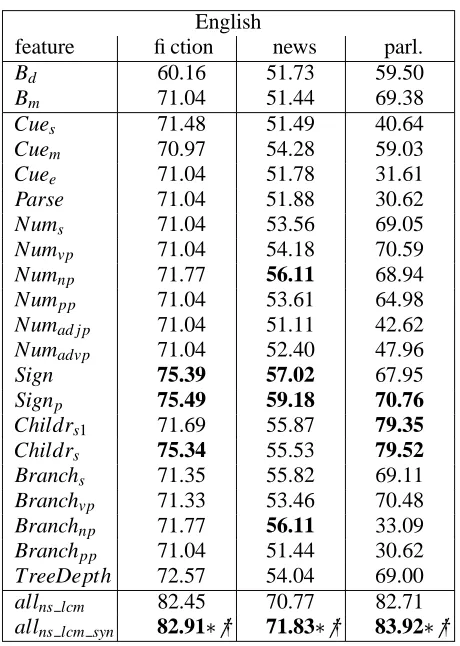
Our second set of experiments concentrated solely on the English data and investigated the useful-ness of the syntactic features (see Table 3). Again, we created one-feature classifiers and a classifier that combined all features, i.e., language and char-acter models, non-syntactic, and syntactic features (allns lcm syn). Table 3 also repeats the performance
of the two baselines (Bd and Bm) and the combined
non-syntactic models (allns lcm). The accuracies of
the three best performing one-feature models and the combined model are again shown in boldface.
As can be seen, syntactic features do not con-tribute very much to the overall performance. They only increase the accuracy by about 1%. Aχ2 test
English
feature fiction news parl.
Bd 60.16 51.73 59.50
Bm 71.04 51.44 69.38
Cues 71.48 51.49 40.64
Cuem 70.97 54.28 59.03
Cuee 71.04 51.78 31.61
Parse 71.04 51.88 30.62
Nums 71.04 53.56 69.05
Numvp 71.04 54.18 70.59
Numnp 71.77 56.11 68.94
Numpp 71.04 53.61 64.98
Numad j p 71.04 51.11 42.62
Numadvp 71.04 52.40 47.96
Sign 75.39 57.02 67.95 Signp 75.49 59.18 70.76 Childrs1 71.69 55.87 79.35 Childrs 75.34 55.53 79.52 Branchs 71.35 55.82 69.11 Branchvp 71.33 53.46 70.48 Branchnp 71.77 56.11 33.09 Branchpp 71.04 51.44 30.62 TreeDepth 72.57 54.04 69.00 allns lcm 82.45 70.77 82.71 allns lcm syn 82.91
† 71.83
† 83.92
[image:6.595.314.544.68.391.2]
†
Table 3: Syntactic features on English test data
revealed that the difference between allns lcm and allns lcm syn is not statistically significant (indicated
by
† in Table 3) for any of the three domains. The syntactic features seem to be less domain de-pendent than the non-syntactic ones. In general, the part-of-speech signature features (Sign, Signp) are
a good predictor, followed by the syntactic labels of the children of the top nodes (Childrs, Childrs1).
The number of NPs (Numnp) and their branching
factor (Branchnp) are also good indicators for some
domains, particularly the news domain. This is plausible since paragraph initial sentences in the Wall Street Journal often contain named entities, such as company names, which are parsed as flat NPs, i.e., have a relatively high branching factor.
4.3 The Effect of Training Size
train-6.8 13.6 20.4 27.2 33.9 40.8 47.6 54.4 61.1 67.9 70
80 90 100
Accuracy (%)
Fiction
3.9 7.8 11.7 15.6 19.5 23.4 27.3 31.20 35.1 39.3
60 70 80 90 100
Accuracy (%)
News
4.5 9.1 13.6 18.1 22.6 27.2 31.7 36.2 40.7 45.4
Thousand instances of training data 70
80 90 100
Accuracy (%)
[image:7.595.140.469.71.304.2]Parliament
Figure 1: Learning Curves for English
Kappa % Agr fiction .72 88.58
news .47 77.45
parl. .76 88.50
Table 4: Human agreement on the paragraph identi-fication task
ing set, the third containing 8/10, etc. The training instances in each data set were selected randomly. BoosTexter was trained on each of these sets (using all features), as described previously, and tested on the test set.
Figure 1 shows the learning curves obtained this way. The curves are more or less flat, i.e., increas-ing the amount of trainincreas-ing data does not have a large effect on the performance of the model. Further-more, even the smallest of our training sets is big enough to outperform the best baseline. Hence, it is possible to do well on this task even with less train-ing data. This is important, given that for spoken texts, paragraph boundaries may have to be obtained by manual annotation. The learning curves indicate that relatively modest effort would be required to obtain training data were it not freely available.
4.4 Human Evaluation
We established an upper bound against which our automatic methods could be compared by conduct-ing an experiment that assessed how well humans agree on identifying paragraph boundaries. Five participants were given three English texts (one from each domain), selected randomly from the test
corpus. Each text consisted of approximately a tenth of the original test set (i.e., 200–400 sentences). The participants were asked to insert paragraph breaks wherever it seemed appropriate to them. No other instructions were given, as we wanted to see whether they could independently perform the task without any specific knowledge regarding the do-mains and their paragraphing conventions.
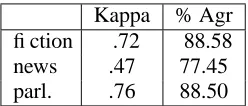
We measured the agreement of the judges using the Kappa coefficient (Siegel and Castellan, 1988) but also report percentage agreement to facilitate comparison with our models. In all cases, we com-pute pairwise agreements and report the mean. Our results are shown in Table 4.
As can be seen, participants tend to agree with each other on the task. The least agreement is ob-served for the news domain. This is somewhat ex-pected as the Wall Street Journal texts are rather dif-ficult to process for non-experts. Also remember, that our subjects were given no instructions or train-ing. In all cases our models yield an accuracy lower than the human agreement. For the fiction domain the best model is 5.67% lower than the upper bound, for the news domain it is 5.62% and for the parlia-ment domain it is 5.42% (see Tables 4 and 3).
5 Conclusion
[image:7.595.123.247.347.400.2]one case significantly higher than the best baseline. We conducted our study in three different do-mains and languages and found that the best fea-tures for the news and parliamentary proceedings domains are based on word co-occurrence, whereas features that exploit punctuation are better predic-tors for the fiction domain. Models which incor-porate syntactic and discourse cue features do not lead to significant improvements over models that do not. This means that paragraph boundaries can be predicted by relying on low-level, language in-dependent features. The task is therefore feasible even for languages for which parsers or cue word lists are not readily available.
We also experimented with training sets of differ-ent sizes and found that more training data does not necessarily lead to significantly better results and that it is possible to beat the best baseline comfort-ably even with a relatively small training set.
Finally, we examined how well humans do on this task. Our results indicate that humans achieve an average accuracy of about 77.45% to 88.58%, where some domains seem to be easier than others. Our models achieved accuracies of within 6% of hu-man perforhu-mance.
In the future, we plan to apply our model to new domains (e.g., broadcast news or scientific papers), to non-Indo-European languages such as Arabic and Chinese, and to machine generated texts.
References
Doug Beeferman, Adam Berger, and John Lafferty. 1999. Statistical models for text segmentation. Machine Learning, 34(1/3):177–210.
Eugene Charniak. 2001. Immediate-head parsing for language models. In Proceedings of the 39th Annual Meeting of the Association for Computa-tional Linguistics, pages 116–123, Toulouse. Heidi Christensen, Bala Kolluru, Yoshi Gotoh, and
Steve Renals. 2004. From text summarisation to style-specific summarisation for broadcast news. In Proceedings of the European Conference on Information Retrieval, Sunderland.
Philip Clarkson and Ronald Rosenfeld. 1997. Statistical language modeling. In Proceedings of ESCA EuroSpeech’97, pages 2707–2710, Rhodes.
Dmitriy Genzel and Eugene Charniak. 2003. Vari-ation of entropy and parse trees of sentences as a function of the sentence number. In Proceed-ings of Empirical Methods in Natural Language Processing, pages 65–72, Sapporo.
Alexander G. Hauptmann and Michael A. Smith. 1995. Text, speech and vision for video
segmen-tation: The informedia project. In Proceedings of the AAAI Fall Symposium, Computational Mod-els for Integrating Language and Vision, Cam-bridge, MA.
Marti A. Hearst. 1997. TextTiling: Segmenting text into multi-paragraph subtopic passages. Compu-tational Linguistics, 23(1):33–64.
Alistair Knott. 1996. A Data-Driven Methodol-ogy for Motivating a Set of Coherence Rela-tions. Ph.D. thesis, Department of Artificial In-telligence, University of Edinburgh.
Philipp Koehn. 2002. Europarl: A multilin-gual corpus for evaluation of machine trans-lation. Unpublished Draft, http://www.isi.
edu/˜koehn/publications/europarl.ps.
R. E. Longacre. 1979. The paragraph as a gram-matical unit. Syntax and Semantics, 12:115–134. Fuchun Peng, Dale Schuurmans, Vlado Keselj, and Shaojun Wang. 2003. Language independent authorship attribution using character level lan-guage models. In Proceedings of the 11th Con-ference of the European Chapter of the Associ-ation for ComputAssoci-ational Linguistics, pages 267– 274, Budapest.
Lev Pevzner and Marti Hearst. 2002. A critique and improvement of an evaluation metric for text segmentation. Computational Linguistics, 28(1o):19–36.
Jeffrey C. Reynar and Adwait Ratnaparkhi. 1997. A maximum entropy approach to identifying sen-tence boundaries. In Proceedings of the Fifth Conference on Applied Natural Language Pro-cessing, Washington, DC.
Robert E. Schapire and Yoram Singer. 2000. Boos-texter: A boosting-based system for text catego-rization. Machine Learning, 39(2/3):135–168. Sidney Siegel and N. John Castellan. 1988. Non
Parametric Statistics for the Behavioral Sciences. McGraw-Hill, New York.
Heather A. Stark. 1988. What do paragraph mark-ings do? Discourse Processes, 11:275–303. Mark Stevenson and Robert Gaizauskas. 2000.
Ex-periments on sentence boundary detection. In Proceedings of the 6th Applied Natural Langauge Processing Conference, pages 84–89, Seattle, WA.
Masao Utiyama and Hitoshi Isahara. 2001. A sta-tistical model for domain-independent text seg-mentation. In Proceedings of the 39th Annual Meeting of the Association for Computational Linguistics, pages 491–498, Toulouse.