Variation of Entropy and Parse Trees of Sentences as a Function of the
Sentence Number
Dmitriy Genzel and Eugene Charniak
Brown Laboratory for Linguistic Information Processing Department of Computer Science
Brown University Providence, RI, USA, 02912
{dg,ec}@cs.brown.edu
Abstract
In this paper we explore the variation of sentences as a function of the sentence number. We demonstrate that while the entropy of the sentence increases with the sentence number, it decreases at the para-graph boundaries in accordance with the Entropy Rate Constancy principle (intro-duced in related work). We also demon-strate that the principle holds for differ-ent genres and languages and explore the role of genre informativeness. We investi-gate potential causes of entropy variation by looking at the tree depth, the branch-ing factor, the size of constituents, and the occurrence of gapping.
1 Introduction and Related Work
In many natural language processing applications, such as parsing or language modeling, sentences are treated as natural self-contained units. Yet it is well-known that for interpreting the sentences the dis-course context is often very important. The later sentences in the discourse contain references to the entities in the preceding sentences, and this fact is often useful, e.g., in caching for language model-ing (Goodman, 2001). The indirect influence of the context, however, can be observed even when a sen-tence is taken as a stand-alone unit, i.e., without its context. It is possible to distinguish between a set of earlier sentences and a set of later sentences with-out any direct comparison by computing certain lo-cal statistics of individual sentences, such as their
entropy (Genzel and Charniak, 2002). In this work we provide additional evidence for this hypothesis and investigate other sentence statistics.
1.1 Entropy Rate Constancy
Entropy, as a measure of information, is often used in the communication theory. If humans have evolved to communicate in the most efficient way (some evidence for that is provided by Plotkin and Nowak (2000)), then they would communicate in such a way that the entropy rate would be constant, namely, equal to the channel capacity (Shannon, 1948).
In our previous work (Genzel and Charniak, 2002) we propose that entropy rate is indeed stant in human communications. When read in con-text, each sentence would appear to contain roughly the same amount of information, per word, whether it is the first sentence or the tenth one. Thus the tenth sentence, when taken out of context, must ap-pear significantly more informative (and therefore harder to process), since it implicitly assumes that the reader already knows all the information in the preceding nine sentences. Indeed, the greater the sentence number, the harder to process the sentence must appear, though for large sentence numbers this would be very difficult to detect. This makes intu-itive sense: out-of-context sentences are harder to understand than in-context ones, and first sentences can never be out of context. It is also demonstrated empirically through estimating entropy rate of vari-ous sentences.
the second part (Section 4), we investigate the poten-tial reasons underlying this variation in complexity by looking at the parse trees of the sentences. We also discuss how genre and style affect the strength of this effect.
1.2 Limitations of Preceding Work
In our previous work we demonstrate that the word entropy rate increases with the sentence number; we do it by estimating entropy of Wall Street Journal articles in Penn Treebank in three different ways. It may be the case, however, that this effect is corpus-and language-specific. To show that the Entropy Rate Constancy Principle is universal, we need to confirm it for different genres and different lan-guages. We will address this issue in Section 3.
Furthermore, if the principle is correct, it should also apply to the sentences numbered from the be-ginning of a paragraph, rather than from the begin-ning of the article, since in either case there is a shift of topic. We will discuss this in Section 2.
2 Within-Paragraph Effects
2.1 Implications of Entropy Rate Constancy Principle
We have previously demonstrated (see Genzel and Charniak (2002) for detailed derivation) that the conditional entropy of the ith word in the sentence (Xi), given its local contextLi(the preceding words in the same sentence) and global context Ci (the words in all preceding sentences) can be represented as
H(Xi|Ci, Li) =H(Xi|Li)−I(Xi, Ci|Li)
where H(Xi|Li) is the conditional entropy of the
ith word given local context, and I(Xi, Ci|Li) is the conditional mutual information between the ith word and out-of-sentence context, given the local context. SinceCiincreases with the sentence num-ber, we will assume that, normally, it will provide more and more information with each sentence. This would cause the second term on the right to increase with the sentence number, and sinceH(Xi|Ci, Li) must remain constant (by our assumption), the first term should increase with sentence number, and it had been shown to do so (Genzel and Charniak, 2002).
Our assumption about the increase of the mutual information term is, however, likely to break at the paragraph boundary. If there is a topic shift at the boundary, the context probably provides more infor-mation to the preceding sentence, than it does to the new one. Hence, the second term will decrease, and so must the first one.
In the next section we will verify this experimen-tally.
2.2 Experimental Setup
We use the Wall Street Journal text (years 1987-1989) as our corpus. We take all articles that con-tain ten or more sentences, and extract the first ten sentences. Then we:
1. Group extracted sentences according to their sentence number into ten sets of 49559 sen-tences each.
2. Separate each set into two subsets, paragraph-starting and non-paragraph-paragraph-starting sentences1.
3. Combine first 45000 sentences from each set into the training set and keep all remaining data as 10 testing sets (19 testing subsets).
We use a simple smoothed trigram language model:
P(xi|x1. . . xi−1) ≈ P(xi|xi−2xi−1)
= λ1Pˆ(xi|xi−2xi−1)
+ λ2Pˆ(xi|xi−1)
+ (1−λ1−λ2) ˆP(xi)
where λ1 and λ2 are the smoothing coefficients2,
andPˆ is a maximum likelihood estimate of the cor-responding probability, e.g.,
ˆ
P(xi|xi−2xi−1) =
C(xi−2xi−1xi) C(xi−2xi−1)
where C(xi. . . xj) is the number of times this se-quence appears in the training data.
We then evaluate the resulting model on each of the testing sets, computing per-word entropy of the set:
ˆ
H(X) = 1 |X|
X
xi∈X
logP(xi|xi−2xi−1)
1
First sentences are, of course, all paragraph-starting.
2
1 2 3 4 5 6 7 8 9 10 5.8
5.9 6.0 6.1 6.2 6.3 6.4 6.5 6.6
Sentence number
Entropy (bits)
[image:3.612.76.297.74.318.2]all sentences paragraph−starting non−paragraph−starting
Figure 1: Entropy vs. Sentence number
2.3 Results and Discussion
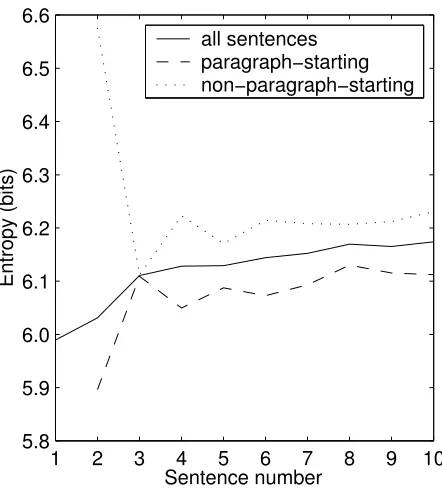
As outlined above, we have ten testing sets, one for each sentence number; each set (except for the first) is split into two subsets: sentences that start a para-graph, and sentences that do not. The results for full sets, paragraph-starting subsets, and non-paragraph-starting subsets are presented in Figure 1.
First, we can see that the the entropy for full sets (solid line) is generally increasing. This re-sult corresponds to the previously discussed effect of entropy increasing with the sentence number. We also see that for all sentence numbers the paragraph-starting sentences have lower entropy than the non-paragraph-starting ones, which is what we intended to demonstrate. In such a way, the paragraph-starting sentences are similar to the first sentences, which makes intuitive sense.
All the lines roughly show that entropy increases with the sentence number, but the behavior at the second and the third sentences is somewhat strange. We do not yet have a good explanation of this phe-nomenon, except to point out that paragraphs that start at the second or third sentences are probably not “normal” because they most likely do not indi-cate a topic shift. Another possible explanation is that this effect is an artifact of the corpus used.
We have also tried to group sentences based on their sentence number within paragraph, but were unable to observe a significant effect. This may be due to the decrease of this effect in the later sen-tences of large articles, or perhaps due to the relative weakness of the effect3.
3 Different Genres and Languages
3.1 Experiments on Fiction
3.1.1 Introduction
All the work on this problem so far has focused on the Wall Street Journal articles. The results are thus naturally suspect; perhaps the observed effect is simply an artifact of the journalistic writing style. To address this criticism, we need to perform com-parable experiments on another genre.
Wall Street Journal is a fairly prototypical exam-ple of a news article, or, more generally, a writing with a primarily informative purpose. One obvious counterpart of such a genre is fiction4. Another al-ternative might be to use transcripts of spoken dia-logue.
Unfortunately, works of fiction, are either non-homogeneous (collections of works) or relatively short with relatively long subdivisions (chapters). This is crucial, since in the sentence number experi-ments we obtain one data point per article, therefore it is impossible to use book chapters in place of arti-cles.
3.1.2 Experimental Setup and Results
For our experiments we use War and Peace (Tol-stoy, 1869), since it is rather large and publicly avail-able. It contains only about 365 rather long chap-ters5. Unlike WSJ articles, each chapter is not writ-ten on a single topic, but usually has multiple topic shifts. These shifts, however, are marked only as paragraph breaks. We, therefore, have to assume that each paragraph break represents a topic shift,
3
We combine into one set very heterogeneous data: both 1st and 51st sentence might be in the same set, if they both start a paragraph. The experiment in Section 2.2 groups only the paragraph-starting sentences with the same sentence number.
4
We use prose rather than poetry, which presumably is even less informative, because poetry often has superficial con-straints (meter); also, it is hard to find a large homogeneous poetry collection.
5
1 2 3 4 5 8.05
8.1 8.15 8.2 8.25 8.3
Sentence number since beginning of paragraph
Entropy in bits
[image:4.612.74.295.71.309.2]Real run Control runs
Figure 2: War and Peace: English
and treat each paragraph as being an equivalent of a WSJ article, even though this is obviously subopti-mal.
The experimental setup is very similar to the one used in Section 2.2. We use roughly half of the data for training purposes and split the rest into testing sets, one per each sentence number, counted from the beginning of a paragraph.
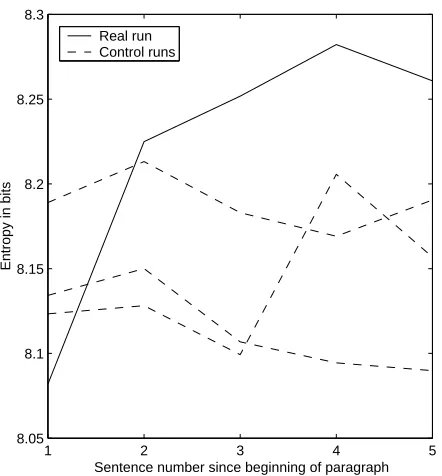
We then evaluate the results using the same method as in Section 2.2. We expect that the en-tropy would increase with the sentence number, just as in the case of the sentences numbered from the article boundary. This effect is present, but is not very pronounced. To make sure that it is statistically significant, we also do 1000 control runs for com-parison, with paragraph breaks inserted randomly at the appropriate rate. The results (including 3 ran-dom runs) can be seen in Figure 2. To make sure our results are significant we compare the correla-tion coefficient between entropy and sentence num-ber to ones from simulated runs, and find them to be significant (P=0.016).
It is fairly clear that the variation, especially be-tween the first and the later sentences, is greater than it would be expected for a purely random oc-currence. We will see further evidence for this in the next section.
3.2 Experiments on Other Languages
To further verify that this effect is significant and universal, it is necessary to do similar experiments in other languages. Luckily, War and Peace is also digitally available in other languages, of which we pick Russian and Spanish for our experiments.
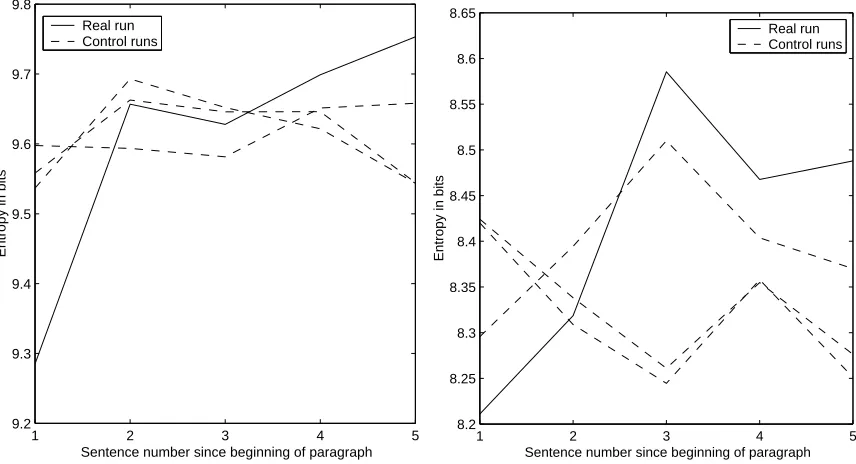
We follow the same experimental procedure as in Section 3.1.2 and obtain the results for Russian (Fig-ure 3(a)) and Spanish (Fig(Fig-ure 3(b)). We see that re-sults are very similar to the ones we obtained for English. The results are again significant for both Russian (P=0.004) and Spanish (P=0.028).
3.3 Influence of Genre on the Strength of the Effect
We have established that entropy increases with the sentence number in the works of fiction. We ob-serve, however, that the effect is smaller than re-ported in our previous work (Genzel and Charniak, 2002) for Wall Street Journal articles. This is to be expected, since business and news writing tends to be more structured and informative in nature, grad-ually introducing the reader to the topic. Context, therefore, plays greater role in this style of writing.
To further investigate the influence of genre and style on the strength of the effect we perform exper-iments on data from British National Corpus (Leech, 1992) which is marked by genre.
For each genre, we extract first ten sentences of each genre subdivision of ten or more sentences. 90% of this data is used as training data and 10% as testing data. Testing data is separated into ten sets: all the first sentences, all the second sentences, and so on. We then use a trigram model trained on the training data set to find the average per-word en-tropy for each set. We obtain ten numbers, which in general tend to increase with the sentence num-ber. To find the degree to which they increase, we compute the correlation coefficient between the en-tropy estimates and the sentence numbers. We report these coefficients for some genres in Table 1. To en-sure reliability of results we performed the described process 400 times for each genre, sampling different testing sets.
1 2 3 4 5 9.2
9.3 9.4 9.5 9.6 9.7 9.8
Sentence number since beginning of paragraph
Entropy in bits
Real run Control runs
(a) Russian
1 2 3 4 5
8.2 8.25 8.3 8.35 8.4 8.45 8.5 8.55 8.6 8.65
Entropy in bits
Sentence number since beginning of paragraph Real run Control runs
[image:5.612.76.504.86.318.2](b) Spanish
Figure 3: War and Peace
stronger correlations between entropy and sentence number. There is only one genre, tabloid newspa-pers6, that has negative correlation. The four gen-res with the smallest correlation are all quite non-informative: tabloids, popular magazines, advertise-ments7 and poetry. Academic writing has higher correlation coefficients than non-academic. Also, humanities and social sciences writing is probably more structured and better stylistically than science and engineering writing. At the bottom of the table we have genres which tend to be produced by pro-fessional writers (biography), are very informative (TV news feed) or persuasive and rhetorical (parlia-mentary proceedings).
3.4 Conclusions
We have demonstrated that paragraph boundaries of-ten cause the entropy to decrease, which seems to support the Entropy Rate Constancy principle. The effects are not very large, perhaps due to the fact
6
Perhaps, in this case the readers are only expected to look at the headlines.
7
Advertisements could be called informative, but they tend to be sets of loosely related sentences describing various fea-tures, often in no particular order.
that each new paragraph does not necessarily rep-resent a shift of topic. This is especially true in a medium like the Wall Street Journal, where articles are very focused and tend to stay on one topic. In fiction, paragraphs are often used to mark a topic shift, but probably only a small proportion of para-graph breaks in fact represents topic shifts. We also observed that more informative and structured writ-ing is subject to stronger effect than speculative and imaginative one, but the effect is present in almost all writing.
In the next section we will discuss the potential causes of the entropy results presented both in the preceding and this work.
4 Investigating Non-Lexical Causes
In our previous work we discuss potential causes of the entropy increase. We find that both lexical (which words are used) and non-lexical (how the words are used) causes are present. In this section we will discuss possible non-lexical causes.
BNC genre Corr. coef. Tabloid newspapers −0.342±0.014 Popular magazines 0.073±0.016 Print advertisements 0.175±0.015 Fiction: poetry 0.261±0.013 Religious texts 0.328±0.012 Newspapers: commerce/finance 0.365±0.013 Non-acad: natural sciences 0.371±0.012 Official documents 0.391±0.012 Fiction: prose 0.409±0.011 Non-acad: medicine 0.411±0.013 Newspapers: sports 0.433±0.047 Acad: natural sciences 0.445±0.010 Non-acad: tech, engineering 0.478±0.011 Non-acad: politics, law, educ. 0.512±0.004 Acad: medicine 0.517±0.007 Acad: tech, engineering 0.521±0.010 Newspapers: news reportage 0.541±0.009 Non-acad: social sciences 0.541±0.008 Non-acad: humanities 0.598±0.007 Acad: politics, laws, educ. 0.619±0.006 Newspapers: miscellaneous 0.622±0.009 Acad: humanities 0.676±0.007 Commerce/finance, economics 0.678±0.007 Acad: social sciences 0.688±0.004 Parliamentary proceedings 0.774±0.002 TV news script 0.850±0.002 Biographies 0.894±0.001
Table 1: Correlation coefficient for different genres
trees and investigate if any statistics show a signifi-cant change with the sentence number.
4.1 Experimental Setup
We use the whole Penn Treebank corpus (Marcus et al., 1993) as our data set. This corpus contains about 50000 parsed sentences.
Many of the statistics we wish to compute are very sensitive to the length of the sentence. For example, the depth of the tree is almost linearly related to the sentence length. This is important because the aver-age length of the sentence varies with the sentence number. To make sure we exclude the effect of the sentence length, we need to normalize for it.
We proceed in the following way. LetTbe the set of trees, andf :T → Rbe some statistic of a tree. Letl(t)be the length of the underlying sentence for
0 2 4 6 8 10
0.985 0.99 0.995 1 1.005 1.01 1.015
Bucket number (for sentence number)
[image:6.612.314.528.72.291.2]Adjusted tree depth
Figure 4: Tree Depth
treet. LetL(n) ={t|l(t) =n}be the set of trees of sizen. LetLf(n)be defined as |L(1n)|Pt∈L(n)f(t),
the average value of the statisticf on all sentences of length n. We then define the sentence-length-adjusted statistic, for all t, as
f0(t) = f(t) Lf(l(t))
The average value of the adjusted statistic is now equal to 1, and it is independent of the sentence length.
We can now report the average value of each statistic for each sentence number, as we have done before, but instead we will group the sentence num-bers into a small number of “buckets” of exponen-tially increasing length8. We do so to capture the behavior for all the sentence numbers, and not just for the first ten (as before), as well as to lump to-gether sentences with similar sentence numbers, for which we do not expect much variation.
4.2 Tree Depth
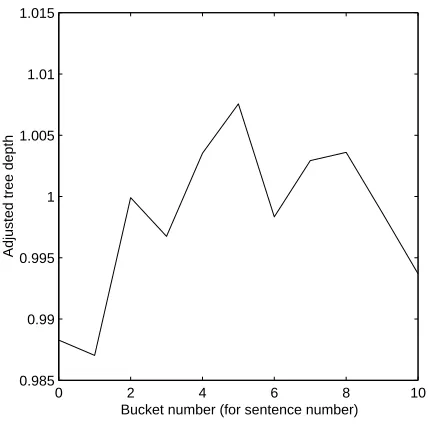
The first statistic we consider is also the most nat-ural: tree depth. The results can be seen in Figure 4.
In the first part of the graph we observe an crease in tree depth, which is consistent with the in-creasing complexity of the sentences. In the later
8
0 2 4 6 8 10 0.96
0.98 1 1.02 1.04 1.06 1.08 1.1 1.12 1.14
Bucket number (for sentence number)
Adjusted branching factor
[image:7.612.74.287.74.284.2]Branching factor NPs only Base NPs only
Figure 5: Branching factor
sentences, the depth decreases slightly, but still stays above the depth of the first few sentences.
4.3 Branching Factor and NP Size
Another statistic we investigate is the average branching factor, defined as the average number of children of all non-leaf nodes in the tree. It does not appear to be directly correlated with the sentence length, but we normalize it to make sure it is on the same scale, so we can compare the strength of re-sulting effect.
Again, we expect lower entropy to correspond to flatter trees, which corresponds to large branching factor. Therefore we expect the branching factor to decrease with the sentence number, which is indeed what we observe (Figure 5, solid line).
Each non-leaf node contributes to the average branching factor. It is likely, however, that the branching factor changes with the sentence num-ber for certain types of nodes only. The most obvi-ous contributors for this effect seem to be NP (noun phrase) nodes. Indeed, one is likely to use several words to refer to an object for the first time, but only a few words (even one, e.g., a pronoun) when refer-ring to it later. We verify this intuitive suggestion, by computing the branching factor for NP, VP (verb phrase) and PP (prepositional phrase) nodes. Only NP nodes show the effect, and it is much stronger (Figure 5, dashed line) than the effect for the
branch-0 2 4 6 8 10
0.98 0.99 1 1.01 1.02 1.03 1.04 1.05
Bucket number (for sentence number)
Adjusted branching factor
[image:7.612.314.526.84.287.2]Branching factor Branching factor w/o base NPs
Figure 6: Branching Factor without Base NPs
ing factor.
Furthermore, it is natural to expect that most of this effect arises from base NPs, which are defined as the NP nodes whose children are all leaf nodes. Indeed, base NPs show a slightly more pronounced effect, at least with regard to the first sentence (Fig-ure 5, dotted line).
4.4 Further Investigations
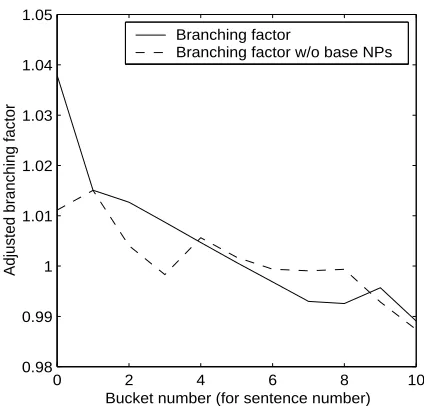
We need to determine whether we have accounted for all of the branching factor effect, by proposing that it is simply due to decrease in the size of the base NPs. To check, we compute the average branching factor, excluding base NP nodes.
By comparing the solid line in Figure 6 (the origi-nal average branching factor result) with the dashed line (base NPs excluded), you can see that base NPs account for most, though not all of the effect. It seems, then, that this problem requires further in-vestigation.
4.5 Gapping
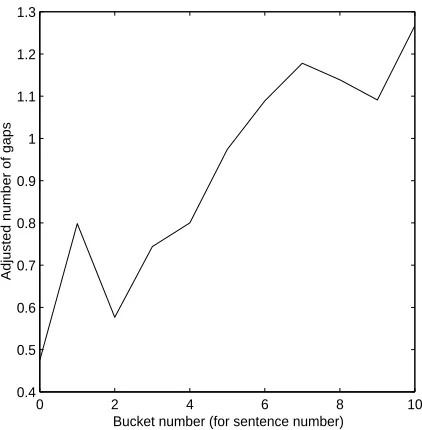
experi-0 2 4 6 8 10 0.4
0.5 0.6 0.7 0.8 0.9 1 1.1 1.2 1.3
Bucket number (for sentence number)
[image:8.612.74.285.73.288.2]Adjusted number of gaps
Figure 7: Number of ellipsis nodes
ment9.
As we can see from Figure 7, there is indeed a sig-nificant increase in the use of ellipsis as the sentence number increases, which presumably makes the sen-tences more complex. Only about 1.5% of all the sentences, however, have gaps.
5 Future Work and Conclusions
We have discovered a number of interesting facts about the variation of sentences with the sentence number. It has been previously known that the com-plexity of the sentences increases with the sentence number. We have shown here that the complexity tends to decrease at the paragraph breaks in accor-dance with the Entropy Rate Constancy principle. We have verified that entropy also increases with the sentence number outside of Wall Street Journal do-main by testing it on a work of fiction. We have also verified that it holds for languages other than En-glish. We have found that the strength of the effect depends on the informativeness of a genre.
We also looked at the various statistics that show a significant change with the sentence number, such as the tree depth, the branching factor, the size of noun phrases, and the occurrence of gapping.
Unfortunately, we have been unable to apply these results successfully to any practical problem so far,
9
Ellipsis nodes in Penn Treebank are marked with *?* . See Bies et al. (1995) for details.
primarily because the effects are significant on av-erage and not in any individual instances. Finding applications of these results is the most important direction for future research.
Also, since this paper essentially makes state-ments about human processing, it would be very ap-propriate to to verify the Entropy Rate Constancy principle by doing reading time experiments on hu-man subjects.
6 Acknowledgments
We would like to acknowledge the members of the Brown Laboratory for Linguistic Information Pro-cessing and particularly Mark Johnson for many useful discussions. This research has been supported in part by NSF grants IIS 0085940, IIS 0112435, and DGE 9870676.
References
A. Bies, M. Ferguson, K. Katz, and R. MacIntyre, 1995.
Bracketing Guidelines for Treebank II Style Penn Tree-bank Project. Penn TreeTree-bank Project, University of
Pennsylvania.
D. Genzel and E. Charniak. 2002. Entropy rate con-stancy in text. In Proceedings of ACL–2002,
Philadel-phia.
J. T. Goodman. 2001. A bit of progress in language mod-eling. Computer Speech and Language, 15:403–434.
G. Leech. 1992. 100 million words of English: the British National Corpus. Language Research,
28(1):1–13.
M. P. Marcus, B. Santorini, and M. A. Marcinkiewicz. 1993. Building a large annotated corpus of En-glish: the Penn treebank. Computational Linguistics, 19:313–330.
J. B. Plotkin and M. A. Nowak. 2000. Language evo-lution and information theory. Journal of Theoretical
Biology, pages 147–159.
C. E. Shannon. 1948. A mathematical theory of commu-nication. The Bell System Technical Journal, 27:379– 423, 623–656, July, October.