An Extensive Empirical Evaluation of
Character-Based Morphological Tagging for 14 Languages
Georg Heigold
DFKI & Saarland University Saarbr¨ucken, Germany
G¨unter Neumann
DFKI
Saarbr¨ucken, Germany
Josef van Genabith
DFKI & Saarland University Saarbr¨ucken, Germany
josef.van [email protected]
Abstract
This paper investigates neural character-based morphological tagging for lan-guages with complex morphology and large tag sets. Character-based approaches are attractive as they can handle rarely-and unseen words gracefully. We eval-uate on 14 languages and observe con-sistent gains over a state-of-the-art mor-phological tagger across all languages ex-cept for English and French, where we match the state-of-the-art. We compare two architectures for computing character-based word vectors using recurrent (RNN) and convolutional (CNN) nets. We show that the CNN based approach performs slightly worse and less consistently than the RNN based approach. Small but sys-tematic gains are observed when combin-ing the two architectures by ensemblcombin-ing.
1 Introduction
Character-based approaches have been studied for many applications in natural language pro-cessing, including part-of-speech (POS) tagging (dos Santos and Zadrozny, 2014; Ling et al., 2015; Gillick et al., 2016; Plank et al., 2016; Ma and Hovy, 2016), morphological tagging (Labeau et al., 2015), parsing (Ballesteros et al., 2015), named entity recognition (Gillick et al., 2016), language modeling (Ling et al., 2015; Kim et al., 2016), and neural machine translation (Costa-juss`a and Fonollosa, 2016). Character-based rep-resentations have the advantage of gracefully han-dling rare or unseen words and tend to produce more compact models as the number of atomic units, i.e., characters, is smaller compared to the number of words in word-level approaches. The issue of rare or unseen words is particularly
pro-nounced when working on morphologically-rich languages, small amounts of training data or noisy user input.
Morphological tagging is the task of assigning a morphological analysis to a token in context. The morphological analysis for a word consists of a sequence of feature:value pairs describing, for example, case, gender, person and tense. A par-ticular concatenation of such feature:value pairs is referred to as a single tag (Oflazer and ˙Ilker Kuroz, 1994; Hajic and Hladka, 1998; Mueller et al., 2013).
Following (M¨uller and Schuetze, 2015), we also add the part-of-speech to this morphological tag and refer to it as POS-MORPH:
I see four words
|
POS=noun:CASE=acc:· · · · · ·:NUMBER=plural
Given a word in context, we predict a POS-MORPH tag as a complete unit, rather than as the individual component parts. This approach al-lows us to share large parts of the model but can only produce POS-MORPH analyses attested in the training data (cf. Table 2). This is still the stan-dard approach to morphological tagging and dis-ambiguation as, given sufficient amounts of train-ing data, the number of POS-MORPH descrip-tions that cannot be produced usually is small.
Character-based POS tagging (rather than full POS-MORPH tagging) has been extensively eval-uated in the literature (dos Santos and Zadrozny, 2014; Ling et al., 2015; Gillick et al., 2016; Plank et al., 2016). The results are competitive but do not systematically outperform the state of the art. Only Plank et al. (2016) report consistent gains by using shallow neural network architectures in combination with multitask learning, multilingual
learning, and pre-trained word embeddings. State-of-the-art results for morphological tag-ging (full POS-MORPH tagtag-ging) can be found in (Mueller et al., 2013; M¨uller and Schuetze, 2015). To the best of our knowledge, there has not been much research on character-based morphological tagging so far. Labeau et al. (2015) is an excep-tion but report results for German only. Their best results are on a par with state-of-the-art re-sults. Heigold et al. (2016) show clear gains of character-based over state-of-the-art morphologi-cal taggers. However, the evaluation is limited to German and Czech.
Research on character-based approaches in gen-eral NLP clearly divides into papers that use CNN-based architectures (dos Santos and Zadrozny, 2014; Kim et al., 2016; Costa-juss`a and Fonol-losa, 2016) and papers that use LSTM-based ar-chitectures (Labeau et al., 2015; Ling et al., 2015; Gillick et al., 2016; Ballesteros et al., 2015; Plank et al., 2016; Ma and Hovy, 2016). There are a number of examples where an LSTM paper re-ports results of a CNN paper for comparison, such as (Ling et al., 2015) (POS tagging for English) and (Gillick et al., 2016) (named entity recognition for English). However, there is no direct compari-son between CNN and LSTM based architectures in morphological tagging.
In this paper, we investigate character-based morphological tagging in more depth. More specifically, the contributions of this paper in-clude:
• the evaluation of character-based morpholog-ical tagging on 14 different languages of dif-ferent morphological complexity;
• the empirical comparison of long-short term memory (LSTM) and convolutional neural network (CNN) based architectures;
• the demonstration of systematic gains of our character-based, language-agnostic logical tagger over a state-of-the-art morpho-logical tagger across morphomorpho-logically rich languages; moreover, and perhaps as ex-pected, we show that the relative gains are clearly correlated with the amount of the training data;
• the evaluation of the complementarity of LSTM- and CNN-based architectures by en-semble experiments.
The remainder of the paper is organized as fol-lows. Section 2 summarizes the character-based neural network approaches used in this paper. The data sets and model configurations are described in Section 3 and in Section 4, respectively. The em-pirical evaluation is presented in Section 5. Sec-tion 6 concludes the paper. The Appendix contains a listing of all experimental results obtained in this paper.
2 Character-based Tagging We assume an input sentence wN
1 with (complex
POS-MORPH morphological) output tagstN 1 and
a zeroth-order Markov model
p(tN1 |wN1 ) = N
Y
n=1
p(tn|w1N) (1)
whose factors are modeled by a suitable neural network. For character-based tagging, we use the character representation of the word, w = cM
1 .
This assumes that the segmentation of the sentence into words is known, which is straightforward for the languages under consideration.
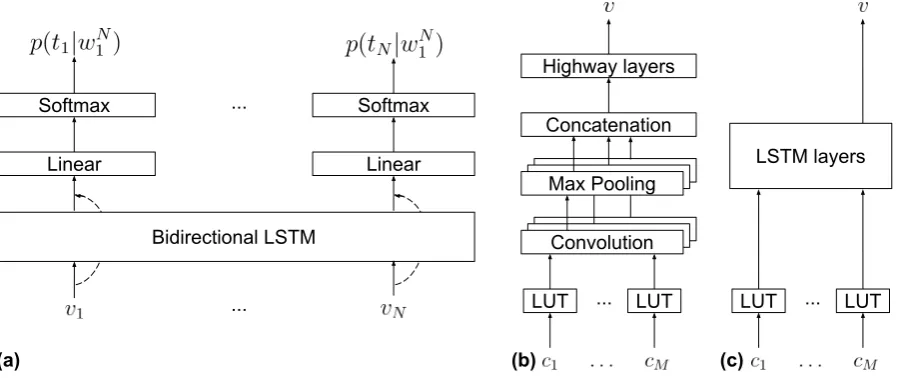
At the top level, each input word maps to one complex POS-MORPH morphological output tag. Hence, we can model the position-wise probabili-tiesp(t|wN
1 )with recurrent neural networks, such
as long short-term memory recurrent neural net-works (LSTMs) (Graves, 2012). Fig. 1 (a) shows such a network architecture where the inputs are the word vectors vN
1 . At the lower level, we use
a CNN-based (Fig. 1 (b)) or an LSTM-based (Fig. 1 (c)) architecture to compute the character-based word vectors. As we are using bidirectional LSTMs (BLSTMs) at the top level, we shall re-fer to the complete architectures as CNNHighway-BLSTM and LSTM-CNNHighway-BLSTM. The two architec-tures are fairly similar. In our opinion, however, there is an important difference between the two. CNNHighway is more constructive in the sense that it explicitly specifies the possible character context widths with a hard upper bound and de-fines an embedding size for each context width. LSTMs are more generic as they are claimed to implicitly learn these details (Schmidhuber, 1992). The weights of the network, θ, are jointly esti-mated using conditional log-likelihood
F(θ) =−XN
n=1
LUT ... LUT LSTM layers
(c) Max Pooling
LUT ... LUT
(b)
Concatenation
Convolution Highway layers
Bidirectional LSTM ...
Softmax Softmax
...
Linear Linear
[image:3.595.77.526.64.253.2](a)
Figure 1: Character-based neural tagging architecture: (a) sub-network mapping word vectorsvN 1 to tags tN
1 , dashed arrows indicate optional skip connections, (b) CNNs with different filter widths followed
by fully-connected layers with highway connections (CNNHighway), and (c) deep LSTM using the last output to map the character string to a word vector. The networks in (b) and (c) are cloned to produce the input word vectorsvN
1 in (a). LUT stands for lookup table.
Learning in recurrent or very deep neural networks is non-trivial and skip/shortcut connections have been proposed to improve the learning of such net-works (Pascanu et al., 2014; He et al., 2016). We use such connections (dashed arrows in Fig. 1) for LSTM-BLSTM to alleviate potential learning is-sues.
At test time, the predicted tag sequence is the tag sequence that maximizes the conditional prob-abilityp(tN
1 |wN1 ). For the factorization in Eq. (1),
the search can be done position-wise. This signif-icantly reduces the computational and implemen-tation complexity compared to first-order Markov models as used in (Collobert et al., 2011; dos San-tos and Zadrozny, 2014; Labeau et al., 2015). 3 Data
Most of the data sets are taken from the UD tree-banks1. We also use a number of older data sets
in order to compare our results with existing re-sults in the literature, including Czech/PDT2,
Ger-man/TIGER3, and Korean/SPMRL4. The corpus
statistics for the different languages can be found in Table 1. The chosen languages are from dif-ferent language families: Balto-Slavic
(Bulgar-1http://dependencies.org/
2https://ufal.mff.cuni.cz/pdt3.0 3http://www.ims.uni-stuttgart.de/ forschung/ressourcen/korpora/tiger.html
4http://dokufarm.phil.hhu.de/ spmrl2013/?animal=spmrl2013
ian, Czech, Russian), Finnic (Estonian, Finnish), Finno-Ugric (Hungarian), Germanic (German), Indo-Iranian (Hindi), Koreanic (Korean), Ro-mance (Romanian, Semitic (Arabic), and Turkic (Turkish). They include several examples for both agglutinative and fusional languages. The amount of training data ranges from 33k training tokens (Hungarian/UD) to 1,174k training tokens (Czech/UD).
Table 2 summarizes the tag statistics for the dif-ferent languages. The number of tags is the num-ber of POS-MORPH tags occurring in the training data. We give the test entropy based on a unigram tag model estimated on the training data as a sim-ple measure for the difficulty of the associated se-quence classification problem. The type/token ra-tio (TTR), also known as vocabulary size divided by text length, is computed on 1M words from ran-domly selected sentences from a different data set5
and is a simple measure to quantify the morpho-logical complexity of a language (Bane, 2008). A higher TTR value indicates higher morphological complexity.
Table 1: Corpus statistics, OOV≥5 denotes the percentage of test word tokens with five or more occur-rences in the training data
Language Train sentences (k) Train tokens (k) Test tokens (k) OOV≥5 (%)
Arabic/UD 6 256 32 20.7
Bulgarian/UD 9 124 16 27.3
Czech/PDT 39 691 93 17.5
UD 68 1174 174 15.7
English/UD 13 205 25 16.7
Estonian/UD 15 188 24 32.2
Finnish/UD 12 163 9 38.9
French/UD 15 367 7 12.7
German/TIGER 40 760 92 17.2
Hindi/UD 13 281 35 10.1
Hungarian/UD 1 33 4 48.0
Korean/SPMRL 23 296 28 42.7
Romanian/UD 5 109 18 27.6
Russian/UD 47 815 108 19.5
[image:4.595.77.285.454.673.2]Turkish/UD 4 42 9 46.5
Table 2: Tag statistics, TTR stands for Type/Token Ratio
Language #Tags Entropy TTR (%)
Arabic/UD 320 32.5 12
Bulgarian/UD 448 49.5 12
Czech/PDT 878 77.7 11
UD 1418 97.7 11
English/UD 119 27.9 7
Estonian/UD 787 57.3 13
Finnish/UD 1593 76.1 17
French/UD 197 34.1 8
German/TIGER 681 97.7 13
Hindi/UD 922 56.9 7
Hungarian/UD 652 64.5 14
Korean/SPMRL 1976 119.4 20
Romanian/UD 444 65.8 7
Russian/UD 434 54.6 16
Turkish/UD 987 73.0 10
4 Setups
We use the same model setups for LSTM-BLSTM and CNNHighway-BLSTM as in (Heigold et al., 2016). The hyper-parameters are set to
• CNNHighway: the large setup from (Kim et al., 2016), i.e., character vector size = 15, fil-ter widths ranging from one to seven, num-ber of filters as a function of the filter width
min{200,50·filter width}, two highway lay-ers
• LSTM: character vector size = 128, two lay-ers with 1024 and 256 nodes
The BLSTM modeling the context of words in a sentence (Fig. 1 (a)) consists of two hidden layers, each with 256 hidden nodes.
parameters as our application is not constrained by memory or runtime. The hyper-parameters were then used for all languages. We ran the external tools MarMoT6and JNN7(see Appendix) with the
suggested default values.
The networks are optimized as described in (Heigold et al., 2016). In particular, the optimiza-tion is done with RMSProp (Tieleman and Hin-ton, 2012), with a fixed initial learning rate and a learning rate decay of two every tenth epoch for German, TIGER, and is adjusted for the other lan-guages according to the amount of training data. The batch size is always 16. Furthermore, we use dropout. The dropout probability is empirically set to 0.4 for Hungarian and Turkish, which only have a very limited amount of training data (Table 1), and to 0.2 for all other languages.
5 Empirical Evaluation
We empirically evaluate an LSTM-based and a CNN-based architecture for character-based mor-phological tagging (Section 2) and compare them against MarMoT, a state-of-the-art morphological tagger (Mueller et al., 2013). For the evalua-tion we use twelve different morphologically-rich languages with different characteristics, plus two morphologically-poor languages for contrastive results (Section 3). The configurations are de-scribed in Section 4.
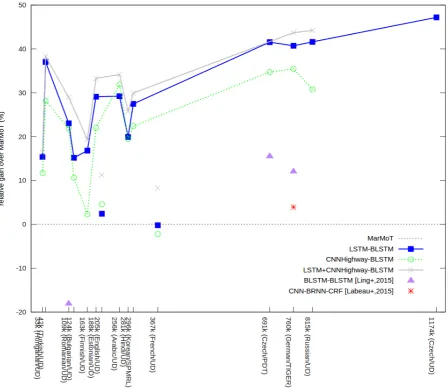
Fig. 2 plots the relative gain over MarMoT (see Appendix A for more details) against the amount of training data. The horizontal dotted line at 0% indicates the MarMoT baseline. The blue squares are for LSTM-BLSTM results. Connecting them for the morphologically-rich languages shows a clear, nearly-linear dependency of the relative gain on the amount of training data. Only the data point for Turkish at 40% is an outlier (should be around 20%). This result suggests that compared to MarMoT, LSTM-BLSTM is very data efficient. Even for very small amounts of training data (e.g., 33k tokens for Hungarian), the relative gain is still 15%. On the other hand, more data helps. In case of Czech, increasing the amount of training data from 691k (Czech/PDT) to 1174k (Czech/UD) to-kens leads to some additional gain and yields al-most a 50% relative gain. It should be noted, how-ever, that the two data sets use different tag sets, with the Czech/UD one being more complex than
6http://cistern.cis.lmu.de/marmot/ 7https://github.com/wlin12/JNN
the Czech/PDT (Table 2).
We use an LSTM-BLSTM of the same size for all languages, although the amount of training data varies by roughly two orders of magnitude. There-fore, it is a valid question if a larger model specifi-cally designed for Czech/UD or a smaller model for Turkish/UD would improve the results. We have developed locally tuned and tested larger and smaller models in terms of number of nodes or lay-ers but with similar or worse performance: -0.1% with more nodes (Czech) or approx. -1% with fewer nodes or fewer layers (Turkish). This obser-vation suggests that the configuration optimized for German is fairly robust across many different languages, which is an attractive property from a practical perspective.
In contrast, we do not observe a gain of LSTM-BLSTM over MarMoT for English and French. Both languages are considered to be morpholog-ically poor, as supported by the tag statistics in Table 2. This may be because of the low mor-phological complexity, i.e., a character represen-tation does not add much information to a word representation. Another explanation might be that the linguistic experts have focused on English and French in the last decades and found a good set of features, which however does not well general-ize to other, morphologically more complex lan-guages.
It is tempting to analyze these results in more detail by splitting languages into sub-categories. Here, we refrain from doing so as it is delicate to draw conclusions from very small sample sizes (3-4 languages, say).
The green circles (in Fig. 2) are for CNNHighway-BLSTM results, a neural net-work architecture that has been developed for character-based language modeling (Kim et al., 2016). Overall, LSTM-BLSTM and CNNHighway-BLSTM perform similarly, see Fig. 2. Looking at the details, however, CNNHighway-BLSTM tends to perform slightly worse and less consistently than LSTM-BLSTM.
cept maybe for English and French, we observe marginal but consistent gains over LSTM-BLSTM or CNNHighway-BLSTM.
For additional comparison, we add a few addi-tional points in the plot. The red cross indicates the result from (Labeau et al., 2015), which is a combination of a CNN, a bidirectional RNN, and a Markov model. The purple triangles are generated with the external tool JNN8, which implements a
shallow BLSTM-BLSTM (i.e., only one bidirec-tional LSTM layer in each BLSTM). One might expect that this model performs better on smaller data sets. But actually, it is clearly worse both for large (Czech/PDT and German/TIGER) and small data sets (Romanian/UD).
6 Summary & Future Work
In this paper, we demonstrated that a character-based neural approach can achieve consistent im-provements over a state-of-the-art morphologi-cal tagger (MarMoT). The evaluation included a dozen of languages of different morphological complexity and with different characteristics. The relative gains for the morphologically-rich lan-guages range from 15% to almost 50%, with a clear dependency on the amount of training data. Several aspects are remarkable about this result.
First, these results use the same model architec-ture with the same number of layers and nodes, without any language-specific modifications. Fur-ther local language and training data setting spe-cific tuning does not seem to help much.
Second, the neural approach seems to be more data efficient than the baseline tagger with manu-ally designed features, also when only 30k training tokens are available.
Third, a fairly generic deep and hierarchical re-current neural network architecture seems to per-form as well or better than a more specialized con-volutional neural network based architecture.
Fourth, to keep the setup as simple as possi-ble, we have not used advanced techniques which are reported to lead to improvements, including a non-trivial structured prediction model (e.g., a first-order Markov model) (Collobert et al., 2011; dos Santos and Zadrozny, 2014; Labeau et al., 2015; Ma and Hovy, 2016), additional unsu-pervised data (e.g., via word2vec) (M¨uller and Schuetze, 2015; Ling et al., 2015; Plank et al., 2016; Ma and Hovy, 2016), combination of
dif-8https://github.com/wlin12/JNN
ferent word representations (Labeau et al., 2015; Ma and Hovy, 2016; Plank et al., 2016), multi-lingual learning (Gillick et al., 2016; Plank et al., 2016), and auxiliary tasks (Plank et al., 2016). Fu-ture work will include the investigation of these more advanced techniques. From this perspective, our paper provides a baseline for future research in multilingual character-based neural morpholog-ical tagging.
Last but not least, we do not observe any gains for English and French (except when using en-sembles). This may be due to the low morpho-logical complexity of these languages or because manual feature engineering has focused on these languages over the last decades with good results. Acknowledgment
This work has been partly funded by the European Unions Horizon 2020 research and innovation programme under grant agreement No. 645452 (QT21).
References
Miguel Ballesteros, Chris Dyer, and Noah A. Smith. 2015. Improved transition-based parsing by model-ing characters instead of words with lstms. In Pro-ceedings of the 2015 Conference on Empirical Meth-ods in Natural Language Processing, pages 349– 359, Lisbon, Portugal, September. Association for Computational Linguistics.
Max Bane. 2008. Quantifying and measuring morpho-logical complexity. In C.B. Chang and H.J. Haynie, editors,Proceedings of the 26th West Coast Confer-ence on Formal Linguistics, pages 69–76. Cascadilla Proceedings Project, Somerville, MA, USA. Ronan Collobert, Jason Weston, Leon Bottou, Michael
Karlen, Koray Kavukcuoglu, and Pavel Kuksa. 2011. Natural language processing (almost) from scratch. Journal of Machine Learning Research, 12:2493–2537.
Marta R. Costa-juss`a and Jos´e A. R. Fonollosa. 2016. Character-based neural machine translation. In Pro-ceedings of the 54th Annual Meeting of the Associa-tion for ComputaAssocia-tional Linguistics (Volume 2: Short Papers), pages 357–361, Berlin, Germany, August. Association for Computational Linguistics.
Alex Graves. 2012. Supervised sequence labelling with recurrent neural networks. Studies in Com-putational Intelligence. Springer, Heidelberg, New York.
Jan Hajic and Barbora Hladka. 1998. Tagging inlective languages: Prediction of morphological categories for a rich structured tagset. In Proceedings of the 36th Annual Meeting of the Association for Compu-tational Linguistics and 17th International Confer-ence on Computational Linguistics, Volume 1, pages 483–490, Montreal, Quebec, Canada, August. Asso-ciation for Computational Linguistics.
Kaiming He, Xiangyu Zhang, Shaoqing Ren, and Jian Sun. 2016. Deep residual learning for image recog-nition. InCVPR.
Georg Heigold, G¨unter Neumann, and Josef van Genabith. 2016. Neural morphological tagging from characters for morphologically rich languages. CoRR, abs/1606.06640.
Yoon Kim, Yacine Jernite, David Sontag, and Alexan-der M. Rush. 2016. Character-aware neural lan-guage models. InAAAI, Phoenix, AZ, USA, Febru-ary.
Matthieu Labeau, Kevin L¨oser, and Alexandre Al-lauzen. 2015. Non-lexical neural architecture for fine-grained pos tagging. InProceedings of the 2015 Conference on Empirical Methods in Natural Lan-guage Processing, pages 232–237, Lisbon, Portugal, September. Association for Computational Linguis-tics.
Wang Ling, Chris Dyer, Alan W Black, Isabel Tran-coso, Ramon Fermandez, Silvio Amir, Luis Marujo, and Tiago Luis. 2015. Finding function in form: Compositional character models for open vocabu-lary word representation. InProceedings of the 2015 Conference on Empirical Methods in Natural Lan-guage Processing, pages 1520–1530, Lisbon, Portu-gal, September. Association for Computational Lin-guistics.
Xuezhe Ma and Eduard Hovy. 2016. End-to-end se-quence labeling via bi-directional lstm-cnns-crf. In Proceedings of the 54th Annual Meeting of the As-sociation for Computational Linguistics (Volume 1: Long Papers), pages 1064–1074, Berlin, Germany, August. Association for Computational Linguistics. Thomas Mueller, Helmut Schmid, and Hinrich Sch¨utze. 2013. Efficient higher-order CRFs for morphological tagging. InProceedings of the 2013 Conference on Empirical Methods in Natural Lan-guage Processing, pages 322–332, Seattle, Wash-ington, USA, October. Association for Computa-tional Linguistics.
Thomas M¨uller and Hinrich Schuetze. 2015. Robust morphological tagging with word representations. InProceedings of the 2015 Conference of the North American Chapter of the Association for Computa-tional Linguistics: Human Language Technologies,
pages 526–536, Denver, Colorado, May–June. As-sociation for Computational Linguistics.
Kemal Oflazer and ˙Ilker Kuroz. 1994. Tagging and morphological disambiguation of Turkish text. In Proceedings of the Applied natural language pro-cessing.
Razvan Pascanu, Caglar Gulcehre, Kyunghyun Cho, and Yoshua Bengio. 2014. How to construct deep recurrent neural networks. InICLR.
Barbara Plank, Anders Søgaard, and Yoav Goldberg. 2016. Multilingual part-of-speech tagging with bidirectional long short-term memory models and auxiliary loss. In Proceedings of the 54th Annual Meeting of the Association for Computational Lin-guistics (Volume 2: Short Papers), pages 412–418, Berlin, Germany, August. Association for Computa-tional Linguistics.
C´ıcero Nogueira dos Santos and Bianca Zadrozny. 2014. Learning character-level representations for part-of-speech tagging. In ICML, Beijing, China, June.
J¨urgen Schmidhuber. 1992. Learning complex, ex-tended sequences using the principle of history com-pression.Neural Computation, 4(2):234–242. Tijmen Tieleman and Geoffrey Hinton. 2012. Lecture
6.5-rmsprop: Divide the gradient by a running av-erage of its recent magnitude. COURSERA: Neural Networks for Machine Learning, 4.
A Raw Results
This appendix contains Table 3 with the raw re-sults used in this paper. When available, the best comparable error rates from the literature are used. Otherwise, we produced the error rates with the publicly available tools and the suggested default values. More specifically, we used the state-of-the-art tagger MarMoT9 for the baselines and the
LSTM-based POS tagger JNN10 for some
con-trastive results.
Table 3: Tag error rates (%) on test sets, some of which are taken from the literature: (a) (Mueller et al., 2013), (b) (Labeau et al., 2015)
Language MarMoT9 CNN BLSTM LSTM CNNHighway
-biRNN-CRF -BLSTM10 -BLSTM -BLSTM
Arabic/UD 9.13 6.46 6.22
Bulgarian/UD 5.73 4.86 5.12
Czech/PDT 7.46a 6.30 4.36 4.87
UD 6.97 3.68
English/UD 7.00 6.83 6.68
Estonian/UD 8.11 5.75 6.32
Finnish/UD 7.79 6.48 7.61
French/UD 5.08 5.09 5.19
German/TIGER 11.42a 10.97b 10.04 6.77 7.37
Hindi/UD 11.44 9.16 9.21
Hungarian/UD 26.49 22.41 23.40
Korean/SPMRL 18.60 13.49 14.43
Romanian/UD 7.64 9.02 5.88 5.97
Russian/UD 6.08 3.55 4.21