Using Morphological and Syntactic Structures
for Chinese Opinion Analysis
Lun-Wei Ku
Ting-Hao Huang
Hsin-Hsi Chen
Department of Computer Science and Information Engineering
National Taiwan University
No. 1, Sec. 4, Roosevelt Road, Taipei, 10617 Taiwan
{lwku,thhuang}@nlg.csie.ntu.edu.tw;[email protected]
Abstract
This paper employs morphological struc-tures and relations between sentence seg-ments for opinion analysis on words and sentences. Chinese words are classified into eight morphological types by two proposed classifiers, CRF classifier and SVM classifier. Experiments show that the injection of morphological information improves the performance of the word po-larity detection. To utilize syntactic struc-tures, we annotate structural trios to repre-sent relations between repre-sentence segments. Experiments show that considering struc-tural trios is useful for sentence opinion analysis. The best f-score achieves 0.77 for opinion word extraction, 0.62 for ion word polarity detection, 0.80 for ion sentence extraction, and 0.54 for opin-ion sentence polarity detectopin-ion.
1
Introduction
Sentiment analysis has attracted much attention in recent years because a large scale of subjective information is disseminated through various plat-forms on the web. Sentiment information can be applied to a wide variety of fields, including product recommendation, review summarization, public polling, and so on.
Opinion dictionaries are important resources for identifying subjective information. Several approaches were proposed to collect such re-sources. Wiebe (2000) learned subjective adjec-tives from corpora. Takamura et al. (2005) ex-tracted semantic orientations of words. Ku et al. (2007) measured sentiment degrees of Chinese words by averaging the sentiment scores of the
composing characters. When the opinion words are available, the polarities of sentences and documents can be determined by them. Riloff and Wiebe (2003) learned the extraction patterns for subjective expressions. Kim and Hovy (2004) found the polarity of subjective expressions. Pang et al. (2002) and Dave et al. (2003) ex-plored various techniques at document level.
Morphological information has been widely used in classifying words, telling the meanings, and doing other in-depth analysis (Tzeng and Chen, 2002). However, morphological informa-tion was seldom applied either in Chinese opin-ion extractopin-ion, or in solving the coverage prob-lem of opinion dictionary. Instead of bag-of-characters approach (Ku et al., 2007), this paper employs morphological structures of words to extract opinion words.
Relations between sentence segments are also defined by linguistics in the Chinese language. These are similar to morphological structures between Chinese characters. Based on parsing trees of sentences, we identify these relations and utilize them for opinion analysis on sentences.
As the experimental corpus, some researchers managed to generate annotated materials and gold standards under many constraints. Ku set a standard for generating final answers from anno-tations of multiple annotators (Ku et al., 2007), and Somasundaran annotated discourse informa-tion from meeting dialogs to train a sentiment model (Somasundaran et al., 2007). For multi-lingual issues, researchers concerned mainly about the applicability of corpus and algorithms from the native language to foreign languages (Banea et al., 2008; Bautin et al., 2008).
Several opinion analysis systems have been developed so far. OASYS (Cesarano et al., 2007) and CopeOpi (Ku et al., 2007) allow users input their queries and select preferred data sources,
and then track opinions in a time zone. For both systems, extracting opinions is the main focus, while holders and targets are identified implicitly when retrieving relevant documents. Carenini’s team proposed a graphical user interface for evaluative texts (2006), in which color blocks were used to present the evaluations for compo-nents of products. Fair News Reader, a Japanese news Web system, incorporates sentiment infor-mation insensibly in an interesting way (Kawai
et al., 2007). It provides readers “balanced” re-ports by analyzing the sentiment in news articles which readers have read, and suggests them new articles according to the analysis results. It leads the application of opinion analysis to the direc-tion of personalizadirec-tion.
2
Chinese Morphological Structures
In the Chinese language, a word is composed of one or more Chinese characters, and its meaning can be interpreted in terms of its composite char-acters. The morphological structures of Chinese words are formulated by three major processes in linguistics: compounding, affixation, and
conver-sion. Compounding is a complex
word-formation process. In most cases, two or more morphemes together are formed as a lexical item by this process. Affixation is a morphological process, by which grammatical or lexical infor-mation is added to a base form. By the conver-sion process, a word is changed from one part of speech into another without the addition or dele-tion of any morphemes.
Compounding is the most productive way to
construct a Chinese word. Mostly, a Chinese character itself carries meanings, so that a mor-pheme can function as a character and has its own part of speech. In some cases, a Chinese morpheme may carry no specific meaning and just makes a word more readable. Cheng and Tian (1992) divided Chinese words into five morphological types based on the relations be-tween the morphemes in compounding words.
(1) Parallel Type: Two morphemes play coordi-nate roles in a word. For example, the mor-phemes “財” (money) and “富” (wealth) are par-allel in the word “財富” (money-wealth).
(2) Substantive-Modifier Type: A modified morpheme follows a modifying morpheme. For example, the morpheme “哭” (cry) is modified by “痛” (bitterly) in the word ”痛哭” (bitterly-cry).
(3) Subjective-Predicate Type: One morpheme is an expresser and the other one is described. The structure is like a subject-verb sentence con-densed in one word. For example, the morpheme “心” (heart) is a subject of the predicate “疼” (hurt) in the word “心疼” (heart-hurt).
(4) Verb-Object Type: The first morpheme is usually a verb which governs the second one, making this word similar to a verb followed by its object. For example, the morpheme “控” (control) serves as the object of the verb “失” (lose) in the word ”失控” (lose-control).
(5) Verb-Complement Type: The first mor-pheme is usually a verb but sometimes can be an adjective, and the second morpheme explains the first one from different aspects. For example, the morpheme “清” (clearly) expresses the aspects of the action “看” (look).
Chinese words constructed by affixation proc-ess can be one of the two cases – say, morpheme
and morpheme, or morpheme and non-morpheme.
In the case of morpheme and morpheme, the af-fixation word belongs to one of the above 5 types if the prefix and the suffix are neither negations nor confirmations. Types 6 and 7 defined below represent the affixation words whose prefix or suffix is a negation or a confirmation. The af-fixation words whose prefix or suffix characters are not morphemes are classified into type 8.
(6) Negation Type: There is at least one nega-tion character in words of this type. For example, the prefix “無” (no) is the negation morpheme in the word ”無法” (no-method).
(7) Confirmation Type: There is at least one confirmation character in words of this type. For example, the prefix “有” (do) is a confirmation in the word “有賴” (do-depend on).
(8) Others: Those words that do not belong to the above seven types are assigned to this type, such as words whose meanings are not a function of their composite characters, words whose com-posite characters are not morphemes, such as “姪 子” (nephew-suffix) and “薄荷” (peppermint).
3
Opinion Scores of Chinese Words
The bag-of-characters approach proposed by Ku
et al. (2007) considers the observation
this approach, the opinion score of a word is de-termined by the combination of the observation probabilities of its composite characters defined by Formulas (1) and (2).
∑ ∑ ∑ = = = + = m i i n i i n i i neg , C f / neg , C f pos , C f / pos , C f pos , C f / pos , C f pos C P 1 1 1 ) ( ) ( ) ( ) ( ) ( ) ( ) , ( (1) ∑ ∑ ∑ = = = + = m i i n i i m i i neg , C f / neg , C f pos , C f / pos , C f neg , C f / neg , C f neg C P 1 1 1 ) ( ) ( ) ( ) ( ) ( ) ( ) , ( (2) ) , ( ) , ( )
(C PC pos N Cneg
S = − (3)
) ( 1 ) ... ( 1 2 1 ∑ = = l i i
l SC
l C C C
S (4)
where C is an arbitrary Chinese character, f(C,
polarity) counts the observed frequency of C in a
set of Chinese words whose opinion polarity is positive (pos) or negative (neg); P(C, pos) and
P(C, neg) denote the observation probabilities of
C as a positive and a negative character, and n
and m denote total number of unique characters in positive and negative words. The difference of P(C, pos) and P(C, neg) in Formula (3) de-termines the sentiment score of character C, de-noted by S(C). Formula (4) computes the opin-ion score of a word of l characters C1C2…Cl by averaging their scores.
Instead of counting the weights as in the bag-of-characters approaches, we consider the word structures and propose a scoring function for each morphological type. According to the Fre-quency Dictionary of Modern Chinese, 96.5% of Chinese words are unigrams and bigrams (Chen,
et al., 1997). In the following functions, S(C1C2) computes the opinion scores of words with char-acters C1 and C2. SIGN(s) returns -1 if polarity degree s is smaller than 0, i.e., negative, and re-turns 1 when positive.
(1) Parallel Type: Since the two composite characters of a word of this type are homogene-ous, the opinion score is the average score of two characters’ opinion scores.
2 ) ( ) ( )
( 1 2
2 1 C S C S C C
S = + (5)
(2) Substantive-Modifier Type: The first mor-pheme of a word of this type modifies the second one, so that its opinion weight comes from the absolute opinion score of the first character, while the opinion polarity is determined by the occurrence of negative opinion characters. If at least one negative opinion character appears, the
word is negative, else it is positive. For example, the word “痛哭” (bitterly cry) is composed of “痛” (bitterly, negative) and “哭” (cry, negative). Negative characters make this word negative and its opinion strength, i.e., the absolute value of the score, is decided by the first character for the degree of crying.
) ( ) ( ) ( else ) ( 1 -) ( else ) ( ) ( then ) 0 ) ( and 0 ) ( ( if then ) 0 ) ( and 0 ) ( ( if 2 1 2 1 1 2 1 1 2 1 2 1 2 1 C S C S C C S C S C C S C S C C S C S C S C S C S + = × = = > > ≠ ≠ (6)
(3) Subjective-Predicate Type: The first mor-pheme of a word of this type is a subject and the second morpheme is the action it performs, so that the action decides the opinion score of the word. If the action is not an opinion or it is neu-tral, the subject determines the opinion score of this word. For example, the word “山崩” (mud-slide, negative) is composed of “山” (mountain, non-opinion) and “崩” (collapse, negative). Its opinion score depends only on the second char-acter “崩” (collapse) since the first character is a subject and usually bears no opinions.
) ( ) ( else ) ( ) ( then ) 0 ) ( ( if 1 2 1 2 2 1 2 C S C C S C S C C S C S = = ≠ (7)
(4) Verb-Object Type: The first morpheme of words of this type acts upon the second mor-pheme. The effect depends not only on the ac-tion but on the target. The weight is determined by the action, but the polarity is the multiplica-tion of the signs of the two morphemes. For ex-ample, the word “避 暑” (to go away for the summer, positive) is composed of “避” (hide, negative) and “暑” (hot summer, negative). Its strength depends on the strength of “避” (hide) and polarity is positive from the multiplication of two negatives. ) ( ) ( ) ( else )) ( ( )) ( ( ) ( ) ( then ) 0 ) ( and 0 ) ( ( if 2 1 2 1 2 1 1 2 1 2 1 C S C S C C S C S SIGN C S SIGN C S C C S C S C S + = × × = ≠ ≠ (8)
positive). The complement morpheme “高” (high) describes the resulting state of the verb morpheme “提” (raise), so both strength and po-larity depend on the morpheme “高” (high).
(6) Negation Type: A negative character speci-fied in a predefined set NC has a negation effect on the opinion score of the other character. The strength depends on the modified morpheme while the polarity of the word is the negation of the polarity of the modified morpheme.
( )
( )
1 ( ) )( else
) ( 1 ) ( then ) (
if
1 2
1
2 2
1 1
C S C
C S
C S C
C S NC C
× − =
× − = ∈
(9)
(7) Confirmation Type: A positive character specified in a predefined set PC ensures that the opinion score of a word only comes from the other character. Therefore, the opinion score of this word is determined by the modified mor-pheme.
) ( ) ( else ) ( ) ( then ) (
if C1∈PC SC1C2 =SC2 SC1C2 =SC1 (10)
(8) Others: Since words of this type contain no clear cues for their morphological structures, we postulate that both characters have the same con-tribution, and adopt Formula (5).
4
Identification of Morphological Types
To compute the opinion score of a word accord-ing to formulae in Section 3, we must know its morphological type from the morphological structure, i.e., the parts of speech of the compos-ite morphemes. Currently, part of speech tag-ging is performed at the word level rather than the morpheme level, and morpheme-tagging cor-pus is not available. We consider an on-line Chinese dictionary, Dictionary of Chinese Words by Ministry of Education, Taiwan (MOEDCW), as a corpus, and compute the statistics of each morpheme in it.
Two classifiers, CRF classifier and SVM clas-sifier are proposed to recognize morphological types (1)-(5). Morphological types (6) to (8) are determined by rules such as whether two com-posite characters are morphemes; whether there are confirmation/negation morphemes; and so on.
4.1 MOEDCW Corpus
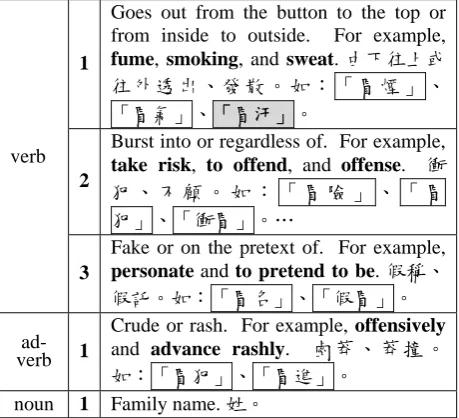
MOEDCW corpus provides possible parts of
speech for each morpheme by treating it as a uni-gram word, and possible senses under each part of speech. In each entry, there are a sense
defini-tion and some example words. Figures 1 and 2 show the specifications of two morphemes “冒” and “汗”. The morpheme “冒” has three parts of speech (verb, adverb and noun) and includes 3, 1, and 1 senses. There are 3, 3, and 2 example words listed under the three verb senses.
We can find the correct parts of speech of the composite characters of a word when it is an ex-ample word in the dictionary. However, not all words are listed in the corpus. Consider the word “冒汗” (sweat, verb). Figure 1 shows that “冒汗” (sweat) is an example word listed under the verb sense of the character “冒” (perspire), thus the character “冒” (perspire) in the word “冒 汗” (sweat) functions as a verb. However, “冒 汗” (sweat) is not an example for the character “汗” (sweat). Figure 2 show that there are two possible parts of speech, noun and verb, for the character “汗” (sweat). We then show how to identify its function in the word “冒汗”.
1
Goes out from the button to the top or from inside to outside. For example,
fume, smoking, and sweat. 由下往上或 往 外 透 出 、 發 散 。 如 : 「 冒 煙 」 、 「冒氣」、「冒汗」。
2
Burst into or regardless of. For example,
take risk, to offend, and offense. 衝 犯 、 不 顧 。 如 : 「 冒 險 」 、 「 冒 犯」、「衝冒」。…
verb
3
Fake or on the pretext of. For example,
personate and to pretend to be. 假稱、 假託。如:「冒名」、「假冒」。
ad-verb 1
Crude or rash. For example, offensively
and advance rashly. 鹵 莽 、 莽 撞 。
如:「冒犯」、「冒進」。 noun 1 Family name. 姓。
Figure 1: Specification of “冒” in MOEDCW
1
Sweat. For example, cold sweat, night sweat, sweatiness, and to drip with
sweat. 由動物皮膚的毛細孔所排泄出
的液體。如:「冷汗」、「盜汗」、 「汗流浹背」、「揮汗如雨」。… noun
2 Family name姓。
[image:4.595.301.531.355.564.2]verb 1 To sweat 流汗、使出汗。
Figure 2: Specification of “汗” in MOEDCW
) (
)
(C,POS NumberOfSenses C,POS
T = (11)
speech is employed to estimate how often this part of speech is used. The function T(C, POS) shown in Formula (11) defines the score of a character C functioning as a particular part of speech POS. Here, POS may be noun (N), adjec-tive (ADJ), verb (V), adverb (ADV), auxiliary (AUX), conjunction (CONJ), pronoun (PRON), preposition (PREP), and interjection (INT). In Figure 2,T(汗<sweat>, N) = 2 and T(汗<sweat>, V) = 1.
4.2 Features for Classifiers
Features for training SVM and CRF classifiers include the pronunciation and the tone of the word, parts of speech of the first and the second characters of training words, and the position information of the composite characters. The tone of the word is acquired from MOEDCW. The parts of speech are estimated by Formula (11). f(C, POS, k, start/end) counts the number of k-grams (k=2, 3, 4). In Figures 1 and 2, f(冒, V, 2, start)=6, f(冒, V, 2, end)= 2, f(冒, ADV, 2, start) = 2, and f(冒, ADV, 2, end)=0. This ex-ample shows that when the character “冒” func-tions as a verb or an adverb, it serves as the start-ing character more often than the endstart-ing charac-ter.
4.3 CRF and SVM Classifier
CRF and SVM are both common used algorithms for building classifiers (Lafferty et al., 2001). We adopted CRF++1 and libSVM (Chang and Lin, 2001) to develop our classifiers. The fea-tures for training our CRF and SVM classifiers include the input word W, the tone of W, the first and the second characters C1 and C2, T(C1, POS),
T(C2, POS), f(C1, POS, k, start), f(C1, POS, k, end), f(C2, POS, k, start), and f(C2, POS, k, end).
POS denotes one of nine parts of speech in
MOEDCW, and k equals to 2, 3 or 4.
Using SVM is straightforward. To classify a word into one of the morphological structure types, we construct the word's feature vector and input the vector into SVM. When using CRF, a different approach is taken. When predicting the classes of two successive instances, CRF takes the predicted class of the first instance into ac-count when predicting the second instance's class. Here is how we exploit this capability. In a nut-shell, we perform classification at the character level instead of the word level. Let W be a word composed of the two characters C1 and C2. Let v
1
http://crfpp.sourceforge.net/
be the feature vector of W. Let t be the morpho-logical structure type of W. We define C1's fea-ture vector to be composed of the feafea-tures in v
which are related to C1, e.g., T(C1, verb). Simi-larly, C2's feature vector is composed of the fea-tures in v which are related to C2. C1's class and
C2's class are defined as t_1 and t_2, respectively. Since t has five possible values, there are 10 character classes.
To determine a word W's morphological struc-ture type, we first apply CRF on W's constituent characters C1 and C2's feature vectors. For C1,
CRF will return a set of probabilities P(C1,t_q), where q∈ {1, 2}, indicating the likelihood of C1 being an instance of class t_q. Similarly, a set of probabilities P(C2,t_q) is returned for C2. W's morphological structure type is defined as the value of t which maximizes the product of P(C1,t_1) and P(C2,t_2).
Though CRF is mostly used for sequential la-beling, the idea of using CRF is to tail this classi-fication questions into a labeling question in or-der to utilizing the position information of char-acters. As mentioned, if a word W of two char-acters C1C2 is of type 1, CRF will label C1 1_1 (type1_1st char) and C2 1_2 (type1_2nd char). The labeling of each character considers both the previous character's features and the next charac-ter's features. That is, if the current character is the first character, its previous character is an empty character (which is used for segmenting sequences in CRF); if the current character is the second character, its next character is an empty character. Hence the position information will be considered by CRF.
5
Experiments and Discussion
Experiments verify whether the morphological types benefit opinion polarity detection on words. The relation between the performance of mor-phological classifiers and opinion polarity detec-tion is discussed.
5.1 Experimental Setup
To compare the bag-of-characters approach (Ku
et al., 2007) with our morphological structure
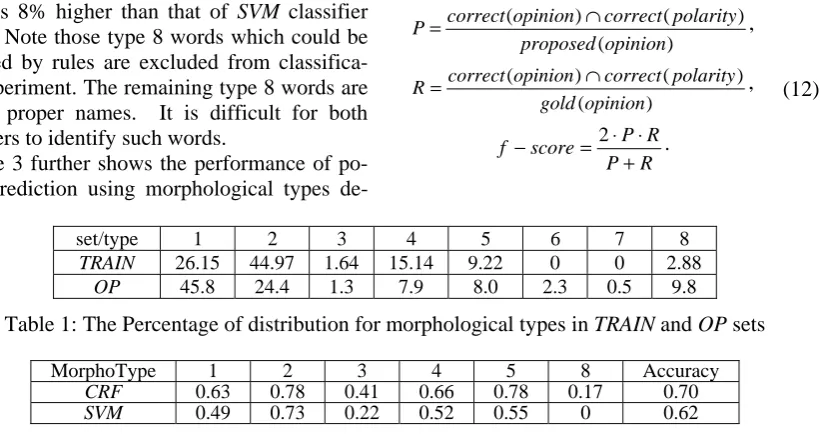
classi-fied by patterns (abbreviated as TRAIN set), all with their morphological types annotated. Table 1 lists the distributions of morphological types in
OP and TRAIN sets.
The polarity of words is predicted by their opinion scores ranging between -1 to 1. We set a positive threshold. Those words with scores above it are considered as positive while those below this threshold multiplied by (-1) are re-garded as negative. The words with non-zero scores falling between the positive and negative thresholds are neutral. Fifty grids from 0 to 0.5 are searched for the best threshold. Since the opinion extraction at word level concerns only word structure, no retraining for the best thresh-old is need when domain shifts, which is a supe-riority of our method.
5.2 Morphological Type Classification and Polarity Detection
The performances of CRF and SVM classifiers on each morphological type are listed in Table 2. We perform four-fold cross validation on the
TRAIN set. Results show that CRF classifier
achieves better performance than SVM classifier in this task. The accuracy of CRF classifier (0.70) is 8% higher than that of SVM classifier (0.62). Note those type 8 words which could be extracted by rules are excluded from classifica-tion experiment. The remaining type 8 words are usually proper names. It is difficult for both classifiers to identify such words.
Table 3 further shows the performance of po-larity prediction using morphological types
de-termined by CRF classifier and SVM classifier. The performance of polarity detection is evalu-ated by the f-score defined in Formula (12).
The f-scores of polarity detection using CRF
classified types and SVM classified types are 0.5806 and 0.5938, respectively. Both of them outperform baseline’s f-score 0.5455, i.e., the bag-of-characters approach (Ku et al., 2007). Experiments show that adopting morphological types annotated by two classifiers for polarity prediction has little difference. In other words,
CRF and SVM classifiers have an 8% f-score difference in their best performance of classifica-tion, while the performance gap in word polarity prediction using morphological types provided by these two classifiers is around 1.3% only (0.5806 vs. 0.5938). The reason may be that we define scoring functions of each morphological type in a straightforward way. If they are not the best scoring functions, the benefit of considering the morphological type information could be re-stricted. Nevertheless, experimental results show that morphological type information is useful for word polarity detection (with p-value less than 0.05).
) (
) (
) (
opinion proposed
polarity correct
opinion correct
P= ∩ ,
) (
) (
) (
opinion gold
polarity correct
opinion correct
R= ∩ ,
R P
R P score f
+ ⋅ ⋅ =
− 2 .
(12)
set/type 1 2 3 4 5 6 7 8
TRAIN 26.15 44.97 1.64 15.14 9.22 0 0 2.88
OP 45.8 24.4 1.3 7.9 8.0 2.3 0.5 9.8
Table 1: The Percentage of distribution for morphological types in TRAIN and OP sets
MorphoType 1 2 3 4 5 8 Accuracy
CRF 0.63 0.78 0.41 0.66 0.78 0.17 0.70
[image:6.595.105.516.402.620.2]SVM 0.49 0.73 0.22 0.52 0.55 0 0.62
Table 2: The f-score of CRF and SVM classifiers
We further examine how well our polarity de-tection method works in combination with a word sentiment dictionary. We use the NTUSD2 word sentiment dictionary. If a word appears in NTUSD, then the word's polarity is the one specified in NTUSD. If a word does not appear in NTUSD, then the word's polarity is deter-mined using our morphological type method.
2
http://nlg18.csie.ntu.edu.tw:8080/opinion/
After introducing a sentiment dictionary NTUSD3, CRF and SVM classifiers both achieve the f-score 0.77 for opinion word extraction, and achieve f-scores 0.61 and 0.62 for polarity detec-tion, respectively. Note that if only NTUSD is used to extract opinion words by string matching, the f-score is only 0.44.
3
Polarity f-score Without NTUSD With NTUSD
Ku 0.5455 0.5789
CRF type 0.5806 0.6100
[image:7.595.367.466.68.214.2]SVM type 0.5938 0.6246
Table 3: Prediction with Morphological Types
We further analyze the improvement of polar-ity prediction for each morphological type. We find that the f-scores of polarity prediction of all morphological types are improved in different degrees, and among them the performance of type 2 words are improved the most. We have shown that our method can assign an opinion score to an arbitrary word without any word thesauri by considering its morphological infor-mation. Moreover, since the Substantive-Modifier (type 2) is the most common way to form a new word in the Chinese language (Cheng and Tian, 1992), the result presents the strength of our method in solving the coverage problem.
6
Syntactic Structure for Chinese
Opin-ion Analysis
As mentioned, the relations introduced in Section 2 exist not only within words, but also between sentence segments. Relations between sentence segments are represented by structural trios here-after and will be introduced in next section. We have already shown that morphological types are useful when extracting opinion words and would like to further testify whether structural trios also benefit the opinion analysis on sentences. We annotate these relations manually, propose a method to identify these relations, and compare results of experimental settings using structural trios with those not using structural trios.
6.1 Structural Trio
Each node in a parsing tree dominates a word string in a sentence. Linguistics have shown that there are also five relations between sentence segments: Parallel, Substantive-Modifier, Sub-jective-Predicate, Object, and Verb-Complement, same as morphological types (1) to (5). Because parsing trees have hierarchical structures, we define a structural trio to represent a relation between two nodes as follows:
(1)A structure trio contains two children nodes which bear a relation.
(2)A structure trio contains one head node which is the nearest common parent of two children nodes in (1).
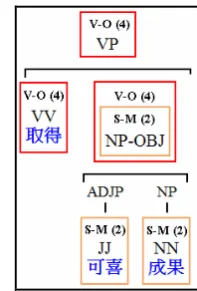
Figure 3: Example of structural trios
Figure 3 shows an example of a structure trio. It is a part of a parsing tree containing words “取 得” (obtain), “可喜” (happy), “成果” (results). Two structural trios are shown in this example. The lower one contains two children nodes “可 喜” (happy) and “成果” (results), and is labeled as Substantive-Modifier (S-M (2)) in their near-est common parent node, while the upper one contains two children nodes “取得” (obtain) and “可喜成果” (happy results), and is labeled as Verb-Object (V-O (4)).
6.2 Experimental Corpus
To experiment with structural trios, we need the parsing trees of all experimental sentences. For this purpose, we adopted Chinese Treebank 5.14 as the experimental materials. Chinese Treebank contains raw Chinese news documents together with their segmented, part of speech tagged, and parsed versions. The parsed documents are adopted in experiments utilizing structural trios, and the part of speech tagged documents are used in experiments not utilizing structural trios.
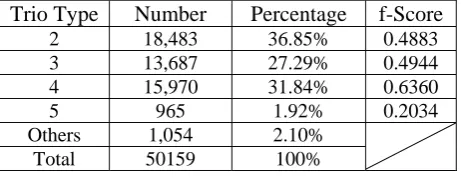
In Chinese Treebank, a unique ID is labeled on each sentence. For each sentence, we had three annotators label their opinions and then we generate the gold standard following NTCIR5 MOAT protocol (Seki et al., 2008). We also annotated structure trios in Chinese Treebank. A total of 17,159 sentences are obtained after drop-ping some faulty sentences such as empty sen-tences and sensen-tences composed of more than one parsing tree. The statistics of opinion sentences and structural trios in the constructed experimen-tal materials are shown in Table 4 and Table 5.
4
http://www.ldc.upenn.edu/Catalog/CatalogEntry.jsp? catalogId=LDC2005T01
5
[image:7.595.65.283.71.116.2]Opinion Non-Opinion Positive Neutral Negative
6,380 1,537 1,714 #
9,631
7,528
66.24 15.96 17.80 %
56.13 43.87
Table 4: Statistics of opinion sentences
Trio Type Number Percentage %
2 18,483 36.85
3 13,687 27.29
4 15,970 31.84
5 965 1.92
Others 1,054 2.10
Total 50,159 100.00
Table 5: Statistics of structural trios
6.3 Experiment Setup
The aim of our experiments is to know how opinion analysis approach performs when mor-phological and syntactic structures are incorpo-rated. They are compared with the bag-of-character and bag-of-word approaches. We im-plemented the bag-of-word approach proposed by Ku et al. (2007) to show its performance on Chinese Treebank. In their approach, the opin-ion scores of words are summed to generate the opinion scores of sentences, and the negation words will negate the closest opinion words. Based on this approach, we further consider structural trios to experiment whether syntactic structures of sentences are beneficial for opinion analysis. Because the scoring functions may not be straight forward as those we have adopted for opinion word extraction, we did not design scor-ing functions for utilizscor-ing all types of structural trios. Instead, we emphasize their original opin-ion scores by multiplying a variable alpha to see whether these structures are important. In this paper, alpha equals five.
We have shown that word morphological structures benefit the word opinion extraction. When we experiment on sentences, we also in-corporate the word morphological structures to see whether they are also useful for opinion analysis on sentences. Five experimental set-tings are listed as below:
(1) bag[w]-bag[s]: structural information is not considered for both words and sen-tences. The bag-of-character approach is used to calculate the opinion scores of words, and the bag-of-word approach sentences.
(2) struc[w]-bag[s]: morphological struc-tures are utilized to calculate word opin-ion scores, but structural trios are not considered. The bag-of-word approach is used to calculate the opinion scores of sentences.
(3) bag[w]-struc[s]: structural trios are con-sidered for calculating sentence opinion scores, while the bag-of-character ap-proach is used to calculate the opinion scores of words.
(4) struc[w]-(m)struc[s]: both word mor-phological structures and manually la-beled structural trios are adopted.
(5) struc[w]-struc[s]: both morphological structure of words and system labeled structural trios are adopted.
As we have shown that NTUSD is beneficial to the opinion analysis at word level, it is used as described in section 5.2 by default.
Our system adopted CRF algorithm to label structural trios for setting (5). The content string and the part of speech of the current node, its parent node, its offspring nodes in the next three generations, together with the depth of the cur-rent node in the Chinese Treebank, are used as the features for each node in CRF. The co-occurrence of the current node and all its siblings are defined in CRF’s template file. CRF will label whether the current node is the first child or the second child of a certain relation in a struc-tural trio, or it is not part of any strucstruc-tural trios. A four-fold experiment is performed for the learning and testing of this labeling process by
CRF.
6.4 Results and Discussion
Trio Type Number Percentage f-Score
2 18,483 36.85% 0.4883
3 13,687 27.29% 0.4944
4 15,970 31.84% 0.6360
5 965 1.92% 0.2034
Others 1,054 2.10%
[image:9.595.63.294.67.299.2]Total 50159 100%
Table 6: Statistics and Results of Identifying Structural Trios
Setting Word [w]
Sentence [s]
f-Score (opinion)
f-Score (polarity)
1 bag bag 0.7073 0.4988
2 struc bag 0.7162 0.5117
3 bag struc 0.8000 0.5361
4 struc (m)struc 0.7922 0.5297 5 struc struc 0.7993 0.5187
Table 7: Results of Opinion Extraction on Chinese Treebank
By summarizing the experimental results in Section 5 and this section, we can conclude that considering the word morphological structures benefits the opinion polarity detection, but in the current approach its assistance to words does not propagate to sentences. Considering the syntac-tic structures, however, do help in opinion analy-sis both for the opinion sentence extraction and the polarity detection. The performance of opin-ion extractopin-ion boosts to an f-score 0.80 and the performance of polarity detection an f-score 0.54.
However, the utilization of structure trios needs the parsing tree of sentences as the prior knowledge. Hence these two kinds of structural information may be suitable for different applica-tions: structural trios for well written sentences such as those in the news articles, while the mor-phological structures for casually written sen-tences such as those appear in SMS messages or articles with limit length on the Web.
Because there are no opinion experiments per-formed on Chinese Treebank, we mention the performance of Ku’s approach (setting (1)) for opinion sentence extraction, f-score 0.6846, in NTCIR-7 MOAT task, on news articles, as a re-sult for comparison. Their approach was ranked the second in this task, and the best team achieved an f-score 0.7453.
7
Conclusion and Future Work
This paper considers morphological and syntac-tic structures in analyzing Chinese opinion words and sentences. For morphological structures, eight Chinese morphological types are defined.
CRF classifier and SVM classifier for morpho-logical type classification are proposed. Experi-ments show that CRF classifier achieves the best accuracy 0.70 in type classification, which is 8% better than SVM classifier. We further show that word morphological structures benefit the opin-ion word extractopin-ion significantly. With the help of the sentiment dictionary NTUSD, the f-score of opinion word extraction achieves 0.77 and the f-score of the word polarity detection achieves 0.62 when the word morphological types are provided by the SVM classifier. They are com-parably better than bag-of-character approach and the dictionary based approach.
We defined structural trios to represent the re-lations between sentence segments and also ex-tract these relations using CRF algorithm. Re-sults show that considering structural trios bene-fits the opinion analysis on sentences. An f-score 0.80 for opinion extraction and an f-f-score 0.54 for polarity detection are achieved, which is a great improvement.
The opinion scoring functions for morphologi-cal types and structural trios are critimorphologi-cal for polar-ity detection, and scoring functions for words determine the scoring functions for sentences. Now we define these functions intuitively based on linguistic rules, but learning methods like re-gression will be investigated in the future. Ex-amining the interaction of cues from word and sentence levels on the opinion sentence extrac-tion and the opinion polarity detecextrac-tion is our next goal.
Acknowledgement
Research of this paper was partially supported by Na-tional Science Council, Taiwan, under the contract NSC95-2221-E-002-265-MY3.
References
Banea, C., Mihalcea, R., Wiebe, J. and Hassan, S. 2008. Multilingual Subjectivity Analysis Using Machine Translation. In Proceedings of Empirical Methods in Natural Language Processing (EMNLP 2008).
Bautin, M., Vijayarenu, L. and Skiena, S. 2008. Inter-national sentiment analysis for news and blogs. In Proceedings of the International Conference on Weblogs and Social Media (ICWSM).
[image:9.595.66.297.71.163.2]Cesarano, C., Picariello, A., Reforgiato, D. and Subrahmanian, V.S. 2007. The OASYS 2.0 Opin-ion Analysis System. Demo in Proceedings of In-ternational Conference on Weblogs and Social Media (pp. 313-314), Boulder, CO USA.
Chang, Chih-Chung and Lin, Chih-Jen. 2001. LIBSVM: a library for support vector machines, http://www.csie.ntu.edu.tw/~cjlin/libsvm
Chen, A., Xu, L., Gey, F.C. and Meggs, J. 1997. Chi-nese Text Retrieval without Using a Dictionary. ACM SIGIR Forum, Volume 31, Issue SI (pp. 42-49).
Cheng, X.-H. and Tian, X.-L. 1992. Modern Chinese. Bookman Books Ltd.
Dave, K., Lawrence, S., and Pennock, D.M. 2003. Mining the Peanut Gallery: Opinion Extraction and Semantic Classification of Product Reviews. In Proc. of the 12th International WWW Confer-ence (pp. 519-528).
Kawai, Y., Kumamoto, T. and Tanaka, K. 2007. Fair News Reader: Recommending news articles with different sentiments based on user preference. In Proceedings of Knowledge-Based Intelligent In-formation and Engineering Systems (KES), No. 4692 in Lecture Notes in Computer Science (pp. 612–622).
Kim, S.-M. and Hovy, E. 2004. Determining the Sen-timent of Opinions. In Proc. of the 20th ICCL (pp. 1367-1373).
Ku, L.-W. and Chen, H.-H. 2007. Mining Opinions from the Web: Beyond Relevance Retrieval. Jour-nal of American Society for Information Science and Technology, Special Issue on Mining Web Re-sources for Enhancing Information Retrieval, 58(12), 1838-1850.
Lafferty, J., McCallum, A. and Pereira, F. 2001. Con-ditional Random Fields: Probabilistic Models for Segmenting and Labeling Sequence Data, In Proc. of ICML (pp.282-289).
Pang, B., Lee, L. and Vaithyanathan, S. 2002. Thumbs up? Sentiment Classification Using Machine Learning Techniques. In Proc. of the 2002 Confer-ence on EMNLP (pp. 79-86).
Riloff, E. and Wiebe, J. 2003. Learning Extraction Patterns for Subjective Expressions. In Proc. of the 2003 Conference on EMNLP (pp. 105-112). Seki, Y., Evans, D. K., Ku, L.-W., Sun, L., Chen, H.-H.
and Kando, N. 2008. Overview of Multilingual Opinion Analysis Task at NTCIR-7. In Proceed-ings of the 7th NTCIR Workshop Meeting on Evaluation of Information Access Technologies: Information Retrieval, Question Answering, and Cross-Lingual Information Access.
Somasundaran, S., Ruppenhofer, J. and Wiebe, J. 2007. Detecting arguing and sentiment in meetings. Proceedings of the SIGdial Workshop on Dis-course and Dialogue, 2007.8.6
Takamura, H., Inui, T. and Okumura, M. 2005. Ex-tracting Semantic Orientations of Words Using Spin Model. In Proc. of the 43rd Annual Meeting of the ACL (pp. 133-140).
Tzeng, H. and Chen, K.-J. 2002. Design of Chinese Morphological Analyzer. In Proc. of the 1st SIGHAN Workshop on Chinese Language Process-ing, vol.18, 1-7.