Bayesian Learning in Text Summarization
Tadashi Nomoto
National Institute of Japanese Literature 1-16-10 Yutaka Shinagawa
Tokyo 142-8585 Japan [email protected]
Abstract
The paper presents a Bayesian model for text summarization, which explicitly en-codes and exploits information on how hu-man judgments are distributed over the text. Comparison is made against non Bayesian summarizers, using test data from Japanese news texts. It is found that the Bayesian approach generally lever-ages performance of a summarizer, at times giving it a significant lead over non-Bayesian models.
1 Introduction
Consider figure 1. What is shown there is the pro-portion of the times that sentences at particular lo-cations are judged as relevant to summarization, or worthy of inclusion in a summary. Each panel shows judgment results on 25 Japanese texts of a particular genre; columns (G1K3), editorials (G2K3) and news stories (G3K3). All the documents are from a sin-gle Japanese news paper, and judgments are elicited from some 100 undergraduate students. While more will be given on the details of the data later (Sec-tion 3.2), we can safely ignore them here.
Each panel has the horizontal axis representing lo-cation or order of sentence in a document, and the vertical axis the proportion of the times sentences at particular locations are picked as relevant to summa-rization. Thus in G1K3, we see that the first sentence (to appear in a document) gets voted for about 12% of the time, while the 26th sentence is voted for less than 2% of the time.
Curiously enough, each of the panels exhibits a distinct pattern in the way votes are spread across
a document: G1K3 has the distribution of votes (DOV) with sharp peaks around 1 and 14; in G2K3, the distribution is peaked around 1, with a small bump around 19; in G3K3, the distribution is sharply skewed to the left, indicating that the majority of votes went to the initial section of a document. What is interesting about the DOV is that we could take it as indicating a collective preference for what to extract for a summary. A question is then, can we somehow exploit the DOV in summarization? To our knowledge, no prior work seems to exist that addresses the question. The paper discusses how we could do this under a Bayesian modeling frame-work, where we explicitly represent and make use of the DOV by way of Dirichlet posterior (Congdon, 2003).1
2 Bayesian Model of Summaries
Since the business of extractive summarization, such as one we are concerned with here, is about ranking sentences according to how useful/important they are as part of summary, we will consider here a par-ticular ranking scheme based on the probability of a sentence being part of summary under a given DOV, i.e.,
P(y|vvv), (1)
where y denotes a given sentence, and vvv =
(v1, . . . , vn)stands for a DOV, an array of observed
vote counts for sentences in the text;v1refers to the
count of votes for a sentence at the text initial posi-tion,v2to that for a sentence occurring at the second
place, etc.
Thus given a four sentence long text, if we have three people in favor of a lead sentence, two in favor
1See Yu et al. (2004) and Cowans (2004) for its use in IR.
1 4 7 10 14 18 22 26
g1k3
sentences
votes won (%)
0.00
0.05
0.10
0.15
0.20
0.25
0.30
1 4 7 10 14 18 22 26
g2k3
sentences
votes won (%)
0.00
0.05
0.10
0.15
0.20
0.25
0.30
1 4 7 10 14 18 22
g3k3
sentences
votes won (%)
0.00
0.05
0.10
0.15
0.20
0.25
[image:2.612.112.478.60.237.2]0.30
Figure 1: Genre-by-genre vote distribution
of the second, one for the third, and none for the fourth, then we would havevvv= (3,2,1,0).
Now suppose that each sentence yi (i.e., a
sen-tence at thei-th place in the order of appearance) is associated with what we might call a prior prefer-ence factorθi, representing how much a sentence at
a particular position is favored as part of a summary in general. Then the probability thatyifinds itself in
a summary is given as:
φ(yi|θi)P(θi), (2)
where φ denotes some likelihood function, and
P(θi)a prior probability ofθi.
Since the DOV is something we could actually observe aboutθi, we might as well couple θi with vvv by making a probability of θi conditioned onvvv.
Formally, this would be written as:
φ(yi|θi)P(θi|vvv). (3)
The problem, however, is that we know nothing about what eachθi looks like, except that it should
somehow be informed byvvv. A typical Bayesian so-lution to this is to ‘erase’θiby marginalizing
(sum-ming) over it, which brings us to this:
P(yi|vvv) =
Z
φ(yi|θi)P(θi|vvv)dθi. (4)
Note that equation 4 no longer talks about the proba-bility ofyiunder a particularθi; rather it talks about
the expected probability foryiwith respect to a
pref-erence factor dictated byvvv. All we need to know
vvv //
Â
Â
θθθ // yi
Figure 2: A graphical view
aboutP(θi|vvv)to compute the expectation isvvvand a
probability distributionP, and notθi’s, anymore.
We know something about vvv, and this would leave us P. So what is it? In principle it could be any probability distribution. However largely for the sake of technical convenience, we assume it is one component of a multinomial distribution known as the Dirichlet distribution. In particular, we talk about Dirichlet(θθθ|vvv), namely a Dirichlet posterior of θ, given observations vvv, where θθθ =
(θ1, . . . , θi, . . . , θn), and
Pn
i θi = 1(θi >0).
(Re-markably, if P(θ) is a Dirichlet, so is P(θ|vvv).) θθθ here represents a vector of preference factors forn sentences — which constitute the text.2
Accordingly, equation 4 could be rewritten as:
P(yi|vvv) =
Z
φ(yi|θθθ)P(θθθ|vvv)dθθθ. (5)
An interesting way to look at the model is by way of a graphical model (GM), which gives some in-tuitive idea of what the model looks like. In a GM perspective, our model is represented as a simple tri-partite structure (figure 2), in which each node corre-sponds to a variable (parameter), and arcs represent
2Since texts generally vary in length, we may setnto a
dependencies among them.x→yreads ‘ydepends onx.’ An arc linkage betweenvvvandyi is meant to
represent marginalization overθθθ.
Moreover, we will make use of a scale parame-ter λ ≥ 1 to have some control over the shape of the distribution, so we will be working with Dirichlet(θ|λ vvv) rather than Dirichlet(θ|vvv). Intu-itively, we might takeλas representing a degree of confidence we have in a set of empirical observa-tions we callvvv, as increasing the value ofλhas the effect of reducing variance over eachθiinθ.
The expectation and variance of Dirichlet(θθθ|vvv)are given as follows.3
E[θi] = vvi
0 (6)
V ar[θi] = vvi2(v0−vi)
0(v0+ 1)
, (7)
where v0 =
Pn
i vi. Therefore the variance of a
scaled Dirichlet is:
V ar[θi|λvvv] = vv2i(v0−vi)
0(λv0+ 1)
. (8)
See howλis stuck in the denominator. Another ob-vious fact about the scaling is that it does not affect the expectation, which remains the same.
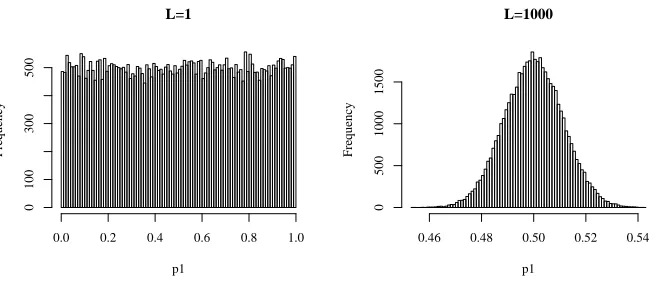
To get a feel for the significance of λ, con-sider figure 3; the left panel shows a histogram of 50,000 variates of p1 randomly drawn from
Dirichlet(p1, p2|λc1, λc2), withλ = 1, and bothc1
andc2 set to 1. The graph shows only the p1 part
but things are no different forp2. (Thex-dimension
represents a particular valuep1takes (which ranges
between 0 and 1) and the y-dimension records the number of the timesp1takes that value.) We see that
points are spread rather evenly over the probability space. Now the right panel shows what happens if you increaseλby a factor of 1,000 (which will give youP(p1, p2|1000,1000)); points take a bell shaped
form, concentrating in a small region around the ex-pectation ofp1. In the experiments section, we will
return to the issue of λ and discuss how it affects performance of summarization.
Let us turn to the question of how to find a solu-tion to the integral in equasolu-tion 5. We will be con-cerned here with two standard approaches to the is-sue: one is based on MAP (maximum a posteriori)
3http://www.cis.hut.fi/ahonkela/dippa/dippa.html
and another on numerical integration. We start off with a MAP based approach known as Bayesian In-formation Criterion or BIC.
For a given modelm, BIC seeks an analytical ap-proximation for equation 4, which looks like the fol-lowing:
lnP(yi|m) = lnφ(yi|θθθ, mˆ )− k
2lnN, (9)
where k denotes the number of free parameters in
m, andN that of observations.θθθˆis a MAP estimate ofθθθunderm, which isE[θθθ]. It is interesting to note that BIC makes no reference to prior. Also worthy of note is that a minus of BIC equals MDL (Minimum Description Length).
Alternatively, one might take a more straightfor-ward (and fully Bayesian) approach known as the Monte Carlo integration method (MacKay, 1998) (MC, hereafter) where the integral is approximated by:
P(yi|vvv)≈ 1
n n X
j=1
φ(yi|x(j)), (10)
where we draw each samplex(j)randomly from the distribution P(θθθ|vvv), and n is the number of x(i)’s so collected. Note that MC gives an expectation of
P(yi|vvv)with respect toP(θθθ|vvv).
Furthermore, φcould be any probabilistic func-tion. Indeed any discriminative classifier (such as C4.5) will do as long as it generates some kind of probability. Given φ, what remains to do is essen-tially training it on samples bootstrapped (i.e., re-sampled) from the training data based onθθθ— which we draw from Dirichlet(θθθ|vvv).4 To be more spe-cific, suppose that we have a four sentence long text and an array of probabilitiesθθθ = (0.4,0.3,0.2,0.1)
drawn from a Dirichlet distribution: which is to say, we have a preference factor of 0.4 for the lead sen-tence, 0.3 for the second sensen-tence, etc. Then we re-sample with replacement lead sentences from train-ing data with the probability of 0.4, the second with the probability of 0.3, and so forth. Obviously, a
4
L=1
p1
Frequency
0.0 0.2 0.4 0.6 0.8 1.0
0
100
300
500
L=1000
p1
Frequency
0.46 0.48 0.50 0.52 0.54
0
500
1000
[image:4.612.137.464.64.207.2]1500
Figure 3: Histograms of random draws from Dirichlet(p1, p2|λc1, λc2) withλ = 1(left panel), andλ = 1000(right panel).
high preference factor causes the associated sen-tence to be chosen more often than those with a low preference.
Thus given a text T = (a, b, c, d) with θθθ =
(0.4,0.3,0.2,0.1), we could end up with a data set dominated by a few sentence types, such asT0 =
(a, a, a, b), which we proceed to train a classifier on
in place of T. Intuitively, this amounts to induc-ing the classifier to attend to or focus on a partic-ular region or area of a text, and dismiss the rest. Note an interesting parallel to boosting (Freund and Schapire, 1996) and the alternating decision tree (Freund and Mason, 1999).
In MC, for eachθθθ(k) drawn from Dirichlet(θθθ|vvv), we resample sentences from the training data using probabilities specified by θθθ(k), use them for train-ing a classifier, and run it on a test document dto find, for each sentence ind, its probability of being a ‘pick’ (summary-worthy) sentence,i.e.,P(yi|θθθ(k)),
which we average acrossθθθ’s. In experiments later described, we apply the procedure for 20,000 runs (meaning we run a classifier on each of 20,000θθθ’s we draw), and average over them to find an estimate forP(yi|vvv).
As for BIC, we generally operate along the lines of MC, except that we bootstrap sentences using onlyE[θθθ], and the model complexity term, namely, −k
2lnN is dropped as it has no effect on ranking
sentences. As with MC, we train a classifier on the bootstrapped samples and run it on a test document. Though we work with a set of fixed parameters, a bootstrapping based on them still fluctuates,
produc-ing a slightly different set of samples each time we run the operation. To get a reasonable convergence in experiments, we took the procedure to 5,000 iter-ations and averaged over the results.
Either with BIC or with MC, building a summa-rizer on it is a fairly straightforward matter. Given a document d and a compression rate r, what a summarizer would do is simply rank sentences ind
based on P(yi|vvv) and pick an r portion of highest
ranking sentences.
3 Working with Bayesian Summarist
3.1 C4.5
In what follows, we will look at whether and how the Bayesian approach, when applied for the C4.5 deci-sion tree learner (Quinlan, 1993), leverages its per-formance on real world data. This means our model now operates either by
P(yi|vvv)≈ n1
n X
j=1
φc4.5(yi|x(j)), (11)
or by
lnP(yi|m) = lnφc4.5(yi|θθθ, mˆ )−k2lnN, (12)
While C4.5 here is configured to work in a bi-nary (positive/negative) classification scheme, we run it in a ‘distributional’ mode, and use a particular class membership probability it produces, namely, the probability of a sentence being positive, i.e., a pick (summary-worthy) sentence, instead of a cate-gory label.
Attributes for C4.5 are broadly intended to repre-sent some aspects of a repre-sentence in a document, an object of interest here. Thus for each sentenceψ, its encoding involves reference to the following set of attributes or features. ‘LocSen’ gives a normalized location ofψin the text, i.e., a normalized distance from the top of the text; likewise, ‘LocPar’ gives a normalized location of the paragraph in whichψ oc-curs, and ‘LocWithinPar’ records its normalized lo-cation within a paragraph. Also included are a few length-related features such as the length of text and sentence. Furthermore we brought in some language specific feature which we call ’EndCue.’ It records the morphology of a linguistic element that endsψ, such as inflection, part of speech, etc.
In addition, we make use of the weight feature (‘Weight’) for a record on the importance ofψbased on tf.idf. Letψ = w1, . . . , wn, for some wordwi.
Then the weightW(ψ)is given as:
W(ψ) =X
w
(1 + log(tf(w)))·log(N/df(w)).
Here ‘tf(w)’ denotes the frequency of wordw in a given document, ‘df(w)’ denotes the ’document fre-quency’ of w, or the number of documents which contain an occurrence ofw. N represents the total number of documents.5
Also among the features used here is ‘Pos,’ a fea-ture intended to record the position or textual order ofψ, given by how many sentences away it occurs from the top of text, starting with 0.
While we do believe that the attributes discussed above have a lot to do with the likelihood that a given sentence becomes part of summary, we choose not to consider them parameters of the Bayesian model, just to keep it from getting unduly complex. Recall the graphical model in figure 2.
5Although one could reasonably argue for normalizing
W(ψ)by sentence length, it is not entirely clear at the moment whether it helps in the way of improving performance.
3.2 Test Data
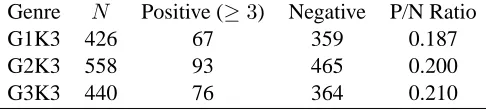
Here is how we created test data. We collected three pools of texts from different genres, columns, edito-rials and news stories, from a Japanese financial pa-per (Nihon Keizai Shinbun) published in 1995, each with 25 articles. Then we asked 112 Japanese stu-dents to go over each article and identify 10% worth of sentences they find most important in creating a summary for that article. For each sentence, we recorded how many of the subjects are in favor of its inclusion in summary. On average, we had about seven people working on each text. In the follow-ing, we say sentences are ‘positive’ if there are three or more people who like to see them in a summary, and ‘negative’ otherwise. For convenience, let us call the corpus of columns G1K3, that of editorials G2K3 and that of news stories G3K3. Additional details are found in table 1.
4 Results and Discussion
Tables 2 through 4 show how the Bayesian sum-marist performs on G1K3, G2K3, and G3K3. The tables list results in precision at compression rates (r) of interest (0< r <1). The figures thereof indi-cate performance averaged over leave-one-out cross validation folds. What this means is that you leave out one text for testing and use the rest for training, which you repeat for each one of the texts in the data. Since we have 25 texts for each data set, this leads to a 25-fold cross validation. Precision is defined by the ratio of hits (positive sentences) to the number of sentences retrieved, i.e.,r-percent of sentences in the text.6
In each table, figures to the left of the verti-cal line indicate performance of summarizers with BIC/MC and those to the right that of summarizers without them. Parenthetical figures like ‘(5K)’ and ‘(20K)’ indicate the number of iterations we took them to: thus BIC(5K) refers to a summarizer based on C4.5/BIC with scores averaged over 5,000 runs. BSE denotes a reference summarizer based on a reg-ular C4.5, which it involves no resampling of train-ing data. LEAD refers to a summarizer which works
6We do not use recall for a evaluation measure, as the
Table 1: N represents the number of sentences in G1K3 to G3K3. Sentences with three or more votes in their favor are marked positive, that is, for each sentence marked positive, at least three people are in favor of including it in a summary.
Genre N Positive (≥3) Negative P/N Ratio
G1K3 426 67 359 0.187
G2K3 558 93 465 0.200
[image:6.612.195.418.208.666.2]G3K3 440 76 364 0.210
Table 2: G1K3.λ= 5. Dashes indicate no meaningful results.
r BIC (5K) MC (20K) BSE LEAD 0.05 0.4583 0.4583 − 0.3333 0.10 0.4167 0.4167 − 0.3472 0.15 0.3333 0.3472 − 0.2604 0.20 0.2757 0.2861 − 0.2306 0.25 0.2525 0.2772 − 0.2233 0.30 0.2368 0.2535 − 0.2066
Table 3: G2K3.λ= 5.
r BIC (5K) MC (20K) BSE LEAD 0.05 0.6000 0.5800 0.4200 0.5400 0.10 0.4200 0.4200 0.3533 0.3933 0.15 0.3427 0.3560 0.2980 0.3147 0.20 0.3033 0.3213 0.2780 0.2767 0.25 0.2993 0.2776 0.2421 0.2397 0.30 0.2743 0.2750 0.2170 0.2054
Table 4: G3K3.λ= 5.
r BIC (5K) MC (20K) BSE LEAD 0.05 0.9600 0.9600 0.8400 0.9600 0.10 0.7600 0.7600 0.6800 0.7000 0.15 0.6133 0.6000 0.5867 0.5133 0.20 0.5233 0.5233 0.4967 0.4533 0.25 0.4367 0.4367 0.3960 0.3840 0.30 0.4033 0.4033 0.3640 0.3673
0 (411.0/65.0)
LenSenA 0 (199.0/23.0) <= 64 EndCueA > 64 Weight = 0 LocWithinPar = 1 0 (0.0) = 2 Weight = 3 0 (5.0/1.0) = 4 LocWithinPar = 5 0 (7.0) = 6 LocWithinPar <= 2.338 0 (17.0) > 2.338 Weight <= 0 LenSenA > 0 LocPar <= 2.255 1 (7.0) > 2.255 1 (4.0) <= 0 0 (22.0/7.0) > 0 LocWithinPar <= 114 LocWithinPar > 114 0 (38.0/4.0) <= 0.8 1 (2.0) > 0.8 1 (10.0/2.0) <= 0.7 0 (3.0) > 0.7 0 (11.0/1.0) <= 0.286 LocPar > 0.286 LenSenA <= 0.667 1 (8.0) > 0.667 1 (13.0/1.0) <= 72 0 (8.0) > 72 0 (15.0) <= 1.707 LocSen > 1.707 LocWithinPar <= 0.917 0 (7.0) > 0.917 0 (5.0/1.0) <= 0 LenSenA > 0 1 (17.0) <= 110 LocSen > 110 0 (3.0) <= 0.333 1 (2.0) > 0.333 1 (3.0/1.0) <= 0.429 0 (6.0) > 0.429
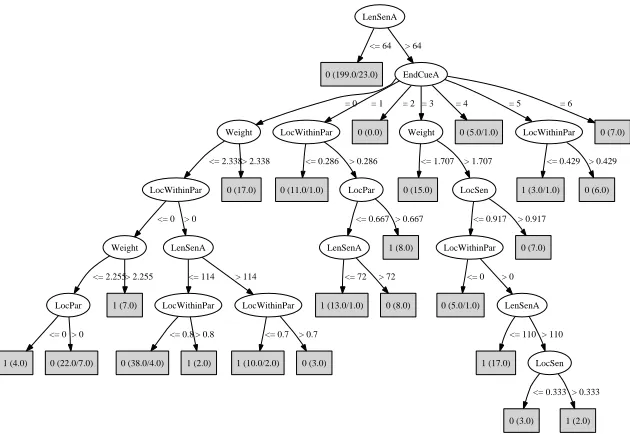
Figure 5: A Bayesian (MC) C4.5 trained on G1K3.
by selecting sentences from the top of the text. It is generally considered a hard-to-beat approach in the summarization literature.
Table 4 shows results for G3K3 (a news story do-main). There we find a significantly improvement to performance of C4.5, whether it operates with BIC or MC. The effect is clearly visible across a whole range of compression rates, and more so at smaller rates.
Table 3 demonstrates that the Bayesian approach is also effective for G2K3 (an editorial domain), out-performing both BSE and LEAD by a large margin. Similarly, we find that our approach comfortably beats LEAD in G1K3 (a column domain). Note the dashes for BSE. What we mean by these, is that we obtained no meaningful results for it, because we were unable to rank sentences based on predictions by BSE. To get an idea of how this happens, let us look at a decision tree BSE builds for G1K3, which is shown in figure 4. What we have there is a deci-sion tree consisting of a single leaf.7 Thus for what-ever sentence we feed to the tree, it throws back the same membership probability, which is 65/411. But then this would make a BSE based summarizer ut-terly useless, as it reduces to generating a summary by picking at random, a particular portion of text.8
7
This is not at all surprising as over 80% of sentences in a non resampled text are negative for the most of the time.
8Its expected performance (averaged over106
runs) comes
Now Figure 5 shows what happens with the Bayesian model (MC), for the same data. There we see a tree of a considerable complexity, with 24 leaves and 18 split nodes.
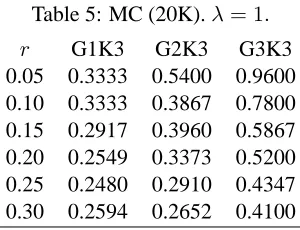
Let us now turn to the issues withλ. As we might recall, λinfluences the shape of a Dirichlet distri-bution: a large value of λ causes the distribution to have less variance and therefore to have a more acute peak around the expectation. What this means is that increasing the value ofλmakes it more likely to have us drawing samples closer to the expecta-tion. As a consequence, we would have the MC model acting more like the BIC model, which is based on MAP estimates. That this is indeed the case is demonstrated by table 5, which gives results for the MC model on G1K3 to G3K3 atλ= 1. We see that the MC behaves less like the BIC atλ= 1 than atλ= 5(table 2 through 4).
Of a particular interest in table 5 is G1K3, where the MC suffers a considerable degradation in per-formance, compared to when it works withλ = 5. G2K3 and G3K3, again, witness some degradation in performance, though not as extensive as in G1K3. It is interesting that at times the MC even works bet-ter withλ= 1thanλ= 5in G2K3 and G3K3.9
to: 0.1466 (r = 0.05), 0.1453 (r = 0.1), 0.1508 (r = 0.15), 0.1530 (r= 0.2), 0.1534 (r= 0.25), and 0.1544 (r= 0.3).
9The results suggest that if one like to have some
Table 5: MC (20K).λ= 1.
r G1K3 G2K3 G3K3
0.05 0.3333 0.5400 0.9600 0.10 0.3333 0.3867 0.7800 0.15 0.2917 0.3960 0.5867 0.20 0.2549 0.3373 0.5200 0.25 0.2480 0.2910 0.4347 0.30 0.2594 0.2652 0.4100
All in all, the Bayesian model proves more effec-tive in leveraging performance of the summarizer on a DOV exhibiting a complex, multiply peaked form as in G1K3 and G2K3, and less on a DOV which has a simple, single-peak structure as in G3K3 (cf. figure 1).10
5 Concluding Remarks
The paper showed how it is possible to incorporate information on human judgments for text summa-rization in a principled manner through Bayesian modeling, and also demonstrated how the approach leverages performance of a summarizer, using data collected from human subjects.
The present study is motivated by the view that that summarization is a particular form of collabo-rative filtering (CF), wherein we view a summary as a particular set of sentences favored by a par-ticular user or a group of users just like any other things people would normally have preference for, such as CDs, books, paintings, emails, news articles, etc. Importantly, under CF, we would not be asking, what is the ‘correct’ or gold standard summary for document X? – the question that consumed much of the past research on summarization. Rather, what we are asking is, what summary is popularly favored for X?
Indeed the fact that there could be as many sum-maries as angles to look at the text from may favor
in general how to best setλrequires some experimenting with data and the optimal value may vary from domain to domain. An interesting approach would be to empirically optimizeλ us-ing methods suggested in MacKay and Peto (1994).
10
Incidentally, summarizers, Bayesian or not, perform con-siderably better on G3K3 than on G1K3 or G2K3. This hap-pens presumably because a large portion of votes concentrate in a rather small region of text there, a property any classifier should pick up easily.
the CF view of summary: the idea of what consti-tutes a good summary may vary from person to per-son, and may well be influenced by particular inter-ests and concerns of people we elicit data from.
Among some recent work with similar concerns, one notable is the Pyramid scheme (Nenkova and Passonneau, 2004) where one does not declare a particular human summary a absolute reference to compare summaries against, but rather makes every one of multiple human summaries at hand bear on evaluation; Rouge (Lin and Hovy, 2003) represents another such effort. The Bayesian summarist rep-resents yet another, whereby one seeks a summary most typical of those created by humans.
References
Peter Congdon. 2003. Bayesian Statistical Modelling. John Wiley and Sons.
Philip J. Cowans. 2004. Information Retrieval Using Hierarchical Dirichlet Processes. In Proc. 27th ACM
SIGIR.
Yoav Freund and Llew Mason. 1999. The alternating decision tree learning algorithm,. In Proc. 16th ICML.
Yoav Freund and Robert E. Schapire. 1996. Experiments with a new boosting algorithm. In Proc. 13th ICML.
Chin-Yew Lin and Eduard Hovy. 2003. Automatic eval-uation of summaries using n-gram co-occurance statis-tics. In Proc. HLT-NAACL 2003.
David J. C. MacKay and Linda C. Bauman Peto. 1994. A Hierarchical Dirichlet Language Model. Natural
Lan-guage Engineering.
D. J. C. MacKay. 1998. Introduction to Monte Carlo methods. In M. I. Jordan, editor, Learning in
Graphi-cal Models, Kluwer Academic Press.
Ani Nenkova and Rebecca Passonneau. 2004. Evalua-tion Content SelecEvalua-tion in SummarizaEvalua-tion: The Pyra-mid Method. In Proc. HLT-NAACL 2004.
J. Ross Quinlan. 1993. C4.5: Programs for Machine
Learning. Morgan Kaufmann.
Ian H. Witten and Eibe Frank. 2000. Data Mining:
Prac-tical Machine Learning Tools and Techniques with Java Implementations. Morgan Kaufmann.