EXTREME POINTS AND AFFINE EQUIVALENCE
The purpose of this note is to use the notions of extreme points and affine transformations — which are studied in the fileaffine-convex.pdf— to prove that certain standard geometrical figures are not affine equivalent (and a fortiori not congruent). In particular, these results imply that a triangle and a convex quadrilateral cannot be affine equivalent and hence cannot be congru-ent. On the intuitive level, the conclusions are fairly self-evident; however, the proofs yield more general insights into the geometric properties of figures and into criteria for determining whether more general pairs of subsets are congruent or affine equivalent.
Needless to say, we shall use material from affine-convex.pdfas needed.
Definition. Letn≥3, and let V ={A1, ... , An} be a linearly ordered set of points inR2 such that no three are collinear; for the sake of notational convenience we shall also denote An by A0. We shall say that the broken line curve ΓV defined by
[A1A2] ∪ [A2A3] ∪ ... ∪ [AnA1]
is aconvex polygon if for everyk such that 0≤k < nall points inV − {Ak, Ak+1}lie on the same open half-plane determined by the lineAkAk+1. The elements of V are called the vertices of ΓV.
Reminder. IfL ⊂R2 is a line defined by the linear equation g= 0, then (i) the two open half-spaces determined byLare the sets determined by the strict inequalities g >0 andg <0, (ii) the two closed half-spaces determined by Lare the sets determined i by the non-strict inequalities
g≥0 andg≤0.
If the number of vertices is unknown or unimportant, we shall often simply say that ΓV is a
convex polygon.
Remarks.
1. If n= 3 then the condition is true for all choices ofV, and the resulting curve is just a triangle. If n = 4 the defining condition is satisfied if V is the set of vertices for the unit square [0,1]×[0,1], but it is not satisfied ifV is the set whose elements are (0,1), (0,0), (1,0) and 13,13.
2. For certain small values of n (say, less than 100) we often use the standard words to describen-gons (e.g., quadrilateral, pentagon, hexagon, octagon, decagon, etc.).
3. The definition itself does not address the question of whether the underlying set of points can also be written in the form
ΓW = [B1B2] ∪ [B2B3] ∪ ... ∪ [BmB1]
for a second set of linearly ordered vertices W = {B1, ... , Bm}. In this note we shall only need to know that the underlying unordered sets are the same. An elementary but somewhat tedious argument also shows that the ordering is unique up to permutations of{1, ... , n}generated by the cyclic permutation (k →k+ 1 for k < nand n→1) and the order-reversing permutation sending
k to n+ 1−k for all k, but we shall not prove or use this.
of AkAk+1 then all the points inF [V − {Ak, Ak+1}] are on the same side of F(Ak)F(Ak+1), (iii) an affine transformation sends the closed segment joining X and Y to the closed segment joining
F(X) andF(Y).
5. It is important to notice that a convex polygon is NOT a convex set. For example, if
X is the midpoint of [A2A3] and Y is the midpoint of [A1X], then Y 6∈ΓV. This is immediately apparent from a simple drawing when n= 3 (see Figure 1 at the end of this file), but for the sake of completeness we shall give a rigorous proof (which may be skipped without loss of continuity).
PROOF. Assume that Y ∈ΓV and in particular that Y ∈ [AkAk+1], where 0 ≤k < n.
First of all, observe that k 6= 1, for if this were true then Y ∈ A1A2 would imply that
A1X =A1Y = A1A2, so that {A1, A2, X} is collinear; since {A2, A3, X} is collinear by construction, this implies thatA3∈A1A2, which contradicts our assumption that no three vertices are collinear. This shows thatk 6= 1. — Next,k= 0 would imply that{An, Y, A1} is collinear, which in turn implies that X ∈ [AnA1]; since X is the midpoint of [A2A3] and no three vertices are collinear, it would follow thatA2A3 6=AnA1 and henceA2 and
A3 lie on opposite sides ofAnA1, contradicting our basic assumption about the vertices. Therefore we also havek6= 0. — Similarly,k= 2 would imply that{Y, A2, A3}is collinear, and sinceX ∈(A2A3) this line also contains X. We can now useA1∗Y ∗X to conclude that A1 ∈ A2A3, again contradicting our basic assumption about the vertices, and thus we further havek 6= 2. — Finally, ifn≥4 we need to exclude the cases where 3≤k < n. In this caseY ∈AkAk+1would imply thatA1andX lie on opposite sides ofAkAk+1, and
X ∈(A2A3) implies thatX andA2 lie on the same side ofAkAk+1(regardless of whether or notk = 3). Combining these, we find thatA1 and A2 lie on opposite sides ofAkAk+1, once again contradicting our basic assumption about the vertices, and thus showing that
Y 6∈[AkAk+1] the remaining values of k.
Extreme points of regular polygons
The notion of extreme point is meaningful for an arbitrary subset S of Rn (i.e., the point is not between two other points of S). Then as inaffine-convex.pdfwe can conclude thatifF is an affine transformation ofRn andS ⊂Rn, thenF sends extreme points ofS to extreme points of
F[S].
We can now state the main results.
THEOREM 1. If V is the ordered set of vertices for the convex polygon ΓV, thenV is the set of extreme points for ΓV.
COROLLARY 2. A convexm-gon and a convex n-gon cannot be affine equivalent (and hence cannot be congruent) if m6=n.
Proof that Theorem 1 implies Corollary 2. The theorem implies that if ΓV and ΓW are convexn- andm-gons respectively, then their extreme points areV andW respectively. Therefore if F is an affine transformation mapping ΓV to ΓW, thenF sends V to W by the earlier remark on extreme points and affine transformations. But this means that V and W must have the same numbers of elements, sot htat n=m.
The following observation plays a key role in the proof of Theorem 1:
LEMMA 3. Let n ≥ 3, and let V = {A1, ... , An} be the linearly ordered vertices of a
convex n-gon ΓV (as usual, take A0 = An). Then for each k such that 0 ≤ k < n we have
Proof of Lemma 3. Letg be a linear function whose zero set is the line AkAk+1; multiplyingg by−1 if necessary, we may assume that g(Ak+2)>0, where we letAn+1=A1 when k=n−1. It follows immediately that g(Ai)>0 for alli6=k, k+ 1 (since all these points lie on the same side of
AkAk+1), and it will suffice to verify that g is positive on each open interval (AjAj+1) for j6=k.
Suppose now thatX ∈(AjAj+1) for somej6=k, so that X =sAj+tAj+1wheres, t >0 and
s+t= 1. Since j 6= k at least one of g(Aj) and g(Aj+1) must be positive; in any case we know that both are nonnegative. These imply that
g(X) = s·g(Aj) + t·(Aj+1) > 0
so that X does not lie onAkAk+1. By construction none of the vertices Aj (where j 6=k) lie on the latter line, and thus the only points in AkAk+1∩ΓV are the points in [AkAk+1].
Proof of Theorem 1. First of all, we claim that the set of extreme points is contained in the set V of vertices, for each point in an open edge (AkAk+1) lies between the vertices Ak and Ak+1. Therefore it remains to prove that every vertex is an extreme point.
LetAk be a typical vertex, and letg be the linear function described in Lemma 3 for the line
AkAk+1. Observe thatgis nonnegative on the vertices, and therefore on each closed edge [AjAj+1] the linear functiong is nonnegative.
If we haveAk =sY +tZ for someY, Z ∈ΓV wheres, t >0 ands+t= 1, then the observation in the preceding paragraph implies that
0 = g(Ak) = s·g(Y) + t·g(Z)
and since g(Y), g(Z)6= 0 this can only happen if g(Y) =g(Z) = 0;i.e., bothY andZ must lie on the lineAkAk+1, and by Lemma 3 these points actually lie on the closed segment [AkAk+1]. Since
Ak is not between two points on this closed segment, it follows that Y and Z cannot exist, and henceAk must be an extreme point of ΓV.
Solid polygonal regions
We shall now prove a similar result for the interior regions of convex polygons. Still using the same notation as before, let gk be the linear function such that its zero set is the lineAkAk+1 and gk is positive on all the vertices except Ak and Ak+1. Then we may define the solid or closed interior region of ΓV to be the set of points X such that gk(X) ≥0 for all k. If we let Gj denote the closed half-plane on which gj is nonnegative (where 0≤j < n), then S is just the intersection
∩j Gj.
The results ofaffine-convex.pdfnow imply that an affine transformation F sends the solid interior region for ΓV into the solid interior region for ΓF[V] (compare Remark 4 following the definition of a convex polygon). This in turn leads to the following result:
THEOREM 4. In the preceding notation, letS denote the solid polygonal region determined by the convex polygonΓV. ThenV is the set of extreme points forS.
This leads immediately to the following analog of Corollary 2.
COROLLARY 5. LetS andS0denote the closed polygonal regions associated to ann-gon and
m-gon respectively. If S and S0
The corollary follows from the theorem because an affine equivalence from S to S0 must send extreme points to extreme points and nonextreme points to nonextreme points by the results in affine-convex.pdf.
Proof of Theorem 4. For the sake of giving a unified approach to several cases, we shall set
A−1 and An+1 equal to An−1 and A1 respectively, with similar conventions for the sets Gj (also let G0 =Gn).
The first step is to prove that for eachksatsifying 0≤k < nwe haveAkAk+1∩S = [AkAk+1]. By hypothesis we know thatAkandAk+1lie inGj for everyj, and therefore by convexity the closed segment [AkAk+1] is contained in∩j Gj =S. Conversely, since Ak ∈ Ak−1Ak and Ak+1 ∈Gk−1 we know thatAkAk+1∩Gk−1 is the closed ray [AkAk+1, and similarly sinceAk+1∈Ak+1Ak+2and
Ak ∈Gk+1we know thatAkAk+1∩Gk+1is the closed ray [Ak+1Ak. Combining these observations, we have
AkAk+1 ∩ S ⊂ AkAk+1 ∩ Gk−1 ∩ Gk+1 = [AkAk+1 ∩ [Ak+1Ak = [AkAk+1]
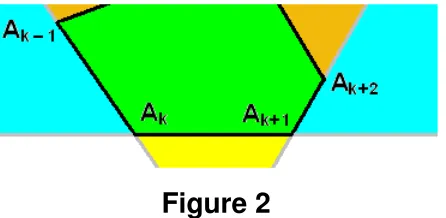
and if we combine this with the second sentence of the paragraph we conclude thatAkAk+1∩S= [AkAk+1], which is what we wanted to prove (the data are depicted in Figure 2).
By the preceding paragraph we know that S−ΓV is the set of all points where gj > 0 for all j. We claim that none of the points in this relative complement are extreme points of S. — By continuity, if gj(X) >0 for all j then there is some δ > 0 such that |Y −X| < δ implies that
gj(Y) > 0 for all j. If we take Y± to be the point X + 12δu where u is some unit vector, then
Y±∈S and X is the midpoint of [Y−Y+] and thereforeX is not an extreme point of X.
Since ΓV ⊂S, it follows that ifX ∈ΓV is an extreme point for S then it is also an extreme point for ΓV. By the preceding paragraph we know that all extreme points forS are contained in ΓV, and accordingly we know that an extreme point ofS must be a vertex of ΓV. To complete the proof, we need to show that each vertex is indeed an extreme point of S. This can be verified by the same sort of argument employed in the proof of Theorem 1 (the most significant point is that the functiongk is nonnegative on all ofS.
In particular, Corollary 5 implies that the closed polygonal regions defined by triangles and convex quadrilaterals cannot be affine equivalent or congruent.
Inequivalence of solid polygonal and circular regions
It is also intuitively apparent that the solid closed region defined by a convex polygon is not affine equivalent to the solid closed region defined by a circle. We shall conclude by presenting one approach to proving this fact (see Theorem 8 below). Once again, the goal of obtaining more insight into the structure of convex sets is at least equally important as the goal of proving the inequivalence statement.
Definition. Let K ⊂R2 be a convex set, let L⊂ R2 be a line, and let p ∈ K∩L. Then L is said to be a supporting line for K ifK ⊂ L or all points of K lie on exactly one of the closed half-planes determined byL.
The next result implies that supporting lines are well-behaved with respect to affine transfor-mations.
PROPOSITION 6. LetK ⊂R2 be convex, let L be a supporting line forK at p∈K, and let
T be an affine transformation of R2. Then T[L] is a supporting line forT[K] at T(p).
Recall that if L is a line in Rn and T is an affine transformation, then the image T[L] is also a line.
Proof. IfK ⊂L this follows immediately, so suppose for the rest of this proof that K contains some point q6∈L.
LetHbe the closed half-plane determined by Lfor whichK⊂H, so thatq ∈H−L. ThenT
mapsHto the closed half-planeH0
containing the pointT(q) by the results inaffine-convex.pdf, and thereforeT[K] is contained inT[H] =H0.
The preceding result will allow us to simplify the computations in the proof of the result on supporting lines for closed circular regions.
PROPOSITION 7. Let D be a solid circular region inR2 (in other words, all points X such that|X−C| ≤r for someC∈R2 andr >0). Then a lineL is a supporting line forD if and only if it is a tangent line to the boundary circle Γat some point of the latter, and each supporting line meetsD at exactly one point.
For the sake of completeness, we shall formally define the boundary circle Γ of D (as above) by the equation |X −C|=r.
Proof. The conclusion can be split into two parts as follows: First, if |X−C|< rthen there are no supporting lines passing throughX. Second, if X lies on the boundary circle Γ, then there is exactly one supporting line, and it is the tangent line to Γ at X. Since there is a translation which mapsD to a circular region of radiusr whose center is the origin, by Proposition 6 it will suffice to prove the result when C =0. Similarly, for every nonzero point in R2 there is a rotation sending that point to some point (0, s) on they-axis withs≥0, by another application of Proposition 6 it will suffice to prove the result whenC=0 and the pointX ∈Dhas coordinates (0, s) wheres≥0.
STEP 1. Suppose|X|< r, so that 0 ≤s < r. Let M be a line passing through X.
Subcase 1.1: Suppose that M is a vertical line, so that it is defined by the equation
x = 0. Then the points (±r,0) lie in D but are on opposite sides of M, and hence the vertical line throughX is not a supporting line.
Subcase1.2: Suppose that M is not a vertical line, so that it is defined by an equation of the formy=mx+s(the constant term must besbecausey(0) =s). Then the points (0,±r) lie in D but are on opposite sides of M, and hence the line M through X is not a supporting line.
STEP 2. Suppose|X| is the point (0, r). LetM be a line passing throughX.
Subcase2.1: Suppose that M is a horizontal line, so that it is defined by the equation
y = 0. Then M is the tangent line to Γ at X, and it is also a supporting line because there is a unique solution to the system of equations x2 +y2 = r2 and y = r; namely, (x, y) = (0, r).
Subcase 2.2: Suppose that M is a vertical line, so that it is defined by the equation
Subcase 2.3: Suppose that M is neither a horizontal nor a vertical line, so that it is defined by an equation of the formy =mx+r wherem6= 0 (the constant term must be
sbecausey(0) =r). Then the proof thatM is not a supporting line reduces to verifying the following statement:
CLAIM. There is someh > 0such that each open half-plane determined by M contains points of the form x,√r2−x2
with|x|< h.
In particular, Γ contains points on each open half-plane and henceM cannot be a supporting line for D. There is a drawing of a typical example in Figure 3.
VERIFICATION OF THE CLAIM. Since the open half-planes determined by M are defined by
the inequalitiesy < mx+rand y > mx+r, another way of stating the claim is that there are real numbersu, v such that 0<|u|,|v| < hand
p
r2−u2 < mu + r , pr2−v2 > mv + r .
Since r >0, by continuity we can take h so small that mx+r >0 for |x| < h. If we do so, then the displayed inequalities are equivalent to their squares
r2−u2 < (mu+r)2 = m2u2+ 2mru+r2 , r2−v2 > (mv+r)2 = m2v2+ 2mrv+r2
which we can rewrite in the form
(m2+ 1)v2 + 2mrv < 0 < (m2+ 1)u2 + 2mru .
Letϕ(x) = (m2+ 1)x2+ 2rmx, so that the preceding display can be rewritten asϕ(v) <0< ϕ(u). By constructionϕ(0) = 0 andϕ0(x) = 2rm+ 2(m2+ 1)x, so thatϕ0(0)6= 0 and by continuity there is someh >0 suc that the signs ofϕ0
(x) andϕ0
(0) are the same when|x|< h. This sign is positive or negative, depending upon whether m is positive or negative, so that ϕ is strictly increasing or decreasing for|x|< h.
Ifm > 0 thenϕ is strictly increasing, and hence if−h < u <0 < v < h we have ϕ(u)<0< ϕ(v), which is the conclusion we wanted. On the other hand, ifm <0 thenϕis strictly decreasing, and hence if −h < v < 0 < u < h we have ϕ(u) < 0 < ϕ(v), which is again the conclusion we wanted. Therefore we have shown that Γ has points on both of the open half-planes determined by
M, and accordingly it cannot be a supporting line forD.
THEOREM 8. A solid polygonal region and a solid circular region cannot be affine equivalent.
Proof. Suppose that T is an affine transformation mapping the solid polygonal region S to the solid circular region D. Let X ∈P be such that X has a supporting line L for which L∩S is a closed interval. By Proposition 6 the line T[L] is a supporting line for D =T[S] at T(X) a such that T[L]∩D =T[L∩S] is also a closed interval. On the other hand, Proposition 7 implies that no such supporting lines exist in D, and therefore there is no affine transformationT sendingS to
DRAWINGS TO ACCOMPANY THE FILE
Extreme points and affine equivalence
Figure 1
A convex set which contains
Δ
ABC will also contain the midpoint Y of the segment [AX],where X is the midpoint of edge [BC]. The notes prove the “visually obvious” fact that Y
does not belong to the triangle, and therefore the triangle is not a convex set.
[image:7.612.198.421.302.411.2]
Figure 2
The solid polygonal region is colored in green with a black border. It is contained in the
intersection of
the closed half
–
plane determined by the line Ak–1Ak and the external point Ak+1 withthe closed half
–
plane determined by the line Ak+1Ak+2 and the external point Ak.One key step in the proof of Theorem
4
is to show that the intersection of the line AkAk+1 withthe closed polygonal region is equal to the closed segment
[
AkAk+1]
, and the illustrationsuggests that the intersection with the two closed half
–
planes is equal to that closed segment(hence the intersection of the line with the closed polygonal region is contained in the segment).
[image:7.612.244.368.549.658.2]
Figure 3
The line M passes through the top (red) point of the circle but is not tangent to the circle. Note
that there are points of the circle on both half