Canada
LAND FORCECOMMAND
(BILINGUAL)
Issued on Authority of the Chief of Defence Staff
Publée avec l’authorization du Chef d’état-major de la Defénse
i
FOREWORD
This publication represents a firm commitment by the Canadian Army to a bold and fundamental shift in the way that we view and will deal with the dynamic challenges of command in the Information Age. Changes should not be entirely unexpected—the recent past has highlighted problems with our implementation of command. Dramatic improvements in technology are also happening now. We must be able to make and implement effective decisions faster than our adversary across the spectrum of conflict.
The aim of Command is to provide guidance to all commanders, institutions and elements of the Canadian Army in order to adopt a uniform approach to operations as we face the challenges of the 21st Century. It is intended to be a complete reference containing both the description of what qualities are needed in a commander as well as the prescription of the various tools available to assist him in the process.
There are three fundamentals in Command that must be appreciated by the reader. The Canadian Army’s approach to operations is consistent with the commonly accepted term Manoeuvre Warfare, which simply requires solutions to problems in a manner that will save our soldiers’ lives. Second, Manoeuvre Warfare is complemented by a philosophy of Mission Command, which places emphasis on decentralizing authority and empowering personal initiative. Third, Battle Procedure is the process used at all levels in the Army in order to properly prepare and commit our soldiers to battle.
This publication encompasses current doctrinal trends amongst our allies but has maintained a unique Canadian perspective. It reflects our United Nations’ experience of the past four decades; the lessons learned in conflicts of the past century and our distinct position within our international alliances. Central to this manual is the importance that we place on our individual commanders. The human component of a command system has primacy. No technology will replace it—the importance of our leaders cannot be overstated, as they alone will bring about success.
ii
iii
PREFACE
GENERAL
CFP 300(3) Command is organized along two main axes. First, much of the material is discursive in nature, intended to promote discussion. Second, it is grounded in sound doctrine. Chapter 6 is prescriptive, and provides common procedures for the application of command theory. This procedural text balances discussion of the more theoretical aspects of command.
PURPOSE
The main purpose of CFP 300(3) Command is to contribute to a common view of command (Mission Command) throughout the Army, upon which a more dynamic style of conducting operations and training (Manoeuvre Warfare) can be developed.
SCOPE OF CFP 300(3) COMMAND
The first chapter—The Nature of Command—provides the underlying framework for this publication, and the unique environment and nature of war. Command is a combat function, which derives its basis from the capabilities and experience of our officers, NCOs and soldiers.
The Components of Command—the human, the doctrinal and the organizational—are detailed from Chapters 2 to 5. The human component centres on the ability to get soldiers to fight based on the leadership and personal qualities of the commander. The doctrinal component, at Chapter 3, establishes the groundwork of Manoeuvre Warfare and Mission Command. The organizational component, divided into the theory and implementation of command organization, is presented in Chapters 4 and 5 respectively. This component includes the framework for operations, the consideration of deputizing of command, and describes in detail the staff, communication and information systems organized into headquarters.
iv
APPLICATION OF CFP 300(3) COMMAND
CFP 300(3) Command is based upon the fundamentals stated in CFP 300 Canada’s Army, CFP 300(1) Conduct of Land Operations and CFP 300(2) Land Force Tactical Doctrine. These publications outline our philosophy and doctrine at the strategic, operational and tactical levels. Command, however, is not restricted to a particular level but is intended to give guidance and provide commonality of procedure at all levels, from the infantry section to the mechanized division. Although, the manual’s primary focus is on command in war at the operational and tactical levels, the philosophy and techniques of command apply equally to any military activity across the spectrum of conflict.
CFP 300(3) Command has a wide scope, but it is essential that the underlying philosophy and doctrine be taught and understood from the start of a junior commander’s training. This instruction should include the fundamentals and techniques of decision-making. From this foundation, integrated command and staff training must be progressively developed. The study and practice of command, including associated staff work and decision-making techniques, remains an essential component of leader development, both in training establishments and in the field army.
OFFICE OF PRIMARY INTEREST
The Director of Army Doctrine is responsible for the content, production and publication of this manual. Direct queries or suggestions to:
DAD 6 Command Fort Frontenac
PO Box 17000 Station Forces Kingston ON K7K 7B4
TERMINOLOGY
Unless otherwise noted, masculine pronouns apply to both men and women.
The following terminology is introduced to improve clarity: • Manoeuvre Arm – Infantry, Armour and Aviation.
• Support Arm – Artillery, Engineers, Signals, Intelligence and Military Police.
vii
TABLE OF CONTENTS
Page
CHAPTER 1 - THE NATURE OF COMMAND ... 1
WHY COMMAND? ... 1
THE UNIQUE ENVIRONMENT OF COMMAND ... 1
ACCOUNTABILITY, AUTHORITY AND RESPONSIBILITY ... 4
LEADERSHIP AND MANAGEMENT ... 5
COMMAND AND CONTROL ... 6
CHAPTER 2 - THE HUMAN COMPONENT OF COMMAND ... 11
QUALITIES OF COMMANDERS... 11
THE ROLE OF THE COMMANDER... 19
CHAPTER 3 - THE DOCTRINAL COMPONENT OF COMMAND27 APPROACH TO FIGHTING ... 27
MANOEUVRE WARFARE ... 28
MISSION COMMAND ... 30
SUMMARY... 38
CHAPTER 3 – ANNEX A ... 41
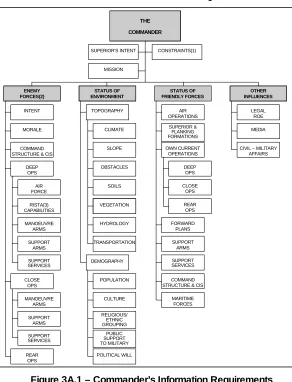
COMMANDER’S INFORMATION REQUIREMENTS... 41
CHAPTER 4 - THE THEORY OF COMMAND ORGANIZATION 43 FUNDAMENTALS OF ORGANIZATION ... 43
ORGANIZATION IN RELATION TO DOCTRINE ... 48
POSITION OF THE COMMANDER... 53
DEPUTIZING OF COMMAND... 54
SUMMARY... 55
CHA PTER 4 – ANNEX A ... 57
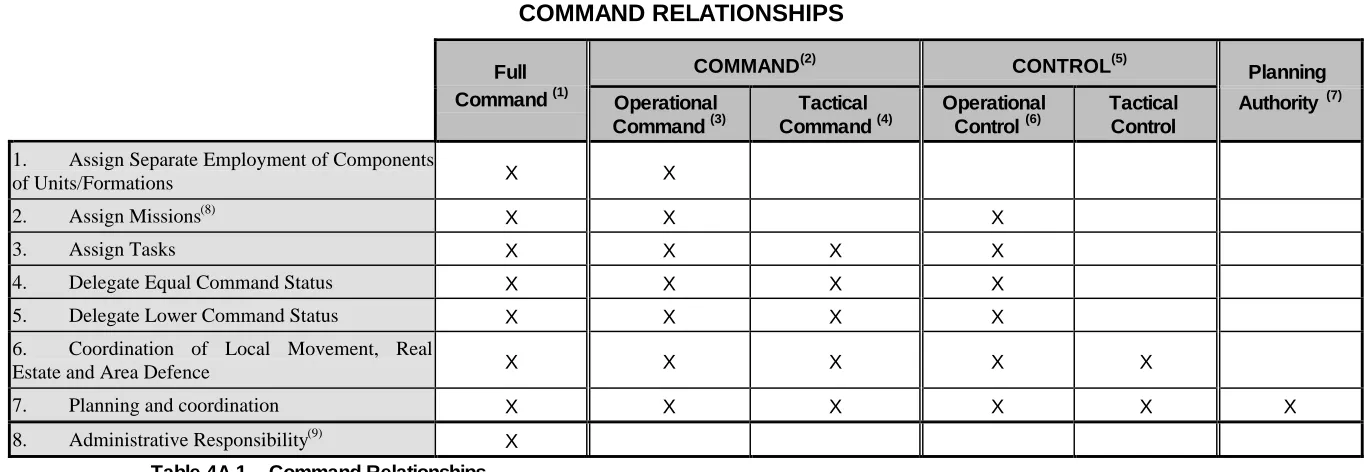
COMMAND RELATIONSHIPS ... 57
CHAPTER 4 – AN NEX B ... 60
ADMINISTRATIVE RELATIONSHIPS ... 60
CHAPTER 4 – ANNEX C ... 63
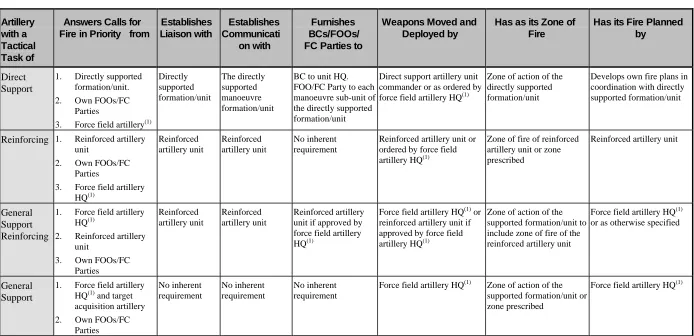
ARTILLERY TASKS AND RESPONSIBILITIES... 63
CHAPTER 4 – ANNEX D ... 65
viii
CHAPTER 5 - THE IMPLEMENTATION OF A COMMAND
ORGANIZATION ... 67
REQUIREMENTS ... 67
THE STAFF ... 68
COMMUNICATION AND INFORMATION SYSTEMS ... 76
HEADQUARTERS ... 80
SUMMARY... 81
CHAPTER 5 – ANNEX A... 83
FUNCTION AND DESIGN OF HEADQUARTERS ... 83
CHAPTER 6 - BATTLE PROCEDURE ... 89
INTRODUCTION... 89
DECISION-ACTION CYCLE AS BATTLE PROCEDURE ... 90
BATTLE PROCEDURE IMPLEMENTATION... 94
THE TOOLS OF BATTLE PROCEDURE... 97
SAMPLE SYNCHRONIZATION MATRIX... 106
SUMMARY... 116
INTEGRATION OF BATTLE PROCEDURE ... 118
CHAPTER 6 – ANNEX A... 119
THE ESTIMATE OF THE SITUATION ... 119
DEVELOPMENT AND REVIEW OF THE PLAN ... 133
THE ESTIMATE IN WRITTEN FORM... 135
CHAPTER 6 – ANNEX B... 141
THE COMBAT ESTIMATE ... 141
CHAPTER 6 –ANNEX C... 143
THE OPERATION PLANNING PROCESS ... 143
CHAPTER 7 - THE FUNCTION OF COMMAND IN CONTEXT . 149 INTRODUCTION... 149
COMBAT POWER ... 149
LEVELS OF WAR AND PLANNING ... 150
JOINT AND COMBINED OPERATIONS ... 151
COMMAND IN THE INFORMATION AGE ... 152
GLOSSARY ... 155
ix
LIST OF FIGURES AND TABLES
Page
Figure 3.1 – Command and Control Warfare ... 30
Figure 3.2 – Mission Command Terminology... 32
Figure 3.3 – The Decision-Action Cycle... 37
Figure 3A.1 – Commander’s Information Requirements... 41
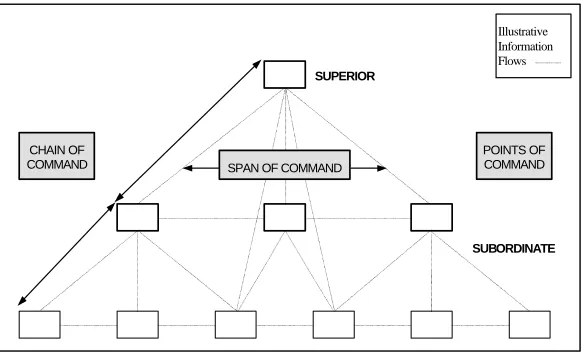
Figure 4.1 – Chain and Span of Command, and Information Flows... 47
Table 4A.1 – Command Relationships... 57
Table 4B.1 – Administrative Relationships... 60
Table 4C.1 – Artillery Tasks and Responsibilities ... 63
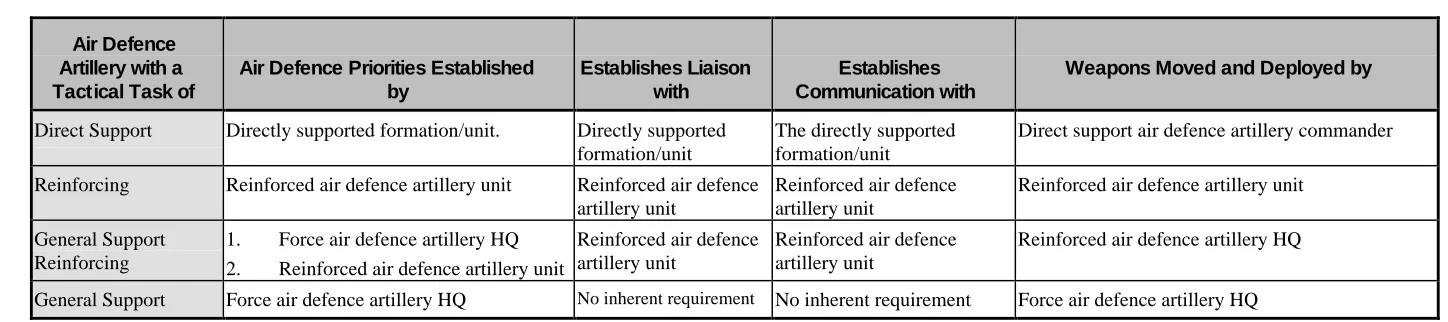
Table 4D.1 – Air Defence Artillery Tasks and Responsibilities ... 65
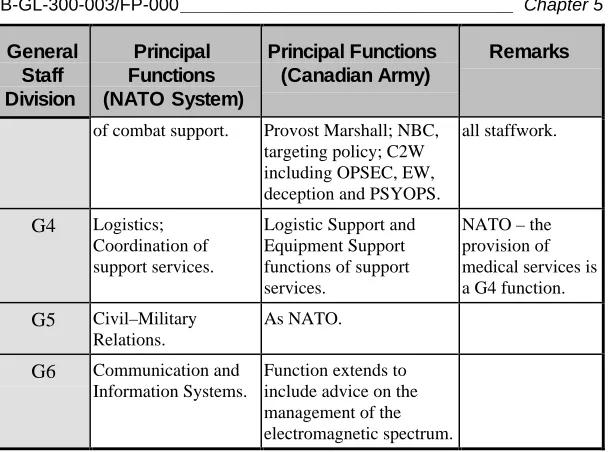
Table 5.1 – Comparison of Staff Systems ... 71
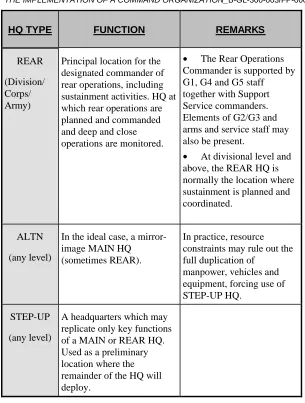
Table 5A.1 – Functions of Headquarters... 84
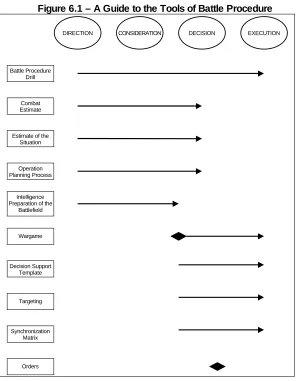
Figure 6.1 – A Guide to the Tools of Battle Procedure... 91
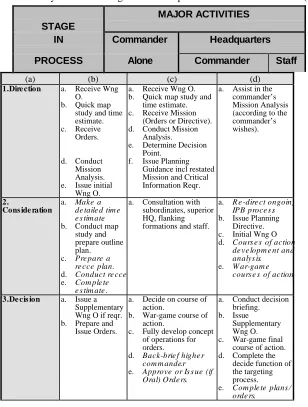
Table 6.2 – The Steps and Major Activities in Battle Procedure ... 97
Figure 6.3 – Intelligence Preparation of the Battlefield ... 101
Figure 6.4 – The Decision Support Template ... 104
Table 6.5 – Sample Synchronization Matrix ... 106
Table 6.6 – The Attack Guidance Matrix... 108
Figure 6.7 – Integration of Battle Procedure ... 118
Figure 6A.1 – The Estimate Process With IPB ... 121
x
1
C H A P T E R 1 - T H E N A T U R E O F
C O M M A N D
In order to properly command soldiers, we must first possess a clear understanding of the fundamental nature of command—its purpose and authority in the Canadian Army, the unique environment of command, and how command relates to leadership and management. The purpose of Chapter 1 is to develop that common understanding upon which the remainder of CFP 300(3) Command can be presented.
We reposing especial Trust and Confidence in your Loyalty, Courage and Integrity, do by these Presents Constitute and Appoint you to be an Officer in our Canadian Armed Forces. You are carefully and diligently to discharge your Duty as such…1
WHY COMMAND?
Command is the most important activity in war. Command by itself will not ensure victory, nor drive home a single attack. It will not destroy a single enemy target, nor will it carry out an emergency re-supply. However, none of these warfighting activities is possible without effective command. Command integrates all combat functions to produce deadly, synchronized combat power, giving purpose to all battlefield activities.
Command is in the human domain. Many activities, such as information operations and battle procedure, assist the execution of command, but command alone will ensure that campaigns, battles and United Nations commitments do not degenerate into mob action. Through command, the nation has the option of recourse to military force to accomplish stated policy.
THE UNIQUE ENVIRONMENT OF COMMAND
On operations, a commander leads in conditions of risk, violence, fear and danger. He must consistently make decisions in a climate of uncertainty, while constrained by time. Uncertainty is what we do not know about a situation— usually a great deal. Uncertainty pervades the battlefield, in the form of unknowns about the enemy, time and space, even our own forces. In the words of Carl von Clausewitz:
1
2
War is the realm of uncertainty; three quarters of the factors on which action in war is based are wrapped in a fog of greater or lesser uncertainty. A sensitive and discriminating judgement is called for; a skilled intelligence to scent out the truth2… [Friction], that force that makes the apparently easy so difficult3… [adds to the confusion of conflict].
A commander should not only accept the inevitability of confusion and disorder, but should seek to generate it in the minds of his opponents. He should attempt to create only sufficient order out of the chaos of war to enable him to carry out his own operations. Much of the scope for success will depend upon his experience, flexibility, will, determination and above all, his decisiveness in the face of uncertainty. However, no military activity takes place in a vacuum. Try as he might, the commander cannot master all conditions and events affecting his command. Military forces are more complex than ever before, with a greater variety of specialized organizations and weapons. The successful commander must adapt and thrive under circumstances of complexity, ambiguity and rapid change.
The environment of command is inextricably linked to the environment of operations of that particular theatre, the strategic context, and the technological climate of that age. Therefore, a military force is unlikely to succeed unless its commander understands the environment of his command—an environment in which the activities of his force and of his adversary play but a part. In the complex conditions of contemporary conflict, commanders are increasingly likely to have to contend with a wide range of external factors such as political, legal, cultural and social considerations. Moreover, the instantaneous media saturation that is a feature of this, the Information Age, tends to accelerate the speed at which events, or public awareness of events, develop. These events often quickly inflate to crisis proportions requiring immediate action. Whether the situation is an international crisis or a fluid tactical action, we can expect the norm to be ‘short-fuse’ rather than deliberate situations. This applies to any military involvement across the spectrum of conflict, whether undertaken on a national or multinational basis, or under the auspices of the United Nations.
Technological improvements in range, lethality and information gathering continue to compress time and space, and create even greater demands for information. There is no denying the increasing importance of technology to command, and to command and control systems. Advances in technology provide capabilities not envisaged even a few years ago. However, this trend
2
Carl von Clausewitz, On War, edited and translated by Michael Howard and Peter Paret, Princeton, NJ: Princeton University Press, 1976, p. 101.
3
3 presents inherent dangers, particularly over-reliance on equipment. Moreover, used unwisely, technology can become part of the problem, contributing to information overload and feeding the dangerous illusion that certainty and precision in war are not only desirable, but attainable.
The human endeavour of command and the physical components of a command and control system are particularly vulnerable to the environment of the 21st Century. The increased scope of responsibility of commanding a modern military force demands a great deal of expertise from any soldier or officer placed in a position of trust. The environment or reality of command in today’s climate must be understood and accepted as a professional challenge. This reality includes the imperatives of the Canadian Government, the technological advances of our profession, and the resulting tensions between imperatives to reduce uncertainty and operate under time constraints.
Because war is a clash between human wills, each with freedom of action, commanders cannot be expected to anticipate, with absolute certainty, the enemy’s intentions. The interactive and complex nature of war guarantees uncertainty, which to the military mind can suggest a loss of control. There are two ways to react. One is to attempt to seize control through strong centralized command. The other is to accept uncertainty as inevitable and adopt a decentralized philosophy of command that places emphasis on a common intent between all levels of command and trust of subordinate commanders.
WHAT IS
CO
MMAND?
To develop a command philosophy, the meaning of command must first be defined. The NATO definition of command is the authority vested in an individual for the direction, coordination and control of military forces. This defines command strictly as a noun: but command is not just the authority and responsibility vested in an individual, more importantly, it is the exercise of that authority and responsibility. Used as a verb, it is clear that command is a human endeavour, and relies more on the dynamics that exist between a commander and his subordinates than simply legal authority.
4
To command Canadian soldiers effectively, it is imperative that commanders understand what this soldier is. The Canadian soldier is a volunteer citizen who represents the essential attributes of the society he protects. Applicable Canadian social values and standards of behaviour, as represented by Government, must be maintained within the army. This is of vital importance in this era of world-wide unrest, military coups and military-political-economic complexity.
Command has a legal and constitutional status, codified in The National Defence Act.4 It is vested in a commander by a higher authority that gives him direction (often encapsulated in a mission) and assigns him forces to accomplish that mission. These forces are organized with a strictly enforced vertical chain of command. However, other structures augment and enhance the chain of command. The societal values of the soldiers, common languages, Canadian Forces’ policies that give common purpose and reassurance, and the military social framework (including our messes and institutions) that provide a familial structure are all important. The veterans and retirees in an Association who pass on their value system and ethos to the next generation of soldiers are an underrated but valuable resource. This supporting organization of beliefs, policies and groups fuels the chain of command—providing the underlying, common intent that ensures that a volunteer force possesses the necessary cohesion and will to fight effectively together.
Military command encompasses the art of decision-making, motivating and directing all ranks into action to accomplish missions. It requires a vision of the desired end-state, an understanding of military science (doctrine), military art (the profession of arms), concepts, missions, priorities and the allocation of resources. It requires an ability to assess people and risks, and involves a continual process of re-evaluating the situation. A commander must have a clear understanding of the dynamics that take place within and outside his command. Above all, he must possess the ability to decide on a course of action and inspire his command to carry out that action.
ACCOUNTABILITY, AUTHORITY AND
RESPONSIBILITY
The relationship between the terms accountability, authority and responsibility often generates confusion, particularly within a hierarchical organization like the army, where subordinates are expected to implement orders issued by their superior commanders.
4
5 Every soldier and every commander, as an individual, is responsible for their actions and the direct consequences of these actions. This is a basic legal precept. Commanders are responsible to make decisions, issue orders, and monitor the execution of assigned tasks; they are also responsible for actions they knew, or ought to have known of. They must provide their subordinates with the necessary guidance and resources to fulfil their mission. These are the basic duties of command.
Commanders derive their authority from many sources, such as the National Defence Act and the Laws of Armed Conflict including the Geneva Convention. Authority gives the commander the right to make decisions, transmit his intentions to his subordinate commanders, and impose his will on subordinates. Together with this authority, commanders accept the additional burden of accountability to their superiors for the actions of their subordinates. This accountability is the complement of authority, and can never be delegated.
LEADERSHIP AND MANAGEMENT
The terms leadership and management have often been used interchangeably within the military community. Misunderstanding has been heightened by civilian firms’ use of military expressions to describe business activity. They refer to their competition as the enemy; cite Sun Tzu or Clausewitz in their promotional campaigns; and incite panic by declaring war on drugs, war on taxes, etc. In short, society has adopted the high drama of the language of war in order to describe non-military activity in a powerful way. However, the executive who returns home at the end of the day has very little in common with the soldier who is preparing his defensive position for another night of hostilities. Although the terms command, leadership, control and management are closely related; it must be clear that military leadership does not equate to military management, and is wholly different from business management.
6
Command at lower levels is closely linked with a direct style of leadership. Much has been written about military leadership, and particularly leadership at unit level in war. Leadership, essentially, is the art of influencing others to do willingly what is required in order to achieve an aim or goal. It is the projection of the personality, character and will of the commander. Because of this purely human attribute of command, the emphasis of all command endeavours and discussion in this book centres on the human dynamics that exist between a commander and his military force.
Management is primarily about the allocation and control of resources (human, material and financial) to achieve objectives. In the military environment, management is defined as the use of a range of techniques to enhance the planning, organization and execution of operations, logistics, administration and procurement. Command incorporates leadership and management, both of which contain elements of decision-making and control. The mix of these skills is present in varying degrees, dependant upon the level of command. While command must be exercised in the differing conditions of peace, conflict and war, it is only tested under the extraordinary stresses of conflict and war.
In principle, command (in particular, identifying what needs to be done and why) embraces both management activities (allocating the resources to achieve it) and leadership (getting subordinates to achieve it). While management is not synonymous with command, resource allocation, budgetary responsibilities and associated management techniques have become critical considerations in an increasing number of military activities. Those who aspire to higher command and senior positions on the staff may therefore require additional study of management techniques.
COMMAND AND CONTROL
There are two traditional views of command and control. The first sees command as the authority vested in commanders and control as the means by which they exercise that authority. The second sees command as the act of deciding and control as the process of implementing that decision. These views are compatible in that they both view command and control as operating in the same direction: from the top of the organization toward the bottom.
7 forces allocated to him.5 However, control should be viewed, not just as top-down direction, but as including the feedback from bottom-up as to the effect of the action taken. This description of control is not contrary to the NATO definition but augmentative. This clarification ties control into command making the term more dynamic. In addition, control is also the attempt to reduce uncertainty and increase response speed by constraining the problem and imposing relative order. As discussed earlier, uncertainty pervades the battlefield. A commander who is capable of operating in an uncertain environment, without becoming frustrated by attempting to over-control a situation, will be more dynamic in his decision-making.
To achieve control, the commander and his staff employ a common doctrine and philosophy for command and use standardized procedures (including staff work) in conjunction with the equipment, communication and information systems available. Command and control are thus closely linked with commanders and staffs requiring a knowledge and understanding of both if they are to perform their duties effectively. Command and control, however, are not ‘equal partners.’ Control is merely one aspect of command. In this publication, the term command therefore encompasses both command and control, except when the control aspect of command requires emphasis.6
COMMAND FROM A CANADIAN PERSPECTIVE
The history of command in the Canadian Army must be viewed through the lens of Canada’s constitutional passage from colony to nation.7 The army progressed from supplying large numbers of soldiers under arms to the British Army, to the formation of the Canadian Corps in World War I, and the 1st Canadian Army in World War II. While Canadian tactical ability was undisputed, there was little strategic political direction as Canada did not participate in Allied discussions that ultimately determined the course of World War II. Each service functioned independently under British direction—never as a joint force under a5
In this context, this description is preferred to the definition in AAP-6: control is “That authority exercised by a commander over part of the activities of subordinate organizations not normally under his command, which encompasses the responsibility for implementing orders or directives …”
6
For this reason, this publication is entitled ‘Command’ in preference to ‘Command and Control’. This is also the approach taken by the US Army in ‘Battle Command’ and the British Army in ADP-2 ‘Command’.
7
8
Canadian commander. Some would argue that this planning gap at the strategic and operational levels has remained with us since. Troops are normally committed under Allied or United Nations’ command with only minor Canadian involvement in the strategic and operational planning process. Strength at the tactical level is possible through tough and realistic training coupled with the provision of reasonably modern and effective equipment. This training, ruthless application of standards and insistence on skilled and principled leaders lead directly to unit cohesion and a strong sense of ‘family’—the keys to tactical success.
Cohesion is the glue that solidifies individual and group will under the command of leaders. Common intent based upon mutual understanding, trust and doctrine is crucial. Cohesion allows military forces to endure hardship while retaining the physical and moral strength to continue fighting to accomplish their mission. Cohesion is equally important for the enemy. The Canadian Army’s approach to operations seeks to defeat the enemy by shattering his moral and physical cohesion, his ability to fight as an effective coordinated whole, rather than by destroying him physically through incremental attrition. This is defined as Manoeuvre Warfare, an approach that emphasizes that our aim is to destroy our opponent’s will to fight.
Our philosophy of command devolves decision-making authority to subordinate commanders better enabling us to deal with the problem of uncertainty and time. The philosophy of command that promotes unity of effort, the duty and authority to act, and initiative is called Mission Command.
11
C H A P T E R 2 - T H E H U M A N C O M P O N E N T
O F C O M M A N D
Chapter 2 introduces the Components of Command by describing the most important—the Human Component. It is crucial to our success that all commanders in the Canadian Army demonstrate, teach and promote the personal qualities required of a leader. Commanders must fulfil the expectations associated with the role entrusted to them.
QUALITIES OF COMMANDERS
There is no unique formula for describing the ‘right combination’ of qualities required of commanders. Clausewitz, for example, described two ‘indispensable’ qualities of command:
First, an intellect that, even in the darkest hour, retains some glimmerings of the inner light which leads to the truth; and second, the courage to follow this faint light wherever it may go.8
Sun Tzu specified five virtues of the general: wisdom, sincerity, humanity, courage and strictness.
[I]f wise, a commander is able to recognize changing circumstances and to act expediently. If sincere, his men will have no doubt of the certainty of rewards and punishments. If humane, he loves mankind, sympathizes with others, and appreciates their industry and toil. If courageous, he gains victory by seizing opportunity without hesitation. If strict, his troops are disciplined because they are in awe of him and are afraid of punishment.9
Field Marshal Slim described leadership as:
…that mixture of example, persuasion and compulsion which makes men do what you want them to do.10
A successful commander requires a measured balance of cerebral, moral and physical qualities. Whatever the level of command, the foundation of successful
8
Clausewitz, On War, p. 102
9
Sun Tzu, The Art of War, Oxford: Clarendon Press, 1963, p. 65.
10
FM Sir William Slim, Courage and Other Broadcasts, Marks of Greatness. The Officer, Lecture at West Point, London: Cassell, 1957 p. 38.
QUALITIES
Leadership
Professional Knowledge Vision and Intellect
Judgement and Decisiveness Willpower
12
mand is good leadership, complemented by a number of essential attributes such as professional knowledge, under-pinned by integrity and example. In general, the higher the level of command, the wider the scope of qualities required and the more exacting the standard. Additionally, the emphasis on a particular quality, and between the required qualities, changes. For example, those at higher levels are likely to require greater moral than physical courage and will have increasing demands placed on their intellect. Increasingly abstract and conceptual skills including vision and the ability to communicate will complement those of leadership, judgement, initiative and self-confidence. That said, the qualities do not lend themselves to being added together to produce the composite characteristics of an ‘ideal’ commander. A commander with poor leadership ability, for example, despite strengths in other qualities, is very unlikely to be a good commander.
LEADERSHIP
Military leadership is the projection of personality and character to get soldiers to do what is required of them. There is no ideal pattern of leadership or simple prescription for it; different commanders will motivate subordinates in different ways. Leadership is essentially creative. The commander determines the objective and, while his staff assists, it is the commander who conceives the plan and provides the drive, motivation and energy to attain that objective. Thus as far as conditions allow, the commander should see and be seen by his troops and not let his staff get between him and his soldiers.
Basic human interest, together with insight and sincerity, will help a commander assess the characteristics, aptitudes, shortcomings and state of training of his formations and units. Above all, the commander must give his command an identity, promote its self-esteem, inspire it with a sense of common purpose and unity of effort, and give it achievable aims, thus ensuring success. Good leadership, discipline, comradeship and self-respect are all necessary for the establishment and maintenance of morale. Commanders cultivate the human element to inspire and direct the activity of their commands.
13 responsibilities that go with joint and combined command. A general is not just one who has proven himself at the tactical level, but is truly suited to higher command.
PROFESSIONAL KNOWLEDGE
Subordinates will not have confidence in a commander unless he is a master of his profession. He must be professionally adept (much of his time will be spent teaching and preparing subordinates for increasing responsibility) at whatever level he is commanding, and have insight into the wider nature of his profession. In addition to formal education and training, a commander’s knowledge is determined by experience and by personal study of his profession. With increasing rank, much of the burden of this professional study falls on the individual officer as self-development. The lesser the degree of relevant operational experience at the level he is commanding (or about to command), the greater is the imperative to study. Specifically, study requires research, contemplation of the theory and practice of war, and an understanding of doctrine and its flexible application to meet new circumstances.
A commander must understand science and technology to a greater degree than in previous eras. He must have a genuine feel for the strengths and weaknesses of the technology his force possesses in order to optimize its contribution. Therefore, he must know the capabilities and limitations of his own weapons, communications and information systems. He should have a complementary knowledge of the enemy’s technical status to assess properly the risks of his possible courses of action. A commander also requires an appreciation of logistic and personnel matters.
In the recent past, the principal threat was well-documented. Study and training were directed towards it. The location and scope of future conflicts, however, is far less certain. Warning times for future operations may prove short with only limited time for the study of the enemy and the operational environment. Commanders must therefore anticipate wisely, and study more broadly the characteristics, strengths and weaknesses of likely enemies, or, in the case of operations other than war, of belligerent parties.
VISION AND INTELLECT
14
A fundamental objective of warfighting is to bring force to bear effec-tively in order to defeat the enemy. To accomplish this, commanders need to set the conditions they wish to establish at the end of the campaign, operation or battle; they must work out in advance the desired end-state.11 No coherent plan of campaign can be written without a clear vision of how it should be concluded. The same approach applies in operations other than war. The ability to anticipate enables a commander to take steps to achieve his vision. In peacetime, this is likely to be preparing his command for a range of operational tasks. On operations, it will be achieving a mission or a campaign objective. In order to do this, a commander shapes his organization and gives it purpose by setting attainable goals. Communicating the vision throughout the span of command before a battle or campaign is as vital as the vision itself. It establishes the framework by which command at lower levels is developed, practised and sustained. How a commander communicates his vision to his force will depend upon his own style; he may address large audiences, visit his subordinates and units, issue directives or combine these methods.
Originality, one of the hallmarks of intellect, is arguably a key element of command. The ability to innovate, rather than adopt others’ methods, singles out original commanders who are well-equipped for adopting a manoeuvrist approach to operations. While few successful commanders have been entirely orthodox, the more successful ‘original’ commanders have placed emphasis in explaining their ideas to their subordinates for mutual understanding. Major General J.F.C. Fuller wrote—
Originality, not conventionality, is one of the main pillars of generalship. To do something that the enemy does not expect, is not prepared for, something which will surprise him and disarm him morally. To be always thinking ahead and to be peeping round corners. To spy out the soul of one’s adversary, and to act in a manner which will astonish and bewilder him, this is generalship.12
JUDGEMENT AND DECISIVENESS
At the lower tactical levels, judgement is a matter of common sense, tempered by military experience. As responsibility increases, greater judgement is required of commanders. Increasingly, it becomes a function of knowledge and intellect. To succeed, a commander must be able to read each major development in a tactical or operational situation and interpret it correctly in the light of the
11
The End-State is defined in CFP 300(1) as: ‘Military conditions established by the operational commander that must be attained to support strategic goals.’
12
15 intelligence available; to deduce its significance and to arrive at a timely decision. However, a commander seldom has a complete picture of the situation, because many factors affecting his course of action are not susceptible to precise calculation. Imponderables abound in warfare. A successful commander requires honed powers of decision-making. He needs a clear and discerning mind to distinguish the essentials from a mass of detail and sound judgement to identify practical solutions.
Decisiveness is central to the exercise of command requiring a balance between analysis and intuition. A commander must have confidence in his own judgement. He should maintain his chosen course of action until persuaded that there is a sufficiently significant change in the situation to require a new decision—at times, it will be a conscious decision not to make a decision. A commander then requires the moral courage to adopt a new course of action and then the mental flexibility to act purposefully when the opportunity of unexpected success presents itself. Conversely, a commander must avoid the stubborn pursuit of an unsuccessful course to disaster. As Clausewitz observed, strength of character can degenerate into obstinacy …it comes from reluctance to admit one is wrong.13 The borderline between resolve and obstinacy is a fine one.
In times of crisis, a commander must remain calm and continue to make decisions appropriate to his level of command. His calmness prevents panic and his resolution compels action. When under stress, the temptation to meddle in lower levels of command, at the expense of the proper level, should be resisted unless vital for the survival of that command. Improving technology, enabling all commanders to share a common view of the battlefield, will exacerbate this temptation.
The Role of Intuition. A commander will have to make a decision in the absence of desired information when, in his judgement, there is an imperative to initiate action quickly. The requirement to make intuitive decisions occurs when there is insufficient time to weigh up analytically all the advantages and disadvantages of various courses of action. Intuition is not wholly synonymous with instinct, as it is not solely a ‘gut feeling.’ Intuition is rather a recognitive quality, based on military judgement, which in turn rests on an informed understanding of the situation based on professional knowledge and experience. Clausewitz described intuition (in terms of the French phrase coup d’oeil) as …the quick recognition of a truth that the mind would ordinarily miss or would
13
16
perceive only after long study and reflection.14 At the tactical level, intuitive decisions require a confident and sure feel for the battlefield (including an eye for ground and a close perception of the enemy’s morale and likely course of action). The danger lies with commanders who lack the required ‘feel’ and experience for the battlefield but proceed using an intuitive process to reach a decision—even if sufficient time is available for a more analytical approach. Intuition is also valuable at the operational level. When a commander is receiving too much information and advice (suffering ‘information overload’), there is a danger of ‘paralysis by analysis.’ In such circumstances, an intuitive decision may prove appropriate.
Initiative concerns recognizing and grasping opportunities, together with the ability to solve problems in an original manner. This requires flexibility of thought and action. For a climate of initiative to flourish, a commander must have the freedom to use his initiative and he must, in turn, encourage his own subordinates to use theirs. Although decisiveness cannot be taught, it can be developed and fostered through a combination of trust, mutual understanding and training. This process must begin in peacetime. Commanders should be encouraged to take the initiative without fearing the consequences of failure. This requires a training and operational culture which promotes an attitude of calculated risk-taking in order to win rather than to prevent defeat, which may often appear as the ‘safer option.’
Acting flexibly, based on an assessment of a changed or unexpected situation, should be expected and encouraged in training, even if it means varying from original orders. The important proviso is that any action should still fall within the general thrust and spirit of the superior’s intentions. A subordinate should report to his superior, and to other interested parties, such as flanking formations, any significant changes to the original plan. This promotes unity of effort and balances the requirement for local initiative with the need to keep others informed, so they can make any necessary adjustments to their own plans. Once the right conditions have been established, commanders should be capable of acting purposefully, within their delegated freedom of action, in the absence of further orders.
WILLPOWER
The essential thing is action. Action has three stages: the decision born of thought, the order or preparation for execution, and the execution itself. All three stages are governed by the will. The will is rooted in character,
14
17 and for the man of action character is of more critical importance than intellect. Intellect without will is worthless, will without intellect is dangerous.15
A commander must possess willpower, a quality that relates directly to the first Principle of War—Selection and Maintenance of the Aim. Willpower helps a commander to remain undaunted by setbacks, casualties and hardship; it gives him the personal drive and resolve to see the operation through to success. He must have the courage, boldness, robustness and determination to pursue that course of action that he knows to be right.
Courage is a quality required by all leaders, regardless of rank or responsibility. Physical courage is one of the greatest moral virtues and characterizes all good leaders. However, physical courage is not sufficient, the demands of warfare also call on leaders’ moral courage to take an unpopular decision and to stick by it in the face of adversity. At the lower levels, this can be as simple as maintaining discipline in spite of severe and prolonged environmental conditions or stress. Similarly, command at higher levels requires a commander to take the longer-term operational level view in the interests of his campaign objectives, commensurate with the need to motivate and sustain his force.
The Canadian Army approach to operations requires commanders who seek the initiative and take risks. Risk-taking means making decisions where the outcome is uncertain and, in this respect, almost every military decision has an element of risk. Although the element of chance in war cannot be eliminated, foresight and careful planning will reduce the risks. The willingness to take calculated risks is an inherent aspect of willpower but must be moderated by military judgement. A good commander acts boldly, assesses the risks, grasps fleeting opportunities and, by so doing, seizes victory.
Physical and mental fitness is a prerequisite of command. Rarely can a sick, weak or exhausted leader remain alert and make sound decisions under the stressful conditions of war. This is not to say that old commanders cannot be successful (witness Moltke the Elder, aged 70, in the Franco-Prussian War), but they must remain young and active in mind. Commanders must possess sufficient mental and physical stamina to endure the strains of a protracted campaign, particularly in operations other than war. In order to keep fresh and to maintain the required high levels of physical and mental fitness, commanders at all levels
15
18
have a duty to themselves and to their commands to obtain sufficient rest and to take leave.16
Self-confidence is linked to willpower and to professional knowledge reflected by a justifiable confidence in one’s own ability. A commander must maintain and project confidence in himself and his plan, even at those moments of self-doubt. There is a fine line between promoting a sense of self-confidence and appearing too opinionated or over-confident. Self-confidence should be based upon the firm rock of professional knowledge and expertise. Commanders need to have sufficient self-confidence to accept advice from the staff and subordinate commanders without fear of losing their own authority. This form of dialogue acknowledges that a commander does not have all the answers and is receptive to good ideas. It also demonstrates confidence in subordinates and engenders a wider level of commitment. Above all, it promotes trust, mutual understanding and respect. A good commander does not rely, however, on others for the creative and imaginative qualities he himself should possess; rather he has the skill to use others’ ideas in pursuit of his own objectives to support his command.
The ability to communicate effectively is critical. However brilliant a commander’s powers of analysis and decision-making, they are of no use if he cannot express his intentions clearly (in the Canadian context, this requirement supports the policy of a bilingual officer corps) in order that others can act. In peacetime, the temptation is to rely too much on written communication, which can be refined over time. Modern information technology facilitates this approach, but written papers, briefs and directives do not have the same initial impact as oral orders, consultations and briefings. However, written direction continues to be indispensable in the exercise of command, including administration, to ensure clarity and consistency of approach. Thus, both oral and written powers of communication are vital to any commander. On operations, a commander must be able to think on his feet, without prepared scripts or notes, and be competent enough to brief well and give succinct orders to his subordinates. A commander inspires his subordinates through the combination of clarity of thought, articulate speech and comprehension of the situation. His presentations to the media should reflect the same competencies.
16
19
INTEGRITY
The setting of high standards of conduct, based on professional ethics and personal moral principles, is required of all commanders. Values such as moral courage, honesty and loyalty are indispensable in any organization, but especially in the military. In a close military community observance of such values, based on self-discipline, personal and professional integrity, and adherence to both military and civilian law, plays a crucial role in the maintenance of military discipline and morale. Commanders have a critical role in setting and maintaining the ethical climate of their commands, a climate that must be robust enough to withstand the pressures of both peacetime and operational soldiering. It is the responsibility and duty of all commanders to sustain institutional values in their commands.
Integrity of character is crucial for effective leadership. A commander cannot maintain the confidence of his troops—nor senior levels the confidence of the government and the Canadian people—unless he possesses the highest degree of moral credibility. Commanders at all levels must set the example with no exceptions permitted to this rule. Any ethical standard and code of discipline set by higher authority is invalid unless it is seen to apply to all ranks.
Self-control is an important component of setting the example. It not only adds dignity to command but will aid its preservation. As Robert E. Lee put it, “I cannot trust a man to control others who cannot control himself.”
THE ROLE OF THE COMMANDER
CREATING THE COMMAND CLIMATE
20
COMMAND PRIOR TO OPERATIONS
A commander directs, trains and prepares his command, and ensures that sufficient resources are available. He should also concern himself with the professional development of individuals to fit them for positions of increased responsibility. The Canadian Army command philosophy (defined as Mission Command in Chapter 3) requires an understanding of operations two levels of command up. It follows that the training of future commanders must reflect this requirement. In addition, a dedicated component of all leadership training should prepare individuals to assume command one level higher. The training and professional development of subordinates is a key responsibility of all commanders in peacetime and a core function which, if neglected, under-resourced, or delegated without close supervision, will undermine the operational effectiveness and combat power of the army.
A commander has a duty to employ a common doctrine in the execution of command. This ensures that the commander, his staff and his subordinates work together in an efficient manner to a common purpose. Only in this way can unity of effort be achieved and maintained. However, the employment of a common doctrine for operations must not lead to stereotypical planning for, and standard responses to, every situation. The use of a common doctrine applies to principles, practices and procedures that must be adapted in a flexible manner to meet changing circumstances.
The ultimate object of all training is to ensure military success. Training provides the means to practise, develop and validate—within constraints—the practical application of a common doctrine. Equally important, it provides the basis for schooling commanders and staffs in the exercise of command.
21 from one drill to another, contributing further to the development and sustainment of tempo.17
Formed units develop bonds between commanders and subordinates, and among subordinates, as a consequence of training. Consider a typical unit Orders Group. Explicit intent18 is the verbal or non-verbal information publicly exchanged between a commander and his subordinates. The commander communicates his intent via the Mission Statement and Execution: Concept of Operations portions of his orders. However, his explicit intent also includes non-verbal cues, such as gestures, tone of voice, and facial expressions.
Each member of the Orders Group possesses implicit or personal intent derived from previous experience, individual personality, personal values, military ethos, cultural biases and national pride. Each individual’s interpretation of the commander’s explicit intent is dependent upon their individual implicit intent. In well-trained, cohesive units, there is a high degree of shared implicit intent, because of common experiences, values and training. This shared implicit intent, i.e., a collective experience base, permits a reduction in the amount of explicit intent required.
The Orders Group of a highly cohesive unit is characterized by subordinates who perfectly understand their commander’s intent. The commander must cultivate an increasingly detailed body of shared implicit intent within his command in order to accelerate the passage of information. As this body of shared implicit intent expands, mutual understanding and trust increase. The best examples of this type of relationship are within formed units, battle groups, and formations that have benefited from long periods of affiliation. Ad hoc units are considerably less likely to attain a similar degree of mutual understanding. The commander of an ad hoc unit must expend much more effort ensuring that his subordinates fully understand his intention and direction, and to feel reassured that the task will be completed properly. Ad hoc units therefore, cause a significant escalation in risk that must be appreciated by higher commanders.
Within its wider context, professional development also includes evoking an interest in the conduct of war through the critical study of past campaigns and
17
For an excellent guide to unit level training with practical advice for leaders at all levels, see CFP 318(15) Leadership in Land Combat – Military Training.
18
22
battles in order to learn relevant lessons for the future. In this respect, commanders should emphasize educating subordinates through battlefield tours, tactical exercises without troops (TEWTs) and study days to stimulate professional interest, evoke an understanding for the realities of war and widen military perspectives in peacetime. Often the basis of such studies is historical research.
Finally, prior to operations, the commander must focus attention on identifying the resources required for operations, managing their condition and ensuring that they are available. Whether these resources are material stocks, equipment or manpower, their readiness requires confirmation. A high state of preparedness is achieved by promoting good personnel and equipment administration measures.
THE OPERATIONAL LEVEL OF COMMAND
Commanders at this level are concerned with the planning and execution of campaigns and major joint and combined operations to meet strategic objectives. A commander’s competence will depend largely on his understanding and application of Operational Art.19 This, in turn, rests on the ability to understand the environment in which operations are to take place, and understanding of the opponent’s capabilities and critical vulnerabilities. It also demands skill in the management of resources and the application of technology. Proficiency in command at the operational level requires the ability to integrate the operations of different environments (and often allied forces) towards the achievement of campaign objectives. It further requires the ability to deal with political, legal, financial and media pressures. Thus the operational commander needs to have a wide perspective of the application of military force and to understand its strategic context and the risks involved in its use. Ultimately, achieving success will depend upon his professional experience and judgement, and his ability to take the appropriate decisions in the full knowledge that the cost of failure could be catastrophic for his command, and ultimately, for Canada.
THE TACTICAL LEVEL OF COMMAND
When military force must be applied, the achievement of strategic and operational goals largely depends on tactical success. While luck may have some
19
23 part to play, a commander’s tactical success is normally based on more certain military requirements such as good leadership, the ability to motivate his command and professional competence at all levels. Tactical command demands a sound knowledge and understanding of tactical doctrine, the ability of a commander to translate his superior’s intent into effective action at his level and expertise in the techniques required to succeed in battle. In short, the tactical commander’s focus must lie on the skilful defeat of the enemy by timely decision-making, superior use of arms and competence in synchronizing combat power on the battlefield.
COMMAND IN OPERATIONS OTHER THAN WAR
In operations other than war, the distinction between the Operational and the tactical levels of command are far less clear-cut (Canadian experiences in the 1990s can certainly confirm this with the missions to Somalia, Rwanda and former Yugoslavia). Unit or formation commanders accustomed to training and operating at the tactical level may be confronted with legal, political and media pressures normally associated with the operational level.
ASSESSMENT OF SUBORDINATES
A higher commander must know the personalities and characteristics of his subordinate commanders. Some need a tighter rein: others work best under minimal control. Some will be content with a general directive; others, less comfortable with Mission Command, will prefer more detail. Some will tire easily and require encouragement and moral support; others, perhaps uninspiring in peace, will find themselves and flourish on operations. Matching talent to tasks is thus an important function of command. The higher commander must continue, therefore, to judge subordinates and staff in peace and on operations, in order that the right appointments can be made in the right place at the right time. Particular care must be exercised when considering a staff officer for a command appointment. Does he have the requisite command experience both in positions of leadership and training of others? An appointment to command should not be regarded as a reward for good staffwork: while that individual might survive in peacetime, on operations success will be more difficult. The recognition of subordinates’ strengths and limits is vital to the effective exercise of command.
24
future of the removed officer. There is often scope for a second chance after a valuable lesson learned.
Successful commanders who have unexpectedly failed may be simply worn out; after rest and recuperation they can be returned to operations and prove themselves again. It is a matter for the higher commander to decide if they should be returned to their previous command.
27
C H A P T E R 3 - T H E D O C T R I N A L
C O M P O N E N T O F C O M M A N D
The second Component of Command is the conceptual or doctrinal. Chapter 3 will highlight the core aspects of the army’s doctrine by outlining the Canadian approach to operations, in order to establish why we have adopted our current warfighting doctrinal basis and Command Philosophy. The fundamental aspects of this Command Philosophy—Mission Command—will then be described in some detail.
Theory exists so that one does not have to start afresh every time sorting out the raw material and ploughing through it, but will find it ready to hand and in good order. It is meant to educate the mind of the future commander, or, more accurately, to guide him in his self-education; not accompany him to the battlefield.20
APPROACH TO FIGHTING
There are two approaches to warfighting. The first concentrates your strength against the enemy’s strength: the second attempts to concentrate your strength against the enemy’s vulnerability. These approaches have commonly been named Attrition and Manoeuvre Warfare respectively.
Attrition Warfare has been practised for centuries, reaching its zenith during the Industrial Revolution when massed armies became logistically supportable. This approach to fighting tends to be characterized by a focus on ground rather than the enemy, and a centralized style of higher command exhibiting detailed and tight control.
Similarly, Manoeuvre Warfare is not a recent development. Sun Tzu documented his thoughts on this approach to fighting some 2600 years ago. Basil Liddell Hart began describing his Indirect Approach21 after seeing the horrors of World War I. However, it was the German Blitzkrieg of early World War II that clearly demonstrated the potential and synergy of Manoeuvre Warfare in a modern context.
The Canadian Army has adopted Manoeuvre Warfare as its doctrinal approach to warfighting. Manoeuvre Warfare has the following objective: To
20
Clausewitz, On War, p. 141.
21
28
defeat the enemy by shattering his moral and physical cohesion, his ability to fight as an effective coordinated whole, rather than by destroying him physically through incremental attrition.22 The focus of Manoeuvre Warfare is on the enemy and not the ground. To achieve the utmost from Manoeuvre Warfare, however, demands more than just focusing on the enemy; it requires a particular style of command. This style or philosophy of command fosters the use of initiative at all levels. Reaction to the unexpected, advantage taken of opportunity, not waiting for decisions—these are only possible through decentralized decision-making at all levels. The junior leadership in the Canadian Army is very competent and needs to be told what to achieve and why, rather than what to do and how. The philosophy of command that decentralizes decisions and fosters initiative is commonly named Mission Command23—a philosophy of command that this publication will espouse.
MANOEUVRE WARFARE
Our doctrine is based on the Canadian Principles of War and the concept of Manoeuvre Warfare described in CFP 300(1) Conduct of Land Operations and developed in CFP 300(2) Land Force Tactical Doctrine. This approach to fighting seeks to attack the enemy’s cohesion, usually, but not necessarily avoiding trials of strength, but preferably striking points of weakness. It plays as much upon the enemy’s will to fight as upon his material ability to do so. It requires a flexible and positive attitude of mind by commanders, who must seek opportunities to exploit enemy vulnerabilities while maximizing their own strengths. The focus is the enemy’s Centre of Gravity, the source of his freedom of action, physical strength or will to fight, and how best to attack, neutralize or destroy it.
The following characteristics further clarify Manoeuvre Warfare:
• It aims to defeat the enemy by destroying his will and desire to continue by seizing the initiative and applying constant and unacceptable pressure at the times and places least expected.
• The emphasis is on the defeat and disruption of the enemy rather than attempting to hold or take ground for its own sake.
• Generally, it aims to apply strength against vulnerability, in contrast to attrition warfare where strength tends to be applied against strength.
22
CFP 300(1) Conduct of Land Operations, p. 2-3.
23
29 • It is normally joint, combining the resources of all arms and services. Air, both fixed wing and rotary, is of crucial importance and the space dimension is becoming ever more important.
• It will invariably include elements of movement, application of firepower and positional defence. There will usually be a requirement to fix the enemy, to deny him access to routes and objectives, and to secure vital ground and key points. The manoeuvrist should not be afraid to take up a defensive posture provided that it is never seen as an end in itself, but for example, as a preliminary to resuming the offensive or to regain balance.
To attack enemy cohesion, our doctrine stresses a number of means of integrating the combat functions to increase our combat power. These are synchronization, tempo and main effort.24 To attack the enemy’s cohesion requires a distinctive style of command. Success is largely determined by the commander’s ability to make timely and informed decisions based on feedback from his control systems, and his position in relation to events. Success is also dependent upon the responsiveness of his command, which is a product of equipment, organization and training. Further, the effectiveness of our adversary’s command system can be degraded, relative to our own, with the astute application of Command and Control Warfare. Figure 3.1 provides a brief description of this important application of Manoeuvre Warfare.
Manoeuvre Warfare is applicable across the spectrum of conflict. This approach is just as appropriate to the special conditions of operations other than war, even if the pace of such operations will normally be slower. However, there are likely to be more limitations on a commander’s freedom of action in such operations.
24
30
MISSION COMMAND
Mission Command, the army’s philosophy of command within the Manoeuvre Warfare approach to fighting, has three enduring tenets: the importance of understanding a superior commander’s intent, a clear responsibility to fulfil that intent, and timely decision-making. The underlying requirement is the fundamental responsibility to act within the framework of the commander’s intentions. Together, this requires a style of command that promotes decentralized decision-making, freedom and speed of action, and initiative. Mission Command meets this requirement and is thus key to the army’s doctrine. Under the Mission Command philosophy, commanders must:
• Give orders in a manner that ensures that subordinates understand intent, their own tasks and the context of those tasks.
• Tell subordinates what effect they are to achieve and the reason why it needs achieving.
• Allocate appropriate resources to carry out missions and tasks. • Use a minimum of control measures not to limit unnecessarily the
freedom of action of his subordinates.
• Allow subordinates to decide within their delegated freedom of action how best to achieve their missions and tasks.
The successful employment of Mission Command on operations rests on its
fundamentals being fully understood, fostered and frequently practised in training. Its application, however, cannot be stereotyped. A commander’s style of command must also reflect the situation, including the capability and understanding of his subordinate commanders. Mission Command provides a common base-line: it applies not only to operations but also to much of the army’s affairs in peacetime. Mission Command is enhanced by a strong Regimental System where cohesion, trust and mutual understanding are products of personal relationships that develop with service together.25 Mission Command must also remain a dynamic component of doctrine and not become dogma. As
25
Messes and other institutes such as Regimental Associations are also important to the fostering of these relationships. For an excellent discussion on the Regimental System see: Major-General D. Loomis, The Somalia Affair, Ottawa: DGL Publications, 1996, Chapter 3.
FUNDAMENTALS
Unity of Effort
Decentralize Authority Trust
Mutual Understanding Timely and Effective
32
Figure 3.2 – Mission Command Terminology
MISSION COMMAND TERMINOLOGY
Unity of effort and common understanding throughout an entire military force are critical to Mission Command. Many factors such as national moral support, the state of training and appropriate equipment contribute to this ‘team’ effectiveness. The force will not be successful, however, if the chain of command is incapable of efficiently ordering soldiers to accomplish tasks that contribute to the overall goal. The framework providing unity of effort and common understanding from the operational commander to the individual soldier hinges upon the consistent application of the following terms.
Commander’s Intent. The commander’s intent is a commander’s personal expression of why an operation is being conducted and what he hopes to achieve. It is a clear and concise statement of the desired end-state (with respect to the relationship of the force to the enemy and to the terrain) and acceptable risk. The overall purpose of the operation is not mandatory in the commander’s intent because purpose is included in the mission statement. The commander words the intent himself and expresses it in the first person i.e. “My intent is …” It will be the first part of paragraph 3.a. (Execution: Concept of Operations) of the Operation Order or Instruction. The commander’s intent provides the unifying focus for all subordinate elements and must be understood two levels below the issuing commander. It provides an overall framework within which subordinate commanders may operate when a plan or concept of operations no longer applies, or circumstances require subordinates to make decisions that support the ultimate goal of the force.
Concept of Operations. The concept of operations comprises the remainder of the Execution paragraph 3.a. of the Operation Order or Instruction. Similar to the Commander’s Intent, it is also normally written and/or presented by the commander personally. The concept of operations describes how the commander visualizes the battle unfolding—in other words, how to achieve the end-state or outcome. The concept is based on the commander’s selected course of action to accomplish his mission or task(s); expressing the what, where, when and how the force will achieve its purpose in relation to the enemy. The Main Effort must be stated.
Mission Statement. The mission is a clear, concise statement of the task of the command and its purpose. It utilizes commonly understood verbs such as ‘attack’ vice ‘clear an objective’ and is not sub-paragraphed. Individual subordinates do not receive separate mission statements unless the commander is assigning a task(s) with a purpose quite separate from the main force. For example, a unit tasked with humanitarian assistance to refugees while the brigade conducts an advance to contact. In this situation, the commander has the flexibility to assign a separate mission statement to the unit concerned.
33
UNITY OF EFFORT
Mission Command is a style of command that decentralizes or devolves decision-making while Manoeuvre Warfare is successful only through unity of effort. The commander surmounts this potential dichotomy by imparting a clear sense of purpose using the common terminology specified at Figure 3.2. Each subordinate commander must also be consistent in the use of these terms.
Subordinates who understand the intent of their immediate superiors and those two levels up further enhance unity of effort. This achieves consistency of aim at three levels of command and promotes mutual understanding. It also allows subordinates to be aware of the ‘big picture’ and makes it far more likely that they will continue to act purposefully in an unexpected situation.
DECENTRALIZING AUTHORITY
There is nothing new in decentralizing decision-making authority; it has marked the practice of many successful commanders in history. Montgomery wrote, for example, in the context of higher command: [The Commander-in-Chief] must decentralize … he must trust his subordinates, and his staff, and must leave them alone to get on with their own jobs.26 This fundamental of decentralization applies not only in a headquarters or higher command. It must apply to all levels. As Field Marshall Slim noted of the 14th Army—
Commanders at all levels had to act more on their own; they were given greater latitude to work out their own plans to achieve what they knew was the Army Commander’s intention. In time they developed to a marked degree a flexibility of mind and a firmness of decision that enabled them to act swiftly to take advantage of sudden information or changing circumstances without reference to their superiors. …This requires in the higher command a corresponding flexibility of mind, confidence in subordinates, and the power to make its intentions clear through the force.27
Decentralizing decision-making includes these considerations:
• Decision thresholds should be set as low as possible. This sets the conditions for making appropriate decisions swiftly in the confusion and uncertainty of battle. It also reduces the need for passing all but essential information up and down the chain of command. The more
26
High Command in War, 21st Army Group publication, June 1945, p. 23.
27
34
fluid the circumstances, the lower the decision threshold should be set.
• Devolution of decision-making requires delegation of specific authorities. It underlies much of the practical application of command, from granting financial authority to designated budget holders in peacetime, to creating the conditions for freedom of action by subordinate commanders on the battlefield at the tactical level. Assessing what authority to delegate is therefore an essential part of a commander’s planning and decision-making.
• While delegation of authority characterizes decentralized command, it does not necessarily imply any slackening in the requirement to control. Control in the form of reporting performance and progress to a higher commander remains an important component of any command organization. Quality decision-making depends on this form of feedback from a subordinate.
• Commanders must possess sufficient judgement to know not only what to delegate but also to whom. Prior knowledge of a subordinate’s strengths and weaknesses will assist in that judgement. Thus, when some subordinates are offered more freedom than others, it does not imply inconsistency of command.
• A commander who delegates authority for action to a subordinate is required to furnish that subordinate with