Abstract— Here we present a study on the dynamics of the individual parameters of resources. We carry out a detailed investigation of the graphics of the function of change of the individual parameter (weight) with time (cycles). We introduce an age parameter for elements of the system. Applying the principles of modelling of renewable resource systems developed in previous works and the theory of functional operators with shift, we have obtained mathematical models that take into account the age of elements of the systems with fixed individual parameters. Based on these models, possibilities to formulate economic ecological problems that use renewable resource systems and account of age are opened.
Index Terms—functional equations, shift, individual parameter, age of resource
I. INTRODUCTION
N works [1], [2], principles of modelling were proposed and applied to the study of systems with one renewable resource. Cyclic models, where the initial state of the system coincides with the final state, were considered. The balance relation has the form
(x) d(x) [ (x)]
P
(x, (x))
g(x)
, (1)where
(x)
is the initial density of the elements of the system. Here, we take natural mortality into account with the coefficientd(x)
, the process of reproduction is represented by the termP(x, (x))
, the process of artificial entry of elements into the system and extraction from the system are accounted for by the termg(x)
.Manuscript received March 04, 2017; revised March 21, 2017. This work was supported by Project CB-2014-01/236816/10017 CONACYT. O. Karelin is with Institute of Basic Sciences and Engineering, Hidalgo State Autonomous University, C.P. 42184, Pachuca, Hgo, Mexico (e-mail: [email protected]).
A. Tarasenko is with Institute of Basic Sciences and Engineering, Hidalgo State Autonomous University, C.P. 42184, Pachuca, Hgo, Mexico (corresponding author, phone: 771-717-2000, fax: 771-717-2133, e-mail: [email protected]).
M. Gonzalez-Hernandez is with Institute of Basic Sciences and Engineering, Hidalgo State Autonomous University, C.P. 42184, Pachuca, Hgo, Mexico (e-mail: [email protected]).
J. Medina-Marin is with Institute of Basic Sciences and Engineering, Hidalgo State Autonomous University, C.P. 42184, Pachuca, Hgo, Mexico (e-mail: [email protected]).
O. Barabash is with the Department of Enterprise Economics, Institute of Business, Economics and Information Technology, Odessa National Polytechnic University, Shevchenko Avenue 1, Odessa, Ukraine (e-mail: [email protected]).
Conditions for the existence and uniqueness of the solution are formulated.
In works [3] - [5], we have continued the study of systems whose state depends on time and whose resources are renewable, using functional operators with shift. We made generalizations to systems with two resources. For functional operators with shift, inverse operators in weighted Hölder spaces were constructed. In modelling, interactions and reciprocal influence between these two resources were taken into account. We applied our results on invertibility of the operators to the study of balance equations. The balance relation has the form
(x)
d(x) ( (x))
P
(x)
W
(x)
g
(x)
,(y)
c(y) ( (y))
P
(y) W (y)
q
(y)
,where
(x)
and
(y)
represent initial densities of the distribution of the group parameters by the individual parametersx
andy
for the resources
1and
2.
The terms
P
(x)
,P
(y)
are responsable for the reproduction and the termsW
(x)
,W
(y)
areresponsable for the mutual influence and contain integrals with degenerate kernels:
1
0 1
1 1
(x)
(x),
(x) ...
(x)
n
n
n
i i n
i
P
P p
P
dx P
dx
1 0 1 1 1(y)
(y),
(y) ...
(y)
n
n
n
i i m
i
P
Q q
Q
dy Q
dy
0 1 max 0 1 max
0
...
nx
, 0
...
ny
,1
0 1
1 1
(x)
(x),
(x) ...R
(x)
k
k
k
i i n
i
W
R r
R
dx
dx
1 0 1 1 1(y)
(y),
(y) ...
(y)
n
n
l
i i i
W
F f
F
dy F
dy
Modelling of Renewable Resource Systems
with an Analysis of Changes of the Individual
Parameter
O. Karelin, A. Tarasenko, O. Barabash, M. Gonzalez-Hernandez, and J. Medina-Marin
0 1 max 0 1 max
0
...
kx
, 0
...
ly
.
For the solution of the balance integral equation with degenerate kernels and inverse operators, a modified Fredholm method [6], [7] for equations of second type is proposed. The equilibrium state of the system is found. Systems whose state depends on time and whose resources are renewable form an important class of general systems. A great number of works has been dedicated to systems with renewable resources [8], [9]. The core of the mathematical apparatus used for the study of such systems consists of differential equations in which the sought for function is dependent on time [10] - 12]. Our approach presupposes discretization of the processes with respect to time. We move away from tracking the changes in the system continuously to tracking the changes at fixed time points. This discretization and the identification of the individual parameter and the group parameter lead us to functional equations with shift.
II. CHANGEOFTHEINDIVIDUALPARAMETER
In this article, we carry out an investigation of the changes in the individual parameter of elements of the system in time.
The function
( )
x
shows how the individualparameter
x
changes, during at the time intervalT
that corresponds to one cycle. If an object has weightx
inside [image:2.595.309.546.51.293.2]period
T
, its weight is transformed to the weight
( )
x
, as shown inFig. 1.
A graphical representation of how the object with individual parameters
x
increases its weight.Fig. 2.
A graphical representation of how the object loses its weight from one cycle to the other.
[image:2.595.313.544.376.596.2]
Fig. 3
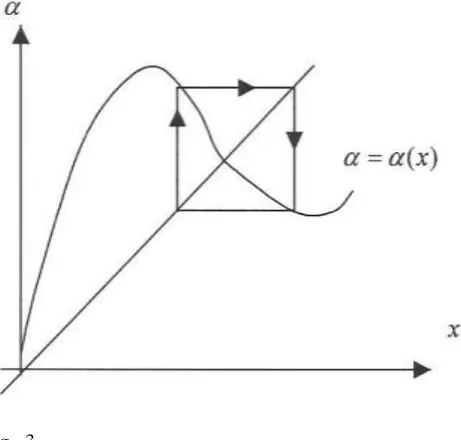
In Figure 3, the condition for cyclic trajectories is the existence symmetrical points with respect to the bisector
y
x
. The point has the coordinates( , ( ))
x
0
x
0 and the other has the coordinates( ( ),
x
0x
0)
and both belong to the graphic of the functiony
( )
x
. In the special case, then both points coincide the degenerate cycle result. In this case
( )
x
0
x
0. [image:2.595.51.284.446.668.2]Fig. 4.
[image:3.595.45.547.40.766.2]
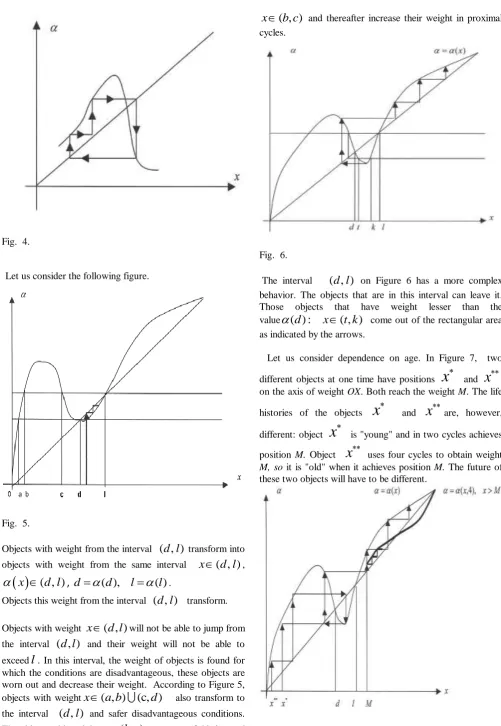
Let us consider the following figure.
Fig. 5.
Objects with weight from the interval
( , )
d l
transform intoobjects with weight from the same interval
x
( , )
d l
,
x
( , )
d l
,d
( ),
d
l
( )
l
.Objects this weight from the interval
( , )
d l
transform.Objects with weight
x
( , )
d l
will not be able to jump fromthe interval
( , )
d l
and their weight will not be able toexceed
l
. In this interval, the weight of objects is found for which the conditions are disadvantageous, these objects are worn out and decrease their weight. According to Figure 5, objects with weightx
( , )
a b
(c, )
d
also transform tothe interval
( , )
d l
and safer disadvantageous conditions. The objects with weightx
( , )
b c
come out of this interval( , )
x
b c
and thereafter increase their weight in proximal cycles.
Fig. 6.
The interval
( , )
d l
on Figure 6 has a more complex behavior. The objects that are in this interval can leave it. Those objects that have weight lesser than the value
( ) :
d
x
( , )
t k
come out of the rectangular area as indicated by the arrows.Let us consider dependence on age. In Figure 7, two
different objects at one time have positions
x
andx
on the axis of weight OX. Both reach the weight M. The lifehistories of the objects
x
andx
are, however, different: objectx
is "young" and in two cycles achievesposition M. Object
x
uses four cycles to obtain weight M, so it is "old" when it achieves position M. The future of these two objects will have to be different.[image:3.595.308.550.522.752.2]
We propose to take into account cycles (age). Consider the function
( , )
x e
with a continuous variable - individual parameterx
and another discrete variable -number of cycles. The graph of development of object
x
is
( , 2),
x
x
M
and the graph of development ofobject
x
is
( , 4),
x
x
M
.We assume that the individual and the group parameters for both resources are the same, and the ranges of variation of the individual parameters are different. Resource
1 has arange of variation equal to
I
1
(0, x
1max)
and resource2
has a range of variation equal toI
2
(0, x
2max)
. Time interval
t t
0,
0
T
is divided into subintervalsT
k,
t t
0,
0
T
T
k. The subintervals are chosen takinginto account the changes taking place in system
S
and the human activity.To avoid introducing new notation, the symbols are independent and are not related to the symbols in the previous sections.
Let
b
1k(x,
e
)
be a shift which describes the change of the individual parameterx
of the resource
1 during1
[t
, t ]
k k k
T
. For the resource
2 we denote the corresponding shift by
2k.Let
b
1k
(x,
e
)
,b
2k(x,
e
)
be differentiable functions andtheir inverse functions be
a
1k
(x,
e
)
,a
2k(x,
e
)
.Applying the approach proposed in [5] we obtain a system of balance relations with non-Carleman shifts
a
1k
(x,
e
)
,a
2k(x,
e
)
:1k 1
(x)
(A
1k 1k)(x),
2k 1(x)
(A
2k 2k)(x),
where
1 1
(A
k
k)(x)
1 1 1 1 1 1 1
(B
k
k)(x) (B
kq
k)(x)
P x
k( )
R
k( )
x
g
k( ),
x
(B
1kn
1k)(x)
=
d
1k(
x
,
e
)
n
1kéë
a
1k(
x
,
e
)
ùû
,
and2 2
(A
k
k)(x)
=2 2 2 2 2 2 2 2
(Bk k)(x) (B kqk)(x)Pk( )x Rk( ) p ( )x k x gk( ),x
where
1k
x
and
2k
x
are densities at the momentt
kof the objects with individual parametersx
for the first and the second resources respectively.Here, the processes of reducing the group parameters (natural mortality) are described by
d
ik.
The termsP
1k,
P
2kare responsible for the processes of natural increase of the group parameters (reproduction), the terms
R
1k,
R
2k are responsible for the reciprocal influence between resources. They have the same form as their corresponding terms in the balance equations and contain integrals with degenerate kernels.The extractions from the system as a result of human economic activity are represented by
g
ik( )
x
.The artificial input into the system is accounted for by
q
ikthe beginning of period
T
k and the actions related tog
iktake place at the end of period
T
k.We will assume that the actions related to
q
iktake place atWe will assume that the actions related to
q
iktake place atthe beginning of period
T
k and the actions related tog
iktake place at the end of period
T
k.State of the system
1k
x
,
2k
x
at the momentst
kare described by the two presiding equations.
Note that we do not require for the final state and the initial state of system
S
to coincide. We obtain an open system
1k 1
x
1kx
,
2k 1x
2kx
.III. EXPLOITATION PROBLEMS FOR OPEN RESOURCE
SYSTEMS
Let us formulate problems for the exploitation of open resource systems.
We introduce into consideration a functional that estimates the system during the period
t t
0,
0
T
.
g q
E
E
E
Let
C
ikjg be some known constants1
,
( )
ij
ij
x g ikj
x ik
g
C
d
where
g
ik( )
is the substraction of resource
i from thesystem during the period
T
k
[t
k1, t ]
k .Here, interval
0,
x
maxi
is divided into0 1 2 max
0
x
i
x
i
x
i
x
i .We write the functional
,
g g g
ik ikj ikj
E
C G
where
C
ikjg are some known constants (product prices). ItBased on the presented model, it is possible to formulate some problems for the rational use of system
S
. What should the strategy for the selection ofq
ik andg
ik on eachinterval
T
k be, in order to reach the maximum value ofE
at the final moment
t
0
T
.Thus, of course, you must comply with various restrictions. We list some. (To simplify the presentation and make it brief, we omit the dependence on age.)
Restrictions on functions
q
ik( )
x
:max
( )
,
,
ikj ikj ikj Iij
ik
Q
Q
Q
q
d
and
min max
,
q q q
ikj ikj ikj
E
E
E
E
ikjq
C Q
ikjq ,min max
,
q q q
ikj ikj ikj
j
E
E
E
min max
0 0
q q q
i ikj i
k j
F
E
F
,
min max
0 0
,
q q q
k ikj k
i j
F
E
F
min max
.
q q q
E
E
F
Restrictions on functions
g
ik( ) :
x
g min g max
(
)
,
,
g g
ikj ikj ikj ikj ik
Iij
G
G
G
G
g
d
q min g max
,
q
ik ikj ikj
j
G
G
G
min max
0 0
,
q q q
i ikj i
k j
K
E
K
min g max
0 0
,
q g
k ikj k
i j
K
G
K
g min g max
,
g
G
G
F
g min g max
00 00 00
,
00.
g g
ik ik
G
G
G
G
G
The state of the system cannot be worse than the permissible state and ecologically acceptable norms must be met.
Restrictions on functions
ik( )
x
: min,
( )
,
ikj ikj ikj
Iij ik
N
N
N
d
min min
0
,
0 0.
ik ikj k ik
j i
N
N
N
N
The functions
ik( ),
x
q
ik( ),
x
g
ik( )
x
must be non-negative.Authors plan to make simplifications of the form of functions, functionals and algorithms for applications to solving specific problems, and submit it to the following WCE congresses.
IV. CONCLUCION
Equations with shift appear on modelling systems with renewable resources. The theory of linear functional operators with shift is the adequate mathematical instrument for the investigation of such systems. Based on the models, it is possible to formulate and to study problems for the rational use of open resource systems.
REFERENCES
[1] A. Tarasenko, O. Karelin, G. P. Lechuga, and M. G. Hernandez, “Modelling systems with renewable resources based on functional operators with shift,” Applied Mathematics and Computations, vol. 216, Issue 7, pp. 1938-1944, 2010.
[2] O. Karelin, A. Tarasenko, and M. G. Hernandez, "Application of functional operators with shift to the study of renewable systems when the reproductive processed is described by integrals with degenerate kernels," Applied Mathematics (AM), vol. 4, pp. 1376--1380, 2013.
[3] O. Karelin, M. Gonzalez-Hernandez, N. Hernandez-Romero, and J Seck-Tuoh-Mora, “Study of renewable systems based on functional operators with shift”, Applied Mathematical Sciences, vol. 9, no. 144, Hikari Ltd, pp. 7167-7173, 2015.
[4] O. Karelin, A. Tarasenko, V. Zolotov, and M. Gonzalez Hernandez, “Mathematical Model for the Study of the Equilibrium State Renewable Systems Based on functional operators with shift,”
Lecture Notes in Engineering and Computer Science: Proceedings of the World Congress on Engineering, 5-7 July, 2017, London, U.K., vol. 1, pp. 40—44, 2017.
[5] O. Karelin, A. Tarasenko, V. Zolotov, and M. Gonzalez Hernandez, “Study of the equilibrium state of systems with two renewable resources based on functional operators with shift,” IAENG International Journal of Applied Mathematics, vol. 48, no. 1, pp. 98—104, 2018.
[6] K. E. Atkinson, The Numerical Solution of Integral Equations of the Second Kind, Cambridge University Press, 1997.
[7] A. J. Jerry, Introduction to Integral Equations with Application, 2nd ed. Yohn Wiley@Sons, 1999.
[8] C. W. Clark, Mathematical Bioeconomics: The Optimal Management of Renewable Resources, 2nd ed. Yohn Wiley@Sons, New York, 1990.
[9] Y. Xiao, D. Cheng, and H. Qin, "Optimal Impulsive control in periodic ecosystem," Systems and Control Letters, vol. 55, no.2, pp. 558-565, 2006.
[10] M. Bohner, and A. Peterson, Dynamic Equations on Time Scales: An Introduction with Applications, Birkhauser, Boston, 2001.
[11] L. Wang, and M. Hu, "Nonzero Periodic Solutions in Shifts Delta (+/-) for a Higher-Dimensional Nabla Dynamic Equation on Time Scales," IAENG International Journal of Applied Mathematics, vol. 47, no.1, pp. 37-42, 2017.