Supporting Arms Observer,
Spotter and Controller
U.S. Marine Corps
DEPARTMENT OF THE NAVY Headquarters United States Marine Corps
Washington, DC 20380-1775
15 October 1998
FOREWORD
1. PURPOSE
Marine Corps Warfighting Publication (MCWP) 3-16.6, Supporting Arms Observer, Spotter, and Controller, provides the techniques and procedures for requesting and adjusting supporting arms.
2. SCOPE
This publication provides techniques and procedures for requesting, adjusting, and controlling mortars, artillery, naval gunfire, and close air support. It is intended as a field reference for supporting arms observers (mortar and artillery forward observers, naval gunfire spotters, and forward air controllers) and as a study guide and field reference for personnel seeking information on supporting arms procedures.
3. SUPERSESSION
Fleet Marine Force Manual (FMFM) 6-8, Supporting Arms Observer, Spotter, and Controller, dated 24 June 1994.
4. CERTIFICATION
J.E. RHODES
Lieutenant General, U.S. Marine Corps Commanding General
Marine Corps Combat Development Command
To Our Readers
Changes: Readers of this publication are encouraged to submit suggestions and changes that will improve it. Recommendations may be sent directly to Commanding General Marine Corps Combat Development Command, Doctrine Division (C42), 3300 Russell Road, Suite 318A, Quantico, VA 22134-5021 or by fax to (703) 784-2917 (DSN 278-2917) or e-mail to smb@doctrine div@mccdc.
Recommendations should include the following information:
Location of change
Publication number and title Current page number
Paragraph number (if applicable) Line number
Figure or table number (if applicable) Nature of change
Add, delete
Proposed new text, preferably double spaced and typewritten Justification and/or source of change.
Additional copies: A printed copy of this publication may be obtained from Marine Corps Logistics Base, Albany, GA 31704-5001, by following the instructions in MCBul 5600, Marine Corps Doctrinal Publications Status. An electronic copy may be obtained from the Doctrine Division, MCCDC, World Wide Web home page, which is found at the following uniform resource locator:
http://138.156.107.3/docdiv.
Unless otherwise specified, masculine nouns and pronouns used in this publication refer to both men and women.
(reverse blank)
Introduction
The technology and organizations for providing supporting arms today are products of our training and operational experience over the past 100 years. Initial techniques for controlling fires of artillery and naval rifles were limited to direct fire, where the crew of the weapon had to see the target. This was primarily because of the lack of a long-range observation and communications capability. These crude measures for controlling fires could prove hazardous to friendly as well as enemy forces, as the Marines found out during operations in Cuba during the Spanish-American War.
On June 14 [1898] Captain George F. Elliott led two infantry companies and a detachment of fifty Cuban scouts on a circular six-mile march toward Cuzco Well [location of a Spanish camp]. Although the Marines did not surprise the Spanish garrison of battalion strength, they won the foot race to the hill that dominated the Spanish camp and caught the enemy in the valley. At ranges up to 1,000 yards the Marines peppered the Spaniards with rifle and machine gun fire. During the fighting another Marine platoon on outpost duty on its own initiative closed off the head of the valley and caught the enemy in a crossfire, while the dispatch ship Dolphin added its shells to the general firing. The Dolphin’s shells, fired without much direction, also drove the Marine platoon from its position until the shelling was stopped by a wigwag message from Sergeant John H. Quick.1
supporting defensive positions. This support was provided by U.S. Army and allied artillery because Marine artillery units did not deploy to France.2
Although techniques for controlling indirect fire had progressed, their responsiveness and flexibility in changing situations were still hampered by a lack of portable, reliable communications. This deficiency would eventually be overcome by the introduction of tactical radios.
Marine aviation began in 1913 when 1stLt Alfred A. Cunningham was designated as naval aviator number 5. Marine aviation’s first involvement in combat occurred in the latter part of World War I during which it conducted aerial observation and bombing missions as part of the Allied air effort. Marine aviation’s first independent mission was flown in 1918 against a German-held railyard in Belgium.3 Marine aircraft were used for a variety of missions from resupplying remote patrols and outposts to providing close air support (CAS) to ground units in the “Banana Wars” during the 1920s. Communications between ground forces and aircraft, although generally effective against the guerrillas, were anything but sophisticated.
The lessons learned from using aircraft to attack ground targets and the need for close coordination between the Marine in the air and the Marine on the ground during these actions were reflected in the Marine Corps Small Wars Manual of 1940.
In order to secure the full measure of cooperation between the air and ground forces, it is necessary that each understands the problems of the other. The aviator must know something of the tactics of the ground patrol, and he must be ready and willing to assume any justified risk to assist the ground commander. On the other hand, the ground commander should understand the hazards and limitations imposed on aviation operating over difficult terrain, and should not expect the impossible.5
This sense of teamwork and the initial procedures for controlling CAS developed between the World Wars would be put to the test during operations in the Pacific during World War II.
World War II provided Marines with the opportunity to make major developments in the techniques for controlling supporting arms. It was an evolutionary process. Marine artillery expanded from the organic regiments of each division to include heavy artillery assigned to the amphibious corps. Marine artillery was used to provide direct fire on enemy bunkers throughout the war, and forward observers (FOs) called for and adjusted indirect fire in support of maneuver units.
...the Naval Gunfire Section turned Kahoolawe Island, Hawaii, into a ship gunnery school and eventually supervised the qualification firing for 532 Pacific Fleet warships. The training exercises dramatized the need for intelligent gunfire spotting. The NGF Section first stressed putting trained Marine ground officers into spotting aircraft but then shifted to training Navy and Marine officer spotting teams for ground employment.6
In October of 1944, LtGen Smith formed the Marine Air Support Control Unit, which was commanded by Col Vernon Megee. The unit provided CAS training and expanded the ability of landing force commanders to plan and direct airstrikes.
The final step in improving close air support—actually directing the strikes from the front lines against targets close to friendly troops—also originated with Megee’s command. Equipped with improved jeep-mounted radios, Marine air controllers argued, they could direct strikes against ground targets within hundreds (rather than thousands) of yards of American troops by communicating directly with the aircraft. This technique, which ran counter to Navy and Army doctrine, required air strike controllers well versed in ground tactics and aircraft capabilities. At first the forward air controllers were air-indoctrinated ground officers, but the Air Liaison Parties (ALPs) soon became the instrument of pilots-turned-infantrymen. This reform proved successful for the Army in the Philippines and the Marine Corps on Okinawa.7
Corps’ current procedures for controlling supporting arms. Although they would continue to be refined, the basic concepts have remained valid to this day. Although the use of semaphore has given way to data burst transmissions, the requirement for a Marine who is capable of controlling the fires of supporting arms remains crucial to success in combined-arms operations.
Table of Contents
Page
Introduction
Chapter 1. Supporting Arms Observers, Spotters, and
Controllers
Section I. Artillery Forward Observer Team
1101 Responsibilities 1-2
1102 Communications 1-5
Section II. 81-mm Mortar Forward Observer
1201 Responsibilities 1-9
1202 Communications 1-10
Section III. Naval Gunfire Spot Team
1301 Responsibilities 1-11 1302 Communications 1-12
Section IV. Forward Air Control Party
1401 Responsibilities 1-14 1402 Communications 1-15
Section V. Employing Supporting Arms Observers,
Spotters, and Controllers
1501 Offensive Operations 1-18 1502 Defensive Operations 1-21
1503 Patrols 1-22
1504 Retrograde Operations 1-22
Chapter 2. Target Location
Section I. Elements and Tools of Target Location
2101 Map Reading 2-1
2102 Direction 2-2
2103 Determining Angular Deviation 2-7
2104 Distance 2-11
2105 Altitude 2-18
2106 Tools To Assist the Observer 2-19
Section I. Artillery and Mortar Call for Fire
3101 Elements of the Call for Fire 3-1 3102 Observer Identification and Warning Order 3-2
3103 Target Location 3-4
3104 Target Description, Method of 3-6 Engagement, and Method of Fire and Control 3105 Call for Fire for Suppressive Fire 3-16
3106 Direction 3-18
3107 Message to Observer 3-18
3108 Authentication 3-21
3109 Report Upon Firing 3-23 3110 Correction of Errors 3-34 3111 Call for Fire From Headquarters Higher 3-24
Than Battalion
Section II. Naval Gunfire Call for Fire
3201 Fire Unit Status 3-25 3202 Elements of the Call for Fire 3-25 3203 Spotter Identification, Warning Order, and 3-26
Target Number
3204 Target Location, Target Description, 3-27
Method of Engagement, and Method of Control
3205 Report Upon Firing 3-39 3206 Correction of Errors 3-39
Section III. Adjustment of Fire
3301 Spottings 3-41
3302 Corrections 3-47
3303 Fire-for-Effect Phase 3-57 3304 Naval Gunfire Adjustment Procedures 3-61 3305 Adjusting Artillery Air Bursts 3-64 3306 Adjusting Naval Gunfire Air Bursts 3-68
Chapter 4. Requesting and Controlling Close Air
Support
4001 Types of Close Air Support 4-1 4002 Levels of Threat 4-2 4003 Airspace Control Measures 4-3 4004 Coordination Techniques 4-7 4005 Aircraft Ordnance 4-9 4006 Close Air Support Request and Control 4-13
Procedures
4007 Request 4-13
4008 Brief 4-22
4014 The Report 4-35 4015 Air-Delivered Ordnance in Vicinity of 4-36
Friendly Troops
4016 Emergency Procedures for Requesting 4-38 Close Air Support
Chapter 5. Artillery and Mortar Special Situations
Section I. Artillery and Mortar High-Angle Fire
5101 Procedures 5-1
Section II. Artillery and Mortar Precision Fire
5201 Artillery Registration Missions 5-2 5202 Precision Registration for Mortars 5-13 5203 Destruction Missions 5-16
Section III. Artillery High-Burst or Mean Point of Impact Registrations
5301 General 5-18
5302 Procedures for High-Burst Registration 5-19 5303 Procedures for Mean Point of Impact 5-25
Registration
Section IV. Artillery Improved Conventional Munitions
5401 Antipersonnel Round 5-26 5402 Dual-Purpose Round 5-27
5403 Dispersion 5-28
5404 Improved Conventional Munitions Call for 5-29 Fire and Adjustment
5405 Employment Considerations 5-32
Section V. Artillery Family of Scatterable Mines
5501 Remote Antiarmor Mine System Projectiles 5-33 5502 Area Denial Artillery Munitions Projectiles 5-33 5503 Types of Minefields 5-34 5504 Target Location 5-35 5505 Family of Scatterable Mines Call for 5-36
Fire and Adjustment
5506 Employment Considerations 5-37
Section VI. Artillery and Mortar Illumination
5601 Employment of Illumination 5-38 5602 Illumination Patterns 5-39 5603 Illumination Call for Fire and Adjustment 5-42 5604 Coordinated Illumination 5-45
5705 Types of Smoke Missions 5-62 5706 Safety Considerations 5-72
Section VIII. Artillery and Mortar Final Protective Fires
5801 Employment of Final Protective Fires 5-74 5802 Final Protective Fire Procedures 5-74
Section IX. Nonstandard Procedures for Artillery and Mortars
5901 Adjustment of Fires by Sound 5-79 5902 Multiple Missions 5-81 5903 Auxiliary Adjusting Point 5-81 5904 Disoriented Observer 5-82 5905 Irregular-Shaped Targets 5-83 5906 Emergency Observer Procedures 5-85
Chapter 6. Naval Gunfire Special Situations
6001 Illumination 6-1
6002 Smoke 6-8
6003 Fresh Target Shift 6-8 6004 New Target Shift 6-12
6005 Simultaneous Engagement of Two Targets 6-12 6006 Firing on a Recorded Target 6-13 6007 Destructive Fire 6-14
6008 Massed Fire 6-14
6009 Special Naval Gunfire Commands and 6-15 Reports
Chapter 7. Aerial Observation
7001 Aerial Observer 7-1
7002 Prelaunch Considerations 7-1 7003 Reporting In and Out 7-2
7004 Call for Fire 7-6
7005 Adjustment of Fire 7-9 7006 Forward Looking Infrared Receiver 7-10 7007 Laser Designators 7-11
Chapter 8. Suppression of Enemy Air Defenses
8001 SEAD Coordination 8-1 8002 Planned SEAD Missions 8-2 8003 Immediate SEAD Missions 8-2 8004 SEAD Decisionmaking 8-3 8005 Separation Techniques 8-6 8006 Airspace Control Measures 8-17
Weapons Systems
9001 Purpose 9-1
9002 Basic Requirements 9-1 9003 Laser Emission Systems 9-2 9004 Laser Acquisition Devices 9-4 9005 Laser-Guided Munitions 9-5 9006 Laser Energy Reflectivity 9-7 9007 Laser-Guided-Munition Planning 9-13 9008 Methods of Employment 9-18 9009 Employment Considerations 9-19 9010 Copperhead Engagement Characteristics 9-22 9011 Copperhead Call for Fire 9-30 9012 Message to Observer 9-33 9013 Trigger Points 9-33
9014 Copperhead Engagement Commands 9-37
9015 Survey Control 9-39
9016 Laser Polar Missions 9-48
9017 Target Shifts 9-50
9018 Registrations with MULEs 9-51 9019 MULE Employment by the Naval 9-52
Gunfire Spot Team
9020 AN/GVS-5 Laser Rangefinder Employment 9-53
Appendixes:
A Target Analysis and Munitions Effects B Crater Analysis
C Observation Post
D Timing the Delivery of Fire Support E Construction of the Visibility Diagram F Weapons Reference Data
G Glossary H Notes
The Marine Corps has four organizations that provide a maneuver company with observers, spotters, and controllers who are specifically trained to plan, call for, adjust, and control supporting arms. They are the artillery FO team, 81-mm mortar FO, NGF spot team, and forward air control party (FACP). Whether a company has one organization or all four attached for an operation (or phase of an operation) depends on the situation and mission.
Section I. Artillery Forward Observer Team
Each firing battery of the artillery battalion has three FO teams. One of these teams is provided to each company-sized unit/element of the supported force. The number of FO teams may vary with the composition of the force and structure limitations. The FO team is led by a Marine lieutenant who is trained in fire support coordination and advises the company commander on the employment of fire support assets. The FO team plans and coordinates artillery fires with the fires of other supporting arms at the company level. It is trained to adjust artillery, rockets, mortars, and NGF, as well as report battlespace information. The FO team can operate within a maneuver element or from an artillery observation post (OP).
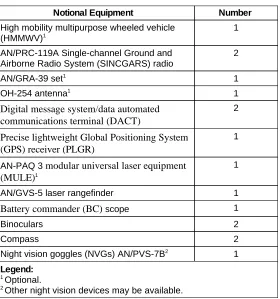
An FO team’s composition may vary with the mode of operation, availability of personnel, and type of force supported, for example, a mechanized unit with limited vehicle space or with a footmobile unit. (See table 1-1 below and table 1-2 on page 1-3 for the personnel and notional equipment of an FO team.)
Table 1-1. Artillery Forward Observer Team Personnel.
Position/Rank/Military Occupational Specialty (MOS)
Number
FO/lieutenant/0802 1
Fire support man/lance corporal/0861 1
Radio operator/corporal/2531 1
Radio operator/private/2531 1
1101. Responsibilities. The primary responsibility of the FO is to plan and coordinate supporting fires at the company level. The FO team locates targets, calls for and adjusts fire, and reports the results of fire. In combat or emergency situations when there is no FAC present, the FO may function as the terminal controller for CAS strikes. The FO team must perform the following tasks:
Assist the commander in overall fire support planning and coordination matters.
Advise the commander on the employment of artillery. The FO
High mobility multipurpose wheeled vehicle
(HMMWV)1
1
AN/PRC-119A Single-channel Ground and Airborne Radio System (SINCGARS) radio
2
AN/GRA-39 set1
1
OH-254 antenna1 1
Digital message system/data automated communications terminal (DACT)
2
Precise lightweight Global Positioning System (GPS) receiver (PLGR)
1
AN-PAQ 3 modular universal laser equipment
(MULE)1
1
AN/GVS-5 laser rangefinder 1
Battery commander (BC) scope 1
Binoculars 2
Compass 2
Night vision goggles (NVGs) AN/PVS-7B2
1
Legend:
1
Optional.
2
Other night vision devices may be available.
Plan artillery fires for the company. This includes normal and quick fire planning. The plan is approved by the company commander.
[image:23.612.59.339.81.380.2]Be familiar with standing operating procedures (SOPs) of the supported and supporting unit, including fire support SOPs and the company’s combat SOP.
Know the tactical situation, including the scheme of maneuver or plan of defense, and the enemy situation.
Maintain continuous observation of the zone. The zone of observation is the zone of action of the supported unit or the zone of fire of the parent battalion. The FO team must occupy the best OP or position permitted by the tactical situation. Determine and refine target locations, engagement criteria, and trigger points as required.
Make a terrain sketch of the area, whenever possible, to improve accuracy and speed in locating targets. When setting into a defensive position, the FO should construct a visibility diagram to pinpoint those areas where targets could remain unseen from his vantage point. See appendix E for construction of a visibility diagram.
Report all target and intelligence information by using the size, activity, location, unit, time, and equipment (SALUTE) format and report actions of enemy aircraft and conduct crater analysis. Ensure constant communications with the battery or battalion
Maintain the FO team location to within 100 meters (six-place grid) at all times. Periodic position reports (POSREPs), coordinated with the reporting of the company commander, should be made to the LNO. In the absence of a unit SOP or special instructions, a rule of thumb for reporting position changes is every 500 meters on foot or every 2 to 5,000 meters in a fast-moving operation.
Provide security for the team through the proper use of cover, concealment, observation, and fire.
Conduct regular preventive maintenance of all equipment belonging to the FO team.
Observe and direct other types of fire support when necessary, for example, mortars, NGF, and CAS.
Assist in training Marines with nonsupporting arms MOSs to request fire support, if required.
1102. Communications. The artillery FO must maintain effective communications to perform his mission. He has several means available.
a. Radio. The FO team uses radio traffic as its primary means of communication. All members of the team must be communications experts; they must maintain the gear to the highest degree of
performance, troubleshoot, and enhance performance when possible through the use of directional antennas and so on. The following nets are employed by the FO team.
(1) Artillery Conduct of Fire Net (Very High Frequency). This net provides a means for observers to request and adjust artillery fire. The artillery LNOs at battalion FSCCs monitor/receive traffic on the net for fire support coordination purposes. FOs and LNOs may use the net to plan and coordinate fires. If conducting
battalion-directed operations, the battalion establishes as many as
three conduct of fire (COF) nets and acts as net control on each. The artillery battalion may identify a COF net for each maneuver battalion to facilitate continuity of fire support during battery displacements. The maneuver battalion (LNOs, FOs) remains on the assigned COF net, and the artillery battalion FDC receives all calls for fire. It then designates which firing battery, or batteries, will provide fire support to the maneuver battalion. This allows the artillery battalion to quickly mass on larger targets, as well as manage the assets of the battalion as a whole. If conducting
autonomous operations, each battery FDC maintains a COF net and
acts as net control; each net is monitored by the battalion FDC when present. Autonomous operations are also conducted by batteries attached to a battalion landing team (BLT). The artillery LNO at the battalion FSCC monitors all traffic on this net for coordination purposes. The artillery LNO at the infantry regiment may enter the net, as required. The stations on this net include the
Artillery LNO at regimental FSCC, as required Reinforcing artillery units, as required.
(2) Division/Ground Combat Element Artillery Air Spot Net (Very High Frequency). The artillery regiment (battalion when operating independently) establishes this net for aerial observers to adjust artillery fire. The artillery regiment is net control; however, for a specific mission, control may be passed to the battalion or battery FDC conducting the mission. When this net is in use, the LNO monitors for targets in his unit’s zone. The FO may use this net to coordinate with an aerial observer for the attack of targets in his company’s zone of action. The stations on this net include the following:
Artillery regiment (net control) (For specific missions, control may be passed to the FDC conducting the mission (battalion or battery).)
Aerial observer
Artillery battalion, as required Firing battery, as required
FOs, as required FSCCs, as required.
(3) Maneuver Tactical (Company Tactical) Net (Very High Frequency). Monitoring maneuver tactical nets is not a requirement for the FO team. However, the ability to monitor multiple channels with the PRC-119 enables the FO team to use company nets to increase situational awareness without requiring additional radios.
b. Automated Systems. Handheld devices, such as the digital message system or DACT, enable users to rapidly prepare, transmit, and receive both text and graphic messages over radios or field wire. Automated systems use a burst transmission capability, which minimizes vulnerability to enemy radio direction finding. It is used by the FO to transmit calls for fire, fire plans, and battlespace information. The DACT is currently being fielded, and fire support software is under development. When using automated systems, the FSCC establishes a mode of operation, which determines the routing of calls for fire through the FSCC. In FSCC-approval mode, the call for fire is sent to the FSCC for clearance then forwarded to the supporting arm. In centralized mode, the request goes to the appropriate artillery FDC first. One or more COF nets should be dedicated to data communications. Note that the artillery battalion still organizes itself to receive missions by using battalion-directed and autonomous operations.
c. Wire. The FO uses wire communications to the extent permitted
frequently when tactical situations permit. This method is a more secure method of sending fire plans than other means. It reduces radio traffic, thereby hampering enemy direction finding.
Section II. 81-mm Mortar Forward Observer
Two FOs are included in each of the two sections of the 81-mm mortar platoon that is organic to the weapons company of the infantry battalion. The infantry battalion commander may employ the mortar platoon by section or as a platoon. The mortar FOs are normally employed with the rifle companies. The mortar FO carries his own radio.
1201. Responsibilities. The primary responsibility of the mortar FO is to locate targets and call for and adjust mortar fire. He performs basically the same duties as the artillery FO. The mortar FO coordinates and plans the use of the mortars for the supported company. The operations of the mortar FOs are coordinated by the mortar platoon commander. A mortar representative is normally positioned in the battalion FSCC to coordinate and advise on matters concerning mortars.
1202. Communications. The infantry battalion mortar net (very high frequency (VHF)) provides the means for requesting, adjusting, controlling, and coordinating the fires of the 81-mm mortar platoon. Stations on this net include the FO(s), the 81-mm
mortar section FDC (platoon FDC when employed as a platoon), the 81-mm mortar representative in the battalion FSCC, and the mortar platoon commander (net control).
Section III. Naval Gunfire Spot Team
The NGF spot team is one element of the shore fire control party (SFCP); the other is a liaison team. The artillery battalion employs its two organic SFCPs in support of the assault battalions in an amphibious assault. The NGF spot team is normally provided to a maneuver company; however, it may operate from a battalion OP. The NGF spotter, a Marine lieutenant, is the company’s expert on all matters concerning NGF support. Like the artillery FO team, its composition may be tailored to the needs of the supported unit. (See table 1-3 and table 1-4 on page 1-11 for the organization of the spot team and a list of notional equipment.)
Table 1-3. Naval Gunfire Spot Team Personnel.
Position/Rank/MOS Number
NGF spotter/lieutenant/0845 1
SFCP man/corporal/0861 1
SFCP man/private - lance corporal/0861 1
Radio operator/private - corporal/2531 2
Binoculars 3
Compass 3
Legend:
1
Includes KY-99 when NGF spot net is covered.
2
Optional.
3
Other night vision devices may be used.
1301. Responsibilities. The primary responsibility of the NGF spotter is to locate targets and call for and adjust NGF. The operation of the spot team is coordinated by the naval gunfire liaison officer (NGLO) in the battalion FSCC, assisted by the artillery S-3, as required. The NGF spotter performs other duties and operations similar to those of the artillery FO. The NGF spotter also performs the following tasks:
Plans NGF to assist the company in accomplishing its mission Keeps the NGLO in the battalion FSCC informed of the company’s tactical situation and the spot team disposition (Periodic POSREPs are provided to the NGLO and the ship.) Establishes and makes frequent contact with the other observers (artillery and mortar FOs) and the FAC supporting the company Remains abreast of what types of ship(s) and ammunition are available.
1302. Communications. The NGF spotter must have effective communications to accomplish his mission. He must understand the functioning of high frequency (HF) radio communications. The NGF spot team communicates by the following means.
a. Radio. The following nets are established.
(1) Naval Gunfire Ground Spot Net (Primary High Frequency/Secondary Very High Frequency). This net provides a means for requesting and adjusting NGF and for passing vital information between stations. Stations on this net include the NGLO in the battalion FSCC, the spotter, and the direct support ship. The NGLO, normally net control, monitors all traffic for purposes of coordination. One frequency is normally allocated to each battalion assigned a direct support ship. A general support ship assigned to support the battalion will enter the NGF ground spot net for the duration of the mission(s). The NGLO at the infantry regiment may monitor the net, as required.
(2)Shore Fire Control Party Local Net (Very High Frequency). This net provides direct communications between the NGF spot team and the NGLO in the battalion FSCC. It provides a means for coordinating the employment of the spot team and for coordinating NGF matters. The net is also used for communication between the NGF spotter and his spot team when separated. The NGLO exercises net control.
appropriate fire coordination agency will exercise net control. The supporting arms coordination center (SACC) is net control before transfer of control and coordination responsibilities ashore.
b. Wire. The spotter, like the artillery FO, has limited opportunities to use wire communications. When permitted by the situation, a land line is established between the NGF spotter and his SFCP men when operating separately and/or between the spotter’s OP and the NGLO.
Section IV. Forward Air Control Party
The FACP is a terminal control agency subordinate to the tactical air control party (TACP). The TACP is the “subordinate operational component of a tactical air control system designed to provide air liaison to land forces and for the control of aircraft.” (Joint Pub 1-02, DOD Dictionary of Military and Associated
Terms) TACPs are integral elements of the Marine Air Command
and Control System (MACCS) and are organic to infantry regiments and infantry, light armored reconnaissance (LAR), and tank battalions. Infantry and LAR battalion TACPs consist of an air party (air officer and communicators) and two FACPs that are typically attached to companies consistent with the commander’s planned employment of aviation. The FACP is led by a FAC, who is “an officer (aviator/pilot) member of the tactical air control party
who, from a forward ground or airborne position, controls aircraft in close air support of ground troops.” (Joint Pub 1-02) Naval aviators or naval flight officers serving as FACs are formally trained to provide terminal control and are officially designated as FACs by MOS. (See Marine Corps Warfighting Publication (MCWP) 3-23.1,
Close Air Support). In addition to the FAC, each FACP has four
enlisted radio operators. Regimental TACPs do not have FACPs. The tank battalion TACP includes two FACs but not the radio operators of the FACP.
1401. Responsibilities. Although not part of the aviation combat element (ACE), the FAC is an essential MACCS element. FACs are the primary terminal controllers of aircraft providing direct air support to task-organized maneuver elements. The FAC maintains radio communications with assigned support aircraft from a forward ground position. From this position, the FAC directs each CAS aircraft in its run on the target. This control aids target identification and enhances troop safety. The FAC may employ a laser system for designating targets. The primary duties of the FAC are as follows:
Control aircraft during the terminal phase of CAS missions to assist in target identification and minimize the danger to friendly troops.
Operate with the assault units of the battalion.
including target damage assessments.
Stay abreast of the supported unit’s plans, position, and needs. Stay abreast of the enemy situation, location of friendly units, and current target list.
Request and control aircraft in accordance with the MAGTF air employment plan.
1402. Communications. The FAC maintains communications with the air officer located in the battalion FSCC and with the air control agency. He establishes and maintains positive communications with assigned support aircraft from his forward position. The FACP communicates by the following means.
a. Radio. The following nets are used.
(1) Tactical Air Request Net (High Frequency). This net provides a means for units to request immediate air support from an air control agency. The FSCC at each echelon monitors this net and coordinates with the air control agency to approve, deny, or modify the requests. Target damage assessments and emergency helicopter requests may also be passed over this net. Preplanned air support requests may, if necessary, be passed over the tactical air request
(TAR) net if other means are not available. The stations on this net include FACPs; the direct air support center (DASC); FSCCs; the Navy tactical air control center (TACC); tactical air coordinators (airborne) (TAC(A)s), FACs (airborne) (FAC(A)s), or other terminal controllers; assault support coordinators (airborne) (ASC(A)s); and other MAGTF agencies, as required.
(2) Tactical Air Direction Net (Primary Ultrahigh Frequency/Secondary Very High Frequency (Depends on Aircraft)). This net provides a means for directing aircraft in CAS missions by the terminal controller (e.g., FAC) and for the air control agency to brief support aircraft on target information and handoff to the terminal controller or TAC(A).
(3) Tactical Air Control Party Local Net (Very High Frequency). This net provides a means for coordination between the air officer in the battalion FSCC and the FACPs.
b. Related Aviation Nets. The FAC may function on the following nets, when required.
(1) Helicopter Request Net (High Frequency/Very High Frequency). This net provides a means for TACPs of helicopterborne forces to request immediate helicopter support from the DASC or the helicopter direction center (HDC).
(2) Helicopter Direction Net (Ultrahigh Frequency/Very High
Section V. Employing Supporting Arms Observers, Spotters, and Controllers
The employment of observers, spotters, and controllers is coordinated by the artillery LNO, NGLO, air officer, and 81-mm mortar representative at the supported-battalion FSCC. The artillery battalion S-3 may assist in this coordination, as required. During operations, supporting arms personnel should remain close to the company commander to provide assistance as needed, mainly because the commander receives reports from all elements of his unit and must decide where fire support is most urgently needed. If they must be separated from the commander, communications must be established between them. The FO and NGF spotter are assisted in their duties by fire support men. The fire support men can locate targets and call for and adjust fire. They also assist in fire planning. The fire support men can be collocated with the FO/NGF spotter during operations or located with a forward element or OP.
1501. Offensive Operations. In offensive operations, supporting arms personnel should be in position to maintain contact with the company commander and to see the battlespace. Depending on the nature of the mission and the situation, specific supporting arms personnel (i.e., FO, FAC, or NGF spotter) may need to be
collocated with the commander to maintain voice contact; because not all companies will have a FAC or NGF spotter, this may often be the FO. Fire support men from the FO team and/or NGF spot team may be located with the company’s lead elements. In a mechanized unit, a designated individual (such as the FO) may be assigned a position on the commander’s vehicle (tank or assault amphibious vehicle (personnel variant) (AAV(P))) from which he can operate (e.g., the loader’s position on a tank). Fire support men may be similarly positioned with the lead platoon. Supporting arms personnel assist the supported unit commander in the offense by doing the following:
Planning fires to support the company’s attack and its reorganization following seizure of the objective (Fires are planned on confirmed and suspected enemy positions and key terrain. See MCWP 3-16, Fire Support Coordination, for detailed discussion on planning fires.)
Executing the fire support plan
Calling fire on targets of opportunity designated by the commander
Providing battlespace information regarding the enemy situation Providing additional channels of communication
and on the map
Conduct immediate action drills on contact
Maintain continuous communications and provide periodic POSREPs to the FDC, LNOs, air officers, and other observers, as required, during movement.
b. Attack, Exploitation, and Pursuit. When enemy contact has been made, supporting arms personnel position themselves where they can best observe the actions of the supported unit, conduct fire missions, and coordinate fires for the company commander. The fire support men may be positioned on a terrain feature that offers good observation of the company’s advance. The company commander is responsible for the fires of his company, including fire support. He either directs which targets to attack with fire support or approves missions. Supporting arms personnel must meet the following requirements:
Be familiar with immediate action drills on contact (via SOP, operation order (OPORD), or situational reporting)
Ensure that fires support maneuvering elements, that is, enable elements to close with and destroy or bypass the enemy
Assess the benefit of fires versus their risk to friendly forces, for example, suppression versus minimum safe distance
Consider the effects of shell/fuze combinations, for example, improved conventional munitions (ICM)
Incorporate movement of elements into the delivery time of fires.
c. Consolidation. During consolidation on the objective, supporting arms personnel perform the following tasks:
Send reports to the FDC, air officer, and LNOs, for example, situation reports (SITREPs) and new POSREPs
Establish defensive fires and fires to disrupt an enemy counterattack in the fire plan
Continue fire planning and make revisions/changes as necessary for the tactical situation
Maintain continuous observation and fire support.
1502. Defensive Operations. Supporting arms personnel plan their fires to support the company’s plan of defense. Artillery, mortar, NGF, and air fires are planned to break up the attack, repel the assault, limit or destroy penetrations, and support counterattacks.
Plan final protective fires (FPFs) (artillery and mortars) and make adjustments if the situation permits
Select an OP that provides good visibility of the company’s area of responsibility (Fire support men may be positioned with the FO or NGF spotter, a platoon, or forward element.)
Execute the fire plan, including battalion targets in the area of responsibility
Construct a visibility diagram of the company’s area of responsibility (artillery FO). (The diagram is prepared in duplicate; one copy is retained by the FO, and the other is forwarded through the artillery LNO to the battalion S-2. At the battalion level, coverage is planned for those areas not under ground observation. See appendix E.)
1503. Patrols. Providing fire support for friendly patrols is an important function for supporting arms personnel, particularly the artillery and mortar FOs. The FOs, FACs, and NGF spotters keep LNOs, air officers, and the FDC informed of friendly patrol plans. The FOs, FACs, and spotters may accompany the company commander on a patrol when the patrol consists of the major portion of the unit. Fire support men are normally positioned with the remainder of the company during their principal’s absence. Fire support men may accompany a platoon or smaller sized patrol.
Supporting arms for the patrol are coordinated before the patrol begins. The planning by fire support personnel should include the following actions:
Obtain from the company commander, along with the patrol leader, the size of the patrol, times of departure and return, mission, routes and checkpoints, and any special instructions. Assist the patrol leader in fire planning, following the guidance provided by the company commander. Fires are planned along the route on critical areas or key terrain by using priority targets when available.
Process the fire plan. Provide a copy to the patrol leader. Obtain from the patrol leader any special communications instructions or signals to be used.
Make arrangements to maintain communications, as required. 1504. Retrograde Operations. Selected supporting arms personnel (FO, FAC, or NGF spotter, depending on the situation) remain with the company commander throughout retrograde operations. The remainder of the teams displace with the withdrawing forces to maintain continuity of observation and fire. Fire support men may be employed in an overwatch position. Supporting arms personnel must perform the following tasks:
of fires.
Maintain orientation during movement.
(reverse blank)
Chapter 2
Target Location
Section I. Elements and Tools of Target Location
The observer’s capability to provide the company with effective fire support depends largely on his ability to locate targets quickly and accurately. The elements of target location consist of direction, distance, and altitude. Terrain/map analysis is key to accurate target location. Because terrain/map analysis is applicable to the artillery/mortar FO, the NGF spotter, the FAC, and other terminal controllers, the use of the word observer in this chapter will apply to all of them.
Locates himself within 100 meters of his actual location on the ground each time he moves
Uses prominent terrain features to relate potential target areas to grid locations on the map
Makes a thorough study of terrain by drawing a terrain sketch Associates the direction in which he is looking with a direction on the map and incorporates the map’s marginal information in orienting direction-determining tools.
2102. Direction. Direction is the most important element of target location and an integral part of terrain/map association and adjustment of fire. Direction is a term used by an observer to indicate the bearing of the spotting line.
a. Units of Measurement. Direction can be measured in mils or degrees. Degrees can be converted to mils when required.
Example
“Direction 1600.” (Understood to be mils grid.)
“Direction 1600 mils magnetic.” (Unit of measurement must be specified if different from the standard.)
(2) Degree(s). A degree is a unit of horizontal clockwise angular measurement that is equal to 1/360 of a circle. Degrees can be measured from grid, magnetic, or true north. When the observer uses degrees in the call for fire, he must specify the type.
Example
“Direction 090 degrees magnetic.”
(3) Conversion of Degrees to Mils. Degrees may be converted to mils by multiplying the number of degrees by 17.8.
Example
90 degrees x 17.8 = 1,602 mils
b. Types of Direction. There are several types of direction that can be used by the observer—an observer-target line (OTL), a gun-target line (GTL), cardinal or intercardinal directions, and an arbitrary reference feature.
adjustments. The standard unit of measurement is mils grid. Observer-target (OT) direction is determined as accurately as possible and transmitted to the nearest 10 mils (or nearest degree).
Example
A direction of 0642 mils would be transmitted as “direction 0640” (mils grid understood).
(2) Gun-Target Line. The GTL is “an imaginary straight line from the gun(s) to the target.” (Joint Pub 1-02) GTL is frequently used by aerial observers as a spotting line for adjustments of fire. It can also be used by ground observers, particularly when positioned on or near the GTL. When the GTL is used as a direction, the standard unit of measurement is mils grid. If the observer desires to use the GTL as a spotting line, he transmits “direction gun-target line” in the call for fire.
(3) Cardinal or Intercardinal Directions. This involves the use of one of the eight cardinal/intercardinal directions (north, northeast, east, southeast, south, southwest, west, northwest). It is often used by aerial observers. It can also be used by ground observers, but the accuracy in adjustment is reduced. (See figure 2-1 on page 2-5.)
Figure 2-1. Cardinal Direction.
(4) Arbitrary Reference Feature.The observer may use a natural or manmade feature (such as north-south river or road) from which reference is made in target location and/or adjustment of fire. This type of direction may be used by aerial observers. It may also be used in situations in which the transmission of the OTL may compromise the ground observer’s location. The observer may use an arbitrary feature to adjust fire.
Example
“Direction north-south road.”
(1) Using a Measuring Device. An observer can measure direction by using a compass or an instrument that has been oriented for direction, such as a MULE, BC scope, or aiming circle. (See paragraph 2106.)
(a) Lensatic or M2 Compass. The lensatic compass has an accuracy of only +/- 50 mils. The M2 compass must be declinated but provides readings to an accuracy of +/- 10 mils.
(b) Modular Universal Laser Equipment. The MULE has a north-finding module to determine direction to an accuracy of +/- 2 mils. Direction can then be read to the nearest mil. Advanced procedures can be used to orient the MULE for direction when the north-finding module is nonfunctional. A detailed discussion on the use of the MULE is contained in chapter 9.
(c) Battery Commander Scope. A BC scope, or aiming circle that has been oriented for direction, provides readings to one mil. The accuracy depends on the means of orientation.
using a reticle pattern (MULE/BC scope/aiming circle), five mils for handheld binoculars or AN/GVS-5, or 10 mils by hand.
(3) Scaling From a Map. The observer may scale direction from a map to an accuracy of 10 mils by using a protractor.
(4) Estimating. Estimating on the ground is the least accurate method, but it can be used when the observer requires speed or is separated from his map and compass. The observer should be able to visualize a cardinal/intercardinal direction, as depicted in figure 2-1, remembering that the sun and moon rise in the east and set in the west.
2103. Determining Angular Deviation. The observer must be able to determine angular deviation or measurement. In addition to using angular deviation or measurement to determine direction, he uses it for determining horizontal and vertical distances to target location and in determining corrections in adjustment. The observer can determine angular deviation or measurement by use of the following.
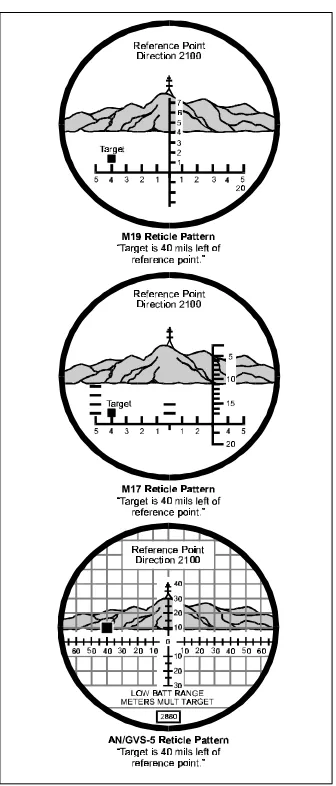
figure 2-2 and paragraph 2106.) When operating in a static situation, the observer can more accurately determine angular deviation by using the reticle pattern on a MULE, BC scope, or aiming circle. These instruments provide a stable platform and are extremely useful when accurate measurements are paramount, for example, for precision missions, for measuring vertical angles, and for night observation. When oriented, they provide accurate
direction. When not oriented, the reticle pattern can still be used to
measure angular deviation to an accuracy of +/- 1 mil.
b. Hand Measurement of Angles. The observer may use his hand and fingers for angular deviation or measurement in situations where speed is essential or when he has no other means. The observer fully extends his arm with the palm of his hand pointed toward the target area or reference point. By using the values contained in figure 2-3 on page 2-10, the observer can determine an approximate angular deviation or measurement. To increase his accuracy, the observer should determine the actual values of his hand and finger measurements. He does this by comparing a known deviation between two objects with that derived from his hand/fingers.
Figure 2-3. Hand Measurement of Angular Deviation.
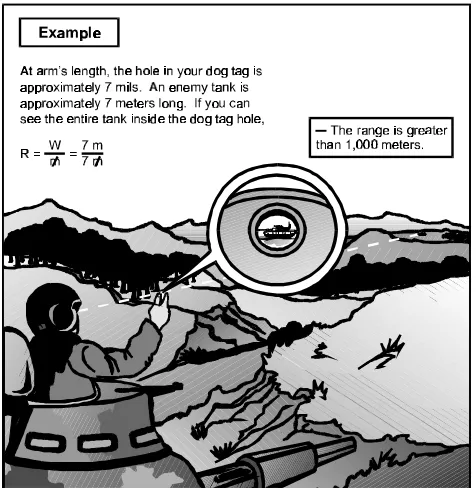
Figure 2-5. Determining Range With Common Objects.
be used if specified in the call for fire. Distance can be determined by one of the following methods.
a. By Measuring Distance (Laser Rangefinder). The MULE or the AN/GVS-5 provides the quickest, most accurate means of determining distance. When battery operated, its usage should be conserved. (See paragraph 9003.) The MULE and AN/GVS-5 measure distances to an accuracy of +/- 10 meters.
b. By Sound
(1) Sound Ranging: Flash-to-Bang Method. To determine distance by using the flash-to-bang method, count the number of seconds between a round detonation (flash) and the sound of the impact (bang), and multiply this time by the speed of sound (350 meters/second).
Formula
Flash to bang (sec) x 350 = distance (m)
methodcanalsobeusedtodeterminethedistance to the muzzle flash of an enemy weapon. When combined with a gooddirection,the observercanachieveaccuratetarget location data.
(2) Audible Sounds. There will be occasions when the observer will not be able to see the flash of a weapon or a round detonation. To estimate distance in these situations, the observer can use common sounds. Table 2-1 provides frequently heard noises with estimated distances.
Table 2-1. Audibility of Various Actions.
Maximum Distance (m) Sound
100 - 200 Human speech
300 Stakes being pounded into the ground by hand
500 Stakes being pounded into the ground
mechanically
500 - 1,000 Trenches being dug (shovel striking rocks or iron)
800 Tree cutting, tree falling
1,000 - 2,000 Automatic fire
3,000 Single rifle shot
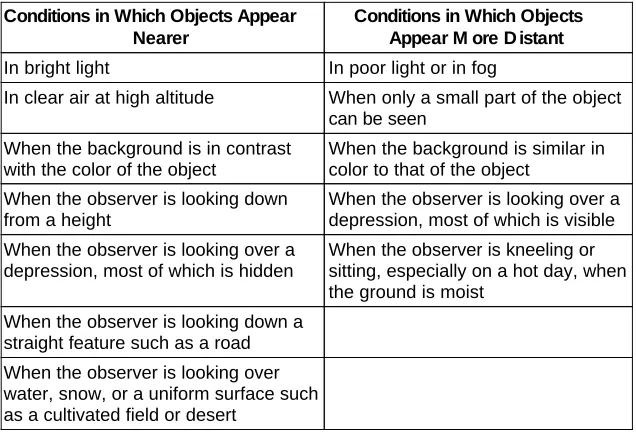
(1) Mental Estimation. A mental distance estimate is made by use of a known unit of measurement. Distance is estimated to the nearest 100 meters by determining the number of known units of measurement between the observer’s position and a target. For example, a football field, which is 100 yards long, can be used as a known unit of measurement for determining the distance between an observer’s position and a target. For longer distances, it may be required to progressively estimate distance. To do this, the observer determines the number of units of measurement to an intermediate point and doubles the value. The observer should consider the effects in table 2-2 to estimate distances.
Table 2-2. Considerations in Mental Estimation of Distances.
Conditions in Which Objects Appear Nearer
Conditions in Which Objects Appear More Distant
In bright light In poor light or in fog
In clear air at high altitude When only a small part of the object
can be seen
When the background is in contrast with the color of the object
When the background is similar in color to that of the object
When the observer is looking down from a height
When the observer is looking over a depression, most of which is visible
When the observer is looking over a depression, most of which is hidden
When the observer is kneeling or sitting, especially on a hot day, when the ground is moist
When the observer is looking down a straight feature such as a road
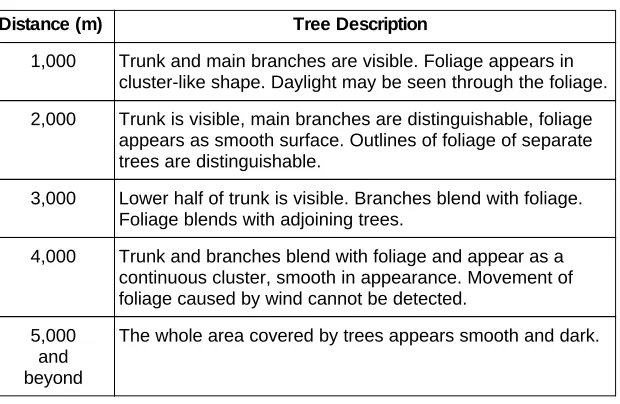
(2) Estimating When Visibility Is Good. When visibility is good, distances can be estimated by using the appearance of tree trunks, their branches, and foliage (as seen by the naked eye) in comparison with map data. Table 2-3 can be used as a guide for wooded terrain. Numerous other objects may be used to estimate distances as well. Table 2-4 on page 2-16 can be used as a guide for urban environments.
Table 2-3. Use of Trees and Foliage for Estimating Distance.
Distance (m) Tree Description
1,000 Trunk and main branches are visible. Foliage appears in
cluster-like shape. Daylight may be seen through the foliage.
2,000 Trunk is visible, main branches are distinguishable, foliage
appears as smooth surface. Outlines of foliage of separate trees are distinguishable.
3,000 Lower half of trunk is visible. Branches blend with foliage.
Foliage blends with adjoining trees.
4,000 Trunk and branches blend with foliage and appear as a
continuous cluster, smooth in appearance. Movement of foliage caused by wind cannot be detected.
5,000 and beyond
The whole area covered by trees appears smooth and dark.
and measuring the width in mils (m///), the distance can be determined by solving the formula for range in thousands (R), or R = W ÷ m///. This data, when compared with map data, will help an observer to estimate distances. Dimensions of equipment can be obtained from armored vehicle recognition cards (Graphic Training Aid (GTA) 17-2-13), which can be obtained from the battalion S-2 or supply officer. The dimensions of selected equipment are provided in table 2-5 on page 2-17.
Table 2-4. Use of Various Objects for Estimating Distance.
Distance (m) Object Identified by the Unaided Eye
1,000 Lone tree trunk
1,500 Individuals and horsemen
3,000 Chimneys on rooftops
4,000 Windows in houses
4,000 - 5,000 Individual houses in a populated area
8,000 - 9,000 Villages and individual houses
15,000 - 18,000 Large houses, towers, and steeples
direction, and refine distances. Particular emphasis should be given to color contrasts of terrain features seen along the OTL. For example, the distance across successive ridge lines or depressions in the distance may be identifiable by only slight changes of color to the eye. Different colors of grass might reveal a hidden terrain feature such as a stream.
Table 2-5. Example of Estimating Distance by Using Known Dimensions.
Equipment Dimensions (m)
Side View Front View
Tank (T-80) (chassis) 7.4 3.4
Tank (T-62) (chassis) 6.5 3.4
Reconnaissance vehicle (BRDM-2)
5.7 2.4
Reconnaissance vehicle (BTR-60)
7.5 2.8
Armored personnel carrier (BMP)
6.8 2.9
Air defense weapon (ZSU-23-4)
Example
An observer sees an armored personnel carrier (BMP). He measures its width as seen from a side view as two mils.
Formula
By using the formula, he determines the distance: R = W ÷ m/// where:
m
/// = 2 mils (measured by binoculars) W = 6.8 m (known dimension of side view)
R = 3,400 m (6.8 ÷ 2 = 3.4)
2105. Altitude. The third element of target location is altitude. Altitude is “the vertical distance of a level, a point or an object considered as a point, measured from mean sea level.” (Joint Pub 1-02) The meter is the standard unit of measurement for altitude. There are three methods of measuring altitude:
Map spot—if measured from a map spot, the altitude of a target is determined by use of contour lines and the contour interval of the map.
Vertical angle—laser polar missions specify the vertical angle in mils. This allows the FDC to incorporate the vertical shift with the associated distance for accurate target location.
Example
“Altitude 480,” “up 50,” and “vertical angle three.”
2106. Tools To Assist the Observer. The following tools are used by the observer in target location and terrain and map analysis. These tools include the M2 compass, binoculars, BC scope, GPS, OF fan, terrain sketch, and visibility diagram. Chapter 9 discusses AN/GVS-5 and MULE employment. The tools are most effective when used together.
a. M2 Compass. The M2 compass is the most accurate compass for determining direction (+/- 10 mils). It is a multipurpose instrument used to obtain azimuth readings and vertical angles. The magnetic needle (the white end of the needle) shows a magnetic north. The magnetic needle reading is taken from the black end when the bubble is centered in the circular level. The azimuth scale adjuster assembly rotates the azimuth scale to introduce the declination constant.
(1) Declinating the M2 Compass. The procedure for declinating the M2 compass from a surveyed declination station free from magnetic attractions is as follows:
Sight on the known, surveyed azimuth marker.
By using the azimuth adjuster scale, rotate the azimuth scale until it indicates the same as the known surveyed azimuth. Recheck sight picture and azimuth to the known point. Once the
sight picture is correct and the azimuth reading is the same as the surveyed data, the M2 is declinated.
The procedure for field-expedient declination of the M2 compass is as follows:
By using the azimuth adjuster scale, set off the grid-magnetic angle (shown on the bottom of all military maps).
Once the grid-magnetic angle has been set off on the azimuth scale, the M2 compass is declinated.
Note
Once declinated, the M2 compass measures grid azimuths.
(2) Measuring Azimuths With the M2 Compass. The procedure for measuring an azimuth follows:
Level the instrument by viewing the circular level in the mirror. Sight on the desired object, and read the azimuth indicated on the reflected azimuth scale by the south-seeking (black) end of the compass needle.
Figure 2-6. Measuring an Azimuth With the M2 Compass.
(3) Measuring Vertical Angles With the M2 Compass. The procedure to measure a vertical angle with the M2 compass is as follows:
Place the cover at approximately 45 degrees to the face of the compass so that the elevation scale reflection can be seen in the mirror. (See figure 2-7 on page 2-23.)
Sight on the target or crest, and center the elevation scale tubular level with the lever on the back of the compass and by viewing the elevation scale in the mirror.
Read the elevation in mils on the elevation scale. Measure again, and record the average.
Warning
The M2 compass must be employed free of magnetic attractions. Below are the minimum distances that should be kept when using the compass to
measure a direction. High-tension power lines: 55 m Artillery, trucks, or tanks: 10 m Telegraph, telephone, or barbed wire: 10 m
Crew-served weapons: 2 m Rifle or radio: 0.5 m
b. Binoculars. In addition to measuring angular deviation, binoculars enable observers to focus on distant objects. When using binoculars, the following considerations apply:
The binoculars must be held parallel to the deck and steadied against the body or a prop.
The protective plastic lens cap on the binoculars can be removed to increase the field of vision for observers who wear glasses. Masking tape can be used on the metal retaining ring to prevent scratching the glasses.
The diopter adjustment ring can be taped in the correct position so that the observer does not have to adjust the diopter setting every time he uses his binoculars.
Figure 2-7. Measuring the Vertical Angle.
source of orientation with its magnetic needle. Emplacement of the BC scope is the same as for the aiming circle, which is referenced in MCWP 3-16.3/U.S. Army Field Manual (FM) 6-50, Tactics, Techniques, and Procedures for the Field Artillery Cannon Battery. The procedures for orienting for direction follow:
Ensure that the instrument is leveled.
Place the known azimuth on the upper (or recording) motion. (The scale should show the known azimuth.)
With the lower (nonrecording) motion, sight on the known azimuth marker. (The scale should still show the known azimuth.)
Use only the upper motion to measure direction. Do not move the lower motion unless reorienting.
d. Global Positioning System. The GPS is a space-based navigation system that provides worldwide, continuous, all-weather, three-dimensional position information. The GPS includes satellites and receivers. The current receiver is the AN/PSN-11 PLGR. The PLGR can provide the observer with grid location and navigational information. To use the PLGR, verify the following.
accuracy and to avoid enemy electronic warfare measures. If the cryptographic variable is not loaded, PLGR accuracy is lessened. (2) Datum. The map datum should be the same as the operational datum being used by all other maneuver, fire support, and target acquisition units. If the same datum is not used, significant position errors are possible.
(3) Coordinates. The universal transverse mercator (UTM) coordinate format is preferred because it is the standard used by survey and most fire control systems.
(4) Elevation. Mean sea level is the preferred selection because most military maps use it as the basis for the elevation scale.
(5) Units of Measurement. Meters is the preferred selection because most military maps refer to distance and elevation in meters.
(6) Almanac Data. Almanac data must be one day old. If almanac data are not one day old, satellite vehicle or timing errors not noted by the PLGR are possible.
(8) Mode of Operation. The PLGR offers three choices—fix, continuous, and averaging—as modes of operation. The averaging mode yields the most accurate data and is preferred when determining a position for indirect-fire weapon employment.
(9) Position. Position verification by a separate means to check for gross errors should always be performed.
Warning
Azimuth determined with the PLGR is for navigation only. The PLGR azimuth is not accurate enough for use in establishing directional control and should never be used for orienting observation devices. Tests show that PLGR-determined azimuth may be in error by as much as 200 mils. Refer to
Technical Manual (TM) 11-5825-291-13, Operations and Maintenance
Manual for Satellite Signals Navigation Sets AN/PSN-11, for further information.
The PLGR does not relieve the observer of his land navigation
responsibilities. He must be able to locate both himself and targets
without the aid of GPS for the following reasons:
GPS receivers rely on electronic line of sight with the satellites. The PLGR must be able to acquire at least four satellites so that a three-dimensional position can be determined. Dense foliage, buildings, mountains, and canyons will mask the GPS signal and cause the receiver to fail.
reflected signal to be received that has more power than the direct signal. Coordinates determined under these conditions can be off by as much as several hundred meters.
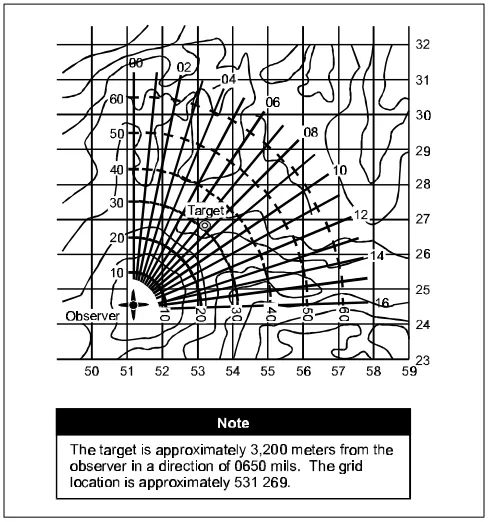
Electronic warfare can jam GPS signals for periods of time. e. Observed Fire Fan. The OF fan is a transparent protractor that can be used to refine distance on the map. (See figure 2-8 on page 2-28.) It is not used to determine direction. It helps the observer to identify on the map what he sees on the ground. The OF fan has 17 radial lines that are 100 mils apart and cover a total area of 1,600 mils. The radial lines represent OT direction. The OT distance is represented by arcs marked on the fan every 500 meters and labeled every 1,000 meters, beginning at 1,000 meters and extending to 6,500 meters.
Note
Figure 2-8. Target Location Using the Observed Fire Fan.
(1) Orienting the Observed Fire Fan on the Map. To prepare the OF fan, perform the following steps:
Move the fan slightly until one of the radial lines is parallel to a grid line. The direction of that radial line is the same as that of the grid line. For example, a radial line parallel to a north-south grid line, with the OF fan oriented generally north, would be direction 6400 or 0.
Attach the OF fan in position on the map by using a piece of tape along one edge of the fan. The OF fan can then be lifted, when required, without disturbing its orientation.
With a marker pen or grease pencil, number the radial of known direction, dropping the last two zeros (6400 would be 64). Then label every second radial with the appropriate direction. Remember that the radial lines are 100 mils apart. (Direction increases to the right and decreases to the left.)
manmade feature that he will cross. He notes the direction to a known point or feature in the target area. In this manner, he can maintain the relative orientation of his OF fan to aid in determining direction and target location.
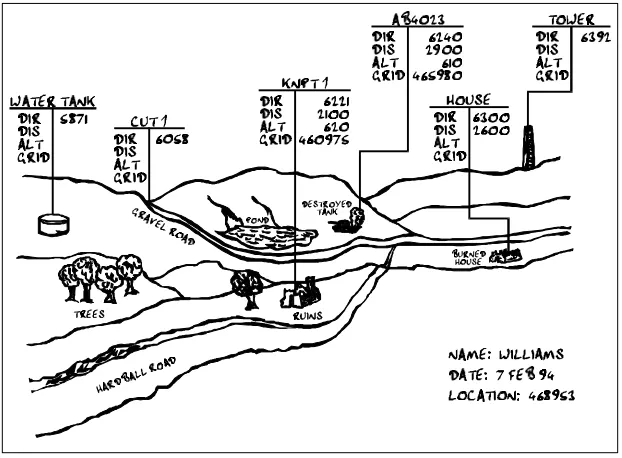
f. Terrain Sketch. The terrain sketch is a rough panoramic drawing by the observer of his area of observation. (See figure 2-9 on page 2-31.) The sketch is primarily used as a rapid means of recording/identifying predetermined directions to reference points. A properly constructed terrain sketch aids the observer in an organized study of the terrain. A terrain sketch also provides a rapid means of orienting relief personnel. The terrain sketch should include the following:
The skyline (horizon)
Prominent objects or features such as draws, hill masses, streams, wood lines, ridge line, roads, buildings, battlespace debris, and so on
Directions and distances to prominent objects or features, with labeling of reference and known points.
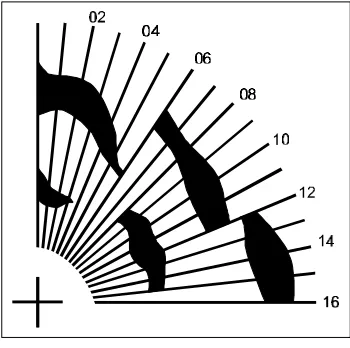
2-32.) It shows those portions of the terrain that cannot be observed from a given OP.
Figure 2-9. Terrain Sketch.
Another alternative would be to give a grid location and radius of an area that cannot be observed. However, at the first opportunity, the observer must construct a visibility diagram.
Figure 2-10. Visibility Diagram.
(1) Method ALFA. This method may be used when the exact location of the beacon is known (OPORD or beacon team information). In this method, the beacon is used simply as a navigation aid to determine the ship’s position. Fire missions are conducted in the normal manner discussed in subsequent chapters. (2) Method ALFA Modified. This method may be used when the exact location of the beacon is not accurately known and when combat grid charts are not available. The observer gives target location in polar coordinates or as a shift from the beacon position. (See section II of this chapter for procedures for polar plot and shift from a known point.) Ship personnel plot the beacon location, the ship’s relative position, and the target’s position relative to the beacon. The target is the point of aim and is engaged as a simple indirect-fire mission.
Section II. Methods of Target Location
Terrain/map analysis is essential in target location. The results of this analysis (i.e., direction, distance, and altitude) provide the basic data for determining a target’s location. Knowledge of information in section I of this chapter is essential to accomplishing the various methods of target location. Because the methods of target location apply to the artillery/mortar FO and the NGF spotter, the word
observer is applicable to both except where separately addressed.
The observer selects a method of target location based on whether his position is known by the firing unit, the availability of known/reference points in the battlespace, and tools available for target location. Three methods of target location exist: polar plot, grid coordinates, and shift from a known point.
Note
Regardless of the method of target location, map datum information is a prerequisite to accuracy. The firing unit must know the spheroid or datum
(e.g., World Geodetic System 1984) and grid zone from the marginal information on the observer’s map before conducting missions.
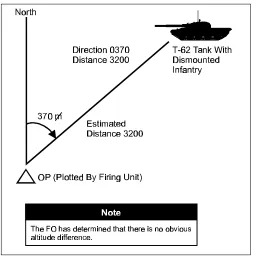
back azimuth from the target. Another disadvantage is that the observer’s position must be known by the firing unit (battery, mortar platoon, or ship). This may require the observer to transmit his location and altitude before sending the call for fire. Figure 2-11 shows target location by the polar plot method.
Figure 2-11. Polar Plot Method of Target Location.