Applying mSpace interfaces to the Semantic Web
Nicholas Gibbins
School of Electronics andComputer Science University of Southampton Southampton, United Kingdom
Stephen Harris
School of Electronics andComputer Science University of Southampton Southampton, United Kingdom
monica schraefel
School of Electronics andComputer Science University of Southampton Southampton, United Kingdom
ABSTRACT
Ontologies can represent large, multidimensional spaces: classi-cal music, research in computer science in the UK, health care for breast cancer are examples of rich domains. There have been no easy ways to represent meaningful slices through these multi-dimensional spaces to privilege the parts of the domain that are of interest to a given user. mSpace, an interaction model we de-scribe here, is particularly suited to ontology-based interaction be-cause it is designed to expose and support exploration of relations in a domain. In this paper we propose the formalism for this in-teraction model to support mapping this kind of user-determined interaction onto a high dimensional space represented by an on-tology. The model provides semantic web designers with a means for rapidly prototyping and interrogating the data represented by an ontology. It also and provides a fast, effective UI alternative to keyword search and browsing for users to explore the domain space while maintaining domain context.
Categories and Subject Descriptors
I.2.1 [Applications and Expert Systems]; H.5.2 [User interfaces]: Prototyping
Keywords
Semantic Web, Human factors
1.
INTRODUCTION
The most popular method for searching the Web at present is by keyword search; it has proven to be an effective way to retrieve information from the Web. The effectiveness of the technique im-proves with the precision of the keywords used. As such, keyword searches rely on one’s domain expertise to retrieve appropriate in-formation. When domain expertise is less certain, one can use cat-egory resources like Yahoo or the Internet Project to search by sub-ject and subcategories of subsub-ject, and narrow one’s search in this way. An advantage of category search is that it communicates a sense of the range of data available in a given domain. Numbers besides category labels also help communicate the scope of the in-stances within that part of the domain. Indeed, there have been efforts to apply categorization to keyword search results [26], but these alert users to the categories only after the fact - based on the results of the retrieved information. One of the limitations of pop-ular Web-based representations of category searches is that they usually rely on fixed hierarchies of categories. That is, both the
Copyright is held by the author/owner(s).
WWW2004, May 17–22, 2004, New York, NY USA. ACM xxx.xxx.
order and the number of subcategories in the tree is fixed. This means that a user cannot reorient the space to support their focus. They must approach the domain from the organizational bias of the designers.
The Semantic Web’s use of ontologies to structure domains pre-sents new opportunities to represent domains to users for their in-teraction with the domain space. This means that users can have greater options in how they engage with Web-based information, thus affording more diverse approaches than keyword or category search for building knowledge from the information they discover. The semantics of ontologies, for instance, privilege relationships; ontologies also afford multiple paths to view the same data instance from multiple perspectives. Exposing these relationships and paths provides knowledge seekers with additional information to inform their knowledge building tasks. Within the Semantic Web com-munity, however, there has been little research to date on how to exploit ontologies to formalize and automate such interaction de-sign opportunities. The closest work in this space has been in in-formation visualization. Understandably, in that case, most work has emphasized how extant visualization techniques can be applied to the Semantic Web [9]; interaction issues have been, again un-derstandably, secondary. Our interest, however, is specifically how interaction affordances can be enhanced by leveraging the proper-ties of the Semantic Web. To that end, we present a formal repre-sentation of an interaction model informed by the Semantic Web. Though we present one visualization to describe the model’s inter-action characteristics, the model itself is visualization agnostic. De-signers can use whichever visualization they choose - tree maps [2], self-organizing maps [4], polyarchies [21], lists. Our interest here is to formalize the behaviours of the data given the set of interac-tions defined.
selec-tion of the instances of the data associated with those configura-tions. The logic of the model also provides for automatic reasoning across the domain to ensure that only meaningful attribute order-ings/selections can occur. Which of these affordances of the inter-action model a system designer wishes to implement are up to the designer.
There are two key advantages to this interaction model for do-main interaction. First, mSpace provides system designers with a way to support fast visual data inspection in the domain from nu-merous perspectives. It also gives designers an automatic way to leverage their ontologies to present the domain to a user such that users first, can readily perceive the scope and relations within the domain from the available attributes, and second can then explore the domain from an orientation of the information that suits their interests.
In the following section, we describe the mSpace interaction model in terms of the interaction design itself. We situate the re-lated work within this discussion. Next we describe the formal model for the behaviours associated with each interaction. We fol-low this with a service-level characterization of the model. We conclude with our plans for future work, including a brief sketch of an API instantiating the mSpace model.
2.
INTERACTION DESIGN OF
THE MSPACE MODEL
The goal of an mSpace is to support users’ exploration of a do-main. By exploration, we mean something other than the Web sense of browsing or surfing. Surfing or browsing Web pages sug-gests moving among discrete Web pages which potentially have only very loose associations between them. The only association several pages may have in common, for instance, is that a user has visited each page within the past thirty seconds. By exploration, we mean that the user is making information selections within a structured information domain, based on ontological associations among its parts. The interaction design for exploration would pro-vide mechanisms for the user to take advantage of these associ-ations in exploring the domain. In exploration, context and the availability of contextual information to support users’ exploration is a critical component of the interaction design. An mSpace, de-signed to support exploration, therefore privileges associations and contexts in the domain interaction and representation.
While mSpace was initially designed as an abstract interface model for exploring information domains, it seems particularly well suited to the Semantic Web, since its semantics themselves fore-ground the relations within a domain’s ontology. Forefore-grounding these relations within an interaction design in turn provides users with an alternative method for interrogating an information source: while keyword searches focus on retrieving a set of matching in-stances from a information source, exploration focuses on repre-senting the context of that information. Within the Human Com-puter Interaction community, this dichotomy between instance and relations is generally referred to as Focus + Context [20, 22]. The Web’s emphasis on keyword searches has so far privileged the Fo-cus part of the equation, if for no other reason than the unstruc-tured nature of Web data is best searched against keyword index-ing, which returns in a list of discrete instances/Web pages. The affordances of the Semantic Web raise the possibility of facilitating the Context side of this interaction equation. mSpace is designed to leverage such semantic affordances. The remainder of this section describes the specific interaction affordances of an mSpace.
2.1
mSpace Representation and Interaction
An ontology can represent a vast, multidimensional domain that can support many ways of focusing on its data. an mSpace facil-itates both the representation of the space and the interaction with this representation in a variety of ways. These are:
slices: projections through the n-dimensional space,
context: spatial rather than temporal layout of a slice
dimensional sorting: the organization of attributes within a slice, and how the organization constrains the data associated with each attribute.
substitution: the revision of a slice by changing one attribute in a slice with another not previously in the slice
expansion/contraction: the addition of a new attribute to a slice; the removal of a previous attribute from a slice.
In the following sections we use the example of the Classical Music domain to ground our description of these features.
2.1.1
Slices, Columns and Context
As described above, slices represent projections through an n-dimensional space that are flattened. The flattened projection re-sults in a hierarchical ordering of the attributes in slice. Slices mean that certain views of the domain are privileged over others. For ex-ample, the classical music domain may be sliced to privilege infor-mation about compositions in a variety of ways. One approach is to foreground information about compositions through the attributes Period (Romantic or Baroque) — Composer ( Mozart or Bach) — Form (symphony or serenade) — Arrangement (solo instrument, orchestra) — Composition. Likewise the domain might be sliced to privilege information on compositions through recordings: Record Company — Orchestra — Conductor — Artist — Year Recorded — Composition. We refer to each of these attributes as Columns, in which the label of the column is the attribute name and the body of the column is the list of instances which are associated with the column - depending on its hierarchical location within the slice
Rationale: Flattened projections are not uncommon treatments for managing representations of n-dimensional spaces. Beyond making an n-dimensional space representationally manageable, flat-tened projections offer other benefits over visualizations attempting to approximate more than two dimensions. First, the resulting hi-erarchies can be readily represented in a variety of 2-dimensional views easily mapped onto the native affordance of a 2D computer screen. Three dimensions can at best only be simulated on such screens. Research has shown that 25% of the population cannot conceptualize information in 3-dimensions [17]. The same study showed that users performed significantly better in information re-trieval tasks when navigating text-based hierarchies rather than ei-ther 2D map views of information clusters of hierarchies or 3D rep-resentations of these clusters. Other research has also challenged claims about the value of 2.5 or greater dimensional views for in-formation organization and access [6]. Therefore 1-2D represen-tations of slices through n-dimensional spaces provide both acces-sibility and performance benefits over more complex dimensional simulations.
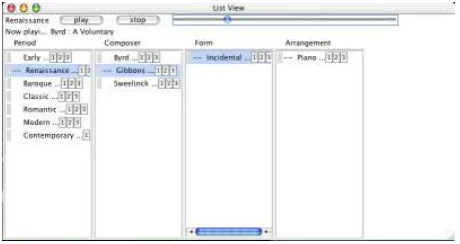
While hierarchies can be represented in a variety of visualiza-tions, our default visualization is a spatial, multipane or multicol-umn view. An example of a spatial multicolmulticol-umn view for the first Classical Music slice is shown in Figure 1.
Figure 1: Spatial multicolumn view for classical music slice
maintained in memory. For instance, the standard Web represen-tation of information is temporal: a click on a link generally re-places the originating page with a new page in the browser window, erasing the previously visible information. While mSpaces are visualization-neutral, we strongly recommend that mSpace visu-alizations support spatial context: in previous work we have shown that supporting spatial rather than temporal context results in better navigation performance by users [14]. Indeed, in the same study, we found that temporal interfaces had a significant negative corre-lation with age. With our simple default multipane view, we get a variety of benefits for low implementation cost: there is little over-head in rendering what are effectively contiguous list views of a data space.
2.1.2
Dimensional Sorting.
In each of the above slices, the organization of the slice im-poses an ordering on the hierarchy. Thus, In a domain slice, the arrangement of the attributes within the slice act as constraints on the information associated with the attributes presented. In the first slice, if Composer is placed after Form, the selected form will de-termine which composers are listed: only those who set works in the selected form will be listed under composer. Putting Com-poser before Period allows one to see quickly which period is as-sociated with a given composer. This arrangement of the slice turns out to be an interesting opportunity for learning more than a single association of a period with a composer, since in cer-tain cases, the composer is associated with multiple periods (Bach with Classic and Baroque, for instance). Thus, this one selection retrieves both the requested information, and potentially reveals meta-information about the construction of the classical music do-main.
Hierarchical rearrangement is not to be confused with sorting order within a fixed hierarchy. That is, in a fixed hierarchy such as Period — Composer — Form — Arrangement — Composition, one might choose to sort the composer column alphabetically or by date of birth. This sorting has no effect on the current instances associated with each attribute. Reordering the attributes in a hier-archy, as we explain in more detail in the formal model descrip-tion below, causes instances associated with each attribute to be reassessed, both in terms of the data associated with that attribute, as well as how that rearrangement effects it neighbours on either side of it, since a dimensional sort - a rearrangement of attributes in the hierarchy - effectively creates a new query within the slice.
Rationale: Dimensional sorting lets the user organize the domain in a manner that suits their current interests/knowledge. Providing multiple perspectives on an information space has long been val-ued by hypertext researchers not only for access for but the value
of learning more about a domain [18, 24] of building knowledge by seeing associations that would not otherwise be apparent. It also lets the explorer move into the domain from a locus of famil-iarity. For someone less familiar with a domain (a domain-naive user), dimensional sorting may provide an approach into a domain that would not otherwise be available. Someone who knows little about classical music, but who once took piano lessons may find it easier to access the domain by privileging Instrument as the first at-tribute in the hierarchical slice. By supporting dimensional sorting to improve access from multiple perspectives, we are not explicitly modelling users for a particular version of a domain, but are letting users determine the domain version for their needs/tasks.
2.1.3
Domain Substitution, Expansion and
Contrac-tion
Substitution, Expansion and Contraction are variations on Di-mensional Sorting. The key difference conceptually is that unlike Dimensional Sorting, these other techniques alter the slice through the space. Substitution can fundamentally alter the slice by poten-tially replacing each attribute with another in the domain. Expan-sion/Contraction can also have a considerable effect on the slice by increasing or decreasing the scope of the slice.
Rationale: The refinements of substitution, expansion and con-traction provide one more lightweight mechanisms by which users can explore a domain. Substitution provides ways to engage what-if scenarios within a domain space: what what-if the user extends the slice Period — Composer — Form — Arrangement — Composi-tion with Recording — InstrumentaComposi-tion — RecordingYear. From exploring this extended version of the data, users may learn that pe-riod instrumentation for Bach’s keyboard work would not include its most popular form of representation, the piano. Similarly, by substituting dimensional values one can gradually reformulate the slice to support new perspectives on an attribute. By translating an Historical slice gradually into a Recordings slice, one might also see that some very familiar works by Bach, like the solo cello sonatas, have been rearranged for a variety of instruments repeat-edly over the centuries, into one of the latest for five string electric bass but have not been frequently recorded, whereas the same ar-rangement of Beethoven’s Fifth symphony has been rerecorded by countless orchestras. In other words, by facilitating manipulation of the slices through substitution, expansion and contraction, we facilitate more ways to explore and therefore provide more ways to understand the domain and its inter-relations - and perhaps the biases informing its organization.
3.
RELATED WORK
mSpaces are largely informed by work in Human Computer In-teraction in direct manipulation interfaces [5] and query previews [19]. Direct Manipulation interfaces support immediate feedback of manipulations in an interface. Thus, moving a slider up in an onscreen volume control and hearing the volume level increase is an example of direct manipulation. Changing the attribute in an mSpace column and immediately seeing the change and its effect is an example of direct manipulation. This style of interaction de-sign is in contrast to user interfaces which change based on ferences about user interactions. Adaptive Interfaces [25], for in-stance, might adjust the ordering of elements in a menu based on frequency of use. Evaluations of such adaptive models have rarely been positive [15].
associated with each so that one can select the degree of spiciness in a dish, whether the dish is fish, meat, or vegetarian; how long it takes to prepare and so on. Based on these constraints, the search engine returns a list of appropriate recipes. The design of avail-able query attributes values eliminates the possibility of returning an empty set. In this way, users gain an easy method to quickly construct potentially more complex queries than a keyword search would allow, and equally can evaluate the results, tweak the param-eters of the query, and run the revised query again just as quickly
Like query previews, mSpaces are direct manipulation, visual queries. Unlike most instantiations of such queries, mSpaces ex-tent the preview query space, foreground domain manipulation af-fordances. Not only can users determine the attributes in the do-main to query, they can organize them to privilege their evolving explorations of the domain.
Most direct manipulation interfaces are hand-crafted for a given application: the application adopts the heuristics for direct manipu-lation or for preview queries and creates an implementation to sup-port that approach. In the following section, we present the formal model for the interaction design described above. Our goal in doing so is to provide Semantic Web designers with an interaction model they can first formally evaluate, and next instantiate to rapidly pro-vide the described interaction affordances.
Our description of mSpace using Semantic Web technologies bears some similarity to work in the Formal Concept Analysis com-munity, particularly in the area of ontology-aware browser inter-faces for information retrieval and discovery [11, 8]. These sys-tems construct a concept lattice which is used to provide support for navigation through an information space; this concept lattice represents the different hierarchies that would result from ordering entities according to their attributes. mSpace also provides such a hierarchical view of the entities in the system, but in a more struc-tured manner that affords the user greater control over their explo-ration of the information space.
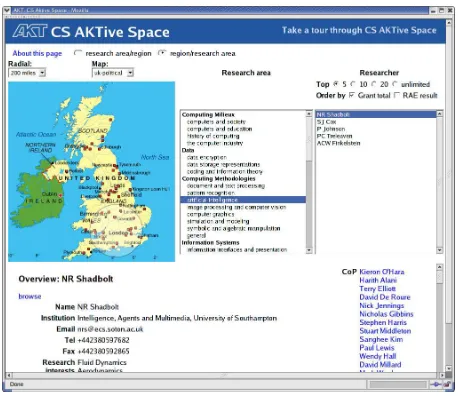
The CS AKTiveSpace (CAS) Semantic Web application [23] which recently won the Semantic Web Challenge for best Seman-tic Web Application1 was very much informed by the interaction
design expressed above. The goal of the application was to sup-port user-determined exploration of the domain Computer Science Research in the UK. Underneath the UI, the application exploits a wide range of semantically heterogeneous and distributed content. The content currently comprises around ten million RDF triples, with information constantly being harvested and updated. The con-tent in the application is mediated through an ontology constructed for the application domain, the AKT Reference Ontology [1], and incorporates components from other published ontologies as well. The challenge for the UI which an mSpace approach addressed, was to make the space managable enough to support meaningful interrogation by users. The UI would afford users the ability to explore the domain such that they could readily compare, for in-stance, what areas of the domain are researched in different areas of the country, who the top rated researchers are in a given domain; who do these researchers work with the most, what have they pub-lished. These are each results of queries that would be complex and potentially too cumbersome to construct to facilitate real-time shift-ing between one formation of a query and another. By modelshift-ing the CAS UI on the mSpace model, we were able to hide the complexity of the queries from the user, and support real-time query manipula-tion and ontology exploramanipula-tion, where data instances are revealed in context.
A large goal of the mSpace work has been to formalize the
in-1
[image:4.612.322.551.51.249.2]http://challenge.semanticweb.org/
Figure 2: CS AKTiveSpace: an example of an mSpace interface
teraction model in order to create a generalizeable model for se-mantically informed information spaces. CAS is the first applica-tion of the mSpace model mapped into a Semantic Web back end. Through the development process of implementing mSpace affor-dances, such as slices and dimensional sorting, against the AKT ontology, we have been better able to determine where the issues would be in formalizing the model for general application deploy-ment. Indeed, the effort to deploy the mSpace interaction design has reinforced the value of formalizing the model. It will make building mSpace-informed applications like CAS more principled. This is important on a practical level, since based on the demon-strations we have given of CAS, we have been approached to de-sign other CAS-inspired applications for granting councils, engine manufacturers and a space agency to name a few. Below, we touch on two of the ways that the formal mSpace model will improve mSpace-informed application development.
Query generation: The query generation performed by the CAS application is based on programmatic query constructions performed in the application logic of the program. This can make extracting and debugging the queries unnecessarily com-plex, whereas the constraint matrix suggested by this model, described below, will provide a cleaner and more general ab-straction for the query generation algorithm.
Inter-column constraints: The current version of the CAS appli-cation is based on adjacent constraints, which has the con-sequence that as columns are rearranged (one of the more common interactions) the semantics of the column positions changes, causing undesirable and confusing changes in the contents of the columns. With the benefit of the model we see that privileged column constraints would have been more ap-propriate for this application (the user is attempting to narrow down selections, approaching a target group of individuals). This approach would have the advantage that re-arranging the columns would not affect the semantics of column selec-tion.
[image:5.612.56.292.48.163.2]
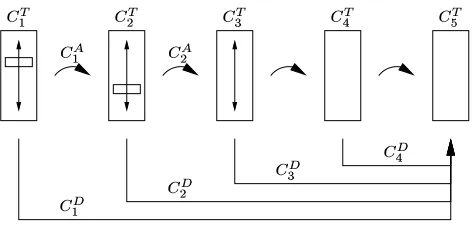
Figure 3: mSpace column constraints
4.
MODELLING MSPACE INTERFACES
As described in the previous section and in [13], an mSpace in-terface consists of a series of user inin-terface controls, which we call columns, each of which presents a selection of objects for the user to choose from. A user’s interaction with these column progresses from the left to the right. The selection that they make in a column affects the selections which are offered in the subsequent columns that lie to its right. The selection offered by each column is a col-lection of objects of the same conceptual type; a list of people, or of institutions, or of publications, for example. Each of the columns represents some facet of the objects being searched, and a selection within a column can be thought of as specifying some dimension in the sparse multidimensional space of a knowledge base (where each class is treated as a dimension).
In this respect, the interface resembles the menu-based interfaces used for exploring databases; a user chooses from lists of options that lead the user through the formulation of a query. The mSpace method differs in that a context (or column layout) may be dynam-ically reconfigured so as to place one dimension at a higher impor-tance than others.
4.1
Constraints
Our basic approach in constructing this model is to consider each column as representing some set of objects. We treat this set as a class which is specified by a class expression in a description logic-based language such as OWL [16] or DAML+OIL [7]; the objects presented in a column are the extension of the class expression for that column. We choose to model the columns and the interactions between them in terms of constraints which determine the choice being presented in each column and the effect that a selection has on other columns. These constraints are expressed as class sions in the description logic language. The overall class expres-sion for a column is the intersection of the separate constraint class expressions that apply to that column.
We identify two broad classes of constraint in the above ap-proach, type constraints and selection constraints.
4.1.1
Type constraints
Each column has an intrinsic constraint which governs the type of the objects that are listed in that column. This may vary from a simple named class to a more complex class expression (for exam-ple, ’all higher education institutions within the UK that were rated 5* in the 2001 Research Assessment Exercise’). In Figure 4.1, type constraints are denoted by
, where
is the constrained column,
and are invariant with selection.
4.1.2
Selection constraints
A selection in a column affects the choices that are presented in
other columns. Selection constraints represent the relation between a particular column and the other columns in a layout (or between one class of objects and another class of objects in the ontology), and are applied to a column in addition to any other constraints it may have.
Selection constraints take the form of a restriction on a property which relates the two columns, to the value which was selected These restrictions are typically (but not always)owl:hasValue
restrictions, written in description logic terms as , where
is the selected value and is the relating property). Multiple
se-lections in a column are handled by forming the union of the con-straints for the individual selections (or by adding both selections to the enumerated class, as in
). Selection constraints are
particular to a given pair of column types; a constraint which works between publications and authors will not work between publica-tions and publishers, because the underlying relapublica-tions which link these types are different.
The set of constraints for a layout must provide a means to relate each column to every other column, either directly, or indirectly by chaining more than one constraint together. For a layout with
columns, the basis set of constraints contains constraints. It is
possible to construct systems with more than this minimum number of basic constraints, but this raises the possibility of inconsistency when there is more than one way to relate one column to another, possibly by chaining constraints, and those relations are incompati-ble or have different meanings. If we restrict ourselves to basis sets of selection constraints, there are two common approaches to form-ing constraints which we can use in mSpace systems, each with its advantages and disadvantages.
4.1.3
Adjacent selection constraints
In the first approach, each column provides a constraint, which we call an adjacent selection constraint, to its immediate successor in the layout. In Figure 4.1, this type of constraint is denoted by
where
is the column from whose selection the constraint is
derived (the constraint is applied to column ). Since this constraint set is a basis, we can determine the pairwise effect of a selection on any other column by composing the basis constraints. For example, in Figure 4.1 the constraint on column three from column one is
"!
.
In practice, these composed constraints are not used in imple-mentations (where the constraints are evaluated column by column from left to right); we describe them in order to illustrate the paral-lels between the two approaches to building a basis set.
4.1.4
Distinguished column selection constraints
The second approach to constructing basis sets for selection con-straints is concerned with the case where the display of ’dead end’ selections is suppressed. A dead end selection in a column is one that, when made, will produce no options to choose from in the fi-nal column. For example, if we have a column containing a list of countries that includes the Vatican City, and our final column con-tains a list of computer science researchers, but we have no infor-mation about the state of computer science research in the Vatican, then we remove Vatican City as a choice in the country column. In effect, we are limiting the system in such a way as to only let the user answer questions that it can answer). In this approach, we introduce a basis set of selection constraints between the final col-umn (in the general case, any distinguished colcol-umn, but we assume that the distinguished column is the final column in order to clarify this explanation) and each of the other columns. We call these con-straints distinguished column selection concon-straints; in Figure 4.1, they are denoted by
, where
selec-tion the constraint is derived.
This set of constraints is slightly more involved, and consists of a separate constraint from each column to the final column (for that between the penultimate column and the final column, this may well be the same as the adjacent selection constraint). As with adjacent selection constraints, these constraints depend on the types of the columns involved; two layouts whose final columns differed in type would have different sets of constraints.
As with the previous constraint scheme, constraints may be com-posed in order to give the effect of one column on another; in Fig-ure 4.1, the constraint from column one to column three is
! , where
is the inverse of the constraint
. Unlike
the previous scheme, we construct the complete set of these com-posed constraints and use them to augment the type constraints on each column in order to produce the no-dead ends behaviour de-scribed above. If no selection has been made in a column, the class expression in a selection constraint restriction is that used for the type constraint of the source column, otherwise it is an enumerated class containing the selected individuals.
For example, if we have two columns with intrinsic types
and
, and column two is a distinguished column, the selection constraint from column one to column two might be a restriction of the form
, where is the relation which relates objects
of type
to objects of type
. The overall constraint on col-umn two is therefore
(the intersection of the intrinsic type constraint and the selection constraint from column one). Con-versely, this constraint is also applied in reverse from column two to column one in order to suppress the display of dead end selec-tions; this constraint is
. When a selection is made in column one, the constraint from column one to column two is modified by changing the class expression in the restriction from
to , where ,
and so on are the selections that have been made in column one.
The exception to this rule in implemented systems is that the re-placement of type constraint class expressions with selection enu-merated classes happens only in columns which succeed the col-umn in which the selection was made. In this way, a selection in a column does not affect the options offered in its predecessors; the constraint from column two to column one is still
. Due to the issues of consistency in the constraint set, either ad-jacent or distinguished column constraints may be used as a basis, but not both at the same time. The choice of which is used depends on the desired behaviour of the mSpace; in some circumstances, the information that a particular path through the space terminates in a dead end is useful knowledge, so adjacency selection constraints would be more appropriate. In addition, the choice of selection constraints changes the behaviour of an mSpace system under some operations, as described in the next section.
4.1.5
Constraint example
As an example of the above constraint schemes, consider a mSpace interface for exploring countries, the institutions located in those countries, the projects in which those institutions are involved, and the people who work on the projects. We choose an initial layout that consists of a column of institutions, then of projects, and finally of people, as shown in Figure 4.1.5. The ontology on which the in-terface is based defines the four named classes Country, Institution, Project and Person, each of which is used as the type constraint on the relevant column. Institutions are related to projects by the contributes-to property, people to projects by the works-on prop-erty, people to institutions by the works-at propprop-erty, institutions to countries by the located-in property and people to countries by the born-in property.
The adjacent selection basis constraint from countries to insti-tutions is of the form located-inCountry, while that from
insti-tutions to projects is contributes-to
Institution, and that from
projects to people is works-onProject Initially, the only
con-straints applied to each column are the type concon-straints and the initial forms of the selection constraints given above. As selec-tions are made in columns, the selection constraints are modified so that the (named) class in the local range restriction is replaced by an enumerated class whose members are the selected instances (we refer to such post-selection constraints as concrete selection constraints).
The distinguished column selection constraint basis set consists of works-atInstitution, which runs from institution to person, works-onProject, which runs from from project to person, and born-inCountry, which runs from country to person. As in the
adjacent case, these constraints are modified as selections are made. The concrete selection constraint between the institution and project columns, which takes into account the existence of people which satisfy the selections made in these columns, is:
works-on works-at where ,
and so on are the individuals which have been selected in the Project column.
In this example, where the selection constraints are straightfor-wardowl:hasValuerestrictions on single properties, the pair-wise selection constraint is anowl:hasValuerestriction on the composition of one of the properties with the inverse of the other (eg. works-on
! works-at
).
So far, we have described layouts which useowl:hasValue
restrictions as selection constraint class expressions, but these are not the only possibility. We can also form constraints of the form
(in OWL terms, anowl:allValuesFrom
re-striction to an enumerated class defined usingowl:oneOf), and can incorporate other restrictions which are not parameterised by selections.
4.2
Layout operations
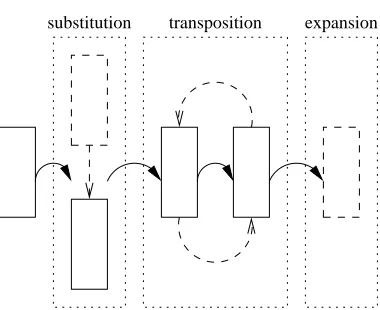
The description of intra- and inter-column constraints above as-sumes a fixed layout of columns, whereas an mSpace interface al-lows the user to modify the layout at will. We define two primitive operations on a layout: the addition of a column within the layout, and the removal of a column from the layout. As they are, these primitive operations are unlikely to be supported in a given mSpace interface because they are at too low a level to fit well within the paradigm of dimensional exploration introduced by mSpace. In-stead, we define three distinct types of higher-level operation which can be expressed as a composition of the primitive operations, and which an mSpace interface would be expected to support (illus-trated in Figure 5):
Expansion: A new column may be added to the right of the exist-ing columns
Substitution: A column within the layout may be switched with a column of a different type
Transposition: The positions of two columns within a layout may be exchanged. This is a specific example of a dimensional sorting operation – there are others.
Institution Project Person Country
works-on
born-in
located-in contributes-to
works-on
works-at
[image:7.612.156.453.52.160.2]
Figure 4: mSpace example
[image:7.612.79.269.201.356.2]transposition expansion substitution
Figure 5: mSpace operations
in the constraint set caused by the operation may affect the selec-tions which the user has made (by affecting the set of opselec-tions from which they made the selection), which in turn may change more instantiated constraints, and so on.
We describe operations which cause the invalidation of selec-tions as disruptive. For example, if a selection has been made in a column, and the column is substituted for one of a different kind, the selection is lost, which affects any presented options or selec-tions in subsequent columns. Similar behaviour is to be expected in the event that two columns are transposed, although it may be possible to retain the selections in the columns provided they do not violate the new selection constraints.
In the general case, we cannot easily characterise this disruptive propagation of changes, but we can determine what the change to the constraint set will be in response to the initial operation for the two selection constraint schemes. We describe the changes brought about by an operation in an abstract fashion, by counting the number of selection constraints which must be changed. These are listed in Table 1; indicates that constraints are added to
the set, that are removed and that are changed.
Since the observed flow of information in an mSpace interface runs from left to right, an operation which changes a column in a layout using adjacent selection constraints is likely to change those columns which lie to its right. For example, the expansion of an existing layout under the adjacent scheme by the addition of a new final column is a non-disruptive operation which does not involve the removal or replacement of existing constraints (shown as in
Table 1).
Conversely, under a distinguished column scheme (where the
Adjacent Distinguished column first/last other distinguished other
add
remove
expand —
transpose
substitute
[image:7.612.327.544.208.284.2]
Table 1: Operation cost on column based on constraint scheme
final column is the distinguished column), all the selection con-straints are replaced with ones suitable for use with the new final column. In this case, the change in the type of the final column leads to the introduction of a new set of selection constraints, which may be violated by the existing selections. Since constraints are applied in a pairwise manner under this scheme (going from one column of a pair to the distinguished column, and then back to the other column in the pair), a change in the type of the distin-guished column affects all selection constraints, which raises the prospect that the selections in all existing columns may be invali-dated (shown as
in Table 1).
Similar behaviours exist for the operations of transposition and substitution under either of the constraint schemes described above. In general, adjacent selection constraints yield more disruptive op-erations for small layouts with less than five columns (there are no distinguished columns, so the cost is mostly constant across the columns in a layout, the first or last columns being an obvious ex-ception).
In contrast, distinguished column selection constraints designate one column as special and express all selection constraints in terms of that column. Operations on columns other than the distinguished column are less disruptive than their counterparts under adjacent selection constraints (note the values for transposition in Table 1). However, operations on the distinguished column become signif-icantly more expensive because they change the entire constraint set.
4.3
Permitted layouts
In certain circumstances, an arrangement of columns may not make sense. For example, a column which required the user to pick from a list of university departments should not be followed by a column which requires the user to pick from a list of universities; there is a dependency between the types of these columns which makes the second column irrelevant. This is particularly true of layouts which use the adjacent selection constraint scheme, where a column directly depends on its predecessor.
We express this behaviour in a successor matrix which relates each column type to the column types after which it may appear; the column types used in this matrix are the type constraint class expressions described in the previous section. When a user is pre-sented with a layout, the set of permissible operations which they may use to rearrange the layout is constructed by consulting this matrix. For example, the user is presented with a list of column types which may be used to expand the current layout that is gen-erated by taking the set of all possible column types and removing those which are prohibited by the columns already in the layout.
Similarly, the transposition of two columns is a two part oper-ation. The user selects the first of the columns to be transposed, then the columns with which that column may be swapped (which would yield a permissible layout when swapped) are indicated. The user then selects the second column from those indicated, and the layout is rearranged.
4.4
Column presentation
The model of mSpace outlined above concerns itself primarily with the generation of the abstract choices offered to the user in each column and the propagation of the effects of making a selec-tion through the system, but this is not the only concern. If each column represents an set of objects from which the user must make some choice, the manner in which that set is rendered for presenta-tion to the user is also of importance.
In our prototype mSpace system, CS AKTiveSpace, we have im-plemented a column view for selecting UK higher education in-stitutions which is rendered as a map of the UK showing the ge-ographical distribution of HEIs. This column need not have been rendered in this fashion; it could have been shown as a simple mul-tipick widget containing the names of the institutions.
In each case, the information required to render the column is obtained from the knowledge base (human-readable labels and lat-itude/longitude coordinates for the HEIs). The design of an mSpace interface must therefore not only include the set of column types, their permitted combinations and the constraints which relate them, but also the alternate rendering styles for each column.
Our CS AKTiveSpace system also illustrates the use of order-ing and limitorder-ing constraints on columns. The final column contains a list of people (filtered by the preceding columns) which may be ordered according to various criteria (we allow ordering by total grant income and by the research rating of their institution). Simi-larly, the number of people shown in this column may be limited to the first five, ten, etc. This behaviour is separate from the selection-based behaviour described earlier in this section and is largely a presentational issue; we implement it as a set of filters which apply to the column after the application of inter-column constraints.
We treat the issue of column presentation as a level above that of the abstract column model, on which it has no direct bearing. In this respect, mSpace interfaces fit well within the model-view-controller paradigm, the model can be effectively decoupled from the view/controller pairs through the adoption of a clean API by which the view interacts with the model.
4.5
Detail view presentation
As with column presentation above, we consider the generation of the detail view provides the user with contextual information as they interact with the system to be a purely presentational issue that has little to no impact on the interactions between the columns described in our formal model. The detail view provides informa-tion (at a fairly coarse granularity) about the entity that was most recently the focus of the user’s attention, namely the most recent selection that they made in a column.
5.
IMPLEMENTATION
The characterisation of an mSpace user interface in terms of de-scription logic expressions given above should be considered to be an abstract description of such a user interface, and not a detailed specification of an implementation itself.
In our prototype Semantic Web application, CS AKTiveSpace, we chose to limit the class expressions used as selection constraints to beowl:hasValue restrictions. We further chose to imple-ment these constraints in a na¨ıve manner which does not require recourse to a DL reasoner; constraints were represented as triple patterns containing variables which were bound as selections are made. For example, the constraint works-atInstitution (used as a
distinguished column selection constraint in the example) would be replaced with the triple patterns ?person
works-at
?institution
and ?institution
rdf:type
Institution. These triple patterns were
expressed in the RDQL language, and used as queries to generate the values with which panels were populated.
This approach has the advantage of simplicity, because a con-straint and its inverse have exactly the same form. The triple pat-terns do not assume that the constraint will be read in the direction of a relation or of its reverse; the reading of the constraint depends on which variable is bound (by a selection), and which is free (and generates potential selection with which a column is populated). In addition, the RDQL query language is supported by a number of RDF stores and inference engines, including 3store [10] (on which we have built our CS AKTiveSpace application), Sesame [3] and Jena [12], so providing some flexibility in our choice of infrastruc-ture.
The disadvantage of this approach is that it permits only one par-ticular type of constraint, and that the construction and composition of disjunctive query patterns (as would be the case when multiple selections are made in a column), is clumsy in RDQL.
6.
CONCLUSION AND FURTHER WORK
In this paper, we have presented a treatment of the mSpace style of user interfaces which builds on Semantic Web technologies. In doing so, we open up possibilities for more strongly correlating the interaction behaviours with the semantics inherent in the informa-tion represented by the system.
Our plans for future work include the development of a frame-work to facilitate the construction of mSpace-based systems (draw-ing on our experiences of implement(draw-ing our prototype CS AKTive-Space system), and the investigation of techniques for automating the development of mSpace systems from ontologies. From this, we intend to develop an API and toolset to make deploying mSpace in OWL-based Semantic Web applications a plug and play opera-tion. To this end, part of our goal with this paper is to generate discussion about and feedback for our model, to better inform the development of an API.
This work was supported by the Advanced Knowledge Tech-nologies (AKT) Interdisciplinary Research Collaboration (IRC). The AKT IRC is sponsored by the UK Engineering and Physical Sci-ences Research Council under grant number GR/N15764/01 and comprises the Universities of Aberdeen, Edinburgh, Sheffield, Southampton and the Open University.
The authors would like to thank Nigel Shadbolt and Srinandan Dasmahapatra for their comments on this work.
8.
REFERENCES
[1] The AKT Reference Ontology.http:
//www.aktors.org/publications/ontology/, 2002.
[2] B. B. Bederson, B. Shneiderman, and M. Wattenberg. Ordered and quantum treemaps: Making effective use of 2d space to display hierarchies. ACM Trans. Graph.,
21(4):833–854, 2002.
[3] J. Broekstra, A. Kampman, and F. van Harmelen. Sesame: An Architecture for Storing and Querying RDF Data and Schema Information. In Spinning the Semantic Web, pages 197–221. MIT Press, 2003.
[4] H. Chen and S. Dumais. Bringing order to the web: Automatically categorizing search results. In Proceedings of the ACM SIGCHI Conference on Human Factors in Computing Systems (CHI’00), pages 145–152, 2000. [5] R. Chimera and B. Shneiderman. An exploratory evaluation
of three interfaces for browsing large hierarchical tables of contents. ACM Transactions on Information Systems (TOIS), 12, 1994.
[6] A. Cockburn and B. McKenzie. Evaluating the effectiveness of spatial memory in 2d and 3d physical and virtual environments. In Proceedings of the SIGCHI conference on Human factors in computing systems, pages 203–210. ACM Press, 2002.
[7] D. Connolly, F. van Harmelen, I. Horrocks, D. L. McGuinness, P. F. Patel-Schneider, and L. A. Stein. DAML+OIL (March 2001) Reference Description. W3C Note, World Wide Web Consortium, Dec. 2001.
[8] P. Eklund and R. Cole. Structured ontology and information retrieval for email search and discovery. In Foundations of Intelligent Systems, 13th International Symposium (ISMIS 2002), pages 75–84, 2001.
[9] V. Geroimenko and C. Chen, editors. Visualizing the Semantic Web. Springer, 2002.
[10] S. Harris and N. Gibbins. 3store: Efficient Bulk RDF Storage. In Proceedings of the First International Workshop on Practical and Scalable Semantic Systems (PSSS2003), pages 3–17, Sanibel Island, Florida, USA, Oct. 2003. [11] M. Kim and P. Compton. A web-based browsing mechamism
based on conceptual structures. In Conceptual Structures: Extracting and Representing Semantics: Contributions to the 9th International Conference on Conceptual Structures (ICCS2001), pages 47–60, 2001.
[12] H.-P. Labs. The Jena Semantic Web Toolkit. Web page, Hewlett-Packard Labs, 2003.
http://www.hpl.hp.com/semweb/jena.htm. [13] m.c. schraefel, M. Karam, and S. Zhao. mspace: interaction
design for user-determined, adaptable domain exploration in hypermedia. In Proceedings of the AH2003 Workshop on Adaptive Hypermedia and Adaptive Web-Based Systems, pages 217–235, Nottingham, UK, June 2003.
[14] m.c. schraefel, M. Karam, and S. Zhao. Preview cues for exploring domain hierarchies. In Proceedings of Interact 2003, Switzerland, 2003.
[15] J. McGrenere, R. M. Baecker, and K. S. Booth. An
evaluation of a multiple interface design solution for bloated software. In Proceedings of the SIGCHI conference on Human factors in computing systems, pages 164–170. ACM Press, 2002.
[16] D. L. McGuinness and F. van Harmelen. OWL Web Ontology Language Overview. Candidate recommendation, World Wide Web Consortium, Aug. 2003.
http://www.w3.org/TR/owl-features/. [17] D. Modjeska and J. Waterworth. Effects of desktop 3d world
design on user navigation and search performance. In Proceedings of Information Visualization 2000, pages 215–220. IEEE, 2000.
[18] C. Neuwirth, D. K. R. Chimera, and T. Gillespie. The notes program: A hypertext application for writing from source texts. In Proceeding of the ACM Conference on Hypertext, pages 121–141, 1987.
[19] C. Plaisant, B. Shneiderman, K. Doan, and T. Bruns. Interface and data architecture for query preview in networked information systems. ACM Transactions on Information Systems (TOIS), 17(3):320–341, 1999. [20] K. Risden, M. Czerwinski, T. Munzner, and D. Cook. An
initial examination of ease of use for 2d and 3d information visualizations of web content. IJHCS, 53, 2000.
[21] G. Robertson, K. Cameron, M. Czerwinski, and D. Robbins. Polyarchy visualization: visualizing multiple intersecting hierarchies. In Proceedings of the SIGCHI conference on Human factors in computing systems, pages 423–430. ACM Press, 2002.
[22] D. Schaffer, Z. Zuo, S. Greenberg, L. Bartram, J. Dill, S. Dubs, and M. Roseman. Navigating hierarchically clustered networks through fisheye and full-zoom methods. ACM Transactions on Computer Human Interaction (TOCHI), pages 162–188, 1996.
[23] N. Shadbolt, monica schraefel, N. Gibbins, H. Glaser, and S. Harris. CS AKTiveSpace: Representing Computer Science in the Semantic Web.http://triplestore. aktors.org/tmp/www2004-cas.pdf, 2003. [24] F. Shipman, J. Moore, P. Maloor, H. Hsieh, and
R. Akkapeddi. Spatial hypertext: Semantics happen: Knowledge building in spatial hypertext. In Proceedings of the Thirteenth Conference on Hypertext and Hypermedia, pages 25–34, 2002.
[25] P. N. Sukaviriya and J. D. Foley. Supporting adaptive interfaces in a knowledge-based user interface environment. In Proceedings of the 1st international conference on Intelligent user interfaces, pages 107–113. ACM Press, 1993.
[26] Vivisimo. Vivisimo document clustering engine.