Thesis by
Stuartt A. Corder
In Partial Fulfillment of the Requirements
for the Degree of
Doctor of Philosophy
California Institute of Technology
Pasadena, California
2009
c
2009
Stuartt A. Corder
Acknowledgements
My thesis could not have been possible without the guidance and direction of my
adviser, Anneila Sargent. Her advice on my writing will, eventually, result in more
concise prose. On a daily basis, my interaction with John Carpenter has been
invalu-able and enjoyinvalu-able. Whether discussing CARMA upgrades and issues or draining the
three, John has been central to many aspects of my life here at Caltech. I wouldn’t
have continued in physical science without the influence of my undergraduate
advis-ers, Bruce and Barbara Twarog and Bozenna Pasik-Duncan. I have been fortunate to
attend lectures by two of the most talented instructors I have known, Sterl Phinney
and Peter Goldreich. I have also benefited from the guidance of Geoff Blake and
Nick Scoville, who were always willing and ready to discuss projects and approaches.
Shri Kulkarni took an interest in my career here and always looked out for my best
interests. I also would like to thank Bob Dickman for giving me some realistic advice.
Mel Wright helped point me towards high-fidelity imaging studies and provided the
seeds for all of the chapters of this thesis. I am grateful not only for his guidance but
also for his laugh, which despite his often quiet demeanor was always ready to burst
out. I would also like to thank Goran Sandell whose wealth of knowledge pertaining
to NGC 7538 is remarkable.
My experience working with CARMA has brought me into contact with a great
diversity of characters and I mean that in all possible senses of the word. Thanks
also to the OVRO staff for putting up with me for some number of days no less than
225 (the exact number has been lost). Specifically, I would like to thank Tom Costa,
Andy Beard, and Rick Hobbs for often following up the question of Why do you
Lamb, Mark Hodges, Paul Rasmussen, and Dave Hawkins were always willing to
explain technical details even if I didn’t need to understand those details to do my
job. Thanks to Curt, Russ, Paul D. and Terry for, among other things, a daily dose of
laughter, especially on my more stressful days. In the early days at CARMA, life was
often challenging. To Jin Koda and Andrew West, thanks for the sharing Christmas
2006 with Jennifer and me. Jenny Patience and I never transported water from the
valley floor to provide ourselves with indoor plumbing, although indoor plumbing
would have been nice. Bevin Zauderer shared by far the most painful of CARMA
runs with me, and I mean that in a literal sense. She also relieved some of the pain
associated with the editing this thesis. Many others have proved excellent company
including Misty LaVigne, Dick Plambeck, Holly Maness, Alberto Bolatto, and Lisa
Wei to name a few. Thanks to Laura Perez and Scott Schnee for picking up the
graduate student-postdoc development torch.
Of my scientific collaborators among the students and postdocs at Caltech, I’d
like to thank Kartik Sheth, Josh Eisner, and Hector Arce for making me finish what
I started and telling me my ideas are not that crazy. The friendship and
collabo-ration with my academic sibling Melissa Enoch will always be remembered. Milan
Bogosavljevic and Brian Cameron are like brothers who never let me take myself too
seriously. Adam Kraus has provided a link to home and someone who understands
what it means to be a Jayhawk. Cathy Slesnick was a fast friend, a good thing in
the early days of the small, dark room office. My other officemates, Laura, Margaret,
Joanna, George, and Brian (J) have made the existence tolerable and were always
willing to listen to (extended) complaints. The lunch crew provided a needed break,
thanks to, among others, Dan and Larry. Special thanks to Karin for being there to
share fears and frustrations in the late stages of writing this thesis.
Finally, I would like to thank my family, Jennifer and Vivian. Jennifer, without
your support this would not have been possible. Thanks for your understanding and
willingness to put up with so many nights with only a phone call. You amaze me.
Abstract
Through simulations, I have investigated the limitations imposed upon the image
fidelity of interferometric observations by primary beam errors. Significant antenna
surface and pointing errors lead to the greatest reduction in fidelity for most cases, but,
when present, imaginary beam components dominate the degradation. Beam errors
were addressed by optimizing the antenna surfaces and aligning the optics and then
determining baseline based primary beams. Methods for applying these measured
patterns to actual data were discussed. Pointing errors were reduced by improving
the fit to the pointing model. Further reduction was achieved by integrating the use
of optical pointing observations into standard radio observing. The greatest benefit
was seen during daytime observations, but general reduction in pointing error was
seen.
The dense uv-coverage of the Combined Array for Research in Millimeter-wave
Astronomy (CARMA) coupled with the techniques described above make it an ideal
instrument for imaging extended regions with high fidelity. The NGC 7538
star-forming cloud contains dense peaks, many high-mass stars and associated accretion
disks, and multiple outflows. I obtained CARMA images at the requisite fidelity,
employing the above techniques. These mosaiced, spectral-line, and 3-mm band
con-tinuum observations provide a clearer picture of the bulk morphology of the region and
the fine-scale structures within it than has hitherto been possible. For the first time in
the region, infall signatures were found towards two sources, allowing comparison of
the infall and outflow mass and verifying that significant accretion (>10−4M
⊙ yr−1)
continues well into the stage where a massive protostar has formed. One of the
P-sources that are separated by 10,000-20,000 AU in projection. The calculated energy
injection rate provides constraints for models of outflow feedback. The NGC 7538
results demonstrate clearly the capability of CARMA to provide high quality images
over wide-fields and the benefits of the techniques I developed. While work to improve
CARMA image fidelity continues, the program described here lays the groundwork
and should help guide further enhancements of image fidelity at CARMA and at other
Contents
1 Introduction 1
1.1 Into the Mainstream . . . 1
1.2 Lingering Doubt . . . 5
1.3 Interferometry and Mosaicing . . . 9
1.3.1 Basic Assumptions & Equations . . . 9
1.3.2 Assumptions Violated . . . 11
1.4 Thesis Outline . . . 13
Bibliography . . . 15
2 Simulations: Limitations on Dynamic Range and Image Fidelity For Wide Field Imaging 17 Abstract . . . 17
2.1 Introduction . . . 17
2.2 Models & Variables . . . 20
2.3 Simulations . . . 26
2.4 Results . . . 30
2.4.1 Gain & Pointing Errors . . . 31
2.4.2 Beam Size Error & Ellipticity . . . 33
2.4.3 Measured Voltage Patterns . . . 36
2.5 Discussion . . . 37
2.5.1 Gain & Pointing Error . . . 37
2.5.2 Beam Size Error & Ellipticity . . . 39
Bibliography . . . 43
3 Holography 44 Abstract . . . 44
3.1 Introduction . . . 45
3.2 Data Acquisition and Reduction . . . 49
3.3 Holography Results: Alignment and Panel Adjustment . . . 53
3.3.1 Optical Alignment . . . 53
3.3.2 Panel Adjustments . . . 60
3.3.3 Preliminary 1-mm Band Results . . . 63
3.4 Holography Results: Shape and Consistency of the Voltage Patterns . 67 3.4.1 Data Acquisition and Reduction . . . 67
3.4.2 Data Analysis . . . 68
3.4.3 Gaussian Fits to Measured Voltage Patterns . . . 70
3.4.3.1 10-m Antennas . . . 70
3.4.3.2 6-m Antennas . . . 73
3.4.3.3 Heterogeneous Baselines . . . 74
3.4.4 Deviation from Circularly-symmetric, Gaussian Fits . . . 75
3.4.4.1 Deviation from Gaussians . . . 75
3.4.4.2 Ellipticity . . . 77
3.4.4.3 Low Levels and Sidelobes . . . 81
3.4.5 Antenna-Based Results . . . 87
3.4.5.1 Frequency, Source and Sampling Dependence . . . . 87
3.4.5.2 Beam Sizes . . . 90
3.4.5.3 Ellipticity & Position Angle . . . 94
3.4.5.4 Imaginary Beams . . . 99
3.4.5.5 Antenna-Based Templates: 2006Aug-2008May . . . . 104
3.5 Summary & Conclusions . . . 104
4 Optimizing Pointing 116
Abstract . . . 116
4.1 Introduction . . . 117
4.2 The CARMA Pointing Model . . . 119
4.3 Pointing Errors . . . 123
4.4 Results: Pointing Improvement . . . 128
4.4.1 Optimized Optical Catalog & Collection Methods . . . 129
4.4.1.1 Motivation . . . 129
4.4.1.2 Approach & Implementation . . . 131
4.4.1.3 Tests & Verification . . . 132
4.4.1.4 Benefits & Applications . . . 136
4.4.1.5 Limits & Future Directions . . . 137
4.4.2 Optical Offset Pointing: Active Optical Pointing . . . 137
4.4.2.1 Motivation . . . 137
4.4.2.2 Approach & Implementation . . . 140
4.4.2.3 Tests & Verification . . . 141
4.4.2.4 Benefits & Applications . . . 152
4.4.2.5 Limitations & Future Development . . . 159
4.5 Summary . . . 161
Bibliography . . . 162
5 Applications: CARMA Mosaic Observations of Young, Massive Pro-tostars in NGC 7538 163 Abstract . . . 163
5.1 Introduction . . . 164
5.2 NGC 7538 . . . 168
5.2.1 IRS1-3 . . . 169
5.2.2 NGC 7538S . . . 173
5.2.3 The Cloud . . . 174
5.3.2 Single-dish Observations . . . 179
5.3.3 Imaging . . . 179
5.3.3.1 Continuum Imaging . . . 179
5.3.3.2 Spectral Line Imaging . . . 182
5.4 Analysis & Results . . . 185
5.4.1 Opacity & Mass Determination . . . 185
5.4.2 Infall Determination . . . 189
5.4.3 General Morphology . . . 191
5.4.4 NGC 7538S . . . 197
5.4.4.1 Dense Structures: Continuum and C18O . . . 197
5.4.4.2 Outflows . . . 206
5.4.4.3 Infall . . . 214
5.4.5 IRS1-3 . . . 216
5.4.5.1 Dense Structures . . . 216
5.4.5.2 Continuum With Measured Primary Beam Correction 218 5.4.5.3 Outflows . . . 220
5.4.5.4 Infall . . . 223
5.4.5.5 Other Regions . . . 224
5.5 Discussion . . . 224
5.6 Conclusions & Future Work . . . 231
Bibliography . . . 234
6 Summary and Future Work 240 6.1 Summary . . . 240
6.2 The Future . . . 243
6.2.1 High Fidelity Science . . . 244
6.2.1.1 Single Dish Correction with NGC 7538 . . . 244
6.2.2 Outflow Feedback in Nearby Star Forming Regions . . . 244
6.2.4 Enhancing Fidelity, Near Future . . . 246
6.2.5 Enhancing Fidelity, Far Future . . . 246
A Optical Alignment 248 B Optical Telescope and Camera System 251 C Implementation of Optical Offset Pointing 257 D Optical Offset Pointing Equation of Merit 261 E CARMA Narrow Band Calibration 264 F Simulator and Using Measured Primary Beams 267 F.1 Overview . . . 267
F.2 pymiriad.py . . . 268
F.3 makeBeams.py. . . 271
F.4 uvsubtract.py . . . 273
List of Figures
1.1 The debris disk around HD 107146 . . . 3
1.2 Possible spiral structure in the AB Aur protoplanetary disk . . . 4
1.3 Spiral arm of M51 with spur substructures . . . 6
2.1 Extended source model . . . 21
2.2 The effects of various primary beam errors on the source flux distribution 24 2.3 The baseline-based primary beams of a few antennas . . . 27
2.4 The model Cas A image illuminated by a specific baseline at different pointing locations . . . 30
2.5 Model, simulation and residual image . . . 31
2.6 Fidelity as a function of gain error . . . 32
2.7 Fidelity plotted against the gain error equivalent of the actual pointing error . . . 33
2.8 Image fidelity plotted as a function of error in the assumed beam width 35 2.9 Image fidelity plotted versus ellipticity of the primary beam . . . 36
3.1 Example of how aperture plane illumination offsets result in phase across the sky . . . 48
3.2 Correction factor for aperture plane centroid . . . 55
3.3 Holography result for C4 . . . 56
3.4 Holography result for C1 . . . 57
3.5 Holography result for C10 . . . 57
3.6 Holography result for C9 . . . 58
3.8 Holography result for C5 . . . 61
3.9 Holography result for C11 . . . 61
3.10 Holography result for C12 . . . 62
3.11 Holography result for C12 interpolated and overlaid with adjuster positions 62
3.12 Holography data for the 10-m antennas in the 1-mm band . . . 65
3.13 Voltage pattern plots of the 10-m antennas in the 1-mm band . . . 66
3.14 Ensemble voltage pattern size of the 10-m antennas clipped at 22% . . 72
3.15 Ensemble voltage pattern size of the 10-m antennas clipped at 10% . . 73
3.16 Ensemble voltage pattern size of the 6-m antennas clipped at 22%. . . 74
3.17 Mean, antenna-style based images and azimuthally-averaged profiles. . 76
3.18 Ensemble voltage pattern ellipticity and position angle of the 10-m
an-tennas clipped at 22% . . . 79
3.19 Ensemble voltage pattern ellipticity and position angle of the 6-m
an-tennas clipped at 22% . . . 80
3.20 Sidelobes of the 10-m antenna illuminated by 6-m and 3.5-m antenna
voltage patterns . . . 82
3.21 10-m antenna real voltage pattern side-lobe stability . . . 84
3.22 10-m antenna imaginary voltage pattern side-lobe stability. . . 85
3.23 Overlaid contours from various runs for the real (left) and imaginary
(right) voltage patterns . . . 89
3.24 Plots of amplitude voltage pattern width as a function of elevation for
the 15 CARMA antennas . . . 92
3.25 Plots of real voltage pattern width as a function of elevation for the 15
CARMA antennas . . . 93
3.26 Plots of amplitude ellipticity as a function of elevation for the 15 CARMA
antennas . . . 95
3.27 Plots of real component ellipticity as a function of elevation for the 15
CARMA antennas . . . 96
3.28 Plots of amplitude voltage pattern ellipticity position angle as a function
angle as a function of elevation for the 15 CARMA antennas . . . 98
3.30 Plots of magnitude of the imaginary voltage pattern as a function of
elevation for the 15 CARMA antennas . . . 101
3.31 Plots of position angle of the imaginary voltage pattern as a function of
elevation for the 15 CARMA antennas . . . 102
3.32 Image and overlaid contours for the real (left) and imaginary (right)
mean voltage pattern for C1 . . . 107
3.33 Image and overlaid contours for the real (left) and imaginary (right)
mean voltage pattern for C2 . . . 107
3.34 Image and overlaid contours for the real (left) and imaginary (right)
mean voltage pattern for C3 . . . 108
3.35 Image and overlaid contours for the real (left) and imaginary (right)
mean voltage pattern for C4 . . . 108
3.36 Image and overlaid contours for the real (left) and imaginary (right)
mean voltage pattern for C5 . . . 109
3.37 Image and overlaid contours for the real (left) and imaginary (right)
mean voltage pattern for C6 . . . 109
3.38 Image and overlaid contours for the real (left) and imaginary (right)
mean voltage pattern for C7 . . . 110
3.39 Image and overlaid contours for the real (left) and imaginary (right)
mean voltage pattern for C8 . . . 110
3.40 Image and overlaid contours for the real (left) and imaginary (right)
mean voltage pattern for C9 . . . 111
3.41 Image and overlaid contours for the real (left) and imaginary (right)
mean voltage pattern for C10 . . . 111
3.42 Image and overlaid contours for the real (left) and imaginary (right)
mean voltage pattern for C11 . . . 112
3.43 Image and overlaid contours for the real (left) and imaginary (right)
3.44 Image and overlaid contours for the real (left) and imaginary (right)
mean voltage pattern for C13 . . . 113
3.45 Image and overlaid contours for the real (left) and imaginary (right) mean voltage pattern for C14 . . . 113
3.46 Image and overlaid contours for the real (left) and imaginary (right) mean voltage pattern for C15 . . . 114
4.1 Two different frequencies for pointing error . . . 126
4.2 Pointing sky coverage and post-fit residuals for 10-m antennas with the original catalog and methods . . . 130
4.3 Bin optimization simulation plot of bin size compared to average time per star . . . 133
4.4 Pointing sky coverage and post-fit residuals for the 10-m antennas with the new pointing methods . . . 134
4.5 Systematic residuals in the 10-m pointing model . . . 135
4.6 Elevation pointing offset trend for C4 under thermal stress . . . 138
4.7 Elevation pointing offset trend for radio and optical . . . 147
4.8 Systematic trends in the optical to radio offset vector by night for the 6-m antennas . . . 148
4.9 Systematic trends in the optical to radio offset vector by day for the 6-m antennas . . . 149
4.10 Systematic trends in the optical to radio offset vector by night for the 10-m antennas . . . 150
4.11 Systematic trends in the optical to radio offset vector by day for the 10-m antennas . . . 151
4.12 Amplitude vs. time on a baseline with and without optical offset guiding.153 4.13 Optical offset guiding applied pointing updates for an example track. . 154
guiding . . . 158
5.1 Overview of the NGC 7538 region in the submillimeter . . . 170
5.2 Spitzer 8µm image of NGC 7538 with 108.1 GHz contours overlaid . . 193
5.3 Spitzer 8µm image of NGC 7538 with high velocity 12CO(1-0) contours overlaid . . . 194
5.4 Integrated 13CO and C18O emission near the cloud velocity . . . 195
5.5 Channel maps of narrow-band HCO+ . . . 196
5.6 Multi-resolution and multi-frequency images of NGC 7538S . . . 200
5.7 Comparison of NGC 7538S at different resolutions . . . 201
5.8 C18O and continuum images of NGC 7538S at multiple resolutions . . 205
5.9 C18O spectra along a 60◦ position angle centered on NGC 7538Sa . . . 207
5.10 HCO+(1-0) contours overlaid on a NGC 7538S continuum image . . . . 212
5.11 12CO(1-0) contours overlaid on a NGC 7538S continuum image . . . . 213
5.12 Self absorption profile toward NGC 7538S . . . 215
5.13 Multi-resolution and multi-frequency images of IRS2 . . . 217
5.14 Very high velocity 12CO contours overlaid on a IRS1 continuum image 221 5.15 Zeroth moment contours overlaid on the first moment map color images of high velocity gas from IRS1 . . . 222
5.16 Inverse P-Cygni profile toward NGC 7538-IRS1 . . . 225
A.1 Optical source and fiber are shown mounted to the antenna secondary in preparation for the optical alignment. . . 249
A.2 The opening to the feed horn is shown overlaid with a cross hairs to aid the optical alignment. . . 250
B.1 The optical telescopes of the 10- and 6-m antennas are shown. . . 254
B.2 The optical camera used at CARMA is shown. . . 255
List of Tables
3.1 Holography Data . . . 51
3.2 Adjustment and Alignment Results . . . 59
3.3 Mean Parameters of Antenna Styles . . . 71
3.4 Voltage Pattern Parameters . . . 88
4.1 CARMA Pointing Parameters . . . 124
4.2 Required Limits on the Optical to Radio Offset . . . 142
4.3 Scatter in the Optical to Radio Vector at Night . . . 144
4.4 Scatter in the Optical to Radio Vector by Day . . . 145
5.1 Properties of Young Stars Associated with IRS1-3 and NGC 7538S Com-plexes . . . 171
5.2 NGC 7538 Data Sets . . . 176
5.2 NGC 7538 Data Sets . . . 177
5.3 NGC 7538 Images . . . 184
5.4 Molecular Constants . . . 189
5.5 NGC 7538 Continuum Fluxes . . . 198
5.6 NGC 7538 High Resolution Continuum Fluxes . . . 199
5.7 NGC 7538 C18O Fluxes . . . 204
5.8 NGC 7538 Outflow Properties I . . . 208
5.8 NGC 7538 Outflow Properties I . . . 209
5.9 NGC 7538 Outflow Properties II . . . 210
5.10 NGC 7538 Outflow Properties III . . . 211
Chapter 1
Introduction
1.1
Into the Mainstream
As both single-dish radio telescopes and radio interferometers have gained in
resolu-tion and sensitivity, the tradiresolu-tional realms of observaresolu-tion–wide field of view, lower
res-olution and high resres-olution, smaller field of view, respectively–have become blended.
Instead of using single-dish observations to map large areas and obtaining
interfer-ometric images to provide detail over single pointings, the advantages of imaging
extended regions with high resolution are becoming evident. New arrays have
re-cently entered into routine function (CARMA1) or are under construction (ALMA2)
that begin to blur this distinction in the submillimeter regime as well. Both of these
arrays have significantly enhanced sensitivity, resolution, and/or imaging capabilities
when compared to existing arrays while being designed to sample the spatial scales
of sources from the entire region mapped down to arcseconds or less.
Studies of sources with large spatial extent and/or large spatial scales are thus
poised for significant gains. High resolution images (a few arcseconds or less) of
such objects, which include the sun, planets, nearby protoplanetary disks, molecular
clouds within the Galaxy, and nearby galaxies, are rarely achieved in the
submil-limeter regime. The mapping of nearby debris disks has revealed substructures on
several spatial scales (e.g. Corder et al., 2008b; Koerner et al., 2001; Wilner et al.,
2002). Nearby examples of debris disks may also have large spatial extent (e.g. ǫEri,
Greaves et al., 2005). The dust in these disks is referred to as debris because the
timescale for removal of such dust is much shorter than the age of the systems, i.e. it
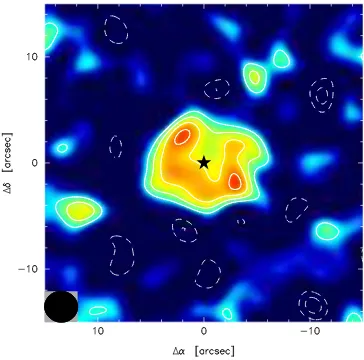
must be recreated by collisions (e.g. Backman & Paresce, 1993). Figure 1.1 shows an
example of such a disk, which surrounds the nearby solar analog, HD 107146.
The-oretical models (e.g. Wyatt, 2006) predict that structures in such disks are caused
by resonances with orbiting planets. Planets often inferred from these studies are
typically analogs to the solar system ice giants, a planet population that is not easily
studied, especially at young ages, with any other method. If the planet formation
process is to be understood, a full census of planets at such young ages is necessary.
Such objects cannot yet be imaged at high resolution, a situation higher frequency
observations with ALMA will remedy.
At greater distances, protoplanetary disks have revealed significant substructure.
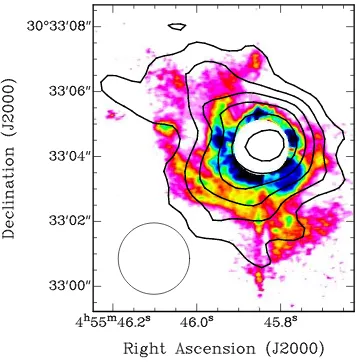
Figure 1.2 shows the complex morphology of the emission surrounding the young
star AB Aur. The nature of this structure is poorly understood and may be the
result of spiral arms or of infalling envelope material (Grady et al., 1999; Fukagawa
et al., 2004; Corder et al., 2005; Pi´etu et al., 2005). The origin of these features
awaits higher resolution observations with improved sensitivity to disentangle, but
their nature provides vital constraints on the models of young disks and may indicate
that gravitational instability is a valid method of forming massive planets (Boss,
2008). ALMA will observe such objects at very high frequency where the disks will
fill a substantial fraction of the primary beam.
The mass distribution of these protostellar disks is also significant in that it allows
estimates of the lifetimes and typical properties. In particular, the typical mass of
the disks sets limits on which disks are likely to support the formation of planetary
systems. Observations of populations of disks are typically carried out by mosaicing
large areas in dense star forming regions (e.g. Carpenter, 2002; Eisner et al., 2008).
Nearby star-forming regions have been the subject of intense study, but little
work has been done at high resolution over large areas. One of the most important
Figure 1.1 1.3 mm continuum emission from the disk surrounding the nearby, solar analog HD 107146 is shown. Contours begin at 2σ and increase by 1σ, where σ is 0.32 mJy beam−1. The central region is depressed relative to an asymmetric ring.
The star indicates the stellar position. The beam is shown in the lower left corner. This image is taken from Corder et al. (2008b).
(IMF). While measurement of this quantity has been studied extensively for stars, it
is unclear whether the stellar IMF is a signature of the distribution of the clumps and
cores from which the stars form or if some evolution has occurred. In the end, it is
the IMF of the clumps and cores that constrain the models of star formation (Enoch,
Figure 1.2 The near-infrared scattered light image of Fukagawa et al. (2004) is overlaid with 3 mm, continuum contours from Corder et al. (2005). The contours begin at 3σ, increasing in steps of 2σ=0.72 mJy beam−1. The 3 mm continuum beam is shown in
the lower left corner of the image. This figure was adapted from Corder et al. (2005).
regions. High resolution maps have been obtained (e.g. Testi & Sargent, 1998), but
the field of view is somewhat limited. Wider field images of several such regions at
high resolution are required to determine both the shape of the clump/core IMF and
any environmental variations.
It is often difficult to see the big picture while embedded in the details. For this
nearby galaxies is the origin and properties of inter-arm H II regions and molecular
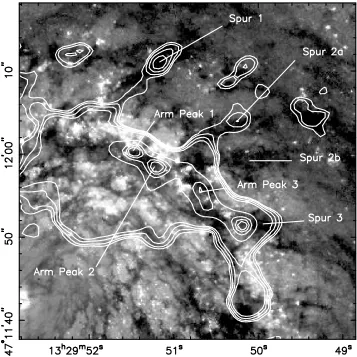
clouds. Spurs, substructures associated with the spiral arms themselves and seen in
Figure 1.3, seem to give rise to the inter-arm H II regions (Corder et al., 2008a; La
Vigne et al., 2006). The mere presence of inter-arm molecular clouds has long been
debated. Recent work by Koda et al. (2008) has revealed copious numbers of such
clouds and has determined the apparent mass distribution of these objects, aiding
the understanding of the origin of these clouds, the larger molecular associations
seen in spiral arms, and global star formation. Nearby galaxies like M51 often cover
many square arcminutes on the sky and require large (∼150 pointing) mosaics. They
also contain a variety of spatial scales with a nearly uniform component covering a
substantial fraction of the disk, linear spiral arm features filling a fraction of the total
area, and point-like molecular clouds populating the inter-arm region.
Arrays like the SMA (Submillimeter Array), CARMA, and ALMA allow efficient
measurement of submillimeter continuum and line emission at several wavelengths at
high resolution. Such multi-wavelength observations are critical. Through the
mea-surement of line ratios, they allow the determination of opacity, temperature, and
spectral indices. The spectral line emission also provides kinematic information.
To-gether, these reveal the physical and dynamical structure of nearly every astrophysical
object. In addition to the objects discussed above, supernova remnants, asymptotic
giant branch stars, and other nebulae contain vital information uncovered through
such ratios.
1.2
Lingering Doubt
From the above discussion, it is clear that submillimeter images of large objects and/or
of large fields of view are critical to several fields of study. However, high dynamic
range is often needed for these observations. The spiral arms of galaxies are bright
while the inter-arm molecular clouds and spiral arm spurs are faint. Weakly emitting
Figure 1.3 Integrated,12CO(1-0) emission from M51 is shown as contours on a Hubble
Space Telescope V-band image. This figure was adapted from Corder et al. (2008a).
protostars. The bright spiral arm-like features or peaks seen in some protoplanetary
disks may dominate the emission from the rest of the disk area. The question becomes
How accurate are the resulting images? If the images are not accurate, the faint end
slope of any mass function or the temperature or the mass density determined by any
image ratio may be more poorly measured than the precision of the measurements
would indicate. The answer to this question is best framed in the study of image
convolved to the resolution of the observations, to the difference between that model
and an observed map. The image fidelity, in the most general case, is then an image
itself. In practice, various methods are used to determine a single number for the
fidelity that is representative of the average fidelity. In this work, image fidelity is
determined by the peak of the model image, convolved to the resolution of the
ob-servations, normalized by the RMS of the difference between the model and observed
map.
Consider the case of a measurement of the clump/core initial mass function. Due
to the nature of star formation, protostars are often clustered. This is expected to be
the case with natal clumps and cores of protostars as well. A map of a dense, cold
cloud might contain sources with fluxes as bright as 200 to 300 mJy beam−1 while
also harboring faint clumps with fluxes on the order of 3 mJy beam−1, i.e. a ratio
of 100. Now also assume that the thermal noise in emission-free parts of the map
is <1 mJy beam−1. An image of such a region might reveal several faint sources in
the vicinity of the brightest peak. This may be evidence of clustered star formation.
On the other hand, it may also be the result of poor image fidelity. If the fidelity of
the image in the neighborhood of the brightest peak is on the order of 30, then the
noise limit is better represented by 10 mJy beam−1 and the population of faint objects
should not be considered as they would easily bias the determination of the faint end
of the initial mass function. Therefore, it is clearly not simply the sensitivity limit
which is of importance, but the fidelity as well.
In the above example, fidelity and dynamic range, the ratio of the peak to the
RMS in an image, are interpreted similarly. Now consider a map of a nearby galaxy or
star forming region in which 12CO(2-1) and13CO(2-1) observations have been made.
The ratio of the two lines gives an indication of the opacity. This opacity is then
used to calculate column densities. If the medium is optically thin, then the ratio of
the two lines should be between 40 and 89, depending on the physical conditions in
the region. However, if one of the lines has poor fidelity, then the ratio is improperly
the mass and any mass moments that are calculated. A similar situation holds for
ratios used to construct spectral indices.
Image fidelity is affected by a variety of factors. For single-dish observations, the
critical limits come from gain and pointing stability. The most fundamental limit
for interferometric observations is the number of samples obtained in the Fourier
plane, i.e. the uv-coverage (Wright, 1999). Therefore, CARMA provides the best
available opportunity for high fidelity, submillimeter imaging to date. CARMA is
a heterogeneous array composed of six 10.4-m (hereafter 10-m) antennas and nine
6.1-m (hereafter 6-m) antennas.3 The 105 simultaneous baselines exceeds other
facil-ities by factors of 3.5 or more.4 CARMA achieved first light in August of 2005 and
has entered into routine function over the last three years.5 Two significant
compo-nents of that commissioning effort are discussed in Chapters 3 and 4. The CARMA
bands are specifically well suited for observing emission from cold dust and
molecu-lar lines. Shorter wavelength bands prove significantly more problematic because of
increased attenuation by the atmosphere and increased difficulties with tropospheric
phase noise.
The heterogeneous nature of CARMA will eventually grant additional benefits
via a unique method of increasing the uv-coverage. The 3.5-m and 6-m antennas can
be placed at separations significantly less than 10 m. This allows observations using
the 10-m antennas as single-dish telescopes, which measures the flux distribution on
angular scales from the entire region toλ/10400, where λ is in millimeters. However,
the limits to image fidelity are restricted by far more than incomplete Fourier coverage.
Due to more stringent constraints on array performance, high fidelity in mosaiced,
interferometric observations is significantly more difficult to achieve (Cornwell et al.,
1993; Wright, 2004, 2007). In the near future with ALMA, a significantly larger
fraction of projects will be limited by image fidelity because the sensitivity will be
greatly increased over any existing facility.
3
At the time of writing, eight 3.5-m antennas of the Sunyaev-Zeldovich Array (SZA) were moved to the location of CARMA and are currently being integrated into the array.
4
The addition of the 3.5-m antennas increases this ratio to nearly a factor of 10.
5
1.3.1
Basic Assumptions & Equations
Some of the earliest mosaiced, interferometric observations to include single-dish data
to measure the largest scales included M31 and NGC 4258 (Bajaja & van Albada,
1979). Since then, algorithms for improved mosaic deconvolution and
mosaic+single-dish combination have steadily improved. Initially, Ekers & Rots (1979) proposed
that individual pointing centers be used to recover information on spacings in a
neighborhood around the measured baseline, but Cornwell (1988) showed that joint
deconvolution of all the mosaic pointings provides similar recovery. The development
of the maximum entropy methods for joint deconvolution of mosaic and single-dish
observations was also extremely important to the recovery of flux on sources which
have a large range of spatial scales (Narayan & Nityananda, 1986; Cornwell & Evans,
1985). However, the desire for the combined benefits of single-dish telescopes and
interferometric arrays brings with it a host of difficulties. Very few studies have
at-tempted to address the concerns of fidelity with actual data (Wright et al., 1999) or
simulation (Cornwell et al., 1993; Wright, 2004, 2007; Bhatnagar et al., 2008). The
problems inherent in mosaicing along with methods for alleviating these challenges is
the subject of this thesis.
Before embarking on a discussion of the difficulties inherent to mosaicing, it is
important to review the basic equations of interferometry and the typical assumptions
used. The signal, Sx, for an antenna is given by Sx = Ssin(2πνt), where ν is the
observing frequency, S is the input voltage amplitude, and t is time. Now, consider
signals from two such antennas but with the antennas separated by a distance, D,
observing the same source at a position with respect to zenith given by the angle θ.
The product of the voltages is then calculated by the correlator.
The separation of the antennas gives rise to a (geometric) delay in the arrival
of a signal between the antennas, given by τg = Dsin(θ)/c = Dl/c, where c is the
speed of light and l = sin(θ). The product of the signals now becomes SxSy =
output of F = cos(2πντg)−cos(4πνt)−sin(4πνt) sin(2πντg). The latter terms vary
more rapidly than the first term, cos(2πντg) = cos(2πνDl/c), by several orders of
magnitude in all terrestrial observing conditions and are therefore easily filtered out
(Thompson et al., 2001). The voltage input is thus modulated byF = cos(2πνDl/c),
the fringe function.
Integration of the fringe function over a finite bandwidth, with central frequency
ν0, results in the fringe function evaluated at the bandwidth center modified by a
function with amplitude that falls off with increasingτgor bandwidth. For this reason,
an instrumental delay,τi, is introduced so thatSxSy =S2sin (2πν(t−τi)) sin (2πν(t−
τg)) = S2F and F ≃ cos2πν(τ
g −τi)
. The value of τi is then updated to keep
τg −τi small. With this approach, angular offsets, ∆θ, are defined with respect
to the direction θ0, defined where τg = τi, so the fringe function, neglecting the bandwidth function, is cos2πν0(D/c) sin(∆θ) cos(θ0)
. Now, l = sin(∆θ) and u =
ν0Dcos(θ0)/c so that the fringe function, F, is now cos(2πul).
For a source brightness distribution I, the illumination of the source by an
in-terferometer baseline results in an output power, P, given by (e.g. Thompson et al.,
2001):
P(l)∝ Z
F(l−l′)P B(l′)H(l′)I(l′)dl′. (1.1) where P B is the baseline primary beam, and H is the bandwidth function. From
the convolution theorem of Fourier transforms, the convolution of two functions is
the same as the product of the Fourier transforms. The Fourier transform of F is
simply the spatial frequency of a given baseline, while the transform of the brightness
distribution, I, is the source visibility function V. The form of H is typically
well-known.
Now, generalizing to two dimensions, P B is the product of the two, complex
antenna voltage patterns, V1 and V2, that constitute a baseline:
P B(l, m) =V1(l, m)V2∗(l, m) =V1(l, m)V1∗(l, m) =|V(l, m)|2, (1.2)
Thompson et al., 2001):
V(l, m) =
Z Z ∞
−∞
E(X, Y) exp2πihX λl+
Y λm
i
dXdY, (1.3)
where E is the field pattern in the aperture, X and Y are positions in the aperture,
and m and l are direction cosines on the sky. The field distribution in the aperture
depends on the source distribution and the sensitivity to the structure in the aperture
plane, i.e. it includes any alteration of the source signal from the illumination pattern
and phase response. Typically, a number of assumptions are placed on these voltage
patterns. It is customary to assume that a voltage pattern is real, circularly
symmet-ric, and constant in time. It is also assumed that any gross, time variable, symmetric
introduction of phase or gain error will be removed via astronomical calibration.
AP B for a specific baseline, given in Equation 1.2, modifies the source brightness
distribution described in Equation 1.1, so that the effective brightness distribution
convolved by the interferometer response is actually
I′(l, m) =P B(l, m)I(l, m) =V
1(l, m)V2∗(l, m)I(l, m). (1.4)
Provided the primary beam or constituent voltage patterns are well known, the true
source brightness distribution can be easily recovered by dividing the altered
bright-ness distribution pattern by the primary beam.
1.3.2
Assumptions Violated
In reality, all of the assumptions about the primary beams are not strictly true. The
voltage patterns are very rarely perfectly symmetric, inducing a directional
depen-dence on the sampled brightness distribution. Due to the altitude-azimuth mounts
employed by most telescopes, this symmetry breaking directly implies a time variable
pattern on the sky. The origin of the asymmetries may also change in magnitude and
6For CARMA there are different beam patterns but patterns from a given size of antenna are
direction with changing physical conditions, specifically temperature and elevation.
Misalignment of the antenna optics can induce phase gradients (to first order) across
the voltage pattern that are also time variable and may depend on observing
condi-tions. The most fundamental of errors in the primary beam, pointing, also induces
this direction, time, and observing condition dependence on the primary beam
pat-tern. Given that the antennas comprising the array are rarely going to have identical
errors, the commonality assumption is also broken. The types of errors in the primary
beam patterns will be elaborated upon in Chapter 2.
Even in the presence of these errors, if precise measurements of the voltage
pat-terns can be obtained, the deviations caused to the attenuated sky brightness
distri-bution can be corrected, although additional procedures are needed (see Chapter 2
or Bhatnagar et al. 2008). That is to say, the deviations of the voltage patterns
from their symmetrized, real, common models are not a problem, but it is the lack of
knowledge of the true voltage pattern which introduces the imaging errors and results
in poor fidelity. However, such complete knowledge is difficult to obtain. Pointing
errors of δl and δm in one antenna cause the source to be illuminated by
I′(l, m) =P B(l, m)I(l, m) =V
1(l−δl, m−δm)V2∗(l, m)I(l, m) (1.5)
instead of by Equation 1.4. When the final image is made, the synthesized image is
divided by the voltage patterns as though the pointing error were not present.
Pointing is a particularly problematic source of primary beam error with respect
to image fidelity. It causes the largest deviations from the assumed pattern at typical
error levels. It is also varies most rapidly. Other types of error, e.g. ellipticity or
beam size errors, introduce additional reductions to the image fidelity, but typically
these are less significant. The decrease in fidelity caused by imaginary components
It is clear that improvement can be made to image fidelity by exploring the effects of
the relaxation of standard assumptions about the primary beam and comparing the
quantities which result in significant fidelity degradation to the measured deviations
in a functioning system. To this end, we have conducted the following studies:
• Chapter 2: Simulations: Simulated observations are carried out to de-termine the magnitude of the reduction in image fidelity as a function of the
deviation from standard primary beam model assumptions. A limited range
of source models are considered which represent many of the typical observing
situations described above. The simulations reveal that highly deviant
sur-faces, offset illumination patterns, and pointing errors are the leading causes
of fidelity reduction. A method for utilizing the individual voltage patterns to
correct observations is presented.
• Chapter 3: Holography: The surface accuracy of the CARMA dishes was measured. The surfaces were adjusted and the optics were aligned, resulting
in significant improvement on the most deviant antennas. Once completed,
peated measurements of the voltage pattern on the sky revealed consistent,
re-peatable, and significant telescope-to-telescope variation in the voltage patterns
implying that the imaging approach discussed in Chapter 2, which accounts for
the independent voltage patterns, will likely improve the image quality.
• Chapter 4: Pointing: At the time of observation, the leading, correctable cause of fidelity degradation is pointing error. To improve the quality of
point-ing at CARMA, we created a new optical catalog which contains uniform sky
coverage down to the magnitude limit of the current CARMA optical cameras.
The data collection routines were modified to utilize the new catalog and
de-crease the measurement time per source. The new approaches resulted in nearly
a factor of four improvement in the data collection rate. The resulting fits to
of two. The method was extended to utilize the optical cameras for use during
science observations first at night and then, through new software development,
by day. The resulting decrease in pointing error during a science track was
sub-stantial. This method, called optical offset pointing, is currently used in most
science observations at CARMA.
• Chapter 5: Application to NGC 7538: The new pointing routines, when possible, were applied to observations of the nearby massive star-forming region
NGC 7538. The complex morphology of the region demands reasonably high
image fidelity. It is compact, making it possible to mosaic a substantial fraction
of the region in relatively few pointings. Spectral line and continuum
observa-tions were conducted. The methods of utilizing the measured primary beams
were employed for a few pointing positions to determine if the dominant source
of error in the images was primary beam errors or some other effect like delay or
calibration errors. The high resolution, high fidelity images allow the
identifica-tion of many outflow sources and associaidentifica-tion of these outflows with their driving
source, the measurement of accretion rates directly from absorption profiles and
outflow masses, and the resolution of the dense core NGC 7538S. In turn, these
Backman, D. E., & Paresce, F. 1993, Protostars and Planets III, 1253
Bajaja, E. & van Albada, G. D. 1979, A&A, 75, 251
Bhatnagar, S., Cornwell, T. J., Golap, K., & Uson, J. M. 2008, A&A, 487, 419
Boss, A. P., ApJ, 677, 607
Carpenter, J. M. 2002, AJ, 124, 1593
Corder, S. A., Eisner, J. E., & Sargent, A. I. 2005, ApJ, 622, L133
Corder, S. A., Sheth, K., Scoville, N. Z., Koda, J., Vogel, S. N., & Ostriker, E. 2008,
ApJ, accepted
Corder, S. A. et al. 2008, ApJ, submitted
Cornwell, T. J. 1988, A&A, 202, 316
Cornwell, T. J. & Evans, K. F. 1985, A&A, 143, 77
Cornwell, T. J., Holdaway, M. A., & Uson, J. M. 1993, A&A, 271, 697
Eisner, J. A., Plambeck, R. L., Carpenter, J. M., Corder, S. A., Qi, C., & Wilner, D.
2008, ApJ, 683, 304
Ekers, R. D. & Rots, A. H. 1979, Image formation from Coherence Functions in
Astronomy, Schoonveld, ed. Reidel, Dordreccht, p 61
Enoch, M. L. 2007, Ph. D. Thesis, Molecular clouds and star formation: a
multiwave-length study of Perseus, Serpens and Ophiuchus
Fukagawa, M. et al. 2004, ApJ, 605, L53
Grady, C. A., Woodgate, B., Bruhweiler, F. C., Boggess, A., Plait, P, Lindler, D. J.,
Greaves, J. S. et al. 2005, ApJ, 619, L187
Koerner, D. W., Sargent, A. I., & Ostroff, N. A. 2001, ApJ, 560, L181
Koda et al. 2008, Nature, submitted
La Vigne, M. A., Vogel, S. N., & Ostriker, E. C. 2006, ApJ, 650, 818
Pi´etu, V., Guilloteau, S., & Dutrey, A. 2005, A&A, 443, 945
Narayan, R. & Nityananda, R. ARA&A, 24, 127
Thompson, A. R., Moran, J. M., & Swenson, G. W. 2001, Interferometry and
Syn-thesis in Radio Astronomy, New York, Wiley-Interscience
Testi, L. & Sargent, A. I. 1998, ApJ, 508, L91
Wilner, D. J., Holman, M. J., Kuchner, M. J., & Ho, P. T. P. 2002, ApJ, 507, L115
Wright, M., Dickel, J., Koralesky, B., & Rudnick, L. ApJ, 518, 284
Wright, M. C. H. 1999, BIMA Memo Series 73
Wright, M. C. H. 2004, CARMA Memo Series 27
Wright, M. C. H. 2007, CARMA Memo Series 38
Chapter 2
Simulations: Limitations on
Dynamic Range and Image
Fidelity For Wide Field Imaging
Abstract
Here we present simulations that include the effects of relaxing many typical
assump-tions about the interferometer primary beam on image fidelity. The degradation of
image fidelity as a function of errors in pointing as well as errors in the assumed
properties of the primary beam are simulated, allowing for heterogeneity among the
constituent beams. Critical characteristics that must be corrected to some degree
be-fore high-fidelity imaging can be achieved include surface accuracy, optical alignment,
and pointing. Once these deviations are addressed, a more accurate model of the
pri-mary beam shape is required to further improve fidelity. Using these simulations, we
propose a method of correcting for deviant primary beams in real observations.
2.1
Introduction
The concepts of high image fidelity and dynamic range were provided in Chapter 1
along with their implications for scientific observations. A variety of factors can,
however, restrict image fidelity. Some of these, including poor sensitivity,uv-coverage,
and atmospheric phase noise, can be attributed to the inherent properties of the array
being used. Others arise from more systematic errors such as baseline solutions,
improper primary beam models, or instrumental gain variation.
Foremost among the inherent limitations is the fact that interferometers sample
finitely many spatial scales. Consider, for example, the measurement of the visibility
VS(~u) = K X
k=1
δ(~u−~uk)V(~u) (2.1)
whereVS is the measured visibility function,V is the Fourier transform of the source
flux distribution, i.e. the visibility function, δ is the delta function, and the points
~uk (the uv-coverage) are the finite positions of measurement for the observation. In
reality, the visibility function is averaged over a patch of uv-space of width ~u±d,
where d is the antenna diameter.
In the neighborhood of uv-points actually measured, i.e. over the range ~u±δ~u,
some information can be recovered by the deconvolution process by making
assump-tions about the source extent (Cornwell, 1988), by inverting with respect to
individ-ual pointing centers (Ekers & Rots, 1979), or by use of Cauchy relations to constrain
derivatives in the complex plane. Also, mosaicing observations allow recovery of
infor-mation initially lost in averaging over the finite size of the antennas in use (Thompson
et al., 2001).
However, the interferometer cannot sample the visibility function everywhere. The
effect of this limitation is greatest in cases where there are few antennas in the array
or where large regions requiring multiple pointings are observed. In the former case,
the number of baselines sampling theuv-plane is inherently sparse. In the latter, the
size of the region impacts the density of sampling of the uv-plane associated with
individual patches of sky. In principle, repeated observations can fill in the uv-gaps
generated by multiple pointings, but in practice this is extremely complicated and
source size inevitably limits image fidelity (Wright, 2007).
Arrays like CARMA, with a significant number of antennas and thus dense uv
nevertheless limited by the inability to sample the central region of theuv-plane due
to the finite physical size of the antennas. This central region of the uv-plane is
associated with the largest angular scales in the map, scales which may contain the
vast majority of the flux. On the other hand, heterogeneous arrays, like CARMA, offer
a unique opportunity to overcome this limitation using the larger antennas to recover
flux on the largest angular scales. In principle, there is no need to utilize smaller
telescopes to bridge the uv-gap (Cornwell et al., 1993), but, in practice, overlap aids
the relative calibration. A value of two (e.g. Thompson et al., 2001) is often quoted for
the necessary ratio of large diameter antenna to smaller diameter antenna to obtain
sufficient overlap, although a slightly smaller ratio is likely tolerable.1
Further limits to image fidelity exist. Array sensitivity limits fidelity since weak,
but real, structure in a map cannot be accurately recovered. Atmospheric phase noise,
causing preferential smearing of the smallest structures in the map, will also have an
adverse effect on fidelity. These limitations are, at present, unavoidable, although
efforts are being made to reduce such phase errors via comparison with phase
fluctu-ations in the water line (water vapor radiometry) and the use of additional antennas
to follow the phase on nearby quasars at lower frequencies. Other detriments to
im-age fidelity arise from random and systematic effects that are, in principle, avoidable
or at least can be minimized. Among these, imperfect knowledge of the primary
beam presents the largest, correctable barrier to obtaining high-fidelity observations
of extended objects (Cornwell et al., 1993).
Theoretical arguments and basic simulations that have been used to date to
pro-duce estimates of fidelity degradation in the presence of primary beam model error
suffer from two fundamental limitations: they assume circular symmetry of the
pri-mary beams and they treat the antennas as identical entities. In reality, errors such
as a misaligned illumination pattern on the antenna surface, sidelobes, off-axis focus
error, or ellipticity in the primary beam result in significant deviations from
sym-1The limiting factor is imposed by the taper of the illumination pattern on the constituent
metry. Since these systematic deviations are rarely uniform across all the antennas,
the antennas cannot be regarded as uniform entities. Indeed, pointing errors alone
result in the non-uniformity of antenna primary beams. The deviations among
anten-nas result in decidedly different performance and may reduce fidelity in final image
reconstruction.
More careful simulations can provide both quantitative measures of the decay
of fidelity as a function of various parameters for different models and qualitative
representations of the resulting changes in image appearance. However, to date, many
difficult parameters have been simulated using simplifying approximations for errors.
Specifically, pointing error has been simulated using gain error. Gain errors affect
the fidelity by scaling the overall flux response. True pointing and primary beam
error affect the image differentially, resulting in gradients across the illuminated sky
relative to the assumed illumination.
Here, we present a suite of simulations encompassing various departures from
the standard primary beam assumptions. While these simulations are specific to
CARMA, the methods are easily generalizable to any array. In practice, the degree of
fidelity decay is highly dependent on the exact source structure. We focus on
situa-tions where fidelity and dynamic range are likely to be of concern. These simulasitua-tions,
in turn, motivate corrective methods for use in real-time (described in Chapters 3
and 4) and in data processing (described in Chapter 5). Source models and the
vari-ables are discussed in§2.2, while the simulations are outlined in§2.3. The simulation
results are presented in §2.4 and discussed in §2.5. Conclusions and suggestions for
future work are in §2.6.
2.2
Models & Variables
Three general models are considered here. Point source and resolved Gaussian source
models represent a large fraction of typical observations with interferometers and
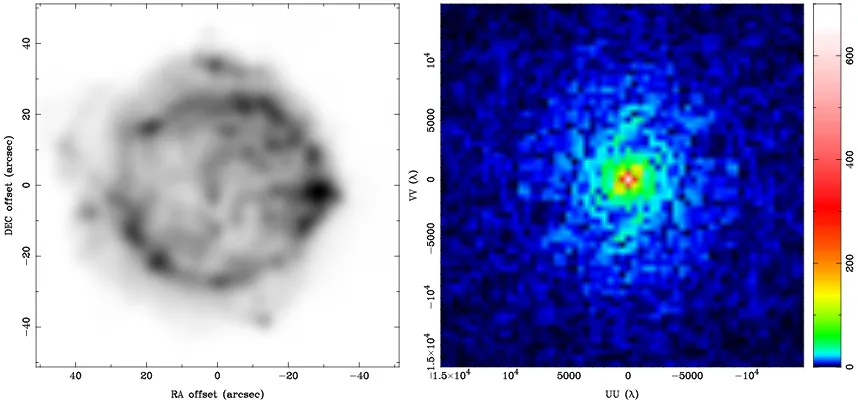
have rather simple structure. The third model, shown in Figure 2.1 at the scale used
reasonable approximation for extended2 sources such as nearby galaxies, supernova
remnants, some debris disks, and asymptotic giant branch stars. In the case of Cas A,
the integrated flux of the map is over 700 Jy and the peak flux is ∼10 Jy. This rather
large flux ensures that the simulations are truly in the fidelity limited regime, since
typical thermal noise in a single, mosaiced, continuum track at CARMA is a few mJy.
The Cas A model shown in Figure 2.1 has significant flux out to 100-m baselines,
[image:38.612.108.537.308.509.2]showing that the source indeed has flux on a variety of spatial scales.
Figure 2.1 The model is a C-band image of the supernova remnant, Cas A. The left panel shows the source scaled to cover a region comparable with the FWHM of the 10-m primary beam. The right panel shows the flux amplitude of the model in the Fourier plane with the pixel scale in Janskys. The axes in the right panel are in units of λ=2.6 cm.
In reality, it is not errors in the primary beam which are a problem but, more
specifically, deviations of the assumed primary beam from the actual one which
de-grade fidelity. In these simulations, the assumption is that arealisticprimary beam is
2In this context, an extended source is one whose spatial extent is comparable to or larger than
used to illuminate the source on the sky and then the assumed, model primary beam
is used in the imaging process. Image fidelity is affected by other systematic errors
as well, but most of these errors are introduced by more fundamental limitations in
the array performance.
The primary beam is the product of two, antenna-based, complex voltage patterns
given by Equation 1.2. The measured visibility function, VM(~u)3 is related to the
voltage patterns, V, through
VM(~u)∝ Z ∞
−∞
Vi(~k)Vj(~k)I(~k)e−2iπ( ~k·~u)
d~k, (2.2)
where I is the source brightness distribution and the bandwidth function has been
ignored since it is assumed to be well known. If one or both of the voltage patterns
differ from the assumed model, then Vi(~k) must be replaced by some altered voltage
pattern, V′
i(~k). However, since Vi(~k) is still used in the final image construction process via the primary beam, errors in the voltage patterns can adversely affect the
measured visibilities and the primary beam correction during the image restoration
process.
At the most basic level, deviations from the ideal primary beam are caused by
errors in the antenna surfaces that in turn reduce forward gain. While the antenna
gain can be measured relatively precisely, flux scattered by small scale imperfections
in the antenna surface pollutes the image with a scattered beam outside the main
beam. The scale of such deviations is typically a fraction of a wavelength (≤100µm at
millimeter wavelengths), and not systematic for well functioning millimeter telescopes
(see Chapter 3). Since it is extremely difficult to model such small scale variations,
these errors can be approximated by gain errors, δG = 1−exp(−[4πσ/λ]2) where σ
is the surface accuracy and λ is the observing wavelength (Ruze, 1966). This
repre-sentation for the error assumes that the surface/phase errors are Gaussian random
numbers which are distributed evenly over the aperture and that the correlation size
3This is to distinguish between the visibility function altered by the illumination patterns, the
true visibility functionV, and the visibility function that arises from the finite sampling of the array,
error, the resulting gain errors are 1.6% and 8.0% at 3 mm and 1.3 mm, respectively.
The next order of primary beam error is simply due to uncertainty in the assumed
center of the primary beam, i.e. a pointing error. Consider the case of two, 1-D
Gaussian patterns, of widths and σ1 and σ2, and one of the patterns is perfectly
pointed while the other is offset by µ, the resulting primary beam has widthσ2
new =
σ2
1σ22/(σ12+σ22), center µnew =µσ12/(σ21 +σ22), and peak
A= exp−µ
2
2σ2 2
h
1− σ
2 1
σ2 1 +σ22
i
, (2.3)
where in the limit of σ1 = σ2 = σ these reduce to σnew2 = σ2/2, µnew = µ/2, and
A = exp (−(µ/2σ)2). For a pair of 10-m antennas, the forward gain is reduced by
1% for antennas offset by 5′′ but reaches 5% by a 11.5′′ offset. For 6-m antennas, the
same 11.5′′ error results in a 2% gain error.
It is worth noting that for sources of any finite extent,4 pointing error does more
than reduce the forward gain. The extension of the source and the offset location
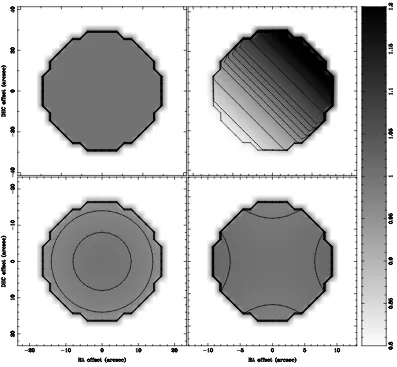
of the beam center results in a differential effect, as demonstrated in Figure 2.2. A
comparison of the upper left and right panels shows the impact of an illuminating
beam offset from the true center for a disk model. The errors in the flux reach
±25% at the edge of the disk and are distributed as a linear gradient. The pointing error assumed for this model is within 2 standard deviations of the nominal pointing
position based on the repeatability of CARMA pointing offsets (see Chapter 4).
As will be described in detail in Chapter 3, the correct width and shape of the
primary beam can be established from detailed measurements of the beam on the sky.
In practice, current software imaging packages utilize circularly symmetric profiles for
the primary beams. MIRIAD, the default imaging package for CARMA, currently
uses a circularly symmetric Gaussian profile for the CARMA primary beams. Errors
can be introduced if the size of the profile differs from that assumed in the model. The
bottom-left panel of Figure 2.2 shows that this effect results in a quadratic variation
4The use of extended is avoided here as the effects to be discussed apply to sources of any
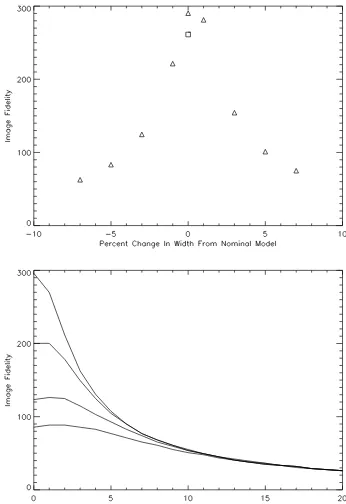
Figure 2.2 The top-left panel shows a uniform disk where the beam used to illuminate the source was also used to correct the final image. The top-right panel shows a primary beam offset by 8% of the FWHM from the nominal pointing location. The bottom-left panel shows the disk restored with a primary beam 3% different in size from the beam model. The bottom-right panel shows the disk illuminated by a beam which has an ellipticity of 3% but of the same size as the beam model. The model disk has unit flux per pixel and is equal to the size of the FWHM of the beam in question. The pixel scale ranges from 0.8 to 1.2. The contours also span 0.8 to 1.2, initially in steps of 0.05. Inside 0.95 and 1.05, the contours are in intervals of 0.02.
across the disk with perfect agreement at the beam center and growing deviation
towards the edges. The errors induced, however, are relatively small when compared
of the profile from a Gaussian. The true shape of the beam compared to a Gaussian
profile is discussed in detail in Chapter 3. In general, the beam profile appears to
be flatter (i.e. wider) in the beam core compared to a Gaussian but steeper (i.e.
narrower) than the Gaussian profile in the wings.
To a lesser extent, errors can result from slight deviations from circular symmetry
even when the adopted primary beam size is correct. This ellipticity is defined ase =
amajor/aminor, where amajor and aminor are Gaussian fits to the FWHM of the beam
profile. The bottom right panel of Figure 2.2 shows the influence of 3% ellipticity
(e = 1.03). Here the error pattern is quadrupolar in shape. Several methods of
introducing ellipticity can be envisioned. A common ellipticity for a given antenna
style, i.e. all 6-m antennas and all 10-m antennas, with a position angle of 0◦ could
be used. Or, the ellipticity could remain fixed on antennas of a common diameter
but the position angle of the ellipticity could vary. Finally, an independent ellipticity
and position angle on an antenna basis may arise.
Sidelobes can also be asymmetric. The primary beam of the heterogeneous
base-lines at CARMA is formed by the geometric mean of the primary beams from the
con-stituent antennas. The low-level sidelobes of the 10-m primary beam are multiplied
by higher power points in the 6-m primary beam, resulting in increased sidelobes.
Measurement of the ellipticity, departures from Gaussian profiles, and sidelobe
patterns are, in practice, quite difficult. In particular, the ellipticity and sidelobe
patterns of the profile can change appreciably with elevation and temperature. A
long-term campaign to monitor the primary beam profiles would be necessary to say
with certainty that a systematic ellipticity is present or that sidelobe patterns are
consistent. Even then, determination of the true primary beam profile would require
further observations to average over temporal changes and noise in the inherently less
sensitive portions of the beam which typically harbor the deviations.
In addition to any departures from Gaussian profiles, it should be noted that the
elements of an array can differ from each other. In reality, CARMA, or any other
array, is not an array ofN+ N2
of distinct antenna types; it is an array of M2
different primary beams whereM is the
number of antennas, i.e. M independent voltage patterns form independent primary
beams on a baseline basis. These antenna voltage patterns might have different
sizes, ellipticities, pointing offsets, and even imaginary components. In the limit of
common antenna voltage patterns for all antennas, the imaginary components of the
beam cancel perfectly in the imaginary beam but these components can give rise to
ellipticity in the real component.
If patterns differ, as they in fact do for every antenna in every array, the imaginary
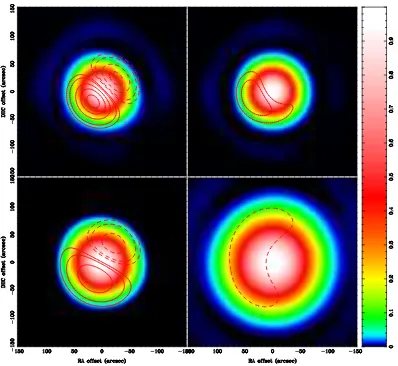
components may seriously influence the image fidelity. The panels of Figure 2.3 show
examples of baseline-based, homogeneous and heterogeneous primary beams from
CARMA. The top panels show the primary beams for a pair baselines composed
en-tirely of 10-m antennas, hereafter a 10-m baseline. On the left, the constituent voltage
patterns have imaginary gradients in opposite directions resulting in an amplified
gra-dient of +20% to -15% across the image. On the top-right, the contributing voltage
patterns have small imaginary components and thus have peak imaginary components
of 6%. The bottom left panel shows a heterogeneous baseline where the 6-m antenna
voltage pattern is imaginary component-free, but it illuminates a 10-m antenna
volt-age pattern which has a significant imaginary component so the gradient persists.
The bottom right panel shows a primary beam from a baseline composed of two 6-m
antennas, hereafter a 6-m baseline, which are largely free of imaginary contribution.
In all, these four examples demonstrate that the assumption of uniformity is far from
valid.
2.3
Simulations
All simulations are conducted using MIRIAD (Sault, Teuben, & Wright, 1995),
wrapped within Python and supplemented with IDL to perform free rotations of
the beams to arbitrary parallactic angle.5 Simulations are carried out at 100.2 GHz
5
Figure 2.3 A variety of measured real (color) and imaginary (contour) primary beams are shown for a heterogeneous array. The first two contours are at 3% and 5% and then contours increase by 5% thereafter. Negative contours are shown as dashed lines. The top panels display primary beams from 10-m baselines. The bottom left panel shows the primary beam from a heterogeneous baseline while the bottom right shows a 6-m baseline primary beam.
since the true voltage patterns are measured at this frequency (see Chapter 3). It
is easy to scale the frequency of the templates used by changing the cell size in the
voltage pattern by a factor of the ratio of the frequencies. Only the influence of gain
and primary beam error are addressed here, although the simulation package includes
For the purposes of these simulations, only the CARMA “D” configuration, which
gives a resolution of 4-5′′in the 3-mm band, is used. Nyquist sampled pointing offsets
for mosaics are used for all simulations. Observations of Cas A consisted of a seven
pointing mosaic. Simulated observations span 4 hours centered about transit. A
variety of metrics are required to assess the resulting image quality. The basic metric
for the simulations will be fidelity, defined as the ratio of the peak flux of the model
at the simulation resolution and RMS of the residual image. For Gaussian and point
source models, fits to the image profile are also used to determine the quality of the
simulated observations.
Simulations begin by separating the specified observing time into subsets since
asymmetric beam patterns or real pointing errors require a time evolving pattern.
Over the specified time range, uv-data for an empty field is generated using uvgen,
which requires information on antenna performance, configuration, and mosaic
pat-tern, as well as the location of the source to be used in the simulation. The average
parallactic angle of the model source is then retrieved from the generated dataset.
For each pointing location in the mosaic pattern and antenna pair, the model image
is multiplied by the product of two offset voltage patterns resulting in, for the most
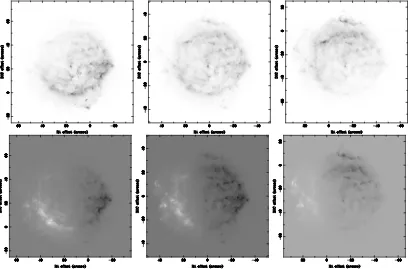
general case, a real and imaginary brightness distribution. Figure 2.4 shows various
primary-beam-illuminated pointings of the Cas A model.
Once the baseline-specific, single-pointing, primary-beam-illuminated model is
available, the image is fed to uvmodel, using the output of uvgen as the
base-line visibility file. This produces a file which adds the noise of the original visibility
file to the visibilities of the model sampled at the values given by uvgen. First the
real component is sampled, then the result is fed to uvmodel again, now using the
imaginary component of the brightness distribution and the optionimaginary, which
permutes the components and changes sign for proper complex algebra.
Gain error is introduced as a percentage of the antenna gain, nominally 1.0. The
amplitudes of the simulated visibilities are multiplied by an antenna based quantity,
independent for each antenna, that has a