Abstract— Medicine is a field with high volatility of changes.
Everyday new discoveries and procedures are tested with the sole goal of providing a better-quality life to patients. With the evolution of computer science, multiple fields saw an increase of productivity and solutions that could be implemented. More specifically, in medicine new techniques started being tested in order to under-stand how the systems and practices used can reach higher performances, while maintaining the predefined high standards of quality. For many years data generated in hospitals was collected and stored yet few tools were implemented to extract knowledge or any type of advantage. One of the areas that successfully implemented in medicine was the usage of data processing tools and techniques to further extract information regarding the high abundance of data generated in a daily basis, in this field of work. This data can be stored in different ways which leads to multiple approaches on how to deals with it. The sole purpose of this paper is to give an overview of some case studies where structured and un-structured data was used, joint and separately and the value of it.
Index Terms—Structured Data, Unstructured Data, Natural Language Processing, Data Integration, Electronic Medical Records.
I. INTRODUCTION
ith the evolution of the medical field, the life expectancy has been increasing. This evolution leads to good things, such as the end of some diseases (smallpox, plague, etc.) but, on the other hand, new problems arise with the appearance of new ones such as dementia, cancer, etc. But, as medicine grew and developed, so did many other areas, specially computer science. Alongside they have a direct impact on fighting new medical challenges.
Nowadays, healthcare providers store loads of data, medical and non-medical. This data can regard drug prescription, treatment records, general check-up
Manuscript received March 06, 2019; revised March 26, 2019. This work has been partially supported by Portuguese National funds through FITEC - Programa Interface, with reference CIT "INOV - INESC Inovação - Financiamento Base".
Diogo Baptista is a Master’s student from Instituto Universitário de Lisboa (ISCTE-IUL) (e-mail: [email protected]).
Ruben Pereira is with Instituto Universitário de Lisboa (ISCTE-IUL), ISTAR, Lisbon, Portugal (e-mail: [email protected]).
Joao C. Ferreira is with INOV INESC Inovação – Instituto de Novas Tecnologias, Lisbon, Portugal (e-mail: [email protected]), Instituto Universitário de Lisboa (ISCTE-IUL) and Information Sciences, Technologies and Architecture Research Center (ISTAR-IUL), Lisbon, Portugal (e-mail: [email protected]).
Marcia Baptista is with the INOV INESC Inovação – Instituto de Novas Tecnologias, Lisbon Portugal (corresponding author e-mail: [email protected]).
information, physician’s notes, surgical information or financial and administrative documents and are either stored in legacy systems or electronic medical records (EMR) [1]. The EMR are computerized medical information systems that collect, store and display patient information [2].
The usage of EMR accommodates multiple advantages. Reference [3] considers that those advantages can be summarized as “optimizing the documentation of patient encounters, improving communication of information to physicians, improving access to patient medical information, reduction of errors, optimizing billing and improving reimbursement for services, forming a data repository for research and quality improvement, and reduction of paper”.
The format in which this information is recorded is very important due to its direct impact on how it can be moulded to provide greater insight.
There are three different types of data structures: structured, semi-structured and unstructured [4]. Although in the present work the authors mainly focus in the structured and unstructured. The specificities of both data types are explained further in this paper.
Associated with these different types of data structures, there are different data manipulation techniques, such as data mining (DM) and text mining (TM) (also known as Text Data Mining [5]). These techniques have been used separately, yet the author did not find many studies that combined both approaches, resulting in this work.
The body of this paper is composed of four main topics, the literature review, where the authors emphasize other projects developed in the area, a small chapter to present the data used in the project, the architecture projected and the last one regarding the obtained results.
To complete, a final chapter of conclusions where the author sums up several points approached during the paper and reflects on them.
II. LITERATURE REVIEW
This chapter intends to show and clarify the work that has already been done in the area of clinical information extraction from EMR and its integration with already structured clinical data. There are some case studies that already manage to integrate extracted information from EMR with structured data.
In 2018 a study developed a hybrid model that would involve the mining of texts integrated with the mining of structured data to allow prediction for early stages of dementia. This was achieved by coupling together TM and Natural Language Processing (NLP) with DM [6]. In this study two approaches were compared, the first only
Structured and Unstructured Data Integration
with Electronic Medical Records
Diogo Baptista, João C. Ferreira, Ruben Pereira and Márcia Baptista
considering the already structured data, and the second considering said structured data plus a new variable that was the result of text clustering of the patient’s previous pathological history. With the final results the authors concluded that the unstructured text that would probably be discarded, has significant value for these models since the best values of precision were obtained in the second approach.
Also in 2018, another study intended to show how different the results would be in a geriatric syndrome case classification, while using three data sources: data claims, structured information from Electronic Health Records (EHR) and unstructured text form the same EHR [7]. The results were somewhat aligned with the conclusions of the first study, since the authors of [7] concluded that the presence of the unstructured element used in the study allowed for a considerable number of individuals to be included that would, otherwise, be missed if only considering the structured information (claims or EHR).
The third case study is also from 2018, and the authors elaborated five iterations to predict the possibility of readmission post hospital discharge congestive heart failure. The data used in this study included both structured (age, ethnicity, marital status, etc.) and unstructured (discharge summary) structures and the five iterations varied in which data was used [8]. The five iterations were:
1) Structured Data;
2) Unstructured Data;
3) Address Class Imbalance (Feature Selection);
4) Merge Data (1+2);
5) Merge Data (1+3).
And with the best results acquired from iteration five, the authors of [8] concluded that said iteration should be used for further research. Showing once again the advantage of the mixed approach.
More case studies regarding this mixed approach have been made but the most recent were presented in this work.
Although these recent case studies show positive results, they all sought to solve the problem of integrating structured data with unstructured data but for their specific problems, i.e., in all the presented scenarios new variables were created based on the unstructured text characteristics., appearing after a document clustering analysis or other analysis.
The approach differs from the ideas of these papers because the authors intend to develop a system for a more generic integration, making the most use of the written text.
III. DATA
Before moving on to the architecture of the system itself, it is good to get an overview of the data in question, both structured and unstructured.
A. Structured Data
On the one hand the structured data used in this work contemplates a collection of records from the Emergencies Departments (ED) of a Portuguese hospital regarding the time between January 1st, 2015 and December 31st, 2017. Each record represents one interaction with hospitals ED.
The aforementioned data has been extracted from the
hospitals data base in the form of an excel file and it contains 305.636 records and 15 attributes. The attributes are represented in the table I.
The “Episode Alert” consists of simple identifier of the specific encounter. The “Patient ID”, “Nurse ID”, “Doctor First Observation ID” are, as the name implies, identifiers of the patients, nurses and doctors. This identification is necessary as a privacy measure. The “ED Sub Department”
represents the local where the event happened. The “Admission Date” is the data at which the patient was admitted. The “Triage Color” categorizes the patient in a scale of color that goes from blue (5) to red (1)1, from non-urgent to imminent danger, respectively. The triage process is according to the Manchester Triage Protocol. The “Date First Medical Observation” represents the moment when the first observation was made to the patient from a doctor. The “Discharge Date” represents the date at which the patient got the discharge clearance. The “Discharge Destination” involves the destination to where the patient was sent. The “Readmission” is a flag that identifies which records represent a readmission (1) or a simply a new entry (0). Finally, the disease codes are represented as numeric codes the, “Disease Code (ICD Code)”, and its description “Disease Code Description”. All these descriptions and codes are from International Code of Diseases 9 (ICD 9) and is regulated by the World Health Organization (WHO) as a way to standardize disease description and “promote international comparability in the collection, processing, classification, and presentation of mortality statistics” [9].
B. Unstructured Data
On the other hand, the unstructured data used in this work consists of a set of EMR’s from the same Portuguese hospital in an excel file, but this time with appointments. In other words, each line from the excel is related to an individual appointment. Since this dataset is related to the appointment’s department, it will be treated by Appointment Department (AD) dataset.
This dataset contains data relative to the year of 2017 and to medical services that do not require the admission of the patient to the hospital or health facility, such as diagnosis,
1 1 – Red; 2 – Orange; 3 – Yellow; 4 – Green; 5 – Blue;
TABLEI EDDATA ATTRIBUTES
Attribute # Attribute Name Data Type
1 Episode Alert Integer
2 Patient ID String
3 ED Sub Department String
4 Admission Date Timestamp
5 Triage Color Integer
6 Nurse ID String
7 Triage Date Timestamp
8 Date First Medical Observation Timestamp 9 Doctor First Observation ID String
10 Discharge Date Timestamp
11 Discharge Status String
12 Discharge Destination String
13 Readmission Flag
14 Disease Code (ICDa Code) Integer
15 Disease Code Description String
a
rehabilitation, treatment, etc. Also, the dataset contains information relative to several medical specialties: pulmonology, oncology, rheumatology, gastroenterology, hematology, nephrology, pediatrics, pediatric hematology and urology.
Next, present in the table II, it is represented the structure of a line of the dataset.
The “Clinical Episode” works exactly as an identifier for each appointment. The “Medical Specialty” infer to the medical specialty of the appointment. The “Medical Specialty Code” represents the code of the medical specialty and the “Medical Specialty Description” represents the correspondent description. The “Diagnosis Description” contains the description of the diagnosis given by the doctor. The “Diagnosis Code” represents the id of the disease in the internal system of the hospital. This code also is adapted from the ICD 9 code aforementioned. In other words, this code from this dataset, can be connected to the ICD 9 code from the structured dataset. The “Date” represents the date of the appointment. And finally, the “Clinical Narrative Text”, maybe the most valuable variable of this dataset, contains a descriptive narrative of the appointment, written by the doctors themselves. This free text can contain a broad of different elements that can give valuable knowledge of what has been done, the drugs prescribed for each disease, its dosages, etc.
Now that the data used in this word is presented, the next chapter overviews the architecture of the system implemented.
IV. THE ARCHITECTURE OF THE SYSTEM
The system implemented for this paper demanded different steps of preparation for each dataset from its “raw form” to its “processed form” ready to be integrated. The overall process is represented in the Figure 1.
A. Emergency Department Processing
The process of preparing this dataset to the final integration involves four steps: removing rows that have the fields “Disease Code (ICD9 Code)” and/or “Disease Code Description” empty, changing all Timestamp data types to Date, creating a new column to accommodate de number of days each patient took in the ED and translating the column “Discharge Destination” since it is still in Portuguese.
Once those changes have ended, the excel file is passed through a python script developed by the authors to turn it into an XML file.
B. Appointments Department Processing
The dataset regarding the appointments of the Portuguese hospital require more operations in order to prepare the data to integration.
Firstly, the rows with empty attributes “Diagnosis Code” and/or “Diagnosis Description” were eliminated in the first dataset, as well as in the second.
Secondly, since the attribute “Clinical Narrative Text” is free text, there is no common framework in the many entries of the excel file, which usually results in improper grammatical use, spelling errors, local dialects [5], short phrases and abbreviations [4]. Hence this second step that consists of misspelling correction and unfolding of abbreviations.
Once that text is pre-processed the data is passed through a translator to change it from Portuguese to English, standardizing the language in both datasets. For each row of the dataset new text file is created with the information of its respective row. The used translator consists of a python script developed by the authors that uses a free API from Google Translator2.
After the dataset is translated, the clinical narratives are ready to be passed through cTAKES, the NLP system selected to be used in the project. The cTAKES system consists of an open-source clinical NLP system implemented in Java. It is “a modular system of pipelined components combining rule-based and machine learning
2https://py-googletrans.readthedocs.io/en/latest/
Fig. 1. Generic overview of the process of integration of both datasets, from the excel files to the final conjoint database.
TABLEII ADDATA ATTRIBUTES
Attribute # Attribute Name Data Type
1 Clinical Episode Integer
2 Medical Specialty String
3 Medical Specialty Code Integer
4 Medical Specialty Description String
5 Diagnosis Description String
6 Diagnosis Code Integer
7 Date Date
[image:3.595.309.535.53.388.2] [image:3.595.48.284.154.266.2]techniques aiming at information extraction from the clinical narrative”[10]. There are several other clinical NLP systems but, not only “cTAKES aims to provide best-of-breed NLP modules to the community and facilitates the translation of research into practice” [11], as it has already proven to be successful when applied to summarization [12], information extraction from EMRs regarding ulcerative colitis and Chron’s disease [13] and successful identification of patients’ smoking status from clinical texts [14].
To enable the identification, and consequently, the extraction of the clinical entities found in the texts, the NLP system database full of clinical terms from the Unified Medical Language System (UMLS). The UMLS is a set of files and software that brings together many health and biomedical vocabularies and standards to enable interoperability between computer systems [15].
The final result from the NLP system is a set of XML files, one for each text file fed to the system. Each XML file contains the clinical terms found in the written texts, which can go from, medication, to diseases, passing though symptoms, anatomical regions, etc.
C. Database Storage of the Data
After all the processing is done, i.e., the creation of the XML files from both datasets, the hospital emergency department excel, and the hospital’s appointment excel, these new files are used to generate a new centralized database that will contain information from two different departments of the hospital.
The database created to integrate the different data sources is an SQLite database considering that the datasets were not too big. As said, since there are two different data sources, the authors opted to develop the database with two different tables, one for each dataset.
A python script was developed to go through the XML files and insert its data into de SQLite database.
The linking point between the two tables is the ICD 9 attribute present in both sides. Therefore, the need to be sure that the attributes “Diagnosis Code” and “Disease Code” were both complacent with the ICD 9.
The two SQLite table attributes are represented in the tables III and IV, the ED SQLite table and the AD SQLite table respectively.
On the one hand, by looking at table III, most of its
attributes did not change although some changes are visible. From the initial 15 attributes only 13 got to the final SQLite table.
A new variable was inserted: “In Hospital Time”. This variable was calculated as the difference between “Admission Date” and “Discharge Date”. This date represents the amount of days from the patient’s entry in the ED to its leave.
Another variation regards the change of data types for some of the attributes “Admission Date” and “Discharge Date” that initially were Timestamp but are now Date. Meaning that the temporal data (hours, minutes and seconds) was not considered.
On the other hand, looking at table IV, many differences can be spotted when comparing it with the initial attributes of the excel file since the AD dataset received a lot more processing then the ED dataset.
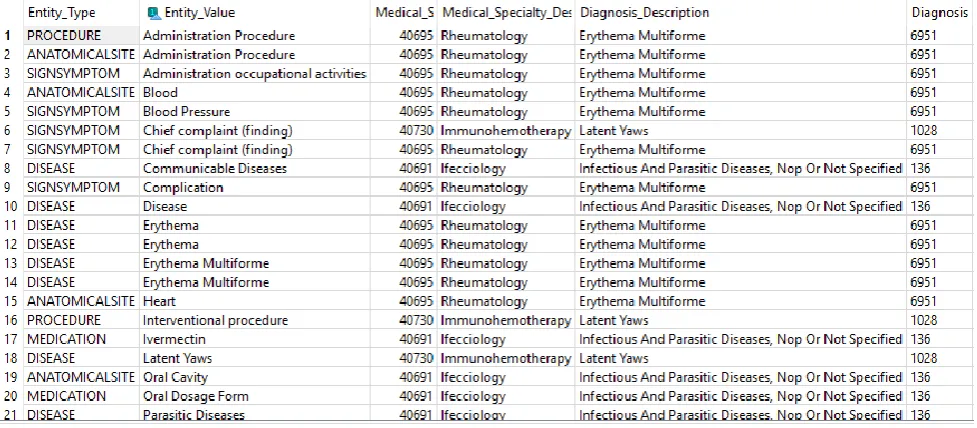
The two new columns “Entity Type” and “Entity Value” are two new attributes and are directly related with the cTAKES and UMLS intervention in this project.
The first one can have one of the following values per entry: medication, disease, anatomic region, sign/symptom and clinical procedure. And represents clinical and medical types found in the medical texts of the excel file.
The “Entity Value” present the specific word related with the type, e.g., there can be an entry with “Entity Type” = Medication followed by “Entity Value” = Tocilizumab.
The column “Clinical Episode”, which was the identifier of the specific episode on the excel disappeared since its purpose was solely to identify the specific entry of the excel, which is no longer needed.
The “File Identification” attribute was conceived to know which XML file is related with which rows of the table.
In the following chapter the results will be further discussed.
V. RESULTS
As explained in the previous chapters, the main purpose of the work is to create a centralized database with the information from two different hospital departments.
Presented in the figures 2 and 3 are screenshots of the AD SQLite table and ED SQLite table, respectively, also presented in table IV. Although some of the columns are not visible it is possible to see how the information is arranged in the table. How this table connects with the ED SQLite table is exactly as explained in the previous chapter.
TABLEIV ADSQLITE TABLE ATTRIBUTES
Attribute # Attribute Name Data Type
1 Entity Type String
2 Entity Value String
3 Medical Specialty Code Integer
4 Medical Specialty Description String
5 Diagnosis Description String
6 Diagnosis Code Integer
7 Date Date
8 File Identification String
TABLEIII EDSQLITE TABLE ATTRIBUTES
Attribute # Attribute Name Data Type
1 Episode Alert Integer
2 Patient ID String
3 ER Sub Department String
4 Admission Date Date
5 Triage Color Integer
6 Nurse ID String
7 Doctor First Observation ID String
8 Discharge Date Date
9 Discharge Status String
10 Discharge Destination String
11 Readmission Flag
12 Disease Code (ICD 9a Code) Integer
13 Disease Code Description String
14 In Hospital Time Integer
a
VI. CONCLUSION
In this work the authors propound a system that would centralize the data from two different hospital departments (Emergency and Appointments), gathering the structured information from the emergencies, already in system, and EMRs from appointments which contained both structured data and unstructured texts.
The paper shows that the integration of these two different departments is possible, which can lead to future integrations with data from other departments.
Some limitations of this research are as follow: the translation and department difference, since most of the data is from a real Portuguese hospital where Portuguese medical narratives can be found. Since the translation is not perfect, some terms can be mistranslated or not well interpreted by the translator which can lead to loss of valuable information. The second limitation regards the difference between departments which leads to only one variable linking two different realities.
In the future the authors intend, not only, to apply some python and R algorithms to extract clinical knowledge that allows the establishment of patterns and relations, but also to extend this research to the healthcare practitioners, by associating the clinical knowledge extracted from EMRs with who wrote them and aligning it with the ids present in the ED creating more bridge points between datasets. This way it would be possible to verify, for example, which medication is more prescribed by a given healthcare practitioner, which diagnostic is most common in the ED and the necessary medication and even relate that with specific periods of the year.
[image:5.595.61.550.305.519.2]Fig. 2. Screenshot partially showing AD_SQLite table of the database developed.
ACKNOWLEDGMENT
This work has been partially supported by Portuguese National funds through FITEC - Programa Interface, with reference CIT "INOV - INESC INOVAÇÃO - Financiamento Base.
REFERENCES
[1] L. Luo et al., “A hybrid solution for extracting structured medical
information from unstructured data in medical records via a double-reading/entry system,” BMC Med. Inform. Decis. Mak., vol. 16, no. 1, pp. 1–15, 2016.
[2] S. McLane, “Designing an EMR planning process based on staff attitudes toward and opinions about computers in healthcare,”
CIN - Comput. Informatics Nurs., vol. 23, no. 2, pp. 85–92, 2005. [3] L. G. Yamamoto and A. N. G. A. Khan, “Challenges of Electronic Medical Record Implementation in the Emergency Department,” Pediatr. Emerg. Care, vol. 22, no. 3, 2006. [4] P. Yadav, M. Steinbach, V. Kumar, and G. Simon, “Mining
Electronic Health Records: A Survey,” vol. 50, no. 6, pp. 1–41, 2017.
[5] W. Sun, Z. Cai, Y. Li, F. Liu, S. Fang, and G. Wang, “Data processing and text mining technologies on electronic medical records: A review,” J. Healthc. Eng., vol. 2018, 2018.
[6] L. B. Moreira and A. A. Namen, “A hybrid data mining model for diagnosis of patients with clinical suspicion of dementia,”
Comput. Methods Programs Biomed., vol. 165, pp. 139–149, 2018.
[7] H. Kharrazi et al., “The Value of Unstructured Electronic Health Record Data in Geriatric Syndrome Case Identification,” J. Am. Geriatr. Soc., vol. 66, no. 8, pp. 1499–1507, 2018.
[8] A. Sundararaman, S. Valady Ramanathan, and R. Thati, “Novel Approach to Predict Hospital Readmissions Using Feature Selection from Unstructured Data with Class Imbalance,” Big Data Res., vol. 13, pp. 65–75, 2018.
[9] “ICD - ICD-9 - International Classification of Diseases, Ninth
Revision.” [Online]. Available:
https://www.cdc.gov/nchs/icd/icd9.htm. [Accessed: 18-Mar-2019].
[10] G. K. Savova et al., “Mayo clinical Text Analysis and Knowledge
Extraction System (cTAKES): Architecture, component evaluation and applications,” J. Am. Med. Informatics Assoc., vol. 17, no. 5, pp. 507–513, 2010.
[11] J. Masanz, S. V Pakhomov, H. Xu, S. T. Wu, C. G. Chute, and H. Liu, “Open Source Clinical NLP - More than Any Single System.,” AMIA Jt. Summits Transl. Sci. proceedings. AMIA Jt. Summits Transl. Sci., vol. 2014, pp. 76–82, 2014.
[12] S. Sohn and G. K. Savova, “Mayo clinic smoking status classification system: extensions and improvements.,” Mayo Clin. Smok. Status Classif. Syst. Extensions Improv., vol. 2009, pp. 619–23, 2009.
[13] A. N. Ananthakrishnan et al., “Improving case definition of Crohn’s disease and ulcerative colitis in electronic medical records using natural language processing: A novel informatics approach,” Inflamm. Bowel Dis., vol. 19, no. 7, pp. 1411–1420, 2013.
[14] G. K. Savova, P. V. Ogren, P. H. Duffy, J. D. Buntrock, and C. G. Chute, “Mayo Clinic NLP System for Patient Smoking Status Identification,” J. Am. Med. Informatics Assoc., vol. 15, no. 1, pp. 25–28, 2008.