Lean and Green in the Transport and Logistics Sector – A Case
Study of Simultaneous Deployment
1st Author and Corresponding Jose Arturo Garza-Reyes*
Derby Business School The University of Derby
Kedleston Road Campus, Derby, UK, DE22 1GB E-mail: [email protected]
Tel. +44(0)1332593281
2nd Author Bernardo Villarreal
Departamento de Ingeniería, Universidad de Monterrey, Ave. Ignacio Morones Prieto 4500 Pte., San Pedro Garza Garcia, NL 66238, Mexico
E-mail: [email protected]
3rd Author Vikas Kumar Bristol Business School University of the West of England Coldharbour Ln, Bristol, UK, BS16 1QY
E-mail: [email protected] Tel. +44(0)1173283466
4th Author Patricia Molina Ruiz
Departamento de Ingeniería, Universidad de Monterrey, Ave. Ignacio Morones Prieto 4500 Pte., San Pedro Garza Garcia, NL 66238, Mexico
E-mail: [email protected]
Lean and Green in the Transport and Logistics Sector – A Case
Study of Simultaneous Deployment
Abstract
The transport and logistics sector is of vital importance for the stimulation of trade and hence the economic development of nations. However, over the last few years, this sector has taken central stage in the green agenda due to the negative environmental effects derived from its operations. Several disciplines including operations research and sub-areas of supply chain management such as green supply chains, green logistics and reverse logistics have tried to address this problem. However, despite the work undertaken through these disciplines, theoretical or empirical research into the sequential or simultaneous deployment of the lean and green paradigms, particularly, in the road transport and logistics sector is limited. This paper presents a case study where both paradigms have been combined to improve the transport operations of a world leader logistics organisation in the metropolitan area of Monterrey, Mexico. To do this, a systematic methodology and a novel tool called Sustainable Transportation Value Stream Map (STVSM) were proposed. The results obtained from the case study indicate that the concurrent deployment of the green and lean paradigms through such methodology and the STVSM tool is an effective approach to improve both operational efficiency and environmental performance of road transport operations. The paper can be used as a guiding reference for transport and logistics organisations to undertake improvement projects similar to the one presented in this paper. Additionally, this research also intends to stimulate scholarly research into the application of lean and green paradigms in the transport and logistics sector to expand the limited research pursued in this area.
Keywords: Efficiency; environmental performance; environmental sustainability; green; lean; road transportation; waste elimination.
1. Introduction
2015a). de Oliveira Neto and Lucato (2016) highlight the fact that the environmental impacts of industrial activity have raised significant concerns amongst firms and their stakeholders. Hence, in order to respond to increasingly stringent environmental regulations and the ‘consumer environmental pull’, companies have now been forced to reassess these objectives by also considering the environmental impact of their products, services and processes. In this line, a study of 119 ISO 14001 manufacturing firms in Malaysia by Lee et al. (2015) shows the existence of a positive and significant linkage between green suppliers with both environmental performance and competitive advantage. This shows that the inclusion of the green paradigm as part of the operations of organisations can bring positive results. As a result of the benefits associated, the green paradigm has emerged as a philosophy and operational approach to minimise the adverse ecological effect of organisations’ products and services as well as to enhance the environmental efficiency of their operations, while still achieving their financial objectives.
Since lean is an operations management approach which fiercely advocates the elimination of waste in all functional areas of an organisation and its supplier network (Chauhan and Singh, 2012), its alignment with the green paradigm, and its methods and tools, seems natural. This alignment, however, is not only natural but also necessary. For instance, Molina et al. (2014) suggest that the implementation of lean principles without the consideration of its impact on environmental performance could have negative ecological results, especially in the area of transport and logistics. For example, Venkat and Wakeland (2006) indicate that owing to the smaller and more frequent deliveries suggested by Just-in-Time (Womack and Jones, 2003), lean supply chains can produce and have higher CO2
emissions and energy consumption, especially when long distances between facilities are involved. This has prompted various researchers (e.g. Garza-Reyes, 2015a; Garza-Reyes, 2015b; Dües et al., 2013; Mollenkopf et al., 2010; Garza-Reyes et al., 2014a; Simpson and Power, 2005) to explore the natural synergies and the compatibility between lean practices and green initiatives.
metropolitan area of Monterrey, Mexico. Besides providing a systematic methodology and a guiding reference for transport and logistics organisations to undertake improvement projects similar to the one presented in this paper, this research also intends to stimulate scholarly research into the application of lean and green paradigms in the transport and logistics sector to fill the gap identified by Garza-Reyes (2015a).
The rest of the paper is organised as follows: Section 2 provides a literature review on the latest advancements of the combined adoption of the lean and green paradigms in road transport and logistics; Section 3 provides a description of the systematic methodology followed, as well as the concepts and tools used to improve the operational efficiency and environmental performance of the case company; a case study is presented in Section 4; and Section 5 presents the conclusions.
2. Literature Review
Four basic transport modes for shipping large quantities of packaged products exist within the developed world, namely: water, rail, road, and air (Spielmann and Scholz, 2005; Davidsson et al., 2005). In this scenario, freight transportation by road has become an important element of international trade and supply chains performance (Demir et al., 2014). Villarreal et al. (2016a), citing a US Department of Transportation’s (2011) report, indicated that 68% of the total tonnage moved in the United States in 2010 was done by road, whereas 29% of the ton-km of this country’s trade with Mexico and Canada was also moved under this mode of transportation. Similarly, the Mexican Transportation Secretary informed that in 2013 nearly 75% of total ton-km was distributed by road (Subsecretaría de Transporte, 2013). In the same line, the European Commission reported in 2008 that the European Union moved 27% of its ton-km by road. However despite its importance, the transportation sector is becoming increasingly linked to environmental problems (Demir et al., 2014; Dekker et al., 2012). With technology relying heavily on the combustion of hydrocarbons, notably with the internal combustion engine, the negative effects of transportation, especially road freight transportation, on environmental systems has increased (Demir et al., 2014). As a result, road transportation activities have emerged as a major factor behind the emission of harmful pollutants including nitrogen oxides (N2O), particulate matter (PM) and carbon dioxide
(CO2). In particular, greenhouse gases (GHGs) are dominated by CO2 emissions from
burning fossil fuels, which generate climate disruptions and atmospheric changes that pose health risks and are harmful to the natural and built environments. Thus, sub-areas of supply chain management such as green supply chains (Zhu et al., 2008; Mohanty and Prakash, 2014; Chow, 2015), green logistics (Ubeda et al., 2011) and reverse logistics (Sarkis, 2003; Huang et al., 2012; Mishra et al. 2012) have tried to address this challenge and hence proliferated over the last decade.
Recent advancements in the field of green road freight transportation, a sub-field of green logistics, have emphasised the relevance of operations research techniques in this area (e.g. Touati and Jost, 2012; Dobers et al., 2013; Dekker et al., 2012; Salimifard et al., 2012; Lin et al., 2013). These works have been mainly focused on optimising resource utilisation, routes, cost, time and distance while at the same time considering CO2 emissions (Ballot and
Villarreal et al. (2016b) and Villarreal et al. (2016c) have focused on improving road transportation through the lean paradigm, but they have not considered the green dimension. On the other hand, although some literature exists in the area of green logistics (e.g. Ubeda et al., 2011; Richardson, 2001), this has not been approached from the waste reduction (i.e. lean) point of view.
A comprehensive and systematic state-of-the-art literature review conducted by Garza-Reyes (2015a) suggested that theoretical or empirical research on the concurrent application of lean and green has been conducted at supply chain level (e.g. Cabral et al., 2012; Mollenkopf et al., 2010; Dües et al., 2013; Hajmohammad et al., 2013a; Hajmohammad et al., 2013b; Kainuma and Tawara, 2006, among others), in production, manufacturing and industrial systems (e.g. Aguado et al., 2013; Azevedo et al., 2012; Besseris and Kremmydas, 2014; Diaz-Elsayed et al., 2013; Moreira et al., 2010; Pampanelli et al., 2014, among others) as well as in the development of new products (Cluzel et al., 2010; Johansson and Sundin, 2014). However, the results of this literature review also indicate that only the works of Esmemr et al. (2010) and Verrier et al. (2014) have considered both the lean and green paradigms within the transport and logistics sector. In the case of Esmemr et al. (2010), they analysed a Turkish container terminal, both in terms of lean and green dimensions, and determined the optimum number of container handling equipment to increase the lean capabilities and minimise the environmental damage they create. On the other hand, Verrier et al. (2014)analysed the practices of 21 Alsatian industrial companies, two of them in the logistics sector, in order to assess how lean and green actions could be enhanced when used together. This resulted in the proposal of a framework for lean and green management, consisting of lean indicators, green performance indicators and green intentions indicators. However, as shown by the overall number of studies in this area and the content of the works of Esmemr et al. (2010), focusing on port logistics, and Verrier et al. (2014), superficially considering two transports/logistics SMEs, the mutual consideration of the lean and green paradigms in the logistic and transport sector, especially road freight transportation, still remains narrow and in early stages. This was the main motivation for the authors to undertake the research and document the case study presented in this paper.
3. Methodology and Concepts
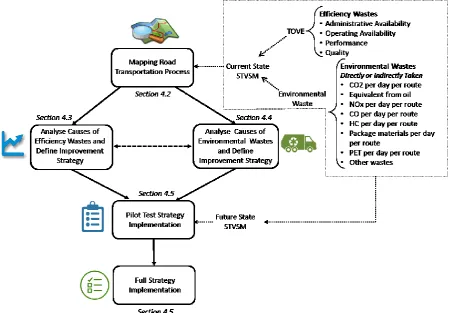
components. As previously done by Norton (2007) when proposing the Sustainable Value Stream Map (SVSM) tool, in the methodology illustrated in Figure 1 we have extended the TVSM proposed by Villarreal (2012) to not only include efficiency wastes but also environmental wastes. We have called this new variant of the VSM (Rother and Shook, 2003; Serrano Lasa et al., 2009), TVSM (Villarreal, 2012) and SVSM (Norton, 2007) tools Sustainable Transportation Value Stream Map (STVSM).
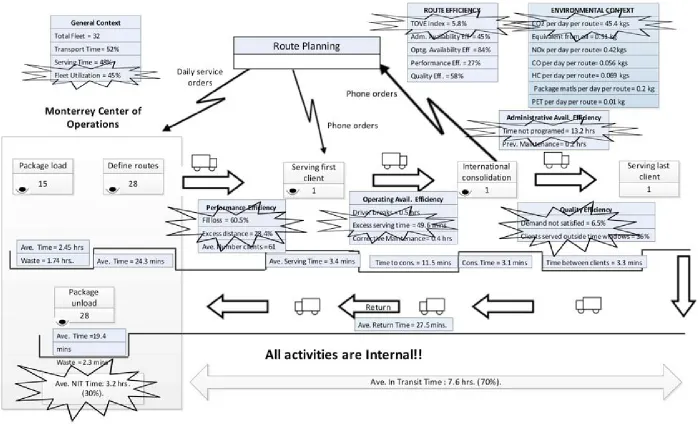
Fig. 1. Methodology followed to improve the routing operations of the case organisation In order to extend the TVSM into the STVSM to consider environmental aspects, it is necessary to specify the set of particular wastes, both efficiency and environmentally oriented, which will be considered. This is a significant factor to determine strategies to meet both objectives (i.e. maximising transport efficiency and improve environmental sustainability) as it was found by Norton (2007) that certain strategies can be effective in eliminating overall supply chain waste, but they may generate more environmental waste. For our proposed STVSM, the selected efficiency wastes were all those considered to estimate the TOVE index (i.e. administrative or strategic availability, operating availability, performance, and quality), see Figure 1. Initially, the environmental wastes selected were those associated with air quality, climate change and the material waste that resulted from packaging products, see Figure 1. Figure 2 shows an example of the structure of the STVSM with the actual data of the case organisation; this is later explained in Section 4.
An important aspect to consider in the creation of a STVSM is the estimation of the values for the environmental wastes. Although it is desirable to fully eliminate air quality and climate change wastes, there are also permitted levels of these wastes (e.g. CO2 emissions) by
Carbon Dioxide (CO2), Hydrocarbons (HC), Nitrogen Oxides (NOx), Particulate Matter (PM)
and toxics from transport vehicles. Examples of these software include MOBILE6 Mexico (EPA, 2015), International Vehicle Emission Model (ISSRC, 2015) and COPERT (Emisia, 2015). An alternative mode of indirect estimations can be obtained from overall average figures at city or country level. Indirect estimates can be used for planning and/or strategy evaluation purposes. Direct estimates for wastes are obtained by measuring them by utilising measurement instruments and tools. Among these are passive samplers, bubbler systems, chemi-luminescence and remote sensing equipment.
STVSM played a critical role in the initial stage of our methodology by mapping the road transportation process of the studied company to understand its current (i.e. ‘how-is’) state, see Figure 1. Based on the knowledge gained from the STVSM regarding the current state of the transport operations of the organisation studied, causes of wastes were analysed and efficiency and environmental improvement strategies were simultaneously formulated in the followings stage, see Figure 1. This simultaneous approach formulation of strategies was necessary to avert the phenomenon indicated by Norton (2007) when creating individual strategies (i.e. efficiency or environmental), where one may have a negative effect on the other if they are independently formulated. A pilot study to assess both the operational efficiency and environmental improvement strategies was then conducted, see Figure 1. In this case, the data obtained from it served as a platform to create the future state STVSM and validate, as suggested by Antony and Banuelas (2002) and Pyzdek (2003), the proposed improvements before proceeding into a full scale deployment of the improvement strategies as indicated in Figure 1.
4. Case Study
This section presents a case study where our methodology illustrated in Figure 1 and proposed tool STVSM were applied, as indicated earlier, to integrate the lean and green paradigms to improve both the operational efficiency and environmental performance of the case organisation’s transport operations. As previously determined in Sections 1 and 2, and ought to the very limited evidence of the application of the lean and green paradigms in the transport and logistics sector, an exploratory case study approach was selected to provide critical and empirical information about this phenomenon. Zander et al. (2015), Cameron and Price (2009) and Eisenhardt (1989) consider a single detailed case study a valid research methodology, particularly when the focus of the study cannot be detached from the organisational context where it occurs (Cameron and Price, 2009). Although a single case study might be considered as a limited approach to prove the effectiveness of our methodology and the STVSM tool, if it is replicated again in this and/or different industrial context a generalisation and validation of findings can be achieved (Garza-Reyes et al., 2014b). Therefore, it would fall to a future research agenda to test both our methodology and STVSM tool through the use of multiple cases study in different industrial settings.
4.1 The Organisation and Monterrey Operations Centre
32 daily routes. Among the type of services provided are: international and national, guaranteed time and date deliveries, fixed time pickup services, and call in pick up services. The operations centres of the organisation studied in Mexico are mainly concentrated in Mexico City, Guadalajara and Monterrey. The performance level of these operations centres had been deteriorating since 2011. The main contributor to this situation had been the operations centre in Monterrey. In efficiency terms, about 74% of the national late routes problems were concentrated in this division. This situation had led to an increasing level of unsatisfied customer services, monetary penalties and an additional 23% of labour cost required to executing the services. Furthermore, an important increase in kilometres per customer stop had been experienced in 2012, negatively impacting the consumption of fuel and cost.
On the other hand, the Mexico’s national division of the logistics organisation studied had expressed concerns about the negative environmental impact of its transport operations. This led the company to participate in the project Transporte Limpio (Clean Transportation), which is a national project designed and run by the Mexican Government to promote and support Mexican organisations on their efforts to achieve environmentally sustainable operations. Due to the previous considerations, the organisation studied decided to start a project with the purpose of defining relevant environmental indicators, the status of their current levels, and the delineation of a strategy to improve its environmental performance. Therefore, the operational (i.e. efficiency) problems and environmental challenges faced by the Monterrey operations centre of the case organisation, and its need to align them, were the main factors to select this company, and specific centre, as the basis for this study.
4.2 Mapping the Road Transportation Process
As indicated in Figure 1, the first step of our methodology consisted of mapping the transportation processes of the vehicle routing operations of the Monterrey operations centre. The current STVSM for the transport operation is shown in Figure 2. This included a follow up of the trucks inside the warehouse until a new journey cycle was initiated. From Figure 2 it is clear that the STVSM shows the various important detail activities of the Monterrey operations centre, their flow and sequence, and performance in terms of both operational efficiency through the TOVE index, and its components, as well as environmental performance. According to Seth and Gupta (2005), a holistic visualisation of this type provides an actual trigger and offers a challenge for improvement. For this reason, the next step of our methodology, see Figure 1, consisted of formulating appropriate efficiency (Section 4.3) and environmental (Section 4.4) strategies for the improvement of these activities.
4.3 Analyse Causes of Efficiency Waste and Define Improvement Strategy
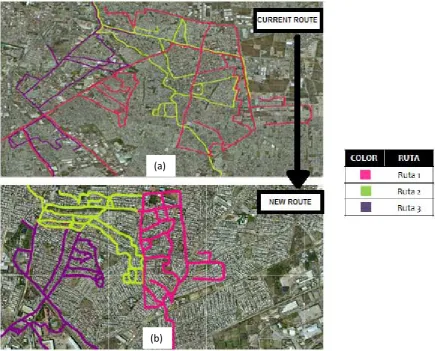
Similarly as OEE (Garza-Reyes et al., 2010; Dal et al., 2000; Bamber et al., 2003), TOVE goes beyond the task of just monitoring and controlling transport operations as it can be used as an approach to prioritise improvement initiatives. Based on this characteristic, the performance efficiency factor was addressed as it resulted in the lowest TOVE factor, see Figure 2. The best strategy to increase the performance efficiency was determined to be the reduction of fill loss waste of 60.5%. Fill loss waste resulted because the volume of packages transported by each truck was lower than its capacity. This excess capacity represented an opportunity if the number of clients served by each route increases in the future. However, this was not feasible at the time of this study because the time required to serve them was greater than the scheduled journey time of eight hours. Also, the excess distance travelled waste of 28.4% represented an important area for improvement. This last waste was the result of several events and situations. First, the current procedure for assigning customer orders to a route was based on post codes. As a result, routes overlapped with each other as shown by Figure 3(a). Once assigned, customer visits were sequenced by each driver according to his experience and criterion. In addition, package loading was executed with no relation to the sequence and without enough care to locate packages of the same customer together. This resulted in having several visits to the same customer in the same route.
(A)
Fig. 3. (a) Current and (b) improved routes in the metropolitan area of Monterrey, Mexico
Finally, the organisation studied had about 58% of ‘preferred customers’. This type of customers handled packages every day. Hence, they were always visited by routes without any notice or knowledge of their demand. Because the database of this type of customers was not updated, routes were initially visited about 25% of customers that should not be preferred any more, resulting in ‘null’ visits. The strategy established to decrease the main efficiency
(a)
[image:10.595.76.512.316.667.2]wastes identified was originally aimed at improving both the administrative availability and performance factors. It consisted of the following initiatives:
• Improving the assignment of customers to routes, see Figure 3(b);
• Reducing excess distance travelled by better customer sequencing in each route, see Figure 3(b);
• Updating the status of preferred customer;
• Sequence package loading according to customer sequence; • Re-assigning NIT activities to warehousing operators; • Scheduling at least two journeys per truck.
4.4 Analyse Causes of Environmental Waste and Define Improvement Strategy
As part of this stage, the environmental wastes selected by the company were those related with air quality, greenhouse gasses, packaging and PET materials, see Figure 1. Current values for air quality and greenhouse gasses wastes were obtained by using available gas emission factors for the Monterrey metropolitan area reported by Aguilar-Gomez et al. (2009). The levels of packaging and PET materials generated by the routing operations were monitored and estimated for a period of one month, see Figure 2 ‘environmental context’ box. The values were established as a reference and upper limit, and improvement objectives were set based on these references. The preliminary strategy for improving environmental performance of the routing operations was defined based on a comparative study done for similar operations. This type of comparative, or benchmarking, improvement strategies have provided prominent results in helping organisation to improve different aspects of their businesses (Deng et al., 2008; Dattakumar and Jagadeesh, 2003; Comm and Mathaisel, 2000). In this line, environmental programmes delineated and deployed in their operations by companies such as DHL (DHL, 2015), Fedex (FedEx, 2015) and UPS (UPS, 2015) were analysed and used as the basis. In summary, their strategies were based on the development of more efficient routing schemes, the use of hybrid vehicles, alternative fuels and the development of new technologies. Therefore, the company studied decided to structure a short and a long term environmental strategy. The short term strategy, in particular, was based on increasing routing efficiency. The long term strategy, on the other hand, was to consider the environmental initiatives implemented by better performing divisions in other operation areas of the organisation studied around the world. This long term strategy required large investments of resources and time to be realised. Thus, this study focused on improving routing efficiency and studying its impact on environmental performance.
4.5 Pilot Test and Full Strategy Implementation - Results
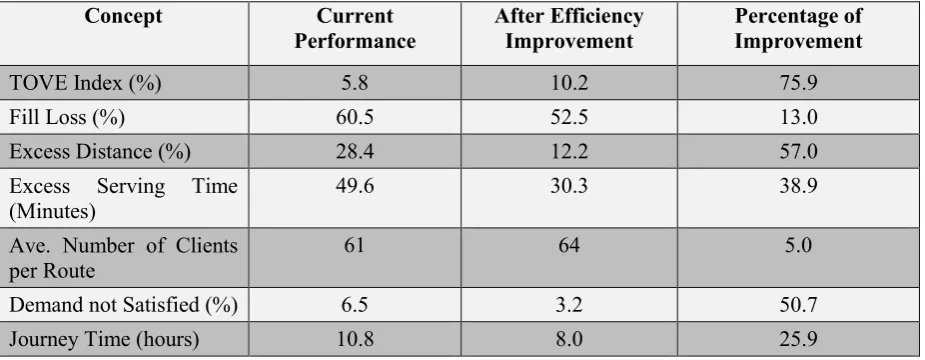
The vehicle routing problem was addressed in an aggregated manner. Initially, the preferred customer and customer time windows database was updated. This action eliminated 25% of current fixed visits to customers that did not have a steady demand. Then, customers were assigned to their location zones, called ‘colonias’. Afterwards, routes were designed for these zones using the software ‘My Route Online’. It provided the sequence in which the ‘colonias’ had to be visited. Even though this scheme did not ensure optimal solutions, it generated feasible and more efficient routes than the current routes. The resulting routes became more ‘clustered’, including customers located much closer to each other as shown in Figure 3(b). Performance efficiency increased from 26.6% to 35.2%. Excess travelled distance was reduced 57%, the level of fill loss decreased 13% and excess time for serving customers decreased 38.9%. The number of customers visited per route increased 5% (i.e. from 61% to 64%). This impacted favourably the fill loss factor, achieving a reduction from 60.5% to 52.5%. Package loading was now carried out according to customer service sequence, eliminating the need for customer re-visits. The operating availability efficiency increased from 84% to 95%, mainly due to the elimination of the number of preferred customers with fixed visits that were not satisfying the condition of continuous demand. The quality efficiency index was improved from 58% to 71% by increasing 50.7% the level of demand satisfied. Average journey time was reduced to the required normal eight hours. Hence, the time not programmed for trucks increased from 13.2 hours to 13.7 hours per day. Table 1 presents the main results of routing efficiency gathered from the pilot test. In summary, routing operations efficiency for the pilot test experienced very favourable improvement results. The company eliminated labour overtime cost, which represented 35% of total labour cost. In addition, a preliminary estimation reported by the logistics responsible indicated a decrease of fuel consumption of 13.5%. Further cost reductions on maintenance, tires and other indirect materials were also projected in the short term horizon by the management of the company.
Table 1. Summary of routing operations efficiency improvement
Concept Current
Performance
After Efficiency Improvement
Percentage of Improvement
TOVE Index (%) 5.8 10.2 75.9
Fill Loss (%) 60.5 52.5 13.0
Excess Distance (%) 28.4 12.2 57.0
Excess Serving Time (Minutes)
49.6 30.3 38.9
Ave. Number of Clients per Route
61 64 5.0
Demand not Satisfied (%) 6.5 3.2 50.7
Journey Time (hours) 10.8 8.0 25.9
Increasing routing efficiency also had a positive impact on the environmental performance
Table 2. Route efficiency improvement effect on environmental performance
Concept Current Performance (Kgs.)
After Environmental Improvement Strategies (Kgs.)
Reduction (Kgs.)
CO2 51.940 45.890 6.050
NOx 0.470 0.416 0.054
CO 0.063 0.056 0.007
HC 0.079 0.069 0.010
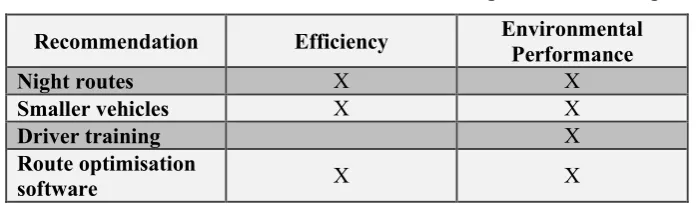
Included in this future implementation are the following suggestions illustrated in Table 3. Table 3. Recommendations to include in future improvement strategies
Recommendation Efficiency Environmental
Performance
Night routes X X
Smaller vehicles X X
Driver training X
Route optimisation
software X X
According to Schrank and Lomax (2007), traffic congestion occurs when “slow speeds caused by heavy traffic or narrow roadways or both due to construction, incidents, or too few lanes for the demand”. Traffic congestion impacts severely both transport efficiency and environmental conditions. Transport efficiency is decreased by increasing speed loss waste and reducing the operating availability efficiency factor. On the other hand, it is well known that adverse traffic congestion increases fuel consumption and contaminant emissions such as CO2, PM2.5, SOx, SO2 and others (Barth and Boriboonsomsin, 2008; Krzyzanowski et al.,
2005; Instituto Nacional de Ecología, 2009). This is particularly important during the 8:00 A.M. to 21:00 P.M. period of every day and for vehicles travelling at speeds lower that 25 mph (Barth and Boriboonsomsin, 2008). The metropolitan area of Monterrey is ranked, after Mexico City, as the most polluted area in Mexico (Green and Sánchez, 2013). This is formed by the cities of Monterrey, San Nicolas, Guadalupe, Escobedo, Garza Garcia and Santa Catarina. It is also ranked as the second Mexican area with the worst traffic conditions (Numbeo, 2016). It is important to point out that the congestion phenomenon has an important impact on those routes that serve the market of Monterrey, San Nicolas and Escobedo cities. This market represents 76% of the total market.
In order to avoid the previously described situation, it is recommended to establish night routes. Avoiding traffic congestion will increase the efficiency and sustainability level of the routing operations. Performance efficiency will increase by having additional customers per route. It is estimated that there will be 9% more clients due to a reduction of the speed and fill losses of 21% approximately. Additionally, night routes will provide the opportunity for increasing vehicle utilisation. This is possible since vehicles have almost 14 hours of idle time per day. Another expected benefit consists of improving the environmental situation. According to Barth and Boriboonsomsin (2008), Krzyzanowski et al. (2005) and Instituto Nacional de Ecología (2009), increasing transportation speed to levels between 35 to 65 mph would provide significant reductions of CO2, NOx, PM2.5 and other contaminants. These
reductions would be in the range of between 25% and 70%.
[image:14.595.124.473.233.336.2]consumption. The level of fill loss waste will practically be eliminated. According to Aguilar-Gomez et al. (2009) and the Instituto Nacional de Ecología (2009), using smaller vehicles will impact significantly the generation of contaminants with reductions in the order of 50%. Driver training with the objective of changing driving habits has the purpose of reducing fuel consumption, similar to the EcoDrive project of Fedex. Finally, the purchase of a route and load plan optimisation software such as Roadnet (UPS Logistics Group, 2004) will enable the organisation to design dynamic routes for all the Mexican operations at customer level. This will further improve performance efficiency and environmental performance by decreasing excess traveling distance.
5. Conclusions
Environmental sustainability is nowadays one of the contemporary and critical organisational objectives which must now be aligned to the traditional priorities of profitability, efficiency, customer satisfaction, quality, and responsiveness (Garza-Reyes, 2015a). This is particularly true for the transport and logistics sector, which despite its importance for the stimulation of trade and hence the economic development of nations, it is increasingly linked to environmental problems (Demir et al., 2014; Dekker et al., 2012). Thus, conventional disciplines such as operations research and sub-areas of supply chain management such as green supply chains, green logistics and reverse logistics have tried to address these problems. However, despite the work conducted through these disciplines, theoretical or empirical research into the sequential or simultaneous deployment of the lean and green paradigms, particularly, in the road transport and logistics sector is very limited and in early stages. Thus, this paper intended to contribute in the fulfilment of this research gap by presenting a case study where both paradigms have been combined to improve the transport operations of a world leader logistics organisation in the metropolitan area of Monterrey, Mexico. By addressing this research gap, the paper aims at stimulating further scholarly research into the application of lean and green paradigms in the transport and logistics sector. The paper theoretically contributes by combining the lean and green paradigms through a systematic methodology and developing a novel tool known as Sustainable Transportation Value Stream Map (TVSM). The methodology and STVSM tool allowed the simultaneous deployment of lean and green fundamentals, principles and tools to help the studied organisation improve both operational efficiency and environmental performance. Within the context of this organisation, the results obtained from the pilot study indicate that the concurrent deployment of the green and lean paradigms through our proposed methodology and STVSM tool is an effective approach to improve road transport operations. This corroborates the positive synergies between the lean and green paradigms previously discussed and investigated by other various authors (e.g. Garza-Reyes, 2015a; Garza-Reyes, 2015b; Dües et al., 2013; Mollenkopf et al., 2010; Garza-Reyes et al., 2014a; Simpson and Power, 2005). In this particular case, the studied organisation not only improved its operational efficiency TOVE index, and some of its individual metrics, but also its environmental performance, particularly, in relation to the reduction of gas emissions such as CO2, NOx, CO and HC. This provides an important practical contribution for transport and
logistics organisations that can use the proposed STVSM tool as a guiding reference to undertake improvement projects similar to the one presented in this paper. We hope that our proposed tool would motivate industrialists, and hence their organisations and assist them in achieving more environmentally sustainable transport operations.
deployment of lean and green initiatives in the transport and logistics sector. The methodology and STVSM tool proposed in this paper were specifically applied within the context of only one organisation and its road transport operations. Thus, further research can be oriented to validate this methodology and tool in other organisations not only to improve road transport operations but also other type of transport operations such as water, rail and air. This is one of the main research streams proposed as a part of the future research agenda derived from this research.
References
Abdul Wahab, A.N., Mukhtar, M., Sulaiman, R., 2013. A conceptual model of lean manufacturing dimensions. Procedia Technology. 11, 1292-1298.
Addulmalek, F.A., Rajgopal, J., 2007. Analyzing the benefits of lean manufacturing and value stream mapping via simulation: A process sector case study. International Journal of Production Economics. 107 (1). 223-236.
Abrell, J., 2010. Regulating CO2 emissions of transportation in Europe: A CGE-analysis
using market-based instruments. Transportation Research Part D: and Environment. 15 (4), 235-239.
Aguilar-Gómez, J.A., Garibay-Bravo, V., Tzintzun-Cervantes, G., Cruz-Jimate, I., Echaniz-Pellicer, G., 2009. Mobile source emission estimates using remote sensing data from Mexican cities. Proceedings of the 18th International Emission Inventory Conference. Baltimore, MA.
Aguado, S., Alvarez, R., Domingo, R., 2013. Model of efficient and sustainable improvements in a lean production system through processes of environmental innovation. Journal of Cleaner Production. 47, 141-148.
Antony, J., Banuelas, R., 2002. Key ingredients for the effective implementation of Six Sigma program, Measuring Business Excellence. 6 (4), 20-27.
Azevedo, S.G., Carvalho, H., Duarte, S., Cruz-Machado, V., 2012. Influence of green and lean upstream supply chain management practices on business sustainability. IEEE Transactions on Engineering Management. 59 (4), 753-765.
Ballot, E., Fontane, F. 2010. Reducing transportation CO2 emissions through pooling of supply networks: perspectives from a case study in French retail chains. Production, Planning & Control, 21 (6), 640-650.
Bamber, C., Castka, P., Sharp, J. and Motara, Y., 2003. Cross-functional team working for overall equipment effectiveness. Journal of Quality in Maintenance Engineering. 9 (3), 223-39.
Barth, M. and Boriboonsomsin, K., 2008. Real-World Carbon Dioxide Impacts of Traffic Congestion. Transportation Research Record. Journal of the Transportation Research Board. 2058, Transportation Research Board of the National Academies, Washington, D.C., pp. 163-171.
Bektas, T., Laporte, G., 2011. The pollution-routing problem. Transportation Research Part B: Methodological. 45(8), 1232-1250.
Birkie, S.E., Trucco, P. 2016. Understanding dynamism and complexity factors in engineer-to-order and their influence on lean implementation strategy. Production, Planning & Control, 27 (5), 345-359.
Cabral, I., Grilo, A., Cruz-Machado, V., 2012. A decision-making model for lean, agile, resilient and green supply chain management. International Journal of Production Research. 50 (17), 4830-4845.
Cameron, S., Price, D., 2009. Business Research Methods: A Practical Approach. Chartered Institute of Personal and Development, London.
Chauhan, G., Singh, T.P., 2012. Measuring parameters of lean manufacturing realization. Measuring Business Excellence. 16 (3), 57-71.
Chow, S.E.S. (2015). Relevant external environmental forces affecting green supply chain in the Philippine consumer electronics industry. International Journal of Supply Chain and Operations Resilience. 1 (3), 219-242.
Cluzel, F., Yannou, B., Afonso, D., Leroy, Y., Millet, D., Pareau, D., 2010. Managing the complexity of environmental assessments of complex industrial systems with a lean 6 Sigma approach. In: Complex Systems Design and Management, 279-294.
Comm, C.L., Mathaisel, D.F.X., 2000. A paradigm for benchmarking lean initiatives for quality improvement. Benchmarking: An International Journal. 7 (2). 118-128.
Dal, B., Tugwell, P. and Greatbanks, R., 2000. Overall equipment effectiveness as a measure of operational improvement – a practical analysis. International Journal of Operations & Production Management. 20 (12), 1488-502.
Dattakumar, R., Jagadeesh, R., 2003. A review of literature on benchmarking. Benchmarking: An International Journal. 10 (3), 176 – 209.
Davidsson, P., Henesey, L., Ramstedt, L., Tömquist, J., Wemstedt, F., 2005. An analysis of agent-based approaches to transport logistics. Transportation Research Part C: Emerging Technologies. 13 (4), 255-271.
Demir, E., Bektas, T., Laporte, G. (2012). An adaptive large neighborhood search heuristic for the pollution-routing problem. European Journal of Operational Research. 223 (2), 346–359.
Demir, E., Bektas, T., Laporte, G., 2014. A review of recent research on green road freight transportation. European Journal of Operational Research. 237 (3), 775-793.
Deng, W.J., Kuo, Y.F., Chen, W.C., 2008. Revised importance–performance analysis: three-factor theory and benchmarking. The Service Industries Journal. 28 (1), 37-51.
de Oliveira Neto, G.C., Lucato, W.C., 2016. Production planning and control as a tool for eco-efficency improvement and environmental impact reduction. Production, Planning & Control, 27 (3), 148-156.
DHL (Deutsche Post DHL Group). 2015. GoGreen program.
(http://www.dpdhl.com/en/responsibility/environmental-protection/gogreen_program.html). (23.06.2015).
Dekker, R., Bloemhof, J., Mallidis, I., 2012, Operations Research for green logistics – An overview of aspects, issues, contributions and challenges. European Journal of Operational Research. 219 (3), 671-679.
Dobers, K., Klukas, A., Lammers, W., Laux, M., Mauer, G., Schneider, M. (2013). Green logistics: Optimisation approaches for resource-efficient logistics services. In Efficiency and Logistics; Lecture Notes in Logistics, 149–161.
Duarte, S., Cruz-Machado, V., 2013a. Modelling lean and green: a review from business models. International Journal of Lean Six Sigma, 4 (3), 228-250.
Duarte, S., Cruz-Machado, V., 2013b. Lean and green: a business model framework. In: Proceedings of the Sixth International Conference on Management Science and Engineering Management Lecture Notes in Electrical Engineering, 185, 751-759. Dües, C.M., Tan, K.H., Lim, M., 2013. Green as the new lean: how to use lean practices as a
catalyst to greening your supply chain. Journal of Cleaner Production. 40, 93-100. Eisenhardt, K.M., 1989. Building theories from case study research. Academy of
Management Review. 14 (4), 532-550.
Emisia. 2015. COPERT 4. (http://emisia.com/copert). (16.06.2015).
Esmemr, S., Ceti, I.B., Tuna, O., 2010. A simulation for optimum terminal truck number in a Turkish port based on lean and green concept. The Asian Journal of Shipping and Logistics. 26 (2), 277-296.
EPA (United States Environmental Protection Agency). 2015. MOBILE6 Vehicle Emission Modeling Software. (http://www.epa.gov/oms/m6.htm). (21.06.2015).
FedEx. 2015. Environmental Sustainability.
(http://www.fedex.com/gb/about/sustainability/index.html). (23.06.2015).
Forrester, P.L., Shimizu, U.K., Soriano-Meier, H., Garza-Reyes, J.A., Cruz Basso, L.F., 2010. Lean production, market share and value creation in the agricultural machinery sector in Brazil. Journal of Manufacturing Technology Management. 21 (7), 853-871. Fugate, B.S., Davis-Sramek, B. and Goldsby, T.J., 2009, Operational collaboration between
shippers and carriers in the transportation industry. International Journal of Logistics Management. 20 (3), 425-47.
Garza-Reyes, J.A., Eldridge, S., Barber, K.D., Soriano-Meier, H. 2010. Overall Equipment Effectiveness (OEE) and Process Capability (PC) measures – a relationship analysis. International Journal of Quality and Reliability Management. 27 (1), 48-62.
Garza-Reyes, J.A., Parkar, H.S., Oraifige, I., Soriano-Meier, H., Harmanto, D., 2012. An empirical-exploratory study of the status of lean manufacturing in India. International Journal of Business Excellence. 5 (4), 395-412.
Garza-Reyes, J.A., Winck Jacques, G., Lim, M.K., Kumar, V., Rocha-Lona, L., 2014a. Lean and green e synergies, differences, limitations, and the need for Six Sigma. In: Advances in Production Management Systems. Innovative and Knowledge based Production Management in a Global-local World. IFIP Advances in Information and Communication Technology, 439, pp. 71-81.
Garza-Reyes J.A., Flint, A., Kumar, V., Antony, J., Soriano-Meier, H., 2014b. A DMAIRC approach to lead time reduction in an aerospace engine assembly process. Journal of Manufacturing Technology Management. 25 (1). 27-48.
Garza-Reyes, J.A., 2015b. Green lean and the need for Six Sigma. International Journal of Lean Six Sigma. 6 (3), 226-248.
Green, J., Sánchez, S., 2013. Air Quality in Latin America: An Overview. Clean Air Institute, Washington, D.C., May.
Guan, T.S., Mason, K., Disney, S., 2003, MOVE: Modified Overall Vehicle Effectiveness. 8th International Symposium on Logistics, Seville, Spain, July 2003.
Hajmohammad, S., Vachon, S., Klassen, R.D., Gavronski, I., 2013a. Lean management and supply management: their role in green practices and performance. Journal of Cleaner Production. 39, 312-320.
Hajmohammad, S., Vachon, S., Klassen, R.D., Gavronski, I., 2013b. Reprint of lean management and supply management: their role in green practices and performance. Journal of Cleaner Production. 56, 83-96.
Hines, P., Taylor, D., 2000. Going lean, Lean Enterprise Research Centre, Cardiff Business School, UK.
Hines, P., Holweg, M., Rich, N., 2004. Learning to evolve: a review of contemporary lean thinking. International Journal of Operations and Production Management. 24 (10), 994-1011.
Huang, Y.C., Wu, J.Y.C., Rahman, S. 2012. The task environment, resource commitment and reverse logistics performance: evidence from the Taiwanese high-tech sector. Production, Planning & Control. 23 (10-11), 851-863.
Instituto Nacional de Ecología, 2009. Guía Metodológica para la Estimación de Emisiones Vehiculares en Ciudades Mexicanas. Secretaría del Medio Ambiente y Recursos Naturales, México, D.F.
ISSRC. 2015. International Vehicle Efficiency Model. (http://www.issrc.org/ive/). (21.06.2015).
Johansson, G., Sundin, E., 2014. Lean and green product development: two sides of the same coin? Journal of Cleaner Production. 85, 104-121.
Kainuma, Y., Tawara, N., 2006. A multiple attribute utility theory approach to lean and green supply chain management. International Journal of Production Economics. 101 (1), 99-108.
Krzyzanowski, M., Kuna-DibBert, B., Schneider, J., 2005. Health Effects of Transport-Related Air Pollution. World Health Organization. Copenhagen, Denmark.
Lee, V.H., Ooi, K. B., Chong, A.Y.L., Lin, B. 2015. A structural analysis of greening the supplier, environmental performance and competitive advantage. Production, Planning & Control. 26 (2), 116-130.
Lin, C., Choy, K. L., Ho, G. T. S., Chung, S. H., Lam, H. Y., 2013. Survey of green vehicle routing problem: Past and future trends. Expert Systems with Applications, 41(4), 1118–1138.
Mason, R., Nieuwenhuis, P., Simons, D., 2008. Lean and green supply chain mapping: adapting a lean management tool to the needs of industrial ecology. Progress in Industrial Ecology: An International Journal. 5 (4), 302-324.
Mohanty, R.P., Prakash, A. 2014. Green supply chain management practices in India: an empirical study. Production, Planning & Control. 25 (16), 1322-1337.
Molina, P., Nuñez, K., Cantu, L., Villarreal, B. 2014. Lean routing and Green in UPS. Proceedings of the 2014 International Conference on Industrial Engineering and Operations Management Bali, Indonesia, January 7 – 9.
Mollenkopf, D., Stolze, H., Tate, W., Ueltschy, M., 2010. Green, lean, and global supply chains. International Journal of Physical Distribution and Logistics Management. 40 (1/2), 14-41.
Moreira, F., Alves, A.C., Sousa, R.M., 2010. Towards eco-efficient lean production systems. In: Balanced Automation Systems for Future Manufacturing Networks IFIP Advances in Information and Communication Technology. 322, 100-108.
Norton, A., 2007. Sustainable Value Stream Mapping as a Technique for Analysing and Reducing Waste in the UK Chilled Food Sector. PhD Thesis. University of London, Imperial College, Centre for Environmental Policy (Applied Economics and Business Management Research Section).
Numbeo 2016. Pollution Index. Available at: http://www.numbeo.com/pollution/rankings.jsp. Accessed on 13/04/2016.
Pampanelli, A.B., Found, P., Bernardes, A.M., 2014. A lean & green model for a production cell. Journal of Cleaner Production. 85, 19-30.
Parveen, C.M., Kumar, A.R.P., Narasimha Rao, T.V.V.L., 2011. Integration of lean and green supply chain - impact on manufacturing firms in improving environmental efficiencies. In: International Conference on Green Technology and Environmental Conservation (GTEC). Chennai, India, December 15-17, pp. 143-147.
Pyzdek, T. 2003. The Six Sigma handbook: A complete guide for Green Belts, Black Belts, and managers at all levels, McGraw-Hill, New York, NY.
Richarson, B.C. 2001. Freight trucking sustainable transportation system. Transportaion Research Record, 1763. 57-64.
Rother, M. and Shook, J., 2003. Learning to see: value stream mapping to create value and eliminate muda, Lean Enterprise Institute Inc., Cambridge, MA.
Saboo, A., Garza-Reyes, J.A., Er, A., Kumar, V., 2014. A VSM improvement-based approach for lean operations in an Indian manufacturing SME. International Journal of Lean Enterprise Research. 1 (1), 41-58.
Salimifard, K., Shahbandarzadeh, H., Raeesi, R. 2012. Green transportation and the role of operation research. In International Conference on Traffic and Transportation Engineering (ICTTE 2012). Belgrade, Serbia.
Sarkis, J., 2003. A strategic decision framework for green supply chain management. Journal of Cleaner Production. 11 (4), 397-409.
Schrank, D., Lomax, T., 2007. The 2007 Urban Mobility Report. Texas Transportation Institute. Texas A&M University System.
Seth, D., Gupta, V., 2005. Application of value stream mapping for lean operations and cycle time reduction: an Indian case study. Production, Planning & Control. 16 (1). 44-59. Serrano Lasa, I., de Castro, R., Ochoa Laburu, C. (2009), Extent of the use of Lean concepts
Simmons, D., Mason, R., Gardner, B., 2004. Overall vehicle effectiveness. International Journal of Logistics: Research and Applications, 7 (2), 119-34.
Simpson, D.F., Power, D.J., 2005. Use the supply relationship to develop lean and green suppliers. Supply Chain Management: An International Journal. 10 (1), 60-68.
Spielmann, M., Scholz, M., 2005. Life cycle inventories of transport services: background data for freight transport (10 pp). The International Journal of Life Cycle Assessment. 10 (1). 85-94.
Sternberg, H., Stefansson, G., Westernberg, E., Boije af Gennas, R., Allenstrom, E., Nauska, M.L., 2013. Applying a lean approach to identify waste in motor carrier operations. International Journal of Productivity and Performance Management. 62 (1), 47-65. Springer, U., Varilek, M., 2005. Estimating the price of tradable permits for greenhouse gas
emissions in 2008–12. Energy Policy. 32 (5), 611-621.
Subsecretaría de Transporte 2013. Estadística básica del autotransporte federal 2013, Dirección General de Autotransporte Federal.
Sutherland, J.L., Bennett, B., 2007. The seven deadly wastes of logistics: applying Toyota Production System principles to create logistics value. White Paper No. 701, Center for Value Chain Research, Lehigh University, August.
Taylor, L., Martichenko, R., 2006. Lean Transportation-Fact or Fiction? Executive White Paper, www.fedex.com, September.
Touati, N., Jost, V. 2012. On green routing and scheduling problem. Technical report, 2012. (http://arxiv.org/pdf/1203.1604.pdf) (18.06.2015).
Ubeda, S., Arcelus, F.J., Faulin, J., 2011. Green logistics at Eroski. International Journal of Production Economics. 131 (1). 44-51.
UPS Logistics Group 2004. Transportation suite routing and scheduling systems, In: UPS Logistic Systems Presentation. Amnon Rasner Engineering Logistic System Ltd. UPS (2015). Sustainability. (http://www.sustainability.ups.com/). (23.06.2015).
US Department of Transportation 2011. Freight facts and figures 2011, Federal Highway Administration, Springfield, VA.
Venkat, K., Wakeland. W. 2006. Is lean necessarily green?. Proceedings of the 50th Annual Meeting of the Annual Meeting of the International Society for the Systems Sciences (ISSS), Sonoma, CA, USA.
Verrier, B., Rose, B., Caillaud, E., Remita, H., 2014. Combining organizational performance with sustainable development issues: the green and lean project benchmarking repository. Journal of Cleaner Production. 85, 83-93.
Villarreal, B., Sañudo, M., Vega, A., Macias, S., Garza, E., 2012. A lean scheme for improving vehicle routing operations. Proceedings of the 2012 International Conference on Industrial and Operations Management, Istanbul, Turkey, July 3–6. Villarreal, B., 2012. The Transportation Value Stream Map (TVSM). European Journal of
Industrial Engineering. 6 (2), 216-233.
Villarreal, B., Macias-Sauza, S., Garza-Varela, E., 2013. An efficiency improvement approach to reduce transportation cost: an application. Industrial and Systems Engineering Review. 1 (2), 153–161.
Villarreal, B., Garza-Reyes, J.A., Kumar, V. 2016b. A lean thinking and simulation-based approach for the improvement of routing operations, Industrial Management & Data Systems. 116 (5), (in press).
Villarreal, B., Garza-Reyes, J.A., Kumar, V., Lim, M.K. 2016c. Improving road transport operations through lean thinking: A case study. International Journal of Logistics Research and Applications: A Leading Journal of Supply Chain Management. DOI: 10.1080/13675567.2016.1170773 (in press).
Womack, J.P., Jones, D.T. 2003. Lean Thinking – Banish Waste and Create Wealth in Your Corporation, Free Press, Simon Schuster Inc., New York, NY.
Zander, S., Trang, S., Kolbe, L.M., 2015. Drivers of network governance: a multi theoretic perspective with insights from case studies in the German wood industry. Journal of Cleaner Production. doi:10.1016/j.jclepro.2015.03.010 (in press).