www.ann-geophys.net/24/3433/2006/ © European Geosciences Union 2006
Annales
Geophysicae
Association of Pi2 pulsations and pulsed reconnection: ground and
Cluster observations in the tail lobe at 16
R
E
A. Keiling1, M. Fujimoto2, H. Hasegawa3, F. Honary4, V. Sergeev5, V. S. Semenov5, H. U. Frey1, O. Amm6, H. R`eme7, I. Dandouras7, and E. Lucek8
1Space Sciences Laboratory, University of California at Berkeley, CA 94720, USA 2Earth and Planetary Sciences, Tokyo Institute of Technology, Tokyo, Japan 3Institute of Space and Astronautical Science, JAXA, Sagamihara, Japan
4Department of communication systems, Lancaster University, Lancaster, LA1 4WA, UK 5St. Petersburg State University, Petrodvoretz, 198504 St. Petersburg, Russia
6Finish Meteorological Institute, Helsinki, FIN 00101, Finland 7Centre d’Etude Spatiale des Rayonnements, Toulouse 31028, France 8Space and Atmospheric Physics, Imperial College, London, SW7 2BZ, UK
Received: 9 March 2006 – Revised: 11 October 2006 – Accepted: 2 November 2006 – Published: 21 December 2006
Abstract. Simultaneous measurements from the Cluster spacecraft and several ground stations (SAMNET, IMAGE, Kakioka, Hermanus) provide evidence for an association of Pi2 pulsations and pulsed reconnection in the magnetotail. On 8 September 2002, substorm-related Pi2 pulsations were recorded with the same waveform (same frequency) in the tail lobe at 16RE and time-delayed on the ground (both nightside and dayside) spanningLvalues from 1.23 to 6.11. The tail lobe Pi2 pulsations were a series of nightside flux transfer event (NFTE) pulses propagating at a speed of 600– 800 km/s towards Earth, which for the first time relates these two magnetospheric phenomena. NFTEs have previously been considered as the remote signature of tail reconnection. The first ground onset of the Pi2 pulsations occurred at high-and midlatitude ground stations with a time delay of∼30 s with respect to the tail lobe Pi2, followed by lower latitude ground stations. The largest pulsations were observed at high latitude (ten times larger than at low latitude) near the polar cap boundary. The polarization pattern of the ground Pi2s in the H-D plane was consistent with a periodically driven field-aligned current (FAC) system. In addition, fast mode waves must have also played a role in the inner magneto-sphere because of propagation effects among ground stations and because of the simultaneous occurrence of dayside low-latitude Pi2. Auroral brightening occurred in the region of upflowing FAC, and the auroral electrojet expanded poleward together with the auroral bulge both of which are typical sub-storm signatures. Hence, we conclude that the subsub-storm- substorm-related Pi2 pulsations in space at 16RE and on the ground were remotely driven by pulsed reconnection in the
magne-Correspondence to: A. Keiling
totail, that is, reconnection not only provided the energy but its temporal variations also determined the characteristic Pi2 frequency. Scenarios are discussed that address the connec-tion of pulsed reconnecconnec-tion and the driven current system in the ionosphere. These results show that reconnection can be coupled to the ionosphere through what is phenomenologi-cally known as Pi2 pulsations. As a corollary, it is shown that the time history of events fits within the modified NENL model of substorms.
Keywords. Magnetospheric physics
(Magnetosphere-ionosphere interactions; Storms and substorms; MHD waves and instabilities)
1 Introduction
Much progress has been made in explaining the generation of Pi2 pulsations (see review by Olson, 1999). It has been estab-lished that there are observational differences between Pi2s occurring at higher latitudes and those occurring at midlati-tudes and low-latimidlati-tudes; typically the frequency is lower and the amplitude larger for high-latitude Pi2s. It is thus widely agreed upon that different mechanisms generate Pi2s. It is important to note that there is a difference between energy provider and frequency driver for Pi2s. In some scenarios, the energy provider not only provides the energy but also dictates the characteristic Pi2 frequency which lies between 7–25 mHz (40–150 s period). In others, the energy provider only provides the energy and the Pi2 frequency is established later by a separate process.
Figure 1 - one column
18oW
0o
18oE
36 oE 54 oE 50o N 55o N 6 0o N 65 o N 70o N BOR CRK ESK FAR GML HAD HAN HLL KIL KVI LAN LER NOR NUR OUJ OUL UPS YOR Cluster SAMNET 22:00 21:00
a)
b)
c)
Polar Geotail Cluster Y (RE) X (RE) -2- 8 -16
2 HER KAK L=10 L=5 IMAGE SAMNET Pi2
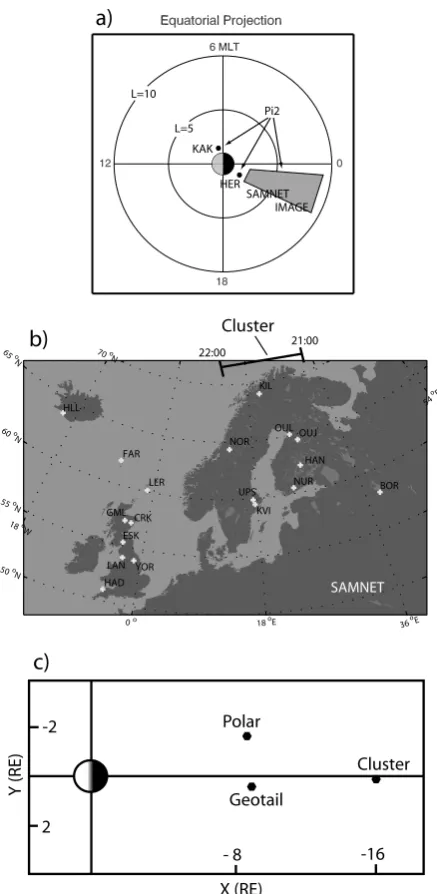
Fig. 1. (a) Mapping of the locations of Hermanus (HER), Kakioka
(KAK), SAMNET, and IMAGE ground stations onto the equatorial plane. (b) Cluster’s footprint during the Pi2 event on 8 September 2002 mapped onto a geographical map. The SAMNET ground sta-tions are indicated. (c) The locasta-tions of various spacecraft used in this study during the Pi2 event.
energy source inside the magnetosphere, which is in effect only one intermediate energy carrier in a sequence of energy transfer processes. There is general agreement that the en-ergy for substorm-related Pi2 – regardless of the Pi2 model – comes from an energy release process occurring in the mag-netotail. It is, on the other hand, more uncertain where the source is located, how the released energy travels from the source to the ground, what energy transfer processes occur
along the way, and where and how the Pi2 frequency is es-tablished. Different energy paths result in different types of Pi2s. In one scenario plasma flow released in the magneto-tail (possibly during reconnection) propagates towards Earth and eventually is slowed down at the transition region be-tween tail-like and dipole-like field lines (Shiokawa et al., 1997). This “braking” can result in two subsequent scenarios yielding two physically different types of Pi2. First, it is pro-posed that the braking leads to a diversion of the cross-tail current into field-aligned currents (Birn et al., 1999). This initially launches an Alfv´en wave towards Earth which un-der the right conditions partially reflects off the ionosphere. The resulting reflection then leads to a “ringing” of the flux tubes at the Pi2 frequency (see review by Baumjohann and Glassmeier, 1984, and references therein). Alternatively, it is argued that the braking can launch a compressional pulse to-ward Earth which is broadband in frequency. This broadband wave excites a cavity resonance in the inner magnetosphere with an eigenfrequency that lies in the Pi2 range (e.g., Sut-cliffe and Yumoto, 1989; Takahashi et al., 1995; Allan et al., 1996). These two scenarios illustrate how the energy path taken from the magnetotail toward the Earth can be different and also how the characteristic Pi2 frequency can be estab-lished in different ways.
Another scenario is based on the observation that fast plasma flows in the plasma sheet showed velocity wave-forms and periodicities which matched those of time-delayed ground Pi2s (Kepko and Kivelson, 1999; Kepko et al., 2001). In this scenario the Pi2 frequency is established by the peri-odicity of plasma flow. It was further proposed that the en-ergy contained in each fast flow is transferred and guided to the ground in possibly different ways.
There is good observational evidence that these differ-ent mechanisms (mdiffer-entioned above) operate in the magneto-sphere. The goal of this paper is to establish another source that produces the characteristic Pi2 frequency, namely pulsed reconnection in the magnetotail, which might be (or might not be) related to the inertial current Pi2 model proposed by Kepko et al. (2001). Magnetic reconnection changes the topology of magnetic fields and allows solar wind energy to enter the magnetosphere. The detailed processes responsible for reconnection, including its time-varying behavior, are not yet fully known.
The Pi2 event presented here occurred on 8 September 2002. The substorm surrounding this Pi2 event has been pre-viously studied with regard to the transition from the growth to the expansion phase (Sergeev et al., 2005). We will make use of some of their findings in this paper by applying them to the analysis of the Pi2 phenomenon. Our approach will be as follows. First, we will establish that on 8 September 2002, Pi2 pulsations occurred on the ground covering low-to high latitudes (both nightside and dayside) in association with a substorm. Second, we will show that a Pi2 signature was also present in the tail lobe at 16REusing Cluster data. Using the analyses from Sergeev et al. (2005) and Semenov
[image:2.595.55.274.61.509.2]et al. (2005), these space Pi2s are identified as the remote sig-nature of reconnection possibly occurring at∼30RE. Third, we will show that tail lobe Pi2 and ground Pi2 had the same waveforms and frequency but occurred at slightly different times. Fourth, using timing analysis, we will rule out previ-ous Pi2 scenarios and will conclude that pulsed reconnection was both the energy provider and the frequency driver for the ground Pi2s. Fifth, we will speculate on how the Pi2 disturbances propagated from the reconnection region to the ground. Finally, this study will also address the outstanding question of the time history of events during the development of a substorm. Here we will use Pi2 pulsations as a “marker” to follow the development.
The observations presented here are from the satellites Cluster, Polar, Geotail, and IMAGE, and the Sub-Auroral Magnetometer Network (SAMNET) and the International Monitor for Auroral Geomagnetic Effects (IMAGE), the Hermanus ground observatory in South Africa, and the Kakioka ground station in Japan. SAMNET, IMAGE and Hermanus are located within the same 3-h MLT sector; Kakioka station is located∼9 h to the east of these stations and was in the dayside during this event (Fig. 1a).
2 Overview
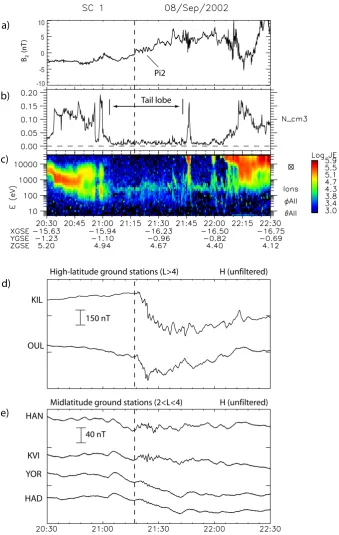
On 8 September 2002, Pi2 pulsations were recorded at about X= –16RE (GSM) in the Northern Hemisphere (Z∼2.5RE GSM) by the four Cluster spacecraft. Figure 2a shows the
Bz (GSM) magnetic field component of Cluster 1. The ion density and the ion energy-time spectrogram (Figs. 2b and c) show that Cluster 1 was in the tail lobe at the time of the Pi2 observation. Cluster 1 left the plasma sheet at about 21:05 UT and remained on tail lobe field lines until 21:45 UT when it briefly reentered the plasma sheet. The ion signa-ture (∼200 eV) in the tail lobe indicates outflowing oxygen as confirmed with the mass spectrometer onboard Cluster 1 (not shown).
During the time of the space Pi2 pulsations, Cluster’s mag-netic footprints were in close proximity to the SAMNET and IMAGE magnetometer networks (Fig. 1b). Figures 2d and e show nightside unfiltered ground magnetograms of theH
component of a subset of ground stations covering high- to midlatitudes. All ground stations show Pi2 pulsations with some time delay with respect to Cluster’s Pi2 which will be shown more clearly in the following sections. In Sect. 5, data from Kakioka ground station (located on the dayside flank during this event) will be shown confirming that Pi2s also occurred in the dayside. The onset time of the ground Pi2 co-incided with the negative turning of theHcomponent at KIL and OUL indicating that these Pi2 were substorm-related.
At the time of the Pi2 pulsations, auroral activity was recorded in the far-ultraviolet spectrum (WIC instrument) by the IMAGE satellite. Figures 3a through f show the devel-opment of the substorm. Cluster’s footprint (star symbol in
Fig. 3b) was located in the polar cap region at the time of the auroral breakup, which is consistent with the Cluster in-situ measurements.
3 Ground observations 3.1 Ground Pi2
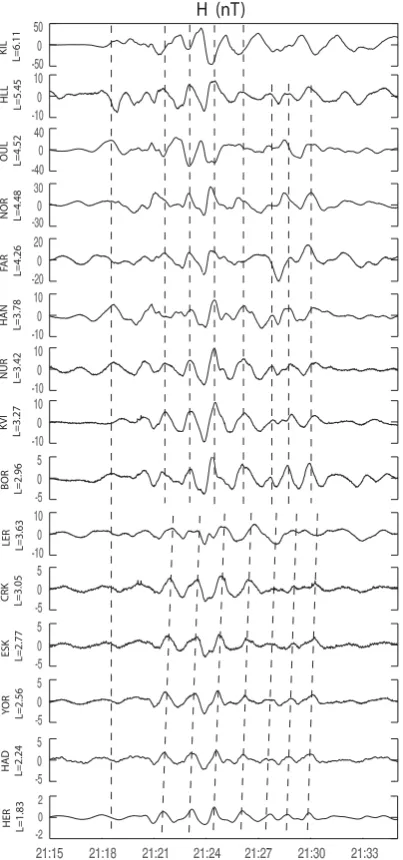
The high-pass-filtered (150 s) H component ground mag-netic field data are shown in Fig. 4 with low- to high-latitude stations (L=1.83 to 6.11) approximately arranged from bot-tom to top. Note that the scales are different for different panels. All but one station (HER) are located in the North-ern Hemisphere. Pi2 pulsations were recorded at all stations. Whereas high-latitude stations (L>4) show Pi2 amplitudes of up to 50 nT, the mid- to low-latitude stations (L<4) show amplitudes of only a few nT. For example, the oscillations at KIL were 10 times larger than those at YOR. The first Pi2 “pulse” occurred at the high- and midlatitude stations OUL, HAN, and NUR (first dashed line from the left). These sta-tions are closest to one another and located on similar merid-ians (c.f. Fig. 1b). The first deflection of the pulse occurred at 21:17:10 UT and is here defined as the “ground Pi2 on-set.” Starting at∼21:21 UT, all stations show very similar waveforms with a frequency (period) of∼11 mHz (90 s) (see dashed lines) which we here call the “main Pi2 event”.
Small phase shifts (tilted dashed lines in lower panels of Fig. 4) can be seen among the six stations HER, HAD, YOR, ESK, CRK, and LER which are located on similar meridians and 1 h (MLT) west of, for example, KVI and HAN. These phase shifts (or time delays) increase systematically with in-creasingLvalue of the stations, suggesting that propagation effects might have been responsible. In contrast, the stations from BOR up to KIL do not show any significant phase shifts (vertical dashed lines). It is also noted that H andD (not shown) were out of phase at HER but were in phase at, for example, YOR.
High-latitude ground stations (L>4) H (unfiltered)
Midlatitude ground stations (2<L<4) H (unfiltered) Pi2
150 nT
40 nT
Tail lobe
Figure 2 - two columns
KIL
OUL
HAN
KVI YOR HAD
B (nT
)
z
a)
b)
c)
d)
e)
Fig. 2. (a–e) Satellite- and ground-based observations of the Pi2 event on 8 September 2002. The vertical dashed line marks the onset of the
tail lobe Pi2 (panel a). Ground Pi2s were recorded with time delays (panels d and e).
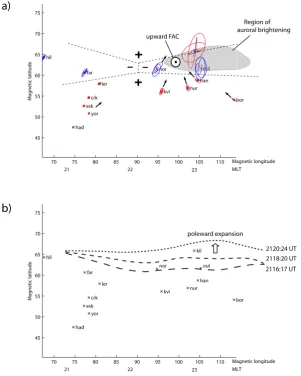
FAC, which is to be expected if the Pi2 pulsations are caused by a transient FAC system (Pashin et al., 1982). Furthermore, the upward FAC coincided with the region of auroral bright-ening (shaded area, see Sect. 3.2).
Further support for a FAC system comes from the polariza-tion reversals occurring at∼60◦and∼65◦latitude (Fig. 5a). This double polarization change appears to be associated with the FAC system and the region of auroral brighten-ing. Such a double polarization change has been discussed
[image:4.595.130.470.60.596.2]Figure 3 : two columns at ~70% page coverage
21:18:20 UT
21:20:24 UT 21:22:26 UT
21:24:30 UT 21:26:33 UT
Cluster
a b
c d
e f
g
Fig. 3. (a–f) WIC images surrounding the Pi2 event. Cluster’s footprint is denoted by a star. Panel (g) (from Sergeev et al., 2005) shows the
time variation of the integrated brightness of 2-h wide MLT strips.
by Samson and Rostoker (1983) where the equatorward and poleward reversals were associated with ionospheric and field-aligned currents, respectively. In their modeling (c.f. their Fig. 31), the westward traveling surge (WTS) would coincide with the shaded area (Fig. 5a), and the dashed lines separate regions with different polarization (“+” and “–” de-note counterclockwise and clockwise, respectively). The downward current maps north-east of the WTS and feeds the upward current in the WTS (Samson and Rostoker, 1983). A downward current at∼120◦longitude can be inferred from the longitudinal profile ofH andD on 8 September 2002 (not shown). Upward and downward FAC are commonly associated with the field-aligned portion of the SCW. This possibility and others are discussed in Sect. 7.
In Sect. 5, when comparing ground and space Pi2s, data will be shown from the low-latitude Kakioka (KAK) ground
station, which was in the dayside at the time of the nightside Pi2s. Kakioka also recorded the same Pi2 pulsations, which again suggests that fast mode waves must have played some role in this Pi2 event, because fast mode waves can travel across the background magnetic field.
[image:5.595.126.467.61.467.2]H (nT)
Figure 4: one column
KIL L=6.11
OUL L=4.52
HAN L=3.78
KVI L=3.27
ESK L=2.77
Y
O
R
L=2.56
HAD L=2.24 HLL L=5.45
NOR L=4.48
NUR L=3.42
F
A
R
L=4.26
BOR L=2.96
LER L=3.63
CRK L=3.05
[image:6.595.66.268.64.495.2]HER L=1.83
Fig. 4. Comparison of Pi2 waveforms recorded by the SAMNET
and Hermanus ground stations coveringLvalues from 1.83 to 6.11. The dashed lines are drawn as visual aides. Note that the scales are different for different panels.
3.2 Auroral bulge
The first sign of change in auroral activity is discernable in Fig. 3b (21:18:20 UT; the center time of integration is shown above each image). Several faint structures formed along the auroral oval in the premidnight sector (19:00–24:00 MLT). The largest of these structures, located at ∼23.5 MLT and 62◦, had expanded poleward. This is the same location where the more dramatic intensification and expansion oc-curred one image later (Fig. 3c) followed by a small west-ward and more pronounced eastwest-ward expansion of the auro-ral bulge (Figs. 3d, e, and f). It is noted that seveauro-ral images
before 21:16:17 UT (Fig. 3a) are very similar to Fig. 3a, i.e., they show no signs of auroral activation. Thus, the weak expansion in Fig. 3b could indeed be the first sign of the “au-roral onset.” Furthermore, the total au“au-roral brightness inte-grated over 2-h wide MLT sectors shows an increase in the 22:00–24:00 MLT sector (red line in Fig. 3g) between the im-ages taken at 21:16:17 and 21:18:20 UT (red dashed line in Fig. 3g). Since the integration time of each image is 20 s, the auroral onset (first sign of an intensity increase and poleward expansion) occurred between 21:16:27 and 21:18:30 UT. It is noted, that this interval includes the onset time of the ground Pi2 (21:17:10 UT) (Sect. 3.1) which could imply that the first pulse and the first weak brightening are related. Alterna-tively, however, it could be argued that the auroral breakup occurred some time during 21:18:30 and 21:20:34 UT based on (1) Fig. 3c which shows that of all developing auroral fea-tures in Fig. 3b only the one at∼23.5 MLT and 62◦further
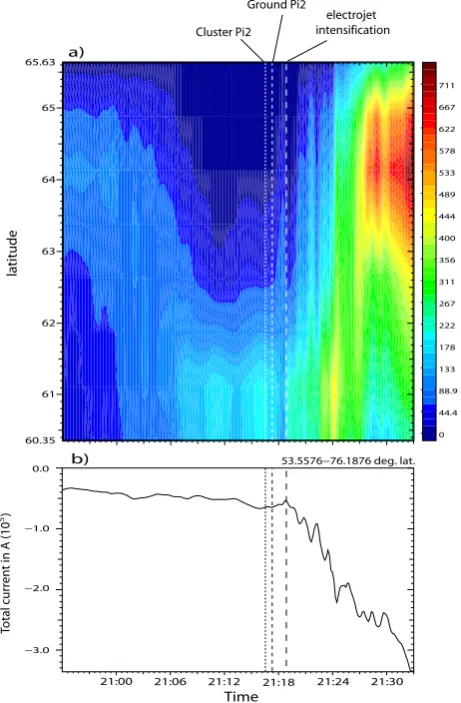
intensified and led to the auroral bulge, and (2) on the result of the next section where it is shown that the auroral elec-trojet significantly intensified at 21:18:40 UT followed by a rapid poleward expansion.
The region of auroral brightening is generally assumed to be associated with an upward FAC. We have drawn this region of auroral brightening in Fig. 5a (shaded area corre-sponds approximately to the outer green border in Fig. 3c), and it indeed encompasses the location of the upward FAC as estimated from the ground magnetic field data (Sect. 3.1), which is also the location of the largest ground Pi2 oscilla-tions. Thus, upward FAC, largest Pi2 pulsations and head of the auroral bulge (WTS) are likely related in this event.
Figure 5b shows the approximate location of the poleward auroral border (determined from Figs. 3a, b, and c) at differ-ent times in relation to the SAMNET ground stations. Note that the determination of this border was subjective because it depends on the brightness criterion used in the WIC images. At ground Pi2 onset (21:17:10 UT), this border was in close vicinity of OUL (dashed line labeled 21:16:17 UT) which was one of the stations to first record the ground Pi2 and to first show the largest amplitudes. The station KIL, however, was in the polar cap (i.e., outside the auroral oval) at this time and did not record large amplitude Pi2. Only when the pole-ward border passed KIL during its expansion (dashed line labeled 21:20:24 UT) did KIL record large (>10 nT) Pi2 os-cillations (top panel in Fig. 4). This is consistent with the scenario that the WTS was the cause of the large amplitude ground Pi2 at high latitude.
3.3 Auroral electrojet
The ground Pi2 signatures and auroral images (presented in the previous two sections) are consistent with the scenario that they were caused by a wedge-like current system. In Sect. 7 we will discuss several sources of such a current system, including the substorm current wedge (SCW). The ionospheric part of the SCW is called the auroral (substorm)
70 75 80 85 90 95 100 105 110 45
50 55 60 65 70 75
Magnetic longitude
Magnetic latitude
oul nor
hll
han far
nur kvi
bor ler
crk
esk yor
had
Figure 5: two columns at ~60% page coverage
21 22 23 MLT
oul
-+
+
Region of auroral brightening upward FAC
70 75 80 85 90 95 100 105 110
45 50 55 60 65 70 75
Magnetic longitude
Magnetic latitude
kil
oul nor
hll
han nur kvi
bor ler
crk
esk yor
had
21 22 23 MLT
far 2116:17 UT
2118:20 UT 2120:24 UT poleward expansion
a)
b)
Fig. 5. (a) Polarization map (H-D plane) of the ground Pi2 pulsations on 8 September 2002. The dashed lines separate regions with different
polarization (“-” and blue = clockwise; “+” and red = anti-clockwise). (b) Each dashed line shows the poleward border of the aurora at a specific time (determined from WIC images, c.f. Fig. 3). The second dashed line from below shows the first indication of a poleward expansion.
electrojet. Together with the field-aligned currents, these currents cause the substorm-related H bay signatures. In Sect. 3.1 the location of upward and downward FAC are es-timated to be at 98◦ and 120◦ longitude, respectively, for the 8 September 2002 event. Furthermore, one can infer that KIL and OUL (L>4) were located beneath the auro-ral electrojet showing the largest negative (southward)H de-flection (Fig. 2d). The negativeH deflections at YOR and HAD (L<3) were much smaller. Since both stations were lo-cated south-west of the electrojet, the negative bay is mostly caused by the FAC portion of the current wedge. HAN and KVI (3<L<4) show no pronounced H deflection because they were located south of the upward FAC.
During the course of a substorm, the location of the au-roral electrojet changes in latitude. This location change can best be investigated with the IMAGE ground
[image:7.595.147.449.65.442.2]60.35 61 62 63 64 65 65.63
0 44.4 88.9 133 178 222 267 311 356 400 444 489 533 578 622 667 711
53.5576−76.1876 deg. lat.
−3.0 −2.0 −1.0 0.0
Time
21:00 21:06 21:12 21:18 21:24 21:30
To
tal c
ur
ren
t in A (
10 )
la
titu
de
5
a)
b)
Cluster Pi2 Ground Pi2
electrojet intensification
Fig. 6. (a) Latitudinal distribution of the ionospheric westward
current (in mA/m) reconstructed from IMAGE magnetometer data (adapted from Sergeev et al., 2005). (b) Total integrated current (in A) of the ionospheric westward current. Dashed lines indicate the onsets of the Cluster Pi2, the ground Pi2, and the intensification of the ionospheric westward current.
auroral feature as determined from WIC images (Sect. 3.2). However, the total magnitude (Fig. 6b) of the auroral electro-jet current did not significantly increase until∼21:18:40 UT (third dashed line from the left) which was also accompa-nied by a rapid poleward expansion (Fig. 6a) reaching∼65◦ at∼21:24 UT and a superposition of Pi2 fluctuations. The total estimated ionospheric westward current was less than 4×10⁵A during the Pi2 event. We note that this intensifi-cation and poleward expansion of the auroral electrojet are consistent with the development of the auroral bulge as seen in WIC images (Fig. 3).
4 Space Pi2–Cluster spacecraft
The four Cluster spacecraft were separated by about 2000 km in a tetrahedral configuration in the tail lobe at∼16RE. All
Figure 7: one column
Cluster 4
B (nT
)
x
B (nT
)
z
B (nT
)
y
(a)
[image:8.595.51.282.67.419.2](c) (b)
Fig. 7. Three magnetic field components in GSM coordinates of the
Pi2 event observed by Cluster 4 on 8 September 2002. Data were averaged (4 s) and detrended (150 s).
Figure 8: one column
B (nT
)
z
E (mV/m)y
Cluster 4
(a)
[image:8.595.314.546.67.333.2](b)
Fig. 8. Comparison of waveforms of the electric (Ey) and magnetic
(Bz) field components (GSM) of the Pi2 event on 8 September 2002.
Data were averaged (4 s) and detrended (150 s).
spacecraft showed the same Pi2 pulsations with little varia-tion and small time delays. Figure 7 shows the three mag-netic field components (GSM) of Cluster 4 during the Pi2 event. The strongest pulsations are seen in Bz. Figure 8 shows theBzandEy component (GSM). Both components
[image:8.595.309.545.398.585.2]are in phase during the first two periods of the Pi2 event, which indicates that this is a disturbance propagating to-wards Earth. Afterto-wards there is some phase shift which might be due to the interference of waves reflected from the ionosphere. From the E-to-B ratio of the first and sec-ond pulse, the propagation speed is estimated to be 600– 800 km/s. This ratio compares well with the estimate of
Vx=627 km/s and Vy= –72 km/s, determined from a time-delay analysis of magnetic field data from the four spacecraft (Sergeev et al., 2005), showing that the main propagation di-rection was Earthward. The important conclusion from these data is that the pulses were launched tailward of Cluster and traveled Earthward.
In Sergeev et al. (2005) it was argued that these pulses which we here identify as Pi2 pulsations show the signa-tures of nightside flux transfer events (NFTE). These struc-tures are thought to originate from the reconnection region (Sergeev et al., 1992). The following characteristics are typ-ical for NFTEs (use dashed lines in Fig. 9 as visual aides): a) asymmetric bipolarBz, b) compression ofBx, c) plasma flow,Vz, towards the plasma sheet, (d) anti-correlation ofBx andVz, and (e) direction change ofBzandVzcorresponds to the maximum inBx. The qualitative NFTE scenario given by Sergeev et al. (2005) is further supported by a quanti-tative analysis using analytical calculations by Semenov et al. (2005) who estimated that reconnection occurred at about 30REduring the 8 September 2002 event. Figure 9 (bottom) illustrates the propagation of an NFTE and its encounter with Cluster.
5 Comparison of space and ground Pi2
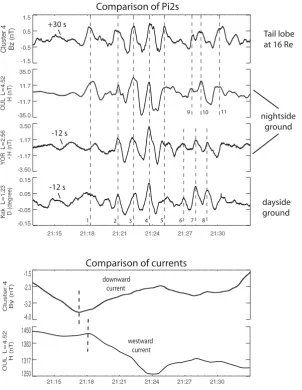
We now compare ground and in-situ (Cluster) Pi2 observa-tions (Fig. 10). OUL and YOR were located in the nightside, and KAK was located in the dayside (Fig. 1a). OUL was chosen because it is among those stations showing the ear-liest Pi2 onset on the ground. Note that the inverse of H
is shown for YOR to account for the polarization reversal at
∼60◦, placing OUL and YOR north and south of this reversal region, respectively. The data from Cluster, YOR and KAK were time-shifted so that signal peaks line up with those of OUL (dashed lines 2 through 5). It is noted that the first pulse (dashed line 1) recorded by Cluster and OUL is not seen at YOR and KAK. Allowing for these time shifts the Pi2 wave-forms are very similar during the main Pi2 event (lines 2–5). The important conclusion is that space and ground Pi2s were caused by the same process occurring in the magnetotail be-yond the location of Cluster (>16RE). This process also dictated the frequency of the space and ground Pi2. Using the results from Sect. 4, we argue that pulsed reconnection was this process.
In the following we estimate the travel time of the Pi2 disturbance from 16RE to the ionosphere. We assume for
this calculation that together with the observed NFTE pulses,
Figure 9: one column
Fig. 9. (a) Field and particle data from the four Cluster spacecraftfor the 8 September 2002 event (from Semenov et al., 2005), (b) Cartoon illustrating NFTE propagation and its encounter with Clus-ter (from Semenov et al., 2005).
[image:9.595.310.544.60.508.2]-12 s +30 s
Figure 10 : two columns at ~60% page coverage
-12 s
1 2 3 4 5 6 7 8
9 10 11
-Tail lobe at 16 Re
nightside ground
dayside ground
Comparison of Pi2s
Comparison of currents
downward current
westward current
Fig. 10. (a) Comparison of magnetic fields of in-situ (Cluster), nightside and dayside ground data for the Pi2 event on 8 September 2002.
The data were band-pass filtered (4 s, 150 s). All records show the same Pi2 event with time delays indicated above the signal lines. The vertical dashed lines are drawn as visual aids. (b) Comparison of currents associated with the Pi2 pulsations at Cluster and on the ground.
Baumjohann and Glassmeier, 1984). Alternatively, the brak-ing can launch compressional waves into the inner magne-tosphere which possibly generate low-latitude Pi2s (e.g., Al-lan et al., 1996; Lee and Kim, 1999; Kepko and Kivelson, 1999). The propagation speed of the compressional waves in the inner magnetosphere is of the order of about 500 km/s. The total travel times for these two scenarios are 98 s and 149 s, respectively. (These calculations are similar to those in Slavin et al., 2002.) Both values appear to be too large to be reconcilable with the observed time delay of∼30 s between Cluster’s Pi2 and the ground Pi2 at OUL (see also Sect. 7.1). An alternative propagation path for the Pi2 disturbance is the tail lobe and/or the separatrix layer (PSBL). In Sect. 3.2, it was shown that at the time of the ground Pi2 onset, OUL was closest to the polar cap boundary, and therefore it might
be argued that a disturbance in the PSBL associated with the tail lobe NFTE caused the high-latitude ground Pi2 ob-served at OUL. In this case it would be required that the aver-age speed of lobe/PSBL Alfv´en waves was about 3200 km/s to travel 15RE in 30 s. Although it was found that the local Alfv´en speed (at 16RE) was between 600–800 km/s (Sect. 4), it is expected that the Alfv´en speed increases to above 10 000 km/s as the waves propagate towards the con-verging Earth magnetic field, and thus an average speed of 3200 km/s might be reasonable. In this scenario, the NFTE could be the first signature of a current layer that maps from the reconnection region along the PSBL into the ionosphere (see also Sect. 7.1). The reader is reminded that the first ground Pi2 pulse was also recorded at HAN and NUR. These two stations were closest to OUL and south of OUL. Among
[image:10.595.147.450.68.459.2]these three stations, OUL recorded the largest oscillations. Those stations located in the polar cap (north of OUL) did not record large oscillations at onset time (Sect. 3.1).
Furthermore, the Pi2 pulsations were superposed on current signatures both in space (slope in By) and on the ground (H component) (Fig. 10). The onsets of the currents were delayed by the same amount as the space Pi2 and the first ground Pi2 at OUL (dashed lines), confirming that the currents are a feature of the Pi2 pul-sations. The strongest westward currents on the ground were observed at high latitude which were closest to Cluster’s footprint. The downward current signature at Cluster is likely the remote effect of a current in the PSBL. A strong downward current was recorded when Cluster entered into the PSBL about 20 min after the tail lobe Pi2 event while the substorm was still ongoing (c.f. Fig. 2b: Cluster 1 entered the PSBL at about 21:45 UT). Owing to their separations (∼2000 km), the four space-craft recorded this current within minutes of each other. Using two spacecraft to determine the boundary velocity (∼21 km/s), the thickness and density of the current layer were estimated to range from 440 to 1800 km and 9 to 28 nA/m2 (1-D sheet approximation), respectively. These variations could be due to temporal and/or spatial effects, since the spacecraft encountered the current layer within minutes of each other. Furthermore, temporal variations are to be expected if reconnection is time-varying as it was here. To compare these current densities with the ionospheric current calculated in Sect. 3.3, we multiply the current densities by the thickness of the current layer and assume an azimuthal width of 1REwhich yields total currents between 6×10⁵–9×10⁵A for the four spacecraft. These values are in fact larger than the ionospheric current during the Pi2 events, but we also note that they were recorded 20 min after the main Pi2 event and we had to make an assumption on the azimuthal width of the current layer. We also note that the ionospheric currents further intensified after the Pi2 event (not shown). In Sect. 7 we will further discuss the significance of the PSBL current.
A well known phenomenon for low-latitude Pi2s is that they can occur simultaneously in both dayside and nightside (Sutcliffe and Yumoto, 1989). The event presented here also shows this feature: both YOR and KAK (located in the day-side flank, see Fig. 1a) show the same oscillations (Fig. 10). Although there appears to be no time delay between these two stations, we remind the reader that other mid- to low-latitude stations showed time delays with respect to YOR and consequently to KAK as well. It is also noted here that YOR and KAK continued to record similar oscillations (dashed lines 6, 7 and 8) after the main Pi2 event. Cluster and OUL, on the other hand, showed similar oscillations (dashed lines 9, 10 and 11) which deviated from those of YOR and KAK.
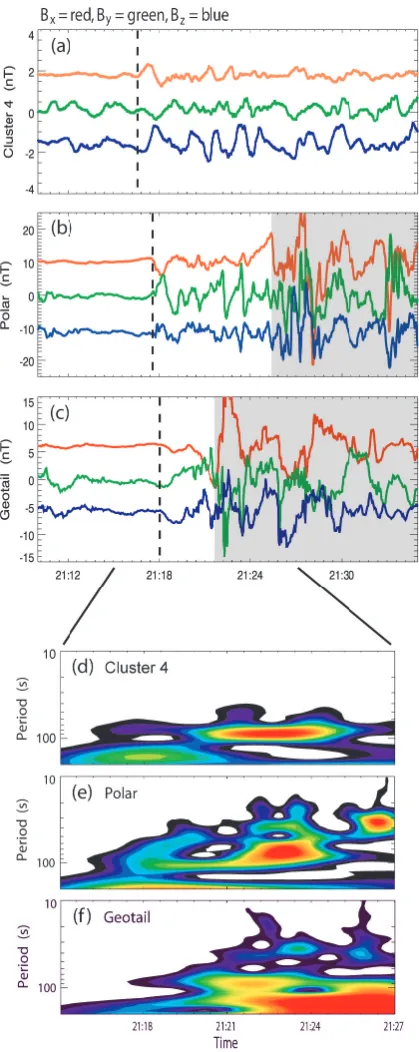
6 Polar and Geotail observations
At the time of the Pi2 event recorded by Cluster and ground magnetometer stations, two other spacecraft (Polar and Geo-tail) were located at about 9REin the nightside magnetotail (Fig. 1c). Polar was∼1 h (MLT) east of Cluster, and Geotail was in the Southern Hemisphere near midnight MLT. Both spacecraft were inside the PSBL near its outer edge. Fig-ures 11a–c show the three magnetic field components (band-pass filtered: 4 s, 200 s) of each spacecraft including Clus-ter for comparison. The shaded part indicates a region of energized plasma. The vertical dashed line in each panel marks the beginning of magnetic field perturbations which were presumably associated with the Pi2 disturbance travel-ing from a site at distances greater than 16REtoward Earth. However, neither of the two other spacecraft recorded mag-netic field waveforms that were convincingly similar (visual inspection) to the Cluster Pi2s. Hence, (normalized) wavelet power spectra were generated of subintervals encompassing the Pi2 event (Figs. 11d–f). For each spacecraft the com-ponent with the strongest signal in the Pi2 frequency band is shown. Figure 11d shows a strong signal in theBz com-ponent on Cluster 4 from about 21:20 to 21:25 UT in the period range 80–100 s, which is of course the identified Pi2 event under investigation (Sect. 4). Before 21:20 UT it shows wave power with a larger period which corresponds to the first pulse observed by Cluster. Polar shows wave power at
∼100 s inBz(not shown), butBydominates between 21:18– 21:24 UT in the band from∼70 to 100 s and is thus shown in Fig. 11e. Geotail has its strongest Pi2 component inBzat 70–100 s centered around 21:22 UT (Fig. 11f).
Fig. 11. (a–c) Three magnetic field components of Cluster, Polar
and Geotail for comparison (band-pass filtered: 4 s, 200 s). The shaded parts indicate regions of energized plasma. The vertical dashed line in each figure marks the beginning of magnetic field perturbations presumably associated with the Pi2 disturbance trav-eling from a site>16REtoward Earth on 8 September 2002. (d–f) Wavelet power spectra of subintervals encompassing the Pi2 event for Cluster (Bz), Polar (By) and Geotail (Bz).
the first instance of the disturbance crossing the y-z plane at X= –9RE. Furthermore, it was shown in Sect. 4 that the NFTE propagated eastward in addition to its dominant Earth-ward propagation which could also play a role in the timing of events.
Additional complications in comparing the wave signals from the various spacecraft arise because they were crossing different plasma regimes during the Pi2 event, which could have obscured the Pi2 magnetic field signatures at Polar and Geotail. Clearly, these are speculations and we will not fur-ther pursue them in this paper.
7 Discussion
Here we reported observations of substorm-related Pi2 pul-sations in the tail lobe in concert with ground Pi2. The fol-lowing key observations were made:
– A series of NFTE pulses in the tail lobe at 16RE resem-bles the magnetic field signature of Pi2s.
– The NFTE pulses (Pi2 pulsations) traveled toward Earth.
– Time-delayed ground Pi2s with the same waveform (same frequency) occurred in the nightside (L=1.83 to 6.11) and the dayside (L=1.23).
– The tail lobe Pi2s were recorded 30 s before the first ground Pi2 at high- and midlatitudes followed by low-latitude Pi2s.
– The Pi2 magnetic field amplitude at high latitudes was one order of magnitude larger than those at mid- to low-latitude.
– The largest Pi2 occurred in the vicinity of the upward FAC that was associated with the auroral bulge. – The polarization pattern of the ground Pi2 was
consis-tent with a transient large-scale wedge-like FAC system in the ionosphere.
– A weak auroral activation occurred at the onset time of the ground Pi2 (within the time resolution of the space imager).
– An intense auroral breakup occurred at the onset time of the auroral electrojet intensification (within the time resolution of the space imager).
– The tail lobe Pi2 was superposed on a downward current signature. The near-by PSBL (crossed 20 min after the Pi2 observation in the tail lobe) carried current densities of 9–28 nA/m2, which yields a total current of>105A (see assumptions in Sect. 4)
[image:12.595.62.272.61.588.2]– The total equivalent ionospheric westward current was
<4×10⁵A during the Pi2 event.
– The substorm evolution unfolded from the magnetotail (>16RE) to Earth.
In the following section, we will use these observations to discuss the source and the propagation path of this Pi2 event. 7.1 Source of Pi2 pulsation on 8 September 2002
The Pi2 event recorded in the tail lobe is a series of 1 min-long NFTE pulses following each other within 1-3 min. NFTEs are thought to form during the reconfiguration of tail magnetic field lines, i.e., reconnection (Sergeev et al., 1992). Semenov et al. (2005) showed that the magnetic field perturbations in the tail lobe on 8 September 2002 are consistent with analytical calculations of NFTEs propagat-ing away from a reconnection site. The reconnection site was estimated to be at ∼30RE. Two alternative explana-tions for the field disturbances in the tail lobe might be put forward: a) flapping motion of the tail; b) Kelvin-Helmholtz (K-H) surface waves on the magnetopause. For the following reasons, however, these explanations are less likely. First, Runov et al. (2005) showed that flapping motion in most cases propagates azimuthally rather than Earthward as was the case in our event. Second, the excitation of K-H waves are not causally associated with substorm onset, whereas it was shown that the disturbances reported here were related to substorm onset as is expected for at least some NFTE.
The key observation is that the magnetic field oscilla-tions of the NFTEs were nearly identical to time-delayed ground Pi2s, which justifies their classification as Pi2 pulses. This similarity strongly suggests that both tail lobe Pi2s and ground Pi2s were driven by the same source, namely pulsed reconnection. Thus, reconnection not only released the en-ergy to drive ground Pi2s but also occurred at a rate that equaled the Pi2 frequency. Even if it turns out in future studies that NFTE are the result of a process other than re-connection, there must be, in any case, a process in the tail launching these disturbances, which has the periodicity and magnetic field signature of Pi2s and which is the driver of one class of ground Pi2s as shown here.
Furthermore, the combination of ground signatures (mag-netic field oscillations, auroral electrojet, and auroral breakup; Sect. 3) suggest that the ground Pi2s were asso-ciated with a transient current wedge system of down- and upward FAC. Such a current wedge has traditionally been associated with the SCW, although, recently, it has also been shown that BBF create wedge-like ionospheric signatures (Kauristie et al., 2000). Furthermore, it was proposed that a wedge-like current structure in the outer plasma sheet ac-companies NFTE structures (Sergeev et al., 1992). It follows a discussion of each of these current sources and how they might be associated with the event reported here.
The initiation of the SCW results from the braking of Earthward plasma flow in the near-Earth region (Shiokawa et al., 1997). At the beginning, this braking creates field-aligned currents which propagate as Alfv´en waves towards the ionosphere. Under the right conditions, these waves re-flect off the ionosphere and continue to bounce inside the flux tube before a steady state FAC is established. This “ringing” of the flux tube is believed to be the source of high-latitude Pi2s and is called the transient response model of Pi2s (e.g., Baumjohann and Glassmeier, 1984). Although the ground observations on 8 September are consistent with this model, the model excludes the possibility that the process determin-ing the Pi2 frequency lies beyond 16RE as was the case for our event. Thus, this model can be ruled out as an expla-nation for the 8 September 2002 event. Nonetheless, it is stressed here that the ground Pi2s showed very large ampli-tudes which so far have only been associated with the tran-sient response model. We also rule out the scenario that a cur-rent disruption, located between Cluster and the ground, oc-curred first which then triggered the SCW and possibly sent Pi2 disturbances toward Cluster, because it was shown that the Pi2 disturbance at Cluster traveled Earthward and was the first signature in a sequence of substorm-related events (see also Sect. 7.2).
ISEE 2) that drove compressional Pi2 waves in the dayside (recorded by GOES 3, which was more than 20RE away from ISEE 2) and Pi2s on the ground (dayside flank) with time delays of 32 s and 65 s, respectively. How the short time delay of 32 s was achieved was not addressed in the study. Thus, whether the tail lobe Pi2s are related to the BBF Pi2 model (Kepko et al., 2001) is an outstanding problem.
Another possible source of an ionospheric current wedge might be flow bursts in the magnetotail. Earlier studies have pointed out the coupling of flow bursts to the iono-sphere via small wedge-like FAC structures (Kauristie et al., 2000; Nakamura et al., 2001; Amm and Kauristie, 2002). In concert with these flow bursts conjugate auroral activity was observed. One class of auroral activity associated with flow bursts are poleward boundary intensifications which are sometimes accompanied by Pi2 pulsations (Lyons et al., 1999; Kim et al., 2005). Another class is auroral streamers (Sergeev et al., 2000). However, these BBF-associated cur-rents have not been associated with creating the characteristic Pi2 frequency in a one-to-one relationship as shown for our event.
Another possible current source is the NFTE structure it-self. During the passage of NFTEs, Sergeev et al. (1992) showed enhanced currents in the outer regions of the PS, us-ing both ISEE 1/2 spacecraft at∼20RE. It was suggested that NFTEs also show a wedge-like current structure. These currents are directly associated with the reconnection site (Sydneva and Semenov, 1987). Location and timing anal-ysis of currents at Cluster and on the ground are consistent with the mapping of the ionospheric current along the PSBL, possibly into the reconnection site. The ground current sig-nature appeared after the current sigsig-nature in the tail lobe which was associated with the tail lobe Pi2. It might there-fore be possible that the separatrix layer was magnetically connected to the region surrounding OUL. We also remind the reader that OUL was located at or in close vicinity to the polar cap boundary at ground onset, and was then engulfed by the poleward expanding bulge. This current layer is not associated with the classical SCW which is generated much closer to Earth, but possibly the Hall current which results from reconnection. In fact, previous studies have already ar-gued that the field-aligned Hall currents resulting from re-connection as shown in simulations (Yamade et al., 2000) and observed in the diffusion region (Vaivads et al., 2004) might play a significant role in the global current pattern (Ya-made et al., 2000; Fujimoto et al., 2001). It was suggested that these currents are carried by Alfv´en waves into the iono-sphere. Fujimoto et al. (2001) who estimated the PSBL cur-rent during a substorm obtained similar values as reported here. Note that in this scenario, the current is not bouncing as in the transient response mechanism but oscillates at the Pi2 frequency by direct control at the reconnection site by an as yet unknown mechanism.
The cavity mode is a global resonance with the same fre-quency throughout the cavity (e.g., Allan et al., 1996; Lee
and Lysak, 1999). The Pi2 event on 8 September 2002 did indeed show oscillations with the same frequency over many
Lshells (L=1.2 to 6.1). However, cavity resonances are con-fined to mid- and low-latitudes (L<∼4) and do not show an amplitude maximum at high-latitude as was shown here. High-latitude Pi2s have been identified as Alfv´enic and their frequency is independent of the cavity resonance (Yeoman et al., 1991). Furthermore, we reported Pi2s in the tail lobe which is not part of the usual cavity (inner magnetosphere). A variation of the cavity mode, called the virtual resonance (Lee and Kim, 1999), does account for oscillations outside the cavity. But for the 8 September 2002 event, the propa-gation direction of the Pi2 observed by Cluster was toward Earth and is thus also inconsistent with this model. It was, however, observed that after the main Pi2 event, low- to mid-latitude stations continued to show similar oscillations which were different from the high-latitude oscillations. Could this mean that a cavity mode established with a frequency close to the initial driving source of the main Pi2 event? This ques-tion cannot be answered here because measurements inside the plasmasphere were not available.
Two additional observations, which have not been fully explained in this study, are (1) that the first pulse of the Pi2 train was only observed at some ground stations, and (2) a systematic latitudinal time delay for a group of low- to mid-latitude ground stations (located west of the current wedge system). Latitudinal and longitudinal variations of Pi2 pul-sations have been invested by several authors (e.g., Li et al., 1998; Uozumi et al., 2000, 2004), and various scenar-ios are proposed for such variations. For example, Uozumi et al. (2000, 2004) showed in statistical studies using ground data from 210 MM that Pi2 pulsations are first observed in the polar cap region albeit with smaller amplitude than those closer to the simultaneously occurring aurora, followed by mid- and low-latitude stations. The Pi2 source of the high-latitude (polar cap) Pi2s was not identified but it was spec-ulated that equatorially excited fast mode waves propagate outward where they eventually resonantly excite lobe field lines, thus sending Alfv´en waves to the polar cap region. The larger speed in the lobe region allows the Alfv´en waves to arrive first on the ground. Uozumi et al. only considered ground data, and thus could not identify a Pi2 disturbance in space. Furthermore, it was not specified what determined the oscillation frequency. Li et al. (1998) investigated longitudi-nal variations and concluded that they are best explained with the presence of two wave sources, the SCW and the cavity-mode, both of which were ruled out in our event. Here we argued for an association of ground Pi2 and a driven current-wedge FAC system, but we also argued that fast mode waves must have played a role in the inner magnetosphere because of propagation effects (i.e., identical waveforms but time-delayed) among some stations and because of the simulta-neous occurrence of dayside Pi2.
In this discussion we did not include the observations of Polar and Geotail which we found to be inconclusive for
Various frequency drivers of Pi2 pulsations
cavity-type mode resonance
periodic BBFs
pulsed reconnection
NFTE
~700 km/s
Psphere j
j
ringing of substorm current wedge Cluster
1 2
3
4
5
surface wave on plasmapause
1
2
3
4
5
Figure 12: two columns at ~70% scale
[image:15.595.125.468.75.330.2]j
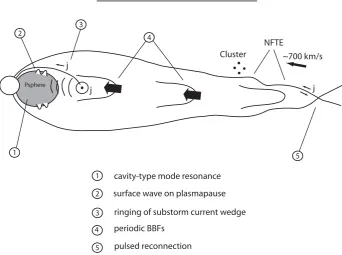
Fig. 12. Schematic showing several proposed mechanisms for establishing the characteristic Pi2 frequency, including our observations for
the 8 September 2002 event.
contributing to this Pi2 study since the clear one-to-one cor-relation among Cluster’s Pi2s and the ground Pi2s was not visible in the Polar and Geotail data. This could, however, simply have been a spatial effect (spacecraft separation) be-cause disturbances (like BBF) in the extended magnetotail are known to travel at times in narrow channels (Angelopou-los et al., 1992).
7.2 Corollary
In addition to the fact that the tail lobe Pi2s were the first (at 21:16:40) observable substorm indicator, it is important to note that they propagated Earthward. This excludes the scenario that the source of the ground Pi2s was located be-tween Cluster and the ground stations. In fact, Sergeev et al. (2005) reported plasma signatures (including data from LANL geosynchronous satellites) for this event with regard to the transition from substorm growth to substorm expan-sion phase and concluded that the observations can be or-ganized in the frame work of the modified NENL model (Baker et al., 1996) in which the events initially unfold from the magnetotail toward Earth. Our analysis confirms this result by including two additional observables. First, the first ground Pi2 pulse was recorded at ∼21:17:10 UT at high- and midlatitude stations, i.e., 30 s after the Cluster Pi2 (21:16:40 UT) which we associated with pulsed reconnection in the magnetotail. Second, it was pointed out that the onset of the strong electrojet intensification and its poleward
ex-pansion started at∼21:18:40 UT, which is also significantly later than the Cluster Pi2 observation. It is interesting to note that the ground Pi2 onset occurred before the strong electro-jet intensification.
Finally, it is noted that although the onset of wave distur-bances at Polar (∼21:17:40 UT) and Geotail (∼21:18:00 UT) occurred after the Pi2 onset at Cluster (∼21:16:40), as expected, they also occurred after the ground Pi2 onset (∼21:17:10) which was unexpected. However, we remind the reader of the caveats associated with these observations (Sect. 6) which could provide an explanation for this para-dox.
8 Conclusions
Pi2 pulsations. These observations relate for the first time these two magnetospheric phenomena: NFTE and Pi2 pulsa-tions. So far, Pi2s in the tail lobes have not been incorporated in any previous Pi2 model.
With time delays, substorm-related ground Pi2 pulsations were observed in both the dayside and the nightside spanning low- to high latitudes. The ground Pi2s showed the same waveforms as the tail lobe Pi2, which led to the conclusion that pulsed reconnection was actively controlling the charac-teristic frequency of the ground Pi2s in addition to provid-ing the energy. The nightside ground Pi2 pulsations could be observationally organized by a wedge-like current sys-tem. However, it was not possible to unambiguously iden-tify the current source of the current wedge. Although the SCW is a candidate, the traditional transient response mech-anism, which relies on the internal ringing (Alfv´en bounce time along magnetic field lines) of the SCW, was ruled out because the frequency source was not inherent to the inner magnetosphere but to the reconnection site. Instead, a modi-fied scenario of the Kepko et al. (2001) model which uses the periodic driving of the inertial current was proposed, which has yet to overcome the time constraint of∼30 s for the Pi2 signal at 16RE in the tail to reach the ionosphere. In ad-dition, we alternatively considered the possibility that the ionospheric current was directly linked to the reconnection site, which is known to generate Hall currents of consider-able intensity. Time delays among mid- to lower latitude sta-tions and dayside Pi2s also suggested that fast mode waves played an additional role since they travel across magnetic field lines.
A great deal of uncertainty still remains about how Pi2 disturbances travel inside the inner magnetosphere. Our ob-servations are no different in this regard. Thus, our main result here is the association of pulsed reconnection as the frequency driver of Pi2 pulsation at various locations such as the ground (both dayside and nightside over manyLvalues) and the tail lobe at 16RE, thus adding to our understanding of what drives Pi2s. In Fig. 12 we show the various proposed frequency drivers of Pi2 pulsations (not to be confused with energy provider; see Sect. 1) supported by previous reports including the new observations.
As a corollary, we also showed that reconnection was the first event in a sequence of substorm events leading to ground Pi2s, visible aurora, and auroral electrojet intensification, i.e., this substorm (8 September 2002) was consistent with the modified NENL.
Acknowledgements. This work was supported by NASA grants
NNG04GF23G and NNG05GL27G-06/08. The Kakioka magnetic field data were provided by the Kakioka Geomagnetic Observatory. The Hermanus magnetic field data were provided by P. Kotze of the Hermanus Magnetic Observatory, South Africa. We thank F. Mozer for providing Cluster EFW data and C. T. Russell for providing Po-lar MFE data.
Topical Editor I. A. Daglis thanks K. Yumoto and L. Kepko for their help in evaluating this paper.
References
Allan, W., Menk, F. W., Fraser, B. J., et al.: Are low-latitude Pi2 pulsations cavity/waveguide modes?, Geophys. Res. Lett., 23, 765–768, 1996.
Amm, O. and Kauristie, K.:Ionospheric signatures of bursty bulk flows, Survey of Geophysics, 23, 1–32, 2002.
Angelopoulos, V., Baumjohann, W., Kennel, C. F., et al.: Bursty bulk flows in the inner central plasma sheet, J. Geophys. Res., 97, 4027–4039, 1992.
Baker, D. N., Pulkkinen, T. I., Angelopoulos, V., et al.: Neutral line model of substorms : Past results and present views, J. Geophys. Res., 101, 12 975–13 010, 1996.
Baumjohann, W. and Glassmeier, K.-H.: The transient response mechanism and Pi2 pulsations at substorm onset: Review and outlook, Planet. Space Sci., 32, 1361–1370, 1984.
Birn, J., Hesse, M., Haerendel, G., et al.: Flow braking and the substorm current wedge, J. Geophys. Res., 104, A9, doi: 10.1029/1999JA90017, 1999.
Fujimoto, M., Nagai, T., Yokokawa, N., et al.: Tailward electrons at the lobe-plasma sheet interface detected upon dipolarizations, J. Geophys. Res., 106, A10, doi:10.1029/2001JA900011, 2001. Gelpi, C. Hughes, W. J., and Singer, H. J.: A comparison of
mag-netic signatures and DMSP auroral images at substorm onset – Three case studies, J. Geophys. Res., 92, 2447–2460, 1987. Hughes, W. J.: The effect of the ionosphere on long period
mag-netospheric micropulsations, Planet. Space Sci., 22, 1157–1172, 1974.
Kauristie, K., Sergeev, V. A., Kubyshkina, M., et al.: Ionospheric current signatures of transient plasma sheet flows, J. Geophys. Res., 105, 10 677–10 690, 2000.
Kepko, L. and Kivelson, M. G.: Generation of Pi2 pulsations by bursty bulk flows, J. Geophys. Res., 104, 25 021–25 034, 1999. Kepko, L., Kivelson, M. G. and Yumoto, K.: Flow bursts, braking,
and Pi2 pulsations, J. Geophys. Res., 106, 1903–1916, 2001. Kim, K.-H., Takahashi, K., Lee, D.-H., et al.: Pi2
pulsa-tions associated with poleward boundary intensificapulsa-tions dur-ing the absence of substorms, J. Geophys. Res., 110, A01217, doi:10.1029/2004JA010780, 2005.
Lee, D.-H. and Lysak, R.: MHD waves in a three-dimensional dipo-lar magnetic field: A search for Pi2 pulsations, J. Geophys. Res., 104, 28 691–28 703, 1999.
Lee, D.-H. and Kim, K.: Compressional MHD waves in the magne-tosphere A new approach, J. Geophys. Res., 104, 12 379–12 386, 1999.
Lester, M., Hughes, W. J., and Singer, H. J.: Polarization patterns of Pi2 magnetic pulsations and the substorm current wedge, J. Geophys. Res., 88, 7958–7966, 1983.
Lester, M., Hughes, W. J., and Singer, H. J.: Longitudinal structure in Pi 2 pulsations and the substorm current wedge, J. Geophys. Res., 89, 5489–5494, 1984.
Li, Y., Fraser, B. J., Menk, F. W., et al., Properties and sources of low and very low latitude Pi2 pulsations, J. Geophys. Res., 103, 2343–2358, 1998.
Lyons, L. R., Nagai, T., Blanchard, G. T., et al.: Associations be-tween Geotail plasma flows and auroral poleward boundary in-tensifications observed by CANOPUS photometers, J. Geophys. Res., 104, 4485–4500, 1999.
Nakamura, R., Baumjohann, W., Brittnacher, M., et al. : Flow bursts and auroral activations: onset timing and foot point location, J. Geophys. Res., 106, 10 777–10 790, 2001.
Olson, J. V.: Pi2 pulsations and substorm onsets: A review, J. Geo-phys. Res., 104, 17 499–17 520, 1999.
Pashin, A. B., Raspopov, O. M., Iakhnin, A. G., et al.: Pi2 magnetic pulsations, auroral break-ups, and the substorm current wedge: A case study, J. Geophys. Res., 51, 223–233, 1982.
Runov, Sergeev, V. A., Baumjohann, W., et al. : Electric current and magnetic field geometry in flapping magnetotail current sheets, Ann. Geophys., 23, 1391–1403, 2005,
http://www.ann-geophys.net/23/1391/2005/.
Saito, T.: Geomagnetic pulsations, Space Sci. Rev., 10, 319–412, 1969.
Samson, J. C. and Rostoker, G.: Polarization characteristic of Pi2 pulsations and implications for their source mechanisms: Influ-ence of the westward traveling surge, Planet. Space Sci., 31, 435– 458, 1983.
Semenov, V. S., Penz, T., Ivanova, V. V., et al.: Reconstruction of the reconnection rate from Cluster measurements: First results, J. Geophys. Res., 110, A11, doi:10.1029/2005JA011181, 2005. Sergeev, V. A., Elphic, R. C., Mozer, F. S., et al.: A two-satellite
study of nightside flux transfer events in the plasma sheet, Planet. Space Sci., 40, 1551–1572, 1992.
Sergeev, V. A., Sauvaud, J.-A., Popescu, D., et al.: Multiple-spacecraft observation of a narrow transient plasma jet in the Earth’s plasma sheet, Geophys. Res. Lett., 27, 851–854, 2000. Sergeev, V. A., Kubyshkina, M. V., Baumjohann, W., et al.:
Tran-sition from substorm growth to substorm expansion phase as ob-served with a radial configuration of ISTP and Cluster spacecraft, Ann. Geophys., 23, 2183–2198, 2005,
http://www.ann-geophys.net/23/2183/2005/.
Shiokawa, K., Baumjohann, W., and Haerendal, G.: Braking of high-speed flows in the near-Earth tail, Geophys. Res. Lett., 24, 1179–1182, 1997.
Slavin, J. A., Fairfield, D. H., Lepping, R. P, et al.: Si-multaneous observations of earthward flow bursts and plas-moid ejection during magnetospheric substorms, 107, A7, doi:10.1029/2000JA003501, 2002.
Sutcliffe, P. R. and Yumoto, K.: Dayside Pi2 pulsations at low lati-tudes, Geophys. Res. Lett., 16, 887–890, 1989.
Sydneva, M. V. and Semenov, V. S.: Magnetic reconnection process as a source for field-aligned currents, Geomagn. Aeronomy, 27, 519–532, 1987.
Takahashi, K., Ohtani, S., and Anderson, B. J.: Statistical analysis of Pi2 pulsations observed by AMPTE CCE spacecraft in the in-ner magnetosphere, J. Geophys. Res., 100, 21 929–21 942, 1995. Uozumi, T., Yumoto, K., Kawano, H., et al.: Characteristics of energy transfer of Pi 2 magnetic pulsations: Latitudinal depen-dence, Geophys. Res. Lett., 27, 1619–1622, 2000.
Uozumi, T., Yumoto, K., Kawano, H., et al.: Propagation charac-teristic of Pi 2 magnetic pulsations observed at ground high lat-itudes, J. Geophys. Res., 109, A8, doi:10.1029/2003JA009898, 2004.
Vaivads, A., Khotyaintsev, Y., Andr´e, M., et al.: Struc-ture of the magnetic reconnection diffusion region from four-spacecraft observations, Phys. Rev. Lett., 93, 10, doi:10.1103/PhysRevLett.93.105001, 2004.
Vanham¨aki, H., Amm, O., and Viljanen, A.: One-dimensional up-ward continuation of the ground magnetic field disturbance using spherical elementary current systems, Earth Planets Space, 55, 613–625, 2003.
Yamade, Y., Fujimoto, M., Yokokawa, N., and Nakamura, M. S.: Field-aligned currents generated in magnetotail reconnection: 3D Hall-MHD simulations, Geophys. Res. Lett., 27, 1091–1094, 2000.