Radchenko O., Pylypiv L., Zukow W. Lung function testing accordingleptin levels in patients with chronic obstructive pulmonary
disease. Journal of Education, Health and Sport. 2017;7(3):231-238. eISSN 2391-8306. DOI http://dx.doi.org/10.5281/zenodo.290121
http://ojs.ukw.edu.pl/index.php/johs/article/view/4248
The journal has had 7 points in Ministry of Science and Higher Education parametric evaluation. Part B item 1223 (26.01.2017). 1223 Journal of Education, Health and Sport eISSN 2391-8306 7
© The Author (s) 2017;
This article is published with open access at Licensee Open Journal Systems of Kazimierz Wielki University in Bydgoszcz, Poland
Open Access. This article is distributed under the terms of the Creative Commons Attribution Noncommercial License which permits any noncommercial use, distribution, and reproduction in any medium, provided the original author(s) and source are credited. This is an open access article licensed under the terms of the Creative Commons Attribution Non Commercial License (http://creativecommons.org/licenses/by-nc/4.0/) which permits unrestricted, non commercial use, distribution and reproduction in any medium, provided the work is properly cited. This is an open access article licensed under the terms of the Creative Commons Attribution Non Commercial License (http://creativecommons.org/licenses/by-nc/4.0/) which permits unrestricted, non commercial
use, distribution and reproduction in any medium, provided the work is properly cited. The authors declare that there is no conflict of interests regarding the publication of this paper.
Received: 10.01.2017. Revised 10.02.2017. Accepted: 10.02.2017.
LUNG FUNCTION TESTING ACCORDING LEPTIN LEVELS IN
PATIENTS WITH CHRONIC OBSTRUCTIVE PULMONARY DISEASE
Radchenko O.1, Pylypiv L.1, Zukow W.2
1Danylo Halytsky Lviv National Medical University, Lviv, Ukraine
2Kazimierz Wielki University, Bydgoszcz, Poland
Abstract. Chronic obstructive pulmonary disease (COPD) belongs to
urgent medical and social problems of our time. Prognosis of COPD is often
determined by a comorbidity, in particular obesity. The key chain, which unites
COPD and obesity, is systemic inflammation, in the development of which the
hormone of fatty tissue leptin plays an important role. The presence of receptors
to leptin in the alveolar and bronchial epithelial cells, in smooth muscle tissue
and submucous bronchial membrane allowes to assume that leptin takes
pathogenetic part in COPD progression. The aim of our research was to estimate
the leptin level in COPD patient and analyze changes of the respiratory function
depending on it. Methods. We have been examined 26 patients with
representative by gender, age and body mass. The level of serum leptin has been
defined by the solid phase enzyme linked immunosorbent analysis, lung function
– by computed testing. Results and conclusion. With the leptin level increase
all of the lung function parameters progressively decreased, most significant -
forced vital capacity and peak expiratory flow. Patients with hyperleptinemia
had significantly lower measurements of forced expiratory volume in 1 second
and vital lungs capacity. Severe degree of both obstructive and restrictive
changes has been found more often among patients with hyperleptinemia and
leptin level has been associated with the bronchial obstruction severity.
Key words: leptin, hyperleptinemia, lung dysfunction tests, chronic
obstructive pulmonary disease.
Introduction. Chronic obstructive pulmonary disease (COPD) belongs to
urgent medical and social problems of our time, that defines the necessity of a
research of new ways of an elimination of risk factors, timely and qualified
diagnosis, and effective treatment [2]. The severity of a COPD progression and
its prognosis are often determined by a comorbidity, in particular obesity, its
frequency among COPD patients reaches up to 54% and significantly exceeds
the prevalence in the population [3]. To the key chain, which unites COPD and
obesity, systemic inflammation is referred, in which a the hormone of fatty
tissue leptin plays an important role. A significant vascularization of lungs, the
smooth muscle tissue and submucous bronchial membrane, and also the increase
of leptin levels in sputum of patients with severe exacerbations of COPD
allowed to assume that leptin takes a pathogenetic part in disease progression
[5,6]. Leptin also promotes the mucin production by respiratory epithelial cells
that leads to the hypersecretion [11], stimulates the inflammatory mediators
synthesis, in particular interleukin-6 which promotes the increase of the
thickness of the membrane, subepithelial fibrosis, hypertrophia and proliferation
of bronchial smooth muscle tissue [7]. Leptin blocks apoptosis of
T-lymphocytes in the submucous tissue of bronchus [1] and supports
inflammatory processes due to the neutrophils and macrophages activation,
releasing of free radicals, stimulation of leukotrienes and prostaglandins
synthesis [9].
Leptin level increase is considered as a biomarker of the emphysematous
COPD phenotype [8] and lung restriction in children or adolescents with obesity
[4]. The increase of level of leptin in people with asthma has been associated
with the decrease of vital capacity (VC), its accelerated value (forced vital
capacity; FVC), peak expiratory flow rate (PEF) [10], although data about
COPD is incomplete what determines the topicality of our research.
Aim: to estimate the leptin level in COPD patients and analyze changes
of lung function parameters according it.
Materials and methods. We have been examined 26 patients with COPD
exacerbation (13 male and 13 female, the median of an age is 58 y.o.). The
control group has consisted of 20 healthy people representative by gender, age
and body mass. The level of serum leptin has been defined by solid phase
enzyme linked immunosorbent analysis with the reagent «DRG Leptin ELISA»
(Germany), the normal range is 2.05-5.63 ng/ml for men and 3.63-11.09 ng/ml
(BMI) is 18-24.9 kg/m 2, overweight - 25-29.9 kg/m2, the obesity has been
diagnosed in BMI>30 kg/m 2. Lung function was checked with computed
spirography («Pneumoscreen»). Results have been processed by methods of
variation statistics (Statistica 6,0), demonstrated as a median[lower; upper
quartile], correlations have been estimated by Kendall (τ) analysis.
Results and discussion. The general content of leptin in patients with
COPD was 12.0[1.4;20.6] ng/ml what is significantly higher than in the control
group (6.9[1.9;9.3] ng/ml; p<0.01). The level of leptin depended on the body
mass. Thus, among patients with normal body mass (n=10) the level of leptin
was 1.5[0.9;8.6] ng/ml, that is significantly lower than among patients with
overweight (n=6; 24.7[14.0,40.0]; p=0.007) and obesity (n=10; 25.9[10.8;45.9];
p=0.0007). According correlative analysis the level of leptin expectedly directly
correlated with BMI (τ=0.5; p=0.0006), the stronger correlation was revealed
among men (τ=0.6; p=0.005). Frequency of hyperleptinemia has reasonably
been increased among patients with obesity, than among persons with normal
body mass (90.0±9.5% vs. 30.0±14.5%; p<0.01). It is important that conducted
Kendall correlative analysis has shown that in all patients with COPD the leptin
level was strictly associated with both volumetric and speed lung function
criteria: FVC (τ=-0.4, p=0.007), VC (τ=-0.3, p=0.02), PEF (τ=-0.3, p=0.04), and
directly - with the severity of bronchial obstruction (τ=0.3; p=0.01).
According to the leptin content all patients have been divided into two
groups: a normal level of leptin has been observed in 31% of patients with
COPD (1st group) and increased - in 69% (2 nd group). The groups do not
substantially differentiate by age, gender, clinical presentations (all p>0.05), but
the difference was in BMI (23.0[20.7;23.8] kg/m 2 vs. 30.5[27.0;35.1] kg/m2,
p=0.0005).
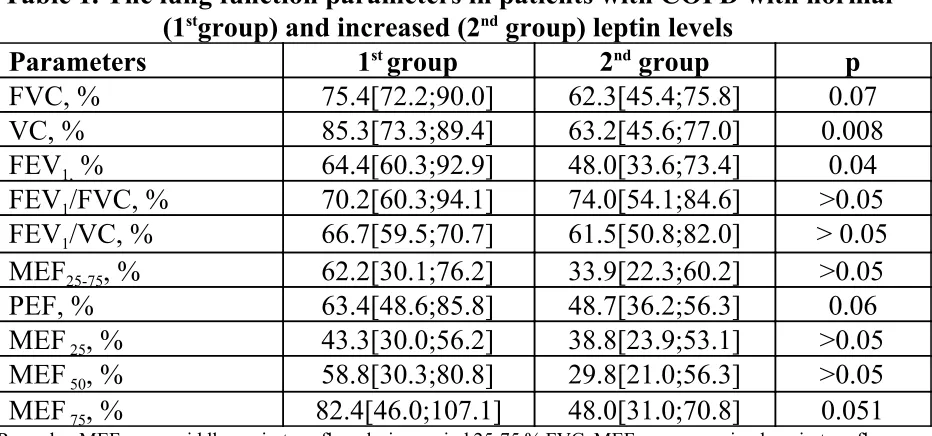
the lung function parameters. Analysis of relative criteria of respiratory function
show that increase of leptin level was associated with all criteria decreasing with
maximum intensity in the key screening tests – the volume of forced expiratory
volume per 1 second (FEV 1) and VC (table 1). This can prove more severe
obstructive and restrictive lung function impairment in the condition of
hyperleptinemia. Attention is also paid to the clear tendency to the decrease of
other results of respiratory flow: FVC,PEF and maximal expiratory flow on the
75% of FVC levels (MEF75) in 2nd group (the difference is statistically
[image:5.594.72.538.317.535.2]substantial).
Table 1. The lung function parameters in patients with COPD with normal (1stgroup) and increased (2nd group) leptin levels
Parameters 1st group 2nd group р
FVC, % 75.4[72.2;90.0] 62.3[45.4;75.8] 0.07
VC, % 85.3[73.3;89.4] 63.2[45.6;77.0] 0.008
FEV1, % 64.4[60.3;92.9] 48.0[33.6;73.4] 0.04
FEV1/FVC, % 70.2[60.3;94.1] 74.0[54.1;84.6] >0.05
FEV1/VC, % 66.7[59.5;70.7] 61.5[50.8;82.0] > 0.05
MEF25-75, % 62.2[30.1;76.2] 33.9[22.3;60.2] >0.05
PEF, % 63.4[48.6;85.8] 48.7[36.2;56.3] 0.06
MEF 25, % 43.3[30.0;56.2] 38.8[23.9;53.1] >0.05
MEF 50, % 58.8[30.3;80.8] 29.8[21.0;56.3] >0.05
MEF 75, % 82.4[46.0;107.1] 48.0[31.0;70.8] 0.051
Remarks: MEF25-75- middle expiratory flow during period 25-75 % FVC, MEF 25,50,75 – maximal expiratory flow on the 25, 50, 75 % FVC levels.
It has also been found that a severe stage of pulmonary obstruction (FEV 1
<49%) has been met significantly more frequently among patients with
hyperleptinemia (52.9±12.1% vs. 11.1±10.5%; p<0.05). It is important that the
most severe stages of both restrictive (VC<50%) and obstructive (FEV 1<30%)
changes have been diagnosed exclusively among patients with hyperleptinemia
(23.5%, p<0.05; and 11.8%, p>0.05).
lung function showed moderate bronchial obstruction, while in patients with
hyperleptinemia tests VC, MEF25-75and MEF75have been significantly reduced,
what together with other lung function tests can point to generalized mixed
obstructive nature of the lung function with the potent restriction. The
significant decrease in VC, which we have seen in the 2 ndgroup patients, can be
explained by the absolute reduction in the number of functioning lung tissue,
and by loss of elastic lung properties (emphysema). In some cases, mild
reduction of VC due to bronchial obstruction can be caused by reduction of
expiratory reserve volume. However, the detection of restrictive violations
provides the defining of total lung capacity that requires further investigation.
The fact that MEF75 was lower than normal just in patients with hyperleptinemia
may indicate presence of bronchial obstruction in small-size bronchi, what on
the other hand, can be potentiated by emphysematous changes in the lungs with
the reduction of lungs elasticity.
As far as we are concerned, the pathogenetic role of leptin in the course of
COPD is not limited by its inflammatory influence, but it is associated with
progressive functional abnormalities of lung ventilation also. The results of our
research point to the negative impact of hyperleptinemia on bronchobstructive
syndrome progression in patients with COPD. The expression of leptin by cells
of alveolar wall and participation of it in the development of emphysema can
explain the reduction of VC in patients with hyperleptinemia and COPD what
has been found by us.
Conclusions: among patients with COPD the level of serum leptin has
significantly exceeded the content among healthy people (р<0.01). The increase
leptin level among patients with COPD with overweight and obesity in
comparison with patients with normal body mass (both р<0.01) has been found.
was established but more significantly of FEV 1 and VC. As severe degree of
obstructive and restrictive changes has been found more often among patients
with hyperleptinemia and its level was strictly associated with the bronchial
obstruction level, the increase of leptin level can be a biomarker of difficult
abnormalities of respiratory function.
References
1. Bychkova SA. Cytokine synthesis function of peripheral blood immune cells
in patients with chronic obstructive pulmonary disease, combined with
metabolic syndrome [in Ukrainian]. Immunology and Allergology: Science and
Practice. 2014; 1: 47-51.
2. Cavaillès A, Brinchault-Rabin G, Dixmier A, Goupil F, Gut-Gobert C,
Marchand-Adam S, Meurice JC, Morel H, Person-Tacnet C, Leroyer C, Diot P.
Comorbidities of COPD. Eur Respir Rev. 2013; 22: 454-475.
3. Hanson C, Rutten EP, Wouters EFM, Rennard S. Influence of diet and obesity
on COPD development and outcomes. Int J Chron Obstruct Pulmon Dis. 2014; 5
(9): 723–733.
4. Khrisanapant W, Sengmeuang P, Kukongviriyapan U, Pasurivong O,
Pakdeechotel P. Plasma leptin levels and a restrictive lung in obese thai children
and adolescents. Southeast Asian J Trop Med Public Health. 2015; 46
(1):116-124.
5. Liang R, Zhang W, Song YM. Levels of leptin and IL-6 in lungs and blood
are associated with the severity of chronic obstructive pulmonary disease in
patients and rat models. Mol med rep. 2013; 7 (5):1470–1476.
6. Mancuso Р. Obesity and lung inflammation. J Appl Physiol. 2010; 108
7. Neveu WA, Allard JL, Raymond DM, Bourassa LM, Burns SM, Bunn JY,
Irvin CG, Kaminsky DA, Rincon M. Elevation of IL-6 in the allergic asthmatic
airway is independent of inflammation but associates with loss of central airway
function. Respir Res. 2010; 11 (28). Retrieved from:
https://respiratory-research.
biomedcentral.com/articles/10.1186/1465-9921-11-28
8. Oh YM, Jeong BH, Woo SY, Kim SY, Kim H, Lee JH, Lim SY, Rhee CK,
Yoo KH, Lee JH, Yoon HK, Sin DD, Lee SD, Kim EK, Park HY. Association
of plasma adipokines with chronic obstructive pulmonary disease severity and
progression.Ann Am Thorac Soc. 2015; 12 (7):1005-1012.
9. Pristupa LN, Fadeeva AA. Study of proinflammatory influence of leptin in
bronchial asthma associated with obesity [in Ukrainian]. Human and his health.
2012;1:112-117.
10. Radchenko OM, Slaba OR. Blood leptin and the external respiration
function in patients with bronchial asthma [in Ukrainian]. Lviv clinical bulletin.
2013; 1: 20-22.
11. Vernooy JH, Ubags ND, Brusselle GG, Tavernier J, Suratt BT, Joos GF,
Wouters EF, Bracke KR. Leptin as regulator of pulmonary immune responses:
Involvement in respiratory diseases. Pulm Pharmacol Ther. 2013; 26