Effect of Diameter and Surface Treatments on the
Retentivity of New Esthetic Posts
1Julie G Alapatt, 2Noxy G Manjuran, 3Jaini L Jaini, 4Thankappan P Sreelal, 5Harshakumar Karunakaran, 6R Ravichandran ORIgInal aRtICle
1Assistant Professor, 2,3Reader, 4,5Professor and Head 6
Professor
1
Department of Prosthodontics, Government Dental College Thrissur, Kerala, India
2Department of Prosthodontics, PMS College of Dental
Science & Research, Thiruvananthapuram, Kerala, India
3
Department of Prosthodontics, Amrita School of Dentistry Amrita University, Kochi, Kerala, India
4Department of Prosthodontics, Sree Mookambika Institute of
Dental Science, Kanyakumari, Tamil Nadu, India
5,6
Department of Prosthodontics, Government Dental College Thiruvananthapuram, Kerala, India
Corresponding Author: Noxy G Manjuran, Reader, Department of Prosthodontics, PMS College of Dental Science & Research Thiruvananthapuram, Kerala, India, e-mail: [email protected] ABSTRACT
Aims and objectives: To determine and compare the reten-tion of different esthetic post systems within the root canal, i.e., zirconium dioxide ceramic post (Zr post) (Cosmopost Ivoclar Vivadent) and glass fiber-reinforced composite post (FRC post) (Twin Luscent Anchor, Dentatus, USA), and the effect of increase in diameter and different surface treatments on the retentivity of these posts.
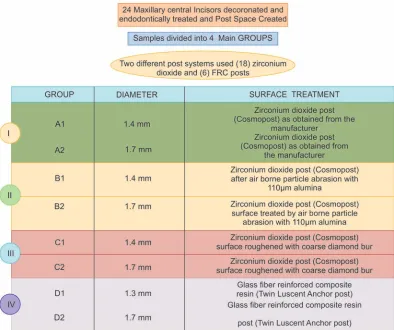
Materials and methods: A total number of 24 prefabricated endodontic posts, including 18 Zr post and six glass FRC post, were used for the study. Two diameters of Zr post, i.e., 1.4 and 1.7 mm, and two diameters of FRC post, 1.3 and 1.6 mm, were used. The Zr posts were divided into three main groups and subjected to three different surface treatments. The first group (group I) served as the control group and was given no surface treatment; instead, it was used as obtained from the manufacturer. The second group (group II) was given a surface treatment of airborne particle abrasion using 110 µm alumina particles. The third group (group III) was ground evenly with a coarse grit diamond bur mounted on a high-speed handpiece. The fourth group (group IV) constituted the FRC post and this group of posts was not given any surface treatment. Thus, the total sample size was fixed as 24 with 6 each to groups I, II, III, and IV. In each of these four groups, three posts each will be with 1.4 and 1.7 mm diameter, respectively. These samples were tested for retentivity, in an Instron universal testing machine.
Results: One-way analysis of variance (ANOVA), small sample Student’s t-test, and Pearson correlation coefficient were the statistical tools employed to analyze the observations. The glass FRC post group IV were reported to have the greatest retentivity, followed by group II. When airborne particle abrasion with 110 µm alumina on the Zr posts significantly improved its retention, and
were related in a linear fashion, the surface roughening with coarse diamond bur on Zr post failed to do so. Both groups I and III did not show any increase in retentivity with an increase in the diameter. Group IV showed an increase in retentivity when the diameter of the posts was increased.
Conclusion: Clinical implications of the study are that in highly demanding situations of esthetics and fracture, the zirconium dioxide ceramic post after airborne particle abrasion with 110 µm alumina is a promising restoration, provided the individual is not a bruxer or engaged in sports where there is a risk of tooth fracture. Even though zirconia post showed better fracture resistance than glass fiber-reinforced posts, the cost factor, retention, and its free availability make the glass FRC posts a promising endodontic restoration for badly damaged teeth.
Keywords: Retentivity, Surface treatment, Zirconia post.
How to cite this article: Alapatt JG, Manjuran NG, Jaini JL, Sreelal TP, Karunakaran H, Ravichandran R. Effect of Diameter and Surface Treatments on the Retentivity of New Esthetic Posts. Int J Prev Clin Dent Res 2018;5(1):68-75.
Source of support: Nil
Conflict of interest: None
INTRODUCTION
In areas of high esthetic demand, all ceramic restorations are considered to be the best choice compared with metal ceramic restorations.1 Endodontically treated teeth often
have a significant compromise of coronal and radicular tooth structure.2 Also, loss of water content in dentin
subsequent to endodontic therapy can reduce tooth resilience and hence, increase the probability of fracture.3
Postendodontic restoration of pulpless teeth is critically important to ensure successful treatment outcomes. Endodontic posts are recommended to strengthen such weakened teeth by distributing the torquing forces along the roots.4 However, some contradictory reports show
that the post placement can create stress which in turn makes these teeth more prone to root fracture.5
Cast metal posts were the popular treatment, with a long history of successful use, but in the last decade, other post systems including prefabricated posts have gained popularity.3 The esthetic value of cast metal posts
is limited since the gray color of metallic post is apparent when used to support the translucent all-ceramic restora-tions.6 Their high elastic modulus cause stress
The advancements in the fiber-reinforced materials, addressing structure, shape, and optical properties of the posts, proved successful to a certain extent in overcoming the limitations of metallic posts, concerning esthetic appear-ance, mode of failure, and clinical performance. Translucent glass fiber posts are being preferred to carbon fiber posts due to superior esthetics for anterior roots. Fiber-reinforced resin composite posts help prevent root fracture since these have modulus of elasticity values close to that of dentin,10 even
if a root fracture occurs that will be located more coronally and more easily retrievable, as compared with metal posts.11
Christel et al in the later 1980s developed zirconia posts that possessed good optical and biologic proper-ties. Evidence-based dentistry also shows that these post systems have favorable mechanical properties, biocompatibility, and low solubility.12 Furthermore,
grinding and airborne particle abrasion can introduce residual surface compressive stresses that increase the mean flexural strength of zirconia-toughened ceram-ics considerably. Airborne particle abrasion prior to cementation tends to increase the retentive properties of zirconium dioxide posts. Silanization and silica coating increase the bond strength for high-alumina and glass-infiltrated zirconium oxide ceramics signifi-cantly, but not a significant improvement for yttrium oxide partiallystabilized zirconium oxide ceramic.13
Airborne particle abrasion of the ceramic and use of a resin composite with an adhesive phosphate monomer ensure a durable resin bond to yttrium partially stabi-lized zirconium oxide ceramic.14
There is no universal post and core system accepted for any tooth or for all clinical situations. Hence, it is the clinician’s role to make an appropriate decision, after weighing the merits and demerits of the factors influ-encing post selection. The purpose of this study was to evaluate the efficacy and reliability of two different post systems. The present study is a sincere attempt to check the effect of diameters and different surface treatments on the retentivity of esthetic endodontic posts.
METHODOLOGy
Freshly extracted intact maxillary central incisors with similar root morphology (comparable length and diameter) were collected. All the teeth had a single canal and
instrumented to a length of 13 mm (i.e., 1 mm above the apical foramen) with K files up to a #60 master apical file. During the instrumentation, canals were irrigated with 1% sodium hypochlorite. Final irrigation was done with 10 mL of distilled water, and the canals were aspirated and dried with absorbent paper points. Root canals were obturated with gutta-percha points and end-odontic cement, using a lateral condensation technique and accessory gutta-percha points. The pulp chambers were sealed with provisional cement. Specimens were immersed in distilled water and maintained at 37°C for 72 hours. Thereafter, the provisional cement that sealed the canals was removed using a round bur mounted on an airotor handpiece.
Root canal post space preparation was initiated with heated condensers to remove 8 mm of the filling mate-rial, measured using a plastic stop. After this, canal space enlargement and lengthening up to a length of 10 mm were done using appropriate-sized reamers and drills supplied by the manufacturer. Posts of two different systems and two diameters were used in the study. This included zirconium dioxide ceramic post (Cosmopost Ivoclar Vivadent) of two diameters, i.e., 1.4 and 1.7 mm, and glass FRC post (Twin Luscent Anchor, Dentatus, USA) of two diameters, i.e., 1.3 and 1.6 mm. Though the two systems of posts were not of exactly the same diam-eter, they were of comparable diameters.
A total number of 24 prefabricated endodontic posts, including 18 Zr post and 6 FRC post, were used for the study The Zr post was divided into three main groups and subjected to three different surface treatments, to evaluate the efficacy of surface treatment. The first group (group I) served as the control group and was given no surface treatment, but instead, used as obtained from the manufacturer. The second group (group II) was given a surface treatment of airborne particle abrasion using 110 µm alumina particles. The posts in the third group (group III) were ground evenly with a coarse grit diamond bur mounted or a high-speed handpiece.
After giving different surface treatments, the posts are now ready to be prepared for cementation into the post space created. Prior to definitive cementation, the posts were trial seated into the post space prepared to ensure complete seating to a depth of 10.0 mm. The smear layer was removed using 5.25% sodium hypochlorite solu-tion and 15% ethylenediaminetetraacetic acid solusolu-tion by keeping the specimens in an ultrasonic bath of the respective solutions. Once the smear layer was removed, the canal was etched with 37% phosphoric acid gel (Total etch Ivoclar Vivadent) for 15 seconds and then rinsed thoroughly with distilled water and dried using gentle jet of air and absorbent paper points. Then, Excite DSC (Ivoclar Vivadent) bonding agent was applied using self-activating microbrush and light cured. The posts were etched with ceramic etching agent 5% hydrofluoric acid (IPS ceramic etch) for 2 minutes. Then, it was rinsed and air dried. Monobond-S silane coupling agent was applied onto the Zr post for 15 seconds and allowed to air dry. Variolink II base and catalyst paste were mixed at a ratio 1:1 and applied in the canal using a lentulo spiral. The resin composite cement was also coated on the post and the post was inserted into the canal with a pumping action and light cured for 40 seconds.
After the cement had set, the roots were embedded in acrylic resin boxes so that the vertical load to be applied
on the posts would be as parallel as possible to the direc-tion of the long axis of the teeth.
Testing the Specimens
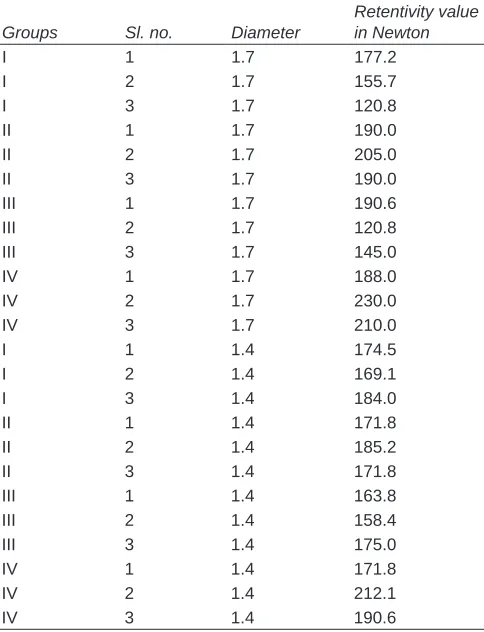
The specimens were loaded in a universal testing machine (Model 4206, Instron Corp.). The loading tip was aimed at an angle of 90° at a constant crosshead speed of 1 mm/minute, and the fracture load was determined by a sudden drop in load magnitude. The tensile load neces-sary to cause failure of the post was recorded. Table 1 gives the values of retentivity.
RESULTS
The results of the test were statistically analyzed. Table 3 shows that one-way ANOVA was used to find out varia-tion among the different groups under study. Small sample Student’s t-test (Table 4) and Pearson correlation coefficient (Table 5) were the other statistical tools to analyze and interpret the data.
Group IV FRC posts had a highly significant retentive value (Table 4) when compared with the Zr posts, of all groups except group II, where the p-value obtained was insignificant. This points out that the retentive strength of the air-abraded Zr post was markedly increased, almost to a level of FRC post.
It was an interesting factor to note that both groups I and III did not show any increase in retentivity with an increase in the diameter, but in groups II and IV, the diam-eter and retention were related in a linear fashion (Tables 2 and 4). Graph 1 clearly shows that group IV was shown to have the greatest retentivity, followed by group II.
DISCUSSION
It has always been a challenge for the dentist to give a successful functional restoration in a devitalized tooth,3
which is accomplished with intraradicular devices.15
These devices may vary from a conventional custom-cast post and core to one-visit techniques, using commercially available prefabricated post systems. The selection of post design is important, because it may have an influence on the longevity of the tooth.16 Fracture resistance of an
otherwise intact tooth is reduced by 5% due to endodontic treatment, and in situations where mesio-occluo-distal restorations are present, the resistance to fracture is reduced by 69%.1
Selecting the right type of post and core systems to meet the biological, mechanical, and esthetic needs depends on several factors like root morphology, length, canal space width, post design, and material esthetics. Post width is an important factor that influences the selection of post and core systems.15 Lloyd and Palik17
summarize and categorize into three, i.e., conservationist, preservationist, and proportionist. Stern and Hirshfield suggested that post width should not be greater than one-third of the root width at its narrowest dimension (proportionist approach). Other investigators propose that post should be surrounded by a minimum of 1 mm of sound dentin (preservationist approach). Others includ-ing Pilo and Tamse advocated minimal canal preparation and maintaining as much residual dentin as possible (conservationist approach).
In case of funnel-shaped canals, custom-made, well-adapted cast post and core will be more retentive than a prefabricated post. But Morgano and Milot concluded that well-adapted post results in more catastrophic failure.
Table 5: The relationship between retentivity and diameter
r p-value
Pearson correlation coefficient 0.567* 0.049
*p < 0.05. The p-value was significant at the 5% level, showing
that there existed a positive correlation between diameter and retention. The p-value was 0.049
coarse diamond bur (group III); air-abraded Zr posts (group II) and
group IV (FRC posts); *p<0.10; **p<0.05; ***p<0.001
III 2 1.7 120.8
III 3 1.7 145.0
IV 1 1.7 188.0
IV 2 1.7 230.0
IV 3 1.7 210.0
I 1 1.4 174.5
I 2 1.4 169.1
I 3 1.4 184.0
II 1 1.4 171.8
II 2 1.4 185.2
II 3 1.4 171.8
III 1 1.4 163.8
III 2 1.4 158.4
III 3 1.4 175.0
IV 1 1.4 171.8
IV 2 1.4 212.1
IV 3 1.4 190.6
Table 2: Comparison of the retention of zirconia post (Cosmopost)
after different treatments and glass fiber post (TLA)
Group Mean Standard deviation Sample n
Group I (Zr post control group) 163.6 23.0 6 Group II (Zr post air-abraded) 185.6 12.6 6 Group III (Zr post diamond bur grit) 158.9 24.2 6
Group IV (FRC post) 200.4 20.8 6
p < 0.01; The mean values showed a difference between each group considered; TLA: Twin luscent anchor
Table 3: One-way ANOVA comparison of the retentivity among the different groups under study, viz., surface-treated Zr posts
and FRC posts
Sum of
squares df Mean square f-value p-value
Between groups 6,780.7 3 2,260.2 5.289 0.008 Within groups 8,546.7 20 427.3
Total 15327.3 23
F-value was significant at a level of 8%, with a p-value of 0.008,
They concluded that 44% of the cast posts were less than one-half to one-quarter of the clinical crown length, and the failure was attributed to compromised length rather than post type. Shear stress is considered to be most detrimental. An increase in the post length will help to reduce shear stresses, if the diameter is kept to a minimum. Torsional forces on the post–core–crown unit may lead to loosening and displacement of the post from the canal, causing failure of the system. Active post designs provide greater torsional resistance than a passive post.
Cementation also has a key role in retention, stress dis-tribution, and sealing irregularities between the tooth and the post. Complete seating of the post may be prevented due to increase in stress within the root canal, while cementation may lead to fracture of the root. A cement vent, to permit escape of the luting agent, can reduce the hydrostatic pressure. Tapered posts are self-venting. Also, the more viscous the cement, the greater the hydrostatic pressure developed.
The materials used for posts ideally should have physi-cal, mechaniphysi-cal, and biological properties compatible to that of dentin and bond well to the tooth structure. It
should be resilient so as to act as a shock absorber, by trans-mitting only limited stress to the residual tooth structure. Conventional method of restoring endodontically treated teeth10 with cast metal post-and-core
founda-tions, due to their superior physical properties, though successfully serves for years, also carries a high risk of root fractures.7 The more rigid the post, the more it
resists force and transmits the stress to the less rigid tooth substance, thus causing failure of tooth structure.18
Cor-rosion by-products, as well as galvanic reaction due to dissimilar alloys used for the post and core, may result in root fracture. Opaque metal posts and cores underneath semi-translucent all-ceramic crowns influence the esthetic outcome of the restoration.18
Recently, the use of tooth-colored esthetic posts has increased. The various metal-free tooth-colored posts used include zirconium dioxide ceramic posts, ceramic-reinforced composite posts, glass fiber posts (translucent quartz fiber), woven fibers posts (polyethylene fibers), and carbon fiber posts in an epoxy fiber matrix.9 These
nonme-tallic posts have their own advantages and disadvantages in the restoration of badly destructed anterior tooth.
Graphs 1A to D: (A) Retention of Zr post and fiber-reinforced composite post. (B) Comparison of retentivity among different groups under study. (C) Comparison of retentivity among different groups of larger diameter. (D) Comparison of retentivity among different groups of smaller diameter
A
C
B
may decrease the mean flexural strength.
Zirconium oxide posts demonstrate high fracture resistance due to high flexure strengths, which is com-parable to that of cast gold posts and core or titanium posts. Zirconia-based ceramic posts are advocated for use with heat-pressed glass ceramic or composite resin core materials. However, some authors have suggested that the composite core and zirconia-based ceramic post combination should be avoided due to possibility of poor bond strength.
According to Ernst et al,19 a durable resin bond to Y 2O3
partially stabilized zirconium TZP can be achieved only after airborne particle abrasion of the ceramic and the use of a resin containing an adhesive phosphate monomer. Findings by other investigators regarding the effect of airborne particle abrasion and surface grinding on the flexural strength of zirconium oxide ceramics indicated that airborne particle abrasion may have a strengthening effect.
Glass fiber-supported resin dowel systems were introduced in 1992. The dowels are composed of uni-directional glass fibers embedded in a resin matrix that strengthen dowels without compromising the modulus of elasticity. Composite resin reportedly absorbs and distributes forces in a more uniform manner as compared with the metallic structures and increases resistance to fracture, providing an improved prognosis. While metal-lic posts tend to produce an irreversible root fracture on failure, even if a root fracture occurs with a fiber post, it is located more coronally and is more easily retreatable than metallic or ceramic posts. These tooth-colored fiber-reinforced resin-based composite posts do not impart a gray color to the remaining teeth; instead, they are light transmitting and highly esthetic. They are easy to place and relatively inexpensive. The most common mode of failure with bonded fiber posts is by debonding due to an adhesive failure at the interface between the dentin and resin cement. The main concern related to the fiber posts is that they undergo degradation due to cyclic mechanical loading and moisture contamination, which reduce the modulus of elasticity with an increased risk of debonding.
The present study is an attempt to compare the reten-tivity of two different system of posts, zirconium dioxide and FRC posts, and to evaluate whether surface treatments
depth of 10 mm so that the variability of post length does not influence the retention of the specimens. Zr post is of cylindrical tapered design, while FRC posts are hour glass shaped. Dentatus claims that the slim mid section of twin lucent anchor FRC post creates a “physical choke” and protects against accidental debonding. This was evident by its high retentive value in the study. The mean values of retentivity for group IV 1.6 mm was 209.3 N and for group IV 1.3 mm, it was 191.6 N. For pair-wise comparison of retentivity, both the diameters were clubbed and group IV still had a significant value, with a mean value of 200.4 ± 20.8 N. However, the mean value for groups I, II, and III was 163.6 ± 23.0 N, 185.6 ± 12.6 N, and 158.9 ± 24.2 N, respectively. Pair-wise comparison of retentivity among the groups was calculated using small sample Student’s t-test and the results showed that group II was superior to group I. The p-value was significant at the 10th percentage (i.e., p < 0.10; p = 0.070). When group I (control group) was compared with group IV, the value was definitely significant (p-value = 0.016, i.e., <0.05). Comparing group III with group I was not statistically significant (p-value = 0.650), which shows that surface roughening of Zr post with a coarse diamond bur does not contribute to its retentivity. There was a significant advantage of the FRC post (group IV) over the control group (group I) p = 0.016, i.e., p < 0.05. Also, it is noteworthy that the airborne particle (110 µm alumina) abraded Zr post (group II) did not give any significant value when compared with the FRC post (group IV) p = 0.217, which implies that airborne particle abrasion of Zr post definitely improves its reten-tive properties to a significant level, whereas roughening with coarse diamond bur does not help much to improve the post retention. Of all the values, the FRC posts showed the best retention which was statistically significant.
The observations of the present study are supported by Schmage et al20 who investigated metal- and ceramic
rial. Consequently, the surface is chemically more reactive to resin after the application of silane coupling agents.
In order to find out the relation between diameter and retention, the correlation coefficient for the same was calculated and this revealed that the greater the diameter, the greater the retention; p-value was significant (p < 0.05; p = 0.04). But the retentivity for individual groups did not show any correlation between diameter and retention, i.e., for groups I and III, the smaller diameter showed increased retention; but in group II, the bigger diameter showed increased retention. But this may be attributed to the surface treatment rather than diameter. In group IV, a definite relation between diameter and retention was noted and the retention proportionally increased with the diameter. Fernandes et al21 suggested that increase in post
width has no significant effect on its retention. Increasing the post diameter in an attempt to increase retention is not recommended because it may unnecessarily weaken the remaining root.
Krupp et al, Standlee et al, and Ruemping et al reported that increasing the post diameter increased retention, other groups do not confirm this. Empirically, overall prognosis is good when the post diameter does not exceed one-third the diameter of the root.21 The present
study results are supported by the studies conducted by Oblak et al1 and Schmage et al.20 However, airborne
particle abrasion or grinding may result in the develop-ment of flaws inside the microstructure of the ceramic.
The effects of thermal cycling and long-term storage on the bond strength were not evaluated and considered as the limitation of this study. In future studies, the effects of these parameters on the bond strength of zirconium oxide ceramic as well as glass FRC should be examined. Controlled clinical trials should be done before clinical recommendations.
SUMMARy AND CONCLUSION
Advances in the field of esthetic restorative materials have made a great leap that resulted in the development of new ceramic crown systems with improved translucency and fluorescence, and superior mechanical properties. However, this will become worthless when these crowns are used in endodontically treated, badly damaged teeth in conjunction with traditional cast metal post and core systems. Tooth-colored post-and-core system ensures a successful esthetic outcome, reflecting and transmitting light in a manner similar to natural tooth.
Among the posts used for the study, viz., zirconia posts and fiber-reinforced posts, the glass FRC posts were reported to have the greatest retentivity, followed
level achieved with that of glass FRC post. The surface roughening with coarse diamond bur on zirconium dioxide post did not significantly improve the retentivity.
It was an interesting factor to note that only when the zirconia posts were abraded with 110 µm alumina, the diameter was a factor in determining the retentivity and related in a linear fashion. The glass fiber post showed an increase in retentivity when the diameter of the post was increased.
In situations where esthetics and fracture are of great concern, the surface-treated zirconium dioxide ceramic post after airborne particle abrasion with 110 µm alumina is a promising restoration, provided the individual is not a bruxer or engaged in sports or activities where there is a risk of tooth fracture. The glass FRC post is also another reliable option, which is relatively inexpensive too, but not as strong as zirconium dioxide ceramic post.
REFERENCES
1. Oblak C, Jevnikar P, Kosmac T, Funduk N, Marion L. Fracture resistance and reliability of new zirconia posts. J Prosthet Dent 2004 Apr;91(4):342-348.
2. Heydecke G, Butz F, Strub JR. Fracture strength and survival rate of endodontically treated maxillary incisors with approxi-mal cavities after restoration with different post and core systems : an in-vitro study. J Dent 2001 Aug;29(6):427-433. 3. Goncalves LA, Vansan LP, Paulino SM, Sousa Neto MD.
Fracture resistance of weakened roots restored with a transil-luminating post and adhesive restorative materials. J Prosthet Dent 2006 Nov;96(5):339-344.
4. Fraga RC, Chaves BT, Mello GS, Siqueira JF. Fracture resistance of endodontically treated roots after restoration. J Oral Rehabil 1998 Nov;25(11):809-813.
5. Newman MP, Yaman P, Dennison J. Fracture resistance of endodontically treated teeth restored with composite posts. J Prosthet Dent 2003 Apr;89(4):360-367.
6. Nothdurft FP, Pospiech PR. Clinical evaluation of pulpless teeth restored with conventionally cemented zirconia posts: a pilot study. J Prosthet Dent 2006 Apr;95(4):311-314. 7. Dilmener FT, Sipahi C, Dalkiz M. Resistance of three new
esthetic post-and-core systems to compressive loading. J Prosthet Dent 2006 Feb;95(2):130-136.
8. Bitter K, Priehn K, Martus P, Kielbassa AM. In vitro evalua-tion of push-out bond strengths of various luting agents to tooth-colored posts. J Prosthet Dent 2006 Apr;95(4):302-310. 9. Shetty T, Bhat GS, Shetty P. Aesthetic postmaterials. J Indian
Prosthet Soc 2005;5(3):122-125.
10. Santos GC, El-Mowafy O, Rubo JH. Diametral tensile strength of a resin composite core with nonmetallic prefabricated posts: an in vitro study. J Prosthet Dent 2004 Apr;91(4):335-341. 11. Monticelli F, Grandini S, Goracci C, Ferrari M. Clinical
behav-ior of translucent-fiber posts: a 2-year prospective study. Int J Prosthodont 2003 Nov-Dec;16(6):593-596.
Dec;90(6):556-562.
16. Sorensen JA, Engelman MJ. Effect of post adaptation on fracture resistance of endodontically treated teeth. J Prosthet Dent 1990 Oct;64(4):419-424.
composite posts. J Prosthet Dent 2009 Dec;102(6):368-377. 21. Fernandes AS, Shetty S, Coutinho I. Factors determining