Vol
u
me 2, Issue 2
, 2013
GENDER ISSUES IN THE INTERACTIONS OF ITALIAN
POLITICIANS ON TWITTER: IDENTITY, REPRESENTATION
AND FLOWS OF CONVERSATION
Stefania Spina1, Jessica Cancila (PhD)2
Abstract: Twitter is emerging as a medium where users negotiate and maintain relationships and identities. How do political actors use Twitter? In a gender perspective, this study aims to shed light on their interactions on Twitter, which can be considered a window on how women and men represent and construct their gender and political identities within conversational flows.
Keywords: social networks; computer-mediated communication; Twitter; dialogue; gender; identity; social interactions; conversation; political discourse.
1. Introduction
Twitter, the social network that enables users to post messages of up to one hundred and forty characters, recently reached almost five million active users in Italy, with an increase of fifty percent in the last year. The first tweet by an Italian politician dates back to mid-2007; after six years, most Italian Members of Parliament have a Twitter account and use it to communicate with their followers. Bentivegna(2006)3 points out that, during the 2006 election campaign, the use of Internet by Italian politicians was overall unable to exploit its full potential, in terms of networking, self-promotion and conversationality.
In this study, we investigate how politicians use Twitter today, with a specific emphasis on two different themes, deeply related to Internet and more specifically social network communication: conversationality and identity construction.
2. Background and research questions
One of the emerging discursive features of Twitter is its conversationality: unlike older media, like television, Twitter is based on interactions among users. Interactions on Twitter can be described as short, public conversations that share a
1Researcher in Linguistics at the University for Foreigners, Perugia (Italy);
2 Università per Stranieri di Perugia, Dipartimento di Scienze Umane e Sociali, Italy;
Vol
u
me 2, Issue
2
, 2013
double audience (Herring, Honeycutt 2009)4: a general audience of followers, and a specific one, selected through the use of mentions (a username preceeded by "@"). In example (1), a politician (@Idvstaff) addresses his tweet to a specific user (@santovasta), who asked him a question, and at the same time to the general audience of his followers.
(1)
@Idvstaff il governo con la scusa di far quadrare i conti vuole licenziare migliaia di dipendenti pubblici ma i partiti dove siete?
(@Idvstaff the government with the excuse of making ends meet wants to lay off thousands of public employees but where are you, the parties?)
@santovasta noi siamo a fare opposizione da più di un anno a questo governo, ma hanno una maggioranza bulgara...
(@santovasta we have been opposing this government for more than a year, but they have a Bulgarian majority...)
Previous research on the use of Twitter by Italian politicians suggested that women and men have different attitudes in their approach to dialogue and in their use of conversational features (Spina 2012)5.
On the side of identity construction, social networks can be used to affirm users' multiple identities. Identity can be defined as the display of or ascription to membership of some feature-rich category (Antaki, Widdicombe 2008)6. As such, identity work is in the hands of participants and it is an endemic feature of discourse.
Twitter users can define themselves through interaction, as it occurs in every type of interaction, but they can also explicitly design self-presentations in the “profile” slot. The profile can be analyzed - this is our intepretation - as an invariable part of discourse, such as greetings or question-answer pairs. Its use (or its absence) can be interpreteted as a “signal” that plays against the expectations of the readers. People use descriptive categories and apply membership criteria to perform various kinds of discursive actions, and if categories (such as age, profession etc.) are not merely factual, the analytic work is to find if and for what they may have relevance.
4 Herring, Susan and Courtenay Honeycutt. “Beyond Microblogging: Conversation and
Collaboration via Twitter”. Proceedings of the Forty-Second Hawai’i International Conference on System Sciences (HICSS-42). Los Alamitos, CA: IEEE Press, 2009: 1-10. Print.
5 Spina, Stefania. Openpolitica. Il discorso dei politici italiani nell’era di Twitter. Milano:
FrancoAngeli, 2012. Print.
6 Antaki, Charles and Susan Widdicombe. “Identity as an achievement and as a tool”. In
Vol
u
me 2, Issue 2
, 2013
In the study of the different ways in which men and women construct their identities of male and female within Twitter interactions, different perspectives need to be considered, connected with political and computer-mediated discourse. From the political discourse perspective, according to Chilton (2004)7, political discourse serves the double function of: representing oneself as a politician, and therefore as someone who has credibility, in order to be accepted in the political arena; and interacting, with all the participants in the political process. In this perspective, Twitter is the place where political actors can spread a positive representation of their multiple identities (Wodak 2003)8, while interacting with their multiple audience. From the computer-mediated discourse perspective (Herring 2001)9, it is well known that, after the age of broadcasting, in which communication is vertical, unidirectional and one-to-many, social media brought a radical change and established a new paradigm of interaction, in which people share horizontally dynamic flows of conversations that create new forms of interpersonal relationships.
Despite the restriction to one hundred and forty characters per tweet, users on Twitter perform different communicative actions on multiple dimensions, and dynamically reshape context (Auer 1996)10 through the use of five main “contextualization cues” (Gumperz 1982)11:
• @ = addressing
• http = redirecting to other texts
• RT = redistributing (with an implicit evaluation)
• # = indexing and aggregating people around key themes or values
• profile = self-defining
Twitter then can be considered a multi-referential discourse system (Dang-Anh 2013)12: through the systematic use of these functions users perform complex communicative activities, based on multiple referentiality, intertextuality, interdiscursivity.
7 Chilton, Paul A. Analysing political discourse: theory and practice. London: Routledge,
2004. Print.
8 Wodak, Ruth. “Multiple Identities: The Roles of Female Parliamentarians in the EU
Parliament”. In J. Holmes, M. Meyerhoff. (Eds.). The Handbook of Language and Gender. Malden: Blackwell, 2003: 671-698. Print.
9 Herring, Susan. “Computer-Mediated Discourse”. In D. Schiffrin, D. Tannen, & H. E.
Hamilton (Eds.). The Handbook of Discourse Analysis. Malden, MA: Blackwell, 2001: 612-634. Print.
10 Auer, Peter “From Context to Contextualization”. Links and Letters, 3 (1996): 11-21.
Print.
11 Gumperz, John. Discourse strategies. Cambridge: Cambridge University Press, 1982.
Print.
12 Dang-Anh, Mark. “Conceptualising Twitter as a discourse system: Discursive practices
Vol
u
me 2, Issue
2
, 2013
In this broader context, the focus of our investigation will be the role of gender. As gender is continually realized in interactional form (Wodak 1997:13)13, does it affect
1. the way politicians perform multi-referentiality and participate in the flow of conversations?
2. self-presentations in profiles?
3. Methodology and data
In order to answer these questions, we have collected a balanced corpus of the tweets produced by one hundred and eighty Italian politicians (ninety male and ninety female) in a time-frame of six months (from January to June 2013). The selected politicians are all members of the current Parliament and are equally distributed into five age groups (25-29, 30-39, 40-49, 50-59 and over 60).
The result is a corpus of 86.841 tweets (36.780 written by men, 50.061 written by women), for 1.460.000 total words.
In this study we will present and discuss some preliminary data extracted from this corpus, which are relative to:
1. the distribution of mentions;
2. the distribution of replies (responses to other tweets); 3. the distribution of selected conversational features.
As for the identity construction in profiles, the analysis is focused on the resources politicians use in producing self descriptions, and more specifically on the use of categories/features of categories made relevant by people in self-presentations. The analysis takes into account:
• if partecipants use self-description;
• which categories and features they use in profiles.
Four analytic groups have been created, according to the following partitioning: 1. Personal or Biographical Data, such as Place of birth, residence; age;
religion; interests.
2. Professional Data such as Job; civil charges or political roles; other relevant remarks.
3. Political Role, to describe the current political position.
4. Involvement Features, which include Aphorisms (quotes or visions) or Contact Data (Personal websites, Blogs, mentions, hashtags).
Personal data are contrasted with Professional and Political data. An Involvement group summarizes information aimed at engaging the audience, such as quotes, personal annotations or contact information. Each group is split into subgroups, to control gender effects in more depth.
The assumptions in this analysis are that each choice of categories is aimed at offering an image of self and that each Category implies some values: the use of
13 Wodak, Ruth. "Some important issues in the research on gender and discourse". In
Vol
u
me 2, Issue 2
, 2013
avvocato (lawyer) may imply a series of values in terms of skills, attitudes,
believes etc..
What follows are the preliminary results and the discussion of these results.
3. Results
As far as conversationality is concerned, 70.1% of tweets written by women contain a mention, against only 57.7% of tweets written by men, as shown in fig. 1.
In addition, 22.4% of women's tweets (against 14.8%) are a reply to a tweet written by someone else.
Fig. 1 - The use of mentions and replies by women and men politicians
Following previous literature on gender patterns in computer-mediated discourse (Baron 2008)14, we have also measured and analyzed a number of selected linguistic and discursive features traditionally associated with dialogic interactions, in order to find evidence of gendered attitudes in the way politicians manage social relations with their followers and participate in the flow of conversations on Twitter. A few examples of these linguistic features are emoticons, second person pronouns and a list of discourse markers. In general, the data replicates previous findings on online and offline gender patterns: women use significantly more conversational features (emoticons for example are almost twice as frequent as in men's tweets, as shown in fig. 2), and they use them especially when they reply to other tweets.
14 Baron, Naomi. S. Always on: Language in an Online and Mobile World. Oxford: Oxford
Vol
u
me 2, Issue
2
, 2013
Fig. 2 - The distribution of a few selected linguistic features in women’s and men’s tweets
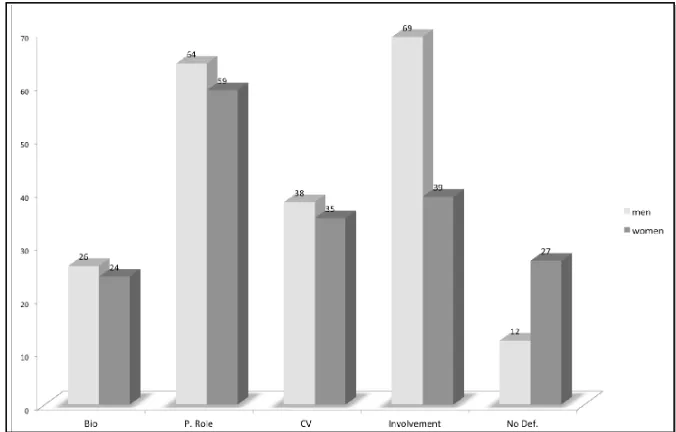
Moving to identity construction in profiles, a first analysis looks at the four main groups (personal, political, professional, involvement data): as shown in fig. 3, the involvement and political data are the most used by both men and women, and, interestingly, women score less than men in all types of self-presentation. In addition, a considerable number of women (27%) do not use any profile description.
Vol
u
me 2, Issue 2
, 2013
5. Discussion: conversationality
The first aim of this study is to provide evidence of the different strategies used by women and men within the stream of conversations on Twitter. As for the term “conversation”, we follow Herring's broad definition, which includes all the written forms of conversation that are typical of computer-mediated discourse: a conversation is “any exchange of messages between two or more participants, where the messages that follow bear at least minimal relevance to those that preceded or are otherwise intended as responses”.15 According to this definition, the typical form of conversation that takes place on Twitter is a short exchange, usually symmetrical, made up of a first message and a reply. More rarely, conversations have a longer extension and multiple participants.
In all these conversational exchanges, a key role is played by the mention, which is an increasingly interpersonal resource and performs the multiple roles of:
• marking addressivity or reference to other users;
• relating one tweet to another;
• assuring coherence to exchanges (which is an important function, because turns in conversations are often interrupted by other tweets).
The results of this analysis of mentions revealed that women use this deictic strategy much more than men, to involve someone else in a conversation and to reply to someone else’s tweet; as suggested by Herring and Honeycutt (2009:6)16, tweets that contain a mention are more focused on an addressee, and their content is more interactive. In contrast, tweets without mentions are more self-focused. The data also shows that men proved to be more self-focused, less interactive, less inclined to reply to the requests of involvement from other participants, and less prone to conversation than women.
The analisys of the selected conversational features also revealed that Twitter interactions share some of the same conversational strategies as in face-to-face conversations.
Women use more than men these strategies, particularly in replies: what emerges from the data is that when they reply to someone else, their focus is much more on establishing interpersonal relationships rather than on simply providing information, as it happens in example (2), which is a tweet written by a man politician (@kito_84):
(2)
ora su #radiowave [link] (Now on #radiowave [link])
15Herring, Susan. “Computer-mediated conversation: Introduction and overview”.
Language@Internet 2010:4.
16 Herring, Susan and Courtenay Honeycutt. “Beyond Microblogging: Conversation and
Vol
u
me 2, Issue
2
, 2013
An example of these different strategies is the use of emoticons, which is aimed at the representation of paralinguistic features (Baron 2008)17, but also at the establishment of interpersonal connection with other users.
The smiley, for example, has precisely this function of creating familiarity and complicity with the addressees, and it also has a strong association with mention, with whom it co-occurs very often; in example (3), @RosCapacchione, a woman politician, interacts with someone who was asking for news on a wind farm in Sardinia:
(3)
@RosCapacchione Che bello sarebbe conoscere tutta la verità sul parco eolico del Sulcis, pezzo di paradiso in pasto alla malapolitica!
(@RosCapacchione How nice it would be to know the whole truth about the Sulcis wind farm, a corner of paradise in the hands of bad politics!)
@frademuru con un po’ di pazienza, se ci fanno lavorare, ci riusciremo :) (@frademuru With a little patience, if they let us work, we will succeed :) )
Example (4) shows that the smiley and the mention themselves can make up the entire content of a tweet, a very short and fixed pattern to reply to a question expressing a mixed feeling of agreement and search for conviviality.
(4)
Che sia giunto il tempo anche in Italia di un ministro della difesa donna? @robertapinotti #flashforward
(Could it be the time in Italy for a woman as Defense Minister? @robertapinotti #flashforward)
@defilippochiara :-)
The widespread use of emoticons, with the function of creating familiarity with others, is one piece of evidence of a search for interaction and dialogue in Twitter exchanges; a striking difference between men and women is not only in the overall frequency of emoticons, but also in their diversification (see table 1), in an attempt to express different nuances and feelings when connecting with others.
Table 1
Emoticons used by women and men
women :-) :) ;) ;-) :( :P :-D
:-( <3 XD :-P :-* :D :(((
:-p O_O -.- =D :S :- .-
:-))) ;-P :-/ o_o =( :/ O.o
men :) ;-) :-) ;) :D :-D :(
:* o) :- :-P :-( :P :O
17 Baron, Naomi. S. Always on: Language in an Online and Mobile World. Oxford: Oxford
Vol
u
me 2, Issue 2
, 2013
To summarize what we have discussed so far with regard to the attitude to conversationality, the analysis of the data suggests that women politicians:
1. systematically use the mention as a deictic marker of addressivity, and they do it significantly more than men;
2. reinforce the co-occurrent use of other conversational devices (discourse markers and emoticons), which strongly qualify their tweets as real conversational exchanges;
3. base their exchanges on Twitter more on the construction of interpersonal relationships than on the simple delivery of information.
6. Discussion: Identity
As mentioned before, women score less than men in all types of self-presentation in profiles.
The involvement group, in particular, seems to be more often used by men: 69% of men against 39% of women present themselves by offering, among other things, information that aims at involving readers.
Looking more in depth into the communication patterns of this group we found that this high percentage is mainly due to a definition used exclusively by the members of M5S in their profile, that is citizen. M5S members, in fact, stress that they are not a party but a “movement of citizens”. In addition, few women are interested in offering an email or blog/site address to establish a contact with their readers: as the data on conversationality revealed, connection with others seems to be instantiated by women more in actual interactions.
Personal data is the third category in use. No gender effect has been observed at a general level. Moreover, the mention of sons or daughters not only is less used than other personal data (such as place of birth, age), but women also refer to children less than men (six women and ten men, 6,6% vs. 11%). We can speculate that the features associated in our culture with the role of father (responsible, reliable, serious) have more positive implications for a politician than the features associated with “mother”.
The most striking result, however, is that twenty four women vs. eleven men (27% vs. 12%) do not use any profile description. This issue will be the object of a further investigation: are “empty” profiles correlated with linguistic features of tweets?
To sum up, the actual political role is the most frequent identity chosen by politicians. Almost one third of women do not use profiles and in general women systematically score less than men in the use of the four category groups.
7. Conclusions
Twitter is emerging as an environment where people establish relationships rather than simply share information (Zappavigna 2012)18, and where, through a
Vol
u
me 2, Issue
2
, 2013
continuous stream of conversations, users negotiate and maintain these relationships.
Political actors, who use social networks to spread a positive representation of themselves, are faced with a new approach to their audience, based on horizontal and pervasive forms of conversation; in a gender perspective, this study aimed to shed light on their interactions on Twitter, which can be considered a window on how women and men represent and construct their gender and political identities within conversational flows.
This study has shown a different approach by Italian men and women politicians towards this conversational nature of Twitter exchanges: while women appear more inclined to a dialogic approach and systematically use linguistic resources to engage specific users in conversations and to establish interpersonal relationships with them, men are far less oriented to the new conversational approach and tend to adopt a self-focused attitude.
It is possible to read in the same direction the results on the use of profiles, in which women appear to disattend the expectations that the profile slot creates in readers/users more often than men; men, conversely, are more comfortable with an assertive and declarative way of presenting themselves.
The politicians in our corpus often do not offer contact information in their profile, but connecting with others seems to be instantiated by women in actual interactions: for women, conversationality is not regarded as an episodic, ephemeral feature, or only as an instrument for creating relationships, but it appears as an intrinsic aspect of the self.
A further stage of our research will be devoted to investigating the procedural consequences of self-definitions (through the integration of profile and tweet analyses), in order to answer the question: how visible is the declared identity in interaction? At a practical level, on the basis of gender peculiarities, can we suggest more consistent ways of integrating men and women styles, and of using Twitter as a platform for networking and self-affirming?
WORKS CITED
Antaki, Charles and Susan Widdicombe, Eds. Identities in talk. London: Sage, 2008. Print.
Antaki, Charles and Susan Widdicombe. “Identity as an achievement and as a tool”. In Identities in talk, Antaki, C., Widdicombe, S. (Eds.). London: Sage, 2008: 1-14. Print.
Auer, Peter. “From Context to Contextualization”. Links and Letters, 3 (1996): 11-21. Print.
Baron, Naomi S. Always on: Language in an Online and Mobile World. Oxford: Oxford University Press, 2008. Print.
Bentivegna, Sara. Campagne elettorali in rete. Bari: Laterza, 2006. Print
Biber, Douglas. Variation Across Speech and Writing. Cambridge: Cambridge University Press, 1988. Print.
Vol
u
me 2, Issue 2
, 2013
Dang-Anh, Mark. “Conceptualising Twitter as a discourse system: Discursive practices in political online communication”. Paper presented at Twitter and Microblogging: Political, Professional and Personal Practices, Lancaster University, April 2013. Oral presentation.
Gumperz, John. Discourse strategies. Cambridge: Cambridge University Press, 1982. Print.
Herring, Susan. “Computer-Mediated Discourse”. In D. Schiffrin, D. Tannen, & H. E. Hamilton (Eds.). The Handbook of Discourse Analysis. Malden, MA: Blackwell, 2001: 612-634. Print.
Herring, Susan. “Computer-mediated conversation: Introduction and overview”. Language@Internet, 7, 2010. Web.
Herring, Susan and Courtenay Honeycutt. “Beyond Microblogging: Conversation and Collaboration via Twitter”. Proceedings of the Forty-Second Hawai’i International Conference on System Sciences (HICSS-42). Los Alamitos, CA: IEEE Press, 2009: 1-10. Print.
Spina, Stefania. Openpolitica. Il discorso dei politici italiani nell’era di Twitter. Milano: FrancoAngeli, 2012. Print.
Wodak, Ruth. "Some important issues in the research on gender and discourse". In Wodak, Ruth (Ed.), Gender and Discourse. London: Sage, 1997: 1-20. Print. Wodak, Ruth. “Multiple Identities: The Roles of Female Parliamentarians in the EU Parliament”. In J. Holmes, M. Meyerhoff. (Eds.). The Handbook of Language and Gender. Malden: Blackwell, 2003: 671-698. Print.