Dynamic Programming Model based on Cost
Minimization algorithms for Thermal
Generating Units
Navpreet Singh Tung
1, Ashutosh Bhadoria
2, Kiranpreet Kaur
3, Simmi Bhadauria
41,3,4
M.Tech Scholar, Electrical Engg. Lovely Professional University, India 2,
Asst.Professor, Electrical Engg., Lovely Professional University, India
ABSTRACT
Electricity companies normally run various units and they need to be committed because electrical energy cannot be stored in a wide-scale systems and load demand is a random variable process fluctuating with the time of the day and the day of the week. This problem generates a term called “Unit Commitment”. DP is one of the advanced techniques to solve the problem of unit commitment. It reduces the dimensionality of the combination and saves time, memory for the computation. It is the most refined algorithm and a powerful tool to solve various optimization problems. In this paper, a DP model is designed for thermal generating units which includes operating cost as the most imperative parameter to optimize. A chunk of unit output ranges is extracted and optimized operating cost is achieved corresponding to various load demands. Load is increased in small step sizes and no. of unit combinations to be derived for particular plant output is reduced in significant manner. A lot of computation time is saved while doing simulation as compared to enumeration technique. Simulation studies reflects different combination units against different load demands and operating cost is minimized for the total loads.
Keywords: Unit Commitment (UC), Dynamic Programming (DP), Operating Cost (OC)
INTRODUCTION
Nomenclature
N Number of units Pd Power Demand PGmax Maximum limit of Unit PGmin Minimum Limit of Unit PG Power Generation
Dynamic Programming Integer Programming Lagrange Relaxation Genetic Algorithm Neural Networks Simulated Annealing Evolutionary Programming Particle Swarm Optimization
Load Cycle of Unit Commitment
Fig 1.Load Cycle of 24 hrs and weekly Unit Commitment Schedule of four units [3]
I. Literature Background
Dynamic programming is a powerful mathematical tool that utilizes the principle of optimality to solve optimization problems that can be characterized by sequential decision processes. It was first introduced by Dr. Richard Bellman in the late 1950, who described the way of solving problems where you need to find the best decisions one after another. The word "programming" in "dynamic programming" is a synonym for optimization and is meant as “planning or a tabular method”. It is basically a stage wise search method of optimization problems whose solutions may be viewed as the result of a sequence of decisions. Dynamic programming method which is based on priority list method is flexible. This method has many advantages such as its ability to maintain solution feasibility. Nevertheless, this method has dimensional problem with a large power system because the problem size increases rapidly with the number of generating units to be committed, which results in an unacceptable solution time. This algorithm would consistently evaluate a large number of possible decisions in terms of minimizing the overall cost in a multistage scheduling problem. In its fundamental form, the dynamic programming algorithm for unit commitment problem examines every possible state in every interval. Some of these states are rejected instantly because they are found infeasible. But even, for an average size utility, a large number of feasible states will exist and the requirement of execution time will stretch the capability of even the largest computers [4].
Dynamic programming has many advantages over the enumeration scheme, the chief advantage being a reduction in the dimensionality of the problem. Suppose we have four units in a system and any combination of them could serve the (single) load. There would be a maximum of 24 - 1 = 15 combinations to test. However, if a strict priority order is imposed, there are only four combinations to try [5]:
Priority 1 unit
Priority 1 unit + Priority 2 unit
Priority 1 unit + Priority 2 unit + Priority 3 unit
Priority 1 unit + Priority 2 unit + Priority 3 unit + Priority 4 unit
The imposition of a priority list arranged in order of the full-load average cost rate would result in a theoretically correct dispatch and commitment only if [6]:
1. No load costs are zero.
2. Unit input-output characteristics are linear between zero output and full load. 3. There are no other restrictions.
II. Theoretical Background
In dynamic programming based unit commitment algorithms, for each time interval (usually an hour), different combinations of units, which render feasible solutions to the scheduling problem, are considered. At each stage, economic dispatch is performed on every feasible unit combination to calculate its generation at equal fuel incremental costs. Taking into account transitional costs associated with the units’ startup and shutdown, the algorithm could proceed in a forward direction to cover the entire scheduling horizon. The optimal schedule is obtained by tracing the path linking the successive decisions that rendered the least total cumulative cost. Since transitional costs are time dependent, forward dynamic programming must be used [7].
The dynamic programming (DP) method consists in implicitly enumerating feasible schedule alternatives and comparing them in terms of operating costs. Thus DP has many advantages over the enumeration method, such as reduction in the dimensionality of the problem. There are two dynamic programming algorithms [6,7]:
Forward dynamic programming Backward dynamic programming
In Forward DP approach one could set up the algorithm to run forward in time from the initial hour to the final hour. Conversely, in Backward DP approach, one could set up a dynamic-programming algorithm to run backward in time starting from the final hour to be studied, back to the initial hour. The advantages of the forward approach are:
• Generally, the initial state and conditions are known. • The start - up cost of a unit is a function of the time.
Thus the forward approach is more suitable since the previous history of the unit can be computed at each stage [8].
III. Formulation of Optimal Operation
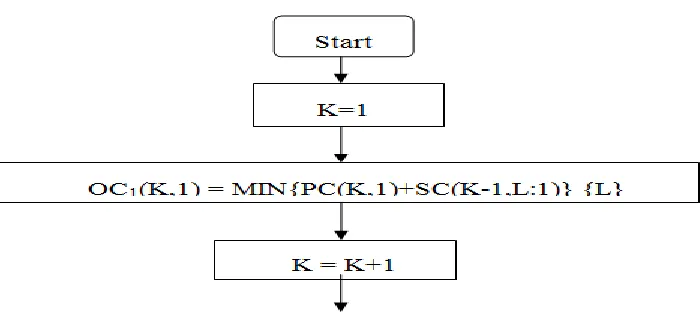
General working methodology for achieving solution using DP approach is given as [9]:
Split into Subproblems – The main problem is divided into a number of smaller, similar subproblems. The solution to main problem is stated in terms of the solution for the smaller subproblems.
Table Construction for Storage - The fundamental idea of dynamic programming is to avoid calculating the same stuff twice and usually a table of known results of subproblems is constructed for the purpose. Dynamic programming thus takes advantage of the duplication and arranges to solve each subproblem only once, saving the solution in table for later use. The key to competence of a dynamic programming algorithm is that once it computes the solution to a constrained version of the problem, it stores that solution in a table until the solution is no longer needed by any future computation. The initial solution is trivial. This tells us that we trade space for time to avoid repeating the computation of a subproblem. Combining using Bottom-up means - Combining solutions of smallest subproblems obtain the solutions to subproblems of increasing size. The process is continued until we arrive at the solution of the original problem.
IV. Experimental Analysis and Simulation Results
A. Assumptions
A state consists of an array of units with defined units operating and the off-line. There are no costs for shutting down a unit.
The start-up cost of a unit is independent of the time it has been off-line (i.e., it is a fixed amount). There is a strict priority order, and in each interval a defined minimum amount of capacity must be
operating.
All the losses are neglected
B. Parameter setup
Operating cost equations for Units(U1,U2,U3,U4) in Rs/hr:
Ci(PGi) =1/2 PGi2+26PGi Rs/Hour(U1)………..(1)
Ci(PGi) =1.5/2ai PGi2+28PGi Rs/Hour(U2)………(2)
Ci(PGi) =2/2ai PGi2+30PGi Rs/Hour(U3)………(3)
Ci(PGi) =2.5/2ai PGi2+32PGi Rs/Hour(U4)……….(4) N=4
Pd=40
C. Experimental Values
Table 1.Commited Schedule combinations of units
U1 U2 U3 U4
0 0 0 0
1 0 0 0
0 1 0 0
1 1 0 0
0 0 1 0
1 0 1 0
0 1 1 0
1 1 1 0
0 0 0 1
1 0 0 1
0 1 0 1
1 1 0 1
0 0 1 1
1 0 1 1
0 1 1 1
1 1 1 1
0-OFF,1-ON,U1-Unit 1,U2-Unit 2,U3-Unit 3,U4-Unit 4
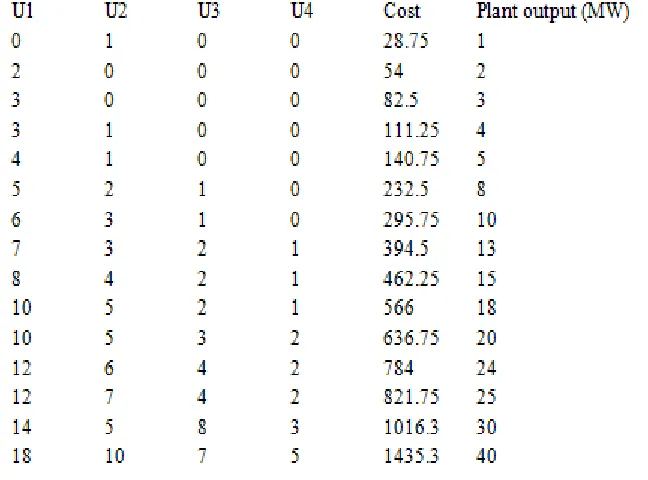
Table.2 Experimental Variation of Operating Cost with Load demand and distribution of loads between generating units
In table 2.,optimized value of OC is estimated under different load demands with subjected to optimium load distribution between four units.
D. Test Result
• Graphical representation of Parameters
Fig 3.Variation of Operating Cost (OC) vs Plant output
Fig 4.Variation of U1 output vs Load demand
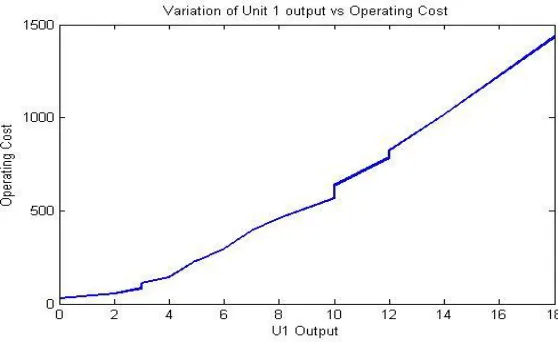
In Fig.3,OC tends to vary linearly as the load demand increases. In Fig.4,U1 tends to vary non -linearly upto load demand of 25 MW and the increases linearly for minimum OC.
Fig 6.Variation of U3 output vs Load demand
Fig 7.Variation of U4 output vs Load demand
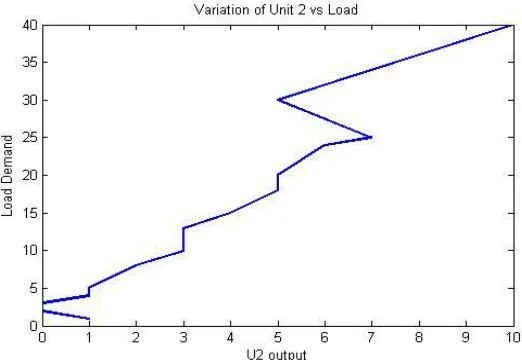
In Fig.5,U2 tends to vary non-linearly upto load demand of 30 MW and the increases linearly for minimum. In Fig.6,U3 tends to vary non-linearly upto load demand of 22 MWand reached its maximum sharing at 30 MW and then decreases. In Fig.7,U4 tends to vary non-linearly from online load demand of 10 MW upto load demand of 40 MW
Variation of Unit output with OC
Fig 9.Variation of U2 output vs OC
Fig 10.Variation of U3 output vs OC
Fig 11.Variation of U4 output vs OC
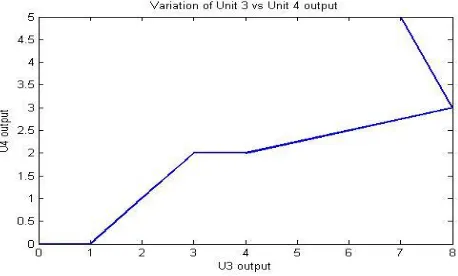
Fig 12.Variation of U3 output vs U4 output
CONCLUSION
In this paper, the optimized value of load sharing among 4 units and minimum OC is extracted using DP.A simple programming model is prepared for the computer simulation using MATLAB. Load sharing at different load demand is reflected in simulation studies with the computation of optimized OC value. This model can be extended to n no. of units and at different load demands. With small step size of load demand, more accuracy can be observed although computation time and memory are involved. Future work incorporates hybrid algorithms in this technique. .
REFERENCES
[1]. A. J. Wood and B. F. Wollenberg, “Power Generation, Operation, and Control”, New York: Wiley, 1984. [2]. Jizhong Zhu, “Optimization of Power System Operation”, IEEE Press Series on Power Engineering, 2009.
[3]. Z. Ouyang, S. M. Shahidehpour, “An Intelligent Dynamic Programming for Unit Commitment Application”, Transactions on Power Systems, Vol. 6, No. 3, August 1991.
[4]. Y. Al Kalaani, “Dynamic Programming Based Unit Scheduling: A Feasibility Study”, Emirates Journal For Engineering Research, 10 (2), 15-21 (2005).
[5]. Sayeed Salam, “Unit Commitment Solution Methods”, World Academy of Science, Engineering and Technology 35, 2007.
[6]. Allen J Wood and Bruce F Wollenberg, “Power Generation, Operation and Control”, 2 nd
edition, Wiley Interscience, 1996. [7]. Chao-an Li, Raymond B. Johnson, Alva J. Svoboda, “A New Unit Commitment Method”, Vol. 12, No. 1, February 1997. [8]. Chung Li Tseng, Chao –an Li, Shmuel S. Oren, “Solving unit Commitment by a Unit Decommitment Method”, Oct. 1997. [9]. Biswajit Bhowmik, “Dynamic Programming –Its Principles, Applications, Strengths, And Limitations”, International
Journal of Engineering Science And Technology, Vol. 2(9), 2010, 4822-4826.
[10]. P. Sriyanyong, Y.H.Song, “Unit Commitment Using Particle Swarm Optimization Combined with Lagrange Relaxation”,0-7803-9156 -X/05/$20.00, 2005.
[11]. J. Zhu, G. Jordan, and S. Ihara, "The market for spinning reserve and its impacts on energy prices", proceedings of the IEEE Power Engineering Society Winter Meeting, 2000.
[12]. Calvin Jin San Chan, “Development of a Profit Maximisation Unit Commitment Program”, September 2000.
[13]. Ugur Aytun Ozturk, “The Stochastic Unit Commitment Problem: A Chance Constrained Programming Approach Considering Extreme Multivariate Tail Probabilities”, 2003.
[14]. Lawrence Jenkins, “Hybrid Algorithms for Power System Unit Commitment”, 1-4244-1176-9/07/$25.00, 2007.
[15]. Navpreet S Tung, Vikram Kamboj, Amit Bhardwaj, “Unit Commitment Dynamics - An Introduction”, ISSN No. -
2250-2734, Vol. 2, Issue 1, Jan - Feb 2012.
[16]. Z. Ouyang, S.M. Shahidehpour, “An Intelligent Dynamic Programming for Unit Commitment Application,” IEEE Transactions on Power Systems, Vol. 6, No. 3, pp. 1203-1209, 1991.
[17]. C. K. Pang, H. C. Chen, “Optimal Short-term Unit Commitment,” IEEE Transactions on Power Apparatus and Systems, Vol. PAS-95, No. 4, pp. 1336- 1343, 1976.