199
Performance Measurement System of Oil and Gas Supply Chain –
Resources Based View Perspectives
Masha Salsabiela Menhat
1,21University Malaysia Terengganu, Terengganu, Malaysia 2 University of Central Lancashire, Preston, United Kingdom
Article Information
Abstract
Keywords
Performance measurement tool, resource based view, supply chain management
In the oil and gas industry, external factors such as market situation, environmental factors, exposure to high uncertainties, fluctuation of oil price and product differentiation are very least control by the organisation. Thus, in line with resources based view theory, it is important for the oil and gas companies to shift their focus into internal factors to distinguish themselves from their competitors. Resource based view (RBV) explains the organisation focus on their tangible and intangible internal resources in improvise the competitive advantage idea that emphasis on the external factors. This paper presents the RBV perspective performs as the basis for performance management in the oil and gas industry. In order to attain competitive advantage, the performance management system is proposed in line with three basic characteristics of RBV which are valuable, non-transferable, and inimitable. The understanding on these basic competitive characteristics underlies the performance measurement system is very important to sustain in todays’ environment.
INTRODUCTION
200
with resources based view theory, it is important for the oil and gas companies to shift their focus into internal factors to distinguish themselves from their competitors. To do this, a systematic approach in evaluating and managing firm’s internal resources and capabilities is very important in promoting supply chain performance in the oil and gas industry. Therefore, this paper presents the resource based view perspective perform as the basis for performance management in the oil and gas industry.
RESOURCE BASED VIEW PERSPECTIVES
The resources based view perspectives have been explored by many scholars in the field of strategic management. The earliest study has been conducted as early as 1959 by Penrose in her book- The theory of the growth of the firm where firm is described as a bundle of resources (Rivard, Raymond, & Verreault, 2006; Wernerfelt, 1984). Nevertheless, the resource based perspective gain more attention by the researchers and practitioners only by 1980s through Wernerfelt works on resource based view of the firm (Hart, Academy, & Oct, 1995; Wernerfelt, 1984).
To elaborate further on this, it is essential to understand the concept of competitive advantage which defined as the ability of firm to position themselves superior over other competitor in term of capabilities or competencies (Anatan, 2014). The concepts of competitive advantage have been discussed by many researchers in business and management field (Barney, 1991; Cockburn, Henderson, & Stern, 2000; Powell, 2001; Wen-Cheng, Chien-Hung, & Ying-Chien, 2011).
Among the concepts suggested by the above authors are; (1) cost leadership, where low cost positions enable to incite pricing and high sales volume, (2) differentiated product, this competitive advantage able to create brand loyalty and amicable reputation which ultimately allows firm to introduce premium pricing, (3) decision concerning timing, the example of this concept are moving early or late, this include just in time concepts which are widely practice in manufacturing industry, (4) decision concerning commitment level, this concept applies entering market on large scale or by stage, (5) pre-emptive action, the concept gives firm more focus to dominate a particular competitive advantage either (lower cost, differentiated product or combination of it) large scale move or early move sometimes possible to pre-empt competitors by setting new standards or gaining preferred access to critical raw materials, locations, production capacity or customers, and (6) competing for the future, where the firm need to be concerned not only on present but with future position of the firm.
Above all, RBV which explains the organisation focus on the tangible and intangible internal resources improvise the competitive advantage idea (Coates & Mcdermott, 2002; Hart et al., 1995). RBV emphasizing that competitive advantage can be sustained only if the capabilities creating the advantage are supported by resources that are valuable, non-transferable, and inimitable (Hart et al., 1995; Peteraf, 1993).
It requires explicit strategizing method in the competitive market when their current strategy is either copied or made obsolete. To do this, firm needs to have abilities of identifying, managing, and leveraging their internal core competencies instead of focusing only on external factors like product and market (Coates & Mcdermott, 2002).
Till today, there are still a lot of on-going researches on resources based view perspective which are presented in various approaches and its associations with other elements of firm’s strategies interacts with environmental aspects, integration with other forms of competitive advantage, the relationship between resources and other external factors and etc. (Rungtusanatham et. al., 2003; Williamson et al., 2012).
BASIC CHARACTERISTICS OF RESOURCE BASED VIEW IN ENHANCING COMPETITIVE ADVANTAGES
As market driven perspectives are originates from economical and external factors, resource based view in the other hand are seen by the distinctive of the firm in managing their internal capabilities (resources) (Rivard et al., 2006). In order for the resource based perspective to sustain in competitive advantage, it needs to have three main characteristics; valuable (not substitutable), non-transferable, and difficult to replicate (Hart et al., 1995; Peteraf, 1993). Even though different authors defined these characteristics in slightly different ways, it is widely understood as similar to three characteristics mentioned earlier.
201
distributed among industry or in other terminology, having imperfect mobility (i.e. have exclusive logistic arrangement or complex system). On the third characteristic, difficult to replicate is where the resources are either using high technology or expert skills, or socially complex and involving various area of expertise which would not easily imitated by competitors (Hart et al., 1995).
THE IMPORTANCE OF MANAGING INTERNAL RESOURCES
Apart from tangible resources, Amlt & Schoemaker, (1993) argue that capabilities or also known as intangible resources are also important as determinant factors for firm’s performance, which is refer as firm’s capacity to deploy resources. This further support by Makadok (2001) and Newbert (2008) which claims that firm’s resources and capability can only achieve its great value of competitive advantage by integrating ones resources and capabilities to its maximum potential.
Williamson et al. (2012) investigated wineries owners’ preference on the coursework that educational institution could offer to produce sophisticated and strategic thinker in wineries business. The result strongly suggest that the wineries industrial owners are more interested in investing on the educational programme that concentrated on firm’s core competencies or resource based view perspective which they believed as the competitive advantage for that particular industry. Again, this research shows that management of RBV is important and not to be neglected in strategizing ones firm.
According to Coates & Mcdermott (2002), the RBV theory view resources management as dynamic. It is believe that the management of resources are generating competitive advantage and not the resources themselves. Advocate this concept; it is important to understand integration of human, physical, tangible, and intangible resources to create value of competitive advantage.
More recently, Newbert (2008) contends that it is not always the case where firms need to have rare resources and capabilities to win over their competitors. They pointed a clear example on how patented chemical process can be designed to manipulate accessible raw material. In this case, the firm will be able to attain competitive advantage by exploiting the common resources differently from other firm. Therefore, it is clear that common resources are also important in obtaining competitive advantage as long as firm good at exploiting their resources and integrating with other resources and capabilities which could distinguish themselves from others.
He further conducted empirical studies on RBV among micro and nanotechnologies firms and found that, value and rareness of firm’s resources – capabilities integration contribute to competitive advantage and that competitive advantage eventually contributes to its performance.
To date, most researches has concentrated on firms’ resources as a basis of competitive advantage and not on stimulating the approach of the resource based view in strategizing ones firm which is far more important (Szymaniec-mlicka, 2014). Like other researchers, he emphasized firms to re-evaluate their own resources and competencies and learn how the integration of these two elements could help the firm attaining competitive advantage and create rent.
Recent study by Chae et. al. (2013), investigated the supply chain analytics (SCA) on resource based perspectives in manufacturing industry. They proposed supply chain analytics consist of the integration of three set of resources namely, data management resources, IT- based supply chain planning resources, and performance management resources. Their research shows that the SCA positively affect operational performance and all the three resources need to be integrated to attain such performance. However the study lack of input on how performance management resources formulate firm’s competitive advantage.
202
Realizing that attaining competitive advantage is more than just having the valuable, non-transferable, and inimitable resources, but instead the exploitation of resources to get the most of it, therefore, it is essential to implement the constructivist theory to highlight the importance of measuring and evaluating how the resources are manage. As such it is important for the oil and gas organisation to shift their focus into internal factors while at the same time managing their external factors in order to distinguish themselves from their competitors. Such factors, includes intangible resources like performance measurement system.
PERFORMANCE MANAGEMENT SYSTEM
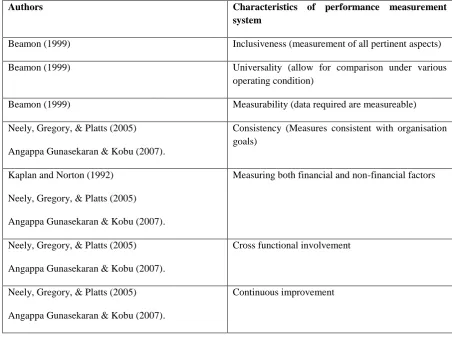
Table 1: Important characteristics of performance measurement system
Authors Characteristics of performance measurement
system
Beamon (1999) Inclusiveness (measurement of all pertinent aspects)
Beamon (1999) Universality (allow for comparison under various
operating condition)
Beamon (1999) Measurability (data required are measureable)
Neely, Gregory, & Platts (2005)
Angappa Gunasekaran & Kobu (2007).
Consistency (Measures consistent with organisation goals)
Kaplan and Norton (1992)
Neely, Gregory, & Platts (2005)
Angappa Gunasekaran & Kobu (2007).
Measuring both financial and non-financial factors
Neely, Gregory, & Platts (2005)
Angappa Gunasekaran & Kobu (2007).
Cross functional involvement
Neely, Gregory, & Platts (2005)
Angappa Gunasekaran & Kobu (2007).
Continuous improvement
There are a lot of researches proved that supply chain performance management as a key to sustainable competitive advantage (Agrell & Hatami-Marbini, 2013; Hsu et. al., 2009). Moreover, lack of the use of performance measurement system in order to maximise supply chain potential has found to be one of the reason for poor overall organisation performance (Varma, 2008; Gunasekaran, 2004).
On top of that, there is empirical evidence suggested that supply chain management practices mediate the impact of operations capability on organisation performance. The integration of internal capabilities and key partners is the basis of attaining sustainable competitive advantage (Hsu et. al., 2009). Intrinsically, the performance measurement system plays and important role to explore its potential and ensure continuous improvement
203
Performance measurement system is designed in an organisation for various purposes including; a) identify success b) identify customer requirements are met, c) to understand their process and identify what they know and what they don’t know d) identify problems, waste and necessary improvements, e) ensure decisions are made based on the recorded data and not merely intuitions or emotions, f) show if improvement plan is actually happens (Parker, 2000). Realising its potential, performance measurement is also considered as one of the important competencies of supply chain management in achieving world class performance (Gunasekaran & Kobu, 2007).
Apart from understanding its purposes, there is also a need to explore the important characteristics of performance measurement system to offer the true meaning of its function. Table 1 presents several characteristics of a good performance measurement system from the previous literature. These include inclusiveness, universality, measurability consistency, measuring both financial and non- financial factors, cross functional involvement, and also continuous improvement.
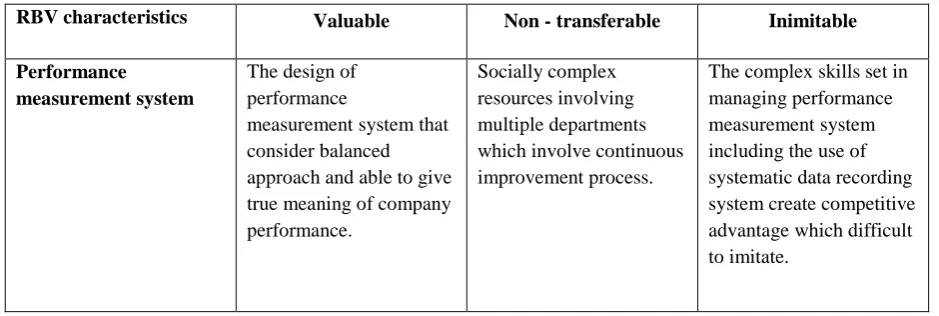
Table 2: Performance measurement system from resource based view perspectives
RBV characteristics Valuable Non - transferable Inimitable
Performance measurement system
The design of performance
measurement system that consider balanced approach and able to give true meaning of company performance.
Socially complex resources involving multiple departments which involve continuous improvement process.
The complex skills set in managing performance measurement system including the use of systematic data recording system create competitive advantage which difficult to imitate.
The importance of managing supply chain performance or internal resources as a core for competitive advantage have explicitly presented in the previous section. Nevertheless, to deploy performance measurement system as a basis for competitive advantage from resources based view perspectives, ones have to design it in a way that valuable, inimitable and non-transferable.
Table 2 depicted the view of performance measurement system from RBV perspective. Firstly, from the valuable aspect, the performance measurement system has to be designed considering balance approach and able to give true meaning to measure organisation performance. Then, the development of performance measurement system requires involvement of multifunction department which promotes continuous improvement make it difficult to transfer to any other organisation. This is in line with Angappa Gunasekaran & Kobu (2007) and Neely, Gregory, & Platts (2005) that suggested the need to constantly updating performance measurement and metrics depending upon business advancement to facilitate continuous improvement. Finally, the complex skills set in managing performance measurement system including the use of systematic data recording system able to hinder this resource from imitation by other competitors. This also includes to have frequent meeting to identify current progress and ways of improving it (Gunasekaran & Kobu, 2007).
FUTURE RESEARCH
204
Secondly, supply chain management is highly complex for the oil and gas industry and its characteristics may vary from one type of organisation to another. For instance, their degree of reliance on the internal resources might be different from one another and also exposed to varieties of external factors. Thus, there is the need to approach different type of organisation in the oil and gas industry with suitable variables in order to acquire a better outcome.
CONCLUSION
This paper has presented the RBV perspective in the SCM of oil and gas industry and focusing on the performance measurement system. It can be concluded that performance measurement system is an important resources in enhancing competitive advantage especially in the oil and gas supply chain environment. The competitive advantage from the resources view perspective suggested the use of performance measurement system as an intangible resource which designed to make it valuable, non-transferable and inimitable. The understanding on these basic competitive characteristics underlies the performance measurement system is very important to sustain in today’s business environment.
ACKNOWLEDGEMENT
This work is financially supported by the University of Malaysia Terengganu, Malaysia.
REFERENCES
Agrell, P. J., & Hatami-Marbini, A. (2013). Frontier-based performance analysis models for supply chain management: State of the art and research directions. Computers & Industrial Engineering, 66(3), 567– 583. doi:10.1016/j.cie.2013.02.014
Al-Othman, W. B. E., Lababidi, H. M. S., Alatiqi, I. M., & Al-Shayji, K. (2008). Supply chain optimization of
petroleum organization under uncertainty in market demands and prices. European Journal of
Operational Research, 189, 822–840. doi:10.1016/j.ejor.2006.06.081
Amlt, R., & Schoemaker, P. J. H. (1993). Strategic assets and organizational rent. Strategic Management
Journal, 14(August 1992), 33–46. doi:10.2307/2486548
Anatan, L. (2014). Factors Influencing Supply Chain Competitive Advantage and Performance. International
Journal F Business and Information, 9(3), 311–335.
Barney, J. (1991). Firm Resources and Sustained Competitive Advantage. Journal of Management.
doi:10.1177/014920639101700108
Beamon, B. M. (1999). Measuring supply chain performance. International Journal of Operations &
Production Management, 19, 275–292. doi:10.1108/01443579910249714
Chae, B. (Kevin), Olson, D., & Sheu, C. (2013). The impact of supply chain analytics on operational performance: a resource-based view. International Journal of Production Research, 52(16), 4695–4710. doi:10.1080/00207543.2013.861616
Chima, C. M., & Hills, D. (2007). Supply-Chain Management Issues, 5(6), 27–36.
Coates, T. T., & Mcdermott, C. M. (2002). An exploratory analysis of new competencies : a resource based view perspective, 20, 435–450.
Cockburn, I. M., Henderson, R. M., & Stern, S. (2000). Untangling the Origins of Competitive Advantage.
Strategic Management Journal, 21, 1123–1145. doi:10.2307/3094430
Fernandes, L. J., Barbosa-póvoa, A. P., & Relvas, S. (2010). Risk Management Framework for the Petroleum
Supply Chain. Risk Management, 28, 157–162. doi:10.1016/S1570-7946(10)28027-6
Gunasekaran, A., & Kobu, B. (2007). Performance measures and metrics in logistics and supply chain management: a review of recent literature (1995–2004) for research and applications. International
Journal of Production Research, 45(12), 2819–2840. doi:10.1080/00207540600806513
Hart, S. L., Academy, T., & Oct, N. (1995). A Natural-Resource-Based View of the Firm, 20(4), 986–1014. Hsu, C.-C., Tan, K. C., Kannan, V. R., & Keong Leong, G. (2009). Supply chain management practices as a
mediator of the relationship between operations capability and firm performance. International Journal of
Production Research, 47(3), 835–855. doi:10.1080/00207540701452142
Makadok, R. (2001). Toward a synthesis of the resource-based and dynamic-capability views of rent creation.
Strategic Management Journal, 22, 387–401. doi:10.1002/smj.158
205
Neely, A., Gregory, M., & Platts, K. (2005). Performance measurement system design: A literature review and research agenda. International Journal of Operations & Production Management, 25(12), 1228–1263. doi:10.1108/01443570510633639
Newbert, S. L. (2008). Value , Rareness , Competitive Advantage , and Performance : A Conceptual-Level
Emperical Investigation of The Resource Based View of The Firm, 768(May 2005), 745–768.
doi:10.1002/smj
Parker, C. (2000). Performance Measurement. Work Study, 49(2), 63–66.
Peteraf, M. A. (1993). The connerstones of competitive advantage: A resource-based view, 14(3), 179–191. Pillai, M., Sandelands, E., & Ashokan, G. (2010). Developing EPC Value Chain. Oil and Gas Business.
Powell, T. C. (2001). Competitive advantage: Logical and philosophical considerations. Strategic Management
Journal, 22, 875–888. doi:10.1002/smj.173
Rivard, S., Raymond, L., & Verreault, D. (2006). Resource-based view and competitive strategy: An integrated model of the contribution of information technology to firm performance. The Journal of Strategic
Information Systems, 15(1), 29–50. doi:10.1016/j.jsis.2005.06.003
Rungtusanatham, M., Salvador, F., Forza, C., & Choi, T. Y. (2003). Supply‐chain linkages and operational performance. International Journal of Operations & Production Management, 23(9), 1084–1099. doi:10.1108/01443570310491783
Szymaniec-mlicka, K. (2014). Resource-based view in strategic management of public organizations – a review of the, 18(2), 19–31.
Varma, S., Wadhwa, S., & Deshmukh, S. G. (2008). Evaluating petroleum supply chain performance: Application of analytical hierarchy process to balanced scorecard. Asia Pacific Journal of Marketing and
Logistics. doi:10.1108/13555850810890093
Wen-Cheng, W., Chien-Hung, L., & Ying-Chien, C. (2011). Types of Competitive Advantage and Analysis.
International Journal of Business and Management. doi:10.5539/ijbm.v6n5p100
Wernerfelt, B. (1984). A Resource-based View of the Firm, 5(2), 171–180.