Scientific Journal Impact Factor: 1.205
International Journal of Applied And Pure Science and
Agriculture
www.ijapsa.com
Effect on quality of developed ginger-garlic paste during storage
Javeed Akhtar1, P.K. Omre2 and Mohd Aftab Alam3
1,2
Department of Post-harvest Process &Food Engineering, G.B.P.U.A&T, Pantnagar, India
3
Sam higginbottom institute of agriculture, technology & sciences, Allahabad, India
Abstract
In this study, the effect on quality of developed ginger-garlic paste were observed.Ginger paste and garlic paste were mixed in equal proportion (1:1 ratio) by weight. The Sodium benzoate (150 ppm), citric acid (0.2% w/w), Sodium benzoate (.015% w/w) and sodium chloride (1.5% w/w) were added to the mixed ginger garlic paste and packed in glass jars. The samples were treated with microwave heating and samples treated with conventional heating. After that all samples stored at 30 to 38°C for
3 months and evaluated at an interval of 15 days. Ginger-garlic paste treated by microwave heating
stored for 3 months had significantly (p<0.05).The pH and moisture content of microwave treated samples were decreased (p<0.05). The effect of microwave treatment on acidity and ash content of samples showed that microwave treatment significantly (p<0.05) affected the acidity and ash content during storage period of 3 months.
Key words: microwave heating, ginger garlic paste, quality attributes and storage.
I. INTRODUCTION
Garlic (Allium sativum L.) belongs to Alliacea family and is the native of Central Asia (Purseglove et al. 1981). Garlic contains allicin which has antioxidant, antibacterial and antibiotic properties. It has been recognized as a valuable condiment for foods in everyday cooking. The genus
Allium contains large amount of sulphur compound, which is primarily responsible for its biological and
medicinal properties (Augusti 1996). China is the largest producer of garlic accounting for 77% of world output, India (4.1%), South Korea (2%), followed by Russia (1.6%) and the United States (1.4%) (Peter 1996).
2005).seldom carried over to processed garlic (Pezzutti and Crapiste 1997).
Ginger (Zingiber officinale) and garlic (Allium sativum L.) have been used as spices and aningredient in folk medicine in many Asian foods especially in Indian cuisine since ancient times. There have been a number of studies showing the antimicrobial activity of garlic essential oil, garlic and ginger extracts. Both ginger and garlic possess volatile oils and chemical compounds responsible for pungent flavours, especially gingerols and allicinrespectively. Allicin (diallyl thiosulfinate) has antioxidant, antibacterial antibiotic properties (Augusti, 1996). Flavones, flavonoids and Flavonols are chemical compounds in these spices, active against microorganisms. Flavonoids are also hydroxylated phenolic substances but occur as a C6- C3 unit linked to an aromatic ring, they are synthesized by plants in response to microbial infections (Dixon et al., 1983).
Ginger–garlic paste is a viscous product prepared from the garlic ginger mix. Ginger and garlic are containing the strong aroma and flavor which are the row materials of ginger garlic paste. Ginger garlic paste is essential in food preparations as a spice for imparting a characteristic fresh ginger garlic odor in factual flavor. Ginger-garlic paste is slightly creamy white, microbiologically stable and free from any pathogens including bacteria and other microorganisms. It is a substitute of fresh ginger and garlic which can be used in homes, restaurants, hotels, food complex institutes and institutional caterings etc.
II. MATERIALS AND METHODS
Source of raw materials
Garlic and Ginger:
Fresh ginger rhizomes were procured from a local market of Pantnagar, U.S. Nagar, U.K. Uttarakhand. The rhizomes were broken into pieces to expose the crevices and then washed in running water to remove the adhering mud. Again the cleaned rhizomes were scraped with a knife to remove dirt as well as spoiled portion.
Composition of ginger-garlic paste samples:
The ratios of each samples of ginger –garlic paste were 1: 1 w/w of ginger paste and garlic paste. The chemical preservative were used as sodium metabisulfite (0.5%w/w), citric acid (0.2% w/w), Sodium benzoate (.015% w/w) and sodium chloride (1.5% w/w).
Manufacturing Process of Ginger- Garlic paste Garlic paste:
Garlic was imperilled to low pressure by hand to separate the pieces. Garlic pieces were dried in a tray drier at 40°C for 25 min. to assist peeling. Peeling was done manually. After peeling, Ginger pieces were immersed in hot water followed by grinding in a heavy duty grinder tailored with mesh to get a fine paste that was used as the raw material for grounding of ginger–garlic paste.
Ginger paste:
.
Ginger–Garlic Paste
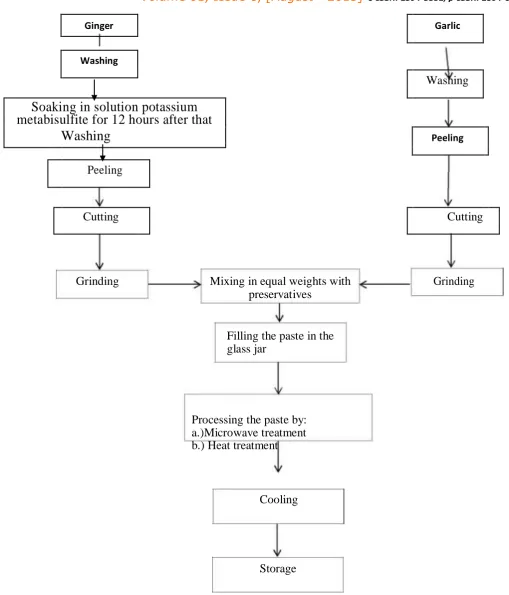
Ginger Paste and Garlic Paste were mixed in equal proportion (1:1 ratio) by weight and passed through heavy duty grinder to obtain the product with uniform evenness. The ginger–garlic paste was become stable by addition of sodium chloride. Ginger garlic pastes of 10 kg were prepared by mixing 10 batches of 1 kg each which shown in Figure 01. Sodium benzoate (150 ppm) was added to the mixed ginger garlic paste and filled in glass gars after that filled jars with ginger garlic paste were sealed. The five sealed samples were placed in a microwave oven. The Microwave oven was switch on at different level of microwave power (160,320, 480,660 and 800 watt for 1 minute) for the processing of ginger garlic paste. After that, these five samples were cooled down to 35°C and stored at ambient temperature. Whereas other five sealed samples of same composition were thermally heated at different temperature 100, 110, 120, 130 and 140°C for 4 minute 30 second, 3 minute 30 second, 2 minute 30 second, 1 minute 30 second and 30 second respectively. After that, these five samples were cooled depressed to 35°C and kept at ambient temperature. Samples were taken out after 0, 15, 30, 45 and 60 days of storing at 30°C and examined for their quality attributes.
Quality Characteristic of ginger- garlic paste
pH value of ginger garlic paste
The 10g of ginger garlic paste samples were taken along with 50ml-distilled water homogenized in a mixer grinder. The ground sample was filtered and the pH was determined by dipping the combined glass electrode of a digital pH meter (Khera model, Indian make) into the filtrate.
Percentage acidity
Acidity of ginger garlic paste was determined by using the method as recommended by
(Ranganna, 1994). To prepare the sample, 10 gm sample was boiled in 100 ml of distilled waterfor one hour, replacing the water lost by evaporation. It was then cooled, filtered and transferred to a volumetric flask and made up to 100 ml with distilled water. 10 ml of the aliquot was pipette out and titrated with 0.1N NaOH using few drops of phenolphthalein as indicator.
The titre value was noted and percent acid total acid was calculated as citric acid using the following equation:
Titre x Normality of NaOH x Volume made up x Eq.wt. of Citric Acid (64.04) x 100
% Acidity = ________________________________________________________________ x 100 (3.1) Volume of Sample taken for Estimation x wt. or volume of sample taken x 1000
Moisture Content
The moisture content of garlic-ginger paste was determined as AOAC (1980) method. Ten gram of sample was transferred to weighed metallic dish which was then transferred to a hot air oven at 100°C and tried till a constant weight was obtained. The dish was kept in desiccators for cooling. After cooling, the loss in weight was determined to calculated moisture content and expressed as %.
Weight of fresh sample (g) - Weight of dried sample (g)
Ginger Garlic
Washing
Washing
Soaking in solution potassium
metabisulfite for 12 hours after that
Washing
Peeling
Peeling
Cutting Cutting
Grinding Mixing in equal weights with Grinding preservatives
Filling the paste in the glass jar
Processing the paste by: a.)Microwave treatment b.) Heat treatment
Cooling
Storage
Ash content
To determine total ash.5g of garlic-ginger paste samples was weighed in a pre-weighed silica dish, Ignited on a burner till the fumes ceased and then transferred to muffle furnace at 500±15ºC for 4 hrs and transferred to desiccator for cooling. After cooling silica dish was reweighed and percent total ash was calculated (AOAC, 1995).
Weight of residue
Total Ash (%) = ———————— x 100 (3.3) Weight of sample
Statistical Analysis
Statistical analysis of data obtained, was done using ANOVA.
III. RESULTS AND DISCUSSIONS
Changing in moisture content of ginger-garlic paste during the storage period of 90 days:
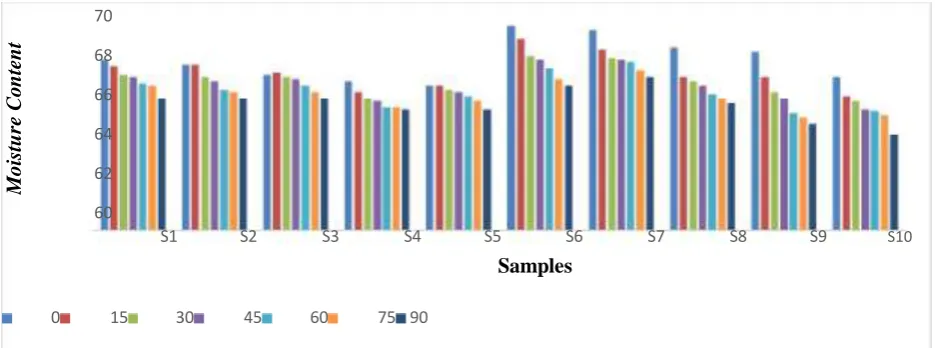
The moisture content of ginger garlic paste samples treated with microwave and conventional heating, was examined during the storage. The samples (S1, S2, S3, S4andS5) treated with microwave heating, had moisture content ranging from 66.8 to 68%db. During the storage moisture content was decreased. It was found that the moisture content of ginger-garlic paste significantly decreased which has been shown by ANOVA. Ginger-garlic paste treated by microwave heating stored for 3 months had significantly (p<0.05). Similar finding was reported by Algadi, M. Z.A. (2014), the chemical treatments affected the moisture content of Garlic paste significantly where untreated Garlic pate had the highest (p>0.05) moisture content (63.88%) compared to the treated ones during storage. The values obtained in this study were within the range of values obtained by Benkeblia (2007), who reported that garlic contain 60-70% moisture. The moisture content of T0 was comparable to the values (66.57%) reported by Odebunmi et al. (2010) for the Nigerian garlic and to that (65%) reported by Blumenthal and Mark (2000). Also Topno et al. (2011) found that Garlic Paste contained 63.04% moisture. The effect of microwave heating was found significant (p<0.05) on the quality of stored sample whereas the samples (S6, S7, S8, S9and S10) were treated with conventional heating which shown the more changed in moisture content during storage.
Moi st u re C o n te n t 70 68 66 64 62 60
S1 S2 S3 S4 S5 S6 S7 S8 S9 S10
Samples
0 15 30 45 60 75 90
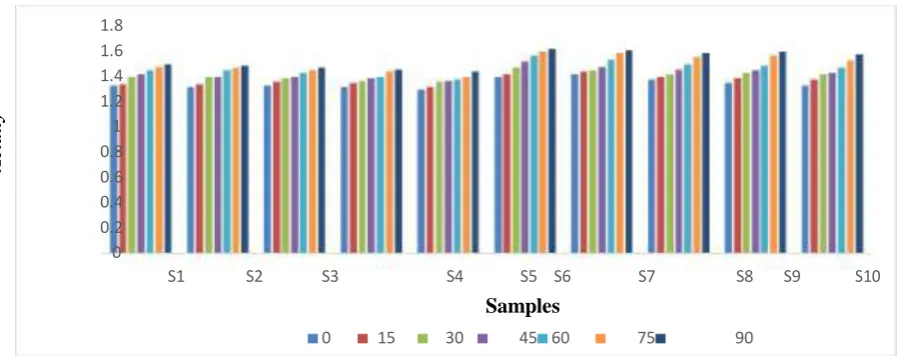
.62. Therefore, the acidity of microwave treated samples increased by lesser amounts than that of conventionally heat treated samples. The ANNOVA of effect of microwave treatment on acidity of ginger-garlic paste showed that microwave treatment significantly (p<0.05) affected the acidity.
A
c
idi
ty
1.8 1.6 1.4 1.2 1 0.8 0.6 0.4 0.2 0
S1 S2 S3 S4 S5 S6 S7 S8 S9 S10
Samples
0 15 30 45 60 75 90
Fig. no. 3 Changing in acidity (%) value of ginger garlic paste during the storage period of90 days.
Changing in pH values of ginger-garlic paste during the storage period of 90 days:
pH
6
5
4
3
2
1
0
S1 S2 S3 S4 S5 S6 S7 S8 S9 S10
Sample
0 15 30 45 60 75 90
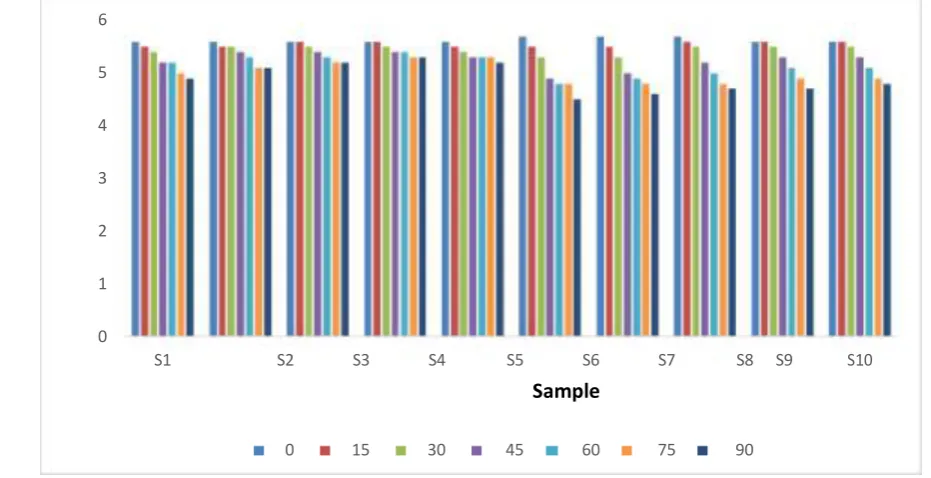
Fig. no. 4 Changing in pH value of ginger garlic paste during the storage period of 90 days
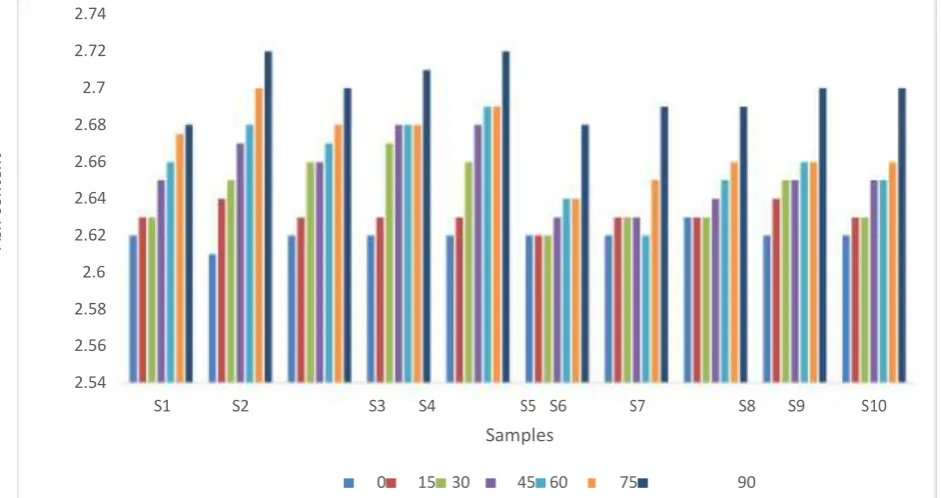
Changes in ash content of ginger-garlic paste during the storage period of 90 days:
A sh c on te n t 2.74 2.72 2.7 2.68 2.66 2.64 2.62 2.6 2.58 2.56 2.54
S1 S2 S3 S4 S5 S6 S7 S8 S9 S10
Samples
0 15 30 45 60 75 90
Fig. no. 5 Changing in pH ash content of ginger garlic paste during the storage period of 90 days
IV. Conclusion
It can be concluded that ginger garlic paste treated with microwave heating was more shelf stable during storage. During storage period of 3 month, the quality of all microwave treated samples was observed to be less changed as compared to that treated with simple heating. The microwave heating of ginger garlic paste was found to be significant.
Bibliography
[1] Ahmed R and Sharma S (1997). Biochemical studies on combined effect of garlic (Allium sativum Linn) and ginger (Zingiber officinale Rosc) in albino rats. Indian journal of experimental biology 35: 841-843.
[2] AOAC. (1980). Official methods of analysis of the Association of Official Analytical Chemists. 13th edition. Washington, D.C.
[3] AOAC. (1995). Official methods of analysis of the Association of Official Analytical Chemists. 16th edition. Washington, D.C.
[4] AUGUSTI, K.T. (1996). Therapeutic values of onion and garlic. Indian J. Exper. Biol. 64: 334-336. [5] Benkeblia (2000). Lebensmittel Wissenschaft und- Technology, 33, 112-116.
[6] Casado, F. J.; Antonio L_pez.; Luis, R.; et al., (2004). Nutritional composition of commercial pickled garlic. Eur Food Res Technol 219: 355–359.
[7] Dixon, RA; Dey, PM; Lanb, and CJ (1983). Phytoalexins: enzymology and molecular biology. Adv Enzymol 56: 1-69. during storage. LWT – Food Sci. Technol. 39: 613–620.
[8] Giridhar, N. and Satyanarayana, A. and Joshi, G. J. (1996) Studies on preparation and storage of ginger-garlic paste. Indian Food Packer, 50 (2): 13-21.
[9] Grzanna R, Lindmark L, Frondoza C (2005). Ginger-A herbal medicinal product with broad anti-inflammatory actions. J. Med. Food, 8(2): 125-132.
[11]Analysis of Some Food Condiments. Journal of Applied Sciences Research. PETER, K.V. 1996. Garlic has greater potential for export. Spice India 9: 4–7.
[12]PEZZUTTI, A. and CRAPISTE, G.H. (1997). Sorptional equilibrium and drying characteristics of garlic. J. Food Eng. 31: 113–123
[13]PURSEGLOVE, J.W., BROWN, E.G., GREEN, C.L. and ROBBINS, S.R.J. 1981). a. Spices,Vol. 2. Longman Inc,NewYork, NY.
[14]Ranganna S (1994). Handbook of Analysis and Quality Control for Fruits and Vegetable products. 2nd edn. Tata MC. Graw- Hill Publishing Co.Ltd. New Delhi.
[15]Topno, P.N, Vinothini, Jayaprakash,S.H., Varadaiah,V., Sheshagiri, S.H, Srinivas, P.M and Naido, M.M. (2011). Ginger–Garrlic Paste in Retort Pouches and its Quality. Journal of
[16]USDA. (2004) Agricultural Research Service. USDA Nutrient database for standard reference, release 16–1. Nutrient data laboratory, http://www.nal.usda.gov/ fnic/food comp