Matrix Exponentiated Gradient Updates for On-line Learning and
Bregman Projection
Koji Tsuda [email protected]
Max Planck Institute for Biological Cybernetics Spemannstrasse 38
72076 T¨ubingen, Germany, and
Computational Biology Research Center
National Institute of Advanced Science and Technology (AIST) 2-42 Aomi, Koto-ku, Tokyo
135-0064, Japan
Gunnar R¨atsch [email protected]
Friedrich Miescher Laboratory of the Max Planck Society Spemannstrasse 35
72076 T¨ubingen, Germany
Manfred K. Warmuth [email protected]
Computer Science Department University of California Santa Cruz, CA 95064, USA
Editor: Yoram Singer
Abstract
We address the problem of learning a symmetric positive definite matrix. The central issue is to de-sign parameter updates that preserve positive definiteness. Our updates are motivated with the von Neumann divergence. Rather than treating the most general case, we focus on two key applications that exemplify our methods: on-line learning with a simple square loss, and finding a symmetric positive definite matrix subject to linear constraints. The updates generalize the exponentiated gra-dient (EG) update and AdaBoost, respectively: the parameter is now a symmetric positive definite matrix of trace one instead of a probability vector (which in this context is a diagonal positive def-inite matrix with trace one). The generalized updates use matrix logarithms and exponentials to preserve positive definiteness. Most importantly, we show how the derivation and the analyses of the original EG update and AdaBoost generalize to the non-diagonal case. We apply the resulting matrix exponentiated gradient (MEG) update and DefiniteBoost to the problem of learning a kernel matrix from distance measurements.
1. Introduction
Most learning algorithms have been developed to learn a vector of parameters from data. However, an increasing number of papers are now dealing with more structured parameters. More specifically, when learning a similarity or a distance function among objects, the parameters are defined as a
sym-metric positive definite matrix that serves as a kernel (e.g., Xing et al., 2003; Shai-Shwartz et al.,
the most commonly used algorithms, but it is not appropriate when the parameters form a posi-tive definite matrix, because the updated parameter matrix does not necessarily stay posiposi-tive def-inite. Xing et al. (2003) solved this problem by always correcting the updated matrix to be pos-itive definite. However no bound has been proven for this update-and-correct approach. Also, Shai-Shwartz et al. (2004) proposed an on-line algorithm for learning a kernel matrix when only some of the class labels of the examples are provided. This algorithm is also based on the update-and-correction approach, but since the update step performs rank-one modification, the correction step can be efficiently implemented. They have shown a generalization bound inspired by similar previously known bounds for the perceptron.
In this paper, we introduce the matrix exponentiated gradient update which works as follows: First, the matrix logarithm of the current parameter matrix is computed. Then a step is taken in the direction of the steepest descent of the loss function. Finally, the parameter matrix is updated to the exponential of the modified log-matrix. Our update preserves symmetry and positive definiteness because the matrix exponential maps any symmetric matrix to a symmetric positive definite matrix. Bregman divergences play a central role in the motivation and the analysis of on-line learning
algorithms (Kivinen and Warmuth, 1997). A learning problem is essentially defined by a loss
func-tion and a divergence that measures the discrepancy between parameters. More precisely, the up-dates are motivated by minimizing the sum of the loss function and the Bregman divergence, where the loss function is multiplied by a positive learning rate. Different divergences lead to radically different updates (Kivinen and Warmuth, 1997, 2001). For example, the gradient descent update is derived from the squared Euclidean distance, and the exponentiated gradient update from the Kullback-Leibler divergence (relative entropy). In this work we use the von Neumann divergence (also called quantum relative entropy) for measuring the discrepancy between two positive definite matrices (Nielsen and Chuang, 2000). We derive a new matrix exponentiated gradient update from this divergence (which is a Bregman divergence for symmetric positive definite matrices). Finally we prove relative loss bounds using the von Neumann divergence as a measure of progress.
We apply our techniques to solve the following related key problem that has received a lot of attention recently (Xing et al., 2003; Shai-Shwartz et al., 2004; Tsang and Kwok, 2003; Tsuda and Noble, 2004). Find a symmetric positive definite matrix that satisfies a number of linear inequality constraints. The new DefiniteBoost algorithm greedily chooses a violated linear con-straint and performs an approximated Bregman projection. In the diagonal case, we recover Ada-Boost (Schapire and Singer, 1999). We also show how the convergence proof of AdaAda-Boost general-izes to the non-diagonal case.
2. Preliminaries
In this section, we first present mathematical definitions and basic lemmas.
2.1 Matrix Basics
We denote matrices by capital bold letters and restrict ourselves to square matrices with real entries
in this paper. For any such matrixA∈Rd×d, expAand logAdenote the matrix exponential and
logarithm, respectively. The matrix exponential is defined as the following power series,
exp(A):=I+A+ 1
2!A
2+ 1
3!A
3+
In the case of symmetric matrices, the matrix exponential operation can be computed using the
eigenvalue decompositionA=VΛV>, whereV is an orthonormal matrix with the eigenvectors
ofAas columns andΛthe diagonal matrix of eigenvalues. Thus, expA=V(expΛ)V>, where
(expΛ)i,i=exp(Λi,i). The matrix logarithm logAis defined as the inverse function of expA, which
does not always exist for arbitraryA. However, whenAis symmetric and strictly positive definite,
logAis computed as logA:=V(logΛ)V>, where(logΛ)i,i=logΛi,i. Throughout the paper log a
and exp a denote the natural logarithm and exponential of scalar “a”.
A square matrix is positive definite if all its eigenvalues are strictly positive. Positive
semi-definiteness only requires the non-negativity of the eigenvalues. For two matricesA andB,A
BiffB−Ais positive semi-definite. Similarly,A≺BiffB−Ais (strictly) positive definite.
The trace of a matrix is the sum of its diagonal elements, i.e. tr(A) =∑iAi,iand thus tr(AB) =
∑i,jAi,jBj,i=tr(BA). In matrix algebra, tr(AB)plays a similar role as the dot product for vectors.
Furthermore, tr(A) =∑iλi, whereλi are the eigenvalues ofAand the determinant det(A) =∏iλi.
If F(W):Rd×d→Ris a real-valued function on matrices, then∇WF(W)denotes the gradient
with respect to matrixW:
∇WF(W) =
∂F
∂W11 ···
∂F
∂W1d
..
. . .. ...
∂F
∂Wd1 ···
∂F
∂Wdd
.
For example, it is easy to see that∇Atr(AB) =B>. More examples of computing gradients are
given in Appendix A.
For a square matrixX, sym(X) = (X+X>)/2 denotes the symmetric part ofX. IfW is
symmetric andX an arbitrary matrix, then
tr(W X) =tr
WX+X >
2
+tr
WX−X >
2
=tr(Wsym(X)). (2.2)
Our analysis requires the use of the Golden-Thompson inequality (Golden, 1965):
tr(exp(A+B))≤tr(exp(A)exp(B)), (2.3)
which holds for arbitrary symmetric matricesAandB.
We also need the following two basic inequalities for symmetric matrices. The first one gener-alizes the following simple inequality, which is a realization of Jensen’s inequality for the convex
function exp(x): For any 0≤a≤1 andρ1,ρ2∈R,
exp(aρ1+ (1−a)ρ2)≤a exp(ρ1) + (1−a)exp(ρ2).
In the below generalization, the distribution(a,1−a)is replaced by(A,I−A), whereA is any
symmetric matrix for which0AI.
Lemma 2.1 For any symmetric matrixA∈Rd×d such that0AI, and anyρ1,ρ2∈R,
Proof AssumeAis eigen-decomposed asA=VΛV>, whereΛis the diagonal matrix of
eigen-values and V is an orthogonal matrix with the eigenvectors of A as columns. By assumption,
0≤λk≤1. Letθkbe the k-th eigenvalue of the left hand side of the inequality that we are to prove.
Clearlyθk=exp(λkρ1+ (1−λk)ρ2)and by Jensen’s inequality,θk≤λkexp(ρ1) + (1−λk)exp(ρ2).
LetΘbe the diagonal matrix with entriesθk. ThenΘΛexp(ρ1) + (I−Λ)exp(ρ2), and by
multi-plying both sides byV from left and byV>from right, we obtain the desired inequality.
Lemma 2.2 For any positive semi-definite symmetric matrix A∈Rd×d and any two symmetric matricesB,C∈Rd×d,BCimplies tr(AB)≤tr(AC).
Proof Let D=C−B, thenD0 by assumption. Suffices to show that tr(AD)≥0. Let us
eigen-decomposeAasVΛV>. SinceV V>=V>V =I,D=VPV>where P=V>DV 0.
Then tr(AD) =tr(VΛV>VPV>) =tr(ΛP) =∑n
i=1λiPii. Since P is positive semi-definite, the
diagonal elements Piiare nonnegative. Also by assumption the eigenvaluesλiofAare nonnegative.
Thus we conclude that tr(AD)≥0.
2.2 Von Neumann Divergence or Quantum Relative Entropy
If F is a real-valued strictly convex differentiable function on the parameter domain (a subset of
matrices inRd×d) andf(W):=∇WF(W), then the Bregman divergence between two parameters
f
W andW is defined as
∆F(Wf,W):=F(Wf)−F(W)−tr((Wf−W)f(W)>).
Since F is strictly convex,∆F(Wf,W)is also strictly convex in its first argument. Furthermore, the
gradient in the first argument has the following simple form:
∇Wf ∆F(Wf,W) =f(Wf)−f(W),
since∇Atr(AB) =B>(cf. Section 2.1).
For the divergences used in this paper, we restrict ourselves to the domain of symmetric positive
definite matrices. Our main choice of F is F(W) =tr(WlogW−W), which is called von
Neu-mann entropy or quantum entropy. The strict convexity of this function is well known (Nielsen and
Chuang, 2000). Furthermore we show in Appendix A that∇WF(W) =f(W) =logW.
The Bregman divergence corresponding to this choice of F is the von Neumann divergence or
quantum relative entropy (e.g., Nielsen and Chuang, 2000):
∆F(Wf,W) =tr(WflogWf−WflogW−Wf+W).
In this paper, we are primarily interested in the case when the parameters are normalized in the
sense that tr(W) =tr(Wf) =1. Symmetric positive definite matrices of trace one are related to
density matrices commonly used in Statistical Physics. For normalized parameters the divergence simplifies to
If W =∑iλivivi> is our notation for the eigenvalue decomposition, then the von Neumann
entropy1becomes F(W) =∑iλilogλi. We can rewrite the normalized divergence2as
∆F(Wf,W) =
∑
i
˜
λilog ˜λi−
∑
i,j
˜
λilogλj(v˜>i vj)2. (2.4)
This divergence quantifies the difference in the eigenvalues as well as the eigenvectors. When both
eigen systems are the same (i.e., ˜vi=vi), then the divergence becomes the usual relative entropy
between the eigenvalues∆F(Wf,W) =∑iλi˜ logλ˜i
λi.
2.3 Rotation Invariance
One can visualize a symmetric positive definite matrixW =∑iλivivi>=VΛV> as an ellipse,
where the eigenvectorsvi are the axes of the ellipse and the square-roots of the eigenvalues (i.e.
√λi
) are the lengths of the corresponding axes. Thus the von Neumann divergence quantifies the “discrepancy” between two ellipses and is invariant under a simultaneous rotation of both eigen
systems. That is, for any orthonormal matrixU, the von Neumann divergence has the property that
∆F(Wf,W) =∆F(UW Uf >,U W U>). (2.5) This follows from (2.4) and
∆F(VeΛeVe>,VΛV>) =∆F(UVeΛe(UVe)>,U VΛ(U V)>).
However, the divergence is decidedly not invariant under the unitary rotation of both parameters,
i.e. typically∆F(Wf,W)6=∆F(UWf,U W)for an orthonormal matrixU. This is because such
ro-tations can change the sign of the eigenvalues. Also rotating symmetric matrices typically produces non-symmetric matrices.
There is a second important divergence between symmetric positive definite matrices that is invariant under the simultaneous rotation of both eigen systems (2.5). It is a Bregman divergence
based on the strictly convex function F(W) =−log det(W)(e.g., Boyd and Vandenberghe (2004))
over the cone of positive definite matrices. Note that F(W) =−∑ilogλi, where theλi denote the
eigenvalues ofW. Also sincef(W) =∇WF(W) = (W−1)>=W−1, the Bregman divergence
becomes:
∆F(Wf,W) = logdet(W)
det(Wf)+tr(W
−1Wf) −d
=
∑
i
logλi˜
λi+tr(W− 1Wf)
−d,
where d is the dimension of the parameter matrices. We call this the LogDet divergence. Notice
that in this case, F(W)is essentially minus the log of the volume of the ellipseW, and the LogDet
divergence is the relative entropy between two multidimensional Gaussians with fixed mean and
covariance matricesWf andW, respectively (see Singer and Warmuth, 1999). At the end of Section
3.1 we will also briefly discuss the updates derived from the LogDet divergence. Note that for this
divergence∆F(Wf,W) =∆F(UWf,U W)for any orthonormal matrixU and parameter matrices
in the domain of F.
3. On-line Learning
In this section we present a natural extension of the exponentiated gradient (EG) update (Kivinen and Warmuth, 1997) to an update for symmetric positive definite matrices.
3.1 Motivation of the Updates
On-line learning proceeds in trials. In the most basic form, the on-line algorithm produces a
param-eterWt at trial t and then incurs a loss Lt(Wt). In this paper, the parameters are square matrices in
Rd×d.
In a refined form, the algorithm aims to predict a label and several actions occur in each trial:
The algorithm first receives an instanceXtin some instance domain
X
. It then produces a predictionˆ
yt for the instanceXt based on the algorithm’s current parameter matrixWt and receives a label yt.
(The prediction ˆyt and the label yt lie some labeling domain
Y
.) Finally the algorithm incurs a realvalued loss L(yˆt,yt)and updates its parameter matrix toWt+1.
For example in Section 3.3 we consider a case where the labeling domain
Y
is the real line.The on-line algorithm we analyze for this case predicts with ˆyt=tr(WtXt)and is based on the loss
Lt(Wt) =L(yˆt,yt) = (yˆt−yt)2.
In this section we only discuss updates at a high level and only consider the basic form of the
on-line algorithm. We assume that Lt(W) is convex in the parameter W (for all t) and that the
gradient∇WLt(W)is a well defined matrix inRd×d. In the update, we aim to solve the following
problem (see Kivinen and Warmuth, 1997, 2001):
Wt+1=argmin
W
∆F(W,Wt) +ηLt(W), (3.1)
where the convex function F defines the Bregman divergence andηis a non-negative learning rate.
The update balances two conflicting goals: staying close to the old parameterWt (as quantified by
the divergence) and achieving small loss on the current labeled instance. The learning rate becomes a trade-off parameter.
We can eliminate the argmin by setting the gradient (with respect toW) of its objective to zero:
Wt+1=f−1(f(Wt)−η∇WLt(Wt+1)). (3.2)
If we assume that f and f−1 preserve symmetry, then constrainingW in (3.1) to be symmetric
changes the update to (cf. Appendix B for details):
Wt+1=f−1(f(Wt)−ηsym(∇WLt(Wt+1))). (3.3)
The above implicit update is usually not solvable in closed form. A common way to avoid this
problem (Kivinen and Warmuth, 1997) is to approximate∇WLt(Wt+1)by∇WLt(Wt), leading to
the following explicit update for the constraint case:
Wt+1=f−1(f(Wt)−ηsym(∇WLt(Wt))).
In the case of the von Neumann divergence, the functionsf(W) =logW andf−1(Q) =expQ
Wt+1=exp log sym.pos.def. z}|{
Wt −ηsym(
pos. semi. def.
z }| {
∇WLt(Wt) )
| {z }
symmetric
| {z }
symmetric positive definite
. (3.4)
We call this update the unnormalized matrix exponentiated gradient update. Note that f(W) =
logW maps symmetric positive definite matrices to arbitrary symmetric matrices, and after adding
a scaled symmetrized gradient, the functionf−1(Q) =expQmaps the symmetric exponent back
to a symmetric positive definite matrix.
When the parameters are constrained to trace one, then we arrive at the Matrix Exponentiated
Gradient (MEG) update, which generalizes the exponentiated gradient (EG) update of Kivinen and
Warmuth (1997) to non-diagonal matrices:
Wt+1=
1 Zt
exp(logWt−ηsym(∇WLt(Wt))), (3.5)
where Zt=tr(exp(logWt−ηsym(∇WLt(Wt))))is the normalizing constant (See Appendix B for
details.)
Finally, observe that for the LogDet divergence f(W) = ∇WF =−W−1 and f−1(Q) =
−Q−1. Thus both f and f−1 negate and invert all eigenvalues. Both functions also preserve
symmetry. However,f−1does not map an arbitrary symmetric matrix back to a symmetric positive
definite matrix. Note that for this divergence update (3.3) becomes
Wt+1=− −(
sym.pos.def. z}|{
Wt )−1−ηsym(
pos.semi.def.
z }| {
∇WLt(Wt+1))
| {z }
symmetric negative definite
−1
| {z }
symmetric positive definite
.
This update also preserves symmetric positive definiteness of the parameter matrix under the
as-sumption that the gradient∇WLt(Wt+1)is positive semi-definite: IfWt is symmetric positive
def-inite, thenf(Wt)is symmetric negative definite. Using this assumption, we have that the argument
off−1is symmetric negative definite and thereforeWt+1is again symmetric positive definite.
In this paper we prove a certain type of relative loss bound for the MEG update which generalize the analogously known bounds for the EG algorithm to the non-diagonal case. To our knowledge, no relative loss bounds have been proven for the above update that is derived from the LogDet divergence. For this update, such bounds are not even known for the diagonal case. Also, if the
gradients of the loss are only known to be symmetric thenηmust be small in order to guarantee that
Wt+1stays in the positive definite cone.
3.2 Numerically Stable MEG Update
The MEG update (3.5) is numerically unstable when the eigenvalues ofWt are around zero.
How-ever we can “unwrap” this update to the following:
Wt+1=
1 ˜
Zt exp ctI+logW1−η t
∑
s=1sym(∇WLs(Ws)) !
where the constant ˜Zt normalizes the trace ofWt+1to one. As long as the eigenvalues of W1 are
not too small, the computation of logW1is stable. Note that the update is independent of the choice
of ct ∈R. We incrementally maintain an eigenvalue decomposition of the matrix in the exponent
(O(n3)per iteration):
VtΛtVt>=ctI+logW1−η t
∑
s=1sym(∇WLs(Ws))
where the constant ctis chosen so that the maximum eigenvalue of the above is zero. NowWt+1=
Vtexp(Λt)Vt>/tr(exp(Λt)). The pseudo-code is given in Algorithm 1.
Algorithm 1 Pseudo-code of the matrix exponentiated gradient (MEG) algorithm for quadratic Loss ChooseW1andη
InitializeG0=logW1
for t=1,2, . . .do
Obtain instance matrixXt Predict ˆyt=tr(WtXt)
Obtain label ytand determine the loss Lt= (yt−yˆt)2 UpdateGt=Gt−1−2η(yˆt−yt)sym(Xt)
Compute spectral decomposition:Gt=VtΛtVt>
UpdateWt+1=Vtexp(Λt−ctI)Vt>/tr(exp(Λt−ctI)), where ct=maxs(Λt)s,s
end for
3.3 Relative Loss Bounds
For the sake of simplicity we now restrict ourselves to the case when the algorithm predicts with ˆ
yt=tr(WtXt)and the loss function is quadratic: Lt(Wt) =L(ytˆ,yt):= (ˆyt−yt)2.
We begin with the definitions needed for the relative loss bounds. Let S = (X1,y1), . . . ,
(XT,yT)denote a sequence of examples, where the instance matricesXt∈Rd×dand the labels yt∈
R. The total loss of the on-line algorithm on the entire sequence S is LMEG(S) =∑t
t=1(tr(WtXt)−
yt)2. We prove a bound on the relative loss L
MEG(S)−LU(S)that holds for any comparator
param-eterU. Such a comparator parameter is any symmetric positive semi-definite matrixU with trace
one, and its total loss is defined as LU(S) =∑T
t=1(tr(U Xt)−yt)2.The relative loss bound is derived
in two steps: Lemma 3.1 upper bounds the relative loss for an individual trial in terms of the progress
towards the comparator parameterU (as measured by the divergence). In the second Lemma 3.2,
the bound for individual trials is summed to obtain a bound for a whole sequence. These two lem-mas generalize similar lemlem-mas previously proven for the exponentiated gradient update (Lemlem-mas 5.8 and 5.9 of Kivinen and Warmuth, 1997).
Lemma 3.1 Let Wt be any symmetric positive definite matrix. LetXt be any square matrix for which the eigenvalues of sym(Xt)have range at most r, i.e.
λmax(sym(X
t))−λmin(sym(Xt))≤r.
Assume Wt+1 is produced from Wt by the MEG update with learning rate η, and let U be any symmetric positive semi-definite matrix. Then for any b>0 and a=η=2b/(2+r2b):
a (yt−tr(WtXt))2
| {z }
MEG-loss
−b (yt−tr(U Xt))2
| {z }
U-loss
≤ ∆F(U,Wt)−∆F(U,Wt+1)
| {z }
progress towardsU
The above type of inequality is central to all relative loss bounds (Kivinen and Warmuth, 1997). If the loss of the algorithm is small, then the inequality becomes vacuous. However, if the algorithm
incurs a large loss, then its parameterWt must make progress towards any parameter vectorU that
has small loss on the current example (if such parameters exist).
The proof of this inequality is given in Appendix C. It has the same structure as the correspond-ing previous lemma proven for the exponentiated gradient algorithm, but now we apply the various matrix inequalities given at the end of Section 2.1 (in particular the Golden-Thompson inequality (2.3) and the approximation of the matrix exponential (Lemma 2.1)). These inequalities will also be essential for the analysis of DefiniteBoost in the next section.
Lemma 3.2 Let S be any sequence of examples with square real matrices as instances and real labels, and let r be an upper bound on the range of eigenvalues of the symmetric part of each instance matrix of S. Let the initial parameter W1 and comparison parameter U be arbitrary symmetric positive definite matrices of trace one. Then for any c such thatη=2c/(r2(2+c)),
LMEG(S)≤1+c 2
LU(S) +
1
2+
1
c
r2∆F(U,W1). (3.7)
Proof For the maximum tightness of (3.6), a should be chosen as a=η=2b/(2+r2b). Let
b=c/r2, and thus a=2c/(r2(2+c)). Then (3.6) is rewritten as 2c
2+c(yt−tr(WtXt)) 2
−c(yt−tr(U Xt))2≤r2(∆F(U,Wt)−∆F(U,Wt+1))
Adding the bounds for t=1,···,T , we get
2c
2+cLMEG(S)−cLU(S)≤r
2(∆F(U,W
1)−∆F(U,Wt+1))≤r2∆F(U,W1),
which is equivalent to (3.7).
Assuming LU(S)≤Lmax and ∆F(U,W1)≤dmax, then the bound (3.7) is tightest when c=
rp2dmax/Lmax. With this choice of c, we have
LMEG(S)−LU(S)≤r p
2Lmaxdmax+
r2
2∆F(U,W1).
In particular, ifW1=1dI, then∆F(U,W1) =log d−∑iλilogλ1i ≤log d. Additionally, when Lmax=
0, then the total loss of the algorithm is bounded by r2log d2 .
Note that the MEG algorithm generalizes the EG algorithm of Kivinen and Warmuth (1997). In the case of linear regression, a square of a product of dual norms appears in the bounds for the EG algorithm: ||u||2
1X∞2. Hereuis a parameter vector and X∞is an upper bound on the infinity norm
of the instance vectorsxt. Note the correspondence with the above bound (which generalizes the
bounds for EG to the non-diagonal case): the one norm of the parameter vector is replaced by the trace and the infinity norm by the maximum range of the eigenvalues.
4. Bregman Projection and DefiniteBoost
4.1 Preliminaries
In this section, we address the following Bregman projection problem of finding a positive
semi-definite symmetric matrixW ∈Rd×dof trace one satisfying a set of linear constraints:3
W∗=argmin
W
∆F(W,W1) (4.1)
s.t. W =W>,tr(W) =1
tr(W Cj)≤0, for j=1, . . . ,n,
where the symmetric positive definite matrix W1 of trace one is the initial parameter matrix and
C1, . . . ,Cnare arbitrary matrices. Note that we do not explicitly constrainW to be positive
semi-definite because when the von Neumann divergence is used, then the solution W∗ will always
be positive semi-definite. Prior knowledge about W is encoded in the constraints, and the
ma-trix closest toW1is chosen among the matrices satisfying all constraints. Tsuda and Noble (2004)
employed this approach for learning a kernel matrix among graph nodes, and this method can be po-tentially applied to learn a kernel matrix in other settings (e.g., Xing et al., 2003; Tsang and Kwok, 2003). In the previous work by (Tsuda and Noble, 2004), an algorithm was developed that pro-cesses a batch of constraints. The problem was converted to a dual unconstraint problem (as done below) and an iterative gradient descent algorithm was given. However, no convergence proofs were
provided previously. In this paper we give on-line algorithms with strong convergence proofs.4
The problem (4.1) is a projection of W1 to the intersection of convex regions defined by
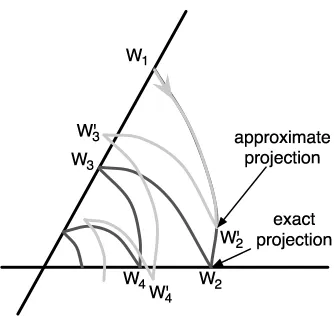
the constraints. It is well known that the Bregman projection into the intersection of convex re-gions can be solved by sequential projections to each region (Bregman, 1967; Censor and Lent, 1981). In the original papers only asymptotic convergence was shown. More recently a connection (Kivinen and Warmuth, 1999; Lafferty, 1999) was made to the AdaBoost algorithm which has an improved convergence analysis (Freund and Schapire, 1997; Schapire and Singer, 1999). We gen-eralize the latter algorithm and its analysis to symmetric positive definite matrices and call the new algorithm DefiniteBoost. As in the original setting, only approximate projections (Figure 1) are required to show fast convergence.
Before presenting the algorithm, let us describe the dual problem of minimizing the von Neu-mann divergence subject to linear constraints (4.1). The dual variables are the Lagrange multipliers
α∈Rn(α≥0) associated with this optimization problem:
α∗=argmax
α≥0 − log
(
tr exp(logW1−
n
∑
j=1αjsym(Cj)) !)
. (4.2)
See Appendix D for a detailed derivation of the dual problem that handles the case when the
con-straint matrixCjis allowed to be an arbitrary square matrix. Previous derivations required
symmet-ricCj(Tsuda and Noble, 2004). When (4.1) is feasible, the optimal solution is described as
W∗= 1
Z(α∗)exp(logW1−
n
∑
j=1α∗
jsym(Cj)),
3. Note that if ηis large then the on-line update (3.1) becomes a Bregman projection subject to a single equality constraint tr(W Xt) =yt.
Figure 1: The intersection of two convex sets (here two straight lines) can be found by projecting
back and forth between the two sets with exact Bregman projections (W1,W2, . . .). In
this paper we use certain approximate projections (W1,W20, . . .). Now each projection
may over or undershoot the alternating target set. Nevertheless, global convergence to the optimal solution is still guaranteed via our proofs.
where Z(α∗) =tr
exp(logW1−∑nj=1α∗jsym(Cj))
andα∗is the optimal dual solution.
4.2 Exact Bregman Projections
Problem (4.1) can be solved with the following algorithm: Start from some initial parameterW1
(for instanceW1=1
dI). At the t-th step, choose an unsatisfied constraint jt, i.e. tr(WtCjt)>0.
5
Then solve the following Bregman projection with respect to the chosen constraint:
Wt+1=argmin
W
∆F(W,Wt) (4.3)
s.t. W =W>,tr(W) =1,
tr(W Cjt)≤0.
By means of a Lagrange multiplierα, the dual problem is described as (cf. Appendix D)
α∗
t =argmin
α≥0
tr(exp(logWt−αsym(Cjt))). (4.4)
Using the solution of the dual problem,Wt is updated as
Wt+1=
1 Zt(α∗t)
exp(logWt−α∗t sym(Cjt)) (4.5)
where the normalization factor is Zt(αt∗) =tr(exp(logWt−α∗t sym(Cjt))). If Wt is symmetric
positive definite, thenWt+1is as well. Note that we can use the same numerically stable
reformu-lation of the update as discussed in Section 3.2.
4.3 Approximate Bregman Projections
The solution of (4.4) cannot be obtained in closed form. However, one can use the following
ap-proximate choice ofαt:
b
αt = 1
λmax t −λmint
log
1+rt/λmax t
1+rt/λmin t
, (4.6)
when the eigenvalues of sym(Cjt)lie in the interval[λ
min
t ,λtmax]and rt =tr(WtCjt). Since the most
unsatisfied constraint is chosen, rt≥0 and thusαtb ≥0. We call this approximate Bregman projection
algorithm DefiniteBoost. It may be seen as a natural extension of AdaBoost (cf. Section 4.5), where probability distributions are replaced by symmetric positive definite matrices of trace one. The pseudo-code of DefiniteBoost is given in Algorithm 2.
Algorithm 2 Pseudo-code of the DefiniteBoost algorithm; λmin
t and λmaxt are lower and upper
bounds on the eigenvalues of sym(Ct).
ChooseW1
InitializeG0=logW1
for t=1,2, . . .do
Choose an unsatisfied constraint jt(i.e. tr(WtCjt)>0) or stop when all constraints satisfied
Compute constraint violation rt=tr(WtCjt)
Compute approximate step sizeαbt= 1 λmax
t −λmint log
1+rt/λmaxt 1+rt/λtmin
UpdateGt=Gt−1−αbtsym(Cjt)
Compute spectral decomposition:Gt=VtΛtVt
UpdateWt+1=Vtexp(Λt−ctI)Vt>/tr(exp(Λt−ctI)), where ct=maxs(Λt)s,s
end for
Although the projection is done only approximately,6the convergence of the dual objective (4.2)
can be shown using the following upper bound of the negative dual objective , i.e.
tr exp(logW1−
n
∑
j=1αjsym(Cj)) !
.
Theorem 4.1 The negative exponentiated dual objective is bounded from above by
tr exp logW1−
T
∑
t=1 bαtsym(Cjt)
!!
≤ T
∏
t=1ρ(rt), (4.7)
where
b
αt= 1
λmax t −λmint
log
1+rt/λmax t
1+rt/λmin t
,rt=tr(WtCjt),
and
ρ(rt) =
1− rt
λmax t
λmax
t
λmax
t −λmint
1− rt
λmin t
−λmin
t
λmax
t −λmint .
The proof of this inequality for our setting is given in Appendix E. The bound (4.7) is monotonically
decreasing, becauseρ(rt)≤1. Also, since we always chose a violated constraint (if there is one),
we have rt >0 and therefore ρ(rt)<1 (or we stop). Thus the dual objective (4.2) continues to
increase until all constraints are satisfied.
4.4 Convergence Speed
Next we determine the maximal number of iterations needed to find a matrixW which satisfies all
constraints up to the predetermined accuracyε, i.e. tr(W Cj)≤ε, for 1≤ j≤n. The algorithm
selects in each iteration an constraint jt that is violated by at leastε (i.e. rt =tr(WtCjt)≥ε), or
stops if no such constraint exists. Assuming the algorithm stops at(T+1)-th step, we derive an
upper bound on T as a function ofε.
For simplicity, let us assume W1 = d1I, λminj =−λ, and λmaxj =λ (for all j). Denote by
hprimal(W)and hdual(α)the primal and dual objective functions in (4.1) and (4.2), respectively.
hprimal(W) = ∆F(W,W1) (4.8) hdual(α) = −log tr exp logW1−
n
∑
j=1αjsym(Cj) !!
(4.9)
The primal objective is upper-bounded by log d, since∆F(W,W1) =∑iλilogλi+log d≤log d.
Since the algorithm stops at the (T +1)-th iteration (with rt ≥ε for t =1, . . . ,T ), we get from
Theorem 4.1:
exp(−hdual(α˜)) =tr exp logW1−
T
∑
t=1 bαtsym(Cjt)
!!
≤
λ2−ε2 λ2
T/2
,
where ˜α is the cumulative coefficient vector for the constraints, i.e. eαj =∑Tt=1bαtδ(jt = j), for
1≤ j≤n.
Thus the objective in (4.2) is lower bounded by 12Tλε22, since
hdual(αe) ≥ −log
λ2−ε2 λ2
T/2
≥ Tε 2
2λ2, (4.10)
where the last inequality follows by convexity of−logλ2λ−2ε2
with respect to ε. At the optimal
solutionW∗andα∗, the values of the objective functions coincide, i.e. hdual(α∗) =hprimal(W∗).
Finally, we obtain
Tε2
2λ2 ≤hdual(αe)≤hdual(α∗) =hprimal(W∗)≤log d,
and the upper bound T ≤2λ2εlog d2 . In summary, we have proven the following:
rt =tr(WtCjt)≥ε, or stops if no such constraint exists. Then after at most T =
2λ2log d
ε2 iterations,
DefiniteBoost stops and the resultingW satisfies all linear constraints up to accuracyε, i.e.
tr(W Cj)≤ε for all j=1, . . . ,n.
This result implies that we can solve (4.1) with accuracyε in
O
(d3log d/ε2) operations(exclud-ing the cost of identify(exclud-ing violated constraints). Similar bounds on the number of iterations for solving a system of linear equations with the EG algorithm were first proven in (Littlestone et al.,
1992, Corollary 15). Observe that if (4.1) is not feasible, then one may continue findingε-violated
constraints and the primal objective can become unbounded, i.e.∑tαtb may become unbounded.
4.5 Relation to Boosting
When all matrices are diagonal, then DefiniteBoost specializes to the AdaBoost algorithm (Schapire
and Singer, 1999). Let{xi,yi}di=1 be the training samples, wherexi ∈Rmand yi ∈ {−1,1}. Let
h1(x), . . . ,hn(x)∈[−1,1]be the weak hypotheses. For the j-th hypothesis hj(x), let us defineCj=
diag(y1hj(x1), . . . ,ydhj(xd)). Since|yhj(x)| ≤1, we may chooseλtmax=1 andλmint =−1 for any t.
SettingW1=1dI, the dual objective (4.7) is rewritten as
−log 1
d d
∑
i=1exp −yi
n
∑
j=1αjhj(xi) !!
,
which is equivalent to the exponential loss function used in AdaBoost. SinceCj andW1 are
di-agonal, the matrixWt stays diagonal after the update. If wt,i= (Wt)i,i, the updating formula (4.5)
becomes the AdaBoost update: wt+1,i=wt,iexp(−αtyiht(xi))/Zt(αt).The approximate solution of
αt (4.6) is described asαt=1
2log 1+rt
1−rt, where rt is the weighted training error of the t-th hypothesis,
i.e. rt =∑di=1wt,iyiht(xi).
4.6 Solving Semi-definite Programs
Suppose we aim to solve the following semi-definite programming problem:
W∗=argmin
W,θ
θ (4.11)
s.t. tr(W) =1,W 0,W =W>
tr(W Cj)≤θ, for j=1, . . . ,n.
If one would know the optimal θ∗ beforehand, then following problem would lead to an optimal
solution of (4.11):
W∗=argmin
W
∆F(W,1
dI) (4.12)
s.t. tr(W) =1,W =W>
tr(W(Cj−θ∗I))≤0,for j=1, . . . ,n.
Running DefiniteBoost on the above problem with matrices Cej = (Cj−θ∗I) can approximate
θ∗. If it is chosen too small, then no feasible solution to (4.12) exists and DefiniteBoost will not
terminate after 2λ2log d/ε2 iterations with accuracyε,7 whereλmin(Ce
j)≥ −λ andλmax(Cje)≤λ.
If it is chosen too large, then a feasible solution exists and DefiniteBoost terminates in a bounded
number of iterations. Hence one has a way of identifying whenθ<θ∗and alsoθ>θ∗. This allows
the design of a binary search procedure to approximate θ∗ in a few steps. Based on this idea we
previously proposed a margin maximizing version of AdaBoost (R¨atsch and Warmuth, 2002). For
this algorithm we could show that after
O
(log d log(1/ε)/ε2)iterations the algorithm achieved anoptimal solution within accuracyε. We claim that the outlined binary search procedure can also
be applied in combination with DefiniteBoost for solving the semi-definite problem (4.11) in time
O
(d3log d log(1/ε)/ε2)(excluding the cost of identifying violated constraints). Additionally weassert that a slightly more advanced adaptation ofθduring the optimization (as was done by R¨atsch,
2001; R¨atsch and Warmuth, 2005, for the diagonal case) will yield the reduced time complexity of
O
(d3log d/ε2). Rigorous proofs of these conjectures go beyond the scope of this paper.5. Experiments on Learning Kernels
In this section, our technique is applied to learning a kernel matrix from a set of distance measure-ments. This application is not on-line per se, but it shows nevertheless that the theoretical bounds can be reasonably tight on natural data.
When K is a d×d kernel matrix among d objects, then the Ki j characterizes the similarity
between objects i and j. In the feature space, Ki j corresponds to the inner product between
ob-ject i and j, and thus the Euclidean distance can be computed from the entries of the kernel ma-trix (Sch¨olkopf and Smola, 2002). In some cases, the kernel mama-trix is not given explicitly, but only a set of distance measurements is available. The data are represented either as (i) quantitative dis-tance values (e.g., the disdis-tance between i and j is 0.75), or (ii) qualitative evaluations (e.g., the distance between i and j is small) (Xing et al., 2003; Tsuda and Noble, 2004). Our task is to obtain a positive definite kernel matrix which fits well to the given distance data.
5.1 On-line Kernel Learning
In the first experiment, we consider the on-line learning scenario in which only one distance example
is shown to the learner at each time step. The distance example at time t is described as{at,bt,yt},
which indicates that the squared Euclidean distance between objects at and bt is yt. Let us define
a time-developing sequence of kernel matrices as {Wt}Tt=1, and the corresponding points in the
feature space as{xti}di=1(i.e.(Wt)ab=x>taxtb). Then, the total loss incurred by this sequence is T
∑
t=1kxtat−xtbtk
2 −yt
2
=
T
∑
t=1(tr(WtXt)−yt)2,
where Xt is a symmetric matrix whose (at,at) and (bt,bt) elements are 0.5, (at,bt) and(bt,at)
elements are -0.5, and all the other elements are zero. We consider a controlled experiment in which
the distance examples are created from a known target kernel matrix. We used a 52×52 kernel
matrix among gyrB proteins of bacteria (d=52). This data contains three bacteria species (see
Tsuda et al., 2003, for details). Each distance example is created by randomly choosing one element
of the target kernel. The initial parameter was set asW1=d1I. When the comparison matrix U is set
0 0.5 1 1.5 2 2.5 3 x 10⁵ 0
0.2 0.4 0.6 0.8 1 1.2 1.4 1.6 1.8
Iterations
Total Loss
0 0.5 1 1.5 2 2.5 3 x 10⁵ 0.05
0.1 0.15 0.2 0.25 0.3 0.35 0.4 0.45
Iterations
Classification Error
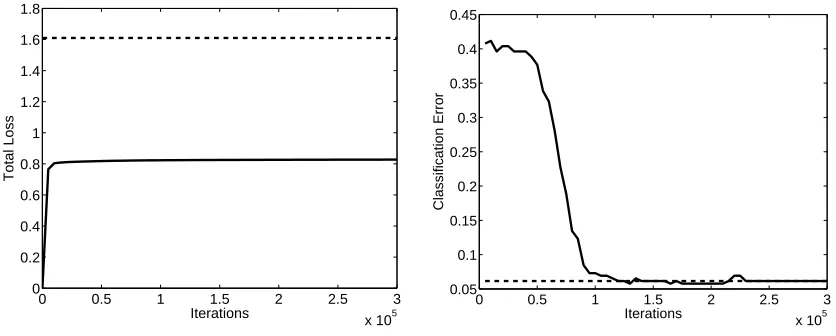
Figure 2: Numerical results of on-line learning. (Left) total loss against the number of iterations. The dashed line shows the loss bound. (Right) classification error of the nearest neighbor classifier using the learned kernel. The dashed line shows the error by the target kernel.
to the target matrix, then because all the distance examples are derived from this matrix, LU(S) =0
and Lmax=0. Therefore we choose learning rateη=2, which minimizes the relative loss bound of
Lemma 3.2. The total loss of the kernel matrix sequence obtained by the matrix exponential update is shown in Figure 2 (left). In the plot, we have also shown the relative loss bound. The bound seems to give a reasonably tight performance guarantee—it is about twice the actual total loss. To evaluate the learned kernel matrix, the prediction accuracy of bacteria species by the nearest neighbor classifier is calculated (Figure 2, right), where the 52 proteins are randomly divided into 50% training and 50% testing data. The value shown in the plot is the test error averaged over 10
different divisions. It took a large number of iterations (∼2×10⁵) for the error rate to converge
to the level of the target kernel. In practice one can often increase the learning rate for faster convergence, but here we chose the small rate suggested by our analysis to check the tightness of the bound.
5.2 Kernel Learning by Bregman Projection
Next, let us consider a batch learning scenario where we have a set of qualitative distance evaluations (i.e. inequality constraints). Given n pairs of similar objects{aj,bj}nj=1, the inequality constraints
are constructed askxaj−xbjk ≤γ,j=1, . . . ,n, whereγis a predetermined constant. IfXjis defined
as in the previous section and Cj =Xj−γI, the inequalities are then rewritten as tr(W Cj)≤
0,j=1, . . . ,n. The largest and smallest eigenvalues of any Cj are 1−γ and −γ, respectively.
As in the previous section, distance examples are randomly generated from the target kernel matrix
betweengyrBproteins. Settingγ=0.2/d, we collected all object pairs whose distance in the feature
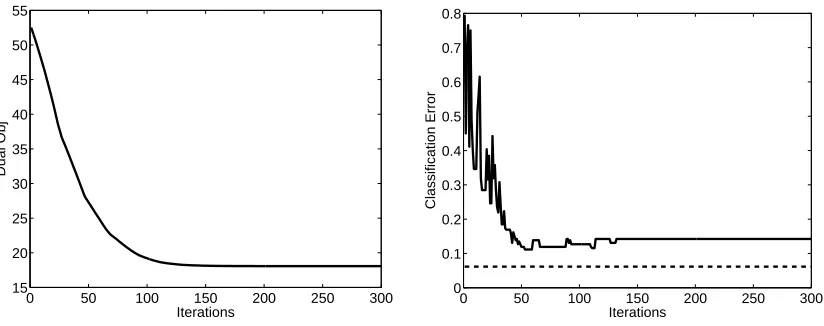
space is less thanγto yield 980 inequalities (n=980). Figure 3 (left) shows the convergence of
0 50 100 150 200 250 300 15
20 25 30 35 40 45 50 55
Iterations
Dual Obj
0 50 100 150 200 250 300 0
0.1 0.2 0.3 0.4 0.5 0.6 0.7 0.8
Iterations
Classification Error
Figure 3: Numerical results of Bregman projection. (Left) convergence of the dual objective func-tion. (Right) classification error of the nearest neighbor classifier using the learned kernel.
neighbor classifier. As opposed to the previous experiment, the error rate is higher than that of the target kernel matrix, because a substantial amount of information is lost by the conversion to inequality constraints.
6. Summary and Discussion
We motivated and analyzed a new update for symmetric positive matrices using the von Neumann divergence. We showed that the standard bounds for on-line learning and boosting generalize to the case when the parameters are symmetric positive definite matrices of trace one instead of a probability vector. As in quantum physics, the eigenvalues act as probabilities. In addition to the applications suggested by the experiments, our algorithm can be straightforwardly applied to
learning a covariance matrix. It would also be interesting to use a robust loss Lt(W)for the purpose
of ignoring outliers (Huber, 1981) and investigate possible applications of our learning algorithms to quantum statistical inference problems (Barndorff-Nielsen et al., 2003).
Our method is designed for learning a positive definite parameter matrix of fixed size. It is
not straightforward to extend it to the case where the size of the parameter matrix grows on-line as more examples are seen. Our methods immediately generalize to the Hermitian matrices, i.e.
square matrices inCd×d for whichA=A¯>=A∗. The spectral decomposition of these matrices
becomesA=UΛU∗, whereU is a unitary matrix (i.e.U U∗=I) andΛis a diagonal matrix of
real eigenvalues. In the case when all entries of the matrix are real, then Hermitian is equivalent
Acknowledgments
We dedicate this paper to Nick Littlestone who first proved relative loss bounds for an algorithm in the EG family—his well known Winnow algorithm for learning disjunctions (Littlestone, 1988, 1989).
K.T. and G.R. gratefully acknowledge partial support from the PASCAL Network of Excellence (EU #506778). M.W. was supported by NSF grant CCR 9821087 and UC Discovery grant LSIT02-10110. This work was partially done while G.R. was still at Fraunhofer FIRST in Berlin and Max Planck Institute for Biological Cybernetics in T¨ubingen. Part of this work was done while all three authors were visiting the National ICT Australia in Canberra.
Appendix A. Derivatives of Matrix Functions
The matrix functions considered in this paper are mostly trace functions e.g. tr(exp(W)) and
tr(WlogW), which we will expand into power series. Thus we begin with computing the
gra-dient of F(W) =tr(Wk). The partial derivative with respect to(i,j)element is described as
∂tr(Wk) ∂Wi j
=lim
λ→0
tr((W+λEi j)k)−tr(Wk)
λ ,
whereEi j is the sparse matrix whose(i,j)element is one and all the others are zero. For example,
when k=3,
(W+λEi j)3= (W3+λEi jW W+λW Ei jW+λW W Ei j) +O(λ2).
The trace is simply described as
tr((W+λEi j)3) = tr(W3) +3λtr(Ei jW2) +O(λ2)
= tr(W3) +3λ[W2]j,i+O(λ2).
Therefore,∇Wtr(W3) =3(W2)>. For general k, we get
∇Wtr(Wk) =k(Wk−1)>. (A.1)
The matrix exponential is defined as
exp(W) =I+W+ 1
2!W
2+ 1
3!W
3+ ···.
Applying (A.1) to all terms, we get∇Wtr(exp(W)) =exp(W)>. Next, let us calculate the gradient
of tr(WlogW−W). Using the expansion
logW = ∞
∑
i=1(−1)i−1
i (W−I) i,
we get
WlogW−W = ∞
∑
i=2(−1)i
i(i−1)(W−I)
i−I.
Applying the shifted version of (A.1), i.e.∇Wtr((W−I)k) =k((W−I)k−1)>, to all terms, the
gradient is obtained as∇Wtr(WlogW−W) = (logW)>. WhenW is symmetric, then one can
Appendix B. Derivation of the MEG Update
In this appendix we derive parameter updates when the parameter must meet some linear constraints. One method is to incorporate such constraints into the strictly convex function F defining the Breg-man divergence. The modified function F is then only defined when the constraints are met. The updates always have the simple form (3.2). However this method often leads to difficult forms of F
andf=∇F. Here we choose the alternate method of keeping the linear constraints on the side. We
begin by discussing how to enforce symmetry. Consider the following optimization problem, where
Xt is an arbitrary matrix inRd×d,Wt an arbitrary symmetric matrix inRd×d and yt ∈R:
Wt+1=argmin
W
∆F(W,Wt) +ηLt(W)
s.t.W =W>.
We assume that∇WLt(W)is always a well defined matrix inRd×d.
We introduce one Lagrange multiplier Γi,j for the each of the constraints Wi,j =Wj,i. This
contributes the termΓi,j(Wi,j−Wj,i)to the Lagrangian. In matrix form these constraints can be
summarized as tr(Γ(W>−W)) =tr((Γ>−Γ)W). This gives us the Lagrangian
L
(W,Γ) =∆F(W,Wt) +ηLt(W) +tr((Γ>−Γ)W).forΓ∈Rd×d. Setting the gradient with respect toW to zero yields:
Wt+1=f−1
f(Wt)−η∇WLt(Wt+1)−(Γ−Γ>)
.
Since the objective is convex, it suffices to exhibit a choice ofΓsuch that the symmetry constraint
is satisfied. Under the assumption that f and f−1 preserve symmetry,Γ=−η∇
WLt(Wt+1)/2
achieves this and the update becomes (3.3):
Wt+1=f−1
f(Wt)−ηsym(∇WLt(Wt+1))>)
.
For the normalized case we still need to enforce the trace one constraint onWt+1. This adds a
termδ(tr(W)−1)to the Lagrangian and the update now has the form
Wt+1=exp
logWt−η∇WLt(Wt+1)−(Γ−Γ>)−δI
.
ChoosingΓ=−η∇WLt(Wt+1)/2 and
δ=−log(tr(exp(logWt−ηsym(∇WLt(Wt+1)))))
enforces the symmetry and trace constraints and after approximating the gradient we arrive at the explicit MEG update (3.5).
Appendix C. Proof of Lemma 3.1
Letδt=−2η(tr(XWt)−yt), then the right hand side of (3.6) can be reformulated as
Therefore, (3.6) is equivalent to f ≤0, where
f=log tr(exp(logWt+δtsym(Xt)))−δttr(U Xt) +a(yt−tr(WtXt))2−b(yt−tr(U Xt))2.
Let us bound the first term. Due to Golden-Thompson inequality (2.3), we have
tr(exp(logWt+δtsym(Xt)))≤tr(Wtexp(δtsym(Xt))). (C.1)
The right hand side can be rewritten as
exp(δtsym(Xt)) =exp(r0δt)exp(δt(sym(Xt)−r0I)).
Let r0be a lower bound of the eigenvalues of sym(Xt). By assumption, the range of the eigenvalues
of sym(Xt)is at most r, i.e.
r0I sym(Xt)(r0+r)I.
Thus0AI, forA= (sym(Xt)−r0I)/r. Applying Lemma 2.1 with this choice ofAand
ρ1=rδt,ρ2=0, we obtain
exp(δt(sym(Xt)−r0I))I−
sym(Xt)−r0I
r (1−exp(rδt)).
SinceWt is symmetric positive definite and both sides of the above inequality are symmetric, we
can apply Lemma 2.2 by pre-multiplying the inequality byWt and taking a trace of both sides:
tr(Wtexp(δtsym(Xt)))≤exp(r0δt)
1−tr(WtXt)−r0
r (1−exp(rδt))
.
Note that we used the assumption that tr(Wt) =1. The above gives an upper bound on the right
hand side of inequality (C.1) We now plug this upper bound into the first term of f and obtain f ≤g,
where
g= r0δt+log(1−tr(WtXt)−r0
r (1−exp(rδt)))−tr(U Xt)δt
+a(yt−tr(WtXt))2−b(yt−tr(U Xt))2. (C.2)
Let us define z=tr(U Xt)and maximize the upper bound (C.2) with respect to z. Solving ∂∂gz =0,
we have z=yt−δt/(2b) =yt+η(tr(XtWt)−yt)/b. Substituting this into (C.2), we have the upper
bound g≤h where
h= 2ηr0(yt−tr(XtWt)) +log1−tr(XtWt)−r0
r (1−exp(2ηr(y−tr(XtWt))))
−2ηyt(yt−tr(XtWt)) + (a+η
2
b(y−tr(XtWt))2.
We now upper bound the second term using the inequality log(1−p(1−exp q))≤pq+q2/8, for
0≤q≤1 and q∈R(Helmbold et al., 1997):
h≤(yt−tr(XtWt)) 2
2b ((2+r
2b)η2−4bη+2ab).
It remains to show q= (2+r2b)η2−4bη+2ab≤0. We easily see that q is minimized forη=
Appendix D. Derivation of the DefiniteBoost Dual Problem
For the sake of brevity we assume that the primal problem has one inequality constraint (note that (4.1) has multiple constraints):
W∗=argmin
W
tr(W(logW−logW1) +W1−W
s.t. tr(W C)≤0
tr(W) =1
W =W>.
Following Appendix B we arrive at the Lagrangian
L
(W,α,β,Γ) := tr(W(logW−logW1) +W1−W+αtr(W C) ++β(tr(W)−1) +tr((Γ>−Γ)W), (D.1)
which is minimized w.r.t.W and maximized w.r.t.α≥0,β∈RandΓ∈Rd×d. Setting the gradient
w.r.t.W to zero we obtain
W∗ = exp(logW1−αC−βI−(Γ−Γ>)
= exp(−β)exp(logW1−αC−(Γ−Γ>).
We now enforce the symmetry constraint, giving usΓ=−α(C−C>)/2, and plug this choice into
the above
W∗=exp(−β)exp(logW1−αsym(C)).
Similarly,β=log tr(exp(logW1−α sym(C)))enforces the trace constraint. Now
W∗=exp(logW1−αsym(C)/Z(α),
where Z(α) =−log tr(exp(logW1−αsym(C))). PluggingW∗into in the Lagrangian, we obtain
the dual optimization problem for one constraint:
α∗=argmax
α≥0 −
log Zt(α).
One can easily verify that the solution of the problem with n constraints is of the form:
α∗=argmax
α≥0 −
log tr(exp(logW1− n
∑
j=1αjsym(Cj))).
Appendix E. Proof of Theorem 4.1
Recall the definition of the normalization factor Zt(α) =tr(exp(logWt−αsym(Cjt)))of
Definite-Boost. By the Golden-Thompson inequality,
Similarly to the proof of Lemma 3.1, we now upper bound the right hand side of this
inequal-ity by applying lemmas 2.1 and 2.2. We chooseA as(λmin
t I+sym(Cjt))/(λ
max
t +λmint ). Then
sym(Cjt)can be expressed asλ
max
t A−λmint (I−A)and0AI. Thus by Lemma 2.1,
exp(−αsym(Cjt))exp(−αλ
max
t )A+exp(αλmint )(I−A).
Since Wt is positive definite and both sides of the above inequality are symmetric, we can apply
Lemma 2.2 by multiplying this inequality byWt and taking a trace of both sides:
tr(Wtexp(−αsym(Cjt)))≤exp(−αλ
max
t )tr(WtA) +exp(αλtmin)tr(Wt(I−A)).
By expandingAand using the shorthand rt=tr(WtCjt), we obtain
Zt(α)≤exp(−αλmaxt ) λmin
t +rt λmax
t +λmint
+exp(αλmin) λ
max t −rt λmax
t +λtmin
.
We now choose theα that minimizes the right hand side of the above inequality (which is theαtb
given in equation (4.6)). With this choice, the inequality becomes
Zt(bαt)≤(1− rt λmax
t
) λmax
t
λmax
t +λtmin(1+ rt
λmin t
) λmin
t
λmax
t +λtmin. (E.2)
Applying the update rule (4.5) T times, we have
WT+1=
exp(logW1−∑Tt=1bαtsym(Cjt))
∏tZt(bαt)
.
Taking the trace of both sides and rearranging terms, we get
tr exp(logW1−
T
∑
t=1 bαtsym(Cjt))
!
=
T
∏
t=1Zt(bαt).
By using the bound (E.2) for each Zt(αt), the inequality of the theorem readily follows.
References
O. E. Barndorff-Nielsen, R. D. Gill, and P. E. Jupp. On quantum statistical inference. J. R. Statist.
Soc. B, 65(4):775–816, 2003.
S. Boyd and L. Vandenberghe. Convex Optimization. Cambridge University Press, 2004.
L. M. Bregman. The relaxation method of finding the common point of convex sets and its applica-tion to the soluapplica-tion of problems in convex programming. USSR Computaapplica-tional Mathematics and
Physics, 7:200–217, 1967.
Y. Censor and A. Lent. An iterative row-action method for interval convex programming. Journal
of Optimization Theory and Applications, 34(3):321–353, July 1981.
S. Golden. Lower bounds for the Helmholtz function. Phys. Rev., 137:B1127–B1128, 1965.
D. Helmbold, R. E. Schapire, Y. Singer, and M. K. Warmuth. A comparison of new and old algo-rithms for amixture estimation problem. Machine Learning, 27(1):97–119, 1997.
P. J. Huber. Robust Statistics. John Wiley and Sons, New York, 1981.
J. Kivinen and M. K. Warmuth. Exponentiated gradient versus gradient descent for linear predictors.
Information and Computation, 132(1):1–63, 1997.
J. Kivinen and M. K. Warmuth. Boosting as entropy projection. In Proceedings of the 12th Annual
Conference on Computational Learning Theory, pages 134–144. ACM Press, New York, NY,
1999.
J. Kivinen and M. K. Warmuth. Relative loss bounds for multidimensional regression problems.
Machine Learning, 45(3):301–329, 2001.
J. Lafferty. Additive models, boosting, and inference for generalized divergences. In Proceedings
of the 12th Annual Conference on Computational Learning Theory, pages 125–133. ACM Press,
New York, NY, 1999.
N. Littlestone. Learning when irrelevant attributes abound: A new linear-threshold algorithm.
Ma-chine Learning, 2:285–318, 1988.
N. Littlestone. Mistake Bounds and Logarithmic Linear-threshold Learning Algorithms. PhD thesis, Technical Report UCSC-CRL-89-11, University of California, Santa Cruz, 1989.
N. Littlestone, P. M. Long, and M. K. Warmuth. On-line learning of linear functions. Technical Report UCSC-CRL-91-29, University of California, Santa Cruz, May 1992.
M. A. Nielsen and I. L. Chuang. Quantum Computation and Quantum Information. Cambridge University Press, 2000.
G. R¨atsch. Robust Boosting via Convex Optimization. PhD thesis, University of Potsdam, Potsdam, Germany, October 2001.
G. R¨atsch and M. K. Warmuth. Maximizing the margin with boosting. In Proceedings of the
15th Annual Conference on Computational Learning Theory, pages 319–333. Springer, Sydney,
Australia, 2002.
G. R¨atsch and M. K. Warmuth. Efficient margin maximization with boosting. submitted to Journal of Machine Learning Research, 2005.
R. E. Schapire and Y. Singer. Improved boosting algorithms using confidence-rated predictions.
Machine Learning, 37:297–336, 1999.
B. Sch¨olkopf and A. J. Smola. Learning with Kernels. MIT Press, Cambridge, MA, 2002.
S. Shai-Shwartz, Y. Singer, and A. Y. Ng. Online and batch learning of pseudo-metrics. In C. E. Brodley, editor, Machine Learning, Proceedings of the Twenty-first International Conference
Y. Singer and M. K. Warmuth. Batch and on-line parameter estimation of Gaussian mixtures based on the joint entropy. In M. S. Kearns, S. A. Solla, and D. A. Cohn, editors, Advances in Neural
Information Processing Systems 11 (NIPS’98), pages 578–584. MIT Press, 1999.
I. W. Tsang and J. T. Kwok. Distance metric learning with kernels. In Proceedings of the
Interna-tional Conference on Artificial Neural Networks (ICANN’03), pages 126–129. Springer Verlag,
New York, NY, 2003.
K. Tsuda, S. Akaho, and K. Asai. The em algorithm for kernel matrix completion with auxiliary data. Journal of Machine Learning Research, 4:67–81, May 2003.
K. Tsuda and W. S. Noble. Learning kernels from biological networks by maximizing entropy.
Bioinformatics, 20(Suppl. 1):i326–i333, 2004.
E. P. Xing, A. Y. Ng, M. I. Jordan, and S. Russell. Distance metric learning with application to clustering with side-information. In S. Thrun S. Becker and K. Obermayer, editors, Advances in