SHREDDED CABBAGE
Thushara.T.Chandran*, Dr. Mini.C1and Dr. Geethalekshmi. P.R2 1,2
Department of Processing Technology, College of Agriculture, Vellayani, Kerala Agricultural University (Kerala) India
*Corresponding author: Thushara.T.Chandran
Abstract
Good quality cabbage of variety NS43 was collected and surface sanitized using 30 ppm sodium hypo chlorite solution, outer strings removed, washed and fresh shreds were made, pretreatedwith 1% calcium chloride solution, air dried and packaged under different packaging materials and stored under refrigerated storage. Analysis of physical, physiological and chemical quality parameters and microbial revealed that vacuum packaging in laminated pouches as the effective packaging material for shredded cabbage.
Key words: Cabbage, fresh cut vegetables, packaging materials, shelf life.
I. INTRODUCTION
Consumer demand for high quality foods requiring only minimum effort and time for preparation has led to the introduction of ready-to-use fresh- cut products/ minimally processed foods.Minimal processing technique has emerged to meet the challenge of replacing traditional methods of preservation while retaining nutritional and sensory quality. Fresh-cut products are fruit or vegetables that have been trimmed and/or peeled and/or cut into 100 percent usable product that is bagged or prepackaged to offer consumers high nutrition, convenience, and flavor while still maintaining its freshness [9].But they are highly perishable due to damaged and exposed tissues and lack of protective skin. Application of partial processingincreases perishability due to increased metabolic activities and decompartmentalization of enzymes and substrates which may cause browning, softening, and off-flavor development [19, 16].Modified atmosphere packaging (MAP) can extend storage life of fruits and vegetables by controlling respiration rate, senescence and ripening [20] and can also decrease the rate of browning reactions due to reduced O2level and elevated CO2 level in the surrounding atmosphere [9]. Physical and
II. MATERIALS AND METHODS
Fresh and good quality cabbage of variety NS43at correct maturity was procured from FSRS, Sadananthapuram wereused for the study. Harvested beans were washed in tap water, followed by distilled water and subjected to surface sanitization using 30 ppm sodium hypo chlorite solution [2] for 10 minutes.Sanitizing solution was drained after 10 minutes, outer damaged and diseased leaves removed, washed again in distilled water and made into uniform cut piecesusing vegetable cutter. Fifty grams of treated shredded cabbage were completely immersed in 1% calcium chloride [3]for 15 minutes.The solution was drained;cuts air dried and 100g cabbage shreds were weighed and packed in following different packaging materials stored under refrigerated condition (5-70C) for finding the most effective packaging material for extending the shelf life of shredded beans. T1- unventilated PE cover
(150 gauge), T2- unventilated PP cover (100 gauge), T3-micro ventilated PE cover (150 gauge), T4-
micro ventilated PP cover (100 gauge), T5- polystyrene tray with cling film, T6- MAP in laminated
pouches and T7- Control. In treatments from T1 to T4 fresh cut vegetables were packaged in plastic
PE/PP covers of 0.18m2 area. In treatments T3 and T4 covers of similar size were perforated by making
total six pores on both sides of the packages. In T6MAP was done in laminated pouches using a
laboratory model vacuum packaging machine (Sevana’s sevol V vacuum packing machine QS 400 MG (MC). Physical, physiological and chemical quality parameters of shredded cabbage were analyzedon the first, third and fifth day of storage and average worked out to find out the most effective packaging material for increasing the shelf life.
The treated packaged cabbage shreds were steamed for 60 seconds and physical parameters like color, texture, appearance, flavor and taste of the steamed shreds were examined on the thirdday of storage by conducting a sensory evaluation trial performed by a 30 member semi - trained panel using a nine point hedonic scale [17].
Physiological parameters like physiological loss in weight (PLW), water potential and percent leakage of the packaged cabbage shreds were recorded on alternate days for five days of storageusing standard techniques.
Physiological loss in weight was determined on initial weight basis using a laboratory level weighing balance and expressed as percentage.Water potential of packaged shreds was estimated using Chardakov’s method [15]and expressed in Mega Pascals. Shredded cabbage from each packageswere dipped in distilled water for three hoursand absorbance of distilled water was recorded at 273nm, shreds were heated in water bath at 1000C for 20 minutes and absorbance was again recorded at 273nm. The ratio of initial and final absorbance values was recorded as percent leakage[15].
Chemical parameters like starch, vitamin C, carotenoids [16] and total phenol [15] of treated packaged cabbage shreds were recorded on alternate days for five days of storage.Comparatively more important quality parameters were given more weightage and selection index was calculated by conducting discriminal function analysis for finding the superior four packaging materials for further microbial analysis using serial dilution spread plate technique [10]. Whole cabbage were surface sanitized using 30 ppm sodium hypochlorite, shreds prepared, treated with standardized 1% calcium chloride and microbial count on one gram treated and packaged cabbage sample was calculated once in two days for five days.Based on the efficiency in controlling microbial population to the lowest level, best effective packaging material for increasing the shelf life of cabbage shreds was selected.
III. RESULTS AND DISCUSSION
Physical and physiological parameters
Minimally processed food products are highly perishable; such products are prepared, and packaged to maintain their freshness and provide convenience to the user. Packaging materials have significant effect in reducing microbial population of fresh cut products [18]. Packaged cut materials are subjected to many stresses including deterioration reactions of wounded or senescing tissues, decay caused by growth of microorganisms, water loss from tissue, increase in respiration and ethylene production. These injuries induce severe damage and stress with considerable reduction in shelf life of commodity.
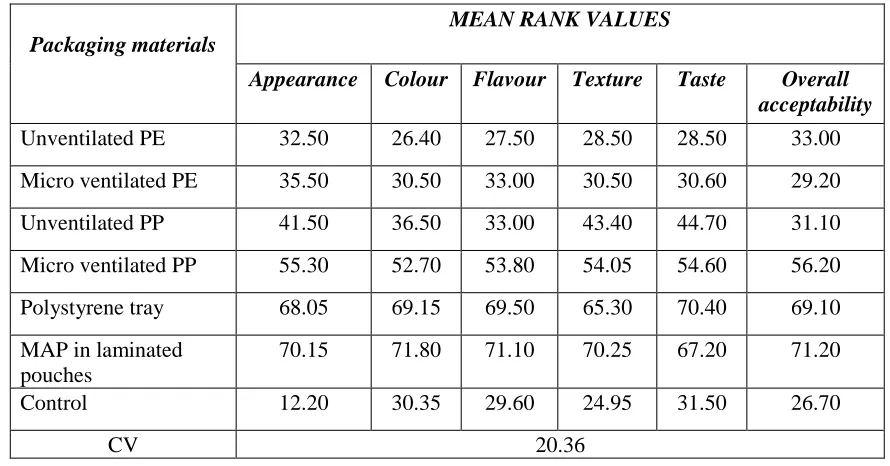
Packaging of fruits is to assemble the produce inconvenient units to protect it from deterioration during its handling from farm gate to consumer’s house [13]. Adequate and proper packaging protects the fruits from physical (firmness), physiological (weight) and pathological (decay) deterioration.Effect of different packaging materials on physiological and physical quality parameters of shredded cabbage showed significant difference (Table 1and 2).
Table 1. Effect of packaging on physiological quality parameters of shredded cabbage
Table 2. Effect of packaging on physical quality parameters of shredded cabbage Packaging materials
Physiological loss in weight
(%)
Water potential
(MPa)
Percent leakage
Unventilated PE 1.25 0.16 89.83
Micro ventilated PE 1.81 0.16 88.70
Unventilated PP 1.26 0.19 87.97
Micro ventilated PP 2.18 0.15 80.12
Polystyrene tray 1.41 0.18 78.56
MAP in laminated pouches 0.88 0.24 76.17
Control 5.79 0.12 92.83
CD (P=0.05) 0.40 0.04 1.91
Packaging materials
MEAN RANK VALUES
Appearance Colour Flavour Texture Taste Overall
acceptability
Unventilated PE 32.50 26.40 27.50 28.50 28.50 33.00
Micro ventilated PE 35.50 30.50 33.00 30.50 30.60 29.20
Unventilated PP 41.50 36.50 33.00 43.40 44.70 31.10
Micro ventilated PP 55.30 52.70 53.80 54.05 54.60 56.20
Polystyrene tray 68.05 69.15 69.50 65.30 70.40 69.10
MAP in laminated pouches
70.15 71.80 71.10 70.25 67.20 71.20
Control 12.20 30.35 29.60 24.95 31.50 26.70
In the present experiment when different packaging materials were compared, modified atmospheric packaging was found superior in performance for all the physiological parameters evaluated for shredded cabbage.Any fresh cut vegetable should have low physiological loss in weight to have high water potential, there by exhibiting freshness and turgidity. An efficient packaging material should help in retention of these characters throughout the storage period. In general modified atmospheric packaging system viz., vacuum packaging had low physiological loss in weight and percent leakage and hence had higher water potential (Table 1). This is in accordance with the findings of [4] who had reported that minimally processed jack fruit bulbs under vacuum packaging showed least physiological weight loss compared to conventional packaging.
Improved physiological parameters are the result of low transpiration and respiration rate of vegetable shreds under modified atmospheric condition. Comparing physiological parameters, physiological loss in weight was least (0.88) for the sample packed MAP. Maximum water potential (0.24) was observed for sample kept in MAP and similarly shredded cabbage under MAP packaging had the least percent leakage (76.17). This was supported by [12] who revealed that the commercial use of modified atmospheric packaging (MAP) provides the means to slow down the process of ripening and senescence by retarding the rate of respiration, transpiration and ethylene evolution and thus subsequently ensuring in better quality retention during storage, transport and marketing.Maximum weight loss (5.79), and lowest water potential (0.12) was reported in unpackaged samples resulted in higher percent leakage (92.83) in shredded cabbage.
Vegetable shreds with good physiological parameters were naturally fresh looking and hence had high score in physical parameters like appearance and texture in sensory scoring. In the present study mean rank value for appearance (70.15), color (71.80), flavor (71.10), texture (70.25) was maximum for samples under MAP in laminated pouches and similarly in case of taste (70.49) Mean rank was maximum for shredded cabbage in polystyrene tray which was on par with samples packaged in laminated pouches under MAP (67.20) and micro ventilated PP (54.60). For all the physical parameters evaluated the least (26.70) mean rank value was for the shredded cabbage without any packaging and hence scored least overall acceptability for physical parameters like color and texture.
IV. CHEMICAL PARAMETERS
Chemical quality parameters viz., starch, vitamin C, carotenoid and total phenol were influenced by different packaging materials used for shredded cabbage.
Shredded cabbage in laminated pouch under MAP packaging showed maximum (5.35) starch content. Vitamin C content was maximum (66.45) for shredded cabbage subjected to MAP. Maximum starch and vitamin C in modified atmospheric packaging was in conformity with the results of [4] who had reported that the vacuum packaging technique with excluded air (O2) from the package headspace
influenced the retention of ascorbic acid in minimally processed jack fruit bulbs compared to the conventional packaging techniques. The least starch and vitamin C was recorded by the unpackaged sample.
Highest carotenoid (199) was for shredded cabbage packaged under MAP. Due to the higher carotenoid content of MAPsamples they had good color and appearance and they scored high mean rank values for physical parameters when scoring was conducted. Lowest carotenoid (91.00) was for the unpackaged shredded cabbagefollowed by the sample packaged in micro ventilated PE (108).
Table 3. Effect of packaging on chemical quality parameters of shredded cabbage
Packaging materials
Starch (%)
Vit. C (mg/100g)
Carotenoids (µg/100g)
Total phenol (mg/100g)
Unventilated PP 4.97 62.95 112.00 59.32
Micro ventilated PP 4.75 60.96 131.00 55.99
Polystyrene tray 5.05 63.34 146.00 43.16
MAP in laminated pouches
5.35 66.45 199.00 23.18
Control 3.93 57.89 91.00 68.92
CD (P=0.05) 0.39 1.50 9.00 1.58
Total phenol was least (23.18) for sample packaged in laminated pouches under MAPand this least phenol content was due to least enzymatic browning which favored the samples to score higher mean rank values for appearance and color during sensory scoring. Highest (68.92) phenol content and least carotenoid (91.00) content were recorded in the unpackaged shreds whichresulted in poor rank value for texture and color during sensory test. Retention of nutritional quality parameters like increased carotenoid, starch and vitamin C was noticed in cabbage shreds packaged under modified atmosphere packaging. This was supported by [7] that the quality of fresh-cut tomato slices during cold storage under various MAP conditions, and MAP provided good quality tomato slices with a shelf life of two weeks or more at 5 °C.
Based on comparatively different chemical and physiological parameters, the top ranking four packaging materials were selected by conducting discriminal function test for each shredded packages, based on which selection index of different packages was determined. Based on selection index, the packaging materials like MAP in laminated pouches, polystyrene tray with cling film and micro ventilated PP and unventilated PE were selected as the top four packaging materials and subjected to microbial analysis.
When microbial population was analyzed, MAP in laminated pouches wasfound effective in reducing the microbial population compared to micro ventilated PP, unventilated PE and polystyrene tray. As microbial count was significantly low under refrigerated condition, influence of low temperature in inhibiting microbial growth on fresh cut products [1]. In the present study, considering the physical. physiological, chemical and microbial population MAP in laminated pouches was selected as the best effective packaging material for extending the shelf life of shredded cabbage. So fresh cabbage sanitized with 30ppm sodium hypochlorite solution, pretreated with 1% calcium chloride and packaged in laminated pouches under MAPwas found safe for storage upto for 7 days.
BIBLIOGRAPHY
[1] Bacts, J. A. and Tamplin, M. L. 2002. Sales of vegetables for hazard analysis and critical control point and sanitation. In. Bacts, J.A and Brecht, J.K (Eds) Postharvest physiology and pathology of vegetables . Marcel Dekker, New York. pp.563-580.
[2] ChandranThushara, T. and Mini, C. 2014. Effect of pre storage treatments on the shelf life of fresh cut carrots. Internat. J. Proc. & Post Harvest Technol., 5(2): 114-119
[3] Chandran,T.C. 2013. Protocol development for fresh cut vegetables. MSc (Hort) thesis. Kerala Agricultural University.
Thrissur. 187p.
[4] Gayathri, R. 2013. Studies on morphological characterization, in vitro culture and minimal processing of bulbs, in some elite clones of jack fruit (Artocarpusheterophyllus L)., MSc (Hort) thesis. University of Horticultural Sciences. Bagalkot. 124p.
[5] Gomez, K.A. and Gomez, A.A. 1984.Statistical proceedings for agricultural research (2nd ed0. John Willey and Sons Inc., Singapore, 262p
[6] Gonzalez-Aguilar, G. A., Ruiz-Cruz.S., Cruz- Valenzuela, R., Rodriguez- Felix, A. and Wang, C.Y. 2004. Physiological
and quality changes of fresh cut pineapple treated with anti-browning agents. Lebensm- wiss Technol. 37, 369-376. [7] Hong, J. H. and Gross, K. C. 2001. Maintaining quality of fresh cut tomato slices through modified atmospheric
packaging and low temperature Storage. J. Fd Sci. 66: 960-965.
[9] IFPA, The International Fresh cut Produce Association. 2004. IFPA homepage (online). Fresh cut facts. http://www. Freshcuts.org.
[10]Kramer, J. M. and Gilbert, R. J. 1978. Enumeration of micro-organisms in food: a comparative study of five methods. J. Hygiene. 81: 151-159.
[11]Lamikanra, O. 2002. Fresh cut fruits and vegetables, science technology and market. Boca Raton, Florida, CRC Press.
LLA.
[12]Mattheis, J. and Fellman, J. K. 2000. Impacts of modified atmosphere packaging and controlled atmosphere on aroma,
flavour and quality of horticultural commodities.Hort. Technol., 18: 507-510.
[13]Neeraj, J. M. S. and Bhatia, S. K. 2003. Use of plastics in fruit packaging :A review. Haryana J. Hort Sci., 32: 1-8. [14]Rolle, R.S. and Chism, G.W. 1987. Physiological consequences of minimally processed fruits and vegetables. J. Food
Qual. 10: 157–165.
[15]Sadasivam, S. and Manikam, A. 1992.Biochemical methods for agricultural science.Wiley Eastern Ltd. New Delhi. 246p
[16]Saini, R. S., Sharma, K. D., Dhankar, O. P. and Kaushik, R.A. 2001. Laboratory manual of analytical techniques in horticulture. AgroBios. India. 135p.
[17]Stone, H., Bleibaum, R. and Thomas, H.A. 2012. Sensory evaluation practices. Academic Press. 446p
[18]Varghese, S. 2006. Standardization of minimal processing techniques for selected vegetables.MSc (Hort.) thesis.Kerala Agricultural University.Thrissur. 89p.
[19]Watada, A.E., Abe, K., and Yamuchi, N. 1990. Physiological activities of partially processed fruits and vegetables. Food Technol. 44(5): 116–122.
[20]Zagory, D. and Kader, A.A. 1988. Quality maintenance in fresh fruits and vegetables by controlled atmosphere. Ch. 14