http://www.sciencepublishinggroup.com/j/ijiis doi: 10.11648/j.ijiis.20170605.11
ISSN: 2328-7675 (Print); ISSN: 2328-7683 (Online)
The Ways of Increasing Quality of Human Recognition in
Biometric Network Environment
Shafagat Mahmudova
Institute of Information Technology of ANAS, Baku, Azerbaijan
Email address:
To cite this article:
Shafagat Mahmudova. The Ways of Increasing Quality of Human Recognition in Biometric Network Environment. International Journal of Intelligent Information Systems. Vol. 6, No. 5, 2017, pp. 56-61. doi: 10.11648/j.ijiis.20170605.11
Received: September 26, 2017; Accepted: October 13, 2017; Published: November 22, 2017
Abstract:
In the paper general information about biometric technologies is given. The advantages of databases based on the unified platform in biometric network environment are shown. The ways of ensuring security in biometric network are clarified. The effective ways of recognition are investigated and their comparative analysis is implemented. The ways of increasing recognition in biometric network are studied and new method is suggested.Keywords:
Biometric Network, Security, Recognition, Effective Ways, Increasing Quality1. Introduction
Scientific and technical progress is developing rapidly and also making great opportunities for biometric technologies. The application of these technologies has an important role in preventing numerous dangerous events. One of the effective ways in detection and neutralization of criminals is namely the opportunities that biometric identification technologies create.
Application of biometric technologies strengthens secure verification in international borders, vise regime, the control on the documents that confirm identity. Recognition systems have an indispensable role here. These systems are applied in many fields, besides criminalities. The world leading scientific organizations attach particular importance to the researches in this regard.
The main advantages of biometric technologies are high reliability, provision of maximum defense from unauthorized access and simplicity of use.
Nowadays, biometric technologies are applied in various areas, from work entrance organization to the person identification during payment transactions. Application of new tools of defense during implementation of e-business and bank activity is especially pressing.
Application fields of biometric technologies are various: access to workplaces and network resources, information protection, provision of access to some resources, security at airports and so on. It should be noted that the implementation
of e-business and e-government is also possible only according to identification of a person.
1. It is difficult to falsify biometric features;
2. Reliability of identification is very high according to the uniqueness of biometric features;
3. Biometric features are not forgettable as a password and can’t be lost as plastic cards.
In comparison to the different methods, biometric methods have several advantages on the identification of a person:
Each biometric method has its own advantages and disadvantages. Therefore it shouldn’t be expected that effective recognition will be achieved by using any of those methods.
2. Using Unified Platform in Biometric
Network
In order to achieve high level recognition, it is expedient to use unified platform. The advantage of the implementation of identification algorithms on biometric features is that the results of identification on all biometric features are becoming operator in a single way. Subsequently, the results transmission, their measurement and approaches to decision-making are designed for the organization of biometric identification algorithms.
1. Realizing the identification according to the data collection, registration cards and descriptions of wanted persons;
2. The data processing and storage, computing operations; 3. Organization of biometric data bank and registration cards database;
4. Definition of the search parameters, delivering the data obtained as the result of face detection, search results analysis expertise, and so on.
3. Ensuring Security in Biometric
Network
Ensuring security is one of the main issues in the implementation of human recognition in network environment. Nowadays scientific articles include a lot of information about ensuring security during human recognition in networks. The study of new devices and technologies is in the process, so that they are applied and developed in various areas. The articles in this field provide information about the face recognition systems, iris scanners, finger print identifiers, smart-cards, explosives detection systems, radio devices, and other new technologies.
Conducting scientific researches on biometric features such as human facial features, fingerprints, hand shape, sound settings, iris and so on, and development of new biometric identification systems are one of the pressing issues. Nowadays the use of search engines on the recognition of a human face has become widespread.
It should be noted that as the various databases are collected and the number of the records increases, the process of human recognition gets more difficult.
One of the key issues in provision systems of general security is the protection of air passengers – however airports work independently in this area. Individual networks of novel available technologies provide the work of numerous suppliers, thus they require new equipment, expensive cabel system for each of them. At many airports, the number of individual communication networks is so great (sometimes more than 50) that even it prevents effective management. Most of these networks help surveillance camres, X-ray systems, cargo scanners, and access control systems to function properly. During the expanding process of additional security systems, the number of networks is increasing. The lack of single biometric network complicates transmission of information to the local and federal law enforcement agencies within and beyond airport.
Combination of new devices related to security shall be applied in order to gain the confidence of the air passengers, and to restore the confidence of the consumers, as well as optimized systems that provide their identification and information sharing shall be used [1].
Expansion of the rapid coordinated network, which provides data transfer between the airlines, airport administration and security service personnel, ensures the law enforcement agencies to reduce the number of delays of
air terminal communications and flights significantly. Nowadays, most air passengers suffer from this.
In order to describe it, it is enough to have a look at the event happened recently. A person passed explosive in his shoes, and surveillance system didn’t recognize it. According to this occasion, law enforcement agencies had evacuated approximately 2-3 thousands of people from the terminal in San Francisco.
If the terminal had adapted unified system, the monitoring cameras, X-ray equipments and wireless communications would identify the necessary person at the checking point, and would rapidly transfer the information to all the services of the airport and law enforcement agencies beyond it. Therefore, the suspects would be arrested, and the provocation would be avoided [2]. In this case, human recognition systems on multiple biometric features can be used. The existence of multiple recognition systems on recognition of images expands the scope of the issues that can be solved through their help [3].
It is possible to achieve high quality identification, maximum accuracy by using indispensable biometric features such as human face, fingerprints and iris. Each biometric feature has its own advantages and disadvantages from accuracy, reliability and durability point of view.
For instance, the use of iris in human recognition provides high accuracy and recognition, but at the same time it requires expensive equipment and additional expenses.
4. The Advantages of Using a Database
in Biometric Network
The size of database and the quality of information stored there is highly essential for biometric systems. The joint use of integrated or distributed biometric databases is one of the main objectives. Harmonization of data used for this purpose with international quality standards is one of those conditions. Implementation of identification on several biometric features on the basis of different databases in biometric networks increases accuracy and quality of recognition [4].
Law enforcement agencies use large databases. Biometric features of criminals are identified by the biometric features of people in databases. One of such methods is human recognition on the basis of images. Nowadays false documents, photos taken with cell phones or taken from social networks are widespread. Identification technologies on the human facial image are actively developed and combined with information infrastructure of law enforcement agencies around the world. In recent years the quality of recognition algorithms is significantly increased and is verified in experiments.
The system contains integrated interfaces of information exchange with image databases of law enforcement agencies and other organizations. Using three dimensional models significantly improves the quality of recognition. In this case, the quality of cameras is very essential.
In the solution of such issues it is necessary to take into account followings:
1. Automatically assessment of the images, improvement of images before sending them to search and recognition servers;
2. Implementation of database management system on the bases of mobile tools while retaining all the features and so on.
Typically biological neural network is used in the cooperation of distributed biometric databases. Biological neural network is consisted of connected neurons. One neuron may be connected with multiple neurons and the total number of neurons and their relations can be quite large. Location of connection between neurons called synapses. The transmission of impulses is implemented through the passage of ions from a cage to the other one with the help of mediator (intermediary) or electricity.
It is tried to imitate some features of biological neural networks in the researches of artificial intelligence and cognitive modeling. Artificial neural networks are successfully applied in development of different robots or software tools for recognition of image and speech in the field of artificial intelligence. Now the majority of artificial neural networks are developed on the basis of statistical methods, optimization and control theory [6].
5. About Some Methods Used in
Biometric Network
Let's learn about some of the scientists involved biometric network area. One of them is Beyn. According to Beyn, any activity leads to activation of certain collection of neurons. The connection between these neurons is strengthened during repeat of their performance. According to his theory, these repetitions leads to the formation of a memory. Scientific community of that age doubted the theory of Beyn, inasmuch as there was outrageous number of neural connections in the brain. The human brain has an extremely complex structure and at the same time is able to work simultaneously on several issues.
Another scientist – James theory was similar to Beyn’s, however at the same time James rested on the assumption that formation of memory is a result of the passage of impulses between neurons in brain without the combination of neurons for each act of memorizing or action [7].
In 1898 a British physiologist C. Sherrington implemented trials to test James’s theory. He left electric current to the spinal cord of rats. In this case, instead of strengthening current, according to James’s theory, Sherrington revealed that an electric current was weakening over time. The results of Sherrington’s trials had an important role in development
of habit theory [8].
In 1943 Mak-Kallok and Pitts also developed computer model of neural network on the basis of mathematical algorithms. They called the model “threshold logic”. Mak-Kallok and Pitts laid the foundation of two distinct approaches of neural network researches in the model. One of the approaches was about the study of biological processes in the brain, the other one was about application of neural networks for artificial intelligence [9].
In the late 1940s, Canadian physiologist and phychologist Donald Xebb suggested the assumption of interpretation of doctrine on the basis of mechanism of neural plasticity known as Xebb theory [10].
In 1954 Farli and Klark developed imitation of Xebb network by using computers in Massachusetts Institute of Technology. In 1956 another researches of neural networks were implemented by Rochester, Xolland, Xebit and Duda by using computer modeling.
In 1957 F. Rozenblat developed mathematical and computer model of adoption of information through brain on the basis of computer network that uses perception. Rozenblat couldn’t define not only schema of the main perception, but also disjunction schema till Verbos developed the method of reverse spread of error in 1975. The researches on neural networks stopped after the publication of machine training of Peipert and Minsky in 1969. They found two main problems associated with computing machines, and they were processing neural networks. The first problem was that disjunction couldn’t be implemented in single layer neural network. The second essential problem was that computers didn’t have enough computing power in order to process necessary computing for effective large neural networks. The researches on neural networks delayed till computers reached large computing power. One of the significant achievements was the development of generalized error distribution method; it let to solve the problem with disjunction. Summation block (pointing with net) equals to the sum of the input signals multiplied by the appropriate weight ratios. Cognition developed by K. Fukusima in 1975 was one of the first models in multilayer neural networks. They changed the actual structure of network and methods, used to determine relative weights of connections, to the other strategy, each of those strategies has its own advantages and disadvantages. Networks were able to transmit information only in one direction or to get information from only one end, so all nodes still were not activated and network couldn’t be as finite-state network. To achieve bilateral transmission of information between neuron nodes was possible only in Xopfild network (1982) and it was included in first hybrid networks for concrete goals. In the middle of 1980s development algorithm of parallel distributed information became popular as under the name of Connectives (Connectives is based on the network theories, and are difficult and self-organized systems). Rummelxart and Mak-Klelland (1986) fully used the connectives for computer modeling of neural processes.
distribution method caused great enthusiasm in the scientific community and as well as it caused a lot of controversy. Implementation of the training was doubtful, inasmuch as the mechanism of reverse passage of signal was not revealed. Besides, in 2006 several algorithms of neural networks training were suggested. These algorithms can be used in the study of interim proceedings and to perceive main features of distribution of sensor signals acting each layer of neural network with or without output signals.
Neural networks used in artificial intelligence are traditionally considered as simplified models of neurons in brain. Therefore artificial neural networks in any size reflect the real structure of the brain.
Theoretically, the problem about complexity and the level of its features is one of the key subjects in neurobiology; therefore they have to have distinct neurons.
6. Human Recognition in Biometric
Network
One of the ways is to implement human recognition by using biometric networks. There is no accurate definition of biometric networks. Databases obtained from different sources are collected in biometric network. Identification of a person is implemented by using biometric characteristics and appropriate biometric features collected in the databases. For instance, human facial images, fingerprints, palm patterns, iris, etc. can be example to biometric characteristics. Implementation of identification according to multiple biometric characteristics of a person increases accuracy of recognition, for this purpose distinct algorithms developed
for identification are used. Identification of any person can be implemented on the basis of the collected databases in biometric networks. Let’s point distinct databases with X1, X2, X3,... Xn, people in appropriate database with Aij i=1,n, j=1,m, biometric characteristics with Pijk. i=1,n, j=1,m, k=1,q. And let’s point any person who is being identified with A*1, A*2... A*t.
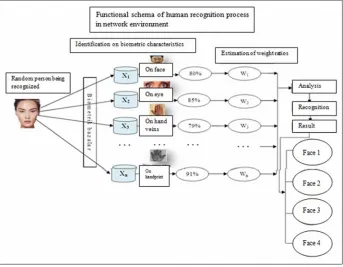
Let’s assume that the i=1,t identification of A*i-th person should be implemented. Structural schema for recognition in network environment shown in Figure 1.
Identification process (facial image, finger print, iris, palm pattern, skull, and hand veins) is implemented on the basis of the algorithms that are developed by using people’s biometric features in databases. In this case, information stored in distinct databases in network is used. For instance, accuracy of human recognition can be 90% if any database and appropriate identification algorithm are used. If the other database and appropriate identification algorithm are used, then accuracy of recognition can be 60%, etc. in this case, in order to increase quality of recognition, weight ratios are used.. Structural schema of human recognition process in network environment shown in Figure 2.
Figure 1. Structural Schema for Recognition in Network Environment.
7. Comparative Analysis of Distinct
Effective Ways of Human Recognition
Weight ratio of geometric traits used in human recognition based on facial images can be calculated on the basis of the algorithm given in [11, 12] work.
Finding weight ratio of geometric traits used in human facial recognition on the basis of images is of importance from several points of view. It causes reducing the number of geometric traits that are not of significant importance, improvement of recognition quality and reducing the time spent on recognition [11, 12]. There are several methods and ways to determine weight ratio in recognition process.
One of the ways is estimation of face changing which are connected in features space. Multiple images belong to one person creates a cluster. In order to achieve high recognition, features space should be chosen where the distance between any images belongs to one cluster is less than the distance between two photo-portraits in distinct clusters. However the distance between clusters in space is different, as the number of clusters increases the result of recognition will be more successful. In order to test importance of features, its impact to the deployment of images in space should be known [13, 14].
In the method of Elastic Bunch Graph Matching, the face of person is represented as a graph, and contours of head lip, nose is situated in the nodes. Each border is pointed with the distance between nodes. In each point, coefficients of Qarbov functions for 5 distinct frequency and 8 directions are calculated [15-18]. During the calculation of coefficients of importance, for the same person maximizing function, and for the different persons minimizing function are used. Collection of such coefficients is called “jet”. For each jet, coefficient of significance is calculated by simplex method. Jets characterize local fields of images and are used for two purposes.
The first on is the finding of appropriate points in two different photo-portraits. The second one is for the comparison of two appropriate fields of photo-portraits. Each coefficient for the points taken from one field of different images is characterized by amplitude, so that it changes as the point change its place, therefore the rotation speed of the phase is proportional to the frequency of the wave vector of base wavelet. The suggested method implements reliable recognition even in the recurs change till the 22°; if the angles are big, then the accuracy of recognition is sharply reduced, and it is revealed that similarity function is more sensitive to recurs than class difference. The later development of the method results in the determination of coefficient of importance on the basis of choosing training.
In order to test efficiency of the estimation of features given above, the second way is used. It is based on the estimation of changes that happen during mutual relationship of photo-portraits in feature space.
Discriminated analysis methods are the most effective way applied in recognition of human face. However, these
methods are not applied in recognition process on unified example. Because, in this case inter-subject variability cannot be evaluated. Generally, if several examples fit to one person, this variability is evaluated through using images of the training set. However, discriminated analysis methods are satisfactory, as inter-subject variability is weakly estimated by using images of general training set. This especially happens when facial expression on the image has sharply variations. A new expressive description can be synthesized by projection random expressive description to expressive sub-space. İnter-subject variability can be more accurately estimated by example image synthesized to subject and more significant improvement can be achieved. Experiments have implemented by using two large data centers: images database on recognition of human face which is intended to support suggested methodology and Cohn-Kaonde AU Coded Facial Expressions Database.
Multiple ways are developed to effectively implement face recognition. But, only some researches solved the problem of the recognition of any random part of facial image [19]. The method is developed to implement face recognition more effectively. As it’s mentioned, one of the effective algorithms given for estimation of weight ratio on the basis of geometric traits applied in human recognition, is developed in the [11, 12] work.
In the [20] work, the algorithm for increasing effectiveness of recognition on the basis of fingerprints is given.
In the [21] work, the algorithm for recognition on the basis of sound is suggested. In the work, it is mentioned that, expensive equipment is not needed for recognition on sound. In this respect, recognition on the basis of human sound surpasses characteristics of the other biometric identification systems.
In the [22] work, recognition on the basis of filtration of human skull is viewed. It is explained that skull is the most complex and important component of human skeletons. It has much information about human and the information depends on people. Biological recognition of human on the basis of skull is possible. Here the main thing is modeling of human skulls and it is the method that makes recognition more reliable on the basis of skull.
As it is mentioned above, quality of human recognition can be increased by using distinct databases collected in biometric network and appropriate recognition algorithms.
8. Conclusion
airlines and federal government permit to solve aforementioned problems and prefer high level technologies. Modern technologies are not only used for new operations, but also for the tasks which are not able to be implemented manually. Using biometric networks can improve the quality of human recognition, so that it is one of the main issues in the solution of problems.
References
[1] http://www.itsec.ru/articles2/Oborandteh/biometricheskie-tehnologii-vchera--segodnya--zavtra# sthash.FKdLyNn9.dpuf.
[2] E. Jun Yoon, K, Young Yoo, A New, Biometric-based User Authentication Scheme without Using Password for Wireless Sensor Networks, IEEE 20th International Workshops on Enabling Technologies: Infrastructure for Collaborative Enterprises, Paris, France, 2011 27-June 29, pp. 279 - 284.
[3] N. Carev, “Povishenie effektivnosti raboti sotrudnikov QUVD q.”, Moskva putem vnedreniya peredovix biometriceskix texnoloqiy. Rukovoditel napravleniya, 2011.
[4] A. K. Das, B. Bruhadeshwar, “A Biometric-Based User Authentication Scheme for Heterogeneous Wireless Sensor Networks” 2013 27th International Conference on Advanced Information Networking and Applications Workshops. Barcelona, Spain, March 25-March 28, 2013.
[5] Eun-Jun Yoon, Kee-Young Yoo, A New Biometric-based User Authentication Scheme without Using Password for Wireless Sensor Networks / 2011 IEEE 20th International Workshops on Enabling Technologies: Infrastructure for Collaborative Enterprises. Paris, France June 27-June 29, 2011.
[6] Hemank Lamba, Ankit Sarkar, Mayank Vatsa, Richa Singh, Afzel Noore. Face recognition for look-alikes: A preliminary study / 2011 International Joint Conference on Biometrics. October 11-13, West Virginia Univeristy, USA, 2011.
[7] V. V. Satyanrayanarayana Tallapragada, E. G. Rajan. Multilevel Network Security Based on Iris Biometric / 2010 International Conference on Advances in Computer Engineering Bangalore, India, June 20-June 21, 2010.
[8] Grove, A. T. Geomorphic evolution of the Sahara and the Nile. In M. A. J. Williams & H. Faure (eds), The Sahara and the Nile: 21-35. Rotterdam: Balkema, 1980.
[9] Mak-Kallok, Uoppen: https://ru.wikipedia.org/wiki/Mak-Kallok, Uoppen.
[10] Donald_O._Hebb:
http://en.wikipedia.org/wiki/Donald_O._Hebb.
[11] Kazımov T. H., Mahmudova Sh. J. About a Method of Calculation of Importance Degree of Geometrical Characteristics to Identify a Human Face on the Basis of Photo Portraits // Computer Science and Engineering, USA, 2012, Vol. 2, No. 5, pp. 59-62.
[12] T. H. Kazımov, Sh. J Mahmudova, “Increase of indicator values of identification systems quality on the recognition of human face on the basis of photoportraits”, Intelligent Control and Automation, USA, 2013, Vol. 4 No. 2, pp. 191-198.
[13] D. I. Samal, V. V. Starovoytov, “Obnaruzheniye antropometricheskikh tochek litsa s pomoshch'yu fil'trov Gabora”, Sb. nauch. tr. “Tsifrovaya obrabotka izobrazheniy”. In-t tekhn. kibern. NAN Belarusi. Minsk, 2001, str. 141-150.
[14] D. I. Samal, V. V. Starovoytov, “Podkhody i metody raspoznavaniya lyudey po fotoportretam”, ITK NANB, Minsk, 1998, № 8, 54 s.
[15] V. A. Kovalov, “Metod elastichnykh eksponentsial'nykh deformatsiy dlya sovmeshcheniya tsifrovykh izobrazheniy”, Sb. nauch. tr. “Tsifrovaya obrabotka izobrazheniy”. Minsk. In-t tekhn. kibern. NAN Belarusi, 1999, str. 47-156.
[16] J. Buhmann, M. Lades and C. Malsburg, “Size and distirtion invariant object recognition by hierarchial graph matching”, Proceedings of Int. Joint Conf. on Neural Networks, 1990, pp. 411-416.
[17] A. Burton, V. Bruce, N. Dench, “What’s the difference between men and women? Evidence from facial measurements”, Perception, 1993, No. 22, pp. 153-176.
[18] C. Choi, K. Aizawa, H. Harashima and T. Takebe,“Analysis and synthesis of facial image sequences in model-based image coding”, IEEE Transactions on Circuits and Systems for Video Technology, 1994, vol. 4, No. 3, pp. 257-274.
[19] S. Jeng, H. Liao, Y. Lui and M. Chern, “An efficient approach for facial feature detection using geometrical face model”, Proceedings Int. Conf. on Pattern Recognition, 1996, vol. 4, pp. 426-430.
[20] V. V. Gilovich, I. V. Prudnikov, “Povysheniye effektivnosti raspoznavaniya lichnosti pri ispol'zovanii biometricheskoy identifikatsii”, Sistemy, seti i ustroystva telekommunikatsiy, 2011, tom 7, № 1, str. 12-16.
[21] YU. N. Matveyev ISSN 0236-3933. Vestnik MGTU, 2012M.