INTRODUCTION
The study of isothermal bulk modulus alkali halides is very interesting, crystallizing into rock-salt structure except CsCl, CsBr and CsI, which has CsCl-structure. Although several theoretical models1-7. have been used to predict the isothermal bulk modulus or compressibility of these solids but only with moderate success. None of them is capable to explain the Cauchy violation (C12≠C44), which is even larger value for CsCl-structure. Few proper applications of the Born-von Karman theory in the calculation of isothermal bulk modulus or Compressibility were suggested by the Woods
et al. 8.
For better result Samunk 9.,R.K. Singh and M.P. Verma10., Mohan and Sudha¹¹., K.S.Upadhyaya
et.al. 12-15, have employed three body force shell model which is a successful extension of the shell model and which includes the effect of electron shell
Effect of many body interactions on the
isothermal bulk modulus of alkali halides
MD. IMRAN AZIZ¹, IRFAN AHMED¹ and AHMED NAEEM²
¹Department of Physics, ²Department of Chemistry, Shibli National PG College, Azamgarh - 276 001 (India)
(Received: March 03, 2008; Accepted: April 14, 2008)
ABSTRACT
The elastic shear stiffness constants of solids, correlated with other cohesive properties, provide a valuable insight into the nature of atomic binding forces. The deviations between calculated and measured values of isothermal bulk modulus of alkali halides have motivated us to frame a model for calculating the same for rock salt and cesium chloride structure alkali halides. The present approach shall include the effect of many body Coulombian, Born-Mayer type overlap repulsive and van der Waals (vdW) interactions in the framework of rigid shell model (R.S.M.). We hope that our results will show excellent agreement with measured isothermal bulk modulus for all the alkali halides.
Key words: Alkali halides, Elastic shear stiffness constants, Isothermal bulk modulus.
displacement as well as deformations to study the lattice dynamics of sodium halides, Potassium halides and lithium halides, Rubidium halides, cesium halides and Uranium monochalcogenides. Although this approach is better than other but without including van der Waals interactions the complete elastic properties can not be investigated .The Cauchy relation (C12=C44), which is strongly violated by the experimental values of the elastic shear stiffness constants. In order to eliminate these draw backs from the two body potentials, one is compelled to incorporate the effect of many body interactions16-18., which take proper account of the Cauchy violation. In order to explain the isothermal bulk modulus of alkali halides better, we have employed a model which includes van der Waals interactions and three body interactions and short-range repulsion effective up to the second neighbors in the frame work of rigid shell model. Thus the isothermal bulk modulus of alkali halides has been investigated in terms of 12- parameters of van
derWaals three body shell model (vTSM).The vTSM theory used for description of lattice dynamics of alkali halides which will be published elsewhere, contains the 12-parameters. Out of which there six parameters for overlap repulsions (A11, A22, A12, B11, B22, B12),two for three body interactions (Zm, rofo ') and four for electrical and mechanical polarizabilities(d1, d2, Y1 and Y2) .Here subscripts 1 and 2 refer to cations and anions,respectively. The knowledge of phonon dispersion relations is of fundamental importance for basic understanding to be gained of some physical properties such as thermal,elastic,dielectric and infrared properties. With the advent of the method of coherent neutron spectrometry, phonon dispersion relations have been obtained for most alkali halides crystals. he 12- parameters was deter mined by several researchers31-34. including our lattice dynamical groups21-25. from the available data of neutron scattering measurements35 Since some of the vibration frequencies of zone-boundary points have been used to deter mine the model parameters,therefore,good agreement achieved for symmetr y directions does not essentially guaranteed the agreement in the other general directions.
Theory
There has been always a continuing effort to obtain accurate interatomic potential functions. The interaction potential energy function is generally used to study the crystalline properties of diatomic crystal like alkali halides. The first alkali halide potential, which gave a good fit to the lattice energy were obtained by Huggins and Mayer in 1933 16 The total potential for the alkali halides can be written as
C R TBI VWI
=
+
+
+
Φ Φ Φ Φ
Φ
...(1)When first term ΦC is coulomb interaction potentials and is long-range in nature, second term is ΦR short –range overlap repulsion potentials, third term ΦTBI is three-body interaction potentials and the last term is ΦVWI van der Waals interaction potentials and owes its origin to the correlations of the electron motions in different atoms. We consider that van der Waals energy converges fast but the overlap repulsion converges much faster. Therefore, the overlap repulsion is effective only up to the first
neighbors and the van der Waals attractions up to the second neighbors17. This means that the second neighbors forces are entirely due to van der Waals interactions and the first neighbor forces are the results of the overlap repulsion and the van der Waals attractions between the nearest neighbors. Therefore,
( ) 2
( )
( )
VWI R
dd
r
r
φ
=
φ
...(2)
The various potentials are described in detail by Aziz et.al36.
Using the crystal potential expression (2.1) the equations of motion of two cores and two shells can be written as
²
MU
(
R
Z
mC
'
Z U
m)
(
T
Z C Y W
m'
m)
ω
=
+
+
+
...(3)'
)
(
'
)
T
m m m m
O
=
T
+
Y
C
Z U
+
S
+ +
K
Y C Y W
...(4)Here U and W are vectors describing the ionic displacements and deformations, respectively. Zm and Ym are diagonal matrices of modified ionic charges and shell charges, respectively. The elements of matrix Zm consists of the parameter Zm giving the modified ionic charge.
m
Z
=
Z
ξ
= ±
Z 1 ( / ) 0
+
n Z f
...(5)This means that the ionic charge parameter (Z) of RSM gets modified by a factor {1+(12/Z)f0} for NaCl – structure and {1+(16/Z)f0} for CsCl -structure in vTSM.
However, the core and shell charge parameters (X, Y) of RSM will be modified to (Xξ, Yξ). These modifications lead to the following relation.
m
Z
=
Z
ξ
=
X
ξ
+
Y
ξ
...(6)Such that X+Y=Z; R, T and S are matrices describing various short-range interactions in the crystal. C’ is the modified long-range interaction matrix given by
Here D is a matrix contributed by the van der Waals interactions.
The elimination of W from equations (2.3) and (2.4) leads to the secular determinant:
²
0
D q
→ω
M I
⎡
−
⎤
=
⎢
⎥
⎢
⎥
...(8)
Here D (q) is the (6×6) dynamical matrix given by
( '
'
) (
'
)
(
'
) ¹(
'
)
m m m m
T
m m
m m
D q
R
Z
C
Z
T
Z C Y
S
K
Y C Y
T
Y C Z
→
−
=
+
−
+
×
+ +
+
...(9)Elastic Properties of NaCl- like structure In the long wavelength limit (as
q
r
→
0
) the acoustic vibration frequencies tends to zero in such a way that (ω/q) 2 attain definite limits. A solution of (2´2) secular equation (2.8) for an acoustic vibration frequency (w) leads to the first non-vanishing term in the expression of w2 which contains a multiplicative factor q2. This term, when subjectedto
q
→
0
r
attains a finite limit which is related to the elastic constants (C11, C12, C44) such that
2 2 2
0
ij
lim( / )² 1/ {2[ (11)] 4[ (12) 2[ (22)] }
4 ²
(linear comibnation of C ) q
w q
ρ
v D D Dπ
ρ
→ → = + + =Where D (11). 2 ... etc. are the coefficients of (-q2) in the expression of
kk Dαβ q
→ ⎛ ⎞ ⎜ ⎟
⎝ ⎠ expressed in powers of
q
r
. The expressions
derived for elastic shear stiffness constants from equation (2.8) corresponding to vTSM is obtained as
4
2
0 11 22 11 22
11 12
4
[ 5.112 9.3204 ' ²]
² m 2
r A A B B
C Z A
e ξ + + + = − + + + ...(11) 4 2 0
12 12 11 22 11 22
4 1
[0.226 ( 5 5 ) 9.3204 ' ²]
² m 4
r
C Z B A A B B
e = + + + + + + ξ
...(12)
4
2 0
44 12 11 22 11 22
4 1
[2.556 ( 3 3 )]
² m 4
r
C Z B A A B B
e = + + + + +
...(13)
In view of the equilibrium condition (dΦ/ dr) 0 = 0., we obtain
B
11+
B
12+
B
22= −
1.165
Z
m2 ...(14)Where,
0
12 ( )
1
mf r
Z
Z
Z
⎧
⎫
= ±
⎨
+
⎬
⎩
⎭
and ' 0 0 0'
Zr
.
df
Zr f
dr
ξ
= ±
⎛
⎜
⎞
⎟
= ±
⎝
⎠
...(15)
The term f(r) is a function dependent on the overlap integrals of the electron wave functions and the subscript zero on the brackets indicates the equilibrium values of the quantities inside.
Elastic properties of CsCl- like structure
12 12 11 22
11
2 ²
10.7010 5.4283 ²
4 ² m 6 4
A B A A e C Z a ξ + + ⎡ ⎤ = ⎢ + + ⎥ ⎣ ⎦
...(16)
12 12 11 22 12
4 ²
0.6898 ² 5.4283 ' ²
4 ² m 6 4
A B B B
e C Z a ξ − + ⎡ ⎤ = ⎢− + + ⎥ ⎣ ⎦ ...(17)
12 12 11 22
44
2
²
0.3505
²
4 ²
m6
4
A
B
B
B
e
C
Z
a
+
+
⎡
⎤
=
⎢
−
+
⎥
⎣
⎦
...(18)In view of the equilibrium condition ([dΦ/ dr)0=0. we obtain
11
2
12 220.3393Zm²
B
+
B
+
B
= −
...(19)
Where
2
0 0 0
16
² 1
and '²=
'
m
Z
Z
f
Zr f
Z
ξ
⎛
⎞
=
⎜
+
⎟
⎝
⎠
...(20)0 0 0
' (
/
)
r r,
3
f
df dr
=r
=
a
is the interionicseparation.
The term f0 is a function dependent on the
overlap integrals of the electron wave functions and the subscript zero indicates the equilibrium value. ...(10)
(A12,B12) and (A11, A22, B11, B22) are the short-range parameters for the nearest neighbors and the next nearest neighbors, respectively. These are defined by
0 0
2 3
( ) ( )
0 0
12 1 12 1
4 4 ²
( ) , ( )
² ² ²
R R
r r r r
r d r d
B r A r
e dr = e dr =
⎡ ⎤ ⎡ ⎤
= ⎢ Φ ⎥ = ⎢ Φ ⎥
⎣ ⎦ ⎣ ⎦
...(21)
( )
0
2
0 ( )
11 22 2
2
4
2
2 (
)
( )
²
R
r r
r
d
B
B
r
e
dr
=⎡
⎤
+
=
⎢
Φ
⎥
⎣
⎦
( )
0
3
0 ( )
11 22 2
2
4
2
²
2(
)
( )
²
²
R r r
r
d
A
A
r
e
dr
=⎡
⎤
+
=
⎢
Φ
⎥
⎣
⎦
...(22)
Where, Φ1(R)(r)and Φ(2R)(r) are the overlap potentials between the nearest neighbors and the next nearest neighbors, respectively.
The modified expressions for the electrical and mechanical polarizabilities are defined by the following relations:
(
)
0² ²
, (
1, 2)
i m i
i
Y Z
e
a
i
R
K
=
=
+
...(23)and
(
)
(
)
0 0
0
=-
(
1, 2)
²
i m i
i
i i m
R Y Z
a R
d
i
R
K
Ze Y Z
−
=
=
+
0 12 12
² ²
=(
2
)
Z e
R
A
B
V
=
+
...(24)The SOE constants lead to the Cauchy violation,
'
12 44 4 0 0
0
²
[9.3304
]
4r
e
C
−
C
=
Zr f
...(25)
For NaCl-like structure
'
12 44 0 0
e²
[5.4383
]
4a²
C
−
C
=
Zr f
...(26)For CsCl-like structure
Where ro (= a 3), is the interionic distance. The isothermal bulk modulus or the compressibility (β) is define by
11
2
121
3
C
C
K
β
+
=
≅
...(27)The derivation implies that these formulae are true for the static lattice only.
EXPERIMENTAL Support for above theory
It can be seen from equation (2.8) that the acoustic modes of long wavelength (q→0) propagate as in continuous medium and their frequencies, acoustical and polarization properties are related to the elastic constant of the crystal. The most accurate method to measure the second-order elastic constant (SOEC) in the ultrasonic pulse echo technique in which an ultrasonic pulse (of frequencies 10-17 sec-1) generated by a quartz transducer is injected into a block of crystal (of length 1cm.) and reflected from its surface to the transducer. The time taken between initiation and receipt of the pulse is measured by standard electronic methods. If the waves are longitudinally polarized and the direction is 100. in a cubic crystal, C11 can be immediately determined. The remaining elastic shear stiffness constants (C12 and C44 ) can be measured from the velocities of longitudinal and of transverse waves traveling in other directions 110. and 111 The details of the technique of measuring SOEC and their values thus determined have been reported 19, 20
Computation
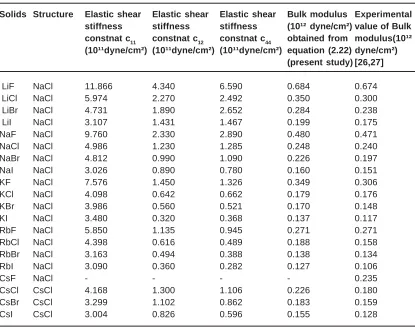
Calculated values of isothermal bulk modulus and its comparison with experimental data26,27.
RESULTS AND DISCUSSION
Table 1:
Solids Structure Elastic shear Elastic shear Elastic shear Bulk modulus Experimental stiffness stiffness stiffness (10¹² dyne/cm²) value of Bulk constnat c11 constnat c12 constnat c44 obtained from modulus(10¹² (10¹¹dyne/cm²) (10¹¹dyne/cm²) (10¹¹dyne/cm²) equation (2.22) dyne/cm²)
(present study) [26,27]
LiF NaCl 11.866 4.340 6.590 0.684 0.674
LiCl NaCl 5.974 2.270 2.492 0.350 0.300
LiBr NaCl 4.731 1.890 2.652 0.284 0.238
LiI NaCl 3.107 1.431 1.467 0.199 0.175
NaF NaCl 9.760 2.330 2.890 0.480 0.471
NaCl NaCl 4.986 1.230 1.285 0.248 0.240
NaBr NaCl 4.812 0.990 1.090 0.226 0.197
NaI NaCl 3.026 0.890 0.780 0.160 0.151
KF NaCl 7.576 1.450 1.326 0.349 0.306
KCl NaCl 4.098 0.642 0.662 0.179 0.176
KBr NaCl 3.986 0.560 0.521 0.170 0.148
KI NaCl 3.480 0.320 0.368 0.137 0.117
RbF NaCl 5.850 1.135 0.945 0.271 0.271
RbCl NaCl 4.398 0.616 0.489 0.188 0.158
RbBr NaCl 3.163 0.494 0.388 0.138 0.134
RbI NaCl 3.090 0.360 0.282 0.127 0.106
CsF NaCl - - - - 0.235
CsCl CsCl 4.168 1.300 1.106 0.226 0.180
CsBr CsCl 3.299 1.102 0.862 0.183 0.159
CsI CsCl 3.004 0.826 0.596 0.155 0.128
the knowledge of certain experimental information to be used as input data. It is evident from the above results that second neighbor interactions (SNI) do not affect the Cauchy violations but they strongly influence the compressibility and hence the isothermal bulk modulus of solids.
ACKNOWLEDGEMENT
The authors are grateful to the Dr Iftekhar Ahmad., principal, Shibli National Post Graduate College (U.P.) India, for providing computer facility for computational work.
REFERENCES
1. Ming-Xing Fang, Pin Ye, Zu-tong Yan, Physica status solidi (b), 241(11): 2464-2471 (2004).
2. Sir Deshmukh DB, Sirdeshmukh L and
Subhadra K.G, Jour nal of Mater ials Science,pp.2001-2006(6),38(9)/May: (2003). 3. A. Martín Pendás, A. Costales, M. A. Blanco, J. M. Recio, and V. Luaña, Phys. Rev. B. 62:
13970-13978 (2000).
4. A.K.Koh, K.N.Ng, Physica status solidi (b), vol.213, Issue 1, pp. 11-14 (1999).
5. W.C.Hughes and L.S.Cain, Phys.Rev.B 53: 5174-5180 (1996).
6. Md. Sadique Ali and Md. Mazahir Hasan physica B 168: 121- 127. North- Holland, Amsterdam (1991).
7. J. M. Recio, V. Luaña, L. Pueyo, and M. Bermejo,J. Solid State Chem. 89: 39-59 (1990).
8. A.D.B. Woods, W. Cochran and B.N.
Brockhouse, Phys. Rev. 119: 980 (1960). 9. R.E. Schmunk, Bull. Am. Phys. Soc.12: 281
(1967).
10. R.K.Singh and M.P. Ver ma, Phys. Stat. Sol.(b), 36: 335-43 (1969).
11. Mohan and Sudha, Indian J. Pure Appl. Phys.
31: 57 (1993).
12. M.K. Tiwari, U.C. Srivastava, Atul Pandey and K. S. Upadhyaya, J. Purv. Acad. of Sci.(India) 10: 141 (2004).
13. K.S. Upadhyaya, A.N. Pandey, Atul Pandey and R.C. Dubey, Latvin J. of Phys. And Tech. Sci. N-6: 1 (2004).
14. Mudit Prakash Srivastava, Rajeev Kumar Singh, A.N. Pandey and K.S. Upadhyaya, Jour. PAS (India) 11: 121 (2005).
15. Pandey Atul, Pandey Amarnath, Upadhyaya Kripa Shanker, Romanian journal of Physics,
51(3-4) 391-400 Bucharest, (2006). 16. P.O. Lowdin, Adv. Phys. 5: 1 (1956). 17. S.O. Lundqvist, Ark. Fys. 12: 365 (1959). 18. R.K. Singh, Physics Reports (Netherlands)
85: 259 (1982).
19. H.B. Huntington, sol. State Phys. 7: 214-349 (1958).
20. G. Leibfried and W. Ludwig,in : solid state physics 12,276 eds. F.Seitz and D.Turnbull (Academic Press, New York) (1961). 21. S.P. Chaubey, Ph. D. Theis, V.B.S.U.P.
Jaunpur (2002).
22. R.C. Dubey, Ph. D. Theis, V.B.S.U.P. Jaunpur (2003).
23. U.C. Srivastava, Ph.D. Thesis, V.B.S.U.P. Jaunpur (2004).
24. M.K. Tiwari, Ph.D. Thesis, V.B.S.U.P. Jaunpur (2005).
25. M.P. Srivastava, Ph. D. Theis, V.B.S.U.P. Jaunpur (2005).
26. M.P. Tosi, Solid state phys.16: 1 (1964). 27. C.S. Smith and L..S.Cain, J. Phys. Chem.
Solids 36: 205 (1975).
28. K.P. Thakur; J. Inorg. Nucl. Chem. 36: 2171 (1974); Ind. J. Pure Appl. Phys. 11: 549 (1973); Austr. J. Phys. 29 (1976).
29. E.W. Kellermann, Phil. Trans. Roy. Soc. (London) A 230: 513 (1940).
30. F.G. Fumi and M.P. Tosi, J. Phys. Chem. Solids: 25: 31 (1964), Solid stat. Physics, 16: 1 (1964).
31. Kiyosi Motida, J.of the Physical soc. of Japan, 58(1) 181-194 (1989).
32. R.K. Singh and H.N.Gupta,Proc.R.Soc.Lond.
A 349: 289 (1976).
33. R.K. Singh and K.Chandra, Phys. Rev. B14 2625 (1976).
34. R.K. Singh, H.N.Gupta and M.K. Agrawal,
Phys. Rev. B, 17(2): 894-906(1978). 35. Bliz, H. & Kress, W., Phonon Dispersion
Relations in insulators (springer-Verlag series) Volume 10, New York (1979). 36. M. Imran Aziz and Irfan Ahmed, Mat. Sci.