_____________________________________________________________________________________________________
(Past name: British Journal of Pharmaceutical Research, PastISSN: 2231-2919, NLM ID: 101631759)
The Relationship between Spiritual Health and
Spiritual Intelligence of Midwives and Midwifery
Students and Satisfaction of Clients with Vaginal
Childbirth
Zahra Ghalaychi
1, Mahrohk Dolatian
2*, Zohreh Mahmoodi
3,
Nasrin Boromandnia
4and Rohollah Valizadeh
51Department of Midwifery, Student Research Committee, School of Nursing and Midwifery,
Shahid Beheshti University of Medical Sciences, Tehran, Iran. 2
Midwifery and Reproductive Health Research Center, School of Nursing and Midwifery, Shahid Beheshti University of Medical Sciences, Tehran, Iran. 3Social Determinant of Health Research Center, Alborz University of Medical Sciences, Karaj, Iran.
4
Urology and Nephrology Research Center, Shahid Beheshti University of Medical Sciences, Tehran, Iran. 5Department of Epidemiology, Student Research Committee, Iran University of Medical Sciences,
Tehran, Iran.
Authors’ contributions
This work was carried out in collaboration among all authors. All authors read and approved the final manuscript.
Article Information
DOI: 10.9734/JPRI/2019/v28i530215
Editor(s):
(1) Dr. Rafik Karaman, Professor, Department of Bioorganic Chemistry, College of Pharmacy, Al-Quds University, Jerusalem, Palestine.
Reviewers:
(1) Borislav Kolaric, University Union - Nikola Tesla, Serbia. (2)Akshat Pandey, Sports Authority of India National Boxing Academy, India. (3)Debra Rose Wilson, Austin Peay State University, USA. Complete Peer review History:http://www.sdiarticle3.com/review-history/50103
Received 10 May 2019 Accepted 19 July 2019 Published 24 July 2019
ABSTRACT
Background: Maternity is one of the most important events in women's lives, and satisfaction with it has a significant impact on the health of women and their relationship with their neonates. On the other hand, characteristics of midwives such as health and spiritual intelligence can affect the satisfaction of women.
Objective: This study aimed to determine the correlation between spiritual health and intelligence of the staff and midwifery students and the satisfaction of the patients with vaginal childbirth.
Methods and Materials: This descriptive-correlational study was carried out on 200 subjects including midwives and patients with vaginal childbirth. Stratified sampling was used as the sampling technique. Research instruments were a demographic questionnaire, Ellison’s and Paluotzian Spiritual Health Questionnaire, and King Spiritual Intelligence Questionnaire for the personnel and midwifery students, Mackey Childbirth Satisfaction Rating Scale, and a demographic questionnaire for patients. The data were analyzed using SPSS software version 24, Pearson correlation and linear regression. A P value less than of 0.05 was considered significant.
Results: In this study, half of mothers were younger than 26 years of age and most of them were nulliparous with wanted pregnancy. Furthermore, half of personnel and students had moderate spiritual intelligence and about half had moderate spiritual health. The satisfaction of the patients had a positive correlation with spiritual health and spiritual intelligence. The lowest score was related to the flexibility component and the highest score was related to the component of stress tolerance.
Conclusion: Since the health and spiritual intelligence correlate with the satisfaction of patients with vaginal childbirth, it is suggested that spiritual characteristics be taken into account as a part of the selection process for midwifery students and staff.
Keywords: Spiritual health; spiritual intelligence; satisfaction; delivery; midwife.
1. INTRODUCTION
The birth of a healthy baby is one of the most important events in the life of women accompanied by maternity; it is considered as a fundamental change in the life of women [1,2].
A satisfactory childbirth experience leads to the development of a positive and attractive relationship between mother and child, in which is essential for the formation of the mother's identity, and increases the capacity of mother's satisfaction to evolve in her maternal identity [3]. Mothers with a pleasant experience of childbirth has a higher degree of self-esteem, a better relationship with their baby, and a better understanding of their next birth [4]. In contrast, dissatisfaction with childbirth can have negative effects on the health of women and their relationship with children [1] and cause post-partum depression, anxiety [5-8] post-traumatic stress disorder (PTSD), fear of subsequent delivery [1], and creates a problem in lactation and taking care of the baby and themselves [1].
Maternity satisfaction includes the satisfaction of a woman with delivery experiences, and the beginning of postpartum period, and is measured by the mother's perception of received care [9]. As an old definition of satisfaction, it is an individual assessment of both care services and service providers [10] and reflects the quality of the health services provided [11].
Evidence show the role of the relationship between mother and midwife in the formation of women's satisfaction, individual communication, information retrieval, emotional support received from health care providers [12-15]. All dissatisfaction are related to the lack of support when it is most needed and more often refers to care providers including nurses, gynecologists and midwives [16-18], and shows the need for professional care givers, especially midwives [19]. There are four factors increasing the satisfaction of women including good support from care providers, quality communication with health care providers, engaging in decision making about care and having a better experience than what they have been waiting for [20]. Spiritual intelligence is one of the dimensions of intelligence [21]. Spiritual intelligence is defined as a set of flexible mental abilities that relate to non-subjective and transcendental aspects of reality and is related to the existential nature of a person and personal meaning [22].
with God, their community, and their environment. Disruption of spiritual health can cause mental disturbances and loss of meaning in life [24].
Given the importance of satisfaction with delivery in mental and physical health reducing the amount of elective cesarean section and improving the relationship between mother and child, as well as lack of adequate research in the field of identification of factors affecting the mothers' satisfaction with vaginal childbirth, the researcher aimed to identify the role of spiritual health and spiritual intelligence on women's satisfaction with vaginal childbirth.
2. MATERIALS AND METHODS
2.1 Study Setting
This was a cross-sectional descriptive-correlation study conducted on the three hospitals of Zanjan city (Ayatollah Mousavi, Social Welfare and a private hospital) during 2017-18. The study population consisted of all pregnant women who referred to the hospitals for vaginal delivery, all midwives working in the hospitals mentioned in the three shifts of morning, evening and night, and all midwifery students attending a course in hospitals.
2.2 Inclusion Criteria
For mothers: Being Iranian, having a normal pregnancy course, having at least elementary level of education and not having any history of illness and mental disorders.
For midwives: Having work experience for at least 3 months; not having any kind of history of illness and mental disorders.
For midwifery students: spending at least one practical course at the desired hospitals.
2.3 Data Collection Tools
In the present study, we had two sets of tools for clients, staff and students that are as following:
2.4 Tools for Patients
2.4.1 Form midwives
Demographic form: Including items about age, number of pregnancies, education, occupation, monthly income, wanted pregnancy, the desired
sex of the infant and the presence of abnormalities in the neonate. No other data in this regard were collected.
Mackey Childbirth Satisfaction Rating Scale:
consisting of 18 questions, which were taken from McKay Satisfaction Questionnaire (34-items). These eighteen questions consist of four subsets including six items about the person herself, one option about the spouse, two about the newborns and eight ones about the midwives, representing the behavior of the main participant in childbirth. Research subjects get a score for each item in a five-point Likert rating of between 0 and 4 points with regard to satisfaction or dissatisfaction. (Very dissatisfied = 0, dissatisfied = 1, no idea = 2, satisfied = 3, very satisfied = 4), and at the end, the rates are calculated as a percentage of 100, and the individuals in terms of their satisfaction with childbirth are divided into four groups (0-24 = very dissatisfied, 25-50 = dissatisfied, 51-75 = Satisfied, 76-100 = very satisfied). The scale was previously translated into Farsi and used in the same studies in our country. Its validity has been confirmed by content validity method and its reliability has been confirmed by Cronbach's alpha coefficient of 0.92 [25].
2.4.2 For midwifery students
Demographic form: Including variables of age, work record, employment status, level of education, college and ethnicity, in which were designed to midwives and students separately.
Ellison’s and Paluotzian Spiritual Health Questionnaire: It is composed of twenty items and measures two dimensions of spiritual well-being [26], including 10 items about religious health and 10 other questions indicating existential health and that spiritual health score is the sum of the two groups i.e. between 20-120 and its response is a 6-point Likert from totally disagree to totally agree, and the spiritual health of the people is divided into three groups of 20-40 as low, from 41 to 99 as moderate, and 100-120 as high. This tool has been used by Iranian researchers frequently, whose Cronbach's alpha has been reported as between 0.82-0.87 and is indicative of the desired reliability [27].
scored 0-4 [28], each of the subscales have 7, 5, 7, and 5 items respectively. The higher the individual score in this questionnaire, the more spiritual intelligence they have. In the study by Khodabakhshi and his colleagues, the Cronbach's alpha of 0.91 was obtained. Reliability of the questionnaire of King in the present study was calculated using Cronbach's alpha and for the whole questionnaire, 0.921 was obtained [29].
2.5 Statistical Analysis
The data were statistically analyzed using SPSS software version 24. In this research, descriptive statistics, Pearson correlation to investigate the correlation between spiritual health and spiritual intelligence and the clients’ satisfaction with vaginal childbirth as well as linear regression was used to predict the effect of spiritual health, spiritual intelligence and emotional intelligence of midwives and midwifery students.
3. RESULTS
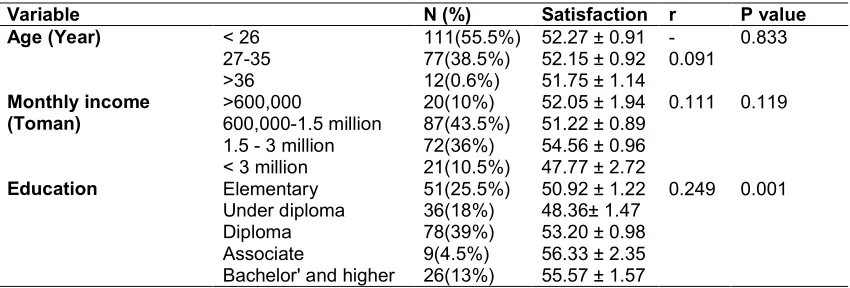
The results showed that in total, of 200 participants who had vaginal childbirth, 47.7% were nulliparous; 51.5% of mothers were younger than 26 years of age, in such a way that most of them had diploma degree (Table 1). Pearson correlation showed a significant correlation between the spiritual health of midwives and midwifery students and the clients’ satisfaction with vaginal childbirth (r=0.408). Furthermore, there was a correlation between spiritual intelligence of midwives and midwifery students and the clients’ satisfaction with vaginal childbirth (r=0.239) (Table 2). Results of linear regression analysis indicated that spiritual intelligence and spiritual health of midwives and
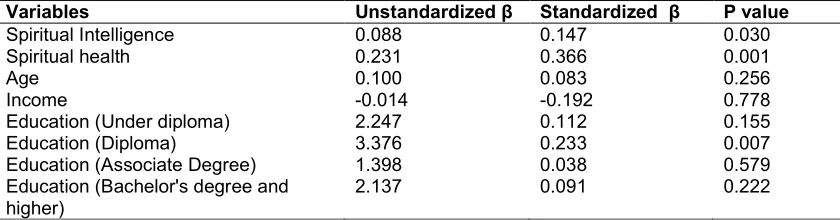
midwifery students had a protective effect on mothers’ satisfaction with increasing spiritual health, the satisfaction increased 0.231 points and with increasing spiritual intelligence, the satisfaction increases by 0.088 points. Also diploma education has effect on regression model (Table 3).
4. DISCUSSION
The results of this study showed that there is a positive and significant correlation between the spiritual health of midwives and midwifery students and clients’ satisfaction with vaginal childbirth in Zanjan hospitals in 2017. Several studies have examined the spiritual health of midwives. Chiang et al. conducted a study entitled "The Effect of Nurses' Spiritual Health on Their Attitude toward Spiritual Care, Professional Commitment and Nursing Care". They found that spiritual health is statistically correlated with professional duties and nursing care, and also increasing spiritual health increases the level of professional commitment and nursing care. They suggested that spiritual health should be considered an important value and that belief system can affect professional performance and that educational planners must be aware of the role of spirituality and take into account the spirituality of nurses within educational period [30].
In this study, as in the present study, the spiritual health of the staff was considered and that spiritual health has been able to affect professional performance and since professional performance can lead to satisfaction of the clients; the results of this study are in line with those of the present study. Similar studies were found in the field of nursing among them,
Table 1. Demographic characteristics of subjects participating in the study
Variable N (%) Satisfaction r P value
Age (Year) < 26 111(55.5%) 52.27 ± 0.91 -0.091
0.833
27-35 77(38.5%) 52.15 ± 0.92
>36 12(0.6%) 51.75 ± 1.14
Monthly income (Toman)
>600,000 20(10%) 52.05 ± 1.94 0.111 0.119
600,000-1.5 million 87(43.5%) 51.22 ± 0.89 1.5 - 3 million 72(36%) 54.56 ± 0.96 < 3 million 21(10.5%) 47.77 ± 2.72
Education Elementary 51(25.5%) 50.92 ± 1.22 0.249 0.001
Under diploma 36(18%) 48.36± 1.47
Diploma 78(39%) 53.20 ± 0.98
Associate 9(4.5%) 56.33 ± 2.35
Table 2. Correlation between satisfaction and spiritual health and intelligence
Variables N (%) Mean ±SD Satisfaction Correlation P value Spiritual health Medium 110(55%) 89.56 ± 0.89 49.38±0.81 0.408 00.00
High 90(45%) 108.03 ± 0.6 53.06±0.61
Spiritual Intelligence
Low 65(32.5%) 22.47± 0.82 49.76±0.92 0.239 0.001
Medium 100(50%) 48.06 ± 0.83 50.55±0.77 High 35(17.5%) 76.20±20.01 54.8±1.11
Table 3.Prediction of satisfaction score in the presence of studied factors
Variables Unstandardized β Standardized β P value
Spiritual Intelligence 0.088 0.147 0.030
Spiritual health 0.231 0.366 0.001
Age 0.100 0.083 0.256
Income -0.014 -0.192 0.778
Education (Under diploma) 2.247 0.112 0.155
Education (Diploma) 3.376 0.233 0.007
Education (Associate Degree) 1.398 0.038 0.579
Education (Bachelor's degree and higher)
2.137 0.091 0.222
a. Dependent Variable: satisfaction
Khandan and colleagues showed that there was a significant relationship between the level of nurses' spirituality and their occupational performance, and the spirituality of nurses was high and there was a positive and significant relationship between nursing spirituality and occupational performance [31]. A similar result was found in the study by Taylor et al., in which 64% of the patients stated that surgeons with a religious and spiritual background would be more trustworthy [32]. According to Kaur et al., entitled "The Impact of Emotional Intelligence and Spiritual Intelligence on the Caring Behavior of Nurses", the mean spiritual intelligence of nurses was average and there was a correlation between spiritual intelligence of nurses and their caring behaviors [33]. Based on these studies, spiritual intelligence can improve the job performance and the caring behaviors of the personnel, and the better the services the staff provides, the better they can achieve the satisfaction of the clients and improve their level of satisfaction with health care.
It seems that people with high spiritual health in their daily lives use methods such as amnesty, forgiveness, search for spiritual communication with God, friendship with religious people, hope for God, and prayer, and can better keep calm and target their own behavior. These skills come with the midwife in midwifery to help them with more patience and more tolerant response to stressful situations and thus have better morale, performance, behavior, and increased
satisfaction of women with childbirth. Moreover, according to the results of Pearson correlation coefficient, linear regression and level of significance, there was a positive relationship between the spiritual intelligence of midwives and midwifery students and the satisfaction of clients with vaginal childbirth in Zanjan hospitals in 2017. As already mentioned, according to Wiggles Worth, people with high spiritual intelligence are caring, kind, generous, peaceful, daring, honest, and promising [34], all of which, if they are in an obstetrician, can define the correlation. According to Hodge et al. [35], meeting the spiritual needs of women is effective in satisfaction with giving birth, and helping to support and resolve spiritual needs can lead to increased satisfaction, and individuals with higher spiritual intelligence can better recognize the spiritual needs of mothers and help meet their spiritual needs.
adaptability, increased flexibility and patience, happiness and action, organizational commitment and communication improvement [31]. These characteristics help midwives in maternity and childbirth departments, in order to better respond to the needs of women; to have better functioning and to increase the satisfaction of clients with vaginal childbirth.
To explain the findings of this research, we can use a stress-relieving mechanism. This mechanism is generally used to describe the relationship between spirituality and health-related outcomes. From the point of view of the mechanism of coping with stress, spirituality can be understood as knowledge of the power that encourages people to face stressful situations as an opportunity to grow or challenge a person, and people try to mean the stressful events that the meaning of the concept is known to help them overcome stress. So, although perceived stress is high in personnel workloads and they suffer a lot of stress, they are willing to maintain their profession [30]. This mechanism helps midwives to better perform in severe labor conditions such as high workload, exposure to stressful situations and consider these conditions as an opportunity for spiritual growth, and as a result, they will take better care of mothers and be able to obtain their satisfaction.
5. CONCLUSION
Spiritual health and spiritual intelligence of midwives and midwifery students are correlated with the satisfaction of clients with vaginal childbirth. Midwives who have higher spiritual health intelligence health scores are able to manage their emotions and excitements, more tolerance of work problems, and better communication with their clients. One of the effective ways to increase the satisfaction of clients with vaginal childbirth is the enhancement of spiritual health and spiritual intelligence of personnel and midwifery students. The results of this research and other research can give weight to the significance of spiritual health and spiritual intelligence of midwives as a valuable tool to predict the satisfaction of clients with vaginal childbirth.
6. STUDY LIMITATIONS
In the present study, data gathering was done using self-report method to assess spiritual health and spiritual intelligence. The precision of responding to questions is one of the limitations
of the present study. Of course, this study, like other studies, has been subject to limitations, including the fact that in this study only self-reporting was used to examine spiritual health and spiritual intelligence.
CONSENT AND ETHICAL APPROVAL
The research followed the tenets of the Declaration of Helsinki. After obtaining the necessary permissions and the code of ethics from Shahid Beheshti University of Medical
Sciences, Tehran, Iran (Code:
IR.SBMU.PHNM1396.743), the researcher began to sample the midwifery personnel and students by referring to the hospitals after obtaining consent from the authorities. The clients were also selected from among patients who were in contact with the midwives and students in order to receive the services. The researcher received the written consent from the participants after their introduction and the objectives of the research and the permission of the participants. Finally, the researcher completed the questionnaires.
ACKNOWLEDGEMENT
Hereby, the authors thank all the staffs of the Ayatollah Mousavi hospital, Imam Hussein hospital, and Bahman hospital as well as all the women who helped us conducting this study.
COMPETING INTERESTS
Authors have declared that no competing interests exist.
REFERENCES
1. Mohammad K, Alafi K, Mohammad A, Gamble J, Creedy D. Jordanian women's dissatisfaction with childbirth care. International Nursing Review. 2014;61(2): 278-84.
2. Perriman N, Davis D. Measuring maternal satisfaction with maternity care: A systematic integrative review: What is the most appropriate, reliable and valid tool that can be used to measure maternal satisfaction with continuity of maternity care? Women and Birth. 2016;29(3):293-9. 3. Howarth AM, Scott KM, Swain NR. Skills-based childbirth preparation reduces stress for midwives. Midwifery. 2017;50:235-8.
4. Jha P, Larsson M, Christensson K, Skoog
services provided in public health facilities: Results from a cross-sectional survey among postnatal women in Chhattisgarh, India. Global Health Action. 2017;10(1): 1386932.
5. Mohammad K, Gamble J, Creedy D. Prevalence and factors associated with the development of antenatal and postnatal depression among Jordanian women. Midwifery. 2011;27(6):e238-e45.
6. Bertucci V, Boffo M, Mannarini S, Serena A, Saccardi C, Cosmi E, et al. Assessing the perception of the childbirth experience in Italian women: A contribution to the adaptation of the childbirth perception questionnaire. Midwifery. 2012;28(2):265-74.
7. Zareipour MA, Valizadeh R, Abdolkarimi M, Mahmoodi H, Ghelichi Ghojogh M, Khazir Z. Perceived stress and its relationship with spiritual health in patients with diabetes in the city of Urmia, Iran. Biosci. Biotech. Res. Comm. 2016;9(4): 750-5.
8. Khalkhali HR, Gharaaghaji R, Ghojogh MG, Valizadeh R. Factors and prevalence of depression in students at Iran’s Urmia University of Medical Sciences. Internal Medicine and Medical Investigation Journal. 2018;3(1):12-6.
9. Goodman P, Mackey MC, Tavakoli AS. Factors related to childbirth satisfaction. Journal of Advanced Nursing. 2004;46(2): 212-9.
10. Ware Jr JE, Snyder MK, Wright WR, Davies AR. Defining and measuring patient satisfaction with medical care. Evaluation and Program Planning. 1983;6(3-4):247-63.
11. Yeh MY, Wu SC, Tung TH. The relation between patient education, patient empowerment and patient satisfaction: A cross-sectional-comparison study. Applied Nursing Research. 2018;39:11-7.
12. Marín-Morales D, Carmona-Monge FJ, Peñacoba-Puente C, Olmos Albacete R, Toro Molina S. Factor structure, validity, and reliability of the Spanish version of the women's views of birth labour satisfaction questionnaire. Midwifery. 2013;29(12): 1339-45.
13. Stahl K. Revalidation of a questionnaire assessing women's satisfaction with maternity care in hospital. Psychotherapie, Psychosomatik, Medizinische Psychologie. 2010;60(9-10):358-67.
14. Dencker A, Taft C, Bergqvist L, Lilja H,
Berg M. Childbirth experience
questionnaire (CEQ): Development and evaluation of a multidimensional
instrument. BMC Pregnancy and
Childbirth. 2010;10(1):81.
15. Dunne CL, Fraser J, Gardner GE. Women's perceptions of social support during labour: Development, reliability and validity of the birth companion support questionnaire. Midwifery. 2014;30(7):847-52.
16. Ford E, Ayers S, Wright DB. Measurement of maternal perceptions of support and control in birth (SCIB). Journal of Women's Health. 2009;18(2):245-52.
17. Van Duong D, Binns CW, Lee AH, Hipgrave DB. Measuring client-perceived quality of maternity services in rural Vietnam. International Journal for Quality in Health Care. 2004;16(6):447-52.
18. Bailham D, Slade P, Joseph S. Principal components analysis of the perceptions of labour and delivery scale and revised scoring criteria. Journal of Reproductive and Infant Psychology. 2004;22(3):157-65. 19. Jeschke E, Ostermann T, Dippong N,
Brauer D, Matthes H. Psychometric properties of the Confidence and Trust in Delivery Questionnaire (CTDQ): A pilot study. BMC Women's Health. 2012;12(1): 26.
20. Molly Remer MSWI. Satisfaction with birth. International Journal of Childbirth Education. 2008;23(3):13.
21. Zohra D, Marshall I. SQ: Spirit all intelligence the ultimate intelligence. London: Bloombury; 2000.
22. King D. The spiritual intelligence project. Trent University, Canada; 2007.
Available:www.dbking.net
23. Afayi Rad I, Karimi L, Shomoossi N, Ahmadi Tahour M. The relationship between spiritual well-being and mental health of university students. Quarterly Journal of Sabzevar University of Medical Sciences. 2010;17(4):274-80.
24. Rezaei M, Seyed Fatemi N, Hoseini F. Spiritual well-being in cancer patients who undergo chemotherapy. Hayat. 2008;14: 33-9.
1385. Pajoohandeh Journal. 2008;13(3): 259-68.
26. Paloutzian RF, Ellison CW. Loneliness, spiritual well-being and the quality of life. In: Peplau LA, Perlman D, Editors. Loneliness: A Sourcebook of Current Theory, Research and Therapy. New York: Wiley. 1982;224–237.
27. Caldeira S, Timmins F, de Carvalho EC, Vieira M. Clinical validation of the nursing diagnosis spiritual distress in cancer patients undergoing chemotherapy. International Journal of Nursing Knowledge. 2017;28(1):44-52.
28. Aghababaei N, Farahani H, Rahimi Nejad A. The characteristics assessment of spiritual intelligence machinery in the short questionnaire study. J Psychol Sci. 2010;9: 169–179.
29. khodabakhshi N, Heydari S, KHoshkonesh A, Heydari M. The relationship between spiritual health and stress for childbirth in pregnant womens. Iranian Journal of Obstetric, Gynecologic, and Infertitity. 2013;2(9):85-95.
30. Chiang YC, Lee HC, Chu TL, Han CY, Hsiao YC. The impact of nurses' spiritual health on their attitudes toward spiritual care, professional commitment, and caring. Nursing Outlook. 2016;64(3):215-24.
31. Khandan M, Eyni Z, Koohpaei A. Relationship between spiritual intelligence and job performance: A case study of nurses and nursing aids in the Main University Hospital of Qom, Iran. Psychology. 2017;2:4.
32. Taylor D, Mulekar MS, Luterman A, Meyer FN, Richards WO, Rodning CB. Spirituality within the patient-surgeon relationship. Journal of Surgical Education. 2011;68(1): 36-43.
33. Kaur D, Sambasivan M, Kumar N. Effect of spiritual intelligence, emotional intelligence, psychological ownership and burnout on caring behaviour of nurses: A cross-sectional study. Journal of Clinical Nursing. 2013;22(21-22):3192-202. 34. Wigglesworth C. Spiritual intelligence. In
Handbook of Faith and Spirituality in the Workplace. Springer, New York, NY. 2013;441-453.
35. Hodge D, Sun F, Wolosin R. Hospitalized Asian patients andtheir spiritual needs: Developing a model of spiritual care Journal of Aging and Health. 2014;26(3): 380-400.
36. Malik MS, Tariq S. Impact of spiritual intelligence on organizational performance. International Review of Management and Marketing. 2016;6(2):289-97.
© 2019 Ghalaychi et al.; This is an Open Access article distributed under the terms of the Creative Commons Attribution License (http://creativecommons.org/licenses/by/4.0), which permits unrestricted use, distribution, and reproduction in any medium, provided the original work is properly cited.
Peer-review history: