Study of Structural Properties of Annealed
Cdo and Zno Thin Films.
KiShor hurde
1* and A. B. LAd
21Department of Physics, Mungasaji Maharaj Mahavidyalaya, Darwha, Dist. Yavatmal. 2Department of Physics, Amolakchand Mahavidyalaya, Yavatmal.
Abstract
The CdO and ZnO are n- type semiconductors are transparent conducting in nature, inexpensive, mechanically stable and highly resistance to oxidation. In the present work these films have been obtained from thermal annealing of chemically deposited CdS and ZnS thin films. The structural properties of chemically deposited CdS and ZnS thin films and thermally annealed CdO and ZnO thin films have been studied. From x-ray diffraction data it is observed that annealing of the thin films at a particular temperature enhance the structural properties.
Article history
Received: 02 September 2017 Accepted: 02 October 2017
Keywords:
CdO, ZnO, Annealing, Structural Properties, Chemical Bath Deposition.
Material Science research india
www.materialsciencejournal.org
CoNTACT Kishor Hurde [email protected] Department of Physics, Mungasaji Maharaj Mahavidyalaya, Darwha, Dist. Yavatmal.
© 2017 The Author(s). Published by Oriental Scientific Publishing Company.
This is an Open Access article licensed under a Creative Commons Attribution-NonCommercial-ShareAlike 4.0 International License (https://creativecommons.org/licenses/by-nc-sa/4.0/), which permits unrestricted NonCommercial use, distribution, and reproduction in any medium, provided the original work is properly cited.
To link to this Article: http://dx.doi.org/10.13005/msri/140213
introduction
CdO and ZnO is an n-type semiconductor belonging to II-VI group of periodic table. These materials possess wide band gap of approximately 2.4eV and 3.3eV at room temperature. These films are semitransparent in nature have been widely used in a flat panel displays, solar cells and gas sensing applications. These films are transparent conducting in nature, inexpensive, mechanically stable and highly resistance to oxidation1-5. The CdS and ZnS thin films prepared by chemical bath deposition technique have been extensively studied by many researchers. In the present work we have attempted
to annealed CdS and ZnS films prepared by chemical bath deposition to form CdO and ZnO thin films.
The CdO and ZnO films obtained by annealing were characterized for investigation of structural properties. It is observed that annealing effect improve structure of thin films6 -7.
experimental
stirrer, change the temperature of the entire assembly and stabilized it at a particular value etc. In order to get uniform film thickness the film substrate is continuously rotated and the solution is continuously stirred using magnetic stirrer. The temperature of assembly is maintained by heating arrangement and temperature controller. The thickness of the films governed by controlling the deposition time and the concentration of the solution8-9-10.
The prepared samples of CdS and ZnS by chemical bath deposition were taken for annealing and kept into muffle furnaces Biotech of India of 2500 watts at 15 amperes which can withstand maximum temperature of 10000c. The temperature of the furnaces was maintained at 6000c for more than 8 hours. After annealing sulfide ions converted into oxide ions by converting CdS into CdO and ZnS into ZnO11-12.
The prepared films of CdO and ZnO with annealing effect were taken for characterization to determine structural properties.
result and discussion
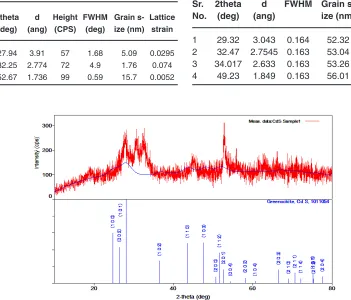
Figure 1 show the X- Ray diffraction pattern of CdS thin film obtained using X-Ray generated at 40kv energy and 15mA current without filter. SC 70 detector with the continuous scan mode was used. Qualitative Analysis Result shows that the Phase Name of the film is Greenokite with the formula CdS having DB Card number 1011054. The peak list of the CdS sample is shown in table 113,14.
The thermally oxidized CdO thin film were obtained by annealing the CdS as-depodited at 6000C for more than 8hours. The X- Ray diffraction data obtained for CdO thin film given in the table 2 and X- ray reflection peaks shown in figure 2 It is seen from the table2
Fig. 1: X- ray diffraction pattern of CdS thin film. Table 1: Xrd data of CdS thin film
No. 2theta d height FWhM Grain s- Lattice (deg) (ang) (CPS) (deg) ize (nm) strain
1 27.94 3.91 57 1.68 5.09 0.0295 2 32.25 2.774 72 4.9 1.76 0.074 3 52.67 1.736 99 0.59 15.7 0.0052
Table 2: Xrd data of Cdo thin film annealed at 6000C
Sr. 2theta d FWhM Grain s- Lattice No. (deg) (ang) ize (nm) strain
that the annealing temperature changes the grain size. The prominent reflection peaks are observed at the annealing temperatur6000C as seen in figure 2. The 2theta values corresponds to the particular reflection planes indicating the formation of CdO nanoparticle having pure hexagonal structure which matches with the standared JCPDF data15,16.
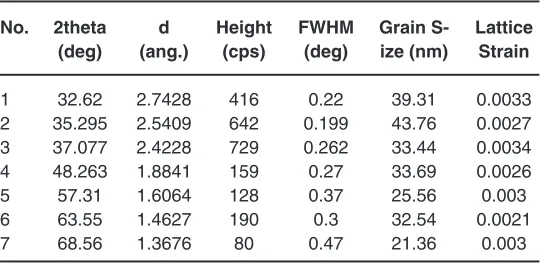
The XRD pattern of the ZnS thin film was investigated by the Regaku Mimflex 600 Model X-ray diffractometer using PDXL software. This pattern explains the structural properties of ZnS film. The XRD pattern of ZnS sample as shown in figure 3 give three prominent peak at 2θ values 32.620, 35.2950, and 37.0770. The d value1.429A0, 1.333A0 and 1.277A0 respectively. These peaks are showing reflection from (100), (002) and (101) planes, indicating the
formation ofZnS nano-particles having cubic zinc blend structure. The enhance intensity for the peak corresponding to (002) plane indicating preference orientation along c-axis. The peak list of ZnS sample is shown in Table 3.17
The X- Ray diffraction data obtained for ZnO thin film annealed at 6000C is shown in table 4. The prominent reflection peaks are observed with the reflection from (100) (002) (101) (102) (110) (103) seen in figure 4. This data indicate that annealed ZnO thin film is polycrystalline in nature having pure hexagonal structure as per the DB card number 2300113 and 9040180 respectively. The grain size obtained from the Debye- Scherer’s formula. It is found that average grain size is obtained which changes due to the change in annealing temperature18,19.
Fig. 2: Xrd Pattern of Cdo thin film annealed at 6000C
Table 3: Xrd data of ZnS thin film
No. 2theta d height FWhM Grain S- Lattice (deg) (ang.) (cps) (deg) ize (nm) Strain
1 32.62 2.7428 416 0.22 39.31 0.0033
2 35.295 2.5409 642 0.199 43.76 0.0027
3 37.077 2.4228 729 0.262 33.44 0.0034
4 48.263 1.8841 159 0.27 33.69 0.0026
5 57.31 1.6064 128 0.37 25.56 0.003
6 63.55 1.4627 190 0.3 32.54 0.0021
Conclusion
The thin film of CdO and ZnO successfully obtained by thermal annealing of CdS and ZnS at 6000C. X- ray diffraction analysis of the thermally annealed films CdO film shows that films are polycrystalline in nature. The prominent reflection peaks are observed at the annealing temperatur 6000C. The 2theta values corresponds to the particular reflection planes indicating the formation of CdO
nanoparticle having pure hexagonal structure. The prominent reflection peaks are observed with the reflection from (100) (002) (101) (102) (110) (103) for ZnO thin film. This data indicate that annealed ZnO thin film is polycrystalline in nature having pure hexagonal structure. It is found that average grain size is obtained which changes due to the change in annealing temperature.
Fig. 4: Xrd Pattern of Zno thin film annealed at 6000C
1. Daniel Abou-Ras, Thomas Kirchartz and Uwe Rau, Advanced Characterization Technique for Thin Film Solar Cells, Wioley- VCH (2011).
2. S. H. Pawar, C. H. Bhosale, Bull. Matter Sci., 8(3), 419(1986)
3. C. D. Lokhande, Material Chemistry and Physics, 27, 1-43, 1991.
4. H. Moualika, S. Hariech, M. S. Aida, Thin Solid Films 518, 1259, 2009
5. D. Ghonein, J of Optoelect. Adv. Mat. Vol. 12,5 (2010)
6. Nair P K, M. T. S. Nair et al, J. Phys D, 22 (1989) 829.
7. Busarin Noikaew et al., Journal of Metals, Materials and Materials, 18(2), 49 (2008) 8. J. P. Borah, K. C. Sarma, Acta Physica
Polonica A 114 (4), (2008).
9. M. Y. Nadeem, Waqas Ahme, Turk J Phy 24, 625 (2008)
10. JCPDS XRD Spectral data files.
11. Dr. Abdulhussein K. Eltkayef, Dr. Ahmed K. Abbas, Hunda M. Multak Int. Jou. OfApp. Or Inn. In Eng. & Management (IJAIEM) Volume 5, Issue 7 July 2015
references
12. A.U. Ubale, S. S. Wadnerkar, P. N. Sonone & G. D. Tayade, Study of Structural, Optical and Electrical Properties of CdO thin film. Archives of Physics Research, 2014, 5(6) 43-48.
13. Mishra, R.L., Sharma, A.K., Prakash, S.G. 2009. Gas sensitivity and characterization of Cadmium Oxide (CdO) Semi-Conducting thin films deposited by Spray Pyrolysis technique. Digest J. Nanomater. Bio. Str., 4(3): 511–518.
14. Ahmed K. Abbas, Huda M. Multak Int Jou. In Eng. And Management, Volume 5, Issue 7, July2015
15. Samir G. Pandya, Influence Of Growth Process On The Properties Of Chemically Prepared Sulphide Thin Films, International Journal of Scientific Research vol.7 Issue 12, pp. 14765-14768, December, 2016.