Published online April 30, 2014 (http://www.sciencepublishinggroup.com/j/pamj) doi: 10.11648/j.pamj.20140302.12
On the system analysis of the foundations of
trigonometry
Temur Z. Kalanov
Home of Physical Problems, Pisatelskaya 6a, Tashkent, Uzbekistan
Email address:
[email protected], t. z. [email protected], [email protected]
To cite this article:
Temur Z. Kalanov. On the System Analysis of the Foundations of Trigonometry. Pure and Applied Mathematics Journal. Vol. 3, No. 2, 2014, pp. 26-39. doi: 10.11648/j.pamj.20140302.12
Abstract
:
Analysis of the foundations of standard trigonometry is proposed. The unity of formal logic and of rational dialectics is methodological basis of the analysis. It is shown that the foundations of trigonometry contradict to the principles of system approach and contain formal-logical errors. The principal logical error is that the definitions of trigonometric functions represent quantitative relationships between the different qualities: between qualitative determinacy of angle and qualitative determinacy of rectilinear segments (legs) in rectangular triangle. These relationships do not satisfy the standard definition of mathematical function because there are no mathematical operations that should be carry out on qualitative determinacy of angle to obtain qualitative determinacy of legs. Therefore, the left-hand and right-hand sides of the standard mathematical definitions have no the identical sense. The logical errors determine the essence of trigonometry: standard trigonometry is a false theory.Keywords
:
Mathematics, Physics, Mathematical Physics, Geometry, Engineering, Formal Logic, Philosophy of Science1. Introduction
Recently, the progress of science, engineering, and technology has led to rise of the new problem – the problem of rationalization of the fundamental sciences. Rationalization of sciences is impossible without rationalization of thinking and critical analysis of the foundations of sciences within the framework of the correct methodological basis: the unity of formal logic and of rational dialectics. Critical analysis of the sciences within the framework of this methodological basis shows [1-9] that the foundations of theoretical physics and mathematical formalism of theoretical physics (for example, classical geometry, the Pythagorean theorem, differential and integral calculus, vector calculus) contain logical errors.
As is well known, trigonometry is a branch of mathematics that studies trigonometric functions and their applications to geometry [10-14]. Trigonometric functions occupy an important place in the modern mathematical formalism, are widely and successfully used in the natural sciences. However, this does not mean that the problem of validity of trigonometry is now completely solved, or that the foundations of trigonometry are not in need of formal-logical and dialectical analysis. In my view, standard trigonometry cannot be considered as absolute truth if there
is no formal-logical and dialectical substantiation of trigonometry.
As is well known, the starting point and basis of trigonometry is calculation of the elements of the geometrical figure – rectangular triangle. The necessity of solution of computational geometrical problems in the initial stages of development of trigonometry was stipulated by practice: trigonometry served as a means of solving practical problems. Therefore, understanding the essence of trigonometry is impossible without the critical analysis of classical geometry. And understanding the essence of geometry is possible only on the basis of the solution of the problem of the relation between geometry and natural sciences.
are absolutely true and incontestable whereas other sciences’ laws are fairly disputable and there is always danger of their refutation by new discoveries. However, mathematics propositions are based not upon real objects, but exceptionally on objects of our imagination. In this connection, there is a question which excited researchers of all times. Why is possible such excellent conformity of mathematics with real objects if mathematics is only product of the human thought which have been not connected with any experience? Can the human reason understand properties of real things by only reflection without any experience? In my opinion, the answer to this question is in brief as follows: if mathematics theorems are applied to reflection of the real world, they are not exact; they are exact if they do not refer to the reality. Mathematics itself can say nothing about real objects. However, on the other hand, it is also truth that mathematics in general and geometry in particular have its origin in the fact that there is necessity to learn something about behavior of materially existent objects. It is clear that from system of concepts of axiomatic geometry it is impossible to obtain any judgments about such really existent objects which we call by practically solid bodies. In order to such judgments were possible, we should deprive geometry of its formal-logical character having compared the empty scheme of concepts of axiomatic geometry to real objects of our experience. For this purpose, it is enough to add only such statement: solid bodies behave in sense of various possibilities of a mutual position as bodies of Euclidean geometry of three measurements; thus, theorems of Euclidean geometry enclose the statements determining behavior of practically solid bodies. The geometry supplemented with such statement becomes, obviously, natural science; we can consider it actually as the most ancient branch of physics. Its statements are based essentially upon empirical conclusions and not just on the logical conclusions. We will call further the geometry supplemented in such a way as “practical geometry” unlike “purely axiomatic geometry”. However, Einstein’s approach has not been correctly analyzed and grounded in works of contemporary scientists. Besides, this approach is not generally accepted because it does not contain a methodological key to solution of the problem of relation between geometry and natural sciences. Therefore, this problem was not solved in 20th century.
As is well known, the problem of relation between geometry and natural sciences remains urgent problem of philosophy and of natural sciences in 21st century (see, for example, Adolf Grünbaum’s work [16]). In the work [2], it was shown within the framework of the unity of formal logic and of rational dialectics that geometry represents field of natural sciences. In other words, the geometry uses mathematical formalism, but is not mathematics. This means that the geometrical elements that are defined by concepts "point", "line", "straight line", "surface", "plane surface", and "triangle" in the elementary (Euclidean) geometry are material objects. From this point of view, the
natural-scientific proof of the Euclidean parallel axiom (Euclid's fifth postulate), classification of triangles on the basis of a qualitative (essential) sign, and also material interpretation of Euclid's, Lobachevski's, and Riemann's geometries are possible [2]. Since trigonometry – a branch of geometry – studies the relationships between the lengths of legs and the angles of triangles, the problem of analysis of trigonometry as a natural science arises. But there are no works devoted the analysis of trigonometry as a natural science.
The purpose of the present work is to propose the analysis of the foundations of standard trigonometry as a natural science within the framework of the system approach. Methodological basis of the analysis is the unity of formal logic and of rational dialectics. In this case, the dimensions of the quantities are taken into consideration. The analysis is made in the inductive way: from consideration of simple geometrical figures to consideration of the more complex geometrical figures. This way gives an opportunity to understand the essence of trigonometry.
2. Methodological Basis of Analysis
Unity of formal logic and of rational dialectics is the only correct methodological basis of science. Therefore, any problem should be solved within the framework of this basis. Application of rational dialectics is possible if one concretizes the fundamental principles of dialectics, chooses the method of dialectical analysis. One of the modern methods of dialectical analysis is the system analysis (system approach). The system approach is based on the following concepts and theoretical propositions:
(a) measure is a philosophical category that designates the unity of qualitative and quantitative determinacy of the object. Measure expresses the boundaries which represent conditions of self-identity (or existence) of objects and of phenomena. Measure determines the dimension of the quantity characterizing the object;
(b) quality is inwardly inherent definiteness in objects and phenomena, the organic unity of the properties, signs, and features, which distinguish given object or phenomenon from others. Since all objects and phenomena have a complex structure, the quality can be considered just as the unity of structure and of component elements. There are not qualities, but only objects which have qualities. Quality is a relatively stable set of essential signs. Quality is a holistic characteristic of an object or phenomenon;
(c) property is a philosophical category that designates such aspect of material object, which stipulates (determines) difference or commonality between other objects. Property is one of the aspects of the given object or phenomenon. Some properties express qualitative determinacy of object, others express quantitative determinacy of object;
(e) the system principle reads as follows: property of system is not a consequence of the properties of its elements; the system determines the properties of the elements; and the properties of elements characterize the system ;
(f) structure (construction, arrangement, order) is a set of stable connections (bonds) in object, which ensure its integrity and qualitative self-identity (i.e., ensure conservation of the basic properties) under different external and internal changes;
(g) movement is change in general. Quantitative change (i.e., movement) of system is characterized by the concept "state". Quantitative change is transition of system from some of the states into other states. Set of states forms a class. Each member of class is a state of the system;
(h) mathematics studies the quantitative determinacy belonging to the qualitative determinacy of the object. In accordance with formal logic, the left-hand side and right-hand side of the mathematical expression describing the property of a system (or subsystem) should be relate and belong to the qualitative determinacy of this system (or subsystem), i.e.,
(qualitative determinacy of system) =
(qualitative determinacy of system).
The left-hand side and right-hand side of the mathematical expression describing the property of element should be relate and belong to the qualitative determinacy of this element, i.e.
(qualitative determinacy of elements) =
(qualitative determinacy of elements).
In other words, the mathematical expression must take into account of the dimension of quantity;
i) as is well known, the functional relationship (dependence) between variable quantities
x
andy
is symbolically designated by the following formula:( )
x
f
y
=
wherex
is independent variable (argument), andy
is dependent variable (i.e., argument of function). Values of the argumentx
in the domain of functiony
can be chosen arbitrarily. Values of functiony
depend on thevalues of the argument
x
. The letterf
designates the law of correspondence between the independent variablex
and functiony
: symbolf
indicates a set of mathematical actions (operations) that one should make onx
to gety
. In accordance with the formal-logical law of identity, the left-hand and right-hand sides of the quantitative relationshipy
=
f
( )
x
should have the same meaning, the same qualitative determinacy, belong to the same qualitative determinacy:(qualitative determinacy of quantity
y
) =(qualitative determinacy of quantity
f
( )
x
).In accordance with the formal-logical law of absence of contradiction, left-hand and right-hand sides of the quantitative relationship
y
=
f
( )
x
should not have a different sense, a different qualitative determinacy, belong to different qualitative determinacy:(qualitative determinacy of quantity
y
)≠
(qualitative determinacy of quantity
non
−
f
( )
x
).In other words, a mathematical expression must take into consideration the dimension of the quantities;
(j) a typical example of a functional dependence between variable quantities
s
andt
is the following formula:s
=
v
t
wheres
is the path traversed by amaterial object
M
for the timet
, andv
is the speed of the objectM
. Paths
represents trajectory length of the material object in the material frame of referenceOxy
. Each point of the trajectory is the state of the objectM
in the frame of referenceOxy
. Timet
is a universal information quantity which is determined by the material clock. The clock determines time, and time characterizes the clock. The material objectM
, the material frame of referenceOxy
, and the material clock are mutually independent objects: the destruction (or change) of either of the three objects does not lead to destruction (or change) other objects. In other words, these objects do not form a material system. Since the concepts "quantitys
" and "quantityt
" are mutually independent concepts, the logical connection between these concepts is carried out by the concept "quantityv
." From mathematical point of view, the functional (informational) connection between quantitiess
andt
is carried out by mathematical operation: multiplication of quantityt
byv
determines the informational correspondence between quantitiess
andt
. Any functional relationship (i.e., mathematical relationship where the left-hand and right-hand sides are connected by sign of equality) represents a definition of one quantity by means of other quantities which enter into this relationship (for example,s
=
v
t
,v
=
s
t
,v
s
t
=
). Thus, the existence of informational (i.e., immaterial) connection between variable quantities is an essential sign of the functional dependence.determinacy of element of the system leads to the destruction or change of qualitative determinacy of system, destruction or change of bonds between the elements means destruction or change of connection between concepts and between mathematical quantities. Set of states of system forms a class (i.e., space of states of system). The functional (informational) connection of type y = f
( )
x can exist between the elements of a class.3. System Analysis of Some
Geometrical Figures
System analysis of geometrical figures represents a task of finding the states of a material system. This task can be reduced to the task of finding quantitative (tabular or analytical) relationships between the characteristics of the elements of the material system under condition of conservation of the structure (i.e., qualitative determinacy) of the system. The correct solution of the task should be based on the following practical operations (steps): (a) one chooses the element which must be subjected to quantitative change (i.e., to movement); selected element undergoes quantitative change without changing the qualitative determinacy of the system; (b) one finds quantitative changes in other elements stipulated (conditioned) by the change of the selected element; these changes should not lead to a change in the structure of the system (i.e., to a change of the qualitative determinacy of the system); (c) one finds the boundaries of quantitative changes within which the system remains identical to itself; (d) one finds the elements that does not change; (e) one finds a quantitative (tabular or analytic) relationships between the values and dimensions of variables quantities characterizing elements. However, it should be emphasized that one can obtain an analytical solution of the task only in case of a simple statement of the problem or in the case of simple systems. In these cases, an analytical solution represents a proportion.
3.1. The Geometrical Figure "Circle + Radius" as a Material System
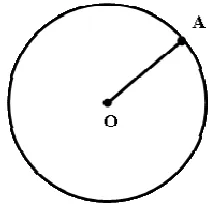
The simplest geometric figure "circle + radius" as a material system can be studied as follows. The material system "circle + radius" is constructed by joining two elements: circle with the center
O
and the rectilinear segment OA . Connection is carried out as follows (Figure 1): the segment OA connects the pointO
withthe point
A
lying on the circle (i.e., the segment OA represents the radius).Figure 1. Geometrical figure "circle + radius OA " as a material system. Point A is a universal joint.
If the structure of the system is not changed (i.e., if qualitative determinacy of the system is conserved) under different external and internal quantitative changes, then: (a) change of the length of the segment OA leads to a change of the length of the circle; (b) change of the length of the circle leads to a change of the length of the segment. As practice shows, this statement is expressed by the following mathematical relationships for relative increments:
if
(
R−R1)
R1 = k1, then(
L−L1)
L1 = k1,if
(
L
−
L
1)
L
1=
k
1, then(
R−R1)
R1 = k1,where variable quantities R and L are radius and length of the circle, respectively (these quantities have the dimension "meter"); R1 and
L
1 are some of the values of variablequantities;
(
R − R1)
and(
L − L1)
are increments of thequantities;
k
1 is the coefficient of relative increment (extension) of the segments. From these relationships, one can obtain the following equivalent relationships between relative increments of quantities characterizing the elements of the system:1
1 k
k = , R
R L
L
= 1 1
, 1 1
R L R L
= ,
1
1 R
R L
L =
,
where L1 R1 represents the dimensionless coefficient of
connection of quantities (the numerical value of the coefficient is determined empirically). These relationships represent the proportions. They do not contain a mathematical definition of the quantity of angle or angle measure since the geometrical system "circle + radius" does not contain an angle. (In other words, the quantity L R does not determine the quantity of the angle, i.e. the concept "quantity LR" is not connected with the concept
"quantity of angle"). In the case of the system "circle + radius", the dimensionless quantity LR represents "radian
measure of length of circle". If the system does not contain the segment OA, then the concept "radian measure of length of circle" does not exist. These relationships satisfy the formal-logical laws. For example, the mathematical relationship
R R L L
=
1 1
(qualitative determinacy of system) =
(qualitative determinacy of system).
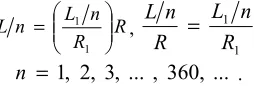
Unit of length of arc of circle has dimension of length and represents 1/360-th part of
L
. In the general case, the length of the segment of arc which constitute (represents)n
-th part ofL
is expressed by the following relationship:R R
n L n
L
= 1 1
,
1 1
R
n
L
R
n
L
=
,
...
,
360
,
...
,
3
,
2
,
1
=
n
.3.2. The Geometrical Figure "Angle" as a Material System
As is well known, the simplest geometrical figure "angle" is one of the most important figures in geometry and trigonometry. This figure as a material system can be constructed and studied as follows.
1. Angle
∠
AOB
is called the geometrical figure (material system) constructed by two rectilinear segments (elements)OA
andOB
as follows: (a) the endpointsO
of these segments is bound up with universal joint; (b) segmentsOA
andOB
can be rotated (revolved) around (about) the pointO
(Figure 2).Figure 2. Geometrical figure "angle ∠AOB + circle" as a material
system. Points
A
,O
,B
are universal joints.The point
O
is called the vertex of the angle, and the segmentsOA
andOB
are called sides of the angle. The joint gives an opportunity to change the position and length. of the segmentsOA
andOB
. The angle as the system does not exist if the length of a side is zero.2. The quantity
α
of angle ∠AOB (i.e., the numerical characteristic of property, the numerical characteristic of the state of the system of elementsOA
andOB
) is a quantity of turn (displacement) of one side of the angle around (about) the pointO
relative to the other side. Rotational motion of side of angle can be performed in two opposite directions: "positive" direction (i.e., in a direction which is opposite to the direction of rotational motion of clock hand) and "negative" direction (i.e., in a direction which coincides with the direction of rotational motion of clock hand). Variable quantityα
takes positive numerical values which do not depend on the direction of the rotational movement of the side of the angle and do notdepend on the lengths of the sides of the angle. The concepts "angle" and "quantity of angle" are the initial (original) concepts which characterize this system of elements and can not be reduced to other elementary concepts (for example, to concepts such as "segment of line", "circle", "length of segment of line", and "arc length"). In the case of the isolated system "angle", the concepts "angle" and "circle" are the mutually independent concepts because the existence of geometrical figure "angle" does not depend on the existence of geometrical figure "circle".
3. The quantity
α
is measured by the number of revolutions of the side of angle. This number is a positive number which has the dimension "revolution". The concept "revolution" designates a result of rotational motion and is not connected with the concept "direction of rotational motion". If the sides of the angle coincide with each other in the initial position (i.e., before the rotation), then the quantityα
of the angle ∠AOB is zero of revolution:revolution
0
=
α
. If the sides of the angle coincide with each other in the end position (i.e., after the rotation), then the quantityα
of the angle ∠AOB represents acomplete revolution:
α
=
1
revolution
. This angle iscalled complete angle. If
α
=
1
2
revolution
, then theangle is called flat angle. If
α
=
1
4
revolution
, then the angle is called right angle. 1/360-th part of the complete angle (complete revolution) is called degree (i.e. has the dimension "degree"). Degree is the unique measure (unit) of angle. Dimension "degree" can not be expressed by the dimension "length". (It should be emphasized that the dimensional quantity (for example, "degree") can not be identical with dimensionless quantity (for example, "radian"). Region of admissible values of the angle is° ≤ ≤
° α N
0 where
N
°
is an arbitrarily large number. 4. In accordance with the formal-logical law of identity, a mathematical expression which describes the quantityα
(as the quantitative determinacy of the system ∠AOB) must belong to the following qualitative relation:(qualitative determinacy of the system ∠AOB) =
(qualitative determinacy of the system ∠AOB).
Mathematical expression which describes length of the side of the angle ∠AOB (as quantitative determinacy of
element of the system ∠AOB ) must belong to the following qualitative relation:
(qualitative determinacy of the element of the system AOB
∠ ) =
(qualitative determinacy of the element of the system
AOB
∠
).(qualitative determinacy of angle)
≠
(qualitative determinacy of segment of line).
This implies that an angle (in particular, a central angle) should not be measured by length of the line segment (in particular, by length of the segment of the arc or by ratio of length of segment of arc to length of radius of this arc). (From the viewpoint of standard geometry, the ratio of length of the arc of the circle to length of the radius of the circle represents radian measure of the central angle. Radian measure of an angle is a dimensionless quantity. Therefore, radian is the name of the dimensionless quantity). In other words, the angle is bound up with the arc of the circle only in case of the system "circle + central angle". Only in this case, there exist a relationship between the quantity of the angle (having dimension "degree") and the quantity of the arc (having dimension "meter"). This relationship is a proportion. Therefore, this relationship is not the definition of the radian measure of angle. This implies that, in the case of the system "angle", concept "radian measure of angle" represents the formal-logical error consisting in violations of the law of identity and of the law of absence of contradiction, respectively:
(dimension of angle, i.e. "degree") = (dimension of angle, i.e. "degree"),
(dimension of length, i.e. "meter" ) = (dimension of length, i.e. "meter");
(radian measure of angle, that has no dimension)
≠
(degree (grade) measure of angle, that has dimension "degree") .This logical error is manifested, for example, in standard mathematical relationships between the degree (grade) measure of angle and the radian measure of angle:
(
" ")
017453 , 0 180
1° =
π
≈ radian and(
"
"
)
=
180
°
≈
57
,
295
°
1
radian
π
.3.3. The Geometrical Figure "Angle + Circle" as a Material System
Angle
∠
AOB
can represent a subsystem (element) of complex material systems, for example: the angle ∠AOB inscribed in a circle; the angle ∠AOB in the triangleAOB
∆ ; the angle
∠
AOB
situated in the Cartesian coordinate systemOxy
. In these cases, the following task arises: one should find quantitative (tabular or analytical) relationships between relative increments of quantities characterizing the elements of a complex system under condition that the structure (i.e., qualitative determinacy) of system is conserved.In the case of the material system "central angle ∠AOB + circle" (Figure 2), the relationship between the relative increment of quantity
α
of the central angle ∠AOB, the relative increment of quantityl
of the arc (whichunderpins the angle), and the quantity
R
of the radius of the circle has the following form:1 1 1
1
l l l −
= − α
α α
,
1
1
l
l
=
α
α
, l l
=
1 1
α
α
, α α
=
1 1
l
l ,
R l R l
= 1
1
α
α , α α
=
1 1 R l R l
where
α
1 (with the dimension "degree"), andl
1 (with the dimension "meter") are some of the values of variable quantities of the angle and of the arc, respectively;(
α −α1)
and(
l − l1)
are increments of quantities of theangle and of the arc, respectively;
(
l
1α
1)
is the coefficient of connection (coupling coefficient) of the quantities (the coefficient has dimension "meter degree");( )
l
R
is a radian measure of arc. This relationship represents a proportion. The proportion satisfies the formal-logical laws: law of identity and law of absence of contradiction:(qualitative determinacy of arc of circle) = (qualitative determinacy of arc of circle); (qualitative determinacy of angle) = (qualitative determinacy of angle). (qualitative determinacy of angle)
≠
(qualitative determinacy of arc of circle).Thus, the connection between degree measure of angle and radian measure of the arc exists only in the case of the system "central angle + circle". From the formal-logical point of view, this connection should not be expressed in the form of the following standard definitions:
(
"
"
)
017453
,
0
180
1
°
=
π
≈
radian
and(
"
"
)
=
180
°
≈
57
,
295
°
1
radian
π
.(Note: If the angle ∠AOB is in coordinate system Oxy, then the lengths of its sides can be expressed in units of length of coordinate scales. However, this does not mean that the quantity
α
(having dimension "degree") can be expressed in units of length of coordinate scales: qualityα
does not belong to qualitative determinacy of the coordinate system Oxy).3.4. The Geometrical Figure "Right Triangle" as a Material System
As is well known, the triangle is one of the most important figures in geometry and trigonometry. This figure as a material system can be constructed and studied as follows.
1. The triangle is constructed as follows. If the sides of the angle are bound up with the rectilinear segment, then the synthesized system (the constructed geometrical figure)
AOB
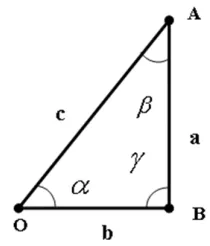
Figure 3. Geometrical figure "right triangle ∆AOB" as a material
system. Points
O
,A
,B
are universal joints.Three points
O
,A
,B
are called vertexes of triangle. The rectilinear segmentsa
,b
,c
bounded (bordered) by vertexes are called legs of triangle ∆AOB. Triangle as a material system does not exist, if length of any leg is equal to zero. Existence of interior anglesα
,β
,γ
of triangle leads to rise of the essential sign (parameter) of system: the sumS
=
α
+
β
+
γ
. The problem of value of the sumS
is the essence of the problem of Euclid's V-th postulate. Value ofS
can be determined only by means of experimental investigation of properties of triangle as a material system [2].2. The experimental device for determination of value
S
represents the following material design: material triangleAOB
∆
which has vertexesO
,A
,B
as joints. The joints give opportunity to change the following characteristics of triangle: values of quantitiesα
,β
,γ
of angles and lengths of legs
a
,b
,c
of the triangle under the condition that a ≠0, b≠ 0, c ≠ 0. In other words,joints give an opportunity of structural ("internal") movement of triangle (i.e., transitions from some structural states into others). (By definition, the structural movement of the system is the conservation of the basic properties of the system under various internal and external changes).
Structural movement of triangle is reduced to two elementary movements of its legs: to the “shift along a straight line” and to the “rotation around a point”). Statement of the problem of Euclid’s V-th postulate is as follows: it is necessary to show experimentally that
°
=
180
S
and this property of a triangle (as a system) does not depend on properties of elements of a triangle. In other words, it is necessary to show thatS
is the invariant of the structural movement of a triangle.The result of the experiment is as follows [2]:
(a) if the quantity
α
is subject to change, then this change leads to a change quantitiesβ
andγ
;° ≤ ≤
° 180
0 α ; 0° ≤
β
≤180°; 0° ≤γ
≤ 180°;(b) if
α
→ 0°, thenβ
+
γ
→
180
°
; (c) ifα
→
180
°
, thenβ
+
γ
→
0
°
; (d) 0° ≤(
β
+γ
)
≤180°;(e) area (as a variable) is not essential sign of a triangle;
(f) lengths of legs
a
,b
,c
of triangle are not equal to zero. In other words, unlike reasoning of A.M. Legendre, it is not assumed in this experiment that “legs of triangle increase infinitely” (N. Lobachevski [17]).Therefore, it is possible “to conclude from this that approaching of opposite legs to the third side under decrease of two angles is necessarily finished with transmutation of other angle into two right angles” (N. Lobachevski [17]). This result of the experiment signifies that quantity
S
represents the sum of the adjacent anglesα
and(
β
+
γ
)
. Hence,S
=
180
°
. Thus, Euclid’s V-th postulate (or the axiom V in the list of Hilbert’s axioms [18]) is proven. Consequence is as follows: the list of Hilbert’s axioms [18] is incomplete because it does not contain the definition of concept of triangle; therefore, axiom V is not a logical consequence of axioms I-IV. (In other words, the properties of the triangle can be learned only if the triangle has already been constructed (i.e., if the triangle is defined in the list of axioms). Therefore, the property (S=180°) of the triangle ∆AOB as the system is not a logical consequence of the property of the angleAOB
∠ ).
Thus, the experimental study of the properties of a triangle as a material system gives an opportunity to prove Euclid's V-th postulate.
3. The class of rectangular triangles occupies an important place in geometry and trigonometry because: firstly, any triangle can be divided (decomposed) into two rectangular triangles; and secondly, the definition of standard trigonometric functions of acute angle is based on the consideration of rectangular triangle. There is no functional relationship of type y= f
( )
x between thequantitative characteristics of the elements of the triangle as a material system. Therefore, the study of the relation between the quantitative characteristics of the elements of rectangular triangle is an experimental (practical) study of structural movement of rectangular triangle, i.e., in an experimental study of a class of rectangular triangles.
The class of rectangular triangles determines a set of states (i.e., space) of rectangular triangle, and the set of states (i.e., space) of rectangular triangle characterizes the class of rectangular triangles. The state of rectangular triangle as a material system composed of six elements represents a measure of the triangle (measure is the unity of qualitative and of quantitative determinacy of a material object) and is symbolically designated as follows:
(
a,b,c;α
,β
,γ
)
AOB∆ .
The existence condition for of a rectangular triangle has the following form (Figure 3):
0
,
0
,
0
≠
≠
≠
b
c
a
;0
°
<
α
<
90
°
,β
=
90
°
−
α
,°
=
90
γ
,α
+
β
+
γ
=
180
°
.symbol
(
a
,
b
,
c
;
α
,
β
,
γ
)
designates the content (i.e. quantitative determinacy, the quantitative aspect) geometrical figure. The state of the rectangular triangleAOB
∆ taking into consideration the condition of existence (existence condition) of the triangle is designated as follows:
(
=
°
−
=
°
)
∆
AOB
a
,
b
,
c
;
α
,
β
90
α
,
γ
90
.Movement of rectangular triangle in the space of states means mathematically that quantities
a
,b
,c
andα
,β
are variable quantities. As is well know, there are two tasks of study rectangular triangles: a geometrical task and trigonometric task. Ifα
=
const
,β
=
const
,°
=
90
γ
, anda
,b
,c
are variable quantities, the set of rectangular triangles forms a subclass of similar rectangular triangles which are studied in geometry. The statement of the task in the standard trigonometry is as follows: one should find the values of variable quantitiesa
,b
,c
under change the values of variable quantity
α
.One can prove experimentally the following facts: the destruction of the angle
∠
AOB
leads to destruction of thetriangle
∆
AOB
; generally, the change of the values of variable quantityα
leads to a change of the values of variable quantitiesa
,b
,c
; generally, change the values of variable quantitiesa
,b
,c
leads to a change of the values of variable quantityα
. These facts mean that: (a) variable quantityα
is not an independent quantity; (b) all the variable quantities are mutually dependent quantities. Consequently, the result of an experimental study of the states (i.e. structural movement) of rectangular triangleAOB
∆ is the following expression:
(
=
°
−
=
°
)
∆
AOB
a
n,
b
n,
c
n;
α
n,
β
n90
α
n,
γ
90
,...
,
2
,
1
,
0
=
n
,where the index
n
numbers the values of variable quantities. One can represent this result in tabular form. Tabular form shows that structural movement as a movement in the space of states is transitions of dimensional quantity from some values to others:1 +
→
nn
a
a
,b
n→
b
n+1,c
n→
c
n+1; αn →αn+1.These relations satisfy the formal-logical law of identity:
(qualitative determination of element) =
(qualitative determination of element).
The relations
n
n b
a → , an → cn,
b
n→
c
n,α
n→
a
n,α
n→
b
nbetween the dimensional quantities which belong to different elements of the system contrary to the
formal-logical law of absence of contradiction. But the relationships between the relative increments of quantities which belong to different elements of the system satisfy the formal-logical laws because these relationships represent proportions.
One can prove the following key propositions: (a) there are the determinative quantities and determinable quantities among the variable quantities
a
,b
,c
,α
,β
which characterize rectangular triangle∆AOB; (b) the quantityα
of angle does not determine the legs
a
,b
of rectangular triangle ∆AOB; (c ) the legsa
,b
of rectangular triangleAOB
∆ determine the quantity
α
of angle. The proof is based on three standard signs of the equality of triangles. These signs are practical signs of equality of triangles and are as follows:(a) The first sign of equality of triangles reads as follows: if the two legs and one angle between them of the triangle are respectively equal to the two legs and one angle between them of another triangle, then such triangles are equal to each other.
(b) The second sign of equality of triangles reads as follows: if one leg and two adjacent angles of the triangle are respectively equal to leg and two adjacent angles of another triangle, then such triangles are equal to each other. (c) The third sign of equality of triangles reads as follows: if three legs of the triangle are respectively equal to the three legs of another triangle, then such triangles are equal to each other.
Note: All three signs of equality of triangles contain the common statement that there is at least one leg of the triangle among the three given elements.
Since the triangle can be represented as a material system of two subsystems, the signs of equality triangles express the relation between measures (measure is the unity of qualitative and quantitative determinacy) of the subsystems of the triangle: the measure of one subsystem determines the measure of another subsystem. In essence, these three signs of equality of triangles represent practical criteria of qualitative and quantitative determinacy of the triangle. Indeed, triangle is qualitatively and quantitatively determined (i.e., triangle has certain measure: all elements has certain measures, and, therefore, concrete triangle can be constructed) if the following subsystems are qualitatively and quantitatively determined (i.e., measures are given):
one leg among the three determinative elements of the triangle. This implies that: legs
a
,b
of rectangular triangle ∆AOB are determined if anglesα
,β
and legc
are determined; legs
a
,b
of rectangular triangle ∆AOB is not determined if only angleα
is determined because the angleα
does not determine the legsa
,b
; the angleα
of rectangular triangle ∆AOB is determined if the legsa
,b
are determined. Thus, the key propositions are proven.Statement of the task in standard trigonometry can be simplified if one inserts (introduces) the following conditions into consideration: the value of the quantity
c
is given andc
=
const
. In this case, the value of the quantityα
determines the values of the quantitiesa
,b
. Then the state of the rectangular triangle has the following form:(
= = ° − = °)
∆AOB an,bn,c const; αn, βn 90 αn, γ 90 ,
... , 2 , 1 , 0
=
n .
In this connection, it should be noted that, from the formal-logical point of view, it is impossible to formulate correctly signs of equality of triangles in the form of mathematical relationships between quantities which have distinct (different) qualitative determinacy (i.e., dimension). Explanation is that the signs of equality of triangles express the relation between the measures (measure is the unity of qualitative and quantitative aspects) of subsystems of the triangle. But standard mathematics abstracts the quantitative aspect from the qualitative aspect of the object and studies only the quantitative aspect. Therefore, the correct mathematical relationships should have a sense of proportion.
3.5. The Geometrical Figure "Mobile Radius + Coordinate System" as a Material System
The geometrical figure "mobile radius + coordinate system" is used in the standard trigonometry to determine the trigonometric functions of arbitrary angle. This figure as a material system can be constructed and studied as follows.
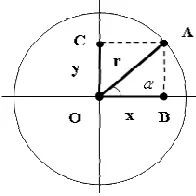
Figure 4. Geometrical figure "mobile radius
OA
+ coordinate systemOxy
" as a material system. PointsO
andA
are universal joints;ϕ
is the quantity of angle between the segment
OA
and the horizontal scalex
.1. In order to study the geometrical figure "mobile radius + coordinate system" as a material system (i.e., to study experimentally), it is necessary to construct a practical (i.e. material) coordinate system. The practical coordinate system on the plane is constructed as follows (Figure 4):
(a) two rulers (for example, with scale marks (deletions) "centimeter") are rigidly joined at point
O
forming an angle 180° and are horizontally arranged; this scale is called a horizontal scalex
; (b) other two rulers (for example, with scale marks (deletions) "centimeter") are rigidly joined at pointO
forming an angle 180° and are vertically arranged; this scale is called a vertical scaley
; (c) the angle between the scales has constant value 90°; (d) horizontal and vertical scales are fastened onto plane and divide the plane into four parts: the quarters I, II, III, IV.Then the geometrical figure (i.e., the material geometrical system) "mobile radius OA + coordinate system" is constructed as follows (Figure 4): (a) the boundary point
O
of the rectilinear segment OA is connected with the pointO
of the practical coordinate system Oxy by joint; (b) the angle between the segment OA and horizontal scalex
is designated by the letterϕ
; (c) the segment OA can rotate around the pointO
in the direction of counter-clockwise rotation, so that the quantityϕ
of angle is considered to be an independent variable; the range of variation of the quantityϕ
is 0° ≤ϕ ≤ N° where N° is an arbitrarily large number. 2. Trigonometric task is to study experimentally the relationship between the quantityϕ
of angle and the projections of the segment OA onto the coordinate scales. Solution of the task is the following results (Figures 4 and 5).Figure 5. Geometrical figure "circle + rectangle OBAC + coordinate system" as a material system. Segment OA is mobile radius; segments OB and OC are projections of radius;
α
is quantity of the angle between the segments OB and OA; pointsO
,A
,B
,C
are universal joints.r
OA
≡
,OB
≡
x
,OC
≡
y
, one can express mathematically the existence condition for rectangleOBAC
as follows:x
≠
0
,y
≠
0
,r
=
const
,°
<
<
°
90
0
α
. This existence condition is identical with the existence condition for the rectangular triangle∆
AOB
because the diagonalOA
divides the rectangleOBAC
into two equal rectangular trianglesAOB
∆
and∆
AOC
.The rotation of radius
OA
leads to a change in values of quantitiesϕ
andα
. The quantityϕ
in the quarters I, II, III, IV possess the values0
°
≤
ϕ
≤
90
°
,°
≤
≤
°
180
90
ϕ
, 180° ≤ϕ
≤ 270°, 270° ≤ϕ
≤360°, respectively. The following values of quantityα
correspond to the values of quantityϕ
:(a) if
ϕ
=
0
°
, thenα
=
0
°
,y
=
0
. Consequently,triangle
∆
AOB
and rectangleOBAC
do not exist;(b) if
0
°
<
ϕ
<
90
°
, then0
°
<
α
<
90
°
.Consequently, triangle
∆
AOB
and rectangleOBAC
exist in the quarter I;(c) if
ϕ
=
90
°
, thenα
=
90
°
,x
=
0
.Consequently, triangle
∆
AOB
and rectangleOBAC
do not exist;(d) if
90
°
<
ϕ
<
180
°
, then0
°
<
α
<
90
°
.Consequently, triangle
∆
AOB
and rectangleOBAC
exist in quarter II;(e) if
ϕ
=
180
°
, thenα
=
0
°
,y
=
0
.Consequently, triangle
∆
AOB
and rectangleOBAC
do not exist;(f) If
180
°
<
ϕ
<
270
°
, then0
°
<
α
<
90
°
.Consequently, triangle
∆
AOB
and rectangleOBAC
exist in quarter III;(g) if
ϕ
=
270
°
, thenα
=
0
°
,x
=
0
.Consequently, triangle
∆
AOB
and rectangleOBAC
do not exist;(h) If
270
°
<
ϕ
<
360
°
, then0
°
<
α
<
90
°
.Consequently, triangle
∆
AOB
and rectangleOBAC
exist in quarter IV;(i) if
ϕ
=
360
°
, thenα
=
0
°
,y
=
0
.Consequently, triangle
∆
AOB
and rectangleOBAC
do not exist.This implies that the increase in values of quantity of
ϕ
under rotation of the radiusOA
leads to movement (displacement) of the rectangleOBAC
(and triangle∆
AOB
) from quarter I into quarter IV. At that, the change in the values of the quantityα
occurs as follows:α
increases in quarters I and III;α
decreases in quarters II and IV. This means that the change in values of the quantityα
at increase in values of the quantityϕ
isperiodic motion.
Thus, the range of permissible values of quantity
α
of the angle∠
AOB
under rotation of the radiusOA
is°
<
<
°
90
0
α
; impermissible values areα
=
0
°
and°
=
90
α
because rectangleOBAC
and triangleAOB
∆
do not exist for the valuesx
=
0
ory
=
0
; the study of the material system "mobile radiusOA
+ coordinate system" reduces to the study of the material system "rectangular triangle ∆AOB".3.6. The Geometrical Figure "Circle + Central Angle + Rectangular Triangle + Coordinate System" as a Material System
Analysis of the material system "circle + central angle + right triangle + coordinate system" gives the key to understanding the essence of the standard trigonometry.
The system "circle + central angle ∠AOB + rectangular triangle ∆AOB + coordinate system" consists of two subsystems: the subsystem "circle + central angle
AOB
∠
" and the subsystem "rectangular triangleAOB
∆
+ coordinate system" (Figures 4 and 5). The following assertions are true for each of the subsystems:1) in the case of subsystem "circle + central angle AOB
∠ ", the relationship between
dimensional quantities
ϕ
andl
has the following form:r l r l
= 1
1
ϕ
ϕ .
This relationship represents the proportion of the relative increments of quantities
ϕ
иl
describing the different elements;2) in the case of subsystem "rectangular triangle
AOB
∆
+ coordinate system", the relationship between the dimensional quantitiesα
andy
in the linearapproximation has the following form:
1 1
1 1
y y y − = −
α α α
, y
y
=
1 1
α
α .
This linear relationship represents the proportion of the relative increments of quantities
α
andy
describing the different elements;3) in the case of subsystem "rectangular triangle
AOB
∆
+ coordinate system", the relationship between the dimensional quantitiesα
andx
in the linear approximation has the following form:1 1 1
1
x x x − − = −
α
α
α
.
4) In the case of the subsystem "rectangular triangle
AOB
∆
+ coordinate system", the relationship between the dimensional quantitiesy
andx
in the linearapproximation has the following form:
1 1
1 1
x
x
x
y
y
y
−
−
=
−
.
This linear relationship represents the proportion of relative increments of quantities
y
andx
describing the different elements.One can obtain linear relationship between the relative increments of quantities
l
andy
relating to different elements of the subsystems if one takes into consideration thatα
=
ϕ
under0
°
<
ϕ
<
90
°
. Substituting the expressions forα
andϕ
into equalityα
=
ϕ
, one obtains the following relationship between( )
l
r
and( )
y
r
:r y y r l l
=
1 1
1
1 α
ϕ
,
α
1=
ϕ
1,i.e.
r y r l l y
=
1 1
,
l
≠
y
.This relationship represents the proportion and expresses the connection between arc length
l
(or radian measure( )
l
r
of the arc) and the length of the legy
of the rectangular triangle∆
AOB
. This relationship exists only in the case of the complete system "circle + central angleAOB
∠
+ rectangular triangle∆
AOB
+ coordinate system".Thus, mathematical relationship between the measure of the arc of circle and the leg
y
of the rectangular triangle does not exist in the case of separate (single) system "rectangular triangle∆
AOB
".4. On the Essence of Standard
Trigonometry
As is known, the standard statement of task in trigonometry is formulated as follows: it is necessary to find the trigonometric functions, i.e. relationship between arbitrary values of quantity
α
of angle and values of quantitiesx
,y
of the rectangular triangle∆
AOB
under condition that the quantityr
=
const
is given (Figure 4 and 5). The standard solution of this task is the following basic trigonometric functions:r
y
=
α
sin
, cosα = x r, tgα
= y x,α
=
l
r
.The form of these relationships shows that one considers
the system "circle + central angle ∠AOB + rectangular triangle ∆AOB + coordinate system": the quantities
r
andl
characterize the circle; the quantityα
characterizes the central angle; quantitiesx
,y
characterize the projections of the mobile radiusOA
; quantitiesx
,y
,r
,α
characterize the inscribed rectangular triangle∆AOB. These relationships are not free from objection.(a) The first objection is that these relationships under the values
α
=
0
°
andα
=
90
°
of the angle ∠AOB does not satisfy the condition of existence of rectangleOBAC
and of rectangular triangle∆
AOB
.(b) The second objection is that these relationships do not satisfy the standard definition of the function because there are no mathematical operations which one should carries out on the quantity
α
to obtain relationshipsr
y
=
α
sin
,cos
α
=
x
r
,tg
α
=
y
x
. Therefore, the conformity operationsy
→
α
,α
→
x
,α
→
y
x
and standard mathematical relationships between the dimensional quantities which belong to different elements of the system contrary to the formal-logical law of absence of contradiction. If there were any operations (rules) of conformity, these operations (rules) of conformity would have the character of non-mathematical operations (rules) because these operations (rules) would change the qualitative determinacy of the angle
α
transmuting angleα
(with the dimension "degree") into the qualitative determinacy of the legs (with the dimension "meter"). However, the relationships between the relative increments of quantities belonging to different elements of the system satisfy the formal-logical laws because these relationships represent proportions.(c) The third objection is that the standard trigonometric functions describing quantitative relationships between the quantity
α
and the quantities of line segments do not represent proportions and therefore do not meet the formal-logical law of absence of contradiction:(qualitative determination of the angle)
≠
(qualitative determination of the line segment).
According to the formal-logical law of identity, the correct mathematical (quantitative) expressions describing the quantities of the angle and of the line segment must belong to the following qualitative relations:
(qualitative certainty angle) =
(qualitative determination of the angle);
(qualitative determination of the line segment) = (qualitative determination of the line segment).