http://mojem.um.edu.my
31
Taylor’s Business School,Taylor’s University, MALAYSIA
Corresponding Author: Taylor’s University, MALAYSIA Email:
ABSTRACT
The purpose of this article is to present undergraduate students’ perception of the Final Year Project’s supervisory process. A survey was carried out to elicit the students’ views to gain an insight into their experience of the supervision process. The sample consisted of 100 students in a private university in Malaysia. The participants’ responses were analyzed according to the research questions and recurring themes. It was found that the supervisor’s area of expertise, timely feedback, duration of the research project and the number of meetings with supervisors were the only factors affected according to gender of students. The findings resulted in a number of implications which can be extended further in future research to add to the literature in this area.
Keywords: Undergraduate student, Supervision, Final year project, Higher education, Malaysia
E-ISSN NO: 2289 – 4489
STUDENTS’ PERCEPTION OF THE SUPERVISORY PROCESS:
A CASE STUDY AT A PRIVATE UNIVERSITY IN MALAYSIA
http://mojem.um.edu.my
32
INTRODUCTION
Supervision of graduate students is a crucial part of the teaching and learning process in higher education. Jewell and Brew’s (2010) report on the undergraduate research programs in Australian universities based on 39 Australian universities and 31 external research institutions reveals that undergraduate research programs are becoming increasingly common, with 58% of the universities surveyed providing research experience as part of their undergraduate programs. According to Ho (2003), currently many programs in Hong Kong universities as well as universities in other parts of the world require students to do final year undergraduate projects, which means writing a thesis on a topic specifically related to an area studied in the program which requires expert supervision. The nature and quality of the educational supervision which is complex and diverse depends on a number of factors (Dainty, 2010).
Research on the supervisor-supervisee relationship in the supervisory process should take into consideration several issues including the sensitivity surrounding the roles and responsibilities of both the supervisor and the supervisee (De Trude, 2001). The supervision task becomes more arduous as there are stringent rules attached to it. As stipulated in the Codes of Ethics for the Association of Counselor Education and Supervision (1993), supervisors are prohibited from having any form of social dealings which would cause a conflict of interest in the supervisor-supervisee relationship. It is further claimed that this form of unprofessional relationship can hamper judgments made in the supervisory process especially in terms of objectivity and it is advocated that in such a situation, it is better to terminate the relationship. Further, according to De Trude (2001), supervisors have a high level of responsibility to ensure that their supervisees are carrying out research in their own area of competency and not in an area that the supervisor is competent in for the role of the supervisor is to enhance the student’s existing competence. Lessing (2014) has listed a number of responsibilities of a supervisor in assisting the students. The responsibilities are:
selecting a research topic and design;
formulating a researchable research question; developing an understanding of the field of study; arriving at a research design;
dividing the research into different phases; conducting a literature review; and
relating the present study to the ongoing dialog in literature
http://mojem.um.edu.my
33
In this research, we investigated the potentials and challenges faced by supervisees in the supervisory process. The findings will enable supervisors and academic management to gain awareness of supervisees’ perceptions on the supervisory process and with this knowledge; they can take the necessary steps to overcome the negative issues raised to ensure more effective future supervisory relationships. The research questions underpinning this investigation are:
1. What are supervisees’ perceptions of the supervisory process? 2. What are supervisees’ perceptions of the role of the supervisors?
This study is highly significant for it is important for academicians to understand the necessity to create a secure environment when supervising to support the students’ growth both academically and professionally as research is now part and parcel in all areas of employment. Further, understanding the dynamics of the supervisor-supervisee relationship and how it affects the supervisory process is the key to effective and successful research.
LITERATURE REVIEW
There is extensive research on the supervisory process, both at undergraduate and post graduate levels. The objective behind this wide research can be attributed to the nature of the subject itself, where it involves relationships between two individuals. The nature of this relationship is very crucial as it could determine whether the project/dissertation is successful or a total failure. For the purpose of this section, the literature review will be discussed under three headings; the supervisory process, supervisor roles and responsibilities, and research on supervision.
Supervisory Process
According to Salmon (1992), in agreeing to supervise a project, the supervisor is involved in taking the supervisee through an arduous journey which can be exciting as well as difficult, risky and painful. Lessing (2014) suggested that efficient supervision requires a good relationship and interaction between supervisors and postgraduate students to ensure quality and successful research outcomes. He added that it is crucial for supervisors to understand the challenges students experienced in the process of completing their postgraduate research projects. He based his claim on views of other researchers such as Kiley and Mullins (2005), Lee (2010), Sambrook, Stewart, and Roberts (2008), Watts (2008) and Wisker, Robinson, Trafford, Warnes and Creighton (2003, as cited in Lessing, 2014). Lessing (2014) also claims that since students lack experience and knowledge in the various aspects of research, supervisors need to provide comprehensive advice, support and direction. On the other hand, Elawar and Corno (1985) assert that students demonstrate higher levels of intrinsic motivation when they are provided with constructive and informative feedback. Nadar (1997) adds to this by claiming such feedback provides discernments that act as a robust motivation for further improvement.
http://mojem.um.edu.my
34
These studies suggest that the supervisor and supervisee relationship plays a significant role in ensuring successful supervision. As supported by Dispenser (2013), prolific supervision depends on a number of elements consisting of trust, respect, and safety in the relationship besides an active, intelligent and responsible involvement by all parties. She added that supervision is also affected by issues of matching and difference. According to Dainty (2010), besides the supervisor-supervisee relationship, other factors contributing to effective educational supervision consist of the following:
- Plan of action
- Frequent meetings and liaison
- Supervisor enthusiasm and collaboration
- Feedback
Peterson (2007) has brought a new perspective to the supervision process by introducing a new term, where he equates research supervision as “category boundary work”. He went on to define how academics are continually involved in a struggle to establish and maintain boundaries in the relationship to ensure the focus of the research project does not deviate and the final outcome is kept in focus. Thus, any failure which threatens successful completion is rectified and any success is reinforced through compliments. There is ample evidence in the literature that supervisors tend to base their supervisory approach on their own experiences as research students (Bitzer, 2010). Although these researchers’ views are based on postgraduate students’ experience, it can also apply to supervision of undergraduate students. According to researchers such as Hockey (1994), Pearson (1996), Phillips and Pugh (2000), Sayed et al. (1998), as cited in Lessing (2014), students should not be dependent on the supervisors but rather take it upon themselves to initiate discussions by requesting assistance when needed.
http://mojem.um.edu.my
35
Thus, it can be concluded that numerous studies have been done on the role of supervisors in the supervision process. However, the aim of this research is to investigate uundergraduate students’ perception of the Final Year Project supervisory process with focus on the Malaysian scenario.
Roles and Responsibilities of a Supervisor
MacKeogh’s (2006) research explores the roles and responsibilities of a supervisor in undergraduate dissertations for both on campus and off-campus students through the use of online methods and peer supervision. The findings describe the roles and responsibilities of supervisors of undergraduate students as subject experts, gatekeepers, and resources for research literature, project managers, shapers, editors, promoters of student self-efficacy, and ensures of safe and ethical research, providing support while instilling autonomy and independence. He added that good supervision is posited as lying on a continuum between and active and passive and direct and indirect supervision, with the most appropriate supervision for undergraduate research as indirect-active (welcome student contact, provides advice, and asks for student justifications and explanations of their ideas) and indirect-passive (adopt a listening non-directive approach, and allows the student to solve their own problems).
http://mojem.um.edu.my
36
Research on SupervisionHarrison and Whalley (2008) carried out a research to examine students’ experiences of being involved in an undergraduate dissertation and findings indicate that the key areas of focus in helping students are choosing and studying the right topic, ensuring student motivation and enjoyment, and good student-supervisor relationships. The same study identified the main issues of difficulty for most students included time management and understanding expectations. Baker et al. (2013) carried out research on the benefits of group supervision in comparison to individual supervision for undergraduate students undertaking a dissertation and the findings indicated that students’ reactions to group supervision were positive. The students valued group supervision as it provided support from peers, enabled comparison and the use of other students as “yardsticks” for performance, as resources for information and as a means to solve problems. The report written by Healey et al. (2013) to identify new and more creative methods of developing a dissertation through the examination of approximately 70 case studies across a range of countries recommended that students and staff be equally involved and be given a choice as to the type of dissertation they undertake and the type of outcomes that are assessed to increase transformational learning among students.
METHODOLOGY
In order to understand how students perceived the supervisory process, we carried out a survey. This study can be considered descriptive in nature as it aims at depicting the findings in an accurate way. It has been noted that descriptive research is about describing people who take part in the study and their perceptions. According to Mills (1959), although some people dismiss descriptive research as mere description, good description is fundamental to the research enterprise and it has added immeasurably to the knowledge of the shape and nature of our society. Descriptions can be concrete or abstract. A relatively concrete description might describe the ethnic mix of a community, the changing age of a population or the gender mix of a workplace. Alternatively the description might ask more abstract questions. Good description provokes the “why” questions of explanatory research (Mills, 1959).
Measures
http://mojem.um.edu.my
37
A number of variables were investigated; gender, nationality, qualification, experience, expertise, number of supervisees, timely feedback, have taught the supervisee before, duration of completion and number of meetings. The questionnaire was distributed to Final Year students; to ensure confidentiality, they were completed anonymously.
Sampling
After considering the research, a convenience sampling technique was used to distribute the questionnaire. The targeted population for this study consisted of 107 students who have gone through the university system. Of the number, 100 usable copies of the questionnaire were returned, yielding a response rate of 92.9%. The survey questions were answered by participants based on their consent and on voluntary basis. The number of this sample exceeds the minimum sample of 30 participants as required by probability sampling technique, showing that it may be analyzed using inferential statistics (Leedy & Ormrod, 2005).
Data Analysis
The SPSS version 16.0 was used to analyze the questionnaire data. Firstly, exploratory factor analysis was used to assess the validity and reliability of measurement scales (Hair et al., 1998; Nunnally & Bernstein, 1994). A factor analysis was first done for all the items representing each research variable and this was followed by Cronbach alpha test. The value of factor analysis for all items that represent each research variable was .4 and more, indicating the items met the acceptable standard of validity analysis. On the other hand, Cronbach alpha research variables exceeded the acceptable standard of reliability analysis of .70, indicating that the variables met the acceptable standard of reliability analysis (Nunnally & Bernstein, 1994).
FINDINGS AND DISCUSSION
Background Data of Samples
There are 91 respondents of whom 42.6% are males and 53.4% are females. These students are from different majors such as Business Administration (28.6%), International Business (22%), International Business and Marketing (48.4%) and Banking and Finance (1.1%). The findings are shown in Table 1 and Table 2.
Table 1
Demographic Data
Frequency Percent
Male 42 46.2
Female 49 53.8
Total 91 100.0
http://mojem.um.edu.my
38
Table 2
Field of Study
Frequency Percent Business Administration
26 28.6
International Business
20 22.0
International Business &
Marketing 44 48.4
Banking & Finance
1 1.1
TOTAL 91 100.0
Students’ Perceptions of the Supervisory Process
0 10 20 30 40 50
Approachable Available for consultation Often gives feedback Feedback given promptly Listens to opinions/views Praises/compliments me for… Reprimands for poor performance
Perfomance improves after… Guidance is effective
Totally reliable
No. of respondents
P
e
rc
e
p
ti
on
s
Strongly Disagree
Disagree
Neither Agree nor Disagree
Agree
Strongly Agree
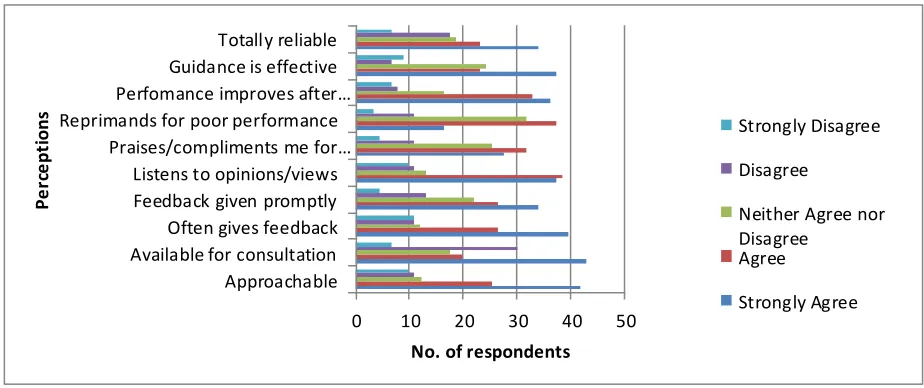
Figure 1. Students’ perceptions on the supervisory process
http://mojem.um.edu.my
39
supervisor is approachable (67.1%), the supervisor listens to the student’s opinions/views (60.5), supervisor gives feedback promptly (66%), the guidance given by the supervisor is effective (60.5%) and lastly, the student’s performance improves after the supervisor’s feedback. Taken together, all these give a strong indication that the students are satisfied with the overall supervisory process. These findings are similar to findings by Grant, Schofield, and Crawford (2012).
Students’ Perceptions on the Role of Supervisors
The survey questionnaire also elicited responses on students’ perceptions as to the role of supervisors in the supervision process. The findings revealed that the students actually have very high expectations with regard to the supervisors’ roles. The ten statements posted to the students in the survey requested them to identify the key roles played by supervisors in the process. Figure 2 illustrates the findings on students’ perceptions of the supervisor role.
0 50
Select a reseach topic. Decide theoretical framework and/or methodology. Ensure the students have access to services &… Advise on policies, procedures & requirements
Maintain professional relationship. Insist on regular meetings. Check students progress regularly. Ensure thesis is completed on time. See all drafts to ensure that students are on the… Responsible for decisions regarding the standard of…
Strongly Disagree
Disagree
Neither Agree nor Disagree
Agree
Fıgure 2. Students’ perceptions on the role of supervisors
http://mojem.um.edu.my
40
The percentage of responses from the students who agreed to the statements was high in the following statements:
Ensure thesis is completed on time—74.8%
Advice on policies, procedures and requirements—73.7% Check students’ progress regularly—72.6%
See all drafts to ensure that the students are on the right track—72.6% Insist on regular meetings—69.3%
Responsible for the decisions regarding the standard of the thesis--69.3%
These findings clearly assign a significant role on the part of the supervisors to ensure that students adhere to policies, procedures and requirements, complete the thesis on time as well as ensure that they are on the right track which can be achieved through regular meetings and regular checks on progress and drafts. An interesting finding was that the students felt that selecting the topic and theoretical framework/methodology should not be within the ambit of the supervisors. This was indicated by the small percentage of students agreeing to the statements. Only 17.6% agreed that supervisors should select research topics and 37.4% agreed that supervisors should decide the theoretical framework/methodology. This can be seen as positive findings showing that these students are quite independent and have the ability to think for themselves which proves that the objective of the Malaysian education system to cultivate students who are able to think critically has succeeded. The responses to the statement that supervisors should have a purely professional relationship had a low response (40.7%). We feel that future research should investigate why students take this view to understand the implications behind the expectation for supervisors to go beyond a professional relationship. This area can be further extended to identify if there is a difference between students from Western countries and Asian countries in their expectations of the supervisor and supervisee relationship needed.
Factors that Affect a Supervisory Process
http://mojem.um.edu.my
41
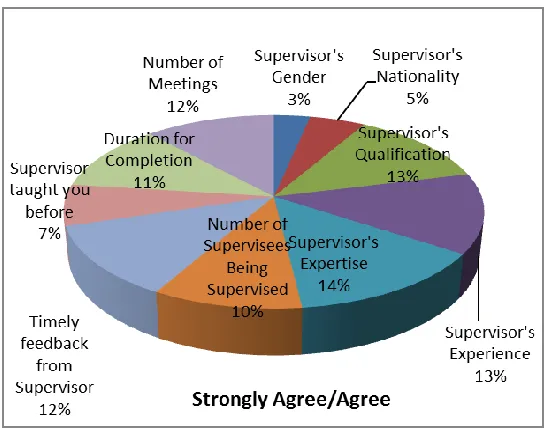
Figure 3. Factors affecting the supervisory process.
The most significant finding is that the students generally feel that the gender and the nationality of the supervisors do not have much impact on the supervision process. This is seen in the low percentage of students agreeing to their importance; gender (18.7%) and nationality (28.6%). The factors that a large percentage of the students agreed had significant impact on the supervision process are the qualifications of supervisors (73.7%), experience (76.9%) and area of expertise (79.1%) This is similar to the findings of Holloway et al. (1989). The students did not mind being assigned supervisors with whom they have not had any prior contact. This was not a problem, as proven by the low percentage of response (39.65%) from those who agreed that supervisors having taught them before is important for successful supervision. The factors of timely feedback (69.2%), duration for completion of project (64.8%) and number of meetings (67%) were considered to be important by more than 50% of the students.
Differences in the Perceptions of the Factors Affecting Supervision between Genders
http://mojem.um.edu.my
42
Differences in Perceptions of the Factors Affecting Supervision According to GendersStrongly
Agree
Agree Neither
Agree nor Disagree
Disagree Strongly
Disagree Total No of Meetings with Supervisor
Gender Male Count 8 13 13 5 3 42
% within Gender 19.00 % 31.00 % 31.00 % 11.90 %
7.10% 100%
Female Count 22 18 2 3 4 49
% within Gender 44.90 % 36.70 %
4.10% 6.10% 8.20% 100%
Total Count 30 31 15 8 7 91
% within Gender 33.00 % 34.10 % 16.50 %
8.80% 7.70% 100%
Area of Supervisor’s Expertise
Gender Male Count 5 18 6 8 5 42
% within Gender 11.95 % 42.85 % 14.29 % 19.05 %
11.90% 100%
Female Count 14 15 9 6 5 49
% within Gender 28.57 % 30.61 % 18.37 % 12.24 %
10.20% 100%
Total Count 19 33 15 14 14 91
% within Gender
51.6% 27.5% 4.4% 4.4% 12.1% 100%
Timely feedback
Gender Male Count 12 16 7 7 0 42
% within
Gender
28.6% 38.1% 16.7% 16.7% 0% 100%
Female Count 22 13 5 3 6 49
% within
Gender
44.9% 26.5% 10.2% 6.1% 12.2% 100%
Total Count 34 29 12 10 6 91
Gender Male % within
Gender
37.4% 31.9% 13.2% 11.0% 6.6% 100%
Duration of the project
Gender Male Count 8 14 10 6 4 42
% within
Gender
19% 33.3% 23.8% 14.3% 9.5% 100%
Female Count 22 15 3 3 6 49
% within
Gender
44.9% 30.6% 6.1% 6.1% 12.2% 100%
Total Count 30 29 13 9 10 91
Gender Male % within
Gender
http://mojem.um.edu.my
43
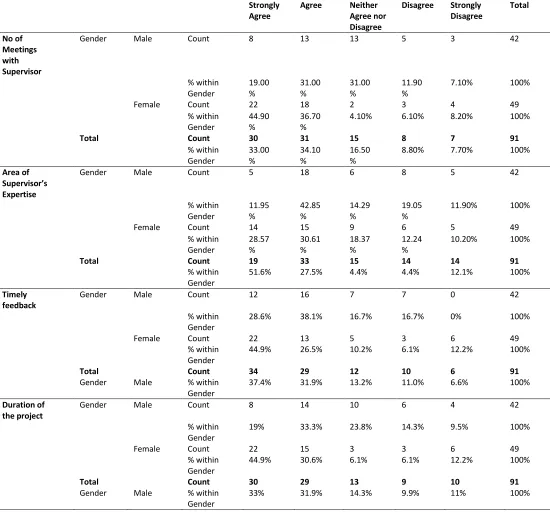
The findings indicated a difference in the perceptions between the male and female students with regard to the number of meetings with supervisors and success of supervision. Only 50% of the male students agreed that it was an important factor while 81.6% of female students agreed that it was important. With regards to the factor on the importance of the supervisor’s area of expertise to the supervision, the findings between the perceptions of the male and female students showed a small difference of 4.38% only where 54.8% of males agreed it was important while 59.2% of female students agreed that it is important. In response to the question of whether timely feedback and project duration affect the supervisory process, the responses between the genders indicated a significant difference. Some 71.4% of female students found it important as opposed to only 66.7% of male students. Similarly, there was a significant difference in the perceptions on the importance of duration to a successful supervisory process. Compared to an average of 52.3% male students claiming it was important, a larger percentage of 75.5% female students found it important.
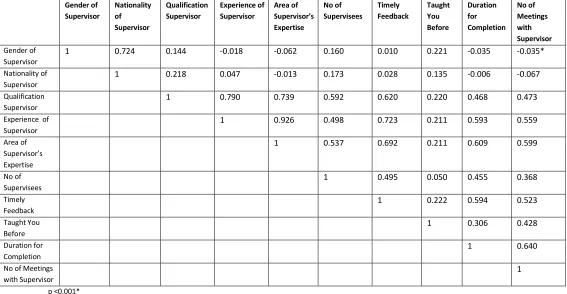
In addition, a cross tab analysis was conducted to determine the relationship between the variables and supervision success. The findings are indicated in Table 4.
Table 4
Cross Tab Analysis of Factors Gender of Supervisor Nationality of Supervisor Qualification Supervisor Experience of Supervisor Area of Supervisor’s Expertise No of Supervisees Timely Feedback Taught You Before Duration for Completion No of Meetings with Supervisor Gender of Supervisor
1 0.724 0.144 -0.018 -0.062 0.160 0.010 0.221 -0.035 -0.035*
Nationality of Supervisor
1 0.218 0.047 -0.013 0.173 0.028 0.135 -0.006 -0.067
Qualification Supervisor
1 0.790 0.739 0.592 0.620 0.220 0.468 0.473
Experience of Supervisor
1 0.926 0.498 0.723 0.211 0.593 0.559
Area of Supervisor’s Expertise
1 0.537 0.692 0.211 0.609 0.599
No of Supervisees
1 0.495 0.050 0.455 0.368
Timely Feedback
1 0.222 0.594 0.523
Taught You Before
1 0.306 0.428
Duration for Completion
1 0.640
No of Meetings with Supervisor
1
http://mojem.um.edu.my
44
Cross tab analysis was conducted to determine the relationship between the variables. Cross tabulations provide a way of analyzing and comparing the results for one or more variables with the results of another (or others). In this section, cross tab was done to determine whether factors affecting the success of supervision process differ with the gender of the students. Table 5 shows the result of the Chi-Square Tests. The factors affected by gender of students (all p-values less than 5%) are; Number of meeting with the supervisors (5% sig level), Area of supervisor’s expertise (10% sig level); timely feedback (5% sig level) and duration given for completion of the project (5% sig level).
Moreover, a chi-square test also carried out to test the goodness of fit in order to see the difference between the observed value and the expected value. The findings are indicated in Table 5.
Table 5
Chi-Square Test
Pearson Chi-Square
Asymp. Sig. (2-sided)
No. of meetings with supervisor 15.603 .004
Area of supervisor’s expertise 8.173 .085
Timely feedback 10.170 .030
Duration of the project 11.265 .004
The goodness of fit test is based on the frequency of occurrence and is used in determining how well the data obtained from an experiment matches the expected data. It is applicable to both qualitative attributes and quantitative variables, as it helps to ensure the experimental results are statistically significant and have not been caused by chance events.
Table 6
Summary of Data
Value df Asymp. Sig. (2-sided)
Pearson Chi-Square 6.023a 4 .197
Likelihood Ratio 6.130 4 .190
Linear-by-Linear Association .030 1 .862
N of Valid Cases 91
http://mojem.um.edu.my
45
number of times a student meets the supervisor is dependent on the gender of student at 5% significant level. Some 50% of the male students agree that the number of times affects the supervision process. In the case of female students, however, it was higher with more than 82% agreeing that the number of meetings is important. The respondents’ supervision process was measured by 9 items which remained after factor analysis was conducted. Based on Cohen’s criteria (1989), two variables are said to be associated if the correlation coefficient value is at least .35. In this study, all the variables in a construct are adequately correlated since the highest absolute correlation falls between .35 and .85. Therefore, every item in the construct correlates adequately with at least one item in the construct. The reliability analysis gave Cronbach alpha value of .842 for the supervision process, which is well above the minimum requirement of .7. The KMO value for the factor analysis was 0.785, indicating a good level of data reduction adequacy. According to the students, the majority of supervisors need better training to ensure effective supervision.
CONCLUSION
This research explored the experience, practices and problems of the supervision process of undergraduate students who completed a final year project. Most of the responses revealed that the role played by their supervisors is not very satisfactory. The results show that a large proportion of the respondents were not very happy with the support and guidance given in terms of time allocated for supervision. They felt that the supervisors did not guide them sufficiently in terms of the research requirement; literature review, designing research questions, methodology and data analysis especially with regard to quantitative data analysis. Since academic research is a complex and highly specialized form of learning activity, it is crucial to adopt high standards of practice.
http://mojem.um.edu.my
46
REFERENCESAbadie, P. D. (1985). A study of interpersonal communication processes in the supervision of counseling. (Unpublished doctoral dissertation, Kansas State University).
Anderson, C., Day, K., & McLaughlin, P. (2007). Mastering the dissertation: Lecturers’ representations of the purposes and processes of master’s level dissertation supervision. Studies in Higher Education, 31, 149-168.
Anderson, C., Day, K., & McLaughlin, P. (2008). Student perspectives on the dissertation process in a Master’s degree concerned with professional practice. Studies in Continuing Education, 30(1), 33-49
Armstrong, S. J. (2004). The impact of supervisors’ cognitive styles on the quality of research supervision in management education. British Journal of Educational Psychology,74(4), 599-616.
Association for Counselor Education and Supervision. (1993). Ethical guidelines for counseling supervisors. ACES Spectrum,53(4), 270-276.
Baker, M., Cluett, E., Ireland, L., Reading, S., & Rourke, S. (2013). Supervising undergraduate research: A collective approach utilizing group work. Nurse Education Today. Advance online publication. doi:10.1016/jnedt.2013.05.006.
Bartlett, W. E., Goodyear, R. K., & Bradley, F. O. (Eds.). (1983). Supervision II [Special issue]. Counseling Psychologist, 11(1), 7-79.
Bitzer, E. (2010). Postgraduate research supervision: More at stake than research training. Acta Academica
Supplementum, 1, 23–56.
Brydon, K., & Flynn, C. (2013). Expert companions? Constructing a pedagogy for supervising honours students.
Social Work Education:The International Journal, 15, 1-16.
Chiaburu, D. S. & Tekleab, A. G. (2005).Individual and contextual influences on multiple dimensions of training effectiveness. Journal of European Industrial Training, 29 (8),604 – 626.
http://mojem.um.edu.my
47
article.html?id=20000908De Kleijn, R. A. M., Mainhard, M. T., Meijer, P. C., Mrekelmans, M., & Pilot, A. (2013). Master’s thesis projects: Students’ perceptions of supervisor feedback. Assessment & Evaluation in Higher Education. Journal of Counselling Psychology, 12, 1-15.
DeTrude, J. (2001). The supervision process: Complications and concerns. Retrieved from http://www.shsu.edu/piic/summer2001/detrude.html Despenser, S. (2013). Getting the most out of supervision. Healthcare Counselling & Psychotherapy Journal, 13(4), 28-31.
Elawar, M. C., & Corno, L. (1985). A factorial experiment in teachers’ written feedback on student homework: Changing teacher behaviour a little rather than a lot. Journal of Educational Psychology, 77 (2),162-73.
Foxon, M. (1993). A process approach to the transfer of training. Part 1: The impact of motivation and supervisor support on transfer maintenance. Australian Journal of Educational Technology, 9 (2) 130-143.
Friedlander, M. L., & Ward, G. W. (1984). Development and validation of the Supervisory Styles Inventory.
Journal of Counseling Psychology, 31, 541–557.
Grant, J., Schofield, M., & Crawford, S. (2012). Managing difficulties in supervision: Supervisors' perspectives.
Journal of Counseling Psychology, 59 (4), 528–541.
Goodyear, R. K. (1982). Psychotherapy supervision by major theorists. Manhattan, KS: Kansas State University Instructional Media Center.
Goodyear, R. K., Abadie, P. D., & Efros, F. (1984). Supervisory theory into practice: Differential perception of supervision. Journal of Counseling Psychology, 31, 228–237.
Goodyear, R. K., & Bradley, F. L. (1983). Theories of counselor supervision: Points of convergence and divergence. The Counseling Psychologist, 11(1), 59–67.
Hair, J. F.; Anderson, R. E., Tatham, R.L., & Black, W. C. (1998). Multivariate dataanalysis. Englewood Cliffs, NJ: Prentice Hall.
Harrison, M. E., & Whalley, W. B. (2008). Undertaking a dissertation from start to finish: The process and product. Journal of Geography in Higher Education, 32, 401-418.
Healey, M. Lannin, L., Stibble, A., & Derounin, J. (2013). Developing and enhancing undergraduate final-year projects and dissertations. Research Report.
http://mojem.um.edu.my
48
involvement to theoretical orientation in supervision: An analysis of discourse. Journal of Counseling Psychology,36(1) , 88–102.
Ismail, A., Abu Bakar, R., & Bongs Ogoh, S. (2008). Motivation to learn, supervisor’s role and transfer of competency: A mediating relationship. Public Service of Malaysia. Journal of Psychology, 3, 89-109.
Jewell, E., & Brew, A. (2010). Undergraduate research experience programs in Australian universities. Research Report.
Kadushin, A. (2002). Supervision in social work. (4th ed.). New York, NY: Columbia University Press.
Leedy, P. D., & Ormrod, J. E. (2005). Practical Research: Planning and Design. Upper Saddle River, NJ: Pearson.
Lessing, A. (2011). The role of the supervisor in the supervisory process, South African Journal of Higher Education, 25 (5), 921-936.
Loganbill, C., Hardy, E., & Delworth, U. (1982). Supervision: A conceptual model. Counseling Psychologist, 10 (1), 3-42.
MacKeogh, K. (2006). Supervising undergraduate research using online and peer supervision In M. Huba (Ed.),
7th International Virtual University Conference, Slovakia (pp. 19-24). European Centre for the Development of Vocational Training.
Malcolm, M. (2012). Examining the implications of learner and supervisor teaching in Higher Education, Studies in Higher Education, 17, 565-576.
Miars, R. D., Tracey, T. J., Ray, P. B., Cornfield, J. L., O'Farrell, M., & Gelso, C.J. (1983). Variation in supervision process across trainee experience levels. Journal of Counseling Psychology, 30, 403-412.
Mills, C. W. (1959). The Sociological imagination. Oxford University Press.
Nadler DA. (1997). Feedback and organisation development: Using data-based methods. Addison-Wesley.
Nordentoft, H., Thomsen, R., & Wichmann-Hansen, G. (2013). Collective Academic Supervision: A Model for Participation and Learning in Higher Education., The International Journal of Higher Education and Educational Planning, 65(5), 581-593.
Norhasni Zainal Abiddin (n.d.) Postgraduate Students and their Supervisors’ Perception on Effective Supervisor: A
Case Study at One Public University in Malaysia.
http://mojem.um.edu.my
49
Nunnally, J. C., & Bernstein, I. H. (1994). Psychometric theory. New York, NY: McGraw- Hill.
Petersen, E. (2007). Negotiating Academicity: Postgraduate Research Supervision as Category Boundary Work.,
Studies In Higher Education, 32(4), 475-487.
Proctor, B. (1988). Supervision: A working alliance. East Essex: Alexia Publications.
Proctor, S., & Rogers, M. (2013). Making the invisible visible: Understanding social processes within multicultural internship supervision. School Psychology Forum, 7 (1), 1-12.
Remely, T., & Herlihy, B. (2001). Ethical legal, and professional issues in counseling. Upper Saddle River, NJ: Prentice Hall.
Salmon, P. (1992). Achieving a PhD: Ten students’ experience. Staffordshire: Trentham Books.
Tsai, W. C., & Tai, W. T. (2003). Perceived importance as a mediator of the relationship
between training assignment and training motivation. Personnel Review, 32(2), 151-163.
Worthington, Everett, L., & Stern, Avner. (1985). Effects of supervisor and supervisee degree level and gender on the supervisory relationship. Journal of Counseling Psychology, 32(2), 252-262.
Worthington, E. L., Jr., & Roehlke, H. J. (1979). Effective supervision as perceived by beginning counselors- in-training. Journal of Counseling Psychology, 26, 64-73.
Xiao, J. (1996). The relationship between organizational factors and the transfer of training in the electronics industry in Shenzhen, China. Human Resource Development Quarterly, 7(1)55-73.