http://mojem.um.edu.my
1
[1] Southern University College ,MALAYSIA
[2]SEGi University, MALAYSIA
Corresponding Author: Southern University College, MALAYSIA
Email: [email protected]
ABSTRACT
The present study is using qualitative research method to develop a model for e-collaborative management on teaching and learning contents (TLC) for a private university college. The model operates on up-building and sustaining competitive niche for higher education institutions (HEI). Participatory action research (PAR) method is applied to fifteen participants across different faculties and academic supporting departments. Those participants are lecturers, department heads, deans and academic supporting colleagues. Advocating, adapting, and aligning are the three continuous revolving spiral improvement actions applied to reflect cycles employed to promote e-collaborative management on TLC. Data were obtained through participant observation, in-depth interviews, and document triangulation of data sources. The purpose was to construct, synthesize, develop, and justify the model. The findings shows “cooperative working behavior”, “guidance collaborative process”, “substantial reciprocal practice” and “conclusive common goals” as four motivating factors functioning as enablers, facilitators, mechanisms, and drivers respectively to inspire e-collaborative management on TLC process. These four factors consequently “foster collective action practices” and “work toward common objectives” to promote e-collaborative management on TLC. This studyadvances ideas on how to group the right profession, recruit right partner, catch right timing, and make right setting. The practical implications are the discovery of theoretical, personal, and workplace practical best practices in relation to e-collaborative management on TLC.
Keywords: e-Collaborative Management, Teaching & Learning, Action Research, Education, Malaysia
APRIL 2017, VOLUME 5, ISSUE 2, 1 - 24
E-ISSN NO: 2289 – 4489
DEVELOPMENT OF E-COLLABORATIVE MANAGEMENT MODEL
FOR TEACHING AND LEARNING ACTIVITIES: AN ACTION
RESEARCH IN MALAYSIA
http://mojem.um.edu.my
2
INTRODUCTIONThe legacy of administrative policies, rules, procedures and mandated controlling approaches are not the most effective and efficient management approaches to be used by knowledge-based organizations, societies, and economies. This phenomenon also exists in the HEI, especially in teaching and learning activities. Enforcing a management approach or administrative policy method to build and maintain teaching and learning contents (TLC) may spoil the collaborative relationships among lecturers, deans and administrative supporting colleagues. Although human behavior and the work culture can change through enforcement, they usually just comply with the management’s instructions.
TLC is one of the critical input resources for any HEI to deliver its curriculum. It is accumulated from various sources of professional knowledge, case studies, lessons learnt, best practices, practical know-how, lecturers’ experiences and others. TLC formats include lecture notes, study guides, illustration slides, audio and video material (Seldin, 2004) used to disseminate knowledge and skills (MQA, 2008). These TLC are unstructured soft-copies data prepared by lecturers with professional expertise and domain of subject knowledge. They are prepared using text books from overseas or developing countries but adapted to the local social setting, cultural and educational goals.
The Internet has created a new way of managing and integrating people which is coined as e-collaborative management. In the HEI, e-collaborative management is commonly used in managing TLC (Southern, 2013). However, e-collaborative management on TLC is often unsatisfactory (Southern, 2013), including that of HEI in Malaysia (Grapragasem, Krishnan, & Mansor, 2014). This highlights the need for understanding what factors motivate HEI colleagues to participate in e-collaborative management on TLC by collecting, updating, sharing, maintaining and auditing the Collaborative Information System (CIS).
Ineffective and inefficient e-collaborative management may cause varying degrees of negative impacts on the HEI and its stakeholders. To start with, TLC becomes difficult to retrieve, not up to date, inconsistent in version, inadequate, and obsolete when needed for sharing, updating and auditing. Next, TLC is not complying with the Malaysian Qualifications Agency (MQA) standards in terms of program quality. This will result in the loss of program accreditation and student inability to obtain loans. In addition, poor TLC for curriculum delivery will make existing students advertise the fact through word of mouth, thus creating a bad image among prospective students. Finally, decreasing quality of TLC will decrease the TLC delivery quality among novice lecturers. In short, the HEI may lose its competitiveness in education markets if it fails to manage collaboration in TLC activities effectively and efficiently. Competition among HEIs will make the abovementioned problems more serious.
http://mojem.um.edu.my
3
LITERATURE REVIEWe-Collaborative Management
Pasmore, Stymne, Shani, Mohrman, and Adler (2008) defined management as a system behavior that looks forward to influence a person or collective group to perform. According to the National Economic Development Committee for Inuit Nunangat (NEDCIN), collaborative or co-management is a process of sharing several common key elements at the workplace (NEDCIN, 2009). e-Collaborative management exploits the information and communication technologies (ICT) to conduct collaborative management tasks. Wikipedia is a form of e-collaborative management to accumulate global knowledge, know-how and experience. Reagle (2010) highlighted that individuals are adopting online, asynchronous, possibly anonymous, incremental, and cumulative ICT tools to work together in Wikis.
Kock, Davison, Wazlawick, and Ocker (2001) championed e-collaboration which applies electronic technologies for collaboration among those engaged in joint projects. It allows individuals to communicate within the group regardless of geographical distance, duration and occasion by using electronic devices to accomplish a common task (Kock, 2007). Moreover, collaboration involves more than one stakeholder or interested party to engage their tangible and intangible resources to solve an intricate problem (Gray, 1989). Shah (2012) stated that e-collaboration complements each other’s competence to attain the whole synergy greater than sum of its parts in achieving shared goals or solving an intricate problem.
To recapitulate, the present study defines e-collaborative management as a cross function of administrative colleagues with shared goals that enables them to plan, organize, lead, and control collective tasks for shared interests using ICT. It manages e-collaboration and collective tasks through CIS. It also manages multiple entities or parties for sharing their knowledge, talents, skills, information, risks, and resources in the CIS to achieve their shared goals. It is contributing to organizational development and growth.
Emerging e-Collaborative Management Technologies
A systematic management practice is required to deliver persistent and well-indexed tools for collaborative knowledge management, social and knowledge network analysis in an organization (Jones, 2001). This systematic practice tool is adequate for monitoring organizational performance, anticipating and attending to feedback and outcome measures, designing the change avenues, and then taking action effectively. It ensures information technology supports organizational learning. Hence, Bessagnet, Schlenker, and Aiken (2005) stated that e-collaborative technologies significantly leverage management efficiency through the CIS platform on which individuals and teams share knowledge and communicate collaboratively.
http://mojem.um.edu.my
4
Existing e-Collaborative Management StudyUniversity of Maryland University College deployed a university-based model in knowledge sharing environment for promoting research and scholarship activities (Liebowitz, 2012). Similarly, the Defense Acquisition University applied the Experience Management Portal using Empirical Results as Organizational Resources (EMPEROR) tool to collect experience reports on practice applications (Becker-Kornstaedt & Shull, 2012). These experiences are shared by the practitioners. The experts worldwide collaboratively and constructively handled, summarized, and interpreted the experience reports according to their experience. Both cases promote collaboration by developing new ways of synthesizing and generating new pragmatic approaches.
Kezar and Lester (2009) have developed a collaborative context in HEI which consist of building commitment, implementing commitment, and sustaining commitment stages. Furthermore, Walsh and Kahn (2010) proposed a collaborative working model in higher education that contains factors of context, practice, professional dialogs, engagement, and social vehicles. However, the researchers found that earlier models are emphasizing on human relationship building, goal oriented team working, and organizational structure design. Little consideration has been given to the contemporary ICT collaborative working environment. Hence, the present study attempts to fill the gap by extending previous findings and collaboration from the perspective of TLC in the HEI. It synthesizes collaboration, collaboration and management concepts, perspectives and studies. It aims at deploying the e-collaborative management on TLC for HEI.
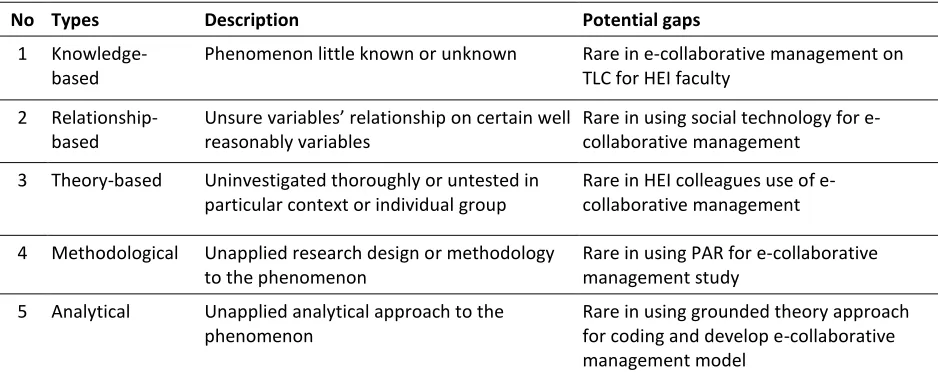
The present study finds five types of knowledge gap in literature review, namely, knowledge-based, relationship-based, theory-relationship-based, methodological and analytical gaps (Murray & Beglar, 2009). Please refer to Table 1 for details. The researchers add the potential gaps of e-collaborative management study on TLC for HEI. There is undiscovered knowledge-based gap in e-collaborative management, relationship-based gap is using social technology for e-collaborative management, theory-based gap in e-collaborative management within HEI colleagues, methodological gap is using participatory action research (PAR), and analytical gap is using grounded theory approach.
Table 1
Five Types of Gaps for e-Collaborative Management on TLC Study
No Types Description Potential gaps
1 Knowledge-based
Phenomenon little known or unknown Rare in e-collaborative management on TLC for HEI faculty
2 Relationship-based
Unsure variables’ relationship on certain well reasonably variables
Rare in using social technology for e-collaborative management
3 Theory-based Uninvestigated thoroughly or untested in particular context or individual group
Rare in HEI colleagues use of e-collaborative management
4 Methodological Unapplied research design or methodology to the phenomenon
Rare in using PAR for e-collaborative management study
5 Analytical Unapplied analytical approach to the phenomenon
Rare in using grounded theory approach for coding and develop e-collaborative management model
http://mojem.um.edu.my
5
Underlying Theories and the Way ForwardThe present study is based on negotiated order theory (Strauss, 1978), social exchange theory (Blau, 1964), and work system theory (Alter, 2013) to accomplish the collaborative management process. Santos, Santoro, and Borges (2008) mentioned that negotiated order is a process of people mutual adjustment and interpretation to have a coherence of understanding and actions. Consequently, Gray (1989) stretched negotiated order theory to construct collaboration theory. But, it lacks the socio-economic perspective of social exchange theory (Blau, 1964) that is rooted in economics. Di- Domenico, Tracey, and Haugh (2011) assumed that individuals engaged in social exchange because of the need or desire to acquire intrinsic or extrinsic rewards. These rewards are unable to be obtained by themselves.
Work system theory is to be reckoned as complementing negotiated theory and social exchange theory on the process of negotiated order and social exchange protocol. Alter (2013) used work system theory as an action project work system approach to connect collaborated participants, curriculum contents, collaboration information systems or computer support cooperative work system for e-collaborative teaching and learning management.
The present study aims at extending the Kezar and Lester (2009) HEI collaboration model in the electronic collaborative working platform; the Ansell and Gash (2007) collaborative governance model; Gray (1989) collaboration theory; and to further develop the Walsh and Kahn (2010) HEI collaborative working model on electronic dynamic collaborative management process model. Based on the preceding review, preliminary e-collaborative management process proposes the use of PAR (refer to
able 2) to explore the e-collaborative management context. The discussion on PAR is offered in the next section.
able 2
Preliminary Participatory Action Research Guideline for e-Collaborative Management on TLC Study
Evolution Route Evolvement from theories into practices
1)Underlying theories
1) Negotiated order theory for catalyzing e-collaborative management deployment. 2) Social exchange theory for sustaining e-collaborative management practice. 3) Work system theory for leveraging e-collaborative management performance.
2) Strategy in e -collaborative management process
1) Catalyzing collaboration by convenience collaborative working environment (CWE) and CIS (technology);
2) Proactive helping attitude, friendly relationships, capability and competency of individual from complementary support members (participants);
3) Allocating organizational resources and sharing personal practices for TLC (information)
3) Importance of initial conditions
http://mojem.um.edu.my
6
METHODResearch Scope
This is a case and focus group study with a scope restricted to lecturers, department heads, deans and academic supporting colleagues who engage in e-collaborative management on TLC in a private university college. The researchers are not building an e-collaborative management on TLC team but encouraging all about fifteen colleagues involved in the present study. They come from various faculties and academic supporting departments including Faculty of Art and Design (FAD), Faculty of Engineering and Information Technology (FEIT), Faculty of Humanities and Social Science (FHSS), Computer Centre Office (CCO), Planning and Development Accreditation Office (PDA), Centre of Innovation for Teaching and Learning (CiTL). They are key representatives of research selective sample for e-collaborative management in the university college. It is because they are critical actors playing different roles to drive and support this e-collaborative management on TLC process.
Underpinning Philosophical Assumption
The present study uses qualitative interpretive research (Klein, 2012). It aims at seeking meanings and understandings about e-collaborative management on TLC practices, and to generate a new theoretical model for e-collaborative management context-bound by the university college’s TLC management. This e-collaborative management study process involves various functional departments, professional individuals equipped with different intentions, interests, skills and knowledge. Thus, interpretive research is appropriate for understanding participants’ motives, actions, and intentions (Saunders, Lewis, & Thornhill, 2012) and to understand what is happening in the social situations in social exchange and negotiate meanings on an agreed-upon order (Mcniff & Whitehead, 2011). Moreover, the researchers and practitioners collaborate for practical judgments and solutions (Willis, 2007). Although the qualitative data collecting approach is more subjective, inter-subjective dialog makes e-collaborative management studies more workable.
Participatory Action Research
PAR fits the present e-collaborative management on TLC study because of its collaborative characteristic, which involves inter-subjective relationships. James, Milenkiewicz, and Bucknam (2008) mentioned how the PAR process in its iterative cycles encourages people to work collaboratively and seek democratically derived solutions to problems and produces new knowledge from personal and professional lessons learnt.
4) Stages of development
1) Envisioning on individual and HEI competitive advantages.
2) Co-constructing on common goal, adaption, and collective accountability. 3) Appreciating on reciprocal learning, doing, and synergizing.
4) Sustaining for effective e-collaborative management.
5) Participatory action research cycles
1) Advocating cycle through envisioning and co-constructing e-collaborative management on TLC project.
2) Adapting cycle with co-constructing and appreciating e-collaborative management on TLC effort.
3) Aligning cycle on appreciating and sustaining community of e-collaborative management on TLC practice.
http://mojem.um.edu.my
7
O’Brien (1998) emphasized that action research is an ongoing process by which knowledge is derived after review of practice learned from previous experience. The present study integrates the Denscombe (2010) with Coghlan and Brannick (2010) action research models into a four-phase cycle, namely, action planning, learning and realizing, observing and inquiring, analyzing and reflecting. The spiral of three action cycles as illustrated in Error!Reference source not found. improves e-collaborative management.
http://mojem.um.edu.my
8
Data Collection and Codinghttp://mojem.um.edu.my
9
FINDINGSAdvocating e-Collaborative Management on TLC Value
We urge urged participants to share common ground to envision this e-collaborative management on TLC as a benefit to themselves and all others. Using the co-construct e-collaborative management on TLC model, collaboration relationships and skills are developed. Teamwork spirit not only accomplishes the e-collaborative management on TLC project goals but also develops an individual’s own competence. Four findings are interpretable from the action research process findings. First, computer center colleagues mention that “securing the TLC and sharing it is a value to the university college” (initiative system support). This TLC is flowing across faculties and academic supporting departments. They need e-collaborative management on TLC colleagues to take care of it as with monetary assets.
Second, PDA colleagues mention that “synchronizing TLC to ensure the availability, consistency, accuracy, credibility and validity of TLC is important to the university college” (leads to collaboration). Therefore, the university college needs e-collaborative management on TLC in order to provide high level quality education management. Third, CiTL colleagues mention that “developing and synthesizing TLC could promote TLC improvement opportunities” (knowledge exchanging and leveraging). Different disciplines and different lecturers have their own style of authoring TLC. Fourth, faculty colleagues mention that “e-collaborative management on TLC increases cohesive work among colleagues and academic supporting departments” (intimate friendly communication). The lecturers know each other’s TLC and this makes learning overlap and interlace.
Adapting e-Collaborative Management on TLC Process
Adapting is the key to sustainability (Graves & Marston, 2013). Adapting is to serve an ever-changing set of community and donor priorities, focusing on the impact today and in the future. It is to evoke cohesive teamwork among e-collaborative management on TLC participants. The researchers and participants together co-construct the e-collaborative management on TLC process at this stage. Positive thinking and appreciating each other’s tactics are used to build e-collaborative management on TLC process. There are four interpretations possible from the action research process findings. First, TLC needs to have tightly linked and secure storage to verify that TLC really involves organizational assets and intellectual property. This requires a highly reliable, efficient, and accessible CIS software, hardware and support team. Moodle is a Shareable Content Object Reference Model (SCORM) compliance open source course management system. TLC in SCORM has reusability, accessibility, interoperability, and durability.
http://mojem.um.edu.my
10
Aligning e-Collaborative Management on TLC PracticeThe researchers are aligning human and ICT resources to establish e-collaborative management on TLC best practice. First, the researchers encourage participants to appreciate each other’s collaboration efforts. Next, the participants are assisted in inventing best practice of e-collaborative management on TLC. This is followed with the process of cultivating the collaborative management community. Four interpretations can be made from the findings of the listed aligning action process. First, computer center colleagues commit to “continuously improve both Moodle and SharePoint portal accessibility” (positive thinking and action), which exhibits their contributions to e-collaborative management on TLC. Continuous application of their ICT knowledge and skills shows their devotion to the e-collaborative management on TLC. Their commitment to quality services boost effectiveness of e-collaborative management on TLC. Second, when PDA colleagues are keen to train, audit and advise faculty colleagues in syllabus writing and TLC development, the consistency in syllabuses and TLC to comply with MQA and other external audits is increased.
Third, CiTL colleagues are creating more resources for faculty colleagues to produce quality TLC, and by doing so show they have an excellent relationship with faculty colleagues. Their willingness in helping faculty colleagues produce better performance in TLC composition and delivery shows their team collaboration spirit. Fourth, faculty colleagues are given role models for creating, updating, sharing and exchanging knowledge of TLC. This increases writing quality and in turn attracts TLC followers and cultivates more collaborative colleagues in the community of e-collaborative management on TLC.
Data Analysis and Synthesis
We make reflections and get lessons learnt from the described interviews, observations, and document mining. These combined sources of data are more comprehensive, cumulative, credible, reliable and valid. We have used this triangulation of data sources to compare, contrast, consolidate, integrate and synthesize in order to have succinct, concise, and coherent transcripts for developing an e-collaborative management on TLC model. The holistic picture of the research effect can now be tabulated in the Appendix “Triangulation of Data Source to Generate Coding”. We have explored all these data and categorized them using the grounded theory method as shown in Error! Reference source not found..
http://mojem.um.edu.my
12
DISCUSSION AND CONCLUSIONThese “cooperative working behavior”, “substantial reciprocal practices”, “guidance collaborative process” and “conclusive common goals” four factors model is more perspicuous and parsimonious than previous findings. The “substantial reciprocal practices” factor enhanced from integrated structures and process and rewards (Kezar & Lester, 2009). Next, the “cooperative working behavior” factor gives more insight on enthusiasm and commitment (Walsh & Kahn, 2010). Moreover, the “guidance collaborative process” factor comes straight to the point of facilitative leadership (Ansell & Gash, 2007). Furthermore, “conclusive common goals” is more fruitful than promising outcomes (Gray, 1989).
http://mojem.um.edu.my
13
The present study fills five types of knowledge gap in e-collaborative management on TLC. The knowledge-based gap to be filled in is HEI and other organization can build their organizational knowledge through this e-collaborative management on TLC model. The relationship-based gap to be filled in is conclusive common goals and substantial reciprocal practices factors enhance a sense of belonging among faculty colleagues and academic supporting colleagues (Jaitli & Hua, 2013) and have a centripetal force (Arroba & Wedgwood-Oppenheim, 1995). The methodological gap to be bridged is how PAR originality with regard to methodology is applied across different functional administrative departments and faculties in virtual working environments. The theory-based gap is filled by using grounded theory to analyze the PAR collected HEI colleagues’ data. In doing so, this research has made use of grounded theory to develop a model of e-collaborative management on TLC that clarifies the correlation of collaborative factors, which filled the analytical gap.The developed model illustrates how human perspective motivational factors can be utilized to promote e-collaborative management on TLC in the university college in particular and HEI in general. The first group of motivational factors comprise “cooperative working behavior”, “guidance collaborative processes”, “substantial reciprocal practices” and “conclusive common goals”. They in turn foster “collective action practice” and “work toward common objectives”. All of them make the effects of the whole greater than the sum of the parts (Shah, 2012). In addition, those factors generate competitive advantage when participants’ empathy in the working relationship to generate enthusiasm and devotion in collaborative management is developed. For example, facilitators direct e-collaborative management into the right track, effort, performance, effect and pace; individual participants fulfill their own needs and career development; participants are encouraged to achieve e-collaborative management on TLC objectives whole-heartedly. Lastly, those factors inspire and improve HEI e-collaborative management on TLC practice through the four stages of envisioning, co-constructing, appreciating, and sustaining.
Today, e-collaborative management is becoming the most frequently employed form of management because the world is becoming smaller, human relationships are becoming more sophisticated, and an increasing amount of work needs to be accomplished in the virtual environment. Collaborative organizations that embrace social and collaborative technologies and strategies stand the best chances of succeeding as mentioned by Morgan (2012). Similarly, e-collaborative working is creating greater benefits than the sum total of individual work and its benefits can be shared by all (Shah, 2012). Last and most important e-collaborative management practice definitely sustains the effectiveness and efficiency of the electronic collaborative working environment (ECWE) and e-collaborative management. Therefore, this human focused e-e-collaborative management on TLC model is well worth considering by other researchers and practitioners for accomplishing e-collaborative management in various fields, organizations, or industries.
REFERENCES
Alter, S. (2013). Work System Theory: Overview of core concepts, extensions, and challenges for futures. Journal of the Association for Information Systems, 14(2), 72-121.
Ansell, C., & Gash, A. (2007). Collaborative governance in theory and practice. Journal of Public Administration Research and Theory, 543 - 571.
Argyris, C. (1978). Organizational learning: A theory of action perspective. Boston, MA: Addison-Wesley.
Arroba, T., & Wedgwood-Oppenheim, F. (1995). Centripetal force. Team Performance Management, 1(2), 18 - 21.
http://mojem.um.edu.my
14
Bessagnet, M.-N., Schlenker, L., & Aiken, R. (2005). Using e-collaboration to improve management education:Three scenarios. Journal of Information Systems and Technology Management, 2(1), 81-94.
Blau, P. (1964). Exchange and power in social life. New York, NY: Wiley.
Boeije, H. (2010). Analysis in qualitative research. Thousand Oaks, CA: Sage.
Campbell, A., & Brown II, M. (2012). Knowledge management and collaboration: Big budget results in a low budget world. In J. Liebowitz (Ed.), Knowledge management handbook: Collaboration and social networking (pp. 219-233). Boca Baton, FL: CRC Press.
Coghlan, D., & Brannick, T. (2010). Doing action research in your own organization. London, UK: Sage.
Denscombe, M. (2010). The Good Research Guide for small-scale social research projects (4th ed.). Maidenhead, UK: Open University Press.
Di Domenico, M., Tracey, P., & Haugh, H. (2011). The dialectic of social exchange: Theorising corporate-social enterprise collaboration. Organization Studies,30(8), 887-907. doi: 10.1177/0170840609334954
Formentini, M., & Romano, P. (2011). Using value analysis to support knowledge transfer in the multi-project setting. International Journal of Production Economics, 131(2), 545 - 560.
Grapragasem, S., Krishnan, A., & Mansor, A. N. (2014). Current trends in Malaysian Higher Education and the effect on education policy and practice: An overview. International Journal of Higher Education, 3(1), 85-93.
Graves, R., & Marston, H. (2013). Align, adapt, aspire: Ten Years of Community Foundation Business Model Evoluation. Boston, MA: CF Insights.
Gray, B. (1989). Collaborating: Finding common ground for multiparty problems. London, UK: Jossey-Bass.
Jaitli, R., & Hua, Y. (2013). Measuring sense of belonging among employees working at a corporate campus: Implication for workplace planning and management. Journal of Corporate Real Estate, 15(2), 117 - 135.
James, E. A., Milenkiewicz, M. T., & Bucknam, A. (2008). Particpatory Action Research for education leadership: Using data-driven decision making to improve schools. Thousand Oaks, CA: Sage.
Jones, M. L., & Burgess, L. (2010). Encouraging SME eCollaboration: The Role of the champion facilitator.
Interdisciplinary Journal of E-Learning & Learning Objects, 6, 137 - 151.
Jones, P. M. (2001). Collaborative knowledge management, social networks, and organizational learning. In M. J. Smith & G. Salvendy, Systems, social, and internationalization design aspects of human-computer interaction Vol. 2 (pp. 306-309). New York, NY: Routledge.
Kezar, A. J., & Lester, J. (2009). Organizing higher education for collaboration: A guide for campus leaders. San Francisco, CA: Jossey-Bass.
Klein, S. R. (2012). Action Research: Before you dive in, read this! In S. R. Klein, Action Research method: Plain and simple (pp. 1-20). New York, NY, US: Palgrave Macmillan.
Kock, N. (2007). A discussion of key conceptual elements of E-collaboration. In N. Kock, Emerging E-collaboration concepts and applications (pp. 1-10). Hershey, PA: Cybertech Publishing.
Kock, N., Davison, R., Wazlawick, R., & Ocker, R. (2001). E-Collaboration: A look at past research and future challenges. Journal of Systems & Information Technology, 5(1), 1 - 8.
Liebowitz, J. (2012). Collaboration and social networking: The keys to knowledge management: Introductory thoughts. In J. Liebowitz (Ed.), Knowledge management handbook: Collaboration and social networking
http://mojem.um.edu.my
15
McNiff, J., & Whitehead, J. (2002). Action research: Principles and practice. London, UK: RoutledgeFalmer.McNiff, J., & Whitehead, J. (2011). All you need to know about action research. Thousand Oaks, CA: Sage.
Morgan, J. (2012). The collaborative organization: A strategic guide to solving your internal business challenges using emerging social and collaborative tools. New York, NY: McGraw-Hill.
MQA, M. Q. (2008). Code of Practice for programme accreditation. Petaling Jaya, Malaysia: Author.
Murray, N., & Beglar, D. (2009). Inside Track writing dissertations and theses. Harlow, UK: Pearson Eduction.
NEDCIN. (2009). Collaborative management: What is 'Collaborative or Co-Management' and how can this approach be applied to AED in Inuit Nunangat. Canada: National Economic Development Committe for Inuit Nunangat .
O'Brien, R. (1998). An overview of the methodology approach of action research. Toronto, Canada: University of Toronto.
Pasmore, W. A., Stymne, B., Shani, A., Mohrman, S. A., & Adler, N. (2008). The promise of collaborative management research. In A. Shani, S. A. Mohrman, W. A. Pasmore, B. Stymne & N. Adler (Eds.) Handbook of collaborative management research (pp. 7-31). Thousand Oaks, CA: SAGE.
Reagle, J. M. (2010). Good faith collaboration: The culture of Wikipedia. London, UK: The MIT Press.
Richards, L., & Morse, J. M. (2007). Readme First for a user's guide to qualitative methods. London, UK: Sage.
Rogers, E. M. (1983). Diffusion of innovation. New York, NY: The Free Press.
Sampson, M. (2009). Seamless teamwork: Using Microsoft SharePoint technologies to collaborate, innovate, and drive business in new ways. Redmond, WA: Microsoft Press.
Santos, N., Santoro, F. M., & Borges, M. R. (2008). Collaborative writing in E-Learning environment. In N. Kock(Ed.),
Encyclopedia of E-Collaboration (pp. 81-95). Hershey, NY: Information Science Reference.
Saunders, M., Lewis, P., & Thornhill, A. (2012). Research methods for Business students. Harlow, UK: Pearson Education.
Seldin, P. (2004). The Teaching Portfolio: A practical guide to improved performance and promotion/tenure decision. San Francisco, CA: Jossey-Bass.
Shah, C. (2012). Collaborative Information Seeking: The art and science of making the whole greater than the sum of all. New York, NY: Springer.
Southern, U. C. (2013, 12 11). The 6th Academic and Teaching Affairs Meeting 2013. Academic and Teaching Affairs Meeting. Skudai, Malaysia: Southern University College.
Strauss, A. (1978). Negotiations: Varieties, contexts, processes, and social order. San Francisco, CA: Jossey-Bass.
Walsh, L., & Kahn, P. (2010). A collaborative future for the Academy. New York, NY: Routledge.
http://mojem.um.edu.my
16
AppendixTriangulation of Data Source to Generate Coding
No. Data Source Transcripts use for significant statement
(data reduction and induction)
Open encoding (conceptualize data)
Axial encoding (categorize data)
1 Interview; Observation
Moodle and SharePoint systems
administrative colleagues had been trained and supported by Computer Centre colleagues actively.
Support systems’ users
Initiative system support
Interview; Observation
Computer Centre colleagues shall always offer substantial support and recommendation to both Moodle and SharePoint systems
administrative colleagues and their end users.
Offering helpful system guidance
Observation; Data Mining
CITL colleagues proactively give assistance to novice lecturers when they face doubts and difficulties in using either the SharePoint or Moodle systems.
Proactively train novice users
2 Observation Computer Centre colleagues standing by to end users’ complaints on inconvenience of accessing SharePoint system.
Alternative approaches
Positive thinking and action
Interview; Observation
PDA colleagues recognize synchronized TLC updating saves time in compiling the syllabus handbook.
Appreciate others’ effort
Observation Computer Centre colleagues are continuously studying both CIMS and CIS to provide quality service.
Learn to make it viable
3 Interview; Observation
Computer Centre colleagues suggested that any collective action taken needs to consider other people’s convenience and benefits
Considering other position and interests
Democratic decision making
Observation Faculty colleagues offered feedback to Computer Centre colleagues and make decision together in order to work concurrently.
Consensus-building principle
Observation CITL colleagues adapted their management approach after having learnt the knowledge from Computer Centre and Faculty.
Cooperate with others
4 Observation; Reflection
Faculty and Computer Centre colleagues are building a rapport relationship with respect and openness while working together on TLC management.
Trust those with whom you have relationship
Intimate friendly communication
http://mojem.um.edu.my
17
Reflection on TLC delivery in the Moodle CIMS is increasetheir intimacy relationship
increasing intimacy
Interview; Observation
Computer Centre colleagues shall always notify PDA colleagues before adding a new item to the SharePoint CIS
http://mojem.um.edu.my
18
Appendix (continued)No Data Source Transcripts use for significant statement
(data reduction and induction)
Open encoding (conceptualize data)
Axial encoding (categorize data)
5 Observation; Data Mining
Top management instructed all lecturers regardless of their being full- or part-time that they must be prepared to conduct TLC before semester start. Sponsoring TLC preparation Continuous executive sponsoring Interview; Observation
Top management sponsored the facilitating session to enhance the creation of better TLC.
Reinforces quality TLC authoring
Observation; Data Mining
Top management helped to acquire a SharePoint server for centralized TLC preserving.
Provide funding for TLC preservation
6 Observation Deans and department heads lead colleagues to work together in order to keep TLC up-to-date
Leads collective action
Leads to
collaboration
Observation; Reflection
Collaborators acted as a bridge to communicate with various departments’ colleagues.
Connects various departments
Interview; Observation
Deans and department heads become role models in knowledge exchange by sharing their TLC.
Serves as a role model for sharing knowledge
7 Interview; Observation
CITL colleagues engaged student to help novice lecturers to create and develop TLC.
Encourages TLC development Enlightening collaboration practice Interview; Observation
Faculty colleagues have their superiors as role model for e-collaborative management on TLC.
Offers practice on collaborative leadership
Observation CITL colleagues used past and existing TLC as guide and the template to facilitate novice lecturer.
Is convenience to learn
8 Observation Colleagues are keen to cooperate and balance the workload of managing their TLC in SharePoint server. Brainstorms to attain a collaborative approach Coaching collaboration skills Observation; Data Mining
Train faculty colleagues to understand how SharePoint helps them reduce their workload.
Resolve mis-understandings
Interview; Observation
SharePoint is reduced colleagues’ email communication and minimizing miscommunication.
Breakthrough collaborative barriers
9 Interview; Reflection
A process that appreciated recognizes and rewards collaboration can reinforce a culture
Foster a collaborative
http://mojem.um.edu.my
19
of cooperation. culture system
Interview; Observation
The adoption of CIS eased online collaborative authoring, reviewing and updating.
Builds a capacity for collaboration
Observation; Reflection
The context of collaboration fitted the
organizational management structure, process and contents to ease cooperation.
http://mojem.um.edu.my
20
Appendix (continued)No Data Source Transcripts use for significant statement
(data reduction and induction)
Open encoding (conceptualize data)
Axial encoding (categorize data)
10 Observation; Reflection
Most difficulties have immediately solved and better result attained when colleagues work together.
Attaining immediate gains through
collaboration
Cultivating an interest in collaboration
Interview; Observation
Showed colleagues the sense-making of collaboration benefits.
Demonstrates the benefits of collaboration
Reflection Developed collaborative practice through mentoring to increase the strength of joint action in TLC management.
Develops joint force strengths
11 Interview Computer Centre colleagues suggested annual appraisal of collaboration efforts among cooperation colleagues.
Increase salary increments through appraisal
Appreciation shown by rational monetary reward
Interview CITL colleague suggested a special bonus be given to those colleagues who contribute input in TLC management.
Gives bonus for cooperative contributions
Interview Faculty colleague proposed monetary
incentive to those lecturers who actively assist others and share the faculty administrative workload.
Compensate for workload sharing
Interview CITL colleagues recommended top management offer additional monetary incentive to those lecturers who developed attractive and quality TLC.
Give monetary incentive to the deserving
12 Interview; Reflection
Computer Centre colleague recognized that they need to learn from each other to make SharePoint data sharing secure and reduce Exchange server workload.
Supplements deficiencies
A complement to weaknesses and deficiencies
Interview; Observation
PDA colleagues acknowledged synchronized TLC updating saves time when compiling a syllabus handbook.
Compensates for weaknesses
Interview; Observation
Faculty colleagues admitted that collaborative TLC management can make reference and improve their TLC.
Compensates for insufficiency
13 Interview; Observation
Faculty deans, department heads and CITL colleagues responded that collaborative TLC authoring advanced their personal knowledge and skills.
Improve individual capabilities
Career and
http://mojem.um.edu.my
21
Interview;Observation
Faculty colleague acknowledged that their proficiency grew when they engaged in collaborative TLC management.
Proficiency grows mutually
Observation Novice lecturers had chances to learn and create TLC from CITL colleagues when there is collaborative management of TLC.
http://mojem.um.edu.my
22
Appendix (continued)No Data Source Transcripts use for significant statement
(data reduction and induction)
Open encoding (conceptualize data)
Axial encoding (categorize data)
14 Interview Faculty colleague hoped top management has mutual respect and appreciation for TLC being intellectual property. Appreciate mutual contributions Fair mutual contribution and benefits Interview; Observation
CITL and faculty colleagues have appreciated TLC sharing and the consultation that improved quality of curriculum delivery.
Appreciate cooperative efforts
Interview Computer Centre colleagues mentioned that the reciprocate process encourages colleagues to help each other more and quickly attain better collaborative results.
Reciprocate mutual interests
Interview Faculty colleagues admitted personal career objectives have to align themselves with faculty and HEI collaborative teaching goals
Resolve individual misunder-standings
15 Interview CITL colleagues stated that collaborative management of TLC cultivates a sense of belonging among teachers.
Build a sense of belonging Sense of belonging and gains Interview; Observation
Faculty colleagues have a sense of being in the same boat and voluntarily helping others work collaboratively to enhance their faculty’s TLC.
Creates a sense of being in the same boat
Observation; Data Mining
When CITL and faculty colleagues assisted each other to improve the teaching and learning context, it developed a curriculum quality and means of delivery that meet university college standards.
Encourages organizational membership behavior
16 Interview; Observation
Faculty colleagues prepared and updated their TLC for review before conducting classes.
Readiness exists for TLC delivery Accumulating teaching and learning resources Interview; Observation
Computer Centre, PDA, CITL and faculty colleagues agreed to standardize the TLC material on both Moodle and SharePoint servers.
Standardizes the organized TLC
Observation; Data Mining
Faculty colleagues utilized their PC’s share folder to review their TLC before uploading to Moodle for delivery and SharePoint for academic e-portfolio preservations.
Securing TLC preservations
17 Interview Faculty colleagues noted that various
professional sharing, discussing and amending TLC enhance their skills and knowledge.
http://mojem.um.edu.my
23
Observation;Data Mining
Faculty colleagues acquired the best TLC samples and templates to learn how best to improve continuously their TLC presenting to students.
TLC benchmarking brings important advantages
Observation Faculty and CITL colleagues collaborative authored and developed TLC, and then collaboratively teach and learn for conducting the lessons.
http://mojem.um.edu.my
24
Appendix (continued)No Data Source Transcripts use for significant statement
(data reduction and induction)
Open encoding (conceptualize data)
Axial encoding (categorize data)
18 Interview;
Observation
Faculty colleagues frequently updated their subjects’ portfolio according to market requirements, which enriched TLC contents and its delivery.
Provide adequate development of TLC
Qualified syllabi and content
Interview; Observation
Faculty colleagues’ draft improved and delivered their TLC according to syllabus requirement established by MQA.
TLC satisfy quality audits
Interview; Observation; Data Mining
CITL colleagues accepted recommendation from faculty colleagues to standardize TLC folders names and its structure for ease access.
Presenting organized TLC
19 Interview;
Observation
Standardize subject names are established for easier locating by faculty colleagues and students. Collaborative TLC updating Comprehensive curriculum improvement Interview; Observation; Data Mining
Deans and department heads needed to review lecturers’ weekly TLC before the semester starts.
Benchmarking helps create quality TLC
Observation; Data Mining
Faculty colleagues aggressively reviewed and updated their TLC to make them excellent for curriculum delivery. Enhance TLC through regular review Observation; Data Mining
CITL colleagues conducted a TLC drafting, developing, and updating workshop for all lecturers.
Training for TLC crafting
20 Observation The HEI group of talents from various departments provided their skills and
knowledge to collaborative TLC management.
Differentiated collaborative management Organizational competitive advantages Interview; Observation
Faculty colleagues suggested that cohesive effort to proliferate TLC content and delivery.
Collaboration enhancing capacity
Interview CITL colleague acknowledged that those TLC created during office hours should be considered as HEI intellectual property and assets.
Accumulates organizational advantage