S O F T W A R E R E V I E W
Open Access
Mega2: validated data-reformatting for linkage
and association analyses
Robert V Baron
1, Charles Kollar
1, Nandita Mukhopadhyay
2and Daniel E Weeks
1,3*Abstract
Background:In a typical study of the genetics of a complex human disease, many different analysis programs are used, to test for linkage and association. This requires extensive and careful data reformatting, as many of these analysis programs use differing input formats. Writing scripts to facilitate this can be tedious, time-consuming, and error-prone. To address these issues, the open source Mega2 data reformatting program provides validated and tested data conversions from several commonly-used input formats to many output formats.
Results:Mega2, the Manipulation Environment for Genetic Analysis, facilitates the creation of analysis-ready datasets from data gathered as part of a genetic study. It transparently allows users to process genetic data for family-based or case/control studies accurately and efficiently. In addition to data validation checks, Mega2 provides analysis setup capabilities for a broad choice of commonly-used genetic analysis programs. First released in 2000, Mega2 has recently been significantly improved in a number of ways. We have rewritten it in C++ and have reduced its memory requirements. Mega2 now can read input files in LINKAGE, PLINK, and VCF/BCF formats, as well as its own specialized annotated format. It supports conversion to many commonly-used formats including SOLAR, PLINK, Merlin, Mendel, SimWalk2, Cranefoot, IQLS, FBAT, MORGAN, BEAGLE, Eigenstrat, Structure, and PLINK/SEQ. When controlled by a batch file, Mega2 can be used non-interactively in data reformatting pipelines. Support for genetic data from several other species besides humans has been added.
Conclusions:By providing tested and validated data reformatting, Mega2 facilitates more accurate and extensive analyses of genetic data, avoiding the need to write, debug, and maintain one’s own custom data reformatting scripts. Mega2 is freely available at https://watson.hgen.pitt.edu/register/.
Keywords:Software, Linkage, Association, Human Genetics, Data management
Background
The gene-discovery process is very well advanced at the data-generation end with sophisticated database man-agement systems, laboratory information manman-agement systems, and bioinformatics tools. There has also been enormous progress in terms of analytical software. How-ever, very little has been done to facilitate the efficient transfer of data from the generation stage to the analysis stage; analysis programs have diverse and stringent re-quirements (not always clearly documented) on how the input data should be formatted, which is often very
different from how the generated data are formatted. Re-searchers face the need to collect and collate genetic data from diverse sources, and this need has increased significantly as rapidly improving technology generates or-ders of magnitude more data. As new analysis programs come into being, data setup and organization continues to be an error-prone and very time-consuming task if per-formed manually, but ideal for well-tested computer automation.
In the course of a single study of the genetics of a com-plex disease, the optimal analysis might require use of sev-eral different programs. For example, one might want to use pedstats [1] to check for data validity, PREST [2,3] to check for relationship errors, SOLAR [4,5] to test for link-age, and Mendel [6-8] to test for association in the pres-ence of linkage. Each provides the best possible analysis but also has its own strict input format requirements, so * Correspondence:[email protected]
1
Department of Human Genetics, Graduate School of Public Health, University of Pittsburgh, Pittsburgh, PA 15261, USA
3
Department of Biostatistics, Graduate School of Public Health, University of Pittsburgh, Pittsburgh, PA 15261, USA
Full list of author information is available at the end of the article
there is great value in being able to quickly and easily convert one’s data format as required.
To meet these needs, we developed Mega2, the Ma-nipulation Environment for Genetic Analysis [9,10], which automates common data reformatting tasks, thereby accelerating analyses, saving time, and reducing errors. We describe here recent major updates to Mega2, which include improvements in memory efficiency, improved support for commonly used input formats such as PLINK and VCF, and addition of several more target output formats.
Implementation
Mega2 was originally released in January 2000, and has undergone continuous revisions since. Mega2 was origin-ally written in C, but now has been written in C++, allow-ing us to now use modern object-oriented programmallow-ing techniques. Mega2 was designed to be used in a Unix en-vironment, and so for extended functionality, such as plot-ting results with R or running generated scripts, uses a few other programs commonly available in the Unix envir-onment, such as Perl, Awk, Python, tcsh and bash-shells, and R. Perl is used for producing formatted output such as tables and HTML reports, and R is used to create graphical output using our R“nplplot” package. The cur-rently released version (4.7.1) of Mega2 is available in Additional file 1; for updated versions, please visit the project home page as listed in the “Availability and requirements”section.
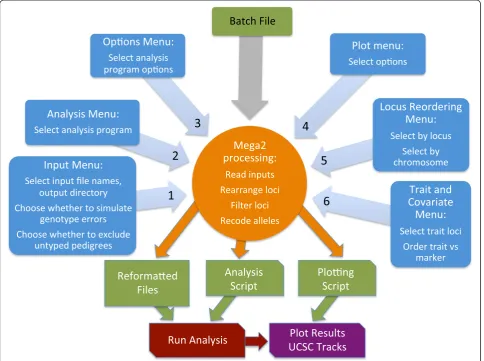
The current Mega2 implementation transforms a matched set of pedigree, phenotype, genotype, and map (genetic and physical) information into a matched set of output files that are ready for analysis by one of many commonly-used genetic analysis tools. Accordingly, Mega2 is organized into input, error-checking, reordering, and output components, constituting a single-layered architecture, and communicating directly with each other as necessary. Mega2 is a command-line program that is typically run without arguments in an interactive mode, where a sequence of menus (Figure 1, blue blocks) are presented to the user to specify 1) input files and filters, 2) the target analysis program, 3) program-specific options, 4) plot customization options, 5) the subset of loci to be included in the output data, and 6) the trait loci and co-variates. The input data can be in LINKAGE format [11-13], Mega2 annotated format, PLINK (ped or binary) format [14], or VCF/BCF format [15]. When reading from Mega2 annotated format, input files include a) a pedigree file containing sample-related pedigree, phenotype, and genotype information, b) a locus names file, and c) a map file containing chromosomal positions for marker loci. Additionally, the user may specify d) an omit file for set-ting selected genotypes to unknown, e) an allele-frequency file, and f ) a disease-model or penetrance file. Mega2 reads
(Figure 1, orange circle) and validates the input data, and creates output files to be run by the target program, pos-sibly partitioned by chromosome and/or traits. Output usually includes (Figure 1, green blocks) scripts to run the analysis on the re-organized, re-formatted data, and may create plots of the analysis results, as well as BED custom tracks suitable for plotting in the UCSC Genome Browser, using our‘nplplot’R library. Detailed diagnostic measures are created in certain cases. Full logs of run-related information including error messages are generated. Mega2 can also be run in a non-interactive mode using a batch file (Figure 1, top center) containing (key, value) pairs corresponding to the choices made via the interactive menus.
Results
Mega2 was originally written without much attention to memory efficiency, as at that time a genome-wide scan consisted of only several hundred markers. Thus, Mega2’s memory usage was initially on the order of people x allele x 8 bytes, as each person/allele combination was assigned a pointer to the allele label. For two-allele marker data, we have markedly reduced memory requirements by re-placing each pair of 8 byte pointers with a 2 bit index spe-cifying which alleles the individual has. We also allow the user to switch out of the 2 bit mode if they want to work with more highly polymorphic markers. Further memory efficiencies have been gained by not storing (unknown) ge-notypes for completely untyped individuals, but who are still needed to specify the pedigree structure. As a result of these improvements, Mega2 now can handle genome-wide scale data–for example, 895K two-allele markers on 3.1K people requires only 1.12 Gb of memory for Mega2 processing.
Mega2 can now read data in from a wider variety of input formats. Many researchers now have their data in PLINK-format [14], so we have extended Mega2 to sup-port reading PLINK input files. Mega2 now directly pro-cesses PLINK‘ped’and binary input formats. Mega2 also supports PLINK phenotype files, as well as Mega2-format map files that specify a sex-specific genetic map. Further-more, we recently added support for reading Variant Call Format (VCF) files and their binary compressed equiva-lent, BCF; most sequencing-based data are now in VCF/ BCF format [15].
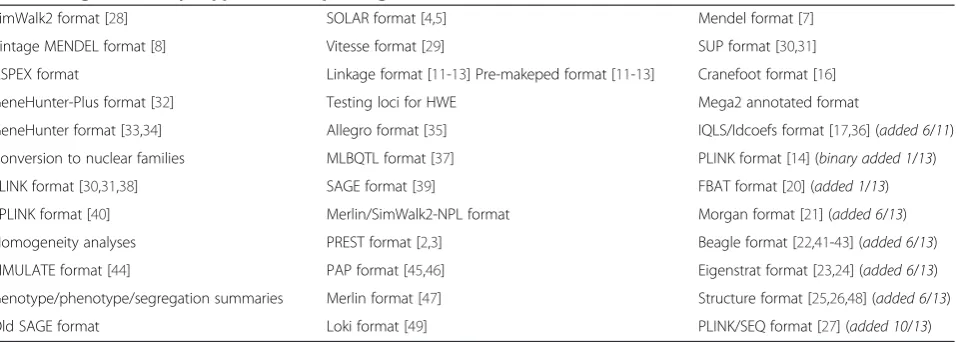
as input and output, is important because it is a common way of compactly storing large scale data and provides a succinct way to efficiently get large scale data into and out of Mega2. Recently, seven new output formats have been added (see Table 1): (1) IQLS/Idcoefs [17-19] - a program for carrying out haplotype-based association tests while properly accounting for relatedness; (2) FBAT [20]–a pro-gram for carrying out family-based association tests; (3) Morgan [21] – a package capable of many analyses, with particular strengths in the area of Monte Carlo Markov Chain analyses of family data; (4) Beagle [22]–a package capable of many analyses, including haplotyping and associ-ation testing; (5) Eigenstrat [23,24]–a program for infer-ring and adjusting for population substructure from genome-wide marker data while testing for association; (6) Structure [25,26]–a program for investigating population structure and admixture using genome-wide marker data; and (7) PLINK/SEQ [27] –a package for analysis of data from large-scale sequencing projects.
The Mega2 distribution package has been updated to provide greater ease of installation and compatibility with many Unix environments. It contains added support for migration of legacy input data to our updated formats.
Discussion
In applied data analysis, a thorough analysis often re-quires the use of multiple different programs, many of which have their own precise input format requirements. Reformatting programs such as Mega2 can markedly ac-celerate analyses by providing accurate, quick, and error-free conversion routines. This need has been recognized in the area of population genetics, where several reformat-ting programs have been written [50-52], including one that converts to 52 different formats [51]. In the area of human genetics, limited reformatting options have been made available as part of larger database systems. For ex-ample, the GeneLink database system [53] initially exported into LINKAGE [11-13,54], GAS [55], or RelCheck [56,57] Figure 1After querying the user via a variety of menus (blue blocks), Mega2 then processes the data (orange circle), creating
formats, while the Integrated Genotyping System [58] exported into several formats, including Merlin [47], Gene-Hunter [33,34], QTDT [59], and Transmit [60] formats. However, these database systems can be difficult to install and maintain. Other more stand-alone approaches to re-formatting in this area include SIB-PAIR [61], by David Duffy, which is a command-line oriented program that can create locus and pedigree files in a variety of formats, such as FISHER [8], GAS [55], Genehunter [33,34], LINKAGE [11-13,54], LOKI [49], MENDEL [6], MERLIN [47], PAP [45,46] and SAGE [39]. SIB-PAIR appears to require very detailed line-by-line commands that would make it harder to use than Mega2 for most users. Another program is fcGENE [62] (available from SourceForge), which is fo-cused on converting PLINK-format data for imputation (MaCH [63], IMPUTE [64], BEAGLE [22,41-43], BIM-BAM [65]), and then converting the resulting imputed data into the following formats: PLINK [14], SNPTEST [64], HAPLOVIEW [66], EIGENSOFT [23,24], GenABEL [67], and VCF [15]. While fcGENE is fast and easy to use, it is currently limited (e.g., it does not accept VCF or LINKAGE format as input, it only supports a single di-chotomous phenotype, it does not support selection by chromosome, etc.).
ALOHOMORA [68] provides an elegant interface for carrying out linkage analyses of Affymetrix 10K single nucleotide polymorphism (SNP) genotype data. This program actually uses Mega2 as its internal reformatting engine for some of its options.
PLINK [14] is an association analysis toolset that has a variety of data management and filtering options for hand-ling large-scale SNP data. The main focus of PLINK is population-based unrelated samples, with some support for family-based association testing. PLINK only exports data in a few limited formats. We have used PLINK on our family data to carry out data cleaning, but then still needed Mega2 to reformat the data in order to carry out analyses using other external programs. In our experience,
it is difficult to use PLINK on family data while maintain-ing the original pedigree structures upon output, as PLINK favors automatically filtering out individuals with low genotyping success rates (such as untyped founders).
From this brief survey of currently available data re-formatting software, two things are immediately apparent: many researchers have recognized the need for providing one’s data in many different formats; and Mega2, which is free, open source, and available on Unix, Windows, and Macintosh platforms, is well-positioned to continue to fill this need.
Conclusion
When carrying out quality control and statistical analyses for a genetic study of a human disease, one quickly dis-covers that data organization and analysis set-up is a crit-ical, time-consuming, and extremely tedious task. Furthermore, one often needs to use several different ana-lysis programs, each with its own idiosyncratic input for-mat requirements. To meet these needs, we developed Mega2, taking the time to carefully understand the precise (sometimes poorly documented) requirements of each tar-get format, implementing our data reformatting pipeline in tested and well-documented code. Mega2’s tested and validated data conversion options expands the universe of possible analyses for the average researcher by removing the hurdle of having to tediously write, check, debug, and maintain their own conversion scripts.
Availability and requirements
Project name:Mega2
Project home page:https://watson.hgen.pitt.edu/register/ Operating systems: Linux, Macintosh OS X, Windows, Solaris
Programming language:C++
Other requirements:R, Perl, Python, awk, bash, and csh License:GNU GPL v3
Any restrictions to use by non-academics:None. Table 1 Mega2 currently supports 37 output targets seven new ones have been added since 2011
SimWalk2 format [28] SOLAR format [4,5] Mendel format [7]
Vintage MENDEL format [8] Vitesse format [29] SUP format [30,31]
ASPEX format Linkage format [11-13] Pre-makeped format [11-13] Cranefoot format [16]
GeneHunter-Plus format [32] Testing loci for HWE Mega2 annotated format
GeneHunter format [33,34] Allegro format [35] IQLS/Idcoefs format [17,36] (added 6/11)
Conversion to nuclear families MLBQTL format [37] PLINK format [14] (binary added 1/13)
SLINK format [30,31,38] SAGE format [39] FBAT format [20] (added 1/13)
SPLINK format [40] Merlin/SimWalk2-NPL format Morgan format [21] (added 6/13)
Homogeneity analyses PREST format [2,3] Beagle format [22,41-43] (added 6/13)
SIMULATE format [44] PAP format [45,46] Eigenstrat format [23,24] (added 6/13)
Genotype/phenotype/segregation summaries Merlin format [47] Structure format [25,26,48] (added 6/13)
Additional file
Additional file 1:A zipped archive containing the Mega2 version 4.7.1 distribution package; both source and binary executables are included.
Competing interests
The authors declare that they have no competing interests.
Authors’contributions
RVB has been contributing to the Mega2 project as a programmer since 2010. CK contributed to the Mega2 project as a programmer from 2012 to 2014. NM was the primary programmer of Mega2 through 2010. DEW supervised the Mega2 project. All authors contributed to the writing of this article. All authors read and approved the final manuscript.
Acknowledgements
This work was supported by the National Institutes of Health grant R01 GM076667 (P.I. Daniel E. Weeks) and the University of Pittsburgh. We thank Lee Almasy, Mark Schroeder, and William P. Mulvihill for early contributions as programmers to our Mega2 project.
Author details
1Department of Human Genetics, Graduate School of Public Health,
University of Pittsburgh, Pittsburgh, PA 15261, USA.2Department of Oral Biology, School of Dental Medicine, University of Pittsburgh, Pittsburgh, PA 15261, USA.3Department of Biostatistics, Graduate School of Public Health, University of Pittsburgh, Pittsburgh, PA 15261, USA.
Received: 18 July 2014 Accepted: 14 November 2014
References
1. Wigginton JE, Abecasis GR:PEDSTATS: descriptive statistics, graphics and quality assessment for gene mapping data.Bioinformatics2005, 21(16):3445–3447.
2. Sun L, Wilder K, McPeek MS:Enhanced pedigree error detection. Hum Hered2002,54(2):99–110.
3. McPeek MS, Sun L:Statistical tests for detection of misspecified relationships by use of genome-screen data.Am J Hum Genet2000, 66(3):1076–1094.
4. Almasy L, Blangero J:Multipoint quantitative-trait linkage analysis in general pedigrees.Am J Hum Genet1998,62(5):1198–1211. 5. Blangero J, Almasy L:Multipoint oligogenic linkage analysis of
quantitative traits.Genet Epidemiol1997,14(6):959–964.
6. Lange K, Papp JC, Sinsheimer JS, Sripracha R, Zhou H, Sobel EM:Mendel: the Swiss army knife of genetic analysis programs.Bioinformatics2013, 29(12):1568–1570.
7. Lange K, Cantor R, Horvath S, Perola M, Sabatti C, Sinsheimer J, Sobel E: MENDEL version 4.0: A complete package for the exact genetic analysis of discrete traits in pedigree and population data sets.Am J Hum Genet 2001,69(Suppl):504.
8. Lange K, Weeks D, Boehnke M:Programs for pedigree analysis: MENDEL, FISHER, and dGENE.Genet Epidemiol1988,5:471–472.
9. Mukhopadhyay N, Almasy L, Schroeder M, Mulvihill WP, Weeks DE:Mega2: data-handling for facilitating genetic linkage and association analyses. Bioinformatics2005,21(10):2556–2557.
10. Mukhopadhyay N, Almasy L, Schroeder M, Mulvihill WP, Weeks DE:Mega2, a data-handling program for facilitating genetic linkage and association analyses.Am J Hum Genet1999,65:A436.
11. Lathrop GM, Lalouel J-M:Easy calculations of lod scores and genetic risks on small computers.Am J Hum Genet1984,36:460–465.
12. Lathrop GM, Lalouel JM, Julier C, Ott J:Strategies for multilocus linkage analysis in humans.Proc Natl Acad Sci U S A1984,81:3443–3446. 13. Lathrop GM, Lalouel JM:Efficient computations in multilocus linkage
analysis.Am J Hum Genet1988,42:498–505.
14. Purcell S, Neale B, Todd-Brown K, Thomas L, Ferreira MAR, Bender D, Maller J, Sklar P, de Bakker PIW, Daly MJ, Sham PC:PLINK: a tool set for whole-genome association and population-based linkage analyses.Am J Hum Genet2007, 81(3):559–575.
15. Danecek P, Auton A, Abecasis G, Albers CA, Banks E, DePristo MA, Handsaker RE, Lunter G, Marth GT, Sherry ST, McVean G, Durbin R, Genomes Project Analysis G:The variant call format and VCFtools.Bioinformatics 2011,27(15):2156–2158.
16. Makinen VP, Parkkonen M, Wessman M, Groop PH, Kanninen T, Kaski K: High-throughput pedigree drawing.Eur J Hum Genet2005,13(8):987–989. 17. Wang Z, McPeek MS:An incomplete-data quasi-likelihood approach to
haplotype-based genetic association studies on related Individuals.J Am Stat Assoc2009,104(487):1251–1260.
18. Abney MA, Ober C, McPeek MS:Homozygosity mapping of quantitative trait loci in complex inbred pedigrees.Am J Hum Genet2000,67(Suppl 2):327. 19. Wang Z, McPeek MS:ATRIUM: testing untyped SNPs in case-control
association studies with related individuals.Am J Hum Genet2009, 85(5):667–678.
20. Laird NM, Horvath S, Xu X:Implementing a unified approach to family-based tests of association.Genet Epidemiol2000,19(Suppl 1):S36–42. 21. Thompson EA:Statistical inference from genetic data on pedigrees, vol. 6.
Beechwood, OH: Institute of Mathematical Sciences and the American Statistical Association; 2000.
22. Browning BL, Browning SR:Efficient multilocus association testing for whole genome association studies using localized haplotype clustering. Genet Epidemiol2007,31(5):365–375.
23. Price AL, Patterson NJ, Plenge RM, Weinblatt ME, Shadick NA, Reich D: Principal components analysis corrects for stratification in genome-wide association studies.Nat Genet2006,38(8):904–909.
24. Patterson N, Price AL, Reich D:Population structure and eigenanalysis. PLoS Genet2006,2(12):e190.
25. Pritchard JK, Stephens M, Donnelly P:Inference of population structure using multilocus genotype data.Genetics2000,155(2):945–959. 26. Falush D, Stephens M, Pritchard JK:Inference of population structure
using multilocus genotype data: linked loci and correlated allele frequencies.Genetics2003,164(4):1567–1587.
27. PLINK/SEQ:A library for the analysis of genetic variation data; [http://atgu. mgh.harvard.edu/plinkseq/]
28. Sobel E, Lange K:Descent graphs in pedigree analysis: Applications to haplotyping, location scores, and marker-sharing statistics.Am J Hum Genet1996,58(6):1323–1337.
29. O’Connell JR, Weeks DE:The VITESSE algorithm for rapid exact multilocus linkage analysis via genotype set-recoding and fuzzy inheritance. Nat Genet1995,11:402–408.
30. Lemire M:SUP: an extension to SLINK to allow a larger number of marker loci to be simulated in pedigrees conditional on trait values. BMC Genet2006,7:40.
31. Schäffer AA, Lemire M, Ott J, Lathrop GM, Weeks DE:Coordinated conditional simulation with SLINK and SUP of many markers linked or associated to a trait in large pedigrees.Hum Hered2011,71(2):126–134. 32. Kong A, Cox NJ:Allele-sharing models: LOD scores and accurate linkage
tests.Am J Hum Genet1997,61(5):1179–1188.
33. Kruglyak L, Daly MJ, Reeve-Daly MP, Lander ES:Parametric and nonparametric linkage analysis: a unified multipoint approach.Am J Hum Genet1996, 58:1347–1363.
34. Kruglyak L, Lander ES:Faster multipoint linkage analysis using Fourier transforms.J Comput Biol1998,5(1):1–7.
35. Gudbjartsson DF, Jonasson K, Frigge ML, Kong A:Allegro, a new computer program for multipoint linkage analysis.Nat Genet2000,25(1):12–13. 36. Abney M, McPeek MS, Ober C:Estimation of variance components of
quantitative traits in inbred populations.Am J Hum Genet2000,66(2):629–650. 37. Alcais A, Abel L:Maximum-Likelihood-Binomial method for genetic
model-free linkage analysis of quantitative traits in sibships.Genet Epidemiol1999,17(2):102–117.
38. Weeks DE, Ott J, Lathrop GM:SLINK: a general simulation program for linkage analysis.Am J Hum Genet1990,47(3):A204.
39. S.A.G.E:Statistical Analysis for Genetic Epidemiology; [http://darwin.cwru.edu/sage/] 40. Holmans P:Asymptotic properties of affected-sib-pair linkage analysis.
Am J Hum Genet1993,52(2):362–374.
41. Browning BL, Browning SR:A unified approach to genotype imputation and haplotype-phase inference for large data sets of trios and unrelated individuals.Am J Hum Genet2009,84(2):210–223.
43. Browning SR, Briley JD, Briley LP, Chandra G, Charnecki JH, Ehm MG, Johansson KA, Jones BJ, Karter AJ, Yarnall DP, Wagner MJ:Case-control single-marker and haplotypic association analysis of pedigree data. Genet Epidemiol2005,28(2):110–122.
44. Terwilliger JD, Speer M, Ott J:Chromosome-based method for rapid computer simulation in human genetic linkage analysis.Genet Epidemiol 1993,10(4):217–224.
45. Hasstedt SJ:jPAP: Document-driven software for genetic analysis. Genet Epidemiol2005,29:255.
46. PAP:Pedigree Analysis Software; [http://hasstedt.genetics.utah.edu/] 47. Abecasis GR, Cherny SS, Cookson WO, Cardon LR:Merlin–rapid analysis of
dense genetic maps using sparse gene flow trees.Nat Genet2002, 30(1):97–101.
48. Falush D, Stephens M, Pritchard JK:Inference of population structure using multilocus genotype data: dominant markers and null alleles. Mol Ecol Notes2007,7(4):574–578.
49. Heath SC:Markov chain Monte Carlo segregation and linkage analysis for oligogenic models.Am J Hum Genet1997,61(3):748–760.
50. Manoukis NC:FORMATOMATIC: a program for converting diploid allelic data between common formats for population genetic analysis.Mol Ecol Notes2007,7(4):592–593.
51. Coombs JA, Letcher BH, Nislow KH:CREATE: a software to create input files from diploid genotypic data for 52 genetic software programs. Mol Ecol Resour2008,8(3):578–580.
52. Glaubitz JC:CONVERT: A user-friendly program to reformat diploid genotypic data for commonly used population genetic software packages.Mol Ecol Notes2004,4(2):309–310.
53. Gillanders EM, Masiello A, Gildea D, Umayam L, Duggal P, Jones MP, Klein AP, Freas-Lutz D, Ibay G, Trout K, Wolfsberg TG, Trent JM, Bailey-Wilson JE, Baxevanis AD:GeneLink: a database to facilitate genetic studies of complex traits.BMC Genomics2004,5(1):81.
54. Lathrop GM, Lalouel JM, Julier C, Ott J:Multilocus linkage analysis in humans: detection of linkage and estimation of recombination.Am J Hum Genet1985,37(3):482–498.
55. GAS:Genetic Analysis System; [http://users.ox.ac.uk/~ayoung/gas.html] 56. Epstein MP, Duren WL, Boehnke M:Improved inference of relationship for
pairs of individuals.Am J Hum Genet2000,67(5):1219–1231.
57. Boehnke M, Cox NJ:Accurate inference of relationships in sib-pair linkage studies.Am J Hum Genet1997,61(2):423–429.
58. Fiddy S, Cattermole D, Xie D, Duan XY, Mott R:An integrated system for genetic analysis.BMC Bioinformatics2006,7:210.
59. Abecasis GR, Cardon LR, Cookson WO:A general test of association for quantitative traits in nuclear families.Am J Hum Genet2000,66(1):279–292. 60. Clayton D:A generalization of the transmission/disequilibrium test for
uncertain-haplotype transmission.Am J Hum Genet1999,65(4):1170–1177. 61. SIB-PAIR; [http://genepi.qimr.edu.au/staff/davidD/]
62. fcGENE:Genotype format converter; [http://sourceforge.net/projects/fcgene/] 63. Li Y, Willer CJ, Ding J, Scheet P, Abecasis GR:MaCH: using sequence and
genotype data to estimate haplotypes and unobserved genotypes. Genet Epidemiol2010,34(8):816–834.
64. Marchini J, Howie B:Genotype imputation for genome-wide association studies.Nat Rev Genet2010,11(7):499–511.
65. Servin B, Stephens M:Imputation-based analysis of association studies: candidate regions and quantitative traits.PLoS Genet2007,3(7):e114. 66. Barrett JC, Fry B, Maller J, Daly MJ:Haploview: analysis and visualization of
LD and haplotype maps.Bioinformatics2005,21(2):263–265.
67. Aulchenko YS, Ripke S, Isaacs A, van Duijn CM:GenABEL: an R library for genome-wide association analysis.Bioinformatics2007,23(10):1294–1296. 68. Ruschendorf F, Nurnberg P:ALOHOMORA: a tool for linkage analysis
using 10K SNP array data.Bioinformatics2005,21(9):2123–2125.
doi:10.1186/s13029-014-0026-y
Cite this article as:Baronet al.:Mega2: validated data-reformatting for linkage and association analyses.Source Code for Biology and Medicine
20149:26.
Submit your next manuscript to BioMed Central and take full advantage of:
• Convenient online submission
• Thorough peer review
• No space constraints or color figure charges
• Immediate publication on acceptance
• Inclusion in PubMed, CAS, Scopus and Google Scholar
• Research which is freely available for redistribution