Open Access
R E S E A R C H
BioMed
Central
© 2010 Abad et al; licensee BioMed Central Ltd. This is an Open Access article distributed under the terms of the Creative CommonsAttribution License (http://creativecommons.org/licenses/by/2.0), which permits unrestricted use, distribution, and reproduction in any medium, provided the original work is properly cited.Research
Stepwise engineering of a
Pichia pastoris
D-amino
acid oxidase whole cell catalyst
Sandra Abad
1, Jozef Nahalka
1,2,3, Gabriele Bergler
1, S Alison Arnold
4, Robert Speight
4, Ian Fotheringham
4,
Bernd Nidetzky
1,2and Anton Glieder*
1Abstract
Background: Trigonopsis variabilis D-amino acid oxidase (TvDAO) is a well characterized enzyme used for cephalosporin C conversion on industrial scale. However, the demands on the enzyme with respect to activity, operational stability and costs also vary with the field of application. Processes that use the soluble enzyme suffer from
fast inactivation of TvDAO while immobilized oxidase preparations raise issues related to expensive carriers and catalyst
efficiency. Therefore, oxidase preparations that are more robust and active than those currently available would enable a much broader range of economically viable applications of this enzyme in fine chemical syntheses. A multi-step
engineering approach was chosen here to develop a robust and highly active Pichia pastoris TvDAO whole-cell
biocatalyst.
Results: As compared to the native T. variabilis host, a more than seven-fold enhancement of the intracellular level of
oxidase activity was achieved in P. pastoris through expression optimization by codon redesign as well as efficient
subcellular targeting of the enzyme to peroxisomes. Multi copy integration further doubled expression and the specific
activity of the whole cell catalyst. From a multicopy production strain, about 1.3 × 10³ U/g wet cell weight (wcw) were
derived by standard induction conditions feeding pure methanol. A fed-batch cultivation protocol using a mixture of methanol and glycerol in the induction phase attenuated the apparent toxicity of the recombinant oxidase to yield final biomass concentrations in the bioreactor of ≥ 200 g/L compared to only 117 g/L using the standard methanol
feed. Permeabilization of P. pastoris using 10% isopropanol yielded a whole-cell enzyme preparation that showed 49%
of the total available intracellular oxidase activity and was notably stabilized (by three times compared to a widely used
TvDAO expressing Escherichia coli strain) under conditions of D-methionine conversion using vigorous aeration.
Conclusions: Stepwise optimization using a multi-level engineering approach has delivered a new P. pastoris whole
cell TvDAO biocatalyst showing substantially enhanced specific activity and stability under operational conditions as
compared to previously reported preparations of the enzyme. The production of the oxidase through fed-batch
bioreactor culture and subsequent cell permeabilization is high-yielding and efficient. Therefore this P. pastoris catalyst
has been evaluated for industrial purposes.
Background
D-Amino acid oxidases (DAO, E.C. 1.4.3.3) are well char-acterized flavoenzymes that have been considered for various applications during the last 20 years. Among these applications, the industrial use of DAO to catalyze the first step of chemo-enzymatic conversion of cepha-losporin C to 7-aminocephalosporanic acid [1] is an
out-standing example. It represents the only known case of a large-scale (> 1000 tons/year) biocatalytic process employing an oxidase as biocatalyst (Figure 1A). Other promising applications of DAO include the production of α-keto acids [2], analytical determination of D-amino acids in biological samples and foodstuffs [3], the devel-opment of DAO biosensors [4] for analytics, and the elimination of traces of D-amino acids from non-natural L-amino acid preparations [5]. More recently, the use of DAO for the chemo-enzymatic synthesis of physiologi-cally active compounds (e.g. L-methionine, phenyl pyru-vate, L-6-hydroxynorleucine, L-2-naphtylalanine) has
* Correspondence: [email protected]
1 Austrian Centre of Industrial Biotechnology, c/o Applied Biocatalysis Research
Centre, c/o Institute of Molecular Biotechnology, Graz University of Technology, Petersgasse 14, 8010 Graz, Austria
reinforced the applied potential of this enzyme [6]. Figure 1B is a schematic representation of a deracemisation pro-cess employing DAO in its first step and scaled up for industrial application [5].
DAO from the yeast Trigonopsis variabilis (TvDAO) [7] was the preferred choice of catalyst for cephalosporin C conversion, primarily because it was more efficient on the
industrial substrate than other known DAOs, such as enzymes from Rhodotorula gracilis and pig kidney for example [8]. T. variabilis also showed higher productivity (volumetric and specific) for biosynthesis of DAO than relevant other native producers of the oxidase [8].
opment and has therefore attracted considerable attention. Enzymatic conversion of cephalosporin C depends on O2 as co-substrate and furthermore relies on the H2O2 produced in the enzymatic reaction (Figure 1A). While isolated TvDAO is sensitive to the conditions applied in the process (bubble aeration, high concentra-tion of oxidants), carrier-bound and entrapped immobil-isates of the enzyme showed enhanced persistence [9,10]. However, demands on the enzyme with respect to activity and stability but also with respect to the costs incurred vary with the process considered. For simple oxidations in fine chemical production, the H2O2 usually has to be removed to avoid enzyme inactivation. To our knowl-edge, a preparation of TvDAO fulfilling the requirements of a broad-scope biocatalyst for fine chemical synthesis was not previously available.
While TvDAO production in the native host presents industrial standard, enhancement of specific as well as volumetric productivity as compared to T. variabilis is also desirable (see later). Heterologous expression in E. coli has provided oxidase preparations having fine-tuned stability [10,11], activity [12] and even solubility [13]. A number of yeasts including Kluveromyces lactis [14], Sac-charomyces cerevisiae [14], a catalase-deficient strain of Schizosaccharomyces pombe [15] and the methylotrophic yeast P. pastoris [16,17] have also been employed for recombinant production of TvDAO.
Contrary to cephalosporin C conversion where H2O2 formed in the reaction of TvDAO is crucial to promote oxidative decarboxylation of the α-keto acid product (Fig-ure 1A), processes for production of chiral amino acids (see Figure 1B) benefit from reduced by-product forma-tion at low peroxide levels (see [18]). A whole-cell biocat-alyst producing both TvDAO and catalase in large amounts would therefore be beneficial and the methy-lotrophic yeast P. pastoris seemed to be an ideal point of departure for its development. Heterologous gene expression in P. pastoris is often performed under control of the very strong alcohol oxidase 1 promoter (PAOX1) [19]
which becomes fully induced when methanol is utilized as the sole carbon source. In addition to promoting recombinant protein production, these conditions also lead to an extensive proliferation of peroxisomes, which can cover up to 80% of the cytoplasmic space [20]. Effi-cient targeting of recombinant TvDAO into peroxisomes of P. pastoris would allow to make efficient use of this intracellular space for the over-expressed protein and at the same time, co-localize the enzyme producing H2O2 with the one destroying it (i.e. the endogenous catalase [21]). Another plausible advantage of having TvDAO and catalase in the same cellular compartment is that conver-sion of H2O2 by catalase recycles O2 for the oxidase reac-tion. Previously described P. pastoris strains
over-expressing the TvDAO gene displayed only modest pro-ductivity [16,17,22]. Driven by a clear industrial demand (Figure 1B) and using a stepwise engineering approach, this paper reports on the successful design and genera-tion of an innovative and notably improved P. pastoris -based DAO biocatalyst.
Results and Discussion Expression engineering
Expression engineering to optimise oxidase production involved the re-design of both the gene and the amino acid sequence of TvDAO. The coding gene was optimized for expression in P. pastoris according to the codon usage of genes that provide high levels of recombinant protein under methanol induction conditions for PAOX1 (see Material and methods). Like other DAOs, TvDAO was assumed to be localized in the peroxisomes of the native host [14]. A targeting sequence recognized by either one of the common transport proteins Pex5p and Pex7p is a general requirement for peroxisomal protein import. A bioinformatic analysis of the TvDAO primary structure using TargetP 1.1 [23] and PSORTII [24] revealed the absence of a Pex7p-selective motif PTS2. The occurrence of PTS1, the sequence recognized by Pex5p, was uncer-tain using publicly available predictor software [25,26] but indicated the C-terminal peptide -Pro-Asn-Leu (PNL) as a putative PTS1. With the aim of enhancing per-oxisomal transport of the enzyme under conditions of heterologous expression, we exchanged the native PNL motif by the well known peroxisomal targeting sequence -Ser-Lys-Leu (SKL) which has previously been success-fully exploited to achieve peroxisomal localisation of recombinant green-fluorescent protein in P. pastoris [27]. Four different gene combinations were obtained by combining native and codon-optimized genes with the C-terminal sequence motifs SKL and PNL. This permuta-tion was necessary because of the currently limited ability to predict the actual success of codon optimization. These DAO variants were combined with the necessary 5'and 3' DNA sequences for expression cassettes deliver-ing chromosomal integration in P. pastoris and expres-sion under control of PAOX1. Pichia transformants were cultivated in 96-well format [28] and screened for puta-tive single copy strains using an enzyme-coupled assay for fast detection of DAO activity. This was done under the assumption that expression increases with increasing copy numbers of integrated expression cassettes. Only single copy strains allow the comparison of the effect of individual gene constructs. Quantitative real time-PCR was then used to analyze the selected strains, and the results confirmed that comparable number of expression cassettes (1-2 copies) had been integrated in each strain.
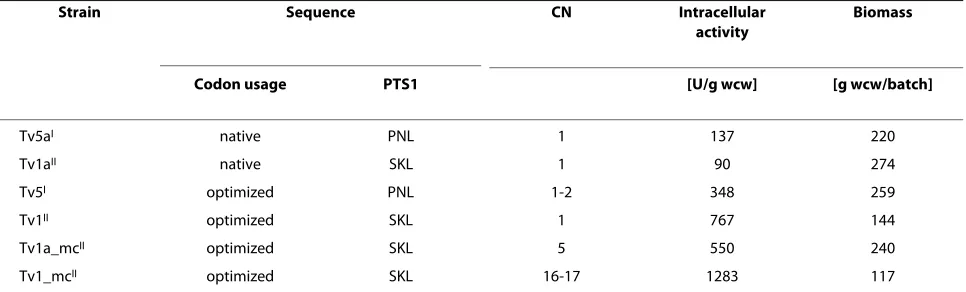
1.5-liter bioreactor cultivations (Table 1). Among the four strains, the strain Tv1 harbouring the codon-optimized gene for production of TvDAO-SKL showed the highest DAO activity. The exchange of the native putative peroxi-somal targeting sequence -PNL to -SKL had no positive effect on enzyme production when the native gene was used (strains Tv5a and Tv1a). However, the same substi-tution brought a substantial increase in oxidase activity when comparing the codon-optimized genes (strains Tv5 and Tv1). The engineering strategies directed towards codon optimization, which is expected to facilitate trans-lation and optimized subcellular targeting at the same time resulted in a synergistic effect on whole cell TvDAO activity. Strain Tv1 showed an about 5-fold improvement in specific oxidase activity as compared to the reference strain Tv5a. To our knowledge, this is the first report describing a combination of PTS1 exchange with codon optimization of a gene to improve intracellular expres-sion.
All low copy strains except Tv1 which integrated a sin-gle copy of the expression cassette containing the codon optimized DAO gene with -SKL C-terminal end, allowed biomass concentrations well above 200 g/L using stan-dard P. pastoris cultivation procedures including metha-nol feed in the production phase. A relatively lower biomass yield of 144 g wcw/batch for Tv1 employing the same cultivation conditions might be explained by the stress, which is generated when large amount of recombi-nant DAO accumulate in the cell. The strain Tv1 grew normally in glycerol containing media where TvDAO expression was repressed, but not during the induction phase using methanol. Similar observations were made with other yeast host organisms, where reduced growth
during induction due to an apparent cell toxicity of recombinant DAO was reported [14,16].
Development of a high-yielding production strain
The codon-optimized gene for TvDAO-SKL was used for further strain development. A new expression construct was made employing the expression vector pPpB1, which facilitates the generation and detection of P. pastoris multi-copy transformants. Using activity-based screening of P. pastoris transformants, the best active strain denoted Tv1_mc was selected. Characterization by real time-PCR revealed integration of about 16 - 17 copies of the expression cassette. Table 1 shows that the Tv1_mc strain gave a twofold enhancement of specific oxidase activity as compared to the single copy clone Tv1. This result implies that the number of gene copies did not translate linearly into an increasing titre of active TvDAO. Notwithstanding, Tv1_mc is the most efficient host for TvDAO production that has been reported so far. A com-parison with earlier reports shows that this strain reached an expression level up to 1.5 and 1 order of magnitude above the expressions levels reported for E. coli and P. pastoris, respectively [13,17]. Other yeasts such as S. cere-visiae and K. lactis showed significant lower TvDAO pro-duction [14]. Unfortunately, the biomass yield for the multi copy transformant Tv1_mc was even lower than in case of the strain Tv1. As with Tv1, growth was impaired only during induction with methanol. For comparison reasons we constructed another multi-copy strain of P. pastoris, termed Tv1a_mc (native gene with -SKL). This strain produced a lower amount of TvDAO activity (550 U/g wcw) than the strains Tv1 and Tv1_mc containing codon optimized genes and it grew normally in the meth-anol feeding phase. This finding further supports the
Table 1: Enzyme and strain engineering for efficient expression of TvDAO in Pichia pastoris.
Strain Sequence CN Intracellular
activity
Biomass
Codon usage PTS1 [U/g wcw] [g wcw/batch]
Tv5aI native PNL 1 137 220
Tv1aII native SKL 1 90 274
Tv5I optimized PNL 1-2 348 259
Tv1II optimized SKL 1 767 144
Tv1a_mcII optimized SKL 5 550 240
Tv1_mcII optimized SKL 16-17 1283 117
IPNL sequence: 5'-CCA-AAC-CTT-3'; IISKL sequence: 5'-TCC-AAG-CTG-3'
notion that the recombinant oxidase, at least when it exceeds a certain level in the cell, seems to be inhibitory to P. pastoris growth. We therefore considered optimiza-tion of the cultivaoptimiza-tion and inducoptimiza-tion condioptimiza-tions for recombinant DAO protein production by the best strain Tv1_mc.
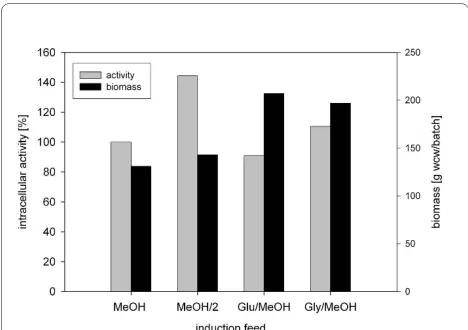
Using the methanol feed of 3 mL/h as a benchmark, alternative strategies for fed-batch cultivation of Tv1_mc were evaluated. It was known [29-32] that a mixed sub-strate feed in the induction phase can support P. pastoris growth and productivity for the target protein at the same time. Figure 2 depicts the results obtained using feeds of glucose-methanol and glycerol-methanol (each at 3 mL/ h) and a reduced pure methanol feed at 1.5 mL/h. The switch from pure methanol feed to mixed substrate feed caused an about 40% increase in biomass yield (~200 g wcw/batch) without compromising the specific activity of the yeast cells. Glycerol-methanol was superior to glu-cose-methanol at the evaluated feed rate. On the other hand a reduced flow rate (1.5 mL/h) of the methanol feed resulted in a 1.4-fold enhancement of specific activity as compared to the reference, while the biomass yield remained rather low (~140 g/batch).
However the volumetric productivity under these con-ditions was the highest. The Tv1_mc cells subjected to induction by a reduced methanol feed gave a volumetric oxidase yield of 218 kU/L and a productivity of 2.0 kU/(h L). In comparison the Tv1_mc strain fed with glycerol-methanol resulted in lower yields of 167 kU/L (1.5 kU/ hL), and 152 kU/L (1.4 kU/hL) for glucose-methanol induction. These values clearly exceeded those of other
known TvDAO expression strains as summarized in Table 2.
Whole cell biocatalyst optimization
Due to already described instability issues of the enzyme a cellular "encapsulation" of the oxidase seemed a promis-ing option. Therefore intact cells obtained in a standard bioreactor cultivation of Tv1 (methanol feed of 3 mL/h) were subjected to stability examination. The determina-tion was performed according to a previously reported assay that provides a first-order inactivation constant (kin) as measure of the operational (in)stability of the oxidase activity [10]. The value of kin is inversely proportional to stability, according to the relationship τ (half-life time) = ln2/kin. Preliminary results showed an extraordinary
half-life time of more than 10 h for the whole cell catalyst Tv1_mc. However, based on the same oxygen consump-tion measurements the specific oxidase activity of intact Tv1_mc cells (5 U/g wcw) was less than 1% of the latent intracellular activity, presumably because of severe mass transfer limitations occurring in the intact cell system.
On the other hand the analysis of a lysate preparation after centrifugation was examined as the soluble fraction and the pellet fraction (probably containing partially lysed cells and peroxisomes) and showed the opposite results. The soluble fraction confirmed the high oxidase activity (~1200 U/g wcw) measured before but a high kin value of 0.0208 min-1 (τ = 0.5 h). Because k
in for the
par-tially lysed pellet fraction was only one-tenth of the value measured for the soluble fraction (kinpellet fraction = 0.0026
min-1; τ = 4.4 h) we still felt strongly encouraged to
pur-sue the development of a whole-cell catalyst. P. pastoris TvDAO-containing Tv1_mc cells served as the starting material. While cell permeabilization was a clear option to attenuate diffusional effects, it was a challenge to pre-vent a trade-off between enhancement of substrate avail-ability and loss of enzyme stavail-ability in the permeabilized whole-cell catalyst. Among various protocols proposed for yeast cell permeabilization [33], the treatment with 2-propanol appeared to be most suitable for our purpose because of its simplicity, efficiency and low costs.
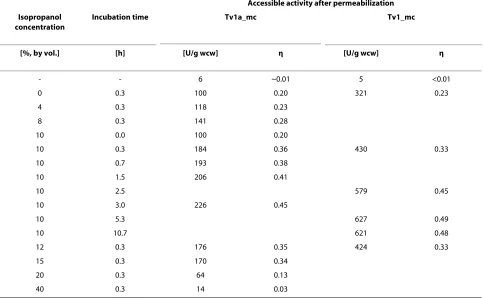
Batches of Tv1_mc and Tv1a_mc cells (10 g each) con-taining about 1300 and 500 U/g wcw intracellular activity, respectively, were lyophilized prior to treatment with iso-propanol considering that handling of dried biomass is easier and more reproducible than that of wet biomass. Key variables of the permeabilization (concentrations of isopropanol and biomass, incubation time) were exam-ined systematically. Oxidase activity measured in the treated cells was related to the total intracellular activity (Table 3). Freeze-dried cells suspended in buffer were poorly active. However, their incubation in aqueous sus-pension caused the gradual "appearance" of enzyme Figure 2 High-cell-density bioreactor cultivation of P. pastoris
activity, reaching ~20% of the maximum available activity after 20 min. Use of isopropanol further enhanced the apparent activity, yielding an effectiveness factor η (= apparent activity/total intracellular activity) of 0.48 (= 627/1300) under optimized conditions where 10% (by volume) of co-solvent was applied. A suitable incubation time was between 5.3 and 10.7 h. Concentrations of iso-propanol greater than 10% caused a decrease in η, and incubation times longer than 5 h did not result in further improvement. Selected whole-cell preparations showing high η (> 0.40; Table 3) were analyzed for the stability of the oxidase activity under operational conditions. Values of kin (hence, the stabilities) were not affected by the per-meabilization as compared to the corresponding kin (kin
-perm. cells = 0.0023 min-1) reaching at least the stability of
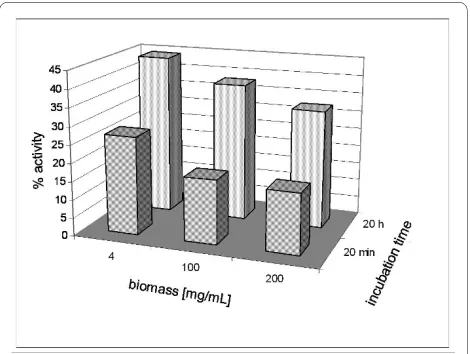
the Tv1_mc pellet fraction. Different biomass concentra-tions in the range 4 - 200 g/L were examined for permea-bilization where the highest biomass level reflects the end concentration for standard fed-batch enzyme production in the bioreactor. The value of η obtained through perme-abilization in the presence of 10% isopropanol was inde-pendent of the biomass concentration although the time required to achieve a maximum level of apparent activity increased with increasing biomass concentration (Figure 3). The stability of the whole-cell catalysts was not affected by the variation of biomass concentration during permeabilization. These results led to the conclusion that the permeabilization of Tv1_mc delivered a novel and promising whole-cell catalyst that was equally active (~500 U/g wcw) but three times more stable than the reported E. coli oxidase preparations [13]. The stability of TvDAO in permeabilized lyophilized P. pastoris cells
rela-tive to the cell free P. pastoris preparation was enhanced by one order of magnitude.
Conclusions
A multi-level engineering approach was successfully applied to develop an innovative whole-cell enzyme prep-aration of TvDAO that is suitable for applications in industrial deracemization processes (Figure 1B). The out-standing capabilities of P. pastoris in recombinant protein production were harnessed to provide high specific
activ-Figure 3 Effect of biomass concentration on permeabilization of recombinant Pichia pastoris cells expressing TvDAO. Cells of Tv1_mc cultivated in a bioreactor were treated with isopropanol for 20 min and 20 h. The activity of permeabilized cells is given as a percent-age of the total intracellular activity (1283 U g/wcw) measured after cell lysis. Activity measurements were performed three times resulting in standard deviations of < 5%.
Table 2: Comparison of relevant host strains used for production of TvDAO.
Expression host Activity Reference
Trigonopsis variabilisI 4,620 U/LIV
Pichia pastoris 7,596 U/LV [16]
Pichia pastoris 23,000 U/L IV [17]
Pichia pastoris 12,532 U/LIV [22]
Pichia pastorisII 218,926 U/LV this study
Saccharomyces cerevisiae ~110 U/g dcwV [14]
Kluveromyces lactis ~150 U/g dcwV [14]
Escherichia coliIII 12,340 U/LV [13]
I Induced with N-carbamoyl-D-alanine II Induced with reduced methanol feed
III Additional D-methionine induction was reported to yield in a 4.5 fold expression improvement IV Activity measured with D-alanine as substrate
V Activity measured with D-methionine as substrate dcw dryed cell weight
ity (1.3 kU/g wcw) and, due to high cell density cultiva-tion of P. pastoris, also very high volumetric oxidase activities (150 kU/L) under standard induction condi-tions, which could be improved by a reduced methanol feed (218 kU/L). These values are well above the highest levels reported in literature (see Table 2). Mild permeabi-lization of the Pichia biomass allowed about half of the latent intracellular activity to be utilized, while at the same time retaining the good operational stability of the enzyme entrapped in the cell matrix of P. pastoris peroxi-somes. Peroxisomal targeting might be a generally useful strategy of producing recombinant oxidases in P. pastoris, especially under circumstances where a whole-cell cata-lyst preparation is considered and immediate removal of the H2O2 generated in the enzymatic reaction is desired. In addition, when protein expression is induced by meth-anol induction, increased peroxisome formation provides increased capacity for the expressed and targeted oxidase. Due to these advantages a P. pastoris-based whole-cell TvDAO preparation and deracemisation processes (Fig-ure 1B) are being scaled up and the new TvDAO whole
cell catalyst can be rapidly integrated into the existing process.
Methods
Chemicals and media
Oligonucleotides were purchased from IDT Integrated DNA Technologies BVBA (Leuven, Belgium) or Invitro-gen Corp. (Carlsbad, CA, USA). Sterile water was from Fresenius Kabi Austria (Graz, Austria). All DNA-modify-ing enzymes were obtained from Fermentas GmbH (Bur-lington, Ontario, Canada). Unless otherwise stated, all chemicals were from Carl Roth GmbH (Karlsruhe, Ger-many), Becton, Dickinson and Company (Franklin Lakes, NJ, USA) or Sigma-Aldrich (St Louis, MO, USA).
Complex media contained 10 g/L yeast extract, 20 g/L peptone and 20 g/L glucose (YPD). Media for plates were solidified by addition of agar to 1.5% w/v. The minimal media used in this work contained 200 mM potassium phosphate buffer (pH 6.0), 13.4 g/L yeast nitrogen base and 0.0004 g/L D-biotin. They differed with respect to the carbon source concentration: 10 g/L glucose for BMD, 1
Table 3: Systematic optimization of process variables for the permeabilization of P. pastoris cells expressing TvDAO.
Accessible activity after permeabilization
Isopropanol concentration
Incubation time Tv1a_mc Tv1_mc
[%, by vol.] [h] [U/g wcw] η [U/g wcw] η
- - 6 ~0.01 5 <0.01
0 0.3 100 0.20 321 0.23
4 0.3 118 0.23
8 0.3 141 0.28
10 0.0 100 0.20
10 0.3 184 0.36 430 0.33
10 0.7 193 0.38
10 1.5 206 0.41
10 2.5 579 0.45
10 3.0 226 0.45
10 5.3 627 0.49
10 10.7 621 0.48
12 0.3 176 0.35 424 0.33
15 0.3 170 0.34
20 0.3 64 0.13
40 0.3 14 0.03
and 5% (by vol.) methanol for BMM2 and BMM10, respectively.
Cloning and engineering of the TvDAO gene, and construction of P. pastoris expression cassettes
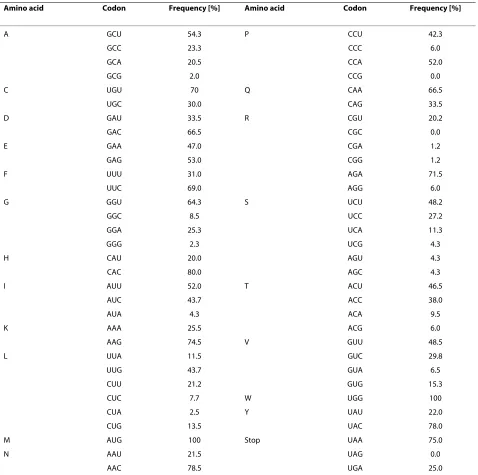
Escherichia coli TOP10F' (Invitrogen Corp.) was used as host for all cloning steps. The protein sequence [Gen-Bank: AAR98816] of D-amino acid oxidase from Trigon-opsis variabilis ATCC 10679 was employed for the design of a codon optimized gene for over-expression in Pichia pastoris under conditions of methanol induction, using the program Gene Designer (DNA2.0, Menlo Park, CA, USA) with a threshold set at 10%, preferring the best codons. Repetitive codons were manually corrected. The optimized codon usage (see Table 4) was calculated from three highly transcribed genes encoding enzymes of the Pichia pastoris methanol utilization pathway (alcohol oxidase 1 Aox1 [GenBank: U96967]; dihydroxyacetone synthase Das1 [GenBank: FJ754551]; formaldehyde dehy-drogenase Fld [Genbank: XP_002493270]) and from a plant gene (Hevea brasiliensis hydroxynitrile lyase HbHNL [Genbank: U40402]) that is efficiently expressed in P. pastoris [34]. The resulting gene was made by gene synthesis. The native gene for TvDAO was kindly pro-vided by Ingenza Ltd. (Roslin, UK). Exchange of the puta-tive peroxisomal targeting sequence at the C-terminus of TvDAO was carried out using a PCR employing a suitable modified reverse primer (see Table 1). Phusion™ High-Fidelity DNA polymerase was used in this and all other PCR experiments applying a protocol provided by the supplier (Finnzymes Oy, Espoo, Finland).
Construction of P. pastoris expression cassettes
Products obtained from PCRs were purified with the QIAquick PCR Purification Kit (Qiagen, Hilden, Ger-many), digested with SpeI and AscI (native TvDAO genes) or EcoRI and NotI (synthetic TvDAO genes). The digested DNA fragments were ligated via SpeI/AscI or EcoRI/NotI restriction sites into equally digested in-house E. coli - P. pastoris shuttle vectors pPpT2 or pPpB1 (TU Graz strain collection BT 5713 and 5709, respectively) that provide single or multi-copy chromosomal integration of target genes in P. pastoris, respectively. Relevant features and sequence elements of these shuttle vectors include: origin of replication of the E. coli plasmid pBR322 [35]; the AOX1 promoter (PAOX1) starting with a BglII site; a multi-ple cloning site with unique restriction sites for EcoRI, SpeI, AscI and NotI; the AOX1 transcription termination sequence; and an antibiotic resistance cassette consisting of a synthetic bacterial promoter called EM72 in tandem with a truncated version of the P. pastoris ILV5 ( acetohy-droxyacid reductoisomerase) promoter, a synthetic gene coding for the amino acid sequence of bleomycin (ble) conferring resistance against Zeocin from
Streptoallotei-chus hindustanus. The ble gene had been codon opti-mized for function in E. coli as well as P. pastoris. The pPpT2 shuttle vector further contained the P. pastoris AOD (alternative oxidase) transcription termination sequence [36] at the 3' of the coding sequence of the syn-thetic ble gene. The pPpB1 vector had the same addi-tional features except that the Saccharomyces cerevisiae ADH1 (alcohol dehydrogenase 1) promoter and termina-tor controlled the transcription of the ble gene.
Transformation of P. pastoris
A MutS strain derived from P. pastoris CBS 7435 (TU
Graz strain collection number BT 3132) was used for transformation. A condensed protocol [37] was used in which the shuttle vectors were employed after lineariza-tion with BglII and purification with the QIAquick PCR Purification Kit (Qiagen). Transformations were per-formed in ice-cold electro-transformation cuvettes (0.2 cm, Cell Projects Ltd., Kent, UK) using pulse at 200 Ù, 25 μF and 1.5 kV. 0.5 mL of ice-cold sorbitol (1 M; in water) was added immediately after the electro shock, and the suspension was transferred to a sterile 12 mL polypropyl-ene tube (Greiner, Frickenhausen, Germany). YPD medium (0.5 mL) was added to the tube which was then incubated for 2 h at 30°C using agitation at 60 rpm. After this regeneration step, aliquots (0.2 mL) were plated on solid selection medium containing 100 mg/L Zeocin.
Copy number determination by quantitative PCR
The number of copies of TvDAO expression cassettes integrated into the P. pastoris genome was determined by quantitative real-time PCR as described in [38] employ-ing the endogenous ARG4 gene as a reference. Power SYBR Green PCR Master Mix (Applied Biosystems, Fos-ter City, CA, USA) was used in an ABI PRISM 7300 Real Time PCR System (Applied Biosystems). The following oligonucleotide primers were applied in a concentration of 250 nM when using 2 ng genomic DNA of P. pastoris as template: AOX1-fw-RT (gaagctgccctgtcttaaacctt)/AOX1-rv-RT (caaaagcttgtcaattggaacca) and ARG4-RT-fw (tcctc-cggtggcagttctt)/ARG4-RT-rv (tccattgactcccgttttgag). The temperature conditions were: 10 min at 95°C; 40 cycles for 15 s at 95°C and 60 s at 60°C followed by a dissociation step (15 s at 95°C, 30 s at 60°C, 15 s at 95°C) at the end of the last cycle.
Small-scale cultivation of P. pastoris
supplied after ~70 h as well as after ~84 h total cultivation time. After a 48 h-long induction phase (108 h of cultiva-tion). 50 μL of each culture were transferred to V-bottom microtiter plates (Greiner Bio-One #651101) from which glycerol stocks were prepared. The remainder of the cell suspension was centrifuged (Eppendorf centrifuge 5810R: 3220 × g, 4°C, 10 min) and the pellets were collected for activity determinations. 300 μL Yeast Buster reagent (Novagen, Darmstadt, Germany) were added to the cell pellet which was resuspended and incubated for ~30 min at room temperature using agitation at 1400 rpm using a TITRAMAX 1000 shaker (Heidolph Instruments GmbH
& Co. KG, Germany). Following removal of cell debris by centrifugation (Eppendorf centrifuge 5810R: 3220 × g, 4°C, 10 min), 10 μL of the supernatant were employed for measuring TvDAO activity using the photometric assay as described below.
Bioreactor cultivation of P. pastoris
The inoculum (optical density OD600 10 - 15) was pre-pared in two preculture steps in 250 mL baffled shake flasks using 50 mL BMGY (10 g/L yeast extract, 20 g/L peptone, 100 mM potassium phosphate buffer (pH 6.0), 13.4 g/L yeast nitrogen base and 10 g/L glycerol).
Incuba-Table 4: Codon usage table designed for high level expression during methanol induction in P. pastoris.
Amino acid Codon Frequency [%] Amino acid Codon Frequency [%]
A GCU 54.3 P CCU 42.3
GCC 23.3 CCC 6.0
GCA 20.5 CCA 52.0
GCG 2.0 CCG 0.0
C UGU 70 Q CAA 66.5
UGC 30.0 CAG 33.5
D GAU 33.5 R CGU 20.2
GAC 66.5 CGC 0.0
E GAA 47.0 CGA 1.2
GAG 53.0 CGG 1.2
F UUU 31.0 AGA 71.5
UUC 69.0 AGG 6.0
G GGU 64.3 S UCU 48.2
GGC 8.5 UCC 27.2
GGA 25.3 UCA 11.3
GGG 2.3 UCG 4.3
H CAU 20.0 AGU 4.3
CAC 80.0 AGC 4.3
I AUU 52.0 T ACU 46.5
AUC 43.7 ACC 38.0
AUA 4.3 ACA 9.5
K AAA 25.5 ACG 6.0
AAG 74.5 V GUU 48.5
L UUA 11.5 GUC 29.8
UUG 43.7 GUA 6.5
CUU 21.2 GUG 15.3
CUC 7.7 W UGG 100
CUA 2.5 Y UAU 22.0
CUG 13.5 UAC 78.0
M AUG 100 Stop UAA 75.0
N AAU 21.5 UAG 0.0
tions were done for about 12 and 8 h at 28°C using agita-tion at 120 rpm (Certomat BS-1). A 1.5-L fed batch-pro®
bioreactor system (DASGIP AG, Juelich, Germany) equipped with a six-bladed Rushton turbine impeller and suitable controllers for pH and dissolved O2 was used for biomass and enzyme production. The basal medium of Invitrogen Corp. was modified according to Hellwig et al. [39] and contained 40 g/L glycerol, 0.17 g/L calcium sul-phate dihydrate, 2.32 g/L magnesium sulsul-phate heptahy-drate, 2.86 g/L potassium sulphate, 7.18 g/L aqueous phosphoric acid (85%), 0.64 g/L potassium hydroxide, 0.22 g/L sodium chloride, 0.6 g/L EDTA disodium dihy-drate, 0.20 mL/L antifoam (ACEPOL 83 E; Lubrizol Addi-tives, Wickliffe, Ohio, USA). PTM1 trace element solution
was added (4.35 mL/L medium) after in situ sterilisation of the basal medium. Its composition was as suggested by Invitrogen, namely 0.2 g/L biotin, 6 g/L CuSO4 × 5 H2O, 80 mg/L NaI, 3.067 g/L MnSO4 × H2O, 0.2 g/L Na2MoO4 × 2 H2O, 20 mg/L H3BO3, 0.916 g/L CoCl2 × 6 H2O, 20 g/ L ZnCl2, 65 g/L FeSO4 × 7 H2O, and 5 mL/L H2SO4. The pH of the final medium was adjusted to 6.0 using an ammonia solution (25% by volume; technical quality).
The cultivation started from an initial liquid volume of 0.65 L (in total) with 50 mL of the 2nd preculture in a
batch phase (28°C, aeration at 0.7 L/min) in which glyc-erol served as the sole source of carbon. The stirrer speed varied between 500 and 1200 rpm as required to maintain a level of dissolved O2 greater or equal 30% air saturation. The ammonia solution was used for pH control and like-wise as nitrogen source. Following depletion of glycerol in the batch phase, typically after ~16 - 18 h, glycerol was fed from a 700 g/L substrate solution containing 12 mL/L PTM1 solution. The feed flow rate increased
exponen-tially over 6 h from 4.77 mL/h to 11.72 mL/h, afterwards gradually decreased to zero within 2 h. Decreasing glyc-erol supply was accompanied by the start of methanol feeding (supplemented with 12 mL/L PTM1 solution). The flow rate was increased linearly to 3 mL/min within the 2 h where the glycerol feed was reduced and remained constant at this high level for another 90 h. Feeding of mix-substrates (methanol/glucose and methanol/glyc-erol) occurred in the same manner. Both mix fed con-tained 452 g/L methanol and 346 g/L glucose or 321 g/L glycerol, respectively and were supplemented with 12 mL/L PTM1 solution.
Biomass was harvested using an Avanti J-20 XP centri-fuge (Beckman Coulter, Krefeld, Germany) employing a JA-10 rotor at 2831 × g (10 min, 4°C). The pellet was washed once with a 100 mM potassium phosphate buffer (pH 6.0) and stored frozen (-20°C) until further use.
For cell lysis the thawed cell mass (~5 g) was suspended in 10 mL Tris buffer (100 mM, pH 7.5) and passed 2 times
through an Aminco French press using an FA-030 cell (SLM Instruments, Rochester, NY, USA) at approx. 150 bar. Insoluble material was separated from the superna-tant by centrifugation (20 min, 14000 rpm, 4°C) and fur-ther washed three times with 10 mL Tris buffer as above. Both the supernatant and the insoluble fraction were used for the measurement of TvDAO activity.
Assays for oxidase activity and stability
An enzyme-coupled colorimetric assay for oxidase activ-ity was used as described by Alexeeva et al. [40] with slight modifications. Briefly, 10 μL of appropriately diluted Yeast Buster cell lysate were transferred into a microtiter plate well. Assay solution (190 μL) was added and colour development (measured at 510 nm) moni-tored for 5 min at room temperature. The composition of the assay solution was 100 mM potassium phosphate buf-fer (pH 7.8), 0.5 mM 2,4,6-tribromo-3-hydroxybenzoic acid, 0.75 mM 4-aminoantipyrine, 10 mM D-methionine, and 0.025 mg/ml horseradish peroxidase (type VIa; Sigma-Aldrich catalogue number P6782).
A direct assay of TvDAO activity used measurement of O2 consumption at 30°C. A previously described glass mini-reactor with a working volume of 30 mL was employed [10]. The reactor was equipped with a fibre-optic oxygen micro-optode (PreSens GmbH, Regensburg, Germany), a temperature sensor, and a teflon sparging tube (1 mm internal diameter) through which air O2 was supplied. Mixing was achieved with a magnetic stirrer operated at 300 rpm.
Initial rates of O2 conversion were recorded using 10 mM D-methionine as the substrate dissolved in 10 mM Tris buffer (pH 7.5). Reactions were started by adding 20 μL of appropriately diluted P. pastoris cell extract, obtained through either lysis or French press disruption of biomass, to 30 mL of reaction mixture. Alternatively, a suitable amount of untreated or permeabilized yeast cells was added. Note the standard protocol for cell lysis which involved mixing of 100 mg wet biomass with 400 μL Yeast Buster reagent followed by incubation of the suspension for 10 min at 4°C. One unit of oxidase activity refers to 1 μmol O2 consumed/min under the conditions used. Stan-dard deviation was derived from three independent activ-ity determinations and calculated according to following equation, where x = experimental value and n = number of independent experiments:
A previously reported procedure was applied for the determination of "operational" stability of the different
n x x
n n
2 2
1
∑ − ∑
(
)
−
oxidase preparations [10]. Air was sparged into the mini-reactor at a flow rate of 30 L/h. The substrate solution contained 100 mM D-methionine dissolved in 100 mM Tris buffer (pH 7.5). The reaction was started by addition of a suitable amount of oxidase (cell extract, whole-cell preparation) such that the level of dissolved O2 initially dropped to about 50 μM (~25% air saturation). The time course for [O2] was then recorded until the concentration of oxygen returned ~100% air saturation. Data were fitted with an exponential decay function to obtain an estimate for the first-order inactivation constant kin [10].
Permeabilization
About 10 g wet P. pastoris biomass was suspended in 10 mL distilled water and freeze-dried over night using a Christ Alpha 1-4 LSC freeze dryer (Martin Christ Gefri-ertrocknungsanlagen, Osterode, Germany) operated at 0°C and 0.570 mbar. Permeabilization by isopropanol was carried out in a total volume of 1 mL, using 4 mg dried cells unless otherwise stated. The alcohol concentration was varied in the range 2 - 40% (by volume, in water). Pure water served as reference. Incubation of the cells was done at 4°C without agitation; the time was variable between 20 min and 50 h as indicated. 100 μL cell suspen-sion was used to measure activity and stability.
Competing interests
The authors SA, JN, GB, BN and AG declare that they have no competing inter-ests. RS is employed by Ingenza Ltd. who is interested in the commercialization of an industrial chemo-enzymatic process for amino acid deracemization.
Authors' contributions
SA and GB constructed the various TvDAO expression cassettes and carried out Pichia pastoris strain construction. They performed the screening work and did the bioreactor cultivations. The screening assay was provided by Ingenza. SA also supervised the RT-PCR experiments and interpreted data concerning pro-tein expression. JN performed cell permeabilization experiments and deter-mined the activities and stabilities of whole-cell catalysts. AA and RS provided feedback about the reproducibility of the lab results in scale up experiments at Ingenza. IF, RS, BN and AG made substantial contributions to the conception, design and discussion of the overall project strategy and the experiments. SA, AG and BN wrote the paper. All authors have read and approved the final ver-sion of the manuscript.
Acknowledgements
The authors thank Thorsten Bachler for excellent technical support, and Clau-dia Ruth for providing Pichia expression vectors. The FFG, the Province of Styria, SFG and Ingenza Ltd. are acknowledged for financial support. JN&BN acknowl-edge Slovak-Austrian travel project SK-AT-0024-08.
Author Details
1Austrian Centre of Industrial Biotechnology, c/o Applied Biocatalysis Research
Centre, c/o Institute of Molecular Biotechnology, Graz University of
Technology, Petersgasse 14, 8010 Graz, Austria, 2Institute of Biotechnology and
Biochemical Engineering, Graz University of Technology, Petersgasse 12, 8010 Graz, Austria, 3Institute of Chemistry, Center of Glycomics, Slovak Academy of
Sciences, Dúbravska cesta 9, SK-84538 Bratislava, Slovak Republic and 4Ingenza
Ltd., Wallace Building, Roslin BioCentre, Roslin, EH25 9PP, UK
References
1. Riethorst W, Reichert A: An industrial view on enzymes for the cleavage of cephalosporin C. Chimia 1999, 53:600-607.
2. Tishkov VI, Khoronenkova SV: D-Amino acid oxidase: Structure, catalytic mechanism, and practical application. Biochemistry (Moscow) 2005,
70:40-54.
3. Pollegioni L, Molla G, Sacchi S, Rosini E, Verga R, Pilone MS: Properties and applications of microbial D-amino acid oxidases: current state and perspectives. Applied Microbiology and Biotechnology 2008, 78:1-16. 4. Rosini E, Molla G, Rossetti C, Pilone MS, Pollegioni L, Sacchi S: A biosensor
for all D-amino acids using evolved D-amino acid oxidase. Journal of Biotechnology 2008, 135:377-384.
5. Beard TM, Turner NJ: Deracemisation and stereoinversion of α-amino acids using D-amino acid oxidase and hydride reducing agents. Chemical Communications 2002, 7:246-247.
6. Khoronenkova SV, Tishkov VI: D-amino acid oxidase: physiological role and applications. Biochemistry (Moscow) 2008, 73:1511-1518. 7. Kubicek-Pranz EM, Rohr M: D-amino acid oxidase from the yeast
Trigonopsis variabilis. Journal of Applied Biochemistry 1985, 7:104-113. 8. Pollegioni L, Caldinelli L, Molla G, Sacchi S, Pilone MS: Catalytic properties
of D-amino acid oxidase in cephalosporin C bioconversion: a comparison between proteins from different sources. Biotechnology Progress 2004, 20:467-473.
9. Dib I, Nidetzky B: The stabilizing effects of immobilization in D-amino acid oxidase from Trigonopsis variabilis. BMC Biotechnology 2008, 8:72. 10. Nahalka J, Dib I, Nidetzky B: Encapsulation of Trigonopsis variabilis
D-amino acid oxidase and fast comparison of the operational stabilities of free and immobilized preparations of the enzyme. Biotechnology and Bioengineering 2008, 99:251-260.
11. Nahalka J, Nidetzky B: Fusion to a pull-down domain: a novel approach of producing Trigonopsis variabilis D-amino acid oxidase as insoluble enzyme aggregates. Biotechnology and Bioengineering 2007, 97:454-461. 12. Vikartovska-Welwardova A, Michalkova E, Gemeiner P, Welward L:
Stabilization of D-amino-acid oxidase from Trigonopsis variabilis by manganese dioxide. Folia Microbiologica 1999, 44:380-384.
13. Dib I, Stanzer D, Nidetzky B: Trigonopsis variabilis D-amino acid oxidase: control of protein quality and opportunities for biocatalysis through production in Escherichia coli. Applied and Environmental Microbiology 2007, 73:331-333.
14. Gonzalez FJ, Montes J, Martin F, Lopez MC, Ferminan E, Catalan J, Galan MA, Dominguez A: Molecular cloning of Tv DAO1, a gene encoding a D-amino acid oxidase from Trigonopsis variabilis and its expression in
Saccharomyces cerevisiae and Kluyveromyces lactis. Yeast 1997,
13:1399-1408.
15. Isoai A, Kimura H, Reichert A, Schorgendorfer K, Nikaido K, Tohda H, Giga-Hama Y, Mutoh N, Kumagai H: Production of D-amino acid oxidase (DAO) of Trigonopsis variabilis in Schizosaccharomyces pombe and the characterization of biocatalysts prepared with recombinant cells. Biotechnology and Bioengineering 2002, 80:22-32.
16. Zheng HB, Wang XL, Chen J, Zhu K, Zhao YH, Yang YL, Yang S, Jiang W:
Expression, purification, and immobilization of His-tagged D-amino acid oxidase of Trigonopsis variabilis in Pichia pastoris. Applied Microbiology and Biotechnology 2006, 70:683-689.
17. Yu J, Li DY, Zhang YJ, Yang S, Li RB, Yuan ZY: High expression of
Trigonopsis variabilis D-amino acid oxidase in Pichia pastoris. Journal of Molecular Catalysis B: Enzymatic 2002, 18:291-297.
18. Fernandez-Lafuente R, Rodriguez V, Guisan JM: The coimmobilization of D-amino acid oxidase and catalase enables the quantitative transformation of D-amino acids (D-phenylalanine) into α-keto acids (phenylpyruvic acid). Enzyme and Microbial Technology 1998, 23:28-33. 19. Cregg JM, Madden KR, Barringer KJ, Thill GP, Stillman CA: Functional
characterization of the two alcohol oxidase genes from the yeast Pichia pastoris. Molecular and Cellular Biology 1989, 9:1316-1323.
20. Gleeson MA, Sudbery PE: The methylotrophic yeasts. Yeast 1988, 4:1-15. 21. Klei IJ van der, Yurimoto H, Sakai Y, Veenhuis M: The significance of
peroxisomes in methanol metabolism in methylotrophic yeast. Biochimica et Biophysica Acta 2006, 1763:1453-1462.
22. Tan Q, Song QX, Zhang YW, Wei DZ: Characterization and application of D-amino acid oxidase and catalase within permeabilized Pichia pastoris
cells in bioconversions. Applied Biochemistry and Biotechnology 2007,
136:279-289.
Received: 10 December 2009 Accepted: 26 April 2010 Published: 26 April 2010
This article is available from: http://www.microbialcellfactories.com/content/9/1/24 © 2010 Abad et al; licensee BioMed Central Ltd.
This is an Open Access article distributed under the terms of the Creative Commons Attribution License (http://creativecommons.org/licenses/by/2.0), which permits unrestricted use, distribution, and reproduction in any medium, provided the original work is properly cited.
23. Emanuelsson O, Brunak S, von Heijne G, Nielsen H: Locating proteins in the cell using TargetP, SignalP and related tools. Nature Protocols 2007,
2:953-971.
24. Nakai K, Horton P: PSORT: a program for detecting sorting signals in proteins and predicting their subcellular localization. Trends in Biochemical Sciences 1999, 24:34-36.
25. Neuberger G, Maurer-Stroh S, Eisenhaber B, Hartig A, Eisenhaber F:
Prediction of peroxisomal targeting signal 1 containing proteins from amino acid sequence. Journal of Molecular Biology 2003, 328:581-592. 26. Neuberger G, Maurer-Stroh S, Eisenhaber B, Hartig A, Eisenhaber F: Motif
refinement of the peroxisomal targeting signal 1 and evaluation of taxon-specific differences. Journal of Molecular Biology 2003,
328:567-579.
27. Monosov EZ, Wenzel TJ, Luers GH, Heyman JA, Subramani S: Labeling of peroxisomes with green fluorescent protein in living P. pastoris cells. Journal of Histochemistry and Cytochemistry 1996, 44:581-589. 28. Weis R, Luiten R, Skranc W, Schwab H, Wubbolts M, Glieder A: Reliable
high-throughput screening with Pichia pastoris by limiting yeast cell death phenomena. FEMS Yeast Research 2004, 5:179-189.
29. Tschopp JF, Brust PF, Cregg JM, Stillman CA, Gingeras TR: Expression of the lacZ gene from two methanol-regulated promoters in Pichia pastoris. Nucleic Acids Research 1987, 15:3859-3876.
30. Zhang W, Hywood Potter KJ, Plantz BA, Schlegel VL, Smith LA, Meagher MM: Pichia pastoris fermentation with mixed-feeds of glycerol and methanol: growth kinetics and production improvement. Journal of Industrial Microbiology and Biotechnology 2003, 30:210-215.
31. d'Anjou MC, Daugulis AJ: A rational approach to improving productivity in recombinant Pichia pastoris fermentation. Biotechnology and Bioengineering 2001, 72:1-11.
32. Lin-Cereghino GP, Lin-Cereghino J, Ilgen C, Cregg JM: Production of recombinant proteins in fermenter cultures of the yeast Pichia pastoris. Current Opinion in Biotechnology 2002, 13:329-332.
33. Pscheidt B, Glieder A: Yeast cell factories for fine chemical and API production. Microbial Cell Factories 2008, 7:25.
34. Hasslacher M, Schall M, Hayn M, Bona R, Rumbold K, Luckl J, Griengl H, Kohlwein SD, Schwab H: High-level intracellular expression of hydroxynitrile lyase from the tropical rubber tree Hevea brasiliensis in microbial hosts. Protein Expression and Purification 1997, 11:61-71. 35. Sutcliffe JG: Complete nucleotide sequence of the Escherichia coli
plasmid pBR322. Cold Spring Harbour Symposia on Quantitative Biology 1979, 43:77-90.
36. Kern A, Hartner FS, Freigassner M, Spielhofer J, Rumpf C, Leitner L, Frohlich KU, Glieder A: Pichia pastoris 'just in time' alternative respiration. Microbiology 2007, 153:1250-1260.
37. Lin-Cereghino J, Wong WW, Xiong S, Giang W, Luong LT, Vu J, Johnson SD, Lin-Cereghino GP: Condensed protocol for competent cell preparation and transformation of the methylotrophic yeast Pichia pastoris. Biotechniques 2005, 38:. 44, 46, 48
38. Abad S, Kitz K, Hormann A, Schreiner U, Hartner FS, Glieder A: Real-time PCR-based determination of gene copy numbers in Pichia pastoris. Biotechnology Journal 2010, 5:413-420.
39. Hellwig S, Emde F, Raven NP, Henke M, Logt P van Der, Fischer R: Analysis of single-chain antibody production in Pichia pastoris using on-line methanol control in fed-batch and mixed-feed fermentations. Biotechnology and Bioengineering 2001, 74:344-352.
40. Alexeeva M, Enright A, Dawson MJ, Mahmoudian M, Turner NJ:
Deracemization of α-methylbenzylamine using an enzyme obtained by in vitro evolution. Angewandte Chemie International Edition 2002,
41:3177-3180.
doi: 10.1186/1475-2859-9-24
Cite this article as: Abad et al., Stepwise engineering of a Pichia pastoris