Abstract
Objective: The aim of the present clinical pilot study was to examine the influence of a combination of mi-cronutrients on individuals with high stress experience.
Methods:40 healthy students (28 female, 12 male) with a mean age of 27.1 ± 3.0 years, experiencing high ex-amination stress, were chosen. after approval of the ethics commission, one group of students (n = 19) took a combination of micronutrients (orthomol vital m/f) for three months, whereas other students (n = 21) served as control group. all participants under-went at the beginning and at the end of the trial a den-tal examination, a determination of 10 periodonden-tal pathogens, a salivary and a blood analysis. In addition, the participants filled in a questionnaire on nutrition, quality of life and degree of stress experienced during their final examinations.
Results: The evaluation of the results, obtained at the end of the trial period, showed that for all students a slight worsening of oral hygiene and an increased con-sumption of unhealthy food could be observed. The intake of the micronutrients led to a slight improve-ment of the degree of gingival inflammation in com-parison to the control group. The blood analysis showed an increase in vitamin (vitamin c, vitamin E) and zinc concentrations, and a lower increase in cRP. In the male subjects, a decrease in the serum concen-trations of triglycerides (p = 0.073) and ldl (p = 0.048) was observed.
Conclusions: This pilot study shows that micronutri-ents, taken during periods of high stress experience, had a beneficial effect on inflammatory processes and helped reduce the level of some of the plasma lipids in males, and thus can be recommended for supple-menting the diet. However, additional studies with a higher number of subjects, also suffering from peri-odontal disease, are necessary to show the effect of a micronutrient supplementation more clearly.
Key words: micronutrients, blood analysis, gingivitis, dental examination, final examination stress
I
nTRoducTIonsound nutritional habits and a sufficient supply of es-sential vitamins and minerals are of considerable im-portance for oral health. for example, in the case of inflammatory processes a fast immune response is
im-portant, which can only take place effectively when there is a sufficient supply of food and micronutrients to the body [1]. diseases of the periodontium, like gingivitis and periodontitis, are local or generalized in-fections, which usually result in a local inflammatory reaction. Periodontal disease is strongly associated with the bacterial microflora present in subgingival plaque [2]; in addition to these main causative parame-ters, there are however additional factors like diabetes or use of tobacco products, which can cause or modi-fy the course of a periodontitis [3].
High stress exposure is also discussed as a possible factor, exerting an unfavorable influence on periodon-tal health. although stress is generally judged to be a highly personal state, which is difficult to determine, exposure to highly increased stress stimuli or perma-nent negative impulses can produce strains or cause various physical disorders, like e. g. tachycardia or changes in the immune system, but it can also interfere with normal learning habits [4]. a distinction has to be made between work-related, private and socio-eco-nomic stress exposure [5]. some studies have shown that under high stress exposure the risk to develop a periodontitis increases, and that the influence on peri-odontal health is comparable to smoking or diabetes [4, 6]. for example examination stress can have a neg-ative influence on oral health, which can manifest it-self in a greater plaque accumulation, local gingivitis and a change in salivary composition [6, 7]. The vari-ous stress theories aim to explain the occurrence of stress and the resulting behavioral patterns and meta-bolic changes. under high stress conditions, plaque ac-cumulation, accompanied by gingivitis, can be consid-erably higher and occur more frequently during stress-ful periods than during stress free periods. However, one has to keep in mind that changes in periodontal health are more likely to be caused by changes in pa-tient behavior than by metabolic changes [4].
The total antioxidant status can be used to measure the oxidative stress of a patient. By means of the Tas test, the ratio of free radicals to various antioxidants can be determined. The total antioxidant status in stressed patients is frequently altered, and, for example in patients suffering from periimplantitis, changes in the total antioxidant status are also seen [8]. a favor-able change of this situation can be achieved by the in-take of nutritional supplements and combinations of micronutrients. an improvement of the total
antioxi-Eur J Med Res (2011) 16: 514-518 © I. Holzapfel Publishers 2011
T
HE
I
nfluEncE of
M
IcRonuTRIEnTs on
o
Ral and
G
EnERal
H
EalTH
B. Willershausen1, a. Ross1, M. försch1, I. Willershausen2, Ph. Mohaupt1, a. callaway1
1department of operative dentistry, university Medical center, Johannes Gutenberg university Mainz
dant status can be detected after supplementation with antioxidants, but also after a successful conventional periodontal therapy [9]. The consumption of dietetic foods and the intake of combinations of micronutri-ents, but also of “functional foods”, have clearly be-come more popular over the past years. The beneficial effect of vitamins on the body as a whole has long been known, and there are numerous studies dealing with the effects and functions of the vitamins for the human body. However, only a few studies investigate the influence of vitamins or micronutrients on oral health [3, 10].
Vitamin c is essential for the formation and matu-ration of collagen, and for the integrity of connective and osteoid tissues, and dentine. In addition, it is also necessary for maintaining the proper functions of the immune system. a deficiency in vitamin c can lead to scurvy or interfere with normal wound healing [11]. In Europe, vitamin c has been added to many foods or it is already present as a natural ingredient, so that a vita-min c deficiency is seen relatively rarely in industrial-ized societies.
The vitamin B complex comprises eight different vitamins, which differ considerably, both in their chemical composition and also in their pharmacologi-cal properties. The B vitamins are needed as important precursors for various coenzymes in metabolic processes [11].
Vitamin d regulates the calcium metabolism of the human body and maintains sufficient levels of calcium and phosphate in the serum for the mineralization of the bones. at present, a deficient supply of vitamin d is frequently seen in the German population. In a study by Garcia et al. [12] a beneficial effect on the course of a chronic periodontitis was seen after a year of vitamin d and calcium supplementation.
also the mineral magnesium is of major impor-tance for the energy metabolism. In addition to caus-ing deficiency symptoms, like for example muscle cramps and muscle twitching, a magnesium deficiency can also be associated with the onset and progression of periodontal disease [13]. In contrast, an iron defi-ciency resulting in iron-defidefi-ciency anemia, which is of-ten seen in young women, seems to have little influ-ence on oral health [14].
The importance of a balanced diet or the consump-tion of dietetic foods or micronutrients for the body composition, has been shown in numerous studies, and is reflected in the recommendations of various professional societies. However, there are only few studies, which have examined the possible influence of a supplemented balanced diet and not just of one vita-min complex or a single trace element / vita-mineral on oral health. In the present pilot study, the possible in-fluence of a micronutrient combination on various pa-rameters of oral and systemic health was to be studied during a period of high stress exposure.
M
aTERIal andM
ETHodsdental students in their last term participated in the present study immediately prior to their final examina-tions (phase of high stress). Exclusion criteria were se-rious general or systemic diseases, pregnancy or
long-term intake of antibiotics. after the approval of the ethics commission (number: 837.015.10 / 7024) was obtained, a total of 42 healthy young subjects were en-rolled in the study. all subjects were informed in de-tail, both orally and in writing, about the planned trial; written informed consent to participate in the trial was obtained from all subjects.
The students were assigned to two groups, using a randomization protocol: one group (n = 21) served as control and didn’t receive any dietary supplements, the subjects in the other group (n=21) received a combi-nation of micronutrients (orthomol vital f/m; ortho-mol pharmazeutische Vertriebs GmbH, langenfeld, Germany), which they were asked to take daily accord-ing to the instructions, over a period of 3 months. In contrast to the micronutrient preparation for male subjects, the one for female subjects contained calci-um as an additive and only half the amount of omega-3 fatty acids. The subjects in both groups were not permitted to take any additional vitamins or nutritional supplements during the course of this trial. They were supposed to continue their daily oral hygiene measures as usual, and they received no specific instructions concerning the use of particular tooth pastes or tooth brushes.
The subjects answered questions concerning their dietary habits, and filled in a short questionnaire (a WHo form) with regard to their presently perceived quality of live.
all subjects underwent a dental assessment, and had a blood sample taken, first at the beginning (at base-line, phase of high stress), and again at the end of this trial (phase of relaxation). after 3 months (end of the trial), only 19 subjects from the group taking micronu-trients, and all 21 subjects from the control group could be reached for the examinations at the end of the study, and only the data from these 40 subjects were included in this study. one subject from the con-trol group missed his appointment for the second den-tal examination, and was therefore not included in the analyses of aPI and sBI [15, 16].
dEnTalassEssMEnT
analysis of the saliva. The salivary flow rate and pH, and the total antioxidant status (Tas) were deter-mined. Each subject chewed on a piece of paraffin for five minutes, and the saliva was collected in a graduat-ed plastic beaker. The amount of collectgraduat-ed saliva was recorded in ml, and to calculate the salivary flow rate, it was divided by five and expressed as ml/min. The salivary pH was measured by means of a portable pH-Meter with an accuracy of ± pH 0.01, equipped with a microelectrode (HI9224, novodirect, Kehl, Germany). The Tas (total antioxidant status) was determined spectrophotometrically (shimadzu uV-1202/ uV-VIs, shimadzu Kyoto, Japan) by means of a colorimetric assay, using a test kit (Randox laboratories, Krefeld, Germany).
BloodanalysIs
from each subject a blood sample (approximately 15 ml) was taken by a certified medical technician at the beginning (baseline) and at the end of the study. The analyses of the samples were performed by an external laboratory (Bioscentia labor, Ingelheim, Germany). The concentrations of homocysteine, vitamin c, d and E, malondialdehyde, zinc, c-reactive protein (cRP), high density lipoprotein cholesterol (Hdl) and low density lipoprotein cholesterol (ldl), triglyc-erides and cortisol were determined.
sTaTIsTIcaldaTaanalysIs
The statistical analysis of the data was carried out with the program sPss for medical statistics (17.0 for Win-dows, chicago, Il, usa) in collaboration with the stitute of Medical Biostatistics, Epidemiology and In-formatics of the university Medical center of the Jo-hannes Gutenberg university Mainz. for the descrip-tive analysis of the data, categorial variables are pre-sented as absolute und relative frequencies, and for the numerical variables minima, means and standard devi-ations, medians and maxima were calculated. To statis-tically analyze the differences between the two groups, the chi-square test and the Mann-Whitney u-Test were used, and the significance level was set at p < 0.05.
R
EsulTsof the total of 42 dental students, recruited immedi-ately prior to their final examination and randomly as-signed to one of two groups, only 19 subjects (5 male, 14 female) from the group taking micronutrients, and 21 subjects (7 male, 14 female) from the control group could be reached after 3 months for the examinations at the end of the study. The age of the subjects ranged from 24 - 37 years (mean: 27.1 ± 3.0 years).
at baseline, the mean aPI value of the 20 subjects in the control group (one subject didn’t come for the dental examination) was 12.3 ± 6.3%, and after 3 months it was17.5 ± 9.1%. similar values were found also for the group taking micronutrients: at baseline the mean value was 11.9 ± 8.8%, and at the end it was 17.9 ± 15.2%. This indicates that all students had slightly neglected their oral hygiene during the phase
of high stress exposure. The difference in aPI be-tween the two groups was not statistically significant (p = 0.61).
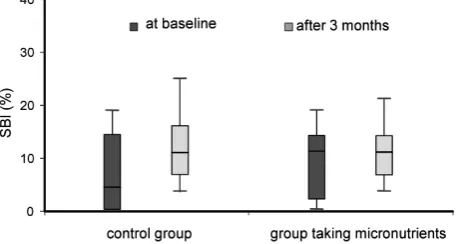
The degree of gingival inflammation (sBI) changed accordingly in a similar fashion.
The worsening of oral hygiene resulted in a slightly higher sBI value (fig. 1).
The 20 subjects in the control group had at baseline a mean sBI value of 6.9 ± 6.5% and at the end of the study a value of 11.9 ± 6.5%. a slightly, but not signif-icantly, smaller increase in this value was found in the group taking micronutrients (p=0.57). at baseline the mean sBI value was 9.2 ± 9.0%, and showed only a slight worsening to 12.6 ± 7.9 %.
When the values for the salivary pH of the subjects in both groups were compared, no significant differ-ences were found (p = 0.93). In addition, the salivary flow rate (ml/min) was determined, which plays an important role in the etiology of caries and gingivitis. likewise, no difference could be found between the two groups (p = 0.48). When the oxidative stress, Tas (total antioxidant status, mmol/l) in whole saliva was determined, in both groups a similar decrease in value was observed after a period of 3 months, which re-mained, however, in the normal range. The subjects in the control group had at baseline a mean Tas value of 1.74 ± 0.32 (mmol/l), and the end of the study this value was 1.0 ± 0.41 (mmol/l). a somewhat smaller, but not significant decrease in Tas was found in the group taking micronutrients (p = 0.43).
The microbiological analysis of the subgingival plaque samples yielded for both groups similar results. samples from selected periodontal sites were tested for the presence of 10 different periodontal patho -gens. In both groups Aggregatibacter actinomycetem-comitans and Por phyromonas gingivalis were not de-tected. The other bacterial species were found with similar frequencies and changes both in the control group and in the group taking micronutrients.
consumed. due to the very high stress experienced by the examinations, the intake of a combination of mi-cronutrients, didn’t lead to any major changes with re-gard to dietary habits and experienced quality of life.
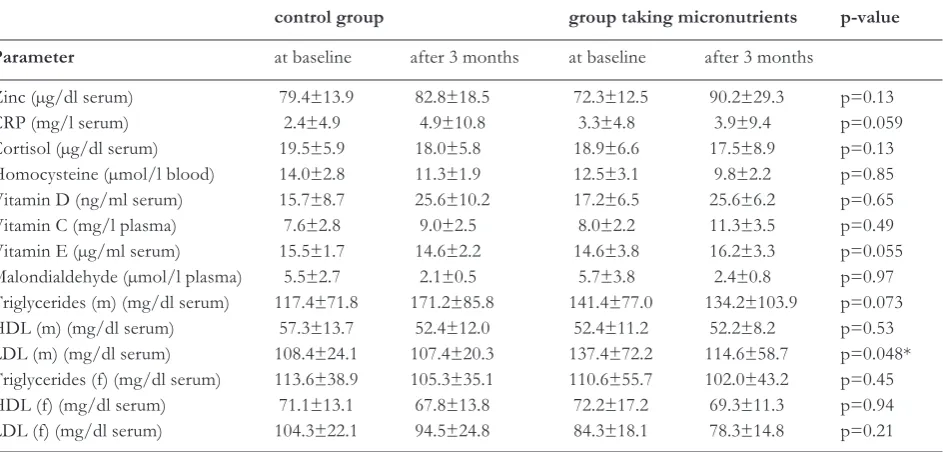
The blood analysis resulted in minor differences be-tween the subjects in the control group and those, tak-ing micronutrients, so that a beneficial effect of the in-take of a combination of micronutrients was shown (Table 1).
To give an example, the control group had at base-line for zinc a mean value of 79.4 ± 13.9 and at the end of the study of 82.8 ± 18.5 (µg/dl plasma), whereas in the group taking micronutrients the con-centration had increased from 72.3 ± 12.5 at baseline to 90.2 ± 29.3 (µg/dl plasma) after 3 months (p = 0.13). likewise, in the group taking micronutrients the concentrations of the vitamins c and E had increased after three months.
due to the increase in stress experience during the examinations, the cRP values increased slightly in both groups; however, the cRP value, as markers for possible inflammatory processes, increased somewhat less in the group taking micronutrients (p = 0.059).
In the male subjects in the micronutrient group, a decrease in the serum concentrations of triglycerides from 141.4 ± 77.0 to 134.2 ± 103.9 mg/dl serum (p = 0.073), and in ldl from 137.4 ± 72.2 to 114.6 ± 58.7 mg/dl (p = 0.048) was observed.
d
IscussIonnutrients play an important regulatory role in preserv-ing health of the human body and of all metabolically active tissues. Micronutrients, vitamins and antioxi-dants play an essential role for constant regenerative processes, for coping with oxidative stress, and also for adequate immune responses [17, 18]. In oral health, undernutrition or malnutrition concerning cer-tain food components can lead to defects of the
den-tal hard tissues, the oral mucosa and the periodontium [1, 19].
sound dietary habits can also contribute consider-ably to the prevention of certain oral tumors [20]. It was shown that in persons, consuming sufficient amounts of fruit, whole grain foods and vegetables, the risk to develop oral or pharyngeal tumors can be lowered by 40-80%, in comparison with persons, which consume these types of foods considerably less frequently [21, 22].
In several epidemiological studies, relationships of periodontal inflammatory processes with systemic dis-eases like diabetes mellitus, atherosclerosis, rheumatic diseases and other disorders with chronic inflammato-ry processes could be shown [23, 24].
Especially in the case of periodontal inflammation, nutrition-based interventions as a part of a possible therapy concept are discussed [25]. While the medical literature contains many reports on the effectiveness of various nutrients and vitamins on wound healing, considerably fewer studies with regard to the impor-tance of micronutrients and periodontal diseases can be found. for example, two studies by nishida et al. [26, 27] could show a weak but significant relation of the intake of vitamin c and calcium and a reduced susceptibility to periodontal diseases. In the present clinical study on micronutrients, a slight beneficial ef-fect of an optimal supply of nutrients on parameters of inflammatory processes could also be demonstrat-ed.
It is certainly of major importance that the peri-odontal state cannot be looked at independently of general health, and that in consequence a specific diet for oral health cannot be discussed as such. To find a definite relationship between nutrition and oral health, further clinical studies are needed, and patients with or without an optimal nutritional state would have to be compared and examined accordingly. In summary, it can be assumed that an additional intake of nutritional Table 1.Blood analysis (means ± sd) of the control group (n = 21; 7 male, 14 female) and the group taking micronutrients (n = 19; 5 male, 14 female), at baseline and after 3 months.
control group group taking micronutrients p-value
Parameter at baseline after 3 months at baseline after 3 months
Zinc (µg/dl serum) 79.4±13.9 82.8±18.5 72.3±12.5 90.2±29.3 p=0.13
cRP (mg/l serum) 2.4±4.9 4.9±10.8 3.3±4.8 3.9±9.4 p=0.059
cortisol (µg/dl serum) 19.5±5.9 18.0±5.8 18.9±6.6 17.5±8.9 p=0.13
Homocysteine (µmol/l blood) 14.0±2.8 11.3±1.9 12.5±3.1 9.8±2.2 p=0.85
Vitamin d (ng/ml serum) 15.7±8.7 25.6±10.2 17.2±6.5 25.6±6.2 p=0.65
Vitamin c (mg/l plasma) 7.6±2.8 9.0±2.5 8.0±2.2 11.3±3.5 p=0.49
Vitamin E (µg/ml serum) 15.5±1.7 14.6±2.2 14.6±3.8 16.2±3.3 p=0.055
Malondialdehyde (µmol/l plasma) 5.5±2.7 2.1±0.5 5.7±3.8 2.4±0.8 p=0.97
Triglycerides (m) (mg/dl serum) 117.4±71.8 171.2±85.8 141.4±77.0 134.2±103.9 p=0.073
Hdl (m) (mg/dl serum) 57.3±13.7 52.4±12.0 52.4±11.2 52.2±8.2 p=0.53
ldl (m) (mg/dl serum) 108.4±24.1 107.4±20.3 137.4±72.2 114.6±58.7 p=0.048*
Triglycerides (f) (mg/dl serum) 113.6±38.9 105.3±35.1 110.6±55.7 102.0±43.2 p=0.45
Hdl (f) (mg/dl serum) 71.1±13.1 67.8±13.8 72.2±17.2 69.3±11.3 p=0.94
supplements will have a slightly positive effect and will generally not cause any side effects. further controlled clinical studies will certainly be needed to show, for ex-ample, that specific foods and combinations of mi-cronutrients can be used to improve the response to therapies, and can complement treatment concepts.
R
EfEREncEs1. Moynihan PJ. The role of diet and nutrition in the etiolo-gy and prevention of oral diseases. Bull World Health or-gan. 2005; 83: 694-9.
2. loesche WJ. Bacterial mediators in periodontal disease. clin Infect dis. 1993; 16: 203-10.
3. logan EI. dietary influences on periodontal health in dogs and cats. Vet clin north am small anim Pract. 2006; 36: 1385-401.
4. Rosania aE, low KG, Mccormick cM, Rosania da. stress, depression, cortisol, and periodontal disease. J Pe-riodontol. 2009; 80: 260-6.
5. Genco RJ, Ho aW, Kopman J, Grossi sG, dunford RG, Tedesco la. Models to evaluate the role of stress in peri-odontal disease. ann Periodontol. 1998; 3: 288-302. 6. ng sK, Keung leung W. a community study on the
rela-tionship between stress, coping, affective dispositions and periodontal attachment loss. community dent oral Epi-demiol. 2006; 34: 252-66.
7. Johannsen a, Bjurshammar n, Gustafsson a. The influ-ence of academic stress on gingival inflammation. Int J dent Hyg. 2010; 8: 22-7.
8. chapple Il. oxidative stress, nutrition and neutroge-nomics in periodontal health and disease. Int J dent Hyg. 2006; 4: 15-21.
9. abou sulaiman aE, shehadeh RM. assessment of total antioxidant capacity and the use of vitamin c in the treat-ment of non-smokers with chronic periodontitis. J Peri-odontol. 2010; 81: 1547-54.
10. Jenzsch a, Eick s, Rassoul f, Purschwitz R, Jentsch H. nutritional intervention in patients with periodontal dis-ease: clinical, immunological and microbiological vari-ables during 12 months. Br J nutr. 2009; 101: 879-85. 11. neiva Rf, steigenga J, al-shammari Kf, Wang Hl.
Ef-fects of specific nutrients on periodontal disease onset, progression and treatment. J clin Periodontol. 2003; 30: 579-89.
12. Garcia Mn, Hildebolt cf, Miley dd, dixon da, cou-ture Ra, spearie cl, langenwalter EM, shannon Wd, deych E, Mueller c, civitelli R. one-year effects of vita-min d and calcium supplementation on chronic periodon-titis. J Periodontol. 2011; 82: 25-32.
13. Meisel P, schwahn c, luedemann J, John u, Kroemer HK, Kocher T. Magnesium deficiency is associated with periodontal disease. J dent Res. 2005; 84: 937-41. 14. Enhos s, duran I, Erdem s, Buyukbas s. Relationship
be-tween iron-deficiency anemia and periodontal status in fe-male patients. J Periodontol. 2009; 80: 1750-55.
15. löe H, silness J. Periodontal disease in pregnancy. I. Prevalence and severity. acta odontol scan. 1963; 21: 533-51.
16. lange dE. die anwendung von Indices zur diagnostik der Perodontopathien. dtsch Zahnärztl Z. 1978; 33: 8-11. 17. chapple Il, Brock GR, Milward MR, ling n, Matthews JB. compromised Gcf total antioxidant capacity in peri-odontitis: cause or effect? J clin Periodontol. 2007; 42: 103-10.
18. Enwonwu co, Phillips Rs, falkler Wa. nutrition and oral infectious diseases: state of the science. compend contin Educ dent. 2002; 23: 431-6.
19. chen M, andersen RM, Barmes dE, leclerq M-H, lyttle sc. comparing oral health systems. a second Interna-tional collaborative study. Geneva: World health organi-zation; 1997.
20. Morse dE. oral and pharyngeal cancer. In. Touger-decker R, sirois da, Mobley cc, editors. nutrition and oral medicine. new Jersey: Humana Press; 2004: 205-21. 21. franceschi s, favero a, conti E, Talamini R, Volpe R,
negri E, Barzan l, la Vecchia c. food groups, oils and butter and cancer of the oral cavity and pharynx. Br J cancer. 1999; 80: 614-20.
22. Mclaughlin JK, Gridley G, Block G, Winn dM, Preston-Martin s, schoenberg JB, Greenberg Rs, stemhagen a, austin df, Ershow aG, Blot WJ fraumeni Jf. dietary factors in oral and pharyngeal cancer. J natl cancer Inst. 1988; 80: 1237-43.
23. Beck Jd, offenbacher s. systemic effects of periodonti-tis: epidemiology of periodontal disease and cardiovascu-lar disease. J Periodontol. 2005; 76: 2089-100.
24. Taylor GW. Bidirectional interrelationships between dia-betes and periodontal diseases: an epidemiologic perspec-tive. ann Periodontol. 2001; 6: 99-112 .
25. chapple Il. Potential mechanisms underpinning the nu-tritional modulation of periodontal inflammation. J am dent assoc. 2009; 140: 178-84.
26. nishida M, Grossi sG, dunford RG, Ho aW, Trevisan M, Genco RJ. calcium and the risk for periodontal dis-ease. J Periodontol. 2000; 71: 1057-66.
27. nishida M, Grossi sG, dunford RG, Ho aW, Trevisan M, Genco RJ. dietary vitamin c and the risk for peri-odontal disease. J Periodontol. 2000; 71: 1215-23.
Received: June 30, 2011 / Accepted: July 11, 2011
Address for correspondence:
Prof. Brita Willershausen
department of operative dentistry university Medical center
Johannes Gutenberg-university Mainz augustusplatz 2
55131 Mainz Germany