S T U D Y P R O T O C O L
Open Access
The effect of intensive nutrition interventions on
weight gain after kidney transplantation: protocol
of a randomised controlled trial
Kristin J Ryan
1, Jessie M Segedin Casas
2, Laura E Mash
2, Sandra L McLellan
2, Lyn E Lloyd
2, James W Stinear
3,
Lindsay D Plank
4and Michael G Collins
5,6*Abstract
Background:Weight gain and obesity are common after kidney transplantation, particularly during the first year. Obesity is a risk factor for the development of new-onset diabetes after transplantation, and is associated with reduced graft survival. There is a lack of evidence for effective interventions to prevent weight gain after kidney transplantation.
Methods/Design:The effect ofINTEnsiveNutrition interventions on weight gain after kidneyTransplantation (INTENT) trial is a single-blind (outcomes assessor), randomised controlled trial to assess the effect of intensive nutrition interventions, including exercise advice, on weight gain and metabolic parameters in the first year after transplantation. Participants will be randomised during the first post-transplant month to either standard care (four visits with a renal dietitian over twelve months) or intensive nutrition intervention (eight visits with a renal dietitian over the first six months, four visits over the second six months, and three visits over the first six months with an exercise physiologist). In the intensive intervention group, nutrition counselling will be provided using motivational interviewing techniques to encourage quality engagement. Collaborative goal setting will be used to develop personalised nutrition care plans. Individualised advice regarding physical activity will be provided by an exercise physiologist. The primary outcome of the study is weight at six months after transplant, adjusted for baseline (one month post-transplant) weight, obesity and gender. Secondary outcomes will include changes in weight and other anthropometric measures over 12 months, body composition (in vivo neutron activation analysis, total body potassium, dual-energy X-ray absorptiometry, and bioelectrical impedance), biochemistry (fasting glucose, lipids, haemoglobin A1c and insulin), dietary intake and nutritional status, quality of life, and physical function. Discussion:There are currently few randomised clinical trials of nutrition interventions after kidney
transplantation. The INTENT trial will thus provide important data on the effect of intensive nutrition interventions on weight gain after transplant and the associated metabolic consequences. Additionally, by assessing changes in glucose metabolism, the study will also provide data on the feasibility of undertaking larger multi-centre trials of nutrition interventions to reduce the incidence or severity of diabetes after transplantation.
Trial registration:Australian New Zealand Clinical Trials Registry Number: ACTRN12614000155695
Keywords:Kidney transplantation, Weight gain, Obesity, Body composition, Nutrition intervention, Randomised-controlled trial
* Correspondence:[email protected]
5
Department of Renal Medicine, Auckland City Hospital, Auckland District Health Board, Private Bag 92024, Auckland 1142, New Zealand 6
Department of Medicine, Faculty of Medical and Health Sciences, University of Auckland, Auckland, New Zealand
Full list of author information is available at the end of the article
Background
Kidney transplantation represents the optimal form of renal replacement therapy and, compared with dialysis treatment, is associated with significantly improved sur-vival [1,2], quality of life [3] and reduced costs over time [4,5]. However, despite improvements in both patient and graft survival, kidney transplant recipients continue to have increased mortality compared with the general population [6]. This is predominantly due to an increased risk of cardiovascular disease [7,8]. Excessive weight gain, obesity and diabetes are important risk factors for cardio-vascular disease in transplant recipients, and are associ-ated in multiple studies with an increased risk of death, cardiac events and graft loss (necessitating a return to dia-lysis treatment), even when confounding factors are taken into account [9-13].
In the first year following kidney transplantation, there is a significant incidence of excess weight gain and obesity in transplant recipients, with average post-transplant weight gains of 10-35% reported [14-18]. These changes are associated with increased total body fat, reduced lean muscle mass and reduced bone mineral density [17,19-22]. Excess weight gain in the first year after transplant has also been shown to be a risk factor for the development of metabolic syndrome and new-onset diabetes after trans-plant (NODAT) [23-27]. Possible causes for weight gain include the use of immunosuppressive medications (such as corticosteroids), the relaxation of dietary re-strictions associated with dialysis treatment (increased freedom of food and fluid choices, which may lead to increased energy intake), and improvements in well-being and appetite associated with the resolution of the uraemic state [10,28-30]. In addition, studies indicate that many transplant recipients do not engage in ad-equate levels of physical exercise and activity, despite the improvements in overall well-being [31-33].
Despite concern about weight gain and obesity following kidney transplantation, not all post-transplant weight gain is considered undesirable. A high incidence of malnutri-tion has been reported in patients receiving dialysis ther-apies [34], even in those with a body mass index (BMI) in the overweight or obese range [35]. Low BMI, malnutri-tion and low muscle mass have been associated with poor survival after kidney transplantation [36,37]. It is therefore important to consider not only weight but other markers of nutrition (including evidence for protein-energy wasting and serum albumin) and body composition in the assess-ment and treatassess-ment of kidney transplant recipients.
Importantly, weight gain in the first post-transplant year has been shown to be associated with reduced graft sur-vival [38], and obese individuals have an increased risk of death and graft failure in the first 12 months compared with individuals of normal weight [39]. Weight gain after transplant therefore represents a potentially modifiable
risk factor for poor outcomes after transplantation that might be an appropriate target for therapeutic intervention.
There are currently no evidence-based clinical guidelines on specific interventions to prevent or manage excessive weight gain and obesity after transplantation, due to a lack of high quality evidence from randomised controlled trials. On the basis of several non-randomised studies, the Caring for Australasians with Renal Impairment (CARI) guidelines have suggested that kidney transplant recipi-ents be referred to a dietitian for advice to prevent weight gain post-transplant, and that this advice should be re-inforced via follow-up assessments on a regular basis [40,41]. Guidelines from the Kidney Disease: Improving Global Outcomes (KDIGO) initiative and the United Kingdom (UK) Renal Association have suggested that obesity is assessed at each visit and weight management services should be available for patients [42,43].
In the general population, systematic reviews of rando-mised studies have shown that interventions addressing nutrition, behaviour and physical activity can be effective in reducing weight in obese patients, although the effects are often not sustained over the long term following the intervention programme [44-46]. Interventions that in-volve regular review (such as fortnightly during the first three months and continued monitoring for at least 12 months) have shown the greatest benefits [47,48].
In kidney transplant patients, the few studies that have considered the effects of nutrition and exercise interven-tions on bodyweight within the 12 months after transplant have had inconsistent results: significantly less weight gain [49], a significant reduction in weight gain from baseline for males [50], or no effect on bodyweight [51]. However, the interpretation of results is limited by the study designs; two studies were non-randomised [49,50] and one was de-signed to assess the effects of the intervention on hyperlip-idaemia [51].
Overall, there is a need to develop effective interventions to minimise the detrimental effects of weight gain and obesity on long-term kidney transplant outcomes. Rando-mised controlled trials are needed to assess whether nutri-tion intervennutri-tions are likely to be effective in preventing weight gain after kidney transplantation.
trials of nutrition interventions to reduce the incidence or severity of diabetes after kidney transplantation.
Methods/Design
Study aims and hypothesis
The primary aim of the INTENT trial is to determine whether the use of an intensive nutrition intervention, in-cluding physical activity advice, following kidney trans-plantation will be effective at reducing weight gain in the first year post-transplant.
Secondary aims are to determine whether the use of an intensive nutrition intervention will be associated with im-provements in anthropometry, body composition, glucose metabolism and markers of metabolic risk; also, whether the use of an intensive nutrition intervention has any ef-fects on dietary intake, nutritional status, quality of life, and physical function.
Our hypothesis is that early intensive nutrition interven-tion, including advice regarding physical activity, after kid-ney transplantation will be effective at reducing weight gain in the first post-transplant year, compared with stand-ard post-transplant care.
The INTENT trial will be used to assess the feasibility of undertaking a larger study to determine if nutrition terventions early after kidney transplant can reduce the in-cidence and severity of diabetes after transplantation (and thus potentially the risk of cardiovascular events). The pri-mary feasibility outcome will be whether a difference in haemoglobin A1c (HbA1c) is observed between the inter-vention and standard care groups at 12 months.
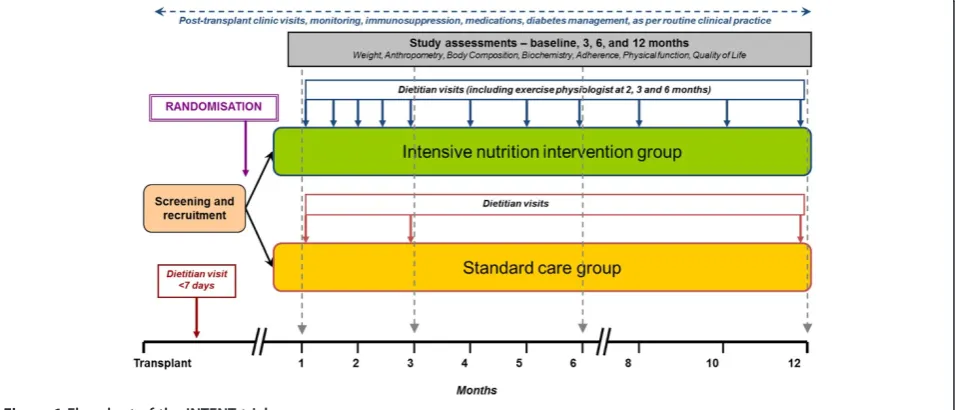
Study design
The INTENT trial is a single-centre, single-blind, rando-mised controlled trial with outcomes assessment blinded to
group allocations. An outline of the study is shown in Figure 1.
Ethical considerations
Ethical approval has been obtained through the Northern B Health and Disability Ethics Committee of the Ministry of Health in New Zealand.
Target population and eligibility criteria
The target population for the trial will be adult kidney transplant recipients, residing within the Auckland re-gional area, and recruited during routine post-transplant care within one month of a kidney transplant procedure at Auckland City Hospital.
Inclusion criteria will include the following: age > 18 years; stable graft function, as determined by the patient’s treating physician; willing and able to participate in all trial proce-dures for the duration of trial follow-up; and ability to pro-vide written informed consent.
Exclusion criteria will include the following: severe obes-ity, defined by BMI >40 kg/m2; underweight, defined by BMI <18.5 kg/m2; evidence of significant malnutrition re-quiring enteral or parenteral nutrition therapy; ongoing significant medical complications that in the opinion of the patient’s treating physician preclude involvement in the trial; and considered likely to become pregnant during the duration of the trial.
Diabetes, cardiovascular disease or other stable medical co-morbidities post-transplant will not be exclusions per se unless deemed to represent a contraindication to par-ticipating in the trial by the patient’s treating physician. Pa-tients who have been or are receiving treatment for acute rejection will not be excluded, providing graft function is stable at the time of entry to the trial in the opinion of the
patient’s treating physician. Participation in another clin-ical trial will not be an exclusion providing that such par-ticipation will not compromise involvement in this trial, in the opinion of the principal investigator.
Recruitment, randomisation and blinding
Potential participants will be identified during their initial inpatient stay following transplantation at Auckland City Hospital, or through the renal transplant outpatient clinic following discharge. Eligible transplant recipients will be invited to participate, given detailed in-formation about the trial and, if agreeable, will be asked to provide written informed consent. In order to participate, transplant recipients will need to provide informed con-sent and be randomised prior to one month post kidney transplantation.
Participants will be randomised in a 1:1 ratio to receive either intensive nutrition intervention or standard of care. Randomisation will be performed externally by a statistical consultant using a computer-generated sequence allocation with permuted blocks of variable size, and stratified by gender. Allocation concealment will be via sealed opaque envelopes.
Formal study assessments of weight, anthropometry, measures of body composition, and physical function will be performed by one of the investigators, who will be blinded to the group allocation of participants. Laboratory staff blinded to the group allocations will perform all la-boratory testing.
Nature of nutrition care
Nutrition care will follow the Nutrition Care Process developed by the Academy of Nutrition and Dietetics, Chicago USA. This involves assessment, diagnosis of nutrition problem, intervention, monitoring and evalu-ation [52]. Australian and New Zealand evidence-based guidelines for the nutritional management of kidney transplant recipients will be used [53,54].
Standard care group
Participants randomised to the standard care group will receive standard post-transplant care as per usual local practice. This includes immunosuppressive medications to prevent rejection and other treatments under the dir-ection of the treating physician and renal transplant team. Standard immunosuppression includes a calcineurin in-hibitor (cyclosporine or tacrolimus as determined by the treating physician), mycophenolate, steroids, and basilixi-mab as induction therapy.
Current standard nutrition care after kidney transplant-ation at Auckland City Hospital includes assessment by a renal dietitian during the inpatient stay. Patients are given resources guiding them on healthy eating and food safety after transplant, and nutrition interventions to address any
identified nutritional problems. Standard outpatient nutri-tion care involves an individual consultanutri-tion with a spe-cialist renal dietitian at 1, 3 and 12 months post-transplant alongside regular physician appointments.
Intensive nutrition intervention group
Patients randomised to the intensive nutrition inter-vention group will, in addition to standard care, re-ceive more frequent counselling with a specialist renal dietitian throughout the trial. These will commence at one month post-transplant and include an additional 8 visits overall compared to the standard care group (see Table 1). Participants will also receive individualised assessment and advice regarding physical activity and exercise, via formal consultations with an exercise physiolo-gist at 2 months, 3 months and 6 months post-transplant.
Individualised nutrition counselling will be provided using motivational interviewing techniques to encourage quality engagement. Personal nutrition plans will be de-veloped using S.M.A.R.T. action steps, i.e. specific, mea-sureable, achievable, relevant and time-limited [55].
Prior to full reviews at 1, 3, 6 and 12 months, a self-administered 3-day food diary record will be completed by participants and analysed using appropriate analysis software (e.g. FoodWorks® Professional [Xyris software]). Dietary intake data will be compared to evidence-based recommendations on nutrient requirements after renal transplant and used to guide nutrition prescriptions. At follow-up reviews, renal dietitians will assess progress, goal setting and adherence to dietary recommendations. Adherence will be measured using rulers to assess motiv-ation to change, level of achievement of patient-centred goals and review of action steps taken in patient action plans.
Primary and secondary outcomes
The primary outcome will be body weight at 6 months post-transplant, adjusted for weight at baseline (one month post-transplant), pre-existing obesity (BMI≥30 kg/m2), and gender.
costs of additional dietitian input (including missed visits), changes in weight and quality of life.
In order to determine the feasibility of undertaking larger multi-centre trials of nutrition interventions to reduce the incidence or severity of diabetes after trans-plantation, the difference in HbA1c observed between the intervention and standard care groups at 12 months will be reported as an exploratory feasibility outcome.
Data collection
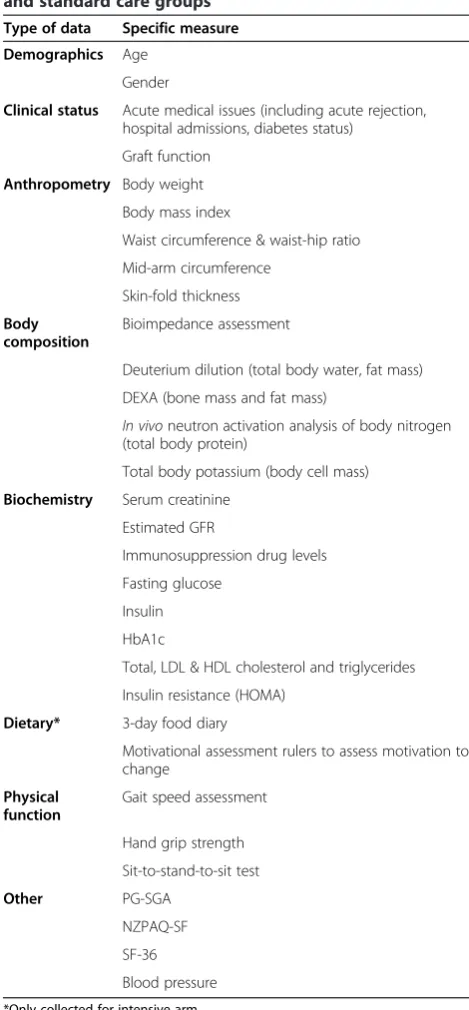
Standard demographic, clinical and laboratory data (in-cluding medication details) will be collected at baseline (1 month) and at 3, 6 and 12 months post-transplant. This will include details of any acute medical issues, clin-ical or other adverse events, graft function, acute rejection, hospital admissions, development of diabetes, or any other issues that might affect nutritional status or change in weight. Formal study assessments (blinded to group allo-cation) will be undertaken at baseline (1 month), and at 3, 6 and 12 months (Table 2).
Anthropometry and body composition
Standardised anthropometric measurements will include body weight, BMI, waist circumference and waist-hip ratio, mid-arm circumference and skin-fold thickness. These will be performed using calibrated instruments stored permanently in the Body Composition Laboratory at the University of Auckland. To ensure standardisation, the same equipment will be used for all measurements in all patients.
Body composition measurements will include gold-standard methods: dual-energy x-ray absorptiometry (DEXA) to determine fat mass [56,57], total body po-tassium to assess body cell mass [58], in vivo neutron activation analysis for body nitrogen to determine total
body protein [59], and deuterium dilution to determine total body water [60]. In addition, bioelectrical imped-ance assessment will be carried out as a surrogate measurement of total body water, extracellular water and fat mass [61].
Nutritional status, physical activity and quality of life
Nutritional status will be assessed using the patient-generated subjective global assessment (PG-SGA) [62,63]. Physical activity will be assessed using the New Zealand Physical Activity Questionnaire–short form (NZPAQ-SF), a modified version of the International Physical Activity Questionnaire (IPAQ) [64,65]. The Short Form 36 (SF-36) will be used to assess quality of life [66].
Physical function
The following physical function assessments will be car-ried out: gait speed, hand grip strength, and sit-to-stand-to-sit test (to assess lower extremity strength) [67-69].
Biochemistry
During the formal study assessments at baseline (1 month), 3, 6 and 12 months, specific biochemical markers of glucose metabolism and metabolic risk will be measured. Blood samples will be collected after an overnight fast and assayed for glucose, insu-lin, HbA1c, lipids (including total cholesterol, low density lipoprotein [LDL], high density lipoprotein [HDL] cholesterol and triglycerides) [70]. The homeo-static model assessment (HOMA) index of insulin re-sistance will be calculated. In addition, where consent is given, serum samples will be stored for the analysis of novel risk factors in the future. Participants and in-vestigators will be blinded to the serum outcomes.
Table 1 Schedule of nutrition assessment, education and advice provided by renal dietitian and exercise physiologist (intensive nutrition intervention group)
Months 1-3 Fortnightlyreview with dietitian to undertake initial assessments, determine progress, goals and adherence to recommendations
Full review of dietary intake and adequacy of adherence to recommendations to be undertaken at 1 month and 3 months (including 3-day food diary and analysis)
Exercise advice (including a consultation with an exercise physiologist at 8 and 12 weeks to provide tailored advice) regarding physical activity and a review of physical activity adherence
Months 4-6 Monthlyreview with dietitian to assess progress, goals and adherence to recommendations, and give further education and advice as appropriate
Full review of dietary intake and adequacy of adherence to recommendations to be undertaken at 6 months (including 3-day food diary and analysis)
Exercise advice (including a consultation with an exercise physiologist at 6 months to provide tailored advice) regarding physical activity and a review of physical activity adherence
Months 7-12 Bi-monthlyreview with dietitian to assess progress, goals and adherence to recommendations, and give further education and advice as appropriate
A final review of diet history and adequacy of adherence to recommendations to be undertaken at 12 months (including 3-day food diary and analysis)
In addition, standard tests will be taken as part of routine post-transplant care, including full blood count, serum cre-atinine, urea and electrolytes, other biochemistry and samples for therapeutic drug monitoring of tacrolimus or cyclospor-ine. The results of standard testing will not be blinded.
Statistical analysis
The primary outcome (body weight at 6 months post-transplant) will be compared between the groups using an analysis of covariance (ANCOVA) adjusted for baseline weight, baseline obesity (BMI≥30 kg/m2), and gender. The extent of weight gain after transplant has been shown be significantly affected by baseline BMI [18]; gender will be included as a covariate due to its use as a stratification variable in the randomisation.
Secondary analyses will include analyses of change in anthropometry (BMI, waist circumference, and waist-hip ratio), physical function, body composition, quality of life, and biochemistry parameters between the groups, using ANCOVA with adjustment for relevant baseline covariates. Repeated measures analyses using linear mixed models with multiple covariates will be used to compare changes in weight, anthropometry, physical function, body composition, quality of life, and biochemistry pa-rameters over time (baseline, 3, 6 and 12 months) between the groups. Multiple linear regression will be used to iden-tify significant predictors other than group allocation asso-ciated with these changes. Variables identified as significant will be analysed with pairwise comparisons.
Comparisons between groups for differences in variables of interest will be conducted using Fisher’s exact test for categorical variables, unpaired t tests for parametric vari-ables, and Wilcoxon rank sum tests for non-parametric variables.
All statistical analyses will be performed using appropriate statistical software, such as STATA or SAS. The level of stat-istical significance will be set at probability level of <0.05.
Calculation of required sample size
Using Stata statistical software to model an ANCOVA analysis of the primary outcome at six months, with power of 80% and alpha level of 5%, we estimate that 14 participants will be required per group, i.e. 28 in total. To account for dropouts, we aim to recruit up to 32 par-ticipants into the study. The effect size was estimated as a weight difference of 5 kg at 6 months between the groups, 74 kg (SD 9 kg) in the standard group and 69 kg (SD 12 kg) in the intervention group. These estimates reflect data from a non-randomised study of intensive nutrition interventions versus standard care in a com-parable population of kidney transplant recipients whose weights were similar at baseline [49]. The correlation be-tween weight at baseline and 6 months was estimated as 0.9, based on data showing a mean difference in weight of 3.2 kg (SD 5.9 kg) between 1 and 6 months of 1299 kidney transplant recipients who received their kidney transplant in Auckland between 1991 and 2012 (unpub-lished observations, data on file), where the correlation was 0.9514. Similar findings were found in an analysis of weight change post-transplant in a comparable
Table 2 INTENT study data collection at baseline and months 3, 6 and 12 post-transplant in the intervention and standard care groups
Type of data Specific measure
Demographics Age
Gender
Clinical status Acute medical issues (including acute rejection, hospital admissions, diabetes status)
Graft function
Anthropometry Body weight
Body mass index
Waist circumference & waist-hip ratio
Mid-arm circumference
Skin-fold thickness
Body composition
Bioimpedance assessment
Deuterium dilution (total body water, fat mass)
DEXA (bone mass and fat mass)
In vivoneutron activation analysis of body nitrogen (total body protein)
Total body potassium (body cell mass)
Biochemistry Serum creatinine
Estimated GFR
Immunosuppression drug levels
Fasting glucose
Insulin
HbA1c
Total, LDL & HDL cholesterol and triglycerides
Insulin resistance (HOMA)
Dietary* 3-day food diary
Motivational assessment rulers to assess motivation to change
Physical function
Gait speed assessment
Hand grip strength
Sit-to-stand-to-sit test
Other PG-SGA
NZPAQ-SF
SF-36
Blood pressure
*Only collected for intensive arm.
DEXA = Dual-energy x-ray absorptiometry; GFR = Glomerular filtration rate; HbA1c = Haemoglobin A1c; HDL = High density lipoprotein; LDL = Low density lipoprotein; NZPAQ-SF = New Zealand physical activity questionnaire–short form; PG-SGA = Patient-generated subjective global assessment;
population of 156 transplant recipients in Brisbane, Australia (mean weight change 3.3 kg, SD 6.0 kg) (Campbell KL, personal communication) [18].
Discussion
This trial will provide evidence on the effects of intensive nutrition intervention on weight gain after kidney trans-plantation. In addition, the study will also examine in de-tail changes in other anthropometric indices (including BMI, waist circumference and waist-hip ratio), body com-position, physical function, and biochemistry including glucose metabolism and markers of metabolic risk. We hypothesise that the intervention (compared to standard care) will result in reduced weight gain and lead to corre-sponding reductions in BMI, waist circumference and waist-hip ratio, improved physical function and favourable changes in body composition including reduced fat mass and increased muscle mass. We also hypothesise that these changes will be associated with improvements in glucose metabolism, reduced lipid levels and reduced insulin resistance.
The outcomes from this research will also provide im-portant data on the feasibility of conducting larger multi-centre randomised trials of intensive nutrition interventions to reduce the incidence and severity of diabetes in kidney transplant recipients, and thus the potential to reduce the risks of cardiovascular disease in transplant recipients.
The use of the gold-standard body composition tech-niques includingin vivoneutron activation analysis, deu-terium dilution, total body potassium and DEXA, as well as the indirect but more readily available measures such as bioelectrical impedance, is a particular strength of this study. Few investigators have the ability to perform these gold-standard analyses and this study will provide im-portant updated data on changes in these measures after kidney transplantation in the current era [71]. The use of these body composition measures will enable a much more detailed understanding of any changes in weight and anthropometry that are observed as a result of the inter-vention. We will also be able to compare the surrogate bioelectrical impedance measures that are more readily available with gold standard measures and thus provide important validation data in this population.
Historical data from a non-randomised study of nutrition interventions in the early period post-transplant [49] have been used to estimate the effect of the intervention on weight change after transplant. More recent data are not available to provide a more reliable estimate of the likely ef-fect size, and it is thus possible that there may be more variability in weight gain observed in this population, and hence a larger sample size may be required for the same power. Some protection, however, is afforded by the fact that the primary outcome analysis will be ac-complished using ANCOVA, rather than a t-test on
weight change as used in the Patel study [49]. Previous data on post-transplant weight change in our popula-tion shows a high degree of correlapopula-tion between weight at baseline (one month) and six months, supporting the use of an ANCOVA [72].
Due to the nature of the intervention, it is not pos-sible to blind participants or investigators involved in the intervention to group allocations, and thus there is a potential risk of bias. We have attempted to minim-ise this by using single-blind design, i.e. by having for-mal measurements of weight and other measures that will be reported as study outcomes performed by a blinded investigator. In addition, to reduce the poten-tial for confounding due to measurement variability, a single investigator will perform all of the outcome measurements using the same instruments throughout the study.
Conclusions
The INTENT trial will provide important data on the effectiveness of nutrition interventions to prevent ex-cessive weight gain after transplantation. Given the current lack of data from randomised controlled trials assessing the benefit of strategies to prevent excessive weight gain, this study therefore addresses an important gap in current evidence regarding optimal care after kidney transplantation.
Abbreviations
ANCOVA:Analysis of covariance; BMI: Body mass index; CARI: Caring for Australasians with Renal Impairment; DEXA: Dual-energy x-ray absorptiometry; GAS: Goal attainment scaling; GFR: Glomerular filtration rate;
HbA1c: Haemoglobin A1c; HDL: High density lipoprotein; HOMA: homeostatic model assessment; INTENT trial: The effect ofINTEnsiveNutrition interventions on weight gain after kidneyTransplantation trial; IPAQ: International physical activity questionnaire; KDIGO: Kidney Disease: Improving Global Outcomes; LDL: Low density lipoprotein; NODAT: New onset diabetes after transplant; NZPAQ-SF: New Zealand physical activity questionnaire–short form; PG-SGA: Patient-generated subjective global assessment; SF-36: Short Form-36.
Competing interests
The authors declare that they have no competing interests.
Authors’contributions
KJR participated in the trial design, coordinates the trial, and drafted the manuscript. JMS, LEL, SLM, and LEM participated in the trial design and coordination. LDP participated in the trial design and coordination, and helped to develop the statistical plan. JWS participated in trial design. MGC conceived of the trial, participated in its design, developed the statistical plan and helped to draft the manuscript. All authors read and approved the final manuscript.
Acknowledgements
Author details 1
Discipline of Nutrition, Faculty of Medical and Health Sciences, University of Auckland, Auckland, New Zealand.2Nutrition Services, Auckland City Hospital, Auckland District Health Board, Auckland, New Zealand.3Department of Sport and Exercise Science, Faculty of Science, University of Auckland, Auckland, New Zealand.4Department of Surgery, Faculty of Medical and Health Sciences, University of Auckland, Auckland, New Zealand. 5
Department of Renal Medicine, Auckland City Hospital, Auckland District Health Board, Private Bag 92024, Auckland 1142, New Zealand.6Department of Medicine, Faculty of Medical and Health Sciences, University of Auckland, Auckland, New Zealand.
Received: 28 July 2014 Accepted: 2 September 2014 Published: 9 September 2014
References
1. McDonald SP, Russ GR:Survival of recipients of cadaveric kidney transplants compared with those receiving dialysis treatment in Australia and New Zealand, 1991–2001.Nephrol Dial Transplant2002, 17(12):2212–2219.
2. Wolfe RA, Ashby VB, Milford EL, Ojo AO, Ettenger RE, Agodoa LY, Held PJ, Port FK:Comparison of mortality in all patients on dialysis, patients on dialysis awaiting transplantation, and recipients of a first cadaveric transplant.N Engl J Med1999,341(23):1725–1730.
3. Laupacis A, Keown PNP, Krueger H, Ferguson B, Wong C, Muirhead N:A study of the quality of life and cost-utility of renal transplantation.
Kidney Int1996,50:235–242.
4. Howard K, Salkeld G, White S, Mcdonald S, Chadban S, Craig JC, Cass A:The cost-effectiveness of increasing kidney transplantation and home‐based dialysis.Nephrology2009,14(1):123–132.
5. Haller M, Gutjahr G, Kramar R, Harnoncourt F, Oberbauer R:Cost-effectiveness analysis of renal replacement therapy in Austria.Nephrol Dial Transplant 2011,26(9):2988–2995.
6. van Walraven C, Manuel DG, Knoll G:Survival trends in ESRD patients compared with the general population in the United States.
Am J Kidney Dis2013,63(3):491–499.
7. Ojo AO, Hanson JA, Wolfe RA, Leichtman AB, Agodoa LY, Port FK:Long-term survival in renal transplant recipients with graft function.Kidney Int2000, 57(1):307–313.
8. Howard RJ, Patton PR, Reed AI, Hemming AW, Van der Werf WJ, Pfaff WW, Srinivas TR, Scornik JC:The changing causes of graft loss and death after kidney transplantation.Transplantation2002,73(12):1923–1928. 9. Armstrong KA, Campbell SB, Hawley CM, Johnson DW, Isbel NM:Impact of
obesity on renal transplant outcomes.Nephrology2005,10(4):405–413. 10. Baum CL:Weight gain and cardiovascular risk after organ
transplantation.JPEN J Parenter Enteral Nutr2001,25(3):114–119. 11. Aakhus S, Dahl K, Widerøe TE:Cardiovascular morbidity and risk
factors in renal transplant patients.Nephrol Dial Transplant1999, 14(3):648–654.
12. Gore JL, Pham PT, Danovitch GM, Wilkinson AH, Rosenthal JT, Lipshutz GS, Singer JS:Obesity and outcome following renal transplantation.
Am J Transplant2006,6(2):357–363.
13. Cosio FG, Pesavento TE, Kim S, Osei K, Henry M, Ferguson RM:Patient survival after renal transplantation: IV. Impact of post-transplant diabetes.Kidney Int 2002,62(4):1440–1446.
14. Jaggers HJ, Allman MA, Chan M:Changes in clinical profile and dietary considerations after renal transplantation.J Ren Nutr1996,6(1):12–20. 15. Johnson CP, Gallagher-Lepak S, Zhu Y-R, Porth C, Kelber S, Roza AM, Adams
MB:Factors influencing weight gain after renal transplantation.
Transplantation1993,56(4):822–826.
16. Teplan V, Poledne R, Schück O, Ritz E, Vitko S:Hyperlipidemia and obesity after renal transplantation.Ann Transplant2001,6(2):21–23.
17. Moore LW, Gaber AO:Patterns of early weight change after renal transplantation.J Ren Nutr1996,6(1):21–25.
18. Orazio L, Chapman J, Isbel NM, Campbell KL:Nutrition care for renal transplant recipients: an evaluation of service delivery and outcomes.
J Ren Care2014,40(2):99–106.
19. Steiger U, Lippuner K, Jensen E, Montandon A, Jaeger P, Horber F:Body composition and fuel metabolism after kidney grafting.Eur J Clin Invest 1995,25(11):809–816.
20. Habedank D, Kung T, Karhausen T, von Haehling S, Doehner W, Schefold JC, Hasper D, Reinke S, Anker SD, Reinke P:Exercise capacity and body composition in living-donor renal transplant recipients over time.
Nephrol Dial Transplant2009,24(12):3854–3860.
21. Verran D, Munn S, Collins J, Hill G:Impact of renal allograft implantation and immunosuppression on body composition using in vivo neutron activation analysis.Transplant Proc1992,24(1):173–174.
22. Grotz W, Mundinger F, Rasenack J, Speidel L, Olschewski M, Exner V, Schollmeyer P:Bone loss after kidney transplantation: a longitudinal study in 115 graft recipients.Nephrol Dial Transplant1995,10(11):2096–2100. 23. Kasiske BL, Snyder JJ, Gilbertson D, Matas AJ:Diabetes mellitus after kidney transplantation in the United States.Am J Transplant2003,3(2):178–185. 24. Rodrigo E, Fernández-Fresnedo G, Valero R, Ruiz JC, Piñera C, Palomar R,
González-Cotorruelo J, Gómez-Alamillo C, Arias M:New-onset diabetes after kidney transplantation: risk factors.J Am Soc Nephrol2006, 17(12 suppl 3):S291–S295.
25. Courivaud C, Kazory A, Simula-Faivre D, Chalopin J-M, Ducloux D:Metabolic syndrome and atherosclerotic events in renal transplant recipients.
Transplantation2007,83(12):1577–1581.
26. Fernandes JF, Leal PM, Rioja S, Bregman R, Sanjuliani AF, Barreto Silva MI, Torres MR:Adiposity and cardiovascular disease risk factors in renal transplant recipients: Are there differences between sexes?
Nutrition2013,29(10):1231–1236.
27. Cullen TJ, McCarthy MP, Lasarev MR, Barry JM, Stadler DD:Body mass index and the development of new-onset diabetes mellitus or the worsening of pre-existing diabetes mellitus in adult kidney transplant patients.
J Ren Nutr2014,24(2):116–122.
28. Vincenti F, Schena F, Paraskevas S, Hauser I, Walker R, Grinyo J:A randomized, multicenter study of steroid avoidance, early steroid withdrawal or standard steroid therapy in kidney transplant recipients.
Am J Transplant2008,8(2):307–316.
29. Baum CL, Thielke K, Westin E, Kogan E, Cicalese L, Benedetti E:Predictors of weight gain and cardiovascular risk in a cohort of racially diverse kidney transplant recipients.Nutrition2002,18(2):139–146.
30. Heaf J, Jakobsen U, Tvedegaard E, Kanstrup I-L, Fogh-Andersen N:Dietary habits and nutritional status of renal transplant patients.J Ren Nutr2004, 14(1):20–25.
31. Orazio L, Hickman I, Armstrong K, Johnson D, Banks M, Isbel N:Higher levels of physical activity are associated with a lower risk of abnormal glucose tolerance in renal transplant recipients.J Ren Nutr2009, 19(4):304–313.
32. Nielens H, Lejeune TM, Lalaoui A, Squifflet JP, Pirson Y, Goffin E:Increase of physical activity level after successful renal transplantation: a 5 year follow‐up study.Nephrol Dial Transplant2001,16(1):134–140. 33. Zelle DM, Kok T, Dontje ML, Danchell EI, Navis G, van Son WJ, Bakker SJ,
Corpeleijn E:The role of diet and physical activity in post-transplant weight gain after renal transplantation.Clin Transplant2013,27(4):E484–E490. 34. Kalantar-Zadeh K, Ikizler TA, Block G, Avram MM, Kopple JD:
Malnutrition-inflammation complex syndrome in dialysis patients: causes and consequences.Am J Kidney Dis2003,42(5):864–881.
35. Beddhu S, Pappas LM, Ramkumar N, Samore M:Effects of body size and body composition on survival in hemodialysis patients.J Am Soc Nephrol 2003,14(9):2366–2372.
36. Meier-Kriesche HU, Arndorfer JA, Kaplan B:The impact of body mass index on renal transplant outcomes: a significant independent risk factor for graft failure and patient death.Transplantation2002,73(1):70–74. 37. Oterdoom LH, Van Ree RM, De Vries APJ, Gansevoort RT, Schouten JP, Van
Son WJ, Homan Van Der Heide JJ, Navis G, De Jong PE, Gans ROB, Bakker SJ:Urinary creatinine excretion reflecting muscle mass is a predictor of mortality and graft loss in renal transplant recipients.Transplantation 2008,86(3):391–398.
38. Ducloux D, Kazory A, Simula-Faivre D, Chalopin JM:One-year post-transplant weight gain is a risk factor for graft loss.Am J Transplant2005, 5(12):2922–2928.
39. Hoogeveen EK, Aalten J, Rothman KJ, Roodnat JI, Mallat MJK, Borm G, Weimar W, Hoitsma AJ, de Fijter JW:Effect of obesity on the outcome of kidney transplantation: a 20-year follow-up.Transplantation2011,91(8):869–874. 40. Chadban S, Chan M, Fry K, Patwardhan A, Ryan C, Trevillian P, Westgarth F,
41. Chadban S, Chan M, Fry K, Patwardhan A, Ryan C, Trevillian P, Westgarth F, Cari:The CARI guidelines. Nutritional management of diabetes mellitus in adult kidney transplant recipients.Nephrology2010, 15(Suppl 1):S37–S39.
42. Kasiske BL, Zeier MG, Chapman JR, Craig JC, Ekberg H, Garvey CA, Green MD, Jha V, Josephson MA, Kiberd BA, Kreis HA, McDonald RA, Newmann JM, Obrador GT, Vincenti FG, Cheung M, Earley A, Raman G, Abariga S, Wagner M, Balk EM, Kidney Disease: Improving Global Outcomes:KDIGO clinical practice guideline for the care of kidney transplant recipients: A summary.Kidney Int2010,77(4):299–311.
43. UK Renal Association:Clinical guidelines: Post-operative care of the kidney transplant recipient.2011, [http://www.renal.org/guidelines/ modules/post-operative-care-of-the-kidney-transplant-recipient] 44. Dansinger ML, Tatsioni A, Wong JB, Chung M, Balk EM:Meta-analysis: the effect
of dietary counseling for weight loss.Ann Intern Med2007,147(1):41–50. 45. Curioni C, Lourenco P:Long-term weight loss after diet and exercise: a
systematic review.Int J Obes2005,29(10):1168–1174.
46. Franz MJ, VanWormer JJ, Crain AL, Boucher JL, Histon T, Caplan W, Bowman JD, Pronk NP:Weight-loss outcomes: a systematic review and meta-analysis of weight-loss clinical trials with a minimum 1-year follow-up.
J Am Diet Assoc2007,107(10):1755–1767.
47. Unick JL, Beavers D, Bond DS, Clark JM, Jakicic JM, Kitabchi AE, Knowler WC, Wadden TA, Wagenknecht LE, Wing RR, Look AHEAD Research Group:The long-term effectiveness of a lifestyle intervention in severely obese individuals.Am J Med2013,126(3):236–242. 242 e231-232.
48. Lindström J, Louheranta A, Mannelin M, Rastas M, Salminen V, Eriksson J, Uusitupa M, Tuomilehto J:The Finnish Diabetes Prevention Study (DPS) Lifestyle intervention and 3-year results on diet and physical activity.
Diabetes Care2003,26(12):3230–3236.
49. Patel MG:The effect of dietary intervention on weight gains after renal transplantation.J Ren Nutr1998,8(3):137–141.
50. Guida B, Trio R, Laccetti R, Nastasi A, Salvi E, Perrino NR, Caputo C, Rotaia E, Federico S, Sabbatini M:Role of dietary intervention on metabolic abnormalities and nutritional status after renal transplantation.Nephrol Dial Transplant2007,22(11):3304–3310.
51. Lawrence IR, Thomson A, Hartley GH, Wilkinson R, Day J, Goodship THJ:The effect of dietary intervention on the management of hyperlipidemia in British renal transplant patients.J Ren Nutr1995,5(2):73–77.
52. Writing Group of the Nutrition Care Process/Standardized Language C: Nutrition care process and model part I: the 2008 update.J Am Diet Assoc2008,108(7):1113–1117.
53. Chan M, Patwardhan A, Ryan C, Trevillian P, Chadban S, Westgarth F, Fry K, Caring for Australasians with Renal Impairment, Dietitians Association of Australia:Evidence-based guidelines for the nutritional management of adult kidney transplant recipients.J Ren Nutr2011,21(1):47–51. 54. Greater Metropolitan Clinical Taskforce (Renal Services Network):Evidence
based practice guidelines for the nutritional management of adult kidney transplant recipients.Sydney: GMCT; 2009.
55. Vickers KS:Self-management education approach: engaging patients in creating a personal and relevant action plan (part 2): I keep telling patients what to do, so why don't they make progress?J Ren Nutr2013, 23(1):e1–e3.
56. Haarbo J, Gotfredsen A, Hassager C, Christiansen C:Validation of body composition by dual energy X-ray absorptiometry (DEXA).Clin Physiol 1991,11(4):331–341.
57. Van Loan M, Mayclin P:Body composition assessment: dual-energy X-ray absorptiometry (DEXA) compared to reference methods.Eur J Clin Nutr 1992,46(2):125.
58. Burch P, Spiers F:Measurement of the gamma-radiation from the human body.Nature1953,172:519–521.
59. Beddoe AH, Streat SJ, Hill GL:Evaluation of an in vivo prompt gamma neutron activation facility for body composition studies in critically ill intensive care patients: results on 41 normals.Metabolism1984, 33(3):270–280.
60. Schloerb PR, Friis-Hansen BJ, Edelman IS, Solomon A, Moore FD:The measurement of total body water in the human subject by deuterium oxide dilution: with a consideration of the dynamics of deuterium distribution 1.J Clin Invest1950,29(10):1296.
61. Lukaski HC, Johnson PE, Bolonchuk W, Lykken G:Assessment of fat-free mass using bioelectrical impedance measurements of the human body.
Am J Clin Nutr1985,41(4):810–817.
62. Detsky AS, McLaughlin JR, Baker JP, Johnston N, Whittaker S, Mendelson R, Jeejeebhoy K:What is subjective global assessment of nutritional status.
J Parenter Enteral Nutr1987,11(1):8–13.
63. Ottery FD:Definition of standardized nutritional assessment and interventional pathways in oncology.Nutrition1996,12(1):S15–S19. 64. Moy KL, Scragg RK, McLean G, Carr H:The New Zealand Physical Activity
Questionnaires: validation by heart-rate monitoring in a multiethnic population.J Phys Act Health2007,5:S45–S61.
65. Sport & Recreation New Zealand (SPARC):The NZ Physical Activity Questionnaires: Report on the validation and use of the NZPAQ-LF and NZPAQ-SF self-report physical activity survey instruments.Wellington: SPARC; 2004.
66. Ware JE Jr, Sherbourne CD:The MOS 36-item short-form health survey (SF-36): I. Conceptual framework and item selection.Med Care1992, 30(6):473–483.
67. Csuka M, McCarty DJ:Simple method for measurement of lower extremity muscle strength.Am J Med1985,78(1):77–81.
68. Bohannon RW:Comfortable and maximum walking speed of adults aged 20–79 years: reference values and determinants.Age Ageing1997, 26(1):15–19.
69. Norman K, Stobäus N, Gonzalez MC, Schulzke J-D, Pirlich M:Hand grip strength: outcome predictor and marker of nutritional status.Clin Nutr 2011,30(2):135–142.
70. Matthews D, Hosker J, Rudenski A, Naylor B, Treacher D, Turner R: Homeostasis model assessment: insulin resistance andβ-cell function from fasting plasma glucose and insulin concentrations in man.
Diabetologia1985,28(7):412–419.
71. Friedman AN:Obesity in patients undergoing dialysis and kidney transplantation.Adv Chronic Kidney Dis2013,20(2):128–134.
72. Van Breukelen GJ:ANCOVA versus change from baseline: more power in randomized studies, more bias in nonrandomized studies [corrected].
J Clin Epidemiol2006,59(9):920–925.
doi:10.1186/1471-2369-15-148
Cite this article as:Ryanet al.:The effect of intensive nutrition interventions on weight gain after kidney transplantation: protocol of a randomised controlled trial.BMC Nephrology201415:148.
Submit your next manuscript to BioMed Central and take full advantage of:
• Convenient online submission
• Thorough peer review
• No space constraints or color figure charges
• Immediate publication on acceptance
• Inclusion in PubMed, CAS, Scopus and Google Scholar
• Research which is freely available for redistribution