Scalable Computing: Practice and Experience
Volume 20, Number 1, pp. 161–180. http://www.scpe.org
ISSN 1895-1767 c
⃝2019 SCPE
A SECURE STRUCTURE FOR HIDING INFORMATION IN A CRYPTOSYSTEM BASED ON MACHINE-LEARNING TECHNIQUES AND CONTENT-BASED OPTIMIZATION
USING PORTFOLIO SELECTION DATA
CHANCHAL KUMAR∗AND MOHAMMAD NAJMUD DOJA †
Abstract. Many systems including networks environment have higher complexity and ubiquitous connections than a normal system, hence design of a security system for hiding pertinent data a challenging task. This paper presents a secure structure that extends a protocol which is available for fast Diffe-Hellman protocol using Kummer surface. We show the extended version of the scheme by inclusion of an additional point, such that a more secure system can be constructed. The scheme has been build by employing machine-learning technique to select an appropriate class from multiple set of surfaces. A brief discussion on inclusion of multiple surfaces and making a selection of a specific surface using NSGA II algorithm is also provided. In this paper, we provide a brief overview of AES-128 (AES also known as Rijndael). In the starting, a short overview of the AES is given. This paper also has a description for altering the key generation module in AES based upon a newly designed content-based matrix which is built from portfolio selection data. The matrix is constructed using some predefined factors modifies the existing index which is computed based upon the context of the message. An optimization algorithm is employed for selecting specified entries from content matrix. These selected entries are used for altering the key generation algorithm in AES. The modified output obtained after altering the key generation scheme is provided in the paper. Lastly, a brief overview of LIM index, which is used as an index in cryptanalysis, is given. This paper has a description of the scheme to construct a more secure system that is capable of hiding the information with above-mentioned techniques.
Key words: Deffie-Hellman key exchange, Machine Learning techniques, NSGA II (Non-dominated Sorting Genetic Algorithm II), Key generation (AES) content based matrix, Optimization, LIM Index
AMS subject classifications. 68M12
1. Introduction. The main objective of a cryptographic system may be stated as providing a capability for secure information exchange over a network. The plain text is the body of the message. Encryption is achieved by coding the input message using an algorithm along with a secret key. The coded message is called cipher-text. On the receiving side, the message is decoded using the secret key and reversing the steps of encryption algorithm. Thus, the plain text is obtained using the same secret key and decryption algorithm. The information which is encoded yields different sets of cipher. The study of information about structure of the cipher could be very beneficial for analysis. Cryptology deals with performing cryptanalysis in order to challenge the security of the encryption algorithm. Diffie-Hellman protocol is a commonly used protocol for secretly exchanging key [1]. In this protocol, the sender and receiver take a decision to select a finite set of points (Group) A, and choose a generator (v) from a subgroup. Using the private key (x1) of the sender, a secret numbern1= (αx1 modp) is generated. Here, p is a prime number andαis a primitive-root of p such that α < p. The receiver generates a secret numbern2= (αx2 modp) wherex2is the private key of the receiver.The secret key exchange can be achieved by
k1=nx21 modp k2=nx12 modp
Recently, a fast version of this protocol is provided that makes use of Kummer Surface [1, 23, 24]. In this paper, a new scheme is proposed for enhancing the security of the protocol by adding another point (u5) on the surface. A brief overview of a scheme that can be incorporated for selecting one of the multiple surfaces using NSGA II is given in the paper.
1.1. A Brief Overview of AES. During 1990’s, it became clear that DES (Data Encryption Standard) will not be able to meet the required security standard [2]. In the year 1997, AES was adopted by NIST. AES was selected among other available ciphers. AES was chosen as a replacement for DES. AES now has a bigger key size and it is capable of handling the type of attacks meant for DES. In 2001, AES Rijndael was chosen
∗Department of Computer Engineering, Jamia Millia Islamia, India ([email protected]) †Department of Computer Engineering, Jamia Millia Islamia, India ([email protected])
among several other variants of ciphers. Previously DES was attacked using linear and differential cryptanalysis, these attacks were not successful in case of AES. AES uses block structure that means plain text is processed as blocks and the encryption is achieved on a block structure. AES composed of algebraic blocks which are relatively simple.
1.2. Different stages used in AES. AES is based upon block structure. The input plain text is divided in to various blocks of fixed size. The encryption takes place with each block separately. The size of the block is 128 bits. The allowed key size could be 128, 192 or 256 bits.
AES works with Galois Field (GF)(28), a polynomial(
b7x7+b6x6+....b0)
is utilized for representing 8 bits (byte). Hexadecimal notation is used to represent bytes.
State: We are considering key size of 128 bits. The results are represented as state which is 128 bits in length and different operations are performed on the state. A matrix consisting of 4 rows and 4 columns is used as given below:
x(0,0) x(0,1) x(0,2) x(0,3)
x(1,0) x(1,1) x(1,2) x(1,3)
x(2,0) x(2,1) x(2,2) x(2,3)
x(3,0) x(3,1) x(3,2) x(3,3)
The state is opterated with multiple rounds. Each round contains substitution box, Diffusion operation (Linear) and xoring with round key generated for each round.
The Diffusion operation consist of performing the shift rows operation then performing the transformation which is centred around mixing the different columns. For generating the round key for each round, the original key is used to generate a sub key for each round. Lastly, the algorithm used in Rijndael may described as below: Firstly, the input message is placed in a state of 4×4 matrix. This state is xored with round key of 0th
round. Next, ten rounds are applied where the last round skips the mix column operation. The final state is the desired ciphertext.
This paper has description of a scheme that alters the key generation algorithm using a content-based matrix. The output of different keys for each round is given. The alteration in key generation is intended to enhance the hiding capability of AES and making it secure against different kinds of attacks.
1.3. Related Work. The use of theories of fuzzy extractor and secure sketch in the framework of key generation from biometrics is proposed in [4]. A description of lossy trapdoor function with their applications is given in [5, 6]. A significant use of pseudo-random number generators is presented in [7, 8]. A public key cryp-tosystem is more adaptive and secure against adaptive chosen ciphertext attack [9]. LIM (Lorenz Information Measure) based Cryptanalysis of AES-128 and AES-256 Block is presented in [11]. Some mathematical attacks like differential and linear cryptanalysis decrease the key search space but they not able to break the AES [12]. A description of some versions of Even-Mansour cipher scheme is given in [13]. Randomization based AES is better than first order differential electromagnetic and power analyses in term of low execution cost [14]. A combined approach of image processing and laser fault injections is given in [15] for security characterization of a hardware AES. A complete solution based on key updating framework to secure the execution of any kind of AES operation is proposed in [16]. A systematic toolbox is proposed in [17] for white-box implementation. A general study of the relationship between cryptography and machine learning is given in [18]. The primal machine algorithms are well performed in order to construct the encrypted models [19, 20, 21]. To perform successful key recovery deep learning techniques are appropriate [22]. A significant use of Kummer Surfaces is provided in [23, 24]. Symmetric and asymmetric cryptographic techniques based a new security protocol is proposed in [27] for online transaction.
Algorithm 1Modified Algorithm for Multiplication by N on the extended surface) Input: U = (U1, U2, U3, U4, U5)∈extended surface andN
Output: N×U (multiplication on the extended surface) Function 1: calculateCjj // (Output parameterCjj)
Input: integers i,j;//(These are index parameters) floatUv,Uw// (UvandUware points on extended Kummer surface )
Output: value ofCjj;
Details: The output is computed using the following equation: Cjj(Uv, Uw) = (Uj(V +W)∗ Uj(V −W) + (Uj(V −W)∗Uj(V +W)), whereUi(V) denotes the ith component ofUv=U(V)
Function 2: calculateCij
Input: integers i,j; float Uv,Uw
Output:value ofCij;
Details: The output is computed using the following equation: (Ui(V+W)Uj(V−W) +Ui(V−W)Uj(V+W)), for 1≤i≤4,1≤j≤4
Function 3: Add on extended surface
Input: m = (m1, m2, m3, m4//(m is a point on extended Kummer surface)) integers i, j, float Uv, Uw
Output: Addition on extended surface Details:The following steps are executed:
1. temp1 =calculateCij(i, j,∗Uv,∗Uw) where temp1 and temp2 are variables 2. temp1 =calculateCjj(j, j,∗Uv,∗Uw)
3. Output = (2∗m[j]∗temp1 -m[i]∗temp2;)
4. Parametersqp is initialized in the beginning of main routine and it is updated here. Parameter t9 is a teporary variable which is initialized to 0, in the beginning of main routine.
x[i] =Output1,1≤i≤4 if (x[i]̸= 0)) then calculateqp qp=qp−((x1[i]) + (x[i]1∗x[i])2); t9=t9+x[i]∗qp,1≤i≤4 t9=abs(t9)
Parameterep1is intialized in the beginning of main routine. Now, compute value of x[5] using the following equation:
x[5] =t9+ep1;
Parameters x,y and z are used in the main routine Here, x,y, and z = (u1, u2, u3, u4, u5)
2.1. New Scheme adopted for inclusion of point (u5) in the extended surface. The description of new method based on inclusion of point (u5) in extended surface is presented here:
Need: A variant of Diffie-Hellman protocol based on Kummer surface is described in [5]. To enhance the security aspects of the structure, a new point (u5) is being added. A sample run with of (u1, u2, u3, u4, u5) is provided in the paper.
Significance: The additional point (u5) could prove a quite useful index for decision-making. The com-puted values of (u1, u2, u3, u4, u5) are used in a machine-learning algorithm to select a specific surface, in case, the design considers multiple surfaces and then chooses one surface for multiplication.
Impact: The selected surface based on computed value of (u5) will be utilized to perform a multiplication. The output obtained with added point (u1, u2, u3, u4, u5) are given below. The details of main routine along with various functions used are given below:
Algorithm 2Main routine Input: N,x = (0,0,0,1,u5) y = (u1, u2, u3, u4, u5) z = (u1, u2, u3, u4, u5) Output: N*Point(x)
1. Parameter: m1, i, j, ep1, ep2, qp, t9, t11, t; 2. Initialize:
t9= 0;t11= 0.0; // (Temporary variables)
ep1= 0.00567;ep2= 0.00598;qp= 0.06908;//(Coefficients) 3. Read the value of N if(N¡0) Then N = -N
Initialize x(u1= 0, u2= 0, u3= 0, u4= 1, u5= 0.08)
Read the values of z (u1, u2, u3, u4, u5) and y (u1, u2, u3, u4, u5) 4. Initializet9 =∑4i=1
x[i] 4 ;t11=
∑4
i=1 y[i]
4 ; 5. Let h = H
6. while h̸= 0 do
7. if ((h%2))̸= 0 //If h is odd then mi=y[i]; // 1≤i≤5
8. for(
i= 1;i≤4;i+ +)
do
// Select value of j such that m[j]̸= 0
Calculate x[i] = add on extended surface(m,i,j,x,z) 9. end forN = N - 1
10. else
11. mi=x[i]; //i≤1≤5
12. for(
i= 1;i≤4;i+ +)
do
// Select value of j such that m[j]̸= 0
Calculate x[i] = add on extended surface(m,i,j,x,z) 13. end for
14. end if
15. z[i] = 2∗z[i]; //1≤i≤4
16. h= h
2 17. end while
18. 7. Display the values ofx(u1, u2, u3, u4, u5)
2.2. Using NSGA II for selecting a particular surface. The Kummer surface is described by the equation [1]:
y= (f6×x6) + (f5×x5) + (f4×x4) + (f3×x3) + (f2×x2) + (f1×x1) +f0 (2.1)
The next section describes different sample surfaces. An application of NSGA II for formulating multi-objective functions using different combinations of these surfaces is given next. NSGA II is an example of evolutionary algorithm designed for multi-objective optimization [28]. NSGA II could also be employed to make the decision about a particular surface.The different multi-objective equations with corresponding outputs are described below.
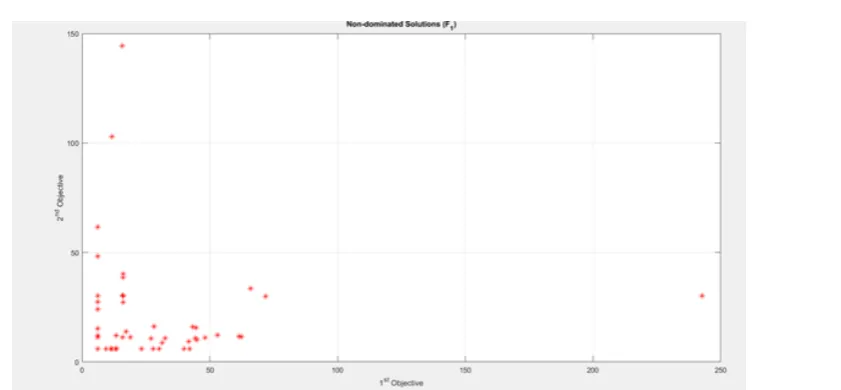
2.2.1. Multi-Objective Program 1. The multi-objective program 1 contains objectivesZ1 andZ2 for two selected surfaces, which uses a parameterep1. The output obtained by running NSGA II for these objectives is shown in Fig. 2.1.
The initial values of parameters and equations used for objectives are given below:
- Coefficients (fi) used in surface 1 are given below:
Algorithm 3Algorithm for Machine-learning for a sample data set of three extended surfaces Step 1: Key = Data - (u1, u2, u3, u4, u5)
Data contains 42 entries - surface 1, surface 2 and surface 3 contains 14 points Key = Target ( surface 1 , surface 2 , surface 3)
// The algorithm given here has been tested for a sample data points of three extended surfaces.
Step 2: The in-built functiontrain test split(), which is available in Pythonsklearn.model selection is used for training based on this data set.
The splitting is achived by the function, is given below:
X train shape= 31,Y train shape= 31,X test shape= 11,Y test shape= 11
The parametersX train,Y train,X testandY testare used for splitting training and testing data points. Step 3: KneighborsClassifier() function is used for classification
This function is available in sklearn.neighbors (Python) Knn = Call KNeighborsClassifier()
Call Knn.fit() withX trainandY trainparameters State 4: Take a sample pointx newusing numpy - arrays
A sample point→x new(numpy - array) = [13.716864, 864.196899, 192.78521, 11. 769211] This sample point has values of (u1, u2, u3, u4, u5)
Step 5: Call predict() function withx newpoint as input parameter The output obtained is index=1, which is, surface number = 2. Here, Index 0: Surface 1, Index 1: Surface 2, Index 2: Surface 3
This algorithm may be utilized for selecting a specific surface from a set of multiple surfaces.
Fig. 2.1.Output of Multi-Objective Program 1
- Coefficients (fi) used in surface 2 are given below:
f02= 120, f12= 3, f22= 0.65, f32=−1.87063, f42= 0.08, f52= 0.09, f62= 0.00085
- Objective 1:
z1=ep1+ √
((f6×x6) + (f5×x5) + (f4×x4) + (f3×x3) + (f2×x2) + (f1×x1) +f0) (2.2)
- Objective 2:
z2= √
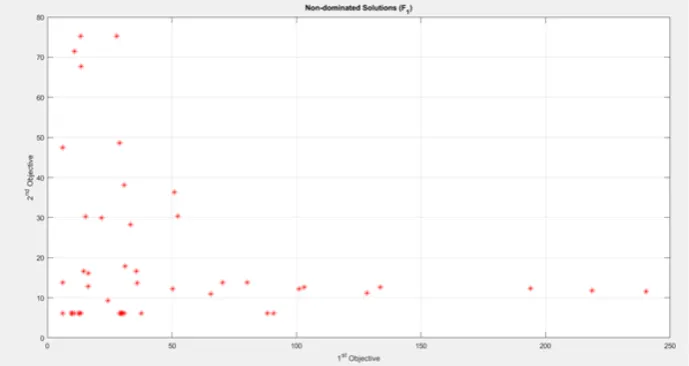
2.2.2. Multi-Objective Program 2. The multi-objective program 2 contains objectivesZ1 andZ2 for two selected surfaces, which uses a parameter ep1.The parameter of f1 of surface 1 has been changed here, as compared to multi-objective program 1. The output obtained by running NSGA II for these objectives is shown in Fig.2.2.
Fig. 2.2.Output of Multi-Objective Program 2
The initial values of parameters and equations used for objectives are given below:
- Coefficients (fi) used in surface 1 are given below:
f0= 100, f1= 0.0, f2= 0.8, f3=−1.87063, f4= 0.06, f5= 0.0, f6= 0.0, andep1= 6.089 - Coefficients (fi) used in surface 2 are given below:
f02= 120, f12= 3, f22= 0.65, f32=−1.87063, f42= 0.08, f52= 0.09, f62= 0.00085 - Objective 1:
z1=ep1+ √
((f6×x6) + (f5×x5) + (f4×x4) + (f3×x3) + (f2×x2) + (f1×x1) +f0) (2.4) - Objective 2:
z2= √
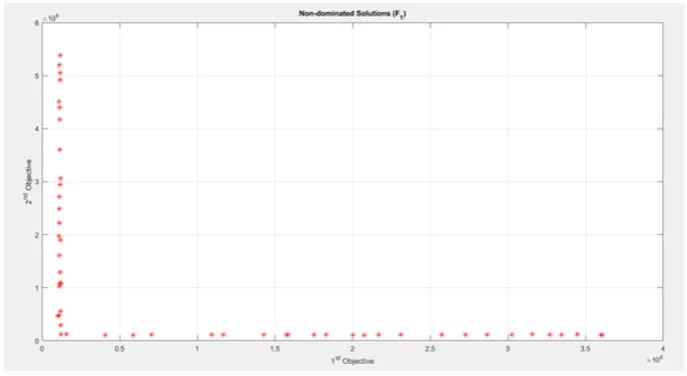
((f62×x6) + (f52×x5) + (f42×x4) + (f32×x3) + (f22×x2) + (f12×x1) +f02) (2.5) 2.2.3. Multi-Objective Program 3. The multi-objective program 3 contains objectivesZ1 andZ2 for selected surface, which uses a parameter ep1 . Here, objective 1 uses two different parametersq1 andMi , it is described by equation (6). The output obtained by running NSGA II for these objectives is shown in Fig. 2.3.
The initial values of parameters and equations used for objectives are given below:
- ep1= 6.089, Mi= 120, q1= 7.41
- Coefficients (fi) used in surface 2 are given below:
f02= 120, f12= 3, f22= 0.65, f32=−1.87063, f42= 0.08, f52= 0.09, f62= 0.00085 - Objective 1:
z1=abs(ep1+q1×Mi2+q1×Mi×x2) (2.6) - Objective 2:
z2= √
Fig. 2.3.Output of Multi-Objective Program 3
2.2.4. Multi-Objective Program 4. The multi-objective program 4 contains objectivesZ1 andZ2 for selected surface, which uses a parameter ep1. Here, objective 1 uses two different parametersq1 and Mi, it is described by equation (8) and objective 2 has different parameters, as compared to multi-objective program 3. The output obtained by running NSGA II for these objectives is shown in Fig. 2.4.
Fig. 2.4.Output of Multi-Objective Program 4
The initial values of parameters and equations used for objectives are given below:
- Coefficients (fi) used in surface 1 aref0= 100, f1= 0.0, f2= 0.8, f3=−1.87063, f4= 0.06, f5= 0.0, f6= 0.0 andep1= 6.089, Mi= 120, q1= 7.41
- Objective 1:
z1=abs(ep1+q1×Mi2+q1×Mi×x2) (2.8)
- Objective 2:
z2= √
Table 2.1
Sample input string composed of data streams of portfolio selection data that is used in SHA1 algorithm
S.No. Input String used in SHA1 algorithm
Expected Return Risk ParameterTa ParameterB5 ParameterB10
1. “0.2560 0.1622 0.023 0.5628 0.4372” +
“0.2786 0.1641 0.023 0.5002 0.4998” +
“0.3012 0.1698 0.023 0.4377 0.5623” +
“0.3238 0.1788 0.023 0.3752 0.6248” +
“0.3464 0.1907 0.023 0.3126 0.6874” +
“0.3690 0.2050 0.023 0.2501 0.7499” +
“0.3916 0.2050 0.023 0.1876 0.8124” +
“0.4142 0.2390 0.023 0.1251 0.8749” +
“0.4368 0.2579 0.023 0.0438 0.9259” +
“0.4594 0.2779 0.023 0.0 1.0”
2.3. Using SHA-1 for authentication . For authentication SHA-1 algorithm could be utilized and a sample run with portfolio data is given in Table 2.1. Where, parameterTa and parametersB5,B10are different values which are used in portfolio selection problem.
The output obtained after giving the input string, which is described in Table 2.1, to SHA1 algorithm is “DCF5C49BB3160A70788A72A06318FB2BE69BB233”.
2.4. Cryptanalysis of the proposed protocol. It is proved that discrete logarithm solution for Kummer surface is equivalent to discrete logarithm solution for Jacobian [1]. With the additional point u5 the security of the proposed protocol has not been lost moreover an additional direction for ensuring security has been included. The intension is to make the proposed protocol more secure with the help of new point u5. The encryption scheme based on proposed protocol may utilize machine-learning methods for selecting a specified surface in the case of multiple surfaces. The machine learning algorithm has been tested on a sample data of three extended surfaces. As suggested in [1], ELGamal scheme for encryption may be designed that is based on calculation on the Kummer surface. The addition function provided here could be used for multiplication on the extended surface. Thus, the use of extended surface does not account for any security losses.
3. Generating keys of each round of AES using content-based matrix. This section provides details about the new scheme that is being used for key generation (AES). An overview of the structure of content-based matrix using sample data of portfolio selection is also given in Fig 3.1.
The formulation of the content-matrix is given next. Here, the input is divided into four categories- category A for characters a-z / A-Z, category B for numbers 0-9, category C for special characters and lastly, the category D for images / videos etc.
Here, a sample frequency distribution of different classes in a sample input is given in Table 3.1. It contains assumed values of weight (x) and the mapping output (y) is found using the following equation:
y=x3+x2+w No=ymod 255
The following constants are used here: epk1 = 13.89,epk2 = 29.17 and epk3 = - 4.089. The values ofN1, N2 andN3 are computed as described below:
N1=N−epk1 N2=N−epk2 N3=N−epk3
Table 3.1 Output of content-matrix
S.No. Type of input Frequency(x) Weight(w) Mapping output(y) Entry (N0) Entry(N1) Entry(N2) Entry(N3)
1 Category A 34 15 40475 185 171.11 155.825 189.089
2 Category B 50 8 6252508 163 149.11 133.825 167.089
3 Category C 60 9 216069 84 70.11 54.825 88.089
4 Category D 12 11 1883 98 84.11 68.825 102.089
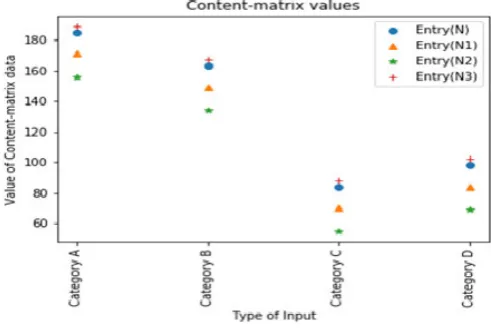
The reduced content-matrix values are based upon only three categories: category-alpha1 =category 1, category-alpha2 = category 2 and category-alpha3 = category 3. The output obtained are given in Table 3.2 and Fig. 3.2.
Table 3.2 Output of content-matrix
S.No. Type of input Entry(N) Entry(N1) Entry(N2) Entry(N3)
1 Category-α1 185 171.11 155.825 189.089
2 Category-α2 163 149.11 133.825 167.089
3 Category-α3 91 77.11 61.825 95.089
The following equations are used to compute optimal values :
cost1=a1α21+b1α1+c1 (3.1)
cost2=a2α22+b2α2+c2 (3.2)
cost3=a3α23+b3α3+c3 (3.3)
Total cost=cost1+cost2+cost3 (3.4)
189.089≤a1≤155.825 167.089≤a2≤133.825 95.089≤a3≤61.825 461.0≤Total cost≤361.0
Fig. 3.2.Reduced content-matrix values
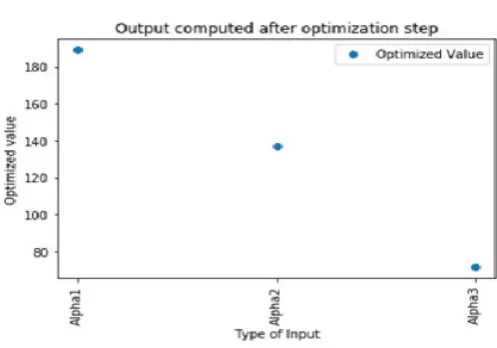
Fig. 3.3.Output computed after optimization step
Table 3.3
Optimized values of different categories
S.No. Category Optimized value
1 Category-α1 189.0809
2 Category-α2 137.2910
3 Category-α3 71.6765
3.1. Cryptanalysis of the proposed scheme. Different kinds of cryptanalysis for AES (Rijndael) is provided in [28]. Using another technique based on calculating partial sum, the complexity of AES can be decreased [28]. The attacks on 7 and 8 rounds can be achieved by incorporating the information about extra texts. The next area to be considered is Key generation. Various undesired behaviour for key generation is discussed in [28].
Algorithm 4New Key Expansion Algorithm
1: The new modified key expansion algorithm is given below:
2: Modified-Key-Expansion(byte x[4*y], word out[4 * 11], y)
3: start
4: wordt11 // ( temporary variable) 5: j= 0
6: While (j ¡ y)
7: out [i] = word(x[4 * j], key[4 * j+1], x[4 * j+2], x[4 * j+3]
8: j = j+1
9: end of while
10: j = y
11: While (j ¡ (4 * 11)) 12: t11 = out [j-1] // stage 1 13: if (j mod y == 0) then
14: t11= Rotate Word(temp) // stage 2 15: t11= Substitute Word(temp) // stage 3
16: t11= (t11 xor content matrix data entry) // stage 4 17: t11=t11 xor R constant[j/4] // stage 5
18: elseif (y ¿ 6 and j mod y = 4)
19: t11= Substitute Word(temp) // stage 6 20: end if
21: out[j] = out[j-y] xort11// stage 7 and stage 8 22: j = j + 1
23: end of while
24: end
4. Result Analysis and Discussion. The following section describes the various outputs obtained after executing extended Kummer surface algorithm explained in section 2.1. An overview of the results obtained for existing Kummer surface is also given. The next section has a description of data obtained after executing new key expansion (AES) algorithm. Lastly, an overview of the results obtained with LIM algorithm are provided.
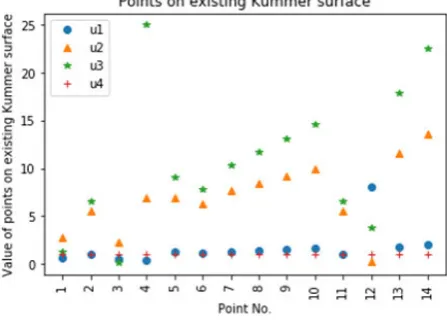
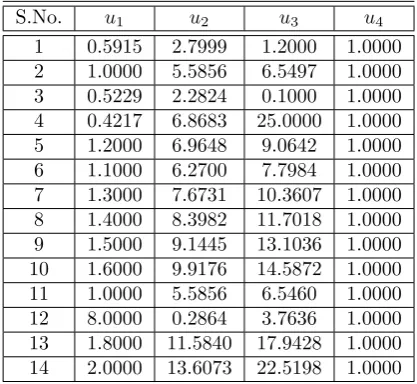
4.1. Existing Kummer Surface Results. This section briefly presents results which are obtained for existing and extended Kummer surface. The results are given in Table 4.1 and Fig 4.1 for existing Kummer surface- surface 1.
Table 4.1
Sample points on Existing Kummer Surface(u1, u2, u3, u4, u5)(Surface 1)
S.No. u1 u2 u3 u4
1 0.5915 2.7999 1.2000 1.0000
2 1.0000 5.5856 6.5497 1.0000
3 0.5229 2.2824 0.1000 1.0000
4 0.4217 6.8683 25.0000 1.0000
5 1.2000 6.9648 9.0642 1.0000
6 1.1000 6.2700 7.7984 1.0000
7 1.3000 7.6731 10.3607 1.0000
8 1.4000 8.3982 11.7018 1.0000
9 1.5000 9.1445 13.1036 1.0000
10 1.6000 9.9176 14.5872 1.0000
11 1.0000 5.5856 6.5460 1.0000
12 8.0000 0.2864 3.7636 1.0000
13 1.8000 11.5840 17.9428 1.0000 14 2.0000 13.6073 22.5198 1.0000
Similarly, sample data points are computed for surface 2 and surface 3.
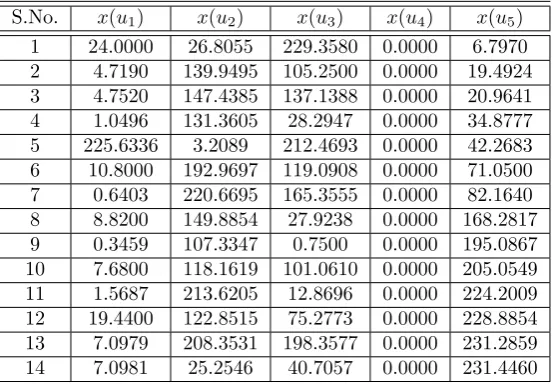
4.1.1. Extended Kummer Surface Results. This section presents the results which are obtained after executing extended Kummer surface algorithm. This algorithm contains a newly added point (u5). The input points z and y on the extended Kummer surface (surface 1) are given in Table 4.2 and are drawn in Fig. 4.2 and Fig. 4.3.
Table 4.2
Value of input point (z) and input point (y) on extended Kummer surface (Surface 1)
S.No. z(u1) z(u2) z(u3) z(u4) z(u5) y(u1) y(u2) y(u3) y(u4) y(u5)
1 1.0000 5.5856 6.5460 1.0000 0.8000 8.0000 0.2864 3.7636 1.0000 0.9800
2 1.1000 6.2700 7.7984 1.0000 0.8000 1.3000 7.6731 10.3607 1.0000 0.9800
3 1.2000 6.9648 9.0642 1.0000 0.8000 1.1000 6.2700 7.7984 1.0000 0.9800
4 0.5915 2.7999 1.2000 1.0000 0.8000 1.0000 5.5856 6.5497 1.0000 0.9800
5 8.0000 0.2864 3.7636 1.0000 0.8000 2.5033 13.0410 5.0000 1.0000 0.9800
6 1.5000 9.1445 13.1036 1.0000 0.8000 1.6000 9.9176 14.5872 1.0000 0.9800
7 0.4217 6.8683 25.0000 1.0000 0.8000 1.2000 6.9648 9.0642 1.0000 0.9800
8 1.4000 8.3982 11.7018 1.0000 0.8000 1.5000 9.1445 13.1036 1.0000 0.9800
9 0.5229 2.2824 0.1000 1.0000 0.8000 0.4217 6.8683 25.0000 1.0000 0.9800
10 1.6000 9.9176 14.5872 1.0000 0.8000 1.0000 5.5856 6.5497 1.0000 0.9800
11 1.0000 5.5856 6.5497 1.0000 0.8000 0.5229 2.2824 0.1000 1.0000 0.9800
12 1.8000 11.5840 17.9428 1.0000 0.8000 2.0000 13.6073 22.5198 1.0000 0.9800
13 1.3000 7.6731 10.3607 1.0000 0.8000 1.4000 8.3982 11.7018 1.0000 0.9800
14 2.0000 13.6073 22.5198 1.0000 0.8000 0.5915 2.7999 1.2000 1.0000 0.9800
Fig. 4.2. Input point (z) on Extended Kummer surface (surface 1)
Fig. 4.3.Input point (y) on Extended Kummer surface (surface 1)
Table 4.3
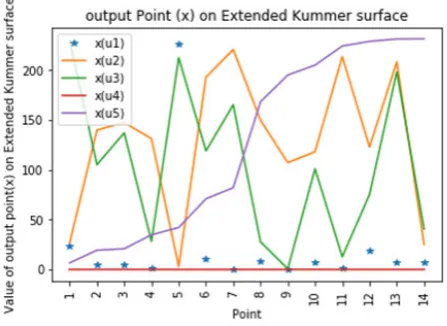
Output values of extended Kummer Surface(x(u1), x(u2), x(u3), x(u4), u5)(Surface 1)
S.No. x(u1) x(u2) x(u3) x(u4) x(u5)
1 24.0000 26.8055 229.3580 0.0000 6.7970
2 4.7190 139.9495 105.2500 0.0000 19.4924
3 4.7520 147.4385 137.1388 0.0000 20.9641
4 1.0496 131.3605 28.2947 0.0000 34.8777
5 225.6336 3.2089 212.4693 0.0000 42.2683
6 10.8000 192.9697 119.0908 0.0000 71.0500
7 0.6403 220.6695 165.3555 0.0000 82.1640
8 8.8200 149.8854 27.9238 0.0000 168.2817
9 0.3459 107.3347 0.7500 0.0000 195.0867
10 7.6800 118.1619 101.0610 0.0000 205.0549
11 1.5687 213.6205 12.8696 0.0000 224.2009
12 19.4400 122.8515 75.2773 0.0000 228.8854
13 7.0979 208.3531 198.3577 0.0000 231.2859
14 7.0981 25.2546 40.7057 0.0000 231.4460
4.2. Results obtained with new Key expansion algorithm in different stages. This section pro-vides an overview of the outputs obtained after different stages in new Key expansion algorithm. For simplicity of the presented output, the decimal values on a scale of (value/109) is chosen. Table 4.4 has output of stage 4 and its (new Key expansion) diagram along with two trend lines - trade line 1(power trend line with forecast of 2.0 periods, equation used: y = 34092×x00743 ,R2= 0.1335, here y is output, x is input parameter for trend line and R2 is R-squared value used for trend line 1) and trend line 2 (polynomial trend with forecast of 2.0 periods) is given in Fig.4.5.
Table 4.4
Output data obtained from new Key expansion algorithm: Stage 4 and Stage 6
S. No. O(hex):Stage 4 O(dec):Stage 4 O(hex):Stgae 6 O(dec):Stage 6
1 bf85ef55 3.2132 be85ef55 3.1964
2 bdc5d7d4 3.1839 bfc5d7d4 3.2174
3 fdd76f5f 4.2588 f9d76f5f 4.1916
4 ff97ef7d 4.2881 f797ef7d 4.1539
5 ffe5c7ff 4.2932 efe5c7ff 4.0248
6 fdd5e6dc 4.2587 ddd5e6dc 3.7218
7 bf954f5e 3.2142 ff954f5e 4.2880
8 ffdfd75d 4.2929 7fdfd75d 2.1454
9 bff5ee5c 3.2206 a4f5ee5c 2.7676
10 ffbdcf74 4.2906 c9bdcf74 3.3847
Table 4.4 has also output of stage 6 and its (new Key expansion) diagram along with two trend lines - trade line 1(power trend line with forecast of 2.0 periods, equation used: y = 3.7022×x0.049,R2 = 0.0266) and trend line 2 (polynomial trend with forecast of 2.0 periods) is given in Fig.4.6.
In Table 4.4, O(hex):Stage 4 denotes Output of new Key expansion algorithm: stage 4 (Hex value), O(dec):Stage 4 denotes Output of new Key expansion algorithm : stage 4 (Decimal value / 109), O(hex):Stage 6 denotes Output of new Key expansion algorithm : stage 6 (Hex value), and O(dec):Stage 6 denotes Output of new Key expansion algorithm : stage 6 (Decimal value / 109).
Fig. 4.5.Output points of new key expansion (stage 4)
Fig. 4.6.Output points of new key expansion (stage 6)
8 denotes Output of new Key expansion algorithm : stage 8 (Hex value), and O(dec):stage 8 denotes Output of new Key expansion algorithm : stage 8 (Decimal value / 109).
Table 4.5 also has output of stage 7 and its (new Key expansion) diagram along with two trend lines trade line 1(power trend line with forecast of 2.0 periods, equation used: y = 0.9656×x0.0177,R2= 0.0002) and trend line 2 (polynomial trend with forecast of 2.0 periods) is given in Fig.4.7.
Table 4.5 has output of stage 8 and its (new Key expansion) diagram along with two trend lines-trade line 1(power trend line with forecast of 2.0 periods, equation used: y = 0.9656×x0.0177, R2 = 0.0002) and trend line 2 (polynomial trend with forecast of 2.0 periods) is given in Fig.4.8.
Table 4.5
Output data obtained from new Key expansion algorithm: Stage 7 and Stage 8
S.No. O(hex):Stage 7 O(dec):Stage 7 O(hex):Stage 8 O(dec):Stage 8
1 2b7e1576 0.7297 2b7e1576 0.7297
2 28aed2a6 0.6825 28aed2a6 0.6825
3 abf71588 2.8851 abf71588 2.8851
4 09cf4f3c 0.1646 09cf4f3c 0.1646
5 95fbfa43 2.5163 95fbfa43 2.5163
6 bd5528e5 3.1765 bd5528e5 3.1765
7 16a23d6d 0.3797 16a23d6d 0.3797
8 1f6d7251 0.5273 1f6d7251 0.5273
9 2a3e2d97 0.7087 2a3e2d97 0.7087
10 976b572 0.1588 976b572 0.1588
11 81c9381f 2.1774 81c9381f 2.1774
12 9ea44a4e 2.6616 9ea44a4e 2.6616
13 d3e942c8 3.5553 d3e942c8 3.5553
14 448247ba 1.1494 448247ba 1.1494
15 c54b7fa5 3.3101 c54b7fa5 3.3101
16 5bef35eb 1.5424 5bef35eb 1.5424
17 247eadb5 0.6123 247eadb5 0.6123
18 60fceaf 0.1017 60fceaf 0.1017
19 a5b795aa 2.7803 a5b795aa 2.7803
20 fe58a041 4.2672 fe58a041 4.2672
21 cb9b6a4a 3.4160 cb9b6a4a 3.4160
22 ab678045 2.8757 ab678045 2.8757
23 ed015ef 0.2485 ed015ef 0.2485
24 f088b5ae 4.0355 f088b5ae 4.0355
25 164e8c96 0.3742 164e8c96 0.3742
26 bd29cd3 0.1984 bd29cd3 0.1984
27 b3f9193c 3.0194 b3f9193c 3.0194
28 4371ac92 1.1315 4371ac92 1.1315
29 e9dbc3c8 3.9235 e9dbc3c8 3.9235
30 54f2cf1b 1.4252 54f2cf1b 1.4252
31 e7bd627 0.2430 e7bd627 0.2430
32 a47a7ab5 2.7595 a47a7ab5 2.7595
33 9641495 0.1576 9641495 0.1576
34 c2f6db8e 3.2710 c2f6db8e 3.2710
35 25fdda9 0.0398 25fdda9 0.0398
36 8187771c 2.1731 8187771c 2.1731
37 32f1fac9 0.8547 32f1fac9 0.8547
38 f072147 0.2521 f072147 0.2521
39 d5fa2cee 3.5899 d5fa2cee 3.5899
40 547d5bf2 1.4175 547d5bf2 1.4175
Fig. 4.7.Output points of new key expansion (stage 7)
Fig. 4.8.Output points of new key expansion (stage 8)
Table 4.6
Output of stage 1, stage 2 and stage 3 (existing and new Key expansion)
S.No. Variable t11 (stage 1) Output after Rotate word ( ) (stage 2) Output after Subtitute word ( ) (stage 3)
1 09cf4f3c cf4f3c09 8a84eb01
2 1f6d7251 6d72511f 3c40d1c0
3 9ea44a4e a44a4e9e 49d62fb
4 5bef35eb ef35eb5b df96e939
5 fe58a041 58a041fe 6ae083bb
6 f088b5ae 88b5aef0 c4d5e48c
7 4371ac92 71ac9243 a3914f1a
8 a47a7ab5 7a7ab5a4 dadad549
9 8187771c81 87771c81 17f5acc
10 547d5bf2 7d5bf254 ff398920
Fig. 4.9.Histogram data used in LIM algorithm (surface 1) (set 1 data)
Fig. 4.10.Histogram data used in LIM algorithm (surface 1) (set 2 data)
Table 4.7 Output of LIM (surface 1)
S. No. Step 1 Step 3 Cval(LIM)
1 6.797 16.080608 0.361209
19.4924 46.115883 20.9641 49.597691 34.8777 82.51503
42.2683 100
2 71.05 34.649258 0.394425
82.164 40.069271 168.2817 82.06665 195.0867 95.138763
205.0549 100
Fig. 4.12.Comparison of average values of N Blocks (LIM) for different surfaces)
4.3.1. Importance of computed values of LIM. An encrypting method, which has randomly dis-tributed cipher texts inside the group of text used while encrypting, would be classified as a potential nice method encrypting. A computed value of LIM, that is, close to a value of 0.5 is an indication of randomly distributed [10]. Moreover, a drift from this value, significance occurrence of a kind of pattern in the cipher text [10]. The average values shown in Fig. 4.12 signifies that all the three surfaces are different, and there is a possibility of occurrence of a pattern, because these values drift from the value of 0.5.
5. Conclusion. This paper has a secure structure which contains mainly two aspects of a cryptographic system. Firstly, a scheme comprising of newly added point (u5) in the kummer surface and then how this information inclusion could be utilized for a machine-learning algorithm in selecting an appropriate surface. Here, the selection of a particular surface based on a machine learning technique is provided. The work based on kummer surfaces and building a Fast Diffie-Hellman protocol is previously given in earlier papers. The focus of the proposed scheme is to enhance the security of the above-mentioned work by selecting an additional point (u5) on the surface. Later, selection of multiple surfaces using NSGA II algorithm is given. Secondly, an encryption based on AES is taken. A new scheme for generating modified key-expansion in AES algorithm is described. The scheme builds a content-matrix using frequencies of different categories in the input message. Next, optimized values of the entries are chosen by running classical Lagrangian multiplier method. The se-lected entries are utilized in the modified key-expansion algorithm. Lastly, a brief overview of LIM index is given.
REFERENCES
[1] N. P. Smart, and S. Siksek,A Fast Diffie Hellman Protocol in Genus 2, in Journal of cryptology, vol.12(1), 1999, pp. 67-73. [2] H. Nover,Algebraic cryptanalysis of AES: an overview, in University of Wisconsin, USA, (2005).
[3] L. Ning, L.Kanfeng, L. Wenliang, and D. Zhongliang,A joint encryption and error correction method used in satellite communications, in China communications, vol. 11(3), (2014),pp. 70-79.
[4] Y. Dodis, R. Leonid, and S. Adam,Fuzzy extractors: How to generate strong keys from biometrics and other noisy data, in International conference on the theory and applications of cryptographic techniques, (2004), pp. 523-540.
[5] C. Peikert, and W. Brent,Lossy trapdoor functions and their applications, in SIAM Journal on Computing, vol.40(6), (2011), pp.1803-1844.
[6] A. C. Yao,Theory and application of trapdoor functions, in 23rd Annual Symposium on Foundations of Computer Science SFCS’08, (1982), pp.80-91.
[7] L. Blum, B. Manuel, and S. Mike,A simple unpredictable pseudo-random number generator, in SIAM Journal on computing, vol. 15(2), (1986), pp.364-383.
[8] P. S. Mehra, M. N. Doja, and B. Alam, Codeword Authenticated Key Exchange (CAKE) light weight secure routing protocol for WSN, International Journal of Communication Systems, 32 (2019).
[9] R. Cramer, and S. Victor,A practical public key cryptosystem provably secure against adaptive chosen ciphertext attack, in Annual International Cryptology Conference, (1982), pp. 13-25.
[10] V. Karuvandan, C. Senthamarai and P. Shantharajah, inCryptanalysis of AES-128 and AES-256 block ciphers using lorenz information measure, in Int. Arab J. Inf. Technology, vol. 13(6B), (2016), pp. 1054-1060.
[11] N. Ferguson, K. John, L. Stefan, S. Bruce, S. Mike, W.David, and W.Doug,Improved cryptanalysis of Rijndael, in International Workshop on Fast Software Encryption, 2000, pp. 213-230.
[12] A. Kaminsky, K. Michael, and R. Stanisaw,An overview of cryptanalysis research for the advanced encryption standard, in MILITARY COMMUNICATIONS CONFERENCE, 2010-MILCOM, (2010), pp.1310-1316.
[13] S. Chen, L. Rodolphe, L. Jooyoung, S. Yannick, and S. John,Minimizing the two-round EvenMansour cipher, in Journal of Cryptology, vol. 31(4), (2018), pp. 1064-1119.
[14] M. Masoumi, and M. Hadi Rezayati,Novel approach to protect advanced encryption standard algorithm implementation against differential electromagnetic and power analysis, in IEEE Transactions on Information Forensics and Security, Vol. 10(2), 2015, pp.256-265.
[15] F. Courbon, JJ. A. Fournier, P. L. Moundi, and A. Tria,Combining image processing and laser fault injections for characterizing a hardware AES, in IEEE transactions on computer-aided design of integrated circuits and systems, vol. 34(6), (2015), pp.928-936.
[16] M. Taha, and P. Schaumont,Key updating for leakage resiliency with application to AES modes of operation, in IEEE transactions on information forensics and security, vol. 10(3), (2015), pp.519-528.
[17] C. H. Baek, J.H.Cheon, and H.Hong,White-box AES implementation revisited, in Journal of Communications and Net-works, vol. 18(3), (2016), pp.273-287.
[18] R. L. Rivest,Cryptography and machine learning, in International Conference on the Theory and Application of Cryptology, (1991), pp.427-439.
[19] R. Bost, R. A. Popa, S. Tu, and S. Goldwasser,Machine learning classification over encrypted data, in NDSS, (2015). [20] T. Graepel, L. Kristin, and M. Naehrig,ML confidential: Machine learning on encrypted data, in International Conference
on Information Security and Cryptology,(2012), pp. 1-21.
[21] F. M. Barbosa, A.R.S.F. Vidal, H.L.S. Almeida, and F.L. de Mello,Machine Learning Applied to the Recognition of Cryptographic Algorithms Used for Multimedia Encryption, in IEEE Latin America Transactions, vol. 15(7),(2017), pp. 1301-1305.
[22] H. Maghrebi, T.Portigliatti, and E. Prouff,Breaking cryptographic implementations using deep learning techniques, in International Conference on Security, Privacy, and Applied Cryptography Engineering, (2016), pp. 3-26.
[23] J.S. Muller,Explicit Kummer surface formulas for arbitrary characteristic, in LMS Journal of Computation and Mathe-matics, vol. 13, (2010), pp. 47-64.
[24] A. Garbagnati, and A. Sarti,Kummer surfaces and K3 surfaces with(Z
2Z) 4
symplectic action, in Rocky Mountain Journal of Mathematics, vol. 46(4),(2016), pp. 1141-1205.
[25] Standard, Advance Encryption,Federal information processing standards publication 197, in FIPS PUB, (2001), pp. 46-53. [26] C. Kumar, and M.N.Doja,A Novel Framework for Portfolio Selection Model Using Modified ANFIS and Fuzzy Sets, in
Computers, vol. 7(4), (2018), pp. 57-64.
[27] R. K. Chahar, G. Datta, and N. Rajpal,Design of a new Security Protocol, in International Conference on Computational Intelligence and Multimedia Applications, vol. 4, (2007), pp. 132-136.
[28] N. Ferguson, K. John, L. Stefan, S. Bruce, S. Mike, W. David, and W. Doug,Improved cryptanalysis of Rijndael, in International Workshop on Fast Software Encryption, (2000), pp. 213-230.
[29] K. Deb, A.Pratap, S. Agarwal, and T. A. M. T. Meyarivan,A fast and elitist multiobjective genetic algorithm: NSGA-II, in IEEE transactions on evolutionary computation, vol. 6(2), (2002), pp. 182-197.