Available Online At www.ijpret.com
INTERNATIONAL JOURNAL OF PURE AND
APPLIED RESEARCH IN ENGINEERING AND
TECHNOLOGY
A PATH FOR HORIZING YOUR INNOVATIVE WORK
EVALUATION OF PROPERTIES OF COAL USING VARIOUS NDT METHODS
D. M. KATE1 , N. K. CHOUDHARI1 , A. R. CHAUDHARI1 PG Students of Smt. Bhagwati Chaturvedi College of Engineering, India
Accepted Date:
27/02/2013
Publish Date:
01/04/2013
Keywords
Coal
Corresponding Author
Mr. D. M. Kate
Abstract
The various methods of non-destructive techniques to evaluate
the properties of coal are describes in this Paper.
Non-destructive techniques have been used almost exclusively for
detection of macroscopic defects in existing structures. It is
practical and cost effective to expand the role of
non-destructive evaluation and can be included in all phases of
material production. Quick analysis of coal properties plays an
important path in improving combustion efficiency and
reducing atmospheric pollution at coal fired power station.
Various NDT techniques can be use to analyze coal samples
very efficiently. Just by sampling a small amount of coal, the
NDT techniques can accurately analyze the calorific value and
the percentage of carbon, oxygen, hydrogen, sulfur, water, and
ash. Objective of this paper is to make an attempt to study
different physical & chemical properties of coal through various
NDT techniques & the comparative study of the all the
Available Online At www.ijpret.com
[I] Introduction: Today in almost all coal
fired power stations, the main problem is to
evaluate the coal properties before using it.
It is essential to find coal calorific value,
moisture content, volatile matter content,
ash content and percentage of elements.
Till date in many power plants, chemical
analysis methods are used to get
information about all these parameters
which is very time consuming and requires
lot of technically skilled persons having
detailed knowledge of chemical testing of
coal. Besides using the traditional chemical
processes many researchers have tried to
characterize coal by using various NDT
techniques . Non-destructive techniques
have been used almost exclusively for
detection of macroscopic defects in existing
structures. It is practical and cost effective
to expand the role of non-destructive
evaluation and can be included in all phases
of material production. In this paper, we
have discussed various techniques that are
used to characterize the coal by using
non-destructive techniques.
[II]Measurement Techniques:
The techniques available for
characterization of materials can be
categorized in two broad classes,
destructive & Non-Destructive Techniques.
The destructive techniques cause certain
variation in physical shape and material
properties, in some cases it damages the
materials. Thus there will be degradation of
the strength of the material being
evaluated. In Non-Destructive evaluation
technique there is no physical damage
while characterization of the material.
The common NDT Techniques are as listed
below:
1. Dye penetrant inspection
2. Magnetic Particle Testing
3. Ultrasonic Testing
4. Eddy Current Testing
5. Radiographic Testing
Available Online At www.ijpret.com Fig 1:Dye penetrant inspection
is a widely applied and low-cost
inspection method used to locate
surface-breaking defects in all non
porous materials (metals, plastics, or
ceramics). LPI is used to detect casting,
forging and welding surface defects such
as hairline cracks, surface porosity leaks
in new products, and fatigue cracks on
in-service components.
2. Magnetic Particle Testing:
Fig 2:Magnetic Particle Testing
This method is suitable for the detection of
surface and near surface discontinuities in
magnetic material, mainly ferritic steel and
iron. The principle is to generate magnetic
flux in the article to be examined, with the
flux lines running along the surface at right
angles to the suspected defect. Where the
flux lines approach a discontinuity they will
stay out in to the air at the mouth of the
crack. The technique not only detects those
defects which are not normally visible to
the unaided eye, but also renders easily
visible those defects which would otherwise
require close scrutiny of the surface.
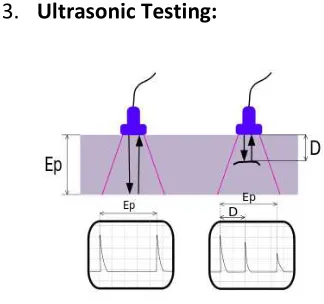
3. Ultrasonic Testing:
Fig 3 : Ultrasonic Testing
In ultrasonic testing (UT), very short
ultrasonic pulse-waves with center
frequencies ranging from 0.1-15 MHz and
occasionally up to 50 MHz are launched
into materials to detect internal flaws or to
Available Online At www.ijpret.com is ultrasonic thickness measurement
which tests the thickness of the test
object, for example, to monitor pipe work
corrosion. Ultrasonic testing is often
performed on steel and other metals and
alloys, though it can also be used on
concrete, wood and composites, albeit
with less resolution. It is a form of
non-destructive testing used in many industries
including aerospace, automotive and other
transportation sectors.
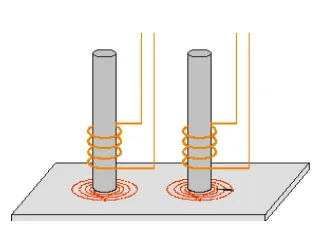
4. Eddy Current Testing:
Fig 4:Eddy Current Testing
Eddy-current testing uses electromagnetic
induction to detect flaws in conductive
materials. Eddy currents can be produced in
any electrically conducting material that is
subjected to an alternating magnetic field.
The alternating magnetic field is normally
generated by passing an alternating current
through a coil. The coil can have many
shapes and can between 10 and 500 turns
of wire. The magnitude of the eddy currents
generated in the product is dependent on
conductivity, permeability and the set up
geometry. When a crack, for example,
occurs in the product surface the eddy
currents must travel farther around the
crack and this is detected by the impedance
change.
5. Radiographic Testing:
Fig 5:Eddy Current Testing:
This technique is suitable for the detection
of internal defects in ferrous and
nonferrous metals and other materials.
X-rays, generated electrically, and Gamma
rays emitted from radio-active isotopes ,are
penetrating radiation which is differentially
absorbed by the material through which it
passes; the greater the thickness, the
Available Online At www.ijpret.com internal voids is tested by placing the
subject between the source of radiation and
the film. The voids show as darkened areas,
where more radiation has reached the film,
on a clear background.
[III] Different NDT methods to evaluation
of properties coal :
Desham Gu et.al. [2]. In his work, the pulsed
neutron beam bombards the elements in
coal samples and interacts with the nuclei
of its different atoms. This bombardment
induces several different reactions. Among
those reactions, the thermal neutron
capture reaction [n, γ ] and the inelastic
scattering reaction [n, n_ , γ ] will induce
instantaneous γ -rays. The elemental
analysis of coal, including the coal industrial
value analysis, shows that the inelastic
reaction cross section of carbon and oxygen
are relatively larger, whereas the other
elements have larger capture cross
sections. The instrument uses the pulsed
neutron generator to control the emitting
period of pulsed neutron beam to separate
the inelastic spectrum induced by fast
neutrons and capture spectrum induced by
thermal neutrons. After the spectrum
separation, the spectrum data to produce
the elemental analysis of the coal samples
In his work the main controlling parameters
were
• Controlling the sampling time precisely
with a computer
• Calibrating the γ -ray sensors properly
• Applying an appropriate algorithm in
data analysis.
Neither one of the [n, γ] and [n, n_, γ ]
reactions can give an accurate elemental
analysis by itself because of the cross
sectional difference between the reactions
on different elements in coal.
Sodium in coal, which causes fouling and
slagging, can be measured with an on-line
analyzer that uses PFTNA Concerning the
neutron generator itself, when it needs
replacement, a new one can be shipped by
common carrier without special shielding
requirements. When de-energized, the
radiation emitted from the beta decay of
the tritium target is entirely stopped by the
rugged stainless steel container in which
the (D-T) neutron generator tube is housed.
The direct measurement of C and O means
Available Online At www.ijpret.com Calorific values can be measured without
recalibrating for each particular seam
analyzed can be done by Vourvopoulos et.
al. [3] & also can produce substantial
financial savings to a coal-fired power plant.
Because of the large amount of coal
consumed each year by coal-fired power
plants, a reduction of a few percent in fuel
cost can result in savings that can easily
justify the installation of the analyzer from a
financial standpoint
L. Dep et.al. [4]. In his work, Coal flowing in
a vertical chute is irradiated by a pulsed
neutron generator, producing 14 MeV
neutrons in pulses several microseconds
wide and with a frequency of several
kilohertz. The high-energy neutrons interact
with elements such as C and O emitting
characteristic gamma rays. In between the
neutron pulses, the fast neutrons within the
coal bulk lose their energy through
scattering with the light elements in the
coal, initiating thermal neutron capture
reactions. Such reactions measure elements
such as H, S, and Cl through their
characteristic gamma rays. For the
measurement of Na, neutron activation is
used, producing isotopes that have longer
half-lives (on the order of seconds) than the
fast and thermal capture reactions. The
gamma rays produced from each category
of nuclear reactions are acquired and
stored in different spectra. By acquiring the
gamma rays in three different time
windows, there is a significant reduction of
the background as compared with the
spectra taken with a radioisotopic source.
The Elemental On Line a analyzer has been
built, able to analyze several tons/hour of
coal. The main features of the analyzer are
self-calibration independent of the coal
seam, better accuracy in the determination
of elements such as carbon, oxygen, and
sodium, and diminished radiation risk. A
fast, accurate, real-time method of
determining the elemental composition of
coal is important to the coal industry for
pricing, quality control, and reduction of
SO2 emissions. Some of the elements such
as C, O, H, and S can be used in an
algorithm for the determination of the
calorific value (BTU/lb) of coal Continuous
control of coal quality can be maintained by
blending different types of coal, a method
opted by nearly 50% of the coal-fired power
Available Online At www.ijpret.com Amendments. A real-time method of
determining the elemental coal
composition can provide the needed
information for blending. Nuclear
techniques using interactions of neutrons
with coal fulfill this need, because the coal
is analyzed within minutes as it travels on a
conveyor belt or as it falls in a chute. These
neutron interactions produce gamma rays
that have energies unique to each element
In this paper Womble P et.al. [5] discuss a
prototype on-line coal analyzer employing
the PFTNA technique that we have
developed and built at Western Kentucky
University & the data from the analysis of a
large number of coal samples are
presented, and the essential components of
the coal analyzer are described.
To monitor the dynamical changes in coals
with temperature, an in-situ method must
be used, therefore, we have applied
single-point-imaging and have carried out the first
systematic in-situ variable-temperature
NMR(Nuclear Magnetic Resonance)
(nondestructive analytical technique
)imaging study of coals between 25 and
500� with our newly developed high
temperature imaging probe and systems. It
has been clarified that the macromolecular
structure of coal is relaxed by the rapid heat
treatment and in addition there is a close
relation in hydrogen bond and relaxation of
molecular structure of coal. The authors [6]
developed and built the first system in the
world to utilize the molecular-level
chemical information provided by NMR
imaging to permit not only direct
observation of coal .An attempt was made
to apply the system to a wide variety of
coals and to clarify the behavior of rapidly
heated coal during the softening and
melting process and the mechanism by
which rapid heat treatment improves the
coking property. By applying the high
temperature in-situ NMR imaging method
to coal samples, it has been found that the
molecular group domain that is formed by
the mobile component at room
temperature expands with the rise in
temperature and is evenly distributed
within the coal grains. By utilizing the
molecular-level chemical information
provided by NMR imaging, the world’s first
system was developed and built that
enables direct, in-situ observation of the
Available Online At www.ijpret.com using solvent vapor to swell the coal. With
this system, it was possible to clearly grasp
the changes in coal at the molecular and
molecular group domain levels and the
change in their behavior in the heating
process
The NMR relaxation has shown potential
advantages for the petrophysical
characterization of coal in several ways.
Firstly, it is a nondestructive technique.
NMR does not require special shape or size
in sample preparation, and the method
does not generally destroy the original pore
structure of coal. Secondly, it is the only
method that fits well for in situ CBM
reservoir. The in situ CBM reservoir is
commonly saturated with water that is
similar to the measurement condition of
NMR. Thirdly, it is an instant detection
method and can be easily applied to drill
cores in well field. Lastly, with further
research it may provide a very promising
technique for well logging. This study [7]
has shown that pore types of coal can be
classified by measuring NMR T distributions.
NMR T2 distributions for 100% water
saturated samples are commonly bimodal,
unimodal and multimodal, with peaks of
adsorption pores (<0.1 lm) at 0.5– 2.5 ms,
seepage pores (>0.1 lm) at 20–50 ms, and
the cleats (or fractures) at >100 ms. The IP
and PP values are estimated using NMR
data of cores at 100% water-saturated and
irreducible water conditions. The PP value
of coals is low, in the range of 0.07–4.67%,
but more commonly between 0.1% and 2%.
PP strongly relates to the developments of
cleats and the air permeability of coals.
Based on an exponential regression of air
permeability and PP, a new NMR-based
permeability model is proposed. This model
provides significantly better permeability
estimations than the classicmodels
originally developed for sandstones. In
combination with mercury intrusion
porosimetry, we also propose a NMR-based
pore structure model that efficiently
estimates the pore size distribution of coals.
This paper[8] demonstrates capabilities of
microfocus X-ray computed tomography
(μCT) in characterizing the development of
coal porosity and fractures. For the
investigated coals, the CT number of
minerals, pores and coal matrix are
approximately 3000, b600 and 1000–1600
Available Online At www.ijpret.com CT number of analyzed coals mainly relate
to the density, coal maceral composition,
and proportion of minerals and pores.
Although the estimated porosities by
segmentation method show some
uncertainty, the results correlate well with
the analyzed porosities by helium gas
method and water-saturated method. The
aperture, spacing and spatial distribution of
fractures, and mineral morphology are
semi-quantitatively evaluated by μCT using
a computer-aided design. The slicing
analyses of coals demonstrated that
distributions of porosity in coals are highly
anisotropic. The spatial disposition of pores,
fractures and minerals is the most
important factor that influences coal
porosity and permeability.
Shepard, Phillip W.[9] in his research tried
to analyze the anisotropic properties of
coal. He has made use of two-path
interferometer at microwave frequencies
(9GHz) to measure the dielectric constant
and conductivity of coal as a function of
direction of propagation & polarization of
the electromagnetic wave within the coal.
Balinis C.A.[10] developed
electromagnetic system to detect and
monitor underground coal gasification
process. In general, it has been observed
that there is a decrease in the values of
dielectric constant and an increase in
conductivity as the frequency increased.
In electrical power generation there are
many problems that may be solved by the
application of Image analysis .The presence
of non ore gangue material mixed with coal
can have impact on combustion efficiency
and emission of power plant
.Differentiation between coal & gangue is
desirable for fuel quality control and yield
analysis . Hobson, D.M.[11] in his research
work analyse the coal samples through a
process of image acquisition and digital
processing. Sheen, S.H.[12] used Ultrasonic
techniques for measurement of coal slurry
viscosity .He used four ultrasonic
techniques measurement of attenuation
,acoustic impedancedance ,relaxation
acoustic straining and cavitations’.
[IV]Conclusions:
The present paper has given the several
Available Online At www.ijpret.com are used for the evaluation of Coal
properties .Moreover, it has been shown
that Non-destructive characterization
affords a most promising opportunity
during production of materials, devices and
structure out of several NDT test. In future
the evolution of a variety of technologies
will enable NDT to move rapidly ahead and
develops. Vastly increased computing
capability will enhanced the ability to
gather, store and manipulate data and
images, and to partially or fully automate
NDT techniques. We believe that the NDT
techniques are most significant
development for characterization and
analysis of Coal properties. To evaluate the
properties of coal that may be useful to
industries which uses boilers and it will be
useful in saving the boilers from damaging.
REFERENCES:
1. Mark Willcox & George Downes “A Brief
Description of NDT Techniques” Insight NDT
Equipment Limited, (2000 – 2003.)
2. Deshan Gu ,Daowen Cheng ; Jie Yin ;
Shuang Qiao ; Linmao Liu ; Xuesong Zhang
“Rapid analysis of coal properties” This
paper appears in Instrumentation &
Measurement Magazine, IEEE Volume: 8 ,
Issue: 5 Page(s): 22 – 27(Dec. 2005).
3. Vourvopoulos G., Belbot M., and
Paschal J., “A commercial online coal
analyzer using pulsed neutrons,” in Proc.
Application Accelerators Research Industry,
16th Int. Conf., ( 2001).
4. L. Dep, M. Belbot, G. Vourvopoulos, S.
Sudar, “Pulsed neutron-based on-line coal
and J. Radio analytical
Nucl. Chem., 107, 234 (1998)
5. Womble P., and Paschal J, “Elemental
online coal analysis using pulsed neutrons,”
Proc, SPIE Conference on Penetrating
Radiation Systems and Applications, SPIE
Vol. 3769 p.168 (2000)
6. Koji SAITO*1 Kenji KATO*2”Evaluation
of Coal Properties Using High Temperature
in-situ NMR Imaging Method “NIPPON
STEEL TECHNICAL REPORT No. (94 JULY
2006)
7. Yanbin Yao, Dameng Liu, Yao Che,
Dazhen Tang, Shuheng Tang, Wenhui
Huang” Petrophysical characterization of
Available Online At www.ijpret.com resonance (NMR)” Fuel 89 -1371–1380.
(2010)
8. Yanbin Yao , Dameng Liu, Yao Che,
Dazhen Tang, Shuheng Tang, Wenhui Huang
“Non-destructive characterization of coal
samples from China using microfocus X-ray
computed tomography” International
Journal of Coal Geology 80-113–123 (2009)
9. Shepard, Phillip W. ,Balanis, Constantine
A. ; Ting, Francis T. C. ; Kardosh, William F.
“Anisotropic Electrical Properties of Coal “
Geoscience and Remote Sensing, IEEE
Transactions onVolume: GE-18 , Issue: 3,
Page(s): 250 - 256 ( July 1980)
10. Balanis, C.A. “Electrical Properties of
Eastern Bituminous Coal as a Function of
Frequency, Polarization and Direction of the
Electromagnetic Wave, and Temperature of
the Sample “Geoscience Electronics, IEEE
Transactions on Volume: 16 ; Issue:, 4
Page(s): 316 – 323,(oct-1978)
11. Hobson, D.M “Differentiation between
Coal and Stone through Image Analysis of
Texture Features” Imaging Systems and
Techniques, IST '07. IEEE International
Workshop (2007)
12. Sheen, S.H. “Ultrasonic techniques for
measurement of coal slurry viscosity”
Ultrasonics Symposium, 1988. Proceedings.