Original Research Article Food science and Technology
ISSN 2250-0480
OPTIMIZATION OF DIFFERENT PARAMETERS FOR
DRIED SOURSOP SLICES
NGUYEN PHUOC MINH*
Faculty of Food Technology - Biotech, Dong A University, Da Nang City, Vietnam
ABSTRACT
Soursop is a typical fruit with high nutritonal value. Its high perishability of soursop and the short shelf life after harvesting are the main difficulties in enhancing its potential market for fresh fruit consumption. The soursop (Annona muricata) fruit is usually transformed into juice, pulp and concentrate. In order to accelerate its valuable characteristics, present investigation was carried out to optimiz different parameters for processing of dried soursop slices An investigation of maturity of soursop fruit, soaking time with CaCl2, blanching time and temperature, sugar concentration and time of soaking, drying temperature to the dried soursop slice quality was conducted. We also monitored product shelf-life during preservation. Results of present study revealed that maturity of soursop material at 15 oBrix, 10 mm in depth of soursop slice, deep soaking in CaCl2 0.5% in 6 hours; blanching at 90oC in 2 minutes; sugar concentration in 50 oBrix and soaking additives in 4 hours; drying its slice at 65 oC to get 14% moisture content in the dried soursop slice. Shelf-life of this product could be extended to 6 months without deterioration in PA bag.
KEYWORDS: Dried soursop slice, maturity, blanching, soaking, drying, shelf-life
Received on: 06-06-2018
Revised and Accepted on: 10-08-2018
DOI: http://dx.doi.org/10.22376/ijpbs/lpr.2018.8.4.L26-32
NGUYEN PHUOC MINH
Faculty of Food Technology - Biotech, Dong A University, Da Nang City, Vietnam
INTRODUCTION
Soursop (also graviola, custard apple, and in Latin America, guanábana) is the fruit of Annona muricata, a broadleaf, flowering, evergreen tree. The exact origin is unknown; it is native to the tropical regions of the Americas and the Caribbean and is widely propagated. It is in the same genus, Annona, as cherimoya and is in the Annonaceae family. Annona muricata is a small, upright, evergreen tree that can grow to about 30 feet (9.1 m) tall.The fruits are dark green and prickly. They are ovoid and can be up to 30 centimetres (12 in) long, with a moderately firm texture. Their flesh is juicy, acid, whitish and aromatic. Soursop (Annona muricata) fruit is also rich in carbohydrates, particularly fructose. Soursop has many therapeutic properties. The juice is diuretic while the other parts are antibacterial, anticancer, astringent, sedative, and houses other properties too.1 There were several researches mentioned to soursop production. The processing and quality evaluation of soursop nectar was identified.2 The soursop is consumed to obtain its pulp, juice, nectar, canned goods and other processed products.3 The soursop fruit is usually transformed into juice, pulp and concentrate.4 A
fermented beverage from soursop fruit was produced.5 The effect of various dehydration techniques such as sun drying, solar drying, drying after freezing, vacuum drying and drying using lab scale air oven on physicochemical and retention of antioxidant in different fruit powder prepared from SourSop (Annona muricata) was assessed.6 Soursop liquors were prepared by varying the concentrations of pulp and sucrose syrup with different contents of total soluble solids and evaluated the effects of these on the physical and chemical characteristics of the beverages.7 A good quality soursop vinegar as an innovative method to preserve and utilise the soursop fruit was produced.8 A production of probiotic soursop juice and determination of properties of the juice samples was carried out.9 The commercial utilization of this fruit is hindered by the lack of adequate processing techniques. The objectives of present research were to optimize various parameters for processing of dried soursop slices. This study focused on the investigation of maturity of soursop fruit, soaking time with CaCl2 0.5%, blanching time and temperature, sugar concentration and time o soaking, and drying temperature to the dried soursop slice quality. Further, shelf-life were also monitored during preservation of product.
MATERIAL & METHODS
Material
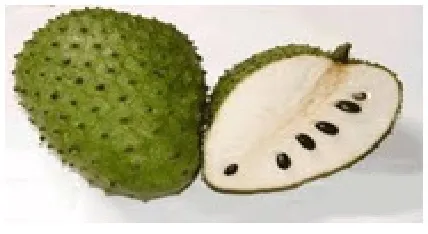
Figure 1 Soursop fruit
We cultivated soursop from Soc Trang province, Vietnam. Soursop fruits should be cultivated following Vietnamese Good Agriculture Practices (VietGAP) to ensure food safety. After harvesting, fruits were stored and carried in laboratory within 4 hours of harvesting. Besides soursop fruit laboratory grade chemicals such as sugar, CaCl2 and ascorbic acid was also used in present study. Lab utensils and equipments included pH meter, weight balance, thermometer, refractometer, cooker, drying oven. During study various physicochemical characteristics such as moisture
content (weighing sample before drying → drying sample to basic weight → weighing sample after drying), total sugar (using Betrand method), soluble dry matter (using hand-held refractometer) and sensory evaluation (score, 1-5 from organoleptic specialists) was evaluated.
Research method
selected. By examing four groups of soursop fruits having different dry matters (11, 13, 15, 17 oBrix) in raw material, the sliced soursop would be dried at 65oC to 14% moisture content. In order to select the right fruit maturity; pH, total acidity, vitamin C, sensory characteristics of raw soursop pulp were analyzed.
Determination of primary treatment time with CaCl2
The soursop pulp having 15 oBrix (sliced in 10mm) must be deeply soaked in 0.5% CaCl2 in wide range of time (2, 4, 6, 8 hours). Then the sliced soursop dried at 65oC to 14% moisture content. In order to select the right time of primary treatment with CaCl2, sensory characteristics of dried soursop slices was evaluated
Determination of blanching time and temperature After selecting the right fruit maturity (15 oBrix), soursop pulp would be peeled, sliced in 10mm depth, soaked in 0.5% CaCl2 for 6 hours and blanched 80, 85, 90, 95oC in 1, 2, 3, 4 minutes. The sliced soursop would be dried at 65oC to 14% moisture content. In order to select the right time and temperature of blanching; the effectiveness of enzymatic inactivation via color characteristic was examined.
Determination of sugar concentration and time of soaking
The soursop pulp having 15 oBrix was sliced 10 mm, soaked in 0.5% CaCl2 for6 hours, blanched at 90oC in 2 minutes, the treated piece would deep soaked in different sugar concentration (46, 48, 50, 52 oBrix) in different time (2, 4, 6, 8 hours) with the present of ascorbic acid 0.2%. The sliced soursop would be dried at 65oC to 14% moisture content. In order to select the right sugar concentration and
time of soaking; sensory characteristic of dried soursop slices were analyzed
Determination of drying temperature
The soursop pulp having 15 oBrix which was sliced 10 mm, soaked CaCl2 0.5% in 6 hours, blanched at 90oC in 2 minutes, the treated piece would be then deep soaked in sugar concentration of 50 oBrix) in 4 hours with the present of ascorbic acid 0.2%. The sliced soursop would be dried at (55, 60, 65, 70oC) to 14% moisture content. In order to select the right drying temperature; we analyzed the weight change and sensory characteristic of dried soursop slices
Observation the shelf-life of finished products The dried soursop slice must be monitored in terms of the changes of aw, color and moisture in finished product by time (2, 4, 6, 8 months) in PA bag to evaluate the product shelf-life.
STATISTICAL ANALYSIS
Data were statistically summarized by Statgraphics Centurion XVII.
RESULT & DISCUSSION
Effect of soursop maturity for processing of dried soursop slices
Fruit maturity is a very important criterion for product quality. Soursop pulp was strongly affected by the maturity. The soursop fruits were nornally all collected at 16 weeks after floral bud formation.10 In this research, we measured soursop maturity via soluble dry matter inside material. 4 samples having different soluble dry matter contents (11, 13, 15, 17 oBrix) were examined. Among these values, optimal soursop maturity was reported at 15 oBrix (Table 1) so this value was choosen for further studies
Table 1
Different soursop pulp maturity for processing
Soluble dry matter (oBrix) pH Total acidity (%) Vitamin C (%mg) Sensory score (1-5)
11 2.6±0.04c 0.91±0.00a 29.11±0.02c 3.17±0.01c
13 2.9±0.02c 0.75±0.01b 32.43±0.03b 3.94±0.02b
15 3.6±0.03b 0.43±0.00c 35.07±0.04a 4.58±0.00a
17 4.0±0.02a 0.39±0.01d 28.22±0.03d 3.15±0.01c
Note: the values were expressed as the mean of three repetitions; the same characters (denoted above), the difference between them was not significant (α = 5%), a was the highest and c was the lowest
The moisture content of different samples ranged from 18.33 to 24.53%, with an average of 21.43% was shown. The pH was between 4.1 and 4.8 with a
Effectiveness of primary treatment time with CaCl2 to sensory characteristics of dried soursop
slices
During processing, some insoluble pectins are lost, and there is an increase of water soluble pectins which cause changes in physical properties, such as texture, leading to tissue softening.12 CaCl2 (0.5%)
treatments strongly affected to sensory characteristics of soursop fruit, especially color and firmness. By 6 hours of treatment with CaCl2 (0.5%), optimal sensory score of soursop was reported during the study (Table 2), so this duration was selected for next level study
Table 2
Effectiveness of treatment time with CaCl2 0.5% to sensory
characteristics of soursop pulp
Time of soaking (hour) Texture score Color score Flavor score Aroma score
2 2.22±0.01c 2.94±0.00c 2.74±0.01c 2.69±0.03c
4 3.18±0.01b 3.45±0.01b 3.28±0.02b 3.33±0.01b
6 4.25±0.03a 4.36±0.02a 4.29±0.02a 4.41±0.02a
8 4.27±0.02a 3.51±0.04b 3.21±0.01b 4.43±0.02a
Note: the values were expressed as the mean of three repetitions; the same characters (denoted above), the difference between them was not significant (α = 5%), a was the highest and c was the lowest
This result was similarl to another research. They demonstrated effect of stepwise blanching with calcium chloride solution on firmness, calcium absorption and microstructural changes of jalapeno peppers.12
Effectiveness of blanching time and temperature
(discoloration), heat treatment help prevent the enzymatic browning reaction. Among different temperature (80, 85, 90, 95oC) and time duration (1, 2, 3, 4 minutes), it was reported that treatment having 90oC temperature for 2 minutes effectively prevent the formation of browing while it maintaining fruit firmness
Blanching strongly affected to pigment formation
Table 3
Effectiveness of blanching time and temperature to enzymatic browning reaction of dried soursop slices
Blanching temperature (oC) Blanching time (minutes) to soursop discoloration (a value)
1 2 3 4
80 65.26±0.06c 66.24±0.03c 67.02±0.05c 68.01±0.01c 85 66.74±0.02b 68.13±0.01b 68.85±0.02b 69.15±0.03b 90 68.13±0.03a 70.24±0.01a 70.29±0.04a 70.31±0.04a 95 68.20±0.01a 70.29±0.04a 70.31±0.07a 70.34±0.02a Note: the values were expressed as the mean of three repetitions; the same characters (denoted above),
the difference between them was not significant (α = 5%), a was the highest and c was the lowest
This result was quite different with data from another research. They used first blanching at 65°C for 4 min with calcium chloride solutions. Then the samples were subjected to the second blanching in acidified water with 2% citric acid at 96°C for 3 min, to completely stop all enzyme activity and attain a balance between tissue and brine acidity.12
Effectiveness of sugar concentration and time of soaking
Sugar supplementation via soaking would
Table 4
Effectiveness of sugar concentration (oBrix) in soaking to sensory characteristics of dried soursop slices
Sugar concentration (oBrix) Sensory score of dried soursop slices by different soaking time (hours)
2 4 6 8
46 3.78±0.01b 3.82±0.02c 3.94±0.02c 4.01±0.04d
48 3.82±0.04b 4.13±0.02b 4.20±0.01b 4.38±0.02b
50 4.03±0.02a 4.65±0.01a 4.67±0.01a 4.70±0.01a
52 4.06±0.03a 4.09±0.03b 4.11±0.03b 4.23±0.03c
Note: the values were expressed as the mean of three repetitions; the same characters (denoted above), the difference between them was not significant (α = 5%), a was the highest and d was the lowest
Treatment of fruit with sugars prevents/ reduces the loss of nutrient during drying, facilitates drying and enhances the organoleptic properties of the dried fruit samples. The results showed that sucrose should be recommended in the drying of fruits as it helps to prevent the loss of fruit nutrient during drying, as well as increase the organoleptic properties of the fruit treated with it.13
Effectiveness of drying temperature
The increasing consumption of dried fruits requires further attention on the quality parameters. Drying has become necessary because most fruits are
highly perishable owing to their high moisture content and the need to make them available all year round and at locations where they are not produced.14 The hot-air drying method could result in a quality product that is characterized by uniform, hygienic, and attractive color of dried fruit and vegetable products.15 The sliced soursop dried at different temperature (55, 60, 65, 70oC) to get down to 15% moisture content. Among the tested temperatures, best results and appearance were obtained at 65 oC, while at 70oC, minor browing discoloration owing to caramel was reported.
Table 5
Sensory score of dried soursop slices by different drying temperature
Drying temperature (oC) Texture score Color score Flavor score Aroma score
55 3.21±0.04d 3.11±0.02d 3.19±0.01d 3.15±0.02c
60 3.79±0.03c 3.85±0.01c 3.90±0.03c 3.94±0.01b
65 4.45±0.02a 4.39±0.01a 4.52±0.01a 4.40±0.01a
70 4.01±0.02b 4.08±0.02b 4.12±0.03b 4.05±0.03b
Note: the values were expressed as the mean of three repetitions; the same characters (denoted above), the difference between them was not significant (α = 5%), a was the highest and d was the lowest
Drying process can cause changes in food surface characteristics which lead to color changes. Changes attributed to carotenoids and other pigments can also be caused by heat and oxidation during drying. In particular, higher drying temperatures and longer drying times were seen to facilitate greater pigment losses.16
Shelf-life of finished product
Table 6
Physico-chemical and sensory characteristics of dried soursop slice by preservation time
Preservation time (months) Water activity (aw) Color (a value) Moisture (%)
2 0.68±0.01a 70.25±0.02a 14.01±0.01a
4 0.68±0.01a 70.23±0.03a 14.01±0.03a
6 0.69±0.00a 70.22±0.01a 14.02±0.01a
8 0.70±0.03a 68.01±0.04b 14.03±0.04a
Note: the values were expressed as the mean of three repetitions; the same characters (denoted above), the difference between them was not significant (α = 5%), a was the highest and b was the lowest
Present study doesn’t use any additive to prolong dried soursop product shelf life. In addition to preservation, the reduced weight and bulk of dehydrated products decreases packaging, handling and transportation costs. Quality changes associated with drying of fruit products include physical, sensory, nutritional, and microbiological. Drying gives rise to low or moderate glycemic index (GI) products with high calorie, vitamin and mineral contents (Adewale O. Omolola et al., 2017).14
AUTHOR CONTRIBUTION STATEMENT
This study focused on the investigation of maturity of soursop fruit, soaking time with CaCl2 0.5%, blanching time and temperature, sugar concentration and time o soaking, and drying temperature to the dried soursop slice quality. Further, shelf-life was also monitored during preservation of product.
CONCLUSION
owing to its pleasant taste and aroma. However, soursop fruit are highly perishable, being very susceptible to bruising and decay. A wide range of studies can be found on fruit processing for soursop fruit. Present study successfully optimized some technical drying parameters for dried soursop slices. By applying different treatment processes, soursop could be preserved with high a product shelf-life.
FUNDING ACKNOWLEDGEMENT
We acknowledge the resources and financial support for the study was provided by Dong A university, Vietnam.
CONFLICT OF INTEREST
Conflict of interest declared none.
REFERENCES
1. Asprey GF, Thornton P. Medicinal plants of Jamaica. West Indian Med .1995; 4: 69–92. 2. Peters m, badrie n, comissiong e. Processing
and quality evaluation of soursop (annona muricata l) nectar. J Food Qual [Internet]. 2001;24(5):361–74. Available from:
http://dx.doi.org/10.1111/j.1745-4557.2001.tb00616.x
3. Samarão SS, Rodrigues LA, Martins MA, Manhães TN, Alvim LA da M. Desempenho de mudas de gravioleira inoculadas com fungos micorrízicos arbusculares em solo não-esterilizado, com diferentes doses de fósforo. Acta Sci Agron [Internet].
2011;33(1):81–8. Available from:
http://dx.doi.org/10.4025/actasciagron.v33i1. 5427
4. Adela M Ceballos Peñaloza; Gloria Inés Giraldo Gómez; Carlos Eduardo Orrego Alzate and Javier Telis-Romero. Sorption thermodynamics of soursop powders obtained
by different dehydration technologies. Rev.Fac.Nal.Agr.Medellín 2013; 66:
7107-7116. Available from :
http://www.scielo.org.co/pdf/rfnam/v66n2/v6 6n2a11.pdf
5. Minh NP. Production of fermented beverage from soursop fruit. Int. J. Pure App. Biosci. 2015;3(2):231-6..
6. Wijewardana RMNA, Nawarathne SB, Wickramasinghe I. Effect of various dehydration methods on proximate composition and retention of antioxidants in different fruit powders. Int Food Res J 2016;
23: 2016-2020.Available from :
http://www.ifrj.upm.edu.my/23%20(05)%202 016/(24).pdf
Available from:
http://dx.doi.org/10.1590/1983-21252016v29n129rc
8. Ho CW, Lazim AM, Fazry S, Zaki UKHH, Lim SJ. Soursop (Annona muricata) vinegar production and its chemical compositions [Internet]. Author(s); 2016. Available from: http://dx.doi.org/10.1063/1.4966774
9. Akpeji S, Adebayo-Tayo B, Sanusi J, Alao S. Production and Properties of Probioticic
Soursop Juice Using Pediococcus
pentosaceus LBF2 as Starter. Int J Biochem Res Rev [Internet]. 2017;17(2):1–10.
Available from:
http://dx.doi.org/10.9734/ijbcrr/2017/32954 10. Carlos Julio Marquez Cardozo1; Jose Regulo
Cartagena Valenzuela and Guillermo Antonio Correa Londono. Determination of soursop (Annona muricata L. cv. Elita) fruit volatiles during ripening by electronic nose and gas
chromatography coupled to mass
spectroscopy. Rev.Fac.Nal.Agr.Medellin 2013; 66: 7117-7128.Available from L http://www.scielo.org.co/pdf/rfnam/v66n2/v6 6n2a12.pdf
11. René G. Degnon, Euloge S. Adjou, Jean-Pierre Noudogbessi, Grâce Metome, Fortune
Boko, Edwige Dahouenon-Ahoussi,
Mohamed Soumanou DCKS. Investigation on nutritional potential of soursop (Annona muricata L.) from Benin for its use as food supplement against protein-energy deficiency. Int J Biosci [Internet]. 2013;3(6):135–44.
Available from:
http://dx.doi.org/10.12692/ijb/3.6.135-144 12. Dinora Judith Palma-Zavala, Armando
Quintero-Ramos, Jorge Jiménez-Castro,
Ricardo Talamás-Abbud, John Barnard, René Renato Balandrán-Quintana and Francisco Solís-Martínez. Effect of stepwise blanching and calcium chloride solution on texture and structural properties of Jalapeno peppers in brine. Food Technol. Biotechnol. 2009; 47: 464–470.Available from : http://www.ftb.com.hr/images/pdfarticles/200 9/October-December/47-464.pdf
13. N.o k, n.c o, j.n n, a.i. p-i, l.o u, . Effects of Sugars on the Drying Of Some Local Fruits and Their Importance on Baked Products-Bread and Cake. IOSR J Environ Sci Toxicol Food Technol [Internet]. 2014;8(3):99–106.
Available from:
http://dx.doi.org/10.9790/2402-083199106 14. Omolola AO, Jideani AIO, Kapila PF.
Quality properties of fruits as affected by drying operation. Crit Rev Food Sci Nutr. 2015;57(1):95–108. Available from: http://dx.doi.org/10.1080/10408398.2013.859 563
15. Roongruangsri, W. and Bronlund, J. E. Effect of air-drying temperature on physico-chemical, powder properties and sorption characteristics of pumpkin powders. Int. Food Res. J. 2016; 23: 962-972.Available from : http://www.ifrj.upm.edu.my/23%20(03)%202 016/(8).pdf