Fitting Multivariate Linear Mixed Model for Multiple
Outcomes Longitudinal Data with Non-ignorable Dropout
Ahmed M. Gad*, Niveen I. EL-Zayat
Statistics Department, Faculty of Economics and Political Science, Cairo University, Egypt
Abstract
Measurements made on several outcomes for the same unit, implying multivariate longitudinal data, are very likely to be correlated. Therefore, fitting such a data structure can be quite challenging due to the high dimensioned correlations exist within and between outcomes over time. Moreover, an additional challenge is encountered in longitudinal studies due to premature withdrawal of the subjects from the study resulting in incomplete (missing) data. Incomplete data is more problematic when missing data mechanism is related to the unobserved outcomes implying what so-called non-ignorable missing data or missing not at random (MNAR). Obtaining valid estimation under non-ignorable assumption requires that the missing-data mechanism be modeled as a part of the estimation process. The multiple continuous outcome-based data model is introduced via the Gaussian multivariate linear mixed models while the missing-data mechanism is linked to the data model via the selection model such that the missing-data mechanism parameters are fitted using the multivariate logistic regression. This article proposes and develops the stochastic expectation-maximization (SEM) algorithm to fit MLMM in the presence of non-ignorable dropout. In the M-step maximizing likelihood function is implemented via a new proposed Quasi-Newton (QN) algorithm that is of EM type, while maximizing the multivariate logistic regression is implemented via Newton-Raphson (NR) algorithm. A simulation study is conducted to assess the performance of the proposed techniques.Keywords
Non-ignorable missing, Selection models, Multivariate linear mixed models, Stochastic EM algorithm, Newton-Raphson, Fisher-Scoring, Quasi-Newton1. Introduction
Longitudinal studies are very common in many fields such as medicine, public health, psychology, biology and more. In the simplest design of univariate longitudinal data a single response is collected repeatedly over time, or possibly under changing experimental conditions, on each subject. A fundamental feature of longitudinal data is that the repeated measurements of the same subject tend to be highly correlated, and even more, such correlations often change over time resulting a complicated covariance structure (Diggle et al, 2002). In many applications it is common to measure a set of several responses, m, at each occasion for subjects which result in multivariate longitudinal data. The relationship among those outcomes is crucial. It requires addressing special methods of statistical analysis that can properly account for the intra-subject correlation as well as the cross-correlation between outcomes since ignoring such
* Corresponding author:
[email protected] (Ahmed M. Gad) Published online at http://journal.sapub.org/ijps
Copyright©2018The Author(s).PublishedbyScientific&AcademicPublishing This work is licensed under the Creative Commons Attribution International License (CC BY). http://creativecommons.org/licenses/by/4.0/
association structure will lead to invalid inferences. Modeling repeated measures on multivariate continuous responses is often implemented via multivariate linear mixed models. The multivariate linear mixed models are more applicable in this area due their flexibility in allowing (i) unbalanced data where a number of repeated measures might differ within subjects per outcome, (ii) using different design matrix across responses, and (iii) modeling distinct and more complex covariance structures. For a comprehensive monograph of multivariate linear mixed models see for example, Demidenko(2004) and Kim and Tim (2007).
modeling process to reduce estimation biases (Little and Rubin, 2002).
Likelihood-Based approach has been established in literature to be one of the most widely-used modern approaches of handling missing data. Parameter estimation has received a serious attention in the missing data literature. However, with non-ignorable assumption, such estimates cannot be obtained unless approaches are developed to model the missing data mechanism (Endres, 2010; Graham, 2012). Therefore, a number of selection model have been proposed to model longitudinal data in the presence of missing values aiming to characterize the joint distribution of data and the probability of missingness (Stubbendick, 2003; Little and Rubin, 2002). Direct maximization of the likelihood function, in this case, is not feasible (Jasson, and Xihong, 2002). So, numerical and iterative computations are exceedingly desired. Three generic iterative approaches such as Newton-Raphson (NR), Fisher Scoring (FS), Quasi-Newton (QN) and Expectation-Maximization (EM). EM algorithm can be used to maximiza the likelihood function. The EM algorithm is a generic iterative approach to find the maximum likelihood estimates (MLEs) for the model parameters when there is missing data or when the model contains unobserved latent variables (Demidenko, 2004).
The multivariate linear mixed models (MLMM) have received more attention in literature particularly under non-ignorable MD. Reinsel (1982, 1984) considered fitting the MLMM by a closed form with complete and balanced data. While Shah et al. (1997) extended the work of Laird and Ware (1982) to the bivariate setting (𝑚=2) using the EM algorithm to obtain the estimates of the model parameters under unbalanced and ignorable missing data. Schafer and Yucel (2002) and later Yucel (2015) proposed a variant technique of EM algorithm again for estimating the MLMM with ignorable missing data. Their EM algorithm considers the fisher scoring procedure in the M-step which fastens the convergence. Under non-ignorable assumption Roy and Lin (2002) consider fitting the MLMM under non-ignorable assumption covering the missingness in covariates as well as the multiple responses. They assumed that the dropout process depends on the latent variable and applied the selection model in order to account for non-ignorable missing data. Luwanda and Mwambi (2016) considered fitting nonlinear mixed-effects models to fit the multivariate longitudinal data in the presence of non-ignorable dropout. They proposed the stochastic approximation EM (SAEM) algorithm and apply the proposed technique to estimate parameters characterising human immunodeficiency virus (HIV) disease dynamics.
The aim of this article is to address statistical modeling of the multivariate longitudinal data with continuous responses via the Gaussian multivariate linear mixed models (MLMM) under non-ignorable incomplete data. The missing-data mechanism is linked to the data model via the selection model such that the missing-data mechanism parameters are fitted using the multivariate logistic regression. The article
proposes a stochastic EM algorithm to estimate the parameters of the model.
The paper is organized as follow. The Multivariate linear mixed model for multivariate longitudinal data is presented in Section 2. This section also presents the dropout model for multivariate longitudinal data and formulates the joint distribution of the dropout mechanism and multivariate longitudinal response in the form of the full likelihood function. Section 3 introduces the proposed method for estimating the multivariate linear mixed model parameters in the presence of non-ignorable dropout. The estimation process involves estimating the dropout parameters and the response model parameters. An SEM algorithm combined with Newton-Raphson approach is proposed to estimate the dropout parameters. Also, a new proposed Quasi-Newton algorithm that is of EM type to estimate the response model parameters. The requied equations for the estimation are derived. In section 4, simulation studies are conducted to evaluate the performance of the proposed technique. Finally, concluding remarks are provided in Section 5.
2. Models and Likelihood Function
In this section we introduce the used models; the multivariate linear mixed model and the dropout model. Also, the needed likelihood functions are defined.
Multivariate linear mixed model (MLMM)
Assume that the number of subjects are N, 𝑖= 1,2, . . . ,𝑁
and there are 𝑛𝑖 repeated measures on each subject. Also, assume that there are 𝑚 outcomes on each subject,
𝑘= 1,2, . . . ,𝑚. The reponses for the subject i are collected in the response matrix 𝐘𝑖= [𝑦𝑖𝑗𝑘]. The 𝑦𝑖𝑗𝑘 denotes the measurement of the 𝑖th subject of the 𝑘th outcome at the
𝑗th occasion. Assume that 𝐘
𝑖= (𝐲𝑖1 𝐲𝑖2 . . .𝐲𝑖𝑚) is the
𝑛𝑖×𝑚 response matrix of the 𝑖th subject where each of
𝐲𝑖𝑘(𝑘= 1,2, . . . ,𝑚) is the 𝑘th response 𝑛𝑖 -vector measuremnets of subject 𝑖. It is very common that some subjects may withdraw from the study prematuraly which results in droput.
The multivariate longitudinal data can be modeled using the multivariate linear mixed model (MLMM), where for the
𝑖th subject the response is modeled as:
𝐘𝑖=𝐗𝑖𝛽+𝐙𝑖𝐛𝑖+𝜀𝑖, 𝑖= 1,2, . . . ,𝑁 (1) where 𝐗𝑖 is the 𝑛𝑖×𝑝 fixed between-subject design matrix,
𝛽 is the 𝑝×𝑚 matrix of fixed effects assumed to be common for all subjects, 𝐙𝑖 is the 𝑛𝑖×𝑞 random within-subject design matrix, 𝐛𝑖 is the 𝑞×𝑚 matrix of random effects, and 𝜀𝑖 is the 𝑛𝑖×𝑚 matrix of the measurements errors associated with the response matrix 𝐘𝑖. The distributional assumptions that are often related to the MLMM are:
The 𝜀̃𝑖=𝑣𝑒𝑐(𝜀𝑖)~𝑁𝑛𝑖𝑚(𝟎𝑛𝑖𝑚,𝚺𝑖=𝚺 ⊗ 𝐈𝑛𝑖; the rows of 𝜀𝑖 are normally distributed with mean 𝟎 and
matrix 𝜀𝑖 vertically.
The random effects 𝐛̃𝑖=𝑣𝑒𝑐(𝐛𝑖)~𝑁𝑞𝑚(𝟎𝑞𝑚,𝚿) , where 𝚿 is 𝑞𝑚×𝑞𝑚 unstructured matrix. Moreover,
𝐛𝑖 and 𝜀𝑖 are assumed to be independent.
The marginal distribution of 𝐘𝑖 has normal distribution with expectation 𝐸(𝐘𝑖) =𝐗𝑖𝛽 and dispersion matrix
𝐕𝑖 of dimension 𝑛𝑖𝑚×𝑛𝑖𝑚;
𝐕𝑖= (𝐼𝑚⊗ 𝐙𝐢) 𝚿 (𝐼𝑚⊗ 𝐙𝐢)′+ (𝚺 ⊗ 𝐈𝑛𝑖). (2) The responses 𝐘𝑖 can be expressed as 𝐲�𝑖=𝑣𝑒𝑐(𝐘𝑖) where 𝐲�𝑖~𝑁𝑛𝑖𝑚(𝜇𝑖= (𝐼𝑚⊗ 𝐗𝐢) 𝛽�,𝐕𝑖) , and can be modelled as:
𝐲�𝑖= (𝐼𝑚⊗ 𝐗𝐢) 𝛽�+ (𝐼𝑚⊗ 𝐙𝐢) 𝐛̃𝑖+𝜀̃𝑖, (3) where 𝑖= 1,2, . . . ,𝑁, and 𝛽�=𝑣𝑒𝑐(𝛽). The p.d.f. of 𝐲�𝑖 is given by
𝑓𝐲�𝑖(𝐲�𝑖) = (2𝜋)− 𝑛𝑖𝑚
2 |𝐕𝑖|−12𝑒−12�[𝐲�𝑖−𝜇𝑖]′𝐕𝑖−1[𝐲�𝑖−𝜇𝑖]�
= (2𝜋)−𝑛𝑖𝑚2 |𝐕𝑖|−12𝑒tr�−12[𝐘𝑖−𝐗𝑖𝛽]𝐕𝑖−1[𝐘𝑖−𝐗𝑖𝛽]′�. (4)
It can be verified that
𝐲�𝑖|𝐛̃𝑖~𝑁𝑛𝑖𝑚�(𝐼𝑚⊗ 𝐗𝐢) 𝛽�+ (𝐼𝑚⊗ 𝐙𝐢) 𝐛̃𝑖,𝚺𝑖�. (5) The complete data likelihood function
Given that the 𝑚 outcomes are fully observed, the complete-data likelihood function of the parameters,
𝜃= (𝛽,𝚿,𝚺), can be obtained as
𝐿1(𝜃) =∏𝑁𝑖=1 𝑓(𝐘𝑖|𝐛𝑖,𝛽,𝚺) ×𝑓(𝐛𝑖|𝚿)
=∏𝑁
𝑖=1 𝑓(𝐘𝑖|𝛽,𝚺) ×𝑓(𝐛𝑖|𝚿)
=∏𝑁
𝑖=1 𝑓(𝐘𝑖|𝜃). (6)
The MLE of 𝜃 can be obtained by maximizing the
likelihood function in Eq. (6). Note that this function is based on the marginal distribution function of the response 𝐘𝑖 in the absence of the random effects. The random effects can be considered as nuisance parameters as long as the major interest is on the variance structure introduced by (𝚺,𝚿). Hence the log-likelihood function, based on Eq. (4) for the whole sample is
ℓ(𝜃) = log�∏𝑁
𝑖=1𝑓𝐲�𝑖(𝐲�𝑖|𝜃)�=∑𝑁𝑖=1log 𝑓𝐲�𝑖(𝐲�𝑖|𝜃)
=−𝑚𝑀2 log(2𝜋)−12∑𝑁
𝑖=1log|𝐕𝑖|−12∑𝑖=1𝑁 𝐫′𝑖𝐕𝑖−1𝐫𝑖,(7)
where 𝜃= (𝛽,𝚿,𝚺), is considered the parameter matrix of interest, 𝑀=∑𝑁
𝑖=1𝑛𝑖, while 𝐫𝑖=𝑣𝑒𝑐(𝐘𝑖− 𝐗𝐢𝛽) =𝐲�𝑖−
(𝐼𝑚⊗ 𝐗𝐢)𝛽�.
A simpler form of the log-likelihood function is given by (Schafer and Yucel, 2002)
ℓ(𝜃) =−𝑚𝑀2 log(2𝜋) +𝑀2log|𝚺−1| +𝑁
2log|𝚿−1|
−12∑𝑁
𝑖=1log|𝐔𝑖−1|−12∑𝑁𝑖=1𝐫′𝑖𝐖𝑖𝐫𝑖, (8) where 𝐔𝑖= (𝚿−1+ (𝚺−1⊗ 𝐙𝑖′𝐙𝑖))−1, and 𝐖𝑖−1=𝐕𝑖.
We assume that the variance-covariance matrices, 𝚿 and
𝚺, are unstructured. Moreover, we represent these matrices in terms of their precision form, 𝚿−1 and 𝚺−1. These forms are obtained as linear functions as.
𝚿−1(𝜔
𝑖𝑗) =∑𝑚𝑞𝑖≥𝑗=1𝜔𝑖𝑗𝜉𝑖𝑗=∑ℎ𝑙=1𝜔𝑙∗ 𝜉𝑙,
𝚺−1(𝜎
𝑖𝑗) =∑𝑚𝑖≥𝑗=1𝜎𝑖𝑗𝜉̇𝑖𝑗=∑𝑔𝑙=1𝜎𝑙∗ 𝜉̇𝑙, (9) where [𝜔𝑙∗] =𝑣𝑒𝑐(𝜓−1) = (𝜔1∗,𝜔2∗, . . . ,𝜔ℎ∗)′ and
ℎ=𝑚𝑞(𝑚𝑞+12 ) is the number of diagnol and off-diagonal
elements of 𝜓−1 . Thus [𝜔
𝑙∗] = [𝜔𝑖𝑗] , such that
{(𝑖,𝑗); 𝑖 ≥ 𝑗,𝑙= [(𝑗 −1)(𝑚𝑞 − 𝑗/2) +𝑖,𝑖,𝑗= 1,2, . . . ,𝑚𝑞] } . Similarly, [𝜎𝑙∗] =𝑣𝑒𝑐(𝚺−1) = (𝜎1∗,𝜎2∗, . . . ,𝜎𝑔∗)′ , 𝑔= 𝑚(𝑚+1)
2 , and [𝜎𝑙∗] = [𝜎𝑖𝑗], such that {(𝑖,𝑗); 𝑖 ≥ 𝑗,𝑙= [(𝑗 −
1)(𝑚 − 𝑗/2) +𝑖,𝑖,𝑗= 1,2, . . . ,𝑚] } (Saber, 2008).
Further, each of 𝜉𝑖𝑗 and 𝜉̇𝑖𝑗 are square matrices of order
𝑚𝑞 and 𝑚, respectively, with one on the (𝑖,𝑗)𝑡ℎ position and zero elsewhere. Hence, the response model parameter vector 𝜃 = (𝑣𝑒𝑐(𝛽)′ 𝜎1∗𝜎2∗. . .𝜎𝑔∗ 𝜔1∗𝜔2∗. . .𝜔ℎ∗) and the total number of parameters is 𝑚𝑝+𝑔+ℎ.
Missing data model and likelihood function
Assume that, for subject 𝑖, 𝐘𝑖 is subject to non-random dropout at a certain occasion 𝑑𝑖> 1; 𝑖= 1,2, . . . ,𝑁). The responses 𝐘𝑖 can be partitioned into two components; the observed part 𝐘𝑖o of dimension (𝑑𝑖−1) ×𝑚 and missing part 𝐘𝑖m of dimension (𝑛𝑖− 𝑑𝑖+ 1) ×𝑚. Also, the response matrix using the 𝑣𝑒𝑐 operator can be partitioned into two parts; 𝐲�𝑖= (𝐲�𝑖o 𝐲�𝑖m)′, where 𝐲�𝑖o=𝑣𝑒𝑐(𝐘𝑖o), and
𝐲�𝑖m=𝑣𝑒𝑐(𝐘𝑖m). Assume that the missing data indicator
𝐑𝑖= [𝑟𝑖𝑗𝑘] of dimension 𝑛𝑖×𝑚 where 𝑟𝑖𝑗𝑘 is defined as
𝑟𝑖𝑗𝑘=�1 if 𝑦0 if 𝑦𝑖𝑗𝑘 is observed, 𝑖𝑗𝑘 is missing.
For monotone missing data we can define 𝐑𝑖= (𝟏 𝟎)′, where 𝟏 is the matrix of ones of dimension (𝑑𝑖−1) ×𝑚 and 𝟎 is the matrix of zeros of dimension (𝑛𝑖− 𝑑𝑖+ 1) ×
𝑚.
The Diggle and Kenward (1994) model has been proposed for univariate longitudinal data setting. We extend this model to the multivariate longitudinal data of 𝑚 outcomes. Assume that the dropout of subject 𝑖 occurs at time 𝑡𝑑𝑖,
𝐇𝑖𝑑𝑖 = (𝐡𝑖𝑙𝐡𝑖2. . .𝐡𝑖𝑚)′ denotes the 𝑚× [𝑑𝑖−1] matrix of observed responses history of the 𝑚 outcomes up to the time 𝑡𝑑𝑖 , where each of 𝐡𝑖𝑘= (𝐲𝑖1𝑘𝐲𝑖2𝑘. . .𝐲𝑖(𝑑𝑖−1)𝑘) corresponds the row vector of length 𝑑𝑖−1 of observed responses of 𝑘th outcome. Diggle and Kenward (1994) modeled the probability of dropout in terms of the history 𝐇𝑖𝑗′ up to occasion 𝑗′ and the possibly missing current response, 𝐲𝑖𝑗′ as 𝑃𝑟(𝐷𝑖=𝑗′|𝐇𝑖𝑗′,𝐲𝑖𝑗′) =
𝑃𝑖𝑗′(𝐇𝑖𝑗′,𝐲𝑖𝑑𝑖,𝜙),𝑗′= 2, . . . ,𝑛𝑖+ 1. This probability is computed for each subject across all occasions as follows:
𝑃𝑟�𝐷𝑖=𝑗′�𝐇
𝑖𝑗′,𝐲𝑖𝑗′�=�∏
𝑑𝑖−1
𝑗′=2 (1− 𝐏𝑖𝑗′)] ×𝐏𝐢𝐝
𝐢 𝑑𝑖≤ 𝑛𝑖
∏𝑑𝑖−1
𝑗′=2 (1− 𝐏𝑖𝑗′)] ×𝐏𝐢𝐝𝐢 𝑑𝑖=𝑛𝑖+ 1,,
(10) where the logit transformation that is used to model that probability, 𝑃𝑖𝑗′ can be obtained by
𝜂𝑖𝑗′= logit(𝐏𝑖𝑗′) = log(1−𝐏𝐏𝑖𝑗′𝑖𝑗′)
=𝜙0+𝜙1𝐲𝑖𝑗′+𝜙2𝐇𝑖𝑗′.
Hence, the dropout probability is obtained via the inverse of the logit transformation as:
𝐏𝑖𝑗′= exp𝜂𝑖𝑗′
exp𝜂𝑖𝑗′+1. (12) The probability 𝐏𝐢𝐝𝐢 can be computed as
𝐏𝐢𝐝𝐢=𝑃𝑟(𝐃𝑖=𝑑𝑖|𝐲𝑑𝑖) =
∫𝑃(𝐇𝑑𝑖,𝐲𝑖𝑑𝑖,𝜙)𝑓(𝐲𝑖𝑑𝑖|𝐇𝑑𝑖,𝜃)𝑑𝐲𝑖𝑑𝑖, (13) where 𝑓(𝐲𝑖𝑑𝑖|𝐇𝑑𝑖,𝜃) is the conditional probability of the missing given the observed responses. Hence the integral in Eq. (13) can be approximated using Monte Carol expectation (Gad and Ahmed, 2006).
The complete-data log-likelihood for the 𝑁 subjects can be given by
ℓ𝐶(𝛾) = log 𝐋𝐶(𝛾) = log ∏𝑁𝑖=1(𝑓(𝐘𝑖,𝐑𝑖|𝛾))
= log ∏𝑁
𝑖=1�𝑓(𝐘𝑖|𝜃) ×𝑓(𝐑𝑖|𝐘𝑖,𝜙)�, (14)
where 𝛾= (𝜃,𝜙) = (𝛽,𝚿,𝚺,𝜙) . Also, it can be
re-expressed as
ℓ𝐶(𝛾) =ℓ(𝜃) +ℓ(𝜙) (15)
The MLEs of the parameters 𝛾 can be obtained
maximizing each of the two components in Eq. (15) separately. Direct maximization is not feasible because it requires multidimensional integration and maximization (Jason and Xihong, 2002). Numerical and iterative computations are exceedingly required.
3. The Proposed SEM Approach
Maximizion of the log-likelihood function can be carried using iterative approaches to obtain the maximum-likelihood estimates (MLEs) such as Newton-Raphson (NR), Fisher Scoring algorithm(FS), Quasi-Newton (QN) and
Expectation-Maximization (EM). Expectation-Maximization algorithm proposed by Dempster
et al. (1977). It overcomes the difficulties involved with obtaining MLEs in the presence of missing values. The EM algorithm generally contains of two main steps; an Expectation step (E-step) and a Maximization step (M-step). For more details see McLachlan and Krishnan (2008). The E-step is often difficult to be evaluated. Celuex (1985) proposes the SEM algorithm as an alternative to the EM by replacing the E-step by a simulation step (S-step). Gad and Ahmed (2006) proposed SEM algorithm to fit the univariate longitudinal data in the presence of non-ignorable dropout.
In this article we propose an SEM algorithm to fit the multivariate linear mixed model for multivariate longitudinal data with non-ignorable dropout. The M-step is implemented via two sub-steps. In the first sub-step the Newton-Raphson algorithm is developed to obtain the MLEs of the dropout parameters 𝜙. In the second sub-step a new type of Quasi-Newton algorithm is proposed to obtain the MLEs of the response parameter 𝜃.
The S-Step (Simulation step)
Let 𝐘𝑖m= (𝐲𝑖𝑑𝑖 | 𝐘𝑖m+) denotes the missing components
of the response matrix 𝐘𝑖 over the 𝑚 outcomes such that
𝐲𝑖𝑑𝑖= (𝐲𝑖𝑑𝑖1,𝐲𝑖𝑑𝑖2, . . . ,𝐲𝑖𝑑𝑖𝑚)′, indicates the first 𝑚𝑖× 1 missing vector, while the second matrix of order 𝑚× [𝑛𝑖−
𝑑𝑖] is introduced by 𝐘𝑖m+= (𝐲𝑖(𝑑𝑖+1),𝐲𝑖(𝑑𝑖+2), . . . ,𝐲𝑖(𝑛𝑖)). In
this step (the S-step), we simulate 𝑚 -vector from
𝑓(𝐲𝑖m|𝐲𝑖o,𝐑𝑖,𝜃(𝑡)) to represent the responses of the 𝑚 outcomes at the time of dropout 𝑑𝑖. This conditional disribution can be factorized, up to a constant of proportionality, as
𝑓�𝐲𝑖m�𝐲𝑖o,𝐑𝑖,𝜃(𝑡)� ∝ �𝐲𝑖m�𝐲𝑖o,𝜃(𝑡)�×𝑓�𝐑𝑖�𝐲𝑖,𝜙(𝑡)�. (16) This conditional distribution has no closed form, so direct simulation is not possible. Following the idea of Gad and Ahmed (2006), we suggest using an accept-reject procedure. A vector of length 𝑚 is simulated from 𝑓(𝐲𝑖m|𝐲𝑖o;𝜃(𝑡)), then it is passed through the following accept-reject procedure;
1. Simulate a candidate 𝑚-vector 𝐲𝑑∗𝑖 = (𝐲𝑑∗𝑖1𝐲𝑑∗𝑖2. . .𝐲𝑑∗𝑖𝑚)′, from the conditional distribution 𝑓(𝐲𝑖m|𝐲𝑖o;𝜃(𝑡)) which is 𝑚-multivariate normal distribution with parameters
𝜇(𝑡) and 𝛀(𝑡); the 𝑚× 1 location vector and the 𝑚×𝑚 dispersion matrix respectively, are given by
𝜇(𝑡) =𝜇
𝑚(𝑡)+𝐕𝑚𝑜(𝑡)(𝐕(𝑡))𝑜𝑜−1(𝐲𝑖o− 𝜇𝑜(𝑡)),
𝛀(𝑡) =𝐕
𝑚𝑚(𝑡) − 𝐕𝑚𝑜(𝑡)(𝐕(𝑡))𝑜𝑜−1𝐕𝑜𝑚(𝑡),
(17)
where (𝐕(𝑡))
𝑜𝑜
−1 is the variance matrix corresponds of the observed response matrix 𝐘𝑖o;
(𝐕(𝑡))
𝑜𝑜= (𝐈𝑚⊗ 𝐙𝑖𝑜) 𝚿𝑜(𝑡) (𝐈𝑚⊗ 𝐙′𝑖𝑜) + (𝚺𝑜(𝑡)⊗ 𝐈𝑛𝑖). 2. Compute the 𝑚-vector probability of dropout for the
candidate vector 𝐲𝑑∗𝑖 based on the dropout model
logit[𝑃𝑟(𝐃𝑖=𝑑𝑖|𝐲𝑑∗𝑖,𝐲𝑑𝑖−1,𝜙)]
=𝜙0(𝑡)+𝜙1(𝑡)𝐲𝑑∗𝑖+𝜙2
(𝑡)𝐲
𝑑𝑖−1, (18) where 𝐲𝑑𝑖−1 comprises the m-vector of responses at (𝑑𝑖−1); the occasion precedes the dropout occasion. The dropout probability vector, 𝐏𝑖= (𝑃𝑖1,𝑃𝑖2, . . . ,𝑃𝑖𝑚)′ , is evaluated using the inverse transformation in Eq. (12). Then define 𝑃𝑖∗=∥ 𝐏𝑖∥.
3. Simulate a random m-vector 𝐔 from uniform
distribution over the interval [0,1], then take 𝐲𝑖m=𝐲𝑑∗𝑖 if ∥ 𝐔 ∥≤ 𝑃𝑖∗, otherwise repeat step 1.
We argue that the remaining missing values, following the first missing value, can be considered as missing at random. The M-Step (Maximization step)
The joint probability function of the pseudo-observed data is
𝑓�𝐲𝑖o,𝐲𝑖𝑑𝑖,𝐑𝑖�𝜃,𝜙�=
∫𝑓(𝐲𝑖o,𝐲𝑖𝑑𝑖,𝐘𝑖m+|𝜃) 𝑓(𝐑𝑖|𝐲𝑖o,𝐲𝑖𝑑𝑖,𝐘𝑖m+;𝜙)𝑑𝐘𝑖m+, (19) where 𝐘𝑖m+=𝑣𝑒𝑐(𝐘𝑖m+). Since 𝐑𝑖 does not depend on
𝐘𝑖m+ by construction, the above equation can be simplified to
Thus the likelihood function for 𝜃 and 𝜙 will be any function of 𝜃 and 𝜙 proportional to 𝑓(𝐲𝑖o,𝐲𝑖𝑑𝑖,𝐑𝑖|𝜃,𝜙). Moreover, based on the selection model, 𝜃 and 𝜙 are assumed to be distinct by definition. Hence,
𝐿(𝜃,𝜙|𝐲𝑖o,𝐲𝑖𝑑𝑖,𝐑𝑖) is the same as likelihood 𝐿(𝜃|𝐲𝑖o,𝐲𝑖𝑑𝑖). The M-step of the algorithm comprises two substeps; the logistic step (M1-Step), and the normal step (M2-Step): The M1-Step (the logistic step):
In this substep the MLEs of the dropout parameter, 𝜙(𝑡),
is estimated numerically using Newton-Raphson approach. A step halfing algorithm is adopted to guarantee that the log-likelihood function increasing toward the maxima over the iterations. Moreover, in case when the Hessian matrix of
𝜙(𝑡) is not negative definite, the Newton direction [−𝐇−1(𝜙
𝑡)𝐠(𝜙𝑡)] may not point in an ascent direction. Therefore, a modification is adopted using the Levenberg-Marquardt technique, to ensure that the search direction is an ascent direction, hence the algorithm guides the process to the maximum point (Chong and Zak, 2013).
The basic Newton-Raphson algorithm is used to obtain the MLEs for the dropout parameters of the multivariate logistic regression model. The algorithm seeks for optimizing, the log-likelihood function
ℓ(𝜙) =∑𝑁−𝑁∗
𝑖=1 [∑𝑑𝑗=2𝑖−1ln(1− 𝐏𝑖𝑗)
+ln 𝐏𝑖𝑑𝑖] +∑𝑁 ∗
𝑖=1∑𝑛𝑗=2𝑖 ln(1− 𝐏𝑖𝑗), (21) where 𝑁∗ refers to the subjects who complete the study (the completers), hence, 𝑁 − 𝑁∗ refers to dropout subjects. The probabilities vector 𝐏𝑖𝑗 is computed using Eq. (11) for any occasion 𝑗= 1,2, . . . ,𝑑𝑖−1, and form Eq. (18) at the occasion of dropout 𝑗=𝑑𝑖. Implementing the algorithm needs computing the gradient 𝐠(𝜙) vector and the Hessian matrix 𝐇(𝜙). First, the elements of the gradient vector 𝐠(𝜙)
are obtained as follow: ∂ℓ(𝜙)
∂𝜙0 =∑ 𝑁−𝑁∗
𝑖=1 (∑𝑑𝑗=2𝑖−1− 𝐏𝑖𝑗+ [1− 𝐏𝑖𝑑𝑖]) +
∑𝑁∗
𝑖=1∑𝑛𝑗=2𝑖 − 𝐏𝑖𝑗 ∂ℓ(𝜙)
∂𝜙1 =∑ 𝑁−𝑁∗
𝑖=1 (∑𝑑𝑗=2𝑖−1− 𝐏𝑖𝑗𝐲𝐢𝐣+ [1− 𝐏𝑖𝑑𝑖]𝐲𝐢𝐝∗𝐢) +
∑𝑁∗
𝑖=1∑𝑛𝑗=2𝑖 − 𝐏𝑖𝑗𝐲𝐢𝐣 ∂ℓ(𝜙)
∂𝜙2 =
∑𝑁−𝑁∗
𝑖=1 (∑𝑑𝑗=2𝑖−1− 𝐏𝑖𝑗𝐲𝐢(𝐣−𝟏)+ [1− 𝐏𝑖𝑑𝑖]𝐲𝐢(𝐝𝐢−𝟏)) +
∑𝑁∗
𝑖=1∑𝑛𝑗=2𝑖 − 𝐏𝑖𝑗𝐲𝐢(𝐣−𝟏),
where 𝐲𝐢𝐣 is the 𝑚-vector of the responses at occasion 𝑗. The elements of the Hessian matrix are obtained as follow:
∂2ℓ(𝜙)
∂𝜙∂𝜙𝑇=∑𝑁−𝑁 ∗ 𝑖=1 (∑𝑑𝑗=2𝑖−1
−𝐏𝑖𝑗2 (1−𝐏𝑖𝑗) 2𝐏𝑖𝑗−1 𝐘̇𝑖𝑗𝐘̇𝑖𝑗
′ +
𝐏𝑑 (1−𝐏𝑑)2 2𝐏𝑑−1 𝐘̇𝑖𝑑𝐘̇𝑖𝑑
′)
+∑𝑁−𝑁∗
𝑖=1 (∑𝑛𝑗=2𝑖 𝐏𝑖𝑗2𝐘̇𝑖𝑗𝐘̇𝑖𝑗′ −[1− 𝐏𝑖𝑑]2𝐘̇𝑖𝑑𝐘̇𝑖𝑑′)
+∑𝑁∗
𝑖=1∑𝑛𝑗=2𝑖 (
−𝐏𝑖𝑗2 (1−𝐏𝑖𝑗) 2𝐏𝑖𝑗−1 𝐘̇𝑖𝑗𝐘̇𝑖𝑗
′ +𝐏
𝑖𝑗2𝐘̇𝑖𝑑𝐘̇𝑖𝑑′ ),
where 𝐘̇𝑖𝑗= [𝟏 𝐲𝑖𝑗 𝐲𝑖(𝑗−1)]′ is the response matrix of order (𝑚× 3).
It is worth noting that at an initial value 𝜙0 that might be chosen at which the Hessian matrix 𝐇(𝜙) is not negative definite, the Levenberg-Marquardt modification of Newton’s algorithm will be adopted. That approach approximates 𝐇(𝜙) with another matrix 𝐇𝑎, such that
𝐇𝑎=𝐇 − 𝜇𝐼, where the scalar 𝜇 is chosen large enough such that 𝐇𝑎 is negative definite (Chong and Zak, 2013).
The M2-Step (the normal step):
In this substep the MLEs of the parameters, 𝜃(𝑡)= �𝛽(𝑡),𝚿(𝑡),𝚺(𝑡)�, for the multivariate normal is estimated
numerically using a new proposed approach of Quazi-Newton type. The proposed Quazi-Newton algorithm begins with initial values of 𝐇∗with 𝐇
0
∗=𝐐̈−1(𝜃 0,𝜃0), where 𝐐̈(𝜃0,𝜃0) is computed as
𝐐̈(𝜃0,𝜃0) =∂ 2𝐐(𝜃,𝜃(𝑡))
∂𝜃 ∂𝜃′ |𝜃=𝜃(𝑡)=𝜃0, (22) where 𝜃0 is the initial values vector of the parameter 𝜃 and the function 𝐐(𝜃,𝜃(𝑡)) as in the EM algorithm. Generally,
the algorithm proceeds as follows:
1. Initiate the algorithm with 𝜃=𝜃0, then compute the corresponding 𝐇0∗ and 𝐠0, where 𝐠0 is the gradient of the observed log-likelihood function.
2. Compute the step direction vector 𝐝=−𝐇∗𝐠, then use the line search algorithm to specify 𝛼 that
maximizes ℓ(𝜃+𝛼𝐝) . The Golden-Section
algorithm is adopted here to specify the single parameter 𝛼 that maximize ℓ(𝜃+𝛼𝐝) along the search direction 𝐝 from the point 𝜃.
3. Set Δ𝜃=𝛼𝐝, and compute Δ𝐠=𝐠(𝜃+Δ𝜃)− 𝐠. 4. Based on 𝐇∗,Δ𝜃, and Δ𝐠, Δ𝐇∗ can be evaluated as
Δ𝐇∗= (1 +Δ𝐠′𝐇𝑡∗Δ𝐠 Δ𝐠′Δ𝜃 )
Δ𝜃Δ𝜃′ Δ𝐠′Δ𝜃−
Δ𝜃Δ𝐠′𝐇𝑡∗+𝐇 𝑡 ∗Δ𝐠Δ𝜃′ Δ𝐠′Δ𝜃 . 5. Replace 𝜃 by 𝜃+Δ𝜃, 𝐠 by 𝐠+Δ𝐠, and 𝐇∗ by
𝐇∗+Δ𝐇∗ and return to step (2) or stop based on a stopping criterion.
To implement the above algorithm, the quantities
𝐐(𝜃,𝜃(𝑡)), 𝐠(𝜃), 𝐐̇(𝜃
0,𝜃(𝑡)), and 𝐐̈(𝜃0,𝜃(𝑡)) are needed. Deviations of such quantities are obtained as follows. First, the EM-quantity, 𝐐(𝜃,𝜃(𝑡)) =𝐸[ℓ
𝐶|𝜃(𝑡),𝐘𝑖o], can be easily deduced by taking the expectation of the log-likelihood of the complete-data given the observed responses 𝐘𝑖o and the current values of the parameter vector 𝜃(𝑡). This function is
given by
𝐐(𝜃,𝜃(𝑡)) =−𝑚𝑀
2 log(2𝜋) + 𝑀
2log|𝚺−1| + 𝑁
2log|𝚿−1|
−12∑𝑁
𝑖=1log|𝐔𝑖−1|−12∑𝑁𝑖=1tr(𝐖𝑖𝐓𝑖), (23) where 𝐓𝑖=𝐸[vec(𝐘𝑖𝑐− 𝐗𝑖𝛽)vec(𝐘𝑖𝑐− 𝐗𝑖𝛽)′|𝜃(𝑡),𝐘𝑖o] and 𝐘𝑖𝑐 indicates the complete-data response matrix. To compute this expectation, set 𝐘�𝑖𝑐 = vec(𝐘𝑖𝑐− 𝐗𝑖𝛽),where
𝐘�𝑖𝑐~𝑁𝑛𝑖𝑚(𝟎𝑛𝑖𝑚,𝐕𝑖=𝐖𝑖−1) . Further the complete-data matrix, 𝐘𝑖𝑐 , is partitioned into [𝐘𝑖m,𝐘𝑖o] , similarly,
𝐸[𝐘�𝑖𝑐|𝜃(𝑡),𝐘𝑖o] =𝐕21𝐕11−1 𝐘�𝑖o,
where 𝐕11 is the square submatrix of 𝐕𝑖 corresponding to the observed elements, and 𝐕21 is the rectangle sub-matrix of covariances between the missing and the observed elements. On the other hand, it also can be shown that
𝐸[𝐘�𝑖𝑐 (𝐘�𝑖𝑐)𝑇|𝜃(𝑡),𝐘𝑖o]
= �𝐘�𝑖o(𝐘�𝑖o)𝑇 𝐘�𝑖o(𝐘�𝑖o)𝑇𝐕11−1𝐕12
𝐕21𝐕11−1𝐘�𝑖o(𝐘�𝑖o)𝑇 𝐕22+𝐕21𝐕11−1(𝐘�𝑖o(𝐘�𝑖o)𝑇− 𝐕11)𝐕11−1𝐕12�, where 𝐕22 is the square submatrix of covariances between the missing elements.
The gradient of the observed log-likelihood, 𝐠(𝜃), is derived as
∂ℓ(𝜃)
∂𝑣𝑒𝑐(𝛽)=−(∑𝑁𝑖=1𝐗̇𝑖′ 𝑊𝑖𝐗̇𝑖)vec(𝛽 − 𝛽�),
∂ℓ(𝜃)
∂𝜔𝑘𝑠= 1
2∑𝑁𝑖=1tr([ 𝚿 − 𝐔𝑖 ] ∂𝜓−1 ∂𝜔𝑘𝑠− 𝐫′𝑖𝐖𝑖𝐙̇𝑖𝚿 ∂𝜓−1 ∂𝜔𝑘𝑠𝚿𝐙̇′𝑖𝐖𝑖𝐫𝑖), ∂ℓ(𝜃) ∂𝜎𝑙𝑡 = 1
2∑𝑁𝑖=1tr(𝑛𝑖𝚺 ∂𝚺−1 ∂𝜎𝑙𝑡− 𝐔𝑖[ ∂𝚺−1 ∂𝜎𝑙𝑡 ⊗ 𝐙′𝑖𝐙𝑖]− 𝐫′𝑖𝐖𝑖[𝚺∂𝚺 −1 ∂𝜎𝑙𝑡𝚺 ⊗ 𝐈𝑛𝑖]𝐖𝑖𝐫𝑖), where, vec(𝛽�) = (∑𝑁
𝑖=1𝐗̇𝑖′ 𝑊𝑖 𝐗̇𝑖)−1(∑𝑁𝑖=1𝐗̇𝑖′ 𝑊𝑖vec(𝐘𝑖)),
𝐗̇𝑖= (𝐈𝑚⊗ 𝐗𝑖), and 𝐙̇𝑖= (𝐈𝑚⊗ 𝐙𝑖). Further, ∂𝜓 −1 ∂𝜔𝑘𝑠 and ∂𝚺−1
∂𝜎𝑙𝑡 are replaced with (2− 𝛿𝑘𝑠)𝜉𝑘𝑠 and (2− 𝛿𝑙𝑡)𝜉̇𝑙𝑡 , respectively, such that, the scalar 𝛿𝑘𝑠 which is intensively known as Kronecker delta, equals 1 when 𝑘=𝑠 and 0 otherwise, where 𝑘 ≥ 𝑠= 1,2, . . . ,𝑚𝑞 , while 𝑙 ≥ 𝑡= 1,2, . . . ,𝑚.
The second derivatives of the EM-𝑄 function are needed. The computation of the first and the second derivative of the EM-𝑄 function are
∂𝐐(𝜃,𝜃(𝑡))
∂vec(𝛽) =−(∑𝑁𝑖=1𝐗̇𝑖′ 𝑊𝑖𝐗̇𝑖)vec(𝛽 − 𝛽̇),
∂𝐐(𝜃,𝜃(𝑡))
∂𝜔𝑘𝑠 = 1
2∑𝑁𝑖=1tr([ 𝚿 − 𝐔𝑖 ] ∂𝜓−1 ∂𝜔𝑘𝑠− 𝐖𝑖𝐙̇𝑖𝚿 ∂𝜓−1 ∂𝜔𝑘𝑠𝚿𝐙̇′𝑖𝐖𝑖𝐓𝑖), ∂𝐐(𝜃,𝜃(𝑡)) ∂𝜎𝑙𝑡 = 1
2∑𝑁𝑖=1tr(𝑛𝑖𝚺 ∂𝚺−1 ∂𝜎𝑙𝑡 − 𝐔𝑖[ ∂𝚺−1 ∂𝜎𝑙𝑡⊗ 𝐙′𝑖𝐙𝑖] − 𝐖𝑖[𝚺∂𝚺 −1 ∂𝜎𝑙𝑡𝚺 ⊗ 𝐈𝑛𝑖]𝐖𝑖𝐓𝑖), where vec(𝛽̇) = (∑𝑁
𝑖=1𝐗̇𝑖′ 𝑊𝑖 𝐗̇𝑖)−1(∑𝑁𝑖=1𝐗̇𝑖′𝑊𝑖 𝐓̇𝑖) and
𝐓̇𝑖=𝐸[vec(𝐘𝑖𝑐)|𝜃,𝐘𝑖o]. ∂2𝐐(𝜃,𝜃(𝑡))
∂vec(𝛽)∂(vec(𝛽))′=− ∑𝑁𝑖=1𝐗̇𝑖′ 𝑊𝑖 𝐗̇𝑖, ∂2𝐐(𝜃,𝜃(𝑡))
∂𝜔𝑘𝑠∂(vec(𝛽))′=
∂2𝐐(𝜃,𝜃(𝑡))
∂𝜎𝑙𝑡∂(vec(𝛽))′= 0, ∂2𝐐(𝜃,𝜃(𝑡))
∂𝜔𝑘′𝑠′∂𝜔𝑘𝑠=− 1
2∑𝑁𝑖=1tr([𝜓 ∂𝜓−1 ∂𝜔𝑘′𝑠′𝜓 ∂𝜓−1 ∂𝜔𝑘𝑠]− [𝐔𝑖 ∂𝜓 −1 ∂𝜔𝑘′𝑠′𝐔𝑖 ∂𝜓−1 ∂𝜔𝑘𝑠]
+2𝐖𝑖𝐙̇𝑖𝚿∂𝜓 −1
∂𝜔𝑘′𝑠′𝚿𝐙′̇𝑖𝐖𝑖𝐙̇𝑖𝚿 ∂𝜓−1
∂𝜔𝑘𝑠𝚿𝐙′̇𝑖𝐖𝑖𝐓𝑖
−2𝐖𝑖𝐙̇𝑖𝚿∂𝜓 −1 ∂𝜔𝑘′𝑠′𝚿
∂𝜓−1
∂𝜔𝑘𝑠𝚿𝐙′̇𝑖𝐖𝑖𝐓𝑖) ∂2𝐐(𝜃,𝜃(𝑡))
∂𝜔𝑘𝑠∂𝜎𝑙𝑡 =− 1
2∑𝑁𝑖=1tr([−𝐔𝑖 ∂𝜓−1 ∂𝜔𝑘𝑠𝐔𝑖(
∂𝚺−1
∂𝜎𝑙𝑡⊗ 𝐙𝑖′𝐙𝑖)]
+2𝐖𝑖𝐙̇𝑖𝚿∂𝜓 −1
∂𝜔𝑘𝑠𝚿𝐙′̇𝑖𝐖𝑖(𝚺
∂𝚺−1
∂𝜎𝑙𝑡 𝚺 ⊗ 𝐈𝑛𝑖)𝐖𝑖𝐓𝑖) ∂2𝐐(𝜃,𝜃(𝑡))
∂𝜎𝑙′𝑡′∂𝜎𝑙𝑡 =− 1
2∑𝑁𝑖=1tr(𝑛𝑖𝚺 ∂𝚺−1 ∂𝜎𝑙′𝑡′𝚺 ∂𝚺−1 ∂𝜎𝑙𝑡 −𝐔𝑖(∂𝚺 −1 ∂𝜎𝑙′𝑡′⊗ 𝐙𝑖′𝐙𝑖)𝐔𝑖( ∂𝚺−1 ∂𝜎𝑙𝑡⊗ 𝐙𝑖′𝐙𝑖)
+2𝐖𝑖(𝚺∂𝚺 −1
∂𝜎𝑙′𝑡′𝚺 ⊗ 𝐈𝑛𝑖)𝐖𝑖(𝚺 ∂𝚺−1
∂𝜎𝑙𝑡𝚺 ⊗ 𝐈𝑛𝑖)𝐖𝑖𝐓𝑖
−2𝐖𝑖(𝚺∂𝚺 −1 ∂𝜎𝑙′𝑡′𝚺
∂𝚺−1
∂𝜎𝑙𝑡𝚺 ⊗ 𝐈𝑛𝑖)𝐖𝑖𝐓𝑖),
For a parameter 𝜃, the SEM estimates is taken as the mean of the sequence {𝜃(𝑡)} as
𝜃�=𝑇−𝑇1
0∑
𝑇
𝑗=𝑇0+1𝜃(𝑗), (24) where 𝑇 is the total number of SEM iterations while 𝑇0 is the length of burn-in period.
In the above derivations of the gradient vector and the derivatives of the EM-Q function, the quantities; ∂𝜓∂𝜔−1
𝑘𝑠 and ∂𝚺−1
∂𝜎𝑙𝑡 are replaced with (1−0.5𝛿𝑘𝑠)[𝑒𝑘𝑒′𝑠+𝑒𝑠𝑒′𝑘] and
(1−0.5𝛿𝑙𝑡)[𝑒𝑙𝑒′𝑡+𝑒𝑡𝑒′𝑙], respectively. The scalar 𝛿𝑘𝑠 is
Kronecker delta which equals 1 when 𝑘=𝑠 and 0
otherwise, where 𝑘 ≥ 𝑠= 1,2, . . . ,𝑚𝑞. Similarly the scalar
𝛿𝑙𝑡 is defined for 𝑙 ≥ 𝑡= 1,2, . . . ,𝑚. The vector 𝑒𝑘 is the basis vector of length 𝑚𝑞 with 𝑘𝑡ℎ element equals 1 and all other elements are zeros.
4. Simulation Study
The aim of this simulation is to evaluate the performance of the proposed approach. The evaluation criteria is the relative bias.
Simulation Setting and data generation
Two sample sizes were assumed; 𝑁1= 25, and 𝑁2= 50 to generate data. The number of outcomes for each subject is assumed to be three outcomes; 𝑚= 3. The number of time points is fixed at 10; 𝑛𝑖= 10. The number of replications is chosen as 200. It is assumed that subjects are allocated to one of three treatments A, B, and C. Hence, there are a matrix of dimension 3 × 3 of fixed-effects 𝛽 of the three covariates across the three outcomes. The subject-specific design matrix is assumed to have two columns (𝑞= 2); the random intercept and slope. Such that, the two subject-specific covariates (𝑧1𝑖,𝑧2𝑖) = (1 0) , for odd subject, and
(𝑧1𝑖,𝑧2𝑖) = (1 1), for even subjects. Also the random design matrix 𝐙𝑖 is assumed to be time-invariant. Consequently, the individual level matrix of random-effect parameters is 𝐛𝑖 is of order (2 × 3) . It represents the parameters of random-effects across outcomes. This matrix is generated for
each subject as
where 𝚿 is of dimension 6 × 6 assumed to be unstructured matrix. The measurement errors associated with the three outcomes are assumed to be independent over the repeated measure having a common unstructured variance-covariance matrix 𝚺 of dimension 3 × 3. Hence, for each subject the matrix 𝜀𝑖 is generated from a matrix normal distribution of parameters 𝑀𝑉𝑁(10×3)(𝟎,𝚺𝑖=𝚺 ⊗ 𝐈10). The true value of the elements of the parameter matrices; 𝛽,𝚺, and 𝚿 are assumed as
𝛽=�1−3 2−2 3−1 2 3 4 �,𝚺=�
3.5 0.2 −2.2 0.2 0.5 1.1 −2.2 1.1 4.7 �, and
𝚿=
⎣ ⎢ ⎢ ⎢ ⎢
⎡7.2−0.9 5.3−0.9 4.8−0.1 0.10.2 10.4 2.21.6
4.8 −0.1 6.3 2.4 0.1 1.7
0.2 0.1 2.4 5.1 −2.5 0.4
1.0 0.4 0.1 −2.5 3.6 0.9
2.2 1.6 1.7 0.4 0.9 3.4⎦⎥ ⎥ ⎥ ⎥ ⎤ .
The response matrix 𝐘𝑖, for each subject, is generated from the model
𝐘𝑖=𝐗𝑖𝛽+𝐙𝑖𝐛𝑖+𝜀𝑖,𝑖= 1,2, . . . ,𝑁𝑠,𝑠= 1,2. (25) The missing data model is
logit(𝐏𝑖𝑗) =𝜙0+𝜙1𝐲𝑖𝑗+𝜙2𝐲𝑖(𝑗−1), (26)
where each of 𝐏𝑖𝑗,𝐲𝑖𝑗, and 𝐲𝑖(𝑗−1) is a 3-column vector,
indicates the probabilities of dropout at the occasion 𝑗
associated to the vector of responses, the vector of responses that were planned to be measured at occasion j, and the vector of responses at the previous occasion (𝑗 −1), respectively. However, if the dropout occasion, for a subject
𝑖, is specified as 𝑑𝑖, then the dropout probability is computed as a probability of the dropout time 𝐷𝑖 at all possible occasion as follow
𝑃𝑟(𝐷𝑖) = ([∏𝑑𝑗=2𝑖−1(1− 𝐏𝑖𝑗)] ×𝐏𝐢𝐝𝐢)𝐼(𝐷𝑖)[𝑑𝑖≤10]
+(∏10
𝑗=2(1− 𝐏𝑖𝑗))𝐼(𝐷𝑖)[𝑑𝑖=11].
For each subject, the response matrix generated in the previous step is exposed to a non-random dropping process on the occasion level. Precisely, at occasion 𝑗, after the baseline (𝑗 ≥2), the response vector 𝐲𝑖𝑗 has been checked to be whether retained or dropped as follow:
1. The initial values for the parameter vector of logistic dropout model is assumed to be
𝜙= [−0.4 2.4 −2.7].
2. The probability vector 𝑃𝑖𝑗 is computed based on Eq. (26).
3. A random variable 𝑈 is generated from uniform (0,1). 4. The response vector 𝐲𝑖𝑗 is dropped if ∥ 𝑃𝑖∥≥ 𝑈,
otherwise it is retained. Simulation Results
The proposed approach introduced has been applied to data. For each of the two maximization steps the stopping criterion that is suggested in Demidenko (2004) is used. Precisely, the iteration will be terminated if the norm value of the absolute difference of two successive values of the gradient vector at fixed parameter values is less that 0.0001.
To accelerate the algorithm the study adopted the Levenberg-Marquardt technique to modify each of the Hessian matrix of the dropout parameters and the second derivative matrix of the Q function of the model precision parameters, to be negative definite. The SEM algorithm is iterated for 500 iterations with a burn-in period of 250 iterations. The MLEs for the parameters were taken as the averages of the last 250 iterations. The performance of the proposed approach is evaluated via the relative bias (RB) of its obtained MLEs, which was computed as follow:
𝑅𝐵(𝜃�) =|𝜃�−𝜃|𝜃|| × 100.
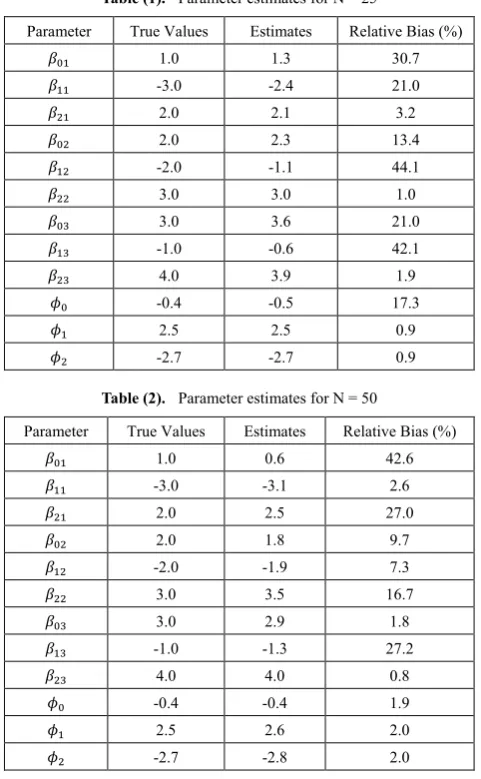
The parameter estimates are displayed in Table (1) for
𝑁=25 and Table (2) for 𝑁=50.
Table (1). Parameter estimates for N = 25
Parameter True Values Estimates Relative Bias (%)
𝛽01 1.0 1.3 30.7
𝛽11 -3.0 -2.4 21.0
𝛽21 2.0 2.1 3.2
𝛽02 2.0 2.3 13.4
𝛽12 -2.0 -1.1 44.1
𝛽22 3.0 3.0 1.0
𝛽03 3.0 3.6 21.0
𝛽13 -1.0 -0.6 42.1
𝛽23 4.0 3.9 1.9
𝜙0 -0.4 -0.5 17.3
𝜙1 2.5 2.5 0.9
𝜙2 -2.7 -2.7 0.9
Table (2). Parameter estimates for N = 50
Parameter True Values Estimates Relative Bias (%)
𝛽01 1.0 0.6 42.6
𝛽11 -3.0 -3.1 2.6
𝛽21 2.0 2.5 27.0
𝛽02 2.0 1.8 9.7
𝛽12 -2.0 -1.9 7.3
𝛽22 3.0 3.5 16.7
𝛽03 3.0 2.9 1.8
𝛽13 -1.0 -1.3 27.2
𝛽23 4.0 4.0 0.8
𝜙0 -0.4 -0.4 1.9
𝜙1 2.5 2.6 2.0
𝜙2 -2.7 -2.8 2.0
intercept). It almost does not exceed 27.0% approximately. Thus, the proposed approach show higher performance with large sample sizes.
5. Conclusions and Future Research
The study introduces a new estimating approach for modeling multiple outcomes longitudinal data under the multivariate linear mixed model (MLMM) in the presence of non-ignorable missingness. The missing pattern was assumed to be monotone, such that the 𝑚 outcomes have the same pattern of dropout, while the covariates were assumed to be fully observed. To obtain valid estimates of the model parameters, the study incorporates the model of missing data into the estimation process via the logit selection model. The SEM algorithm is used as estimation approach. The S-Step of the algorithm was implemented via accept-reject principle for simulating the 𝑚-vector of outcomes at the dropout occasion from the specified distribution. The algorithm suggested two maximization steps; M1-Step to maximize the likelihood function of the dropout parameters of the multivariate logistic model, and M2-Step to maximize the likelihood function of the response model parameters. The study proposed a novel algorithm to implement the second maximization which is a new form of Quasi-Newton algorithm that incorporates EM-related quantity which is the Q function. The resulted proposed approach is a QN of EM-type.
The proposed approach in efficient in at least major two respects. It suggested using a new version of Quasi-Newton algorithm that embedded with some EM quantities. It takes the advantage of the EM algorithm in handling incomplete data by augmenting the missing and the observed observation to produce better estimates. However, it avoids complicated computation of the EM algorithm due to its iterating on the E-step which is infeasible with models with multi-parameters. So, it suggested computing the matrix of the second derivatives of the 𝑄 function with respect to the current guess of the precision parameters only once to initiate the basic Quasi-Newton algorithm.
Some possible extensions to the current study are recommended for further investigation. The current study could be extended assuming the intermittent pattern. Consequently, different likelihood function for the missing data mechanism parameters should be derived to fit such pattern. Moreover, it is very practically to violate the assumption that all outcomes have the same pattern of missingness. Violating such assumption will cause a considerable modification in the computation of the 𝑄
function. One further extension is to admit possible missing covariates. This will motivate incorporating missing data mechanism of the covariates into the estimation process.
It is very common to assume that the measurement errors within subjects are autocorrelated. It is possible to extend the variance structure of the errors from 𝚺𝑖=𝚺 ⊗ 𝐈𝑛𝑖 to be
𝚺𝑖=𝚺 ⊗ 𝐑𝑖, where the matrix 𝐑𝑖 can take a simple
autoregressive pattern. However, this will imply estimating more parameters.
The performance of the proposed approach is evaluated by a simulation study assuming three outcomes. The study is needed to be extended to check its applicability for a higher number of outcomes.
REFERENCES
[1] Celeux, G. (1985) The SEM algorithm: A probabilistic teacher algorithm derived from the EM algorithm for the mixture problem, Computational statistics quarterly, 2, 73–82.
[2] Chong, E. K. & Zak, S. H. (2013) An introduction to optimization (Fourth Edition), Wiley.
[3] Demidenko, E. (2004) Mixed models: Theory and applications, Wiley.
[4] Diggle, P. J., Heagerty, P. J., Liang, K.-Y., Zeger, S. (2002) Analysis of longitudinal data, Oxford University Press. [5] Dempster, A. P., Liard, N. M., and Robin, D. B. (1977)
Maximum Likelihood from Incomplete Data Via EM Algorithm (With Discussion), Journal of Royal Statistical Society B, 39, 1-38.
[6] Diggle, P. & Kenward, M. G. (1994) Informative drop-out in longitudinal data analysis, Applied Statistics, 43, 49–93. [7] Enders, C. K. (2010) Applied missing data analysis (Second
Edition), The Guilford Press, New York.
[8] Gad, M. A. and Ahmed, A. S. (2006) Analysis of longitudinal data with intermittent missing values using the stochastic EM algorithm, Computational Statistics and Data Analysis, 50, 2702 - 2714.
[9] Graham, J. W. (2012) Missing data: Analysis and design, Springer. New York.
[10] Jamshidian, M. & Jennrich, R. I. (1993) Conjugate gradient acceleration of the EM algorithm, Journal of the American Statistical Association, 88, 221–228.
[11] Kim, K. & Tim, N. (2007) Univariate and multivariate general linear models: Theory and applications with SAS (2nd
Edition), Chapman & Hall, New York.
[12] Laird, N. M. &Ware, J. H. (1982) Random-effects models for longitudinal data, Biometrics, 38, 963–974.
[13] Little, R. J. A. & Rubin, D. B. (2002) Statistical analysis with missing data (2nd Edition), Wiley.
[14] Luwanda, A. G. & Mwambi, H. G. (2016) A nonlinear mixed-effects model for multivariate longitudinal data with dropout with application to HIV disease dynamics, Journal of Agricultural, Biological, and Environmental Statistics, 21(2), 277–294.
[15] McLachlan, G. J. & Krishnan, T. (2008) The EM algorithm and extensions (2nd Edition), Wiley.
covariance structure, Journal of the American Statistical Association, 77, 190–195.
[17] Reinsel, G. (1984) Estimation and prediction in a multivariate random effects generalized linear model, Journal of the American Statistical Association, 79, 406–414.
[18] Roy, J. & Lin, X. (2002) Analysis of multivariate longitudinal outcomes with non-ignorable dropouts and missing covariates: Changes in methadone treatment practices, Journal of the American Statistical Association, 97, 40–52. [19] Rubin, D. B. (1976) Inference and missing data, Biometrika,
63, 581–592.
[20] Schafer, J. L. & Yucel, R. M. (2002) Computational strategies for multivariate linear mixed-effects models with missing values, Journal of Computational and Graphical Statistics, 11, 437–457.
[21] Seber, G. A. F. (2008) A matrix handbook for statisticians, Wiley.
[22] Shah, A., Laird, N. & Schoenfeld, D. (1997) A random-effects model for multiple characteristics with possibly missing data, Journal of the American Statistical Association, 92, 775–779.
[23] Stubbendick, A. L. & Ibrahim, J. G. (2003) Maximum likelihood methods for non-ignorable missing responses and covariates in random effects models, Biometrics, 59, 1140–1150.