WATER-BORNE BACTERIAL PATHOGENS IN SURFACE WATERS
OF NAIROBI RIVER AND HEALTH IMPLICATION TO COMMUNITIES
DOWNSTREAM ATHI RIVER
ABEDNEGO M. MUSYOKI1*, MBARUK A. SULEIMAN2, JOHN N. MBITHI1, AND 3JOHN M. MAINGI
1
Department of medical laboratory sciences, Kenyatta University, P. O box 43844 - 00100, Nairobi, Kenya
2
Mt. Kenya University, P.O box 342 – 01000, Thika, Kenya
3Department of plant and microbial sciences, Kenyatta University, P. O box 43844 - 00100, Nairobi, Kenya
ABSTRACT
The quality of surface water in Nairobi River and the adjacent river Athi was assessed to ascertain whether it meets local and international microbiological standards for safe human consumption. Standard bacteriological techniques were used to describe bacteria content from water samples collected from the two confluent sources. The waters were highly contaminated with human pathogenic bacteria. The most dominant bacteria in combined waters of the two rivers was Escherichia coli (1.0 x 10⁴ ± 2.6 x 10³ / 100 mL) while the least was Shigella flexneri (1.2 x 101 ± 1.2 x 101 / 100 mL). Other bacteria were Klebsiella aerogenes (7.4 x 101 ± 1.8 x 101 / 100 mL), Enterococcus faecalis (3.6 x 10³ ± 3.2 x 10³ / 100 mL), Salmonella typhi (2.1 x 10² ± 1.3 x 10² / 100 mL), Pseudomonas aeruginosa (6.5 x 10² ± 1.1 x 10² / 100 mL), Salmonella paratyphi (1.6 x 101 ±1.1 x 101 / 100 mL), and Vibrio cholerae (5.6 x 10² ± 1.0 x 10² / 100 mL). Microbiological quality of the surface water was unacceptably high above compliance level of national standards, and the World Health Organization (WHO) guidelines for drinking water and agricultural use. The water from these rivers is not potable, and poses a health risk to communities that rely on the rivers as primary sources of domestic and subsistence irrigation use. These findings in water scarce region of the world underline the challenges a number of developing countries are facing currently and in long-term into the future. Lessons learnt in this study would suggest appropriate measures are necessary to control pollution of similar rivers in sub-Saharan regions in particular and developing countries in general to ensure availability of clean water supplies to large concentrated populations in cities within the Millennium Development Goals.
KEY WORDS: Microbiological water quality, bacterial pathogens, low-income countries, water scarce region.
INTRODUCTION
Pollution of river waters with deleterious microbes, including bacteria, viruses, parasites, as well as fungi, has been on steady increase in the recent past (Niyogi, 2005; Abraham et al., 2007). The major source of microbes in water is faeces from human and other mammals. Entry of pathogens into rivers can occur either from a point source, non- point sources or both. Non- point
concentration of pathogens in the water (Niyogi, 2005). Waterborne pathogens present a greater health risk to people using river water for drinking, bathing, irrigation of crops eaten raw, fishing, and recreational activities (Liu et al.,
2006; Hellweger and Masopust, 2008). In order to reduce waterborne disease outbreaks World
Health Organization (WHO) developed
microbiological quality guidelines based on intended water uses. The guidelines stipulate that faecal coliforms (FC) should not exceed 103 per 100 mL of water to be used in irrigation of crops that are eaten uncooked, sports fields, and public parks in unrestricted regions (WHO, 1989). Environmental Protection Agency (EPA) standard is stricter, and requires zero (0) FC / 100 mL of water to be used in irrigation of any food crops not commercially processed including crops eaten raw (EPA, 1992). Kenya standard for drinking water quality states that no Escherichia coli, Shigellae, Pseudomonas aeruginosa or coliforms should be detectable in 250 mL of drinking water (WASREB, 2006). The Nairobi River traverses Nairobi, a city with population over 3 million, and flows along a number of informal settlements such as Mathare, Korogocho, and Dandora that are inhabited by poor people with young children. It receives effluent discharged from the city sewage treatment plant, before emptying its water into Athi River that runs for over 400km to the Indian Ocean. Wastewater generated by inhabitants of megacities contaminates rivers traversing them (Abraham, 2010). Yet, human pathogen content of Nairobi River is unknown. The combined waters of Nairobi and Athi rivers are extensively used by an estimated 4 million people, for drinking, and agricultural irrigation downstream. Residents of the capital city and nearby towns use the crops irrigated with the river water. Most of the farm produce grown with contaminated water including tomatoes, onions and carrots are eaten raw. Epidemiologic reports show a correlation between use of river water contaminated with pathogenic bacteria and disease outbreaks (Nyogi, 2005; Hammer et al.,
2006; Abraham et al., 2007). It is important to assess the human pathogens associated with the Nairobi and Athi rivers with the aim of reducing and controlling disease burdens of downstream communities.
MATERIALS AND METHODS
Study area
The study was carried out in Nairobi River, which traverses Kenyan capital city, Nairobi. The samples were taken from 500 meters (m) upstream of the largest sewage treatment plant, Dandora Sewage Treatment Plant (DSTP), to a major tributary, Athi River that is about 23 kilometers (km) downstream. The Nairobi River has its catchment on the Kikuyu and Limuru Hills that are to western side, and within the outskirts of the city. Beyond the city, the river flows along six informal settlements composed of shacks built out of cardboards, iron sheets, and gunny bags. The informal settlements include: - Mathare, Korogocho, Kyambiu, Soweto, Dandora, and Njiru. At the DSTP site in Ruai the river receives partially treated effluent (UN-HABITAT, 2007). The combined Nairobi and Athi river water constitute the primary source of water for domestic and agricultural farming by downstream communities in urban centres of Machakos, Makueni, Kitui, Taita Taveta and Malindi before emptying into the Indian Ocean as river Sabaki.
Study design
The study design was purposive. Sampling points were deliberately chosen to account for the microbial loads in the Nairobi River before and after discharge of DSTP, and bacterial load that enter the receiving waters of Athi River. The sampled wastewater volumes and depth of sampling were as recommended by standard methods for water and wastewater examination (APHA, 1998). Five sampling points were mapped in the Nairobi and Athi rivers. Sampling points in the Nairobi River were located 500 m upstream and downstream of the treatment plant effluent, and downstream, 500 m confluence with the Athi River. In Athi River sampling points were located 500 m upstream before entry of Nairobi River and 500 m downstream after confluence.
Wastewater sampling procedures
millilitres polypropylene bottles. The samples were then transported to DSTP laboratory in ice packed cooler boxes and analyzed within two hours of collection.
Isolation and characterization
of bacterial isolates
Bacterial types were determined by serial dilution and plating of water samples on differential culture media. The isolates were identified and biochemically characterized following the methods described in Bergey’s Manual of Systematic Bacteriology (Kreig and Holt, 1984).
2.5 Data Analysis
Statistical Package for the Social Sciences (SPSS) version 16 for Windows was used to calculate
means and Standard Deviations and the data is tabulated. Student t - test is used to test the significance of microbial loads in river Nairobi and Athi.
RESULTS
Bacteria in Nairobi River
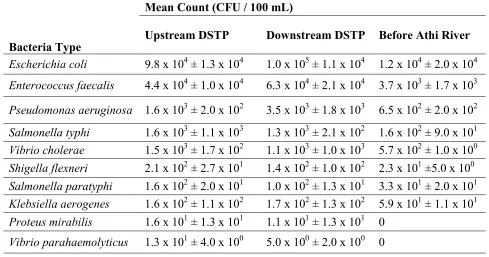
The bacterial types found in river Nairobi, 500 meters upstream of DSTP effluent were
Escherichia coli, Klebsiella aerogenes, Enterococus faecalis, Salmonella typhi, Salmonella paratyphi, Pseudomonas aeruginosa, Vibrio cholerae, Vibrio parahaemolyticus, Proteus mirabilis and Shigella flexneri (Table 1).
Table 1
Bacterial types in Nairobi River
The concentration of Escherichia coli in Nairobi River increased by tenfold after discharge of DSTP effluent, while V. parahaemolyticus level decreased by the same magnitude. The concentration of the other bacterial types remained similar after the effluent. Downstream
the DSTP effluent, about a distance of 23 km to Athi River, the levels of all bacterial types reduced by tenfold, and P. mirabilis and P. parahaemolyticus were not found in water entering Athi River.
Bacteria Type
Mean Count (CFU / 100 mL)
Upstream DSTP Downstream DSTP Before Athi River
Escherichia coli 9.8 x 10⁴ ± 1.3 x 10⁴ 1.0 x 10⁵ ± 1.1 x 10⁴ 1.2 x 10⁴ ± 2.0 x 10⁴
Enterococcus faecalis 4.4 x 10⁴ ± 1.0 x 10⁴ 6.3 x 10⁴ ± 2.1 x 10⁴ 3.7 x 10³ ± 1.7 x 10³
Pseudomonas aeruginosa 1.6 x 10³ ± 2.0 x 10² 3.5 x 10³ ± 1.8 x 10³ 6.5 x 10² ± 2.0 x 10²
Salmonella typhi 1.6 x 10³ ± 1.1 x 10³ 1.3 x 10³ ± 2.1 x 10² 1.6 x 10² ± 9.0 x 101
Vibrio cholerae 1.5 x 10³ ± 1.7 x 10² 1.1 x 10³ ± 1.0 x 10³ 5.7 x 10² ± 1.0 x 100
Shigella flexneri 2.1 x 10² ± 2.7 x 101 1.4 x 10² ± 1.0 x 10² 2.3 x 101 ±5.0 x 100
Salmonella paratyphi 1.6 x 10² ± 2.0 x 101 1.0 x 10² ± 1.3 x 101 3.3 x 101 ± 2.0 x 101
Klebsiella aerogenes 1.6 x 10² ± 1.1 x 10² 1.7 x 10² ± 1.3 x 10² 5.9 x 101 ± 1.1 x 101
Proteus mirabilis 1.6 x 101 ± 1.3 x 101 1.1 x 101 ± 1.3 x 101 0
Table 2
Bacterial types isolated from Athi River
Bacteria Type
Mean Count (CFU / 100 mL)
Before entry of Nairobi River After entry of Nairobi River
Escherichia coli 1.1 x 10² ± 1.3 x 10² 1.0 x 10⁴ ± 2.6 x 10³
Salmonella typhi 7.6 x 101 ± 1.0x 101 2.1 x 10² ± 1.3 x 10²
Enterococcus faecalis 6.5 x 101 ± 1.7 x 101 3.6 x 10³ ± 3.2 x 10³
Vibrio cholerae 4.9 x 101± 1.2 x 101 5.6 x 10² ± 1.0 x 10²
Klebsiella oxytoca 3.4 x 101 ± 1.4 x 101 7.4 x 101 ± 1.8 x 101
Pseudomonas aeruginosa 5.0 x 100 ± 2.0 x 100 6.5 x 10² ± 1.1 x 10²
Salmonella paratyphi 0 1.6 x 101 ±1.1 x 101
Shigella flexneri 0 1.2 x 101 ± 1.2 x 101
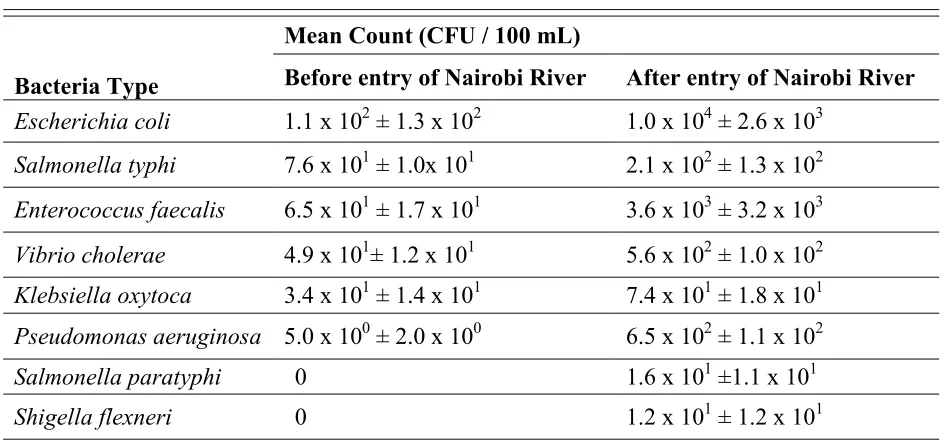
Microorganisms found in the Athi River water samples were similar to those found in Nairobi River, 500 m upstream, before the two rivers join each other (Tables 1 and 2). In Athi River S. paratyphi and S. flexneri were isolated only after
confluence with Nairobi River. The
concentration for all bacteria types, except K. aerogenes, increased by 1 to 2 tenfold after entry of Nairobi River water. In general, the concentration of bacteria in Athi River was significantly lower than observed for Nairobi River (F ꞊ 13.638; p ꞊ 0.009).
DISCUSSION
In this study, we assessed the bacteriological quality of the river of metropolitan capital city of Kenya in East Africa, Nairobi River. Water sampling was started from 500 m upstream of Dandora Sewage Treatment Plant (DSTP) effluent to a 400 Km long Athi River that is about 23 km to the east of the city. River Athi flows and empties into the Indian Ocean. Bacteriological quality of river Athi was tested from 500 m before entry, and similarly after the entry of river Nairobi water. It was found that the two rivers to be highly contaminated with pathogenic bacteria (Tables 1 and 2). These results are in agreement with those of Doughari
et al. (2007) and Niyogi (2005) in Gudu stream in Abuja, Nigeria and Tietĕ River in Brazil
(Abraham, 2010). For instance, an estimated that 200 million liters of untreated human sewage from Varanasi city in India are discharged into the Ganges River every day, with consequent high bacterial concentration of up to 108 per 100 mL being reported downstream (Hamner et al., 2006). The bacterial concentration reported in Ganges River is higher than that obtained in the river Nairobi during this study even though the Varanasi City population of more than one million is lower than the Nairobi city population (3.5 million). Hide et al. (2001) reported microbial levels higher than the current study at Njiru Bridge, approximately 10 kilometer upstream of DSTP. The difference in results of these studies suggest a positive impact of a massive clean-up campaign of river Nairobi which was being undertaken by National Environmental Management Authority (NEMA) in conjunction with the Ministry of Metropolitan and the City Council of Nairobi (CCN) during the period of the current study.
According to UN-Habitant (2007), river Nairobi receives improperly treated effluents from the DSTP. This corroborates our finding of one (1) log increase in concentration of E. coli
after entry of DSTP effluent. Although in seemingly reduced numbers and concentrations, the bacteria isolated from samples drawn after DSTP effluent were also isolated downstream about 23 km into river Athi. This corroborates findings in Tietˆe River in Brazil, where concentrations of pathogenic bacteria including
S. flexneri, S. boydii, and E. coli considerably declined after 30 km, although it was still reported about 100 km downstream from S˜ao Paulo to Salto (Niyogi, 2005; Abraham et al.,
2007). Levels of Bacterial pathogens decline downstream a river as result of river assimilation but they may persist and travel for a long distance posing public health risk to downstream populations relying on the river for primary water source (Abraham, 2010). Although assimilation of bacteria occurs relatively fast, this was not the case in river Nairobi. There was only one (1)-log reduction in bacterial concentration from the treatment plant to river Athi, 23 km downstream except for P. mirabilis and V. parahaemolyticus that were completely assimilated. This finding is in contrast to that of Okoronkwo and Odeyemi (2003) in Nigeria,
where three (3)-log reductions of bacterial concentration was reported over 10 km stretch. Survival period of pathogens in river water is usually short; however, there may be niches where they survive for longer (Ho et al., 2003). The niches may include animal faeces carried into rivers by rain surface run-off, non-point source pollution (Venglovsky et al., 2009). This explains the low reduction in bacterial concentration in river Nairobi. Agricultural farming including livestock rearing and crop irrigation were evident during this study post-treatment, which suggests the probable sources of microbes in the water analyzed downstream.
The population dependant on river Athi is about 3 million (CBS, 2009). Crops irrigated with this water are consumed locally and some sold to inhabitants of the metropolitan capital City of Nairobi and the environs. Epidemiologic reports have associated use of raw river water with waterborne disease outbreaks. Hamner et al.
(2006) associated water-borne disease occurrences including acute gastrointestinal disease, cholera, dysentery, hepatitis- A, and typhoid with the use of Ganges River in India for bathing, laundry, washing eating utensils, and brushing teeth. Water from river Athi was highly contaminated with human pathogenic bacteria contrary to the WHO guideline value of zero (0)
education to avoid consumption of untreated water from these rivers, are vital to ensure the public health protection.
CONCLUSION
The microbiological contamination of Nairobi and Athi rivers was unacceptably high as per Kenya standards, and WHO guidelines for drinking water and agricultural use. The water is not potable, and it poses a health risk to communities that rely on the two rivers as a primary source for domestic use. The findings suggest that water from these rivers is not potable, and poses a health risk to communities that rely on the rivers as primary sources of domestic and subsistence irrigation use. These findings in water scarce region of the world underline the challenges a number of developing countries are facing currently and in long-term into the future. Lessons learnt in this study would suggest appropriate measures to control pollution of similar rivers in sub-Saharan regions in
particular and developing countries in general to ensure availability of clean water supplies to large concentrated populations in cities within the Millennium Development Goals. Regular monitoring of the water microbiological quality, and public health education to avoid consumption of untreated water from these rivers, are vital to ensure the reduced water-borne disease burden in low-income countries.
ACKNOWLEDGEMENTS
The authors wish to acknowledge Kenyatta University for the approval of this research project. We should also express our gratitude to Nairobi City Water and Sewage Company for granting research permission and access to Dandora sewage treatment plant laboratory. Finally, we thank the staff members at Dandora sewage treatment plant laboratory, Kimenyi, Linet, Felista, and Jane, for their cooperation and assistance during the study period.
REFERENCES
1. Abraham WR, Macedo AJ, Gomes LH and Tavares FCA. Occurrence and resistance of pathogenic bacteria along the Tietˆe River downstream of S˜ao Paulo in Brazil. Clean. 2007; 35 (4): 339–347.
2. Abraham WR. Megacities as source for pathogenic bacteria in rivers and their fate downstream. Intl. J. Microbiol. 2010; 10 (1155): 13.
3. APHA. Standard methods for the
examination of water and wastewater. American Public Health Association, American Water Works Association and Water Pollution Control Federation, Washington, DC. 1998.
4. Bitton G. Wastewater Microbiology. Wiley-Liss, inc. 2005:109 – 257.
5. CBS. Population and Housing Census Report of 2009. Central Bureau of Statistics. 2010 6. Donovan E, Unice K, Roberts JD, Harris M
and Finley B. Risk of gastrointestinal disease associated with exposure to pathogens in the water of the lower Passaic River. Appl. Environ. Microbiol. 2008; 74: 994 - 1003.
7. Doughari J, Dodo J and Mbuh F. Impact of Effluent from Gudu District Sewage Treatment Plant on Gudu Stream in Abuja, Nigeria, J. Appl. Sci. Environ. 2007; 11 (1): 79 – 83.
8. EPA. Guidelines for Water Reuse.
Washington, DC, Environmental Protection Agency. 1992; Technical Report no. EPA/625/R-92/004).
9. Grabow WOK. Waterborne Diseases: Update on Water Quality Assessment and Control. Water SA. 1996; 22, 193–202.
10. Hamner S, Tripathi A and Mishra RK. The role of water use patterns and sewage pollution in incidence of water-borne/enteric diseases along the Ganges River in Varanasi, India. International Journal of Environmental Health Research. 2006; 16 (2):113–132.
12. Hide M, Hide F and Kimani J. Informal Irrigation in the Peri-Urban Zone of Nairobi, Kenya: An Assessment of Surface Water Quality Used for Irrigation. HR Wallingford Ltd. Howbery Park, Wallingford. 2001; Report OD/TN 105.
13. Ho KC, Chow YL and Yau JTS. Chemical and microbiological qualities of The East River (Dongjiang) water, with particular reference to drinking water supply in Hong Kong. Chemosphere. 2003; 52 (9): 1441– 1450.
14. Kreig NR and Holt JG. Bergey’s Manual of Systematic Bacteriology. 2nd edn. Williams and Wilkins, Baltimore. 1984:353 – 514. 15. Liu L, Phanikumar MS, Molloy SL, Whitman
RL, Shively DA, Nevers MB, Schwab DJ and Rose JB. Modelingthe transport and inactivation of E. coli and Enterococci in the near-shore region of Lake Michigan. Environ. Sci. Technol. 2006; 40: 5022-5028. 16. Medema GJ, Payment P, Dufour A,
Robertson W, Waite M, Hunter P, Kirby R and Anderson Y. Safe drinking water: an ongoing challenge. In assessing microbial safety of drinking water. Improving approaches and method; WHO & OECD, IWA Publishing. 2003; 11–45.
17. Niyogi K. Shigellosis. J. Microbiol. 2005; 43 (2): 133-143.
18. Okoronkwo N. and Odeyemi O. Effects of a sewage lagoon effluent on the water quality of the receiving stream. Environ. pollution
series A, Ecologic. and Biologic. . 2003; 37 (1): 71 – 86.
19. Petersen TM, Rifai HS, Suarez MP, Stein AR. Bacteria loads from point and nonpoint sources in an urban watershed. J. Environ. Eng. 2005; 131 (10): 1414 - 1425
20. UN-HABITAT. (ed.) Tibaijuki A. Cities can achieve more sustainable land use if municipalities combine urban planning and
development with environmental
management: Nairobi and its environment. 2007.
21. UN-HABITAT. Rapid Urban Sector
Profiling for Sustainability (RUSPS): Mavoko urban sector profile. United Nations Human Settlements Programme Regional Office for Africa and the Arab States. 2006. 22. Venglovsky J, Sasakova N and Placha I.
Pathogens and antibiotic residues in animal manures and hygienic and ecological risks related to subsequent land application. Bioresource Technology. 2009; 100 (22): 5386–5391.
23. WASREB. Drinking Water Quality and Effluent Monitoring Guidelines, Water Service Regulatory Board, Kenya. 2006. 24. WHO. Guidelines for Drinking water quality,
first addendum to third edition vol. 1. World Health Organization Press, Geneva, Switzerland. 2006.