Available Online at www.ijpret.com 1368
INTERNATIONAL JOURNAL OF PURE AND
APPLIED RESEARCH IN ENGINEERING AND
TECHNOLOGY
A PATH FOR HORIZING YOUR INNOVATIVE WORK
ANDROID APPLICATION FOR SEARCHING AND SHOPPING BASED ON
CLOUD
DR. H. R.DESHMUKH, ANKIT RAVANKAR, LALIT VIRULKAR, DHIRAJ GHAGARE, RAHIL KHAN
Department of Computer Engineering, Dr. Rajendra Gode Institute of Technology & Research, Amravati, Maharashtra, India Professor, RGITA, Amravati.
Accepted Date: 15/03/2016; Published Date: 01/05/2016
\
0
Abstract: This paper describes the design and development of an android shopping application for Amravati city. It elaborates and shows offers and deals of particular malls and local market. Application shows offers but also provide analytics to the seller. Whole application is organized on cloud. The three-tier architecture includes front-end, middle-ware and back-end. The front-end level consists of product-based mobile shopping application for android mobile devices, for purchasing miscellaneous products from malls and nearby local markets. Front-end level also displays association among the purchased items. The middle-ware level offers a web service to generate JSON (JavaScript Object Notation) yield from the relational database. It exchanges info and data between application and servers in cloud. The back-end level offers the Linux Based Hosted server and MySQL database. This application is based on cloud that provides application as a service to user.
Keywords: Association Rule Mining, JSON, Product Based Service, Mobile Cloud Computing, Apriori.
Corresponding Author: DR. H. R.DESHMUKH Access Online On:
www.ijpret.com
How to Cite This Article:
Available Online at www.ijpret.com 1369 INTRODUCTION
The idea behind this paper to bring the importance of local search app that made to give faster results for such things. The local market is very far from Internet, This paper is made to introduce the importance of local market and surroundings, for that we focusing on the searching Application that brings all the information in front of you using data mining. There are several mining algorithms of association rules. One of the most popular algorithms is Apriori that is used to extract frequent item sets from large database and getting the association rule for discovering the knowledge. The implementation of Apriori algorithm plays vital role in the data mining. This research implements association rule mining on the data gathered from mobile application. This application is specially designed for product purchasing in the city for malls and local market nearby the customer location. It uses Wi-Fi and mobile network to get current position of the customer and displays any registered malls and markets on server from customer’s search product. Association rule mining as a technique of data mining is used to find the product and offers associated with products. Technically, data mining is the process of extraction of interesting information or patterns from data in large database. Association rule mining is widely used in market basket analysis. This method benefits retailers in numerous ways for marketing or planning shelf space. A product-based mobile application for any product shopping was designed and developed to find nearby malls and stores in local markets, association among the products purchased, display association to customer side screen, post order, and it is deployed on cloud. The computing process solves the problem of inadequate computing power of smart devices. Web facilities are used to manage the connection between front-end and back-end.
II. METHODS AND MATERIAL
a. Related Work
The application based on data mining for quick result and has been implemented by Apriori Algorithm. Graphical user interface (GUI) was designed by using product based services and association rule mining. This section discusses the existing projects related to these techniques.
b. Mobile Cloud Computing
Available Online at www.ijpret.com 1370 is used for storage. Data is easily stored and retrieve on the cloud. The app data is stored on Linux based hosted server and then on cloud. The following architecture shows the mobile app cloud computing. Architecture shows Front layer, Middle layer and Cloud layer.
Figure1: Mobile Cloud Computing
c. Association Rule Mining
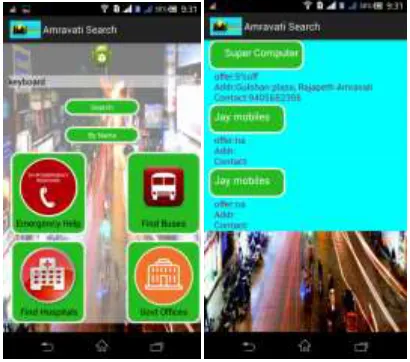
Available Online at www.ijpret.com 1371 Figure2: Searching a product & Result after mining
The algorithm compares keyword enter by user with frequency of data matched with database on cloud and shows the mined result.
System Architecture
The architecture of shopping application is divided into three parts as: Front end, Middle ware level and backend.
Figure 3: System Architecture.
Available Online at www.ijpret.com 1372 nearby location. The registered retailers can upload and remove their own offers and advertisement from this application. When user search for specific offers of showroom in mall, then the request is send to middleware level that is to the Web Service. Web service is act like interface for front-end and back-end. The data exchange between front-end and back-end of shopping application happens via middleware level. Android shopping application sends HTTP Request and Web Service will sends Query to fetch requested data from MySQL database located on cloud [3]. JSON unique for data communication with any programming language. As shown in figure 3 JSON is present in middleware which runs in four steps. In first step, application send HTTP request to web service. Request is accepted in JSON format and in second step the response generated by MySQL, web service is also in JSON format. The query is send back to MySQL database to obtain data from back end. In the third step, Web service generates JSON response which is send to android application, JSON object needed to decode using String which is displayed on application screen. Using JSON, when it comes to mobile application it does not have any specific tag format, which avoids the bandwidth requirement. The output of query is the parsed at android application with the help of JSON.
ASSOSIATION RULES
Association rule is a technique which is looking for a relationship among an item with other items. Association rule is generally cast of ‘if’ and ‘then’ such as ‘if X then Y and Z’, these shows if X then Y and Z. To define the Association's rules, it needs to be stated the support and confidence to limit whether the rule is interesting or not.
Support: A measure that shows how much the level of dominance of an item or item set of the overall transaction
Confidence: A measure that shows the association between items in a conditional (e.g. how frequently purchased item Y if the person buying the item X).
Apriori Algorithm
The Apriori Algorithm is an influential algorithm for mining frequent item sets for Boolean association rules.
Key Concepts:
Available Online at www.ijpret.com 1373 Apriori Property: Any subset of frequent itemset must be frequent.
Join Operation: To find Lk , a set of candidate k-itemsets is generated by joining Lk-1 with itself.
Algorithm
Join Step: Ck is generated by joining Lk-1with itself
Prune Step: Any (k-1)-itemset that is not frequent cannot be a subset of a frequent k-itemset
Pseudo-code: Ck: Candidate itemset of size k
Lk : frequent itemset of size k
L1 = {frequent items};
for ( k = 1; Lk != ∅; k++) do begin
Ck+1 = candidates generated from Lk;
for each transaction t in database do
increment the count of all candidates in Ck+1 that are contained in t
Lk+1 = candidates in Ck+1 with min_support
end
return ∪k Lk;
CONCLUSION
Available Online at www.ijpret.com 1374 FUTURE WORK
In future works we can focus on small organization more precisely. Application can feature more options like providing home delivery and also the payment gateways. A deep market survey is need to done in order to provide marketing and sells for such developers and products.
ACKNOWLEDGEMENTS
We would like to thank all academic staff and all the guides for supporting us in research project.
REFERENCES
1. X. Wu, V. Kumar, J. Ross Quinlan, J. Ghosh, Q. Yang, H. Motoda, G. J. McLachlan, A. Ng, B. Liu, P. S. Yu, Z.-H. Zhou, M. Steinbach, D. J. Hand, and D. Steinberg, “Top 10 algorithms in data mining,” Knowledge and Information Systems, vol. 14, no. 1, pp. 1–37, Dec. 2007.
2. S. Rao, R. Gupta, “Implementing Improved Algorithm Over APRIORI Data Mining Association Rule Algorithm”, International Journal of Computer Science And Technology, pp. 489-493, Mar. 2012
3. H. H. O. Nasereddin, “Stream data mining,” International Journal of Web Applications, vol. 1, no. 4, pp. 183–190, 2009.
4. F. Crespo and R. Weber, “A methodology for dynamic data mining based on fuzzy clustering,” Fuzzy Sets and Systems, vol. 150, no. 2, pp. 267–284, Mar. 2005.
5. R. Srikant, “Fast algorithms for mining association rules and sequential patterns,” UNIVERSITY OF WISCONSIN, 1996.