Policy-relevant population health research:
new approaches and opportunities
GUEST EDITORS
Sally Redman
A,C, Beth Stickney
Band Jo Mitchell
BAThe Sax Institute B
Centre for Epidemiology and Research, NSW Department of Health
C
Corresponding author. Email: [email protected]
The use of evidence from research in the development and evaluation of health policy and practice has the potential to improve both health outcomes and resource allocation. The potential value of evidence from research in health policy has been recognised by the New South Wales (NSW)
Government in the State Health Plan1which promised to:
Build national and international research collaborations, to speed the transfer of the best research evidence from across the world to drive health policy and practice in NSW.
At the national level, recent work has emphasised the need for an evidence-based approach to public policy and has suggested ways to build and utilise an effective evidence
base.2–4 Leaders of governments in the United States,5
the United Kingdom (UK)6,7 and Australia8 support the
increased use of evidence in policy. The 58th session of the World Health Assembly acknowledged the importance of this issue in passing a resolution requesting the Director-General of the World Health Organization (WHO) to:
yassist in the development of more effective mechan-isms to bridge the divide between ways in which know-ledge is generated and ways in which it is used, including the transformation of health research findings into policy and practice.9,10
While the benefits are agreed, opportunities to use existing research to inform policy and practice and to generate
new and useful information are often missed. In his review
of the Medical Research Council in the UK, Cooksey11
noted that:
The UK is at risk of failing to reap the full economic, health and social benefits that the UK’s public investment in health research should generateyThe Review identi-fied cultural, institutional, and financial barriers to translating research into practice.
Similarly in Australia the 1998 Health and Medical Research Review, the Virtuous Cycle (known as the Wills Review), emphasised the need for ‘priority-driven research that contributes directly to population health and evidence-based health care’, particularly the need to routinely inte-grate research-based knowledge into health policy and
practice.12 This message was restated in the subsequent
review, Sustaining the Virtuous Cycle, chaired by John Grant (2004). The report noted the need for a greater focus on strategic research and the development of the infrastruc-ture needed to enable the transfer of research results into
policy and practice.13
Challenges and opportunities
How can we increase the use of evidence from research in health decision making? Over the past 10 years there has been an explosion of interest in grappling with this issue. For research to make an optimal impact on policy, better use should be made of existing evidence from research by improving the access of policy makers to research findings. Equally important is the generation of new research findings that are more relevant and useful to policy makers in Australia – in turn, this will require greater research capacity, research expertise and tools and infrastructure. There is a growing literature about the barriers to using evidence in policy and a wealth of different models to bring policy and research closer together that are being implemen-ted both in Australia and internationally. However, a recent
Vol. 22(1–2) January–February 2011
ISSN 1034 7674
NSW PUBLIC HEALTH
BULLETIN
review by Moore et al14found only five studies that had attempted to evaluate the impact of strategies to increase the use of evidence from research in health policy or practice.
In the next 10 years, the development of a more strategic approach will be critical; this will require a shared under-standing of different strategies, more explicit testing of what works and what doesn’t, and a more careful selection of the best approaches for support by government.
Innovative approaches
This issue of the NSW Public Health Bulletin aims to
contribute to the development of a shared understanding by describing some of the current innovative approaches to generating relevant research and increasing the use of evidence from research, particularly in NSW. The issue focuses on population health research (i.e. research rele-vant to the health status of groups or whole populations), though some authors in this issue and in the broader literature use the term ‘public health research’ to refer to this body of work.
Space has required us to be selective and there are many other interesting strategies – we note, for example, the Policy Liaison Initiative, a partnership between the Australasian Cochrane Collaboration and the Commonwealth Depart-ment of Health and Ageing designed to increase the use of systematic reviews and the forums conducted by the Menzies Centre for Health Policy to stimulate debate. Other examples in NSW are the Sax Institute’s Evidence Check Program and the Centre for Informing Policy in Health with Evidence from Research (CIPHER). Evidence Check helps policy makers commission rapid reviews of research – over 70 reviews have been commissioned through the program
and an evaluation has been undertaken.15CIPHER is a new
National Health and Medical Research Council Centre of Research Excellence that will develop and test interventions to increase the use of evidence in policy and build methods for evaluating these interventions.
In this context, NSW Health’s development of a population health research strategy is timely. The paper by Biggs and Stickney outlines the development of this strategy and its three main themes: the generation of high quality, relevant, population health research; maximising the use of popula-tion health research evidence; and building our capability for population health research. The paper illustrates how a review of strategic documents from other jurisdictions and countries, and consultations with key stakeholders, were used to design a set of actions to assist the Population Health Division of the NSW Department of Health to use more efficiently funds currently devoted to supporting research. A snapshot of the resulting actions highlights the importance of communication and collaboration.
The issue includes initiatives that receive either direct or indirect infrastructure support from NSW Health. Three
case studies of different approaches to generating evidence that is more relevant to policy and programs, and which use this infrastructure funding, are highlighted. The paper by Milat et al demonstrates the value of a long term relation-ship between government and researchers which is focused on areas of mutual interest (the Physical Activity, Nutrition
and Obesity Research Group). Banks et al (the45 and Up
Study) and Irvine and Taylor (the Centre for Health Record Linkage) describe ways in which large-scale data sets and data linkage infrastructure can be used to provide accurate and timely information for health policy decisions.
Two papers describe more integrated approaches to gen-erating and using evidence from research. The paper by Ritter presents the Drug Policy Modelling Program and the use of computer modelling as a translational tool to bridge the divide between research and policy. This approach links three separate elements: generating new evidence based on policy priorities; translating evidence; and study-ing policy processes includstudy-ing the impact of media on illicit drug policy. The paper by Perkins et al provides an insight into the Australian Rural Health Research Colla-boration which aims to build capacity to foster high quality research and its use in programs for the benefit of remote and rural communities in NSW. This collaboration demon-strates the value of bringing together small research units and working in partnership with local health services and state-level policy makers.
The final paper by Hawe et al outlines the development and future directions of the Population Health Intervention Research Initiative (PHIRIC) in Canada, an approach to building population health research capacity at the national level. The PHIRIC has used a collaborative model: harnes-sing the energy, ideas and resources of key research funders, non-government organisations, policy makers and researchers across Canada. Through strategic, system-level changes, efforts are being realigned from the description of health problems to the identification and embedding of successful population health interventions.
The approaches illustrated in this issue describe existing examples of the better use of research in policy and generating research with policy relevance. However, more can be done to build a comprehensive understanding of effective methods of research translation. Initiatives such as NSW Health’s Population Health Research Strategy and the CIPHER project will help to build this understanding, to improve population health outcomes.
References
1. NSW Government. A new direction for NSW: State Health Plan, towards 2010. Sydney: NSW Department of Health; February 2007. Available from: http://www.health.nsw.gov.au/pubs/ 2007/pdf/state_health_plan.pdf (Cited 4 March 2011.)
Canberra: Commonwealth of Australia; 2009. Available from: http://www.apsc.gov.au/publications09/evidencebasedpolicy. pdf (Cited 4 March 2011.)
3. Productivity Commission. Strengthening Evidence-Based Policy in the Australian Federation, Volume 1: Proceedings, Roundtable Proceedings. Canberra: Productivity Commission; 2010.
4. Productivity Commission. Strengthening Evidence-Based Policy in the Australian Federation, Volume 2: Background Paper. Canberra: Productivity Commission; 2010.
5. Mecklin J. The Science of Good Government. Miller-McCune Magazine, 22 June 2009. Available from: http://www.miller-mccune.com//politics/the-science-of-good-government-1284 (Cited 14 July 2009.)
6. Cabinet Office. Modernising Government. White Paper. London: Cabinet Office; 1999. Available from: http://www. archive.official-documents.co.uk/document/cm43/4310/4310. htm (Cited 27 July 2009.)
7. Cabinet Office (Strategic Policy Making Team). Professional Policy Making for the Twenty-First Century. London: Cabinet Office; 1999. Available from: http://archive.cabinetoffice.gov. uk/moderngov/policy/index.htm (Cited 27 July 2009.)
8. Rudd K. Address to Heads of Agencies and Members of Senior Executive Service. Canberra: Commonwealth of Australia; 2008.
9. World Health Assembly. Resolution on Health Research. 2005. Available from: http://www.who.int/rpc/meetings/
58th_WHA_resolution.pdf (Cited 8 March 2011.)
10. Oxman AD, Bjorndal A, Becerra-Posada F, Gibson M, Block MA, Haines A et al. A framework for mandatory impact evaluation to ensure well informed public policy decisions.
Lancet2010; 375(9712): 427–31. doi:10.1016/S0140-6736(09) 61251-4
11. Cooksey D. A Review of UK Health Research Funding. London: HMSO; 2006.
12. Wills P. The Virtuous Cycle — Working Together for Health and Medical Research. Health and Medical Research Strategic Review. Canberra: Commonwealth of Australia; 1998.
13. Grant J. Sustaining the Virtuous Cycle for a Healthy, Competitive Australia. Investment Review of Health and Medical Research. Canberra: Commonwealth of Australia; 2004
14. Moore G, Todd A, Redman S. Strategies to increase the use of evidence from research in population health policy and programs: a rapid review. November 2009. Available from the Centre for Epidemiology and Research, NSW Department of Health.
15. Campbell D, Donald B, Moore G, Frew D. Evidence check: knowledge brokering to commission research reviews for policy.
Evidence and Policy2011; 7(1): 97–107. doi:10.1332/ 174426411X553034
Developing a strategy to promote the
generation and effective use of population
health research for NSW Health: 2011
–
2015
Janice S. Biggs
Aand Beth Stickney
B,CA
NSW Public Health Officer Training Program, NSW Department of Health
BCentre for Epidemiology and Research, NSW Department of Health
C
Corresponding author. Email: [email protected]
Abstract: The Population Health Division of the NSW Department of Health has developed a 5-year strategy to improve the effectiveness of its resource investment in population health research. This paper describes the development of the strat-egy,Promoting the generation and effective use of population health research in NSW: a Strategy for NSW Health 2011–2015. A review of Australian and international strategic research documents and stakeholder interviews was conducted to support the development of the strategy. The findings from these two processes influenced the structure of the document and supported the inclusion of strategies and actions to assist with identifying research priorities, improving communication, enhancing networks and partnerships, supporting workforce development initiatives, providing research infra-structure, enhancing research and the use of research evidence and streamlining research gov-ernance and ethics processes. Small group discus-sions and a detailed review of literature were conducted to refine the thinking around four of the more complex aspects of the strategy. Finally, a broad consultation process was used to test the face validity of the proposed strategy content.
The value of using evidence to inform health policy and
practice is widely acknowledged.1,2A number of models
have been developed; these processes are complex and evaluations of strategies to increase the use of evidence in
policies and programs are rare.3,4
NSW Health invests in population health research through both the Population Health Division of the New South Wales (NSW) Department of Health and local population health services. The Population Health Division has recently developed a strategy which outlines how it will facilitate the conduct of high-quality, relevant, population health research and the use of research evidence in policy and practice in NSW Health. This paper describes how
this strategy,Promoting the generation and effective use of
population health research in NSW: a Strategy for NSW Health 2011–2015(the Strategy), was developed.
Methods
An Advisory Committee, comprising senior population health managers from the NSW Department of Health and local health services, academics in population health from NSW universities and senior managers from relevant non-government organisations, was established to provide guidance on the development and content of the Strategy.
To inform development three projects were undertaken: (1) a review of strategic documents that support decision-making for health research; (2) a series of stakeholder interviews; and (3) a rapid review of the literature that examined strategies to increase the use of evidence from research in population health policy and programs. The first two projects, the review of strategic documents and
the stakeholder interviews, form the basis of this paper.5,6
The findings from the rapid literature review have been
reported elsewhere.4Three small-group discussions were
held to refine complex aspects of the Strategy and, as a final step, the draft Strategy was circulated for broad consultation.
Review of strategic documents
enough to be relevant to the NSW Strategy. Policy officers from the health departments of other jurisdictions were contacted to confirm whether they had a research plan and to ensure that current documents, including those from the grey literature, were included in the review.
Based on a preliminary analysis of the documents, an outline for the Strategy was prepared which covered advocacy for, the planning of, conducting, building capacity for, and using, population health research. The outline also proposed the inclusion of guidelines for researchers and users of research.
A detailed analysis of all the documents gathered was then conducted: their structure, content and terminology was summarised and systematically coded using the proposed headings in the Strategy outline. Additional themes not included in the outline were identified. The findings from this review, and input from the Advisory Committee, informed the second version of the Strategy outline that was used in the stakeholder interviews. This second Strategy outline also contained a draft vision, aim, objec-tives and key strategies.
Stakeholder interviews
A purposive selection process was used to include
stake-holder groups in the interview process.7 Twelve people
were selected for individual interviews based upon their role (policy maker, health service manager or researcher, at state or local level). Three group interviews were held, two with NSW Department of Health managers and one with senior population health representatives from NSW uni-versities. Ethical approval for all interviews was obtained through the University of New South Wales and all participants signed a consent form prior to interview.
Each interview took between 30 and 60 minutes. Informa-tion was collected using a combinaInforma-tion of non-directive and standardised open-ended questions. Questions focused on participants’ experience of conducting and using research, structures and strategies to support research and its use in population health, and gathering feedback on the Strategy outline.
Themes from the interviews were coded by two
investiga-tors based on the propositions in the Strategy outline.7
Emerging themes and recurring patterns of interest were
also identified and coded.8 Iterative analysis was used;
that is, the data were examined, coded and compared until saturation was reached. In consultation with the Advisory Committee, the results of the stakeholder interviews and the rapid review of strategies to increase the use of evidence from research in population health policy and
programs4were used to develop a draft Strategy document,
including a modified vision, aim, objectives and strategies, and with the inclusion of detailed actions to achieve the objectives.
Further group discussions were held to refine the sections on research priority setting, workforce development and fostering supportive organisational cultures.
Final consultation on the draft Strategy
The draft Strategy was circulated widely among a broad range of population health stakeholders in NSW (including those from the NSW Department of Health, local popula-tion health services, universities and non-government organisations) to confirm the face validity of the content of the Strategy. Limited modifications were made as a result of this final consultation.
Results
Review of strategic documents
The fifteen documents identified in the review had differ-ent formats: over half were strategies, five were plans,
two were frameworks and one was a policy statement.9–23
Although the terminology used differed, the strategies and plans shared similar structures and included specific actions to achieve identified goals and objectives. The strategies were longer-term (e.g. 5 years), higher-level and had substantial implementation budgets. The plans were more operational and covered shorter time periods. The frameworks were promotional in nature and the policy statement identified issues and methods of implementing solutions. Only one document included guidelines (for research funders).
Most of the actions within the documents reflected the proposed content of the NSW Strategy. Similar themes included: identifying research priorities to focus research planning; workforce development and research infrastruc-ture to build research capacity; and enhancing the use of research evidence in policy and practice through networks and partnerships. The approach to identifying research priorities varied from linking to state health priorities or prescribing priority research questions, to assessing prio-rities against set criteria and providing principles of effec-tive priority setting. Additional themes included research leadership (not well elucidated in the documents), and research governance and ethics. None of the documents contained specific advocacy strategies.
Stakeholder interviews
Four major themes emerged from the analysis of the stakeholder interviews.
Theme 1 – Improving communication and sharing of information
A common issue was the need for improved communica-tion about: research developments; funding opportunities; infrastructure assets and training opportunities. Com-munication across four dimensions was identified as
important: (1) from the NSW Department of Health to local health services, universities and external organisations; (2) between researchers; (3) between researchers and policy makers and practitioners; and (4) across the Centres in the Population Health Division.
Many participants referred to the value of formal networks for formulating and conducting research, seeking advice, offering encouragement, sharing and disseminating infor-mation, fostering collaborations, and identifying gaps in research.
Decision makers noted that time constraints precluded conducting comprehensive literature searches to inform policy or practice decisions. A facility that summarises and stores research findings in an easy-to-digest format was suggested. Reviews conducted by NSW Health-funded research centres were valued, but thought not to be widely known.
Increasing access to, and utilisation of, existing data sets was recommended to enhance a coordinated, cohesive approach to research within NSW.
Those external to the Department often heard about Departmental funding through informal networks. There was a general consensus that funding processes could be more consistent and transparent and that potential syner-gies between Centres in the Population Health Division regarding funding procedures should be explored.
Theme 2 – Developing partnerships
Strengthening partnerships was seen as an important ele-ment of the NSW Strategy, underpinning many of the other strategies in the document. Long-term programmatic engagement between researchers and policy makers and practitioners was seen as essential to enhance the quality and relevance of population health research in NSW and for effective use of evidence in policy and practice. Partnerships supporting joint research projects between NSW Health and local universities were highlighted as beneficial and desirable, however, challenges to develop-ment of these partnerships were also raised.
Research partnerships were seen as a way for local health services to conduct larger research projects, thus ensuring sufficient size, power and effect, and to provide support for less experienced researchers. Partnerships were also per-ceived to foster common understanding between NSW Health, affiliated organisations and local universities.
Theme 3 – Workforce development
Support and encouragement for conducting population health research varied considerably across NSW Health. Practitioners said they often had to conduct research alongside their full-time ‘day-to-day activities’ and felt
that research should be legitimised as part of the work of the Population Health Division and local population health services. The need for supportive policy and practice environments that value and use research evidence was emphasised.
Capacity building for several key groups in NSW was identified as important to improve population health research and its use, for example: NSW Health researchers at the state and local level require technical skills such as in mixed and complex research methods, biostatistics and epidemiology; policy makers and the population health workforce require broad research literacy to be able to use research evidence and consider appropriate evaluation techniques; and university researchers require support to undertake policy relevant research. Building collabora-tions with local universities and promoting opportunities to be involved in larger projects were identified as strategies for developing research skills.
Fellowships and scholarships were identified as valuable, cost-effective ways to: increase researcher capacity; strengthen links between NSW Health and universities; foster relevant research; and build the capacity of organisa-tions to secure research funds. Mentorship for skills devel-opment and confidence building was not raised explicitly, but was implied through comments such as needing ‘sup-port from other staff’ and ‘someone to go to’.
Theme 4 – Enhancing research and the use of research evidence
Population health research priorities were seen as an essential component of the Strategy to enhance the rele-vance of research and the use of research evidence. As research priorities will change over time, participants recommended the establishment of processes for identify-ing, updating and communicating priorities for NSW Health, rather than specifying priorities in the document.
Simplifying ethics procedures, particularly for low and negligible risk projects, was cited as a way to streamline research processes. Guidance on research governance was also sought, particularly in relation to accessing datasets and developing research partnerships.
Using knowledge brokers and establishing long-term,
project-based relationships were acknowledged as
approaches for bringing researchers, policy makers and practitioners together and assisting with processes of exchange and knowledge co-creation to support the use of research evidence in practice.
Discussion
The review of strategic documents and stakeholder inter-views contributed to shaping the structure and content of the NSW Strategy. The review confirmed that structuring the document as a longer-term strategy with specific actions was appropriate.
Encouragingly, the review endorsed the suggested content and focus of the Strategy, however some modifica-tions were indicated. In the reviewed documents guidelines for research were rare, so for brevity a decision was made to remove guidelines from the NSW Strategy. Research governance and ethics, a common inclusion in the documents, was added to the Strategy while advocacy was removed as a separate action. Further, the review elucidated the multiple approaches used in other jurisdictions for identifying population health research priorities.
The stakeholder interviews were used to test the propo-sed content of the Strategy, a process recommended by
Bridgeman and Davis (2004).24In particular, the
impor-tance of improved communication and information sharing
was highlighted and is supported in the literature.4,25,26
Actions have been included in the Strategy to keep researchers, policy makers and practitioners informed of: population health research priorities; research funding opportunities; funded research and its use in policy and practice; research syntheses; networks and training
opportunities; data sets; infrastructure assets; and emer-ging research developments from within the Population Health Division.
Stakeholders frequently referred to the benefits of partner-ships for research and the use of research evidence, a
common theme in reviews of health research.27–29
Partner-ships were seen to reduce the tendency for services to work in silos, particularly important during a period of health
service reform.30Essential to many other strategies,
part-nerships were seen to have the strongest connection with building research capability. The Strategy therefore places partnerships within the capability-building frame and focuses on improving researcher–practitioner links, parti-cularly with universities. Effective partnerships are also key inputs and outcomes of many of the other actions in the document.
Underpinning capability for research was an expressed need to legitimise research as a core function of state and local population health services, initially described as a
deficit inNSW Research: Prescription for Health.29The
Strategy itself will be an initial driver for raising the profile and importance of research in population health services and specific actions have been included to foster environ-ments that support the generation and use of research.
In relation to setting research priorities for population health, the Strategy adopted the approach favoured by
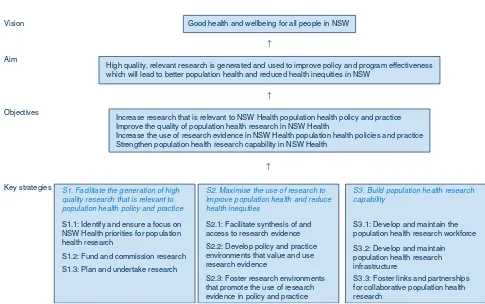
Vision
↑
Aim
↑
Objectives
↑
Key strategies
Good health and wellbeing for all people in NSW
High quality, relevant research is generated and used to improve policy and program effectiveness which will lead to better population health and reduced health inequities in NSW
S1. Facilitate the generation of high quality research that is relevant to population health policy and practice
S1.1: Identify and ensure a focus on NSW Health priorities for population health research
S1.2: Fund and commission research
S1.3: Plan and undertake research
S2. Maximise the use of research to improve population health and reduce health inequities
S2.1: Facilitate synthesis of and access to research evidence
S2.2: Develop policy and practice environments that value and use research evidence
S2.3: Foster research environments that promote the use of research evidence in policy and practice
Increase research that is relevant to NSW Health population health policy and practice Improve the quality of population health research in NSW Health
Increase the use of research evidence in NSW Health population health policies and practice Strengthen population health research capability in NSW Health
S3. Build population health research capability
S3.1: Develop and maintain the population health research workforce
S3.2: Develop and maintain population health research infrastructure
S3.3: Foster links and partnerships for collaborative population health research
Figure 1. The Population Health Research Strategy framework.
stakeholders, that is, the establishment of a process for identification and dissemination of priorities.
Most of the other actions raised in the interviews have been incorporated into the Strategy and many of these are supported in the literature. For example, the value of
knowledge brokerage services,31 success of fellowship
programs in other jurisdictions,5 enhancing the capacity
of the existing research workforce through networks and
improved access to training opportunities26,32and
simpli-fying ethics procedures.33
The actions in the Strategy are designed to be implemented within existing NSW Health funds, with a focus on mana-ging current investment more strategically and working better with internal and external partners.
Conclusion
Review and stakeholder consultation processes used to
formulate NSW Health’s Promoting the generation and
effective use of population health research in NSW: a Strategy for NSW Health 2011–2015 refined ideas for actions to improve the generation and use of population health research within current budget allocations. These processes strengthened the relevance and comprehensive-ness of the Strategy. The Population Health Division will facilitate implementation of the Strategy and report on progress and outcomes.
Promoting the generation and effective use of popu-lation health research in NSW: a strategy for NSW Health 2011–2015is available from: http://www.health.nsw.gov. au/resources
Acknowledgments
The authors would like to thank the NSW Health Strategic Direc-tions for Population Health Research Advisory Committee and those involved in the stakeholder interviews, small group discussions and final consultation for their contribution.
References
1. Banks G. Challenges of Evidence-Based Policy-Making. Australian Government Productivity Commission. Canberra: Commonwealth of Australia; 2009. Available from: http://www. apsc.gov.au/publications09/evidencebasedpolicy.pdf (Cited 4 March 2011.)
2. Productivity Commission. Strengthening Evidence-based Policy in the Australian Federation, Volume 2: Background Paper. Canberra: Productivity Commission; 2010.
3. Kitson A, Rycroft-Malone J, Harvey G, McCormack B, Seers K, Titchen A. Evaluating the successful implementation of evidence into practice using the PARiHS framework: theoretical and practical challenges.Implement Sci2008; 3: 1. doi:10.1186/ 1748-5908-3-1
4. Moore G, Todd A, Redman S. Strategies to increase the use of evidence from research in population health policy and
programs: a rapid review. November 2009. Available from the Centre for Epidemiology and Research, NSW Department of Health.
5. Biggs J. A review of strategic documents that support decision-making for population health research. February 2010. Available on request from the Centre for Epidemiology and Research, NSW Department of Health.
6. Biggs J. The results of stakeholder consultations to inform the development of the Strategic Directions for Population Health Research. March 2010. Available on request from the Centre for Epidemiology and Research, NSW Department of Health.
7. Patton MQ. Qualitative research and evaluation methods. 3rd ed. Thousand Oaks, CA: Sage Publications; 2002.
8. Burnard P. A method of analysing interview transcripts in qualitative research.Nurse Educ Today1991; 11(6): 461–6. doi:10.1016/0260-6917(91)90009-Y
9. Canadian Institutes of Health Research. Health Research Roadmap: Creating innovative research for better health and health care: 2009/10–2013/14; 2009.
10. Government of South Australia, Department of Human Services. Research and Evaluation Framework: 2002–2005.
11. Government of South Australia, Department of Health. Strategic health research program. Research priorities: general health topics; 2007–2008.
12. Government of South Australia, Department of Health. Strategic health research program. Research priorities: health systems research; 2007–2008.
13. Health Protection Agency. Providing the Evidence Base for Public Health: The Health Protection Agency’s Research Strategy 2005–10; 2005.
14. Health Research Council of New Zealand. HRC Strategic Plan 2008–2013; 2008.
15. NHS Department of Health, Research and Development Directorate. Best Research for Best Health: A new national health research strategy – the NHS contribution to health research in England; 2006.
16. NHS Department of Health. A Research and Development Strategy for Public Health; 2001.
17. Queensland Health. Queensland Health’s Research and Development Plan; 2007–2010.
18. Queensland Health. Research for a healthier future: 2020. Health and Medical Research and Development Strategy; 2009.
19. Saskatchewan Health. Healthy People. A Healthy Province; 2004.
20. Scottish Executive. Prevention/Wellness: Research strategy for Health and Healthcare; 2003.
21. Victorian Government, Department of Human Services. Public Health Research Policy Statement: New knowledge for improved health; 2005.
22. Victorian Health Promotion Foundation. Lead, empower, support, connect. Victorian Health Promotion Foundation: Strategic Priorities; 2006–2009.
23. Welsh Assembly Government, Wales Office of Research and Development for Health and Social Care. A Health and Social Care Research and Development Strategic Framework for Wales: a consultation document; 2002.
24. Bridgeman P, Davis G. The Australian Policy Handbook. 3rd ed. Sydney: Allen and Unwin; 2004.
25. Straus S, Haynes RB. Managing evidence-based knowledge: the need for reliable, relevant and readable resources.CMAJ2009; 180(9): 942–5. doi:10.1503/cmaj.081697
26. Van Wave TW, Scrutchfield FD, Honore´ PA. Recent Advances in Public Health Systems Research in the United States.Annu Rev Public Health2010; 31: 283–95. doi:10.1146/annurev. publhealth.012809.103550
27. National Health and Medical Research Council. Report of the Review of Public Health Research Funding in Australia, December 2008. Canberra: Commonwealth of Australia; 2009.
28. National Health and Hospitals Reform Commission. Beyond the Blame Game: Accountability and performance benchmarks for the next Australian Health Care Agreements. Canberra: NHHRC; 2008.
29. NSW Government. NSW Research: a Prescription for Health. Report of a review commissioned by the Minister for Science and Medical Research, the Hon Frank Sartor MP. Sydney: NSW Government; 2004.
30. Australian Government. A National Health and Hospitals Network for Australia’s Future. Australian Government; 2010.
31. Redman S, Jorm L, Haines M. Increasing the use of research in health policy: the Sax Institute model.Australasian Epidemiologist2008; 15(3): 15–8.
32. Madden L, Salmon A. Public health workforce: results of a NSW statewide consultation on the development of the national public health workforce.N S W Public Health Bull1999; 10(3): 19–21. doi:10.1071/NB99009
Fostering population health research in NSW:
the role of research infrastructure
Sarah V. Thackway
Aand Jo Mitchell
A,BA
Centre for Epidemiology and Research, NSW Department of Health
B
Corresponding author. Email: [email protected]
Research infrastructure – the assets, facilities and services
that support research and maintain the capacity
of researchers to undertake research – is an important
contributor to research excellence.1 A key theme in the
2008 review of public health research funding in Australia was the need for strategic investment in public health research infrastructure, including centres of research excellence, large scale assets such as cohort studies, dis-ease registers, data linkage and survey facilities, and the
career development of researchers.2
Several infrastructure funding programs at the federal and state government level provide research organisations with resources to help meet indirect costs that are not met by research grants. There is also a move towards more stra-tegic investment in research infrastructure, for example the
National Collaborative Research Infrastructure Strategy.1
Such investments, which are often collaborative, are designed to create research assets, promote data access for a wide range of researchers and avoid duplication of effort.
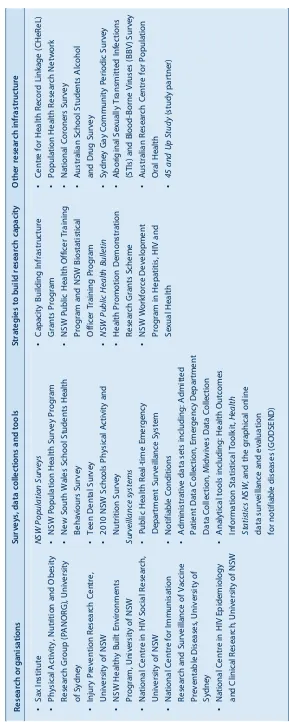
NSW Health provides support for population health
research infrastructure.3 Strategies include funding
research organisations relevant to NSW population health priorities, population health surveys and statewide data collections, research capacity building programs and sup-porting other research assets (Table 1).
The infrastructure supported by NSW Health promotes the generation and use of population health research in several ways. For example:
• Research centres build the evidence base around New South Wales (NSW) priority areas and facilitate the adoption of research findings in policy and programs through the synthesis and dissemination of research
findings and provision of advice in strategy
development.
• The ongoing monitoring of population health and the establishment of research asset studies provide informa-tion about trends in health, health behaviours and
attitudes.4 Surveillance data and linked data sets can
be made available to researchers, allowing cost-effective analyses on large population samples. The outputs of these analyses help to test hypotheses, iden-tify population health issues and inform the evaluation of policies and programs.
• Capacity building strategies increase workforce skills in commissioning and undertaking research and in using
research evidence in policy and practice.3
The following three case studies illustrate how infrastruc-ture fosters better population health research in NSW. The first describes how the Physical Activity, Nutrition and Obesity Research Group, a NSW Health funded research centre, has increased the generation and use of policy-relevant research. The second and third case studies
explain how the45 and Up Studyand the Centre for Health
Record Linkage encourage large scale, efficient and timely research. All three initiatives include a focus on developing links and partnerships between policy makers and researchers.
Research infrastructure contributes to the generation and use of high quality, policy-relevant research, leading to improved policy and program effectiveness, better population health and reduced health inequity. While NSW Health makes a significant investment in this area, increasing the impact of this investment (e.g. through fostering greater awareness of major research assets and how to use them and determining the best invest-ment mix) remains an ongoing challenge. Increasing the impact of this investment is a major focus of work within
NSW Health over the next 5 years.3
References
1. Department of Innovation. Industry and Science. Strategic Roadmap for Australian Research Infrastructure. Canberra: Australian Government; 2008.
2. National Health and Medical Research Council. Report of the Review of Public Health Research Funding in Australia, December 2008. Canberra: Commonwealth of Australia; 2009.
3. Centre for Epidemiology and Research. Promoting the generation and effective use of population health research in NSW: a Strategy for NSW Health 2011–2015. North Sydney: NSW Department of Health; 2010.
4. NSW Health. New South Wales School Students Health Beha-viours Survey. Available from: http://www.health.nsw.gov.au/ publichealth/surveys/hss/index.asp (Cited
The Physical Activity, Nutrition and Obesity
Research Group: fostering population health
research in NSW
Andrew J. Milat
A,C, Lesley King
Band
Adrian Bauman
BA
The Sax Institute (formerly Centre for Health Advancement, NSW Department of Health)
B
Physical Activity, Nutrition and Obesity Research Group, The University of Sydney
C
Corresponding author. Email: [email protected]
The requirements of policy makers for contextually relevant evidence are increasingly documented and
understood.1,2 In response, there have been significant
recent international and Australian initiatives to facil-itate closer links between policy makers and researchers
to address questions of policy relevance.3–5 The gap
between researchers and policy makers has been
well described by Lomas, who noted that: ‘yefforts
by researchers and by decision makers seem to proceed largely independently. Both have their own (often mis-placed) ideas about the other’s environment. Opportu-nities for ongoing exchange and communication are
fewy’.6One way to bridge this structural and
commu-nication gap is to develop formal collaborative mechan-isms between researchers and policy makers, such as the
establishment of university-based research centres.7
The role of the Physical Activity, Nutrition and Obesity Research Group as a university-based research centre
The New South Wales (NSW) Department of Health has arguably led the way in Australia with its commitment to funding university-based research groups to inform public health efforts across a range of issues including drug and alcohol, HIV/AIDS, injury prevention, immu-nisation, physical activity, nutrition and obesity preven-tion. The development of a body of policy-relevant research that is rapidly applied to policy and practice is particularly important for primary prevention of chronic disease, as there continues to be limited high quality and appropriate evidence of effective and sustainable
interventions.8 Over the past decade, this funding
has, at different times, supported the NSW Centre for Overweight and Obesity, the NSW Centre for Physical Activity and Health, and the NSW Centre for Public Health Nutrition. A review of these centres in 2007
concluded that they had made important contributions to health behaviour surveillance, determinants and intervention research, and ultimately resulted in greater
collaboration between policy makers and researchers.9
The review also recommended the formation of a larger, single research group across these interconnected health issues with longer term funding.
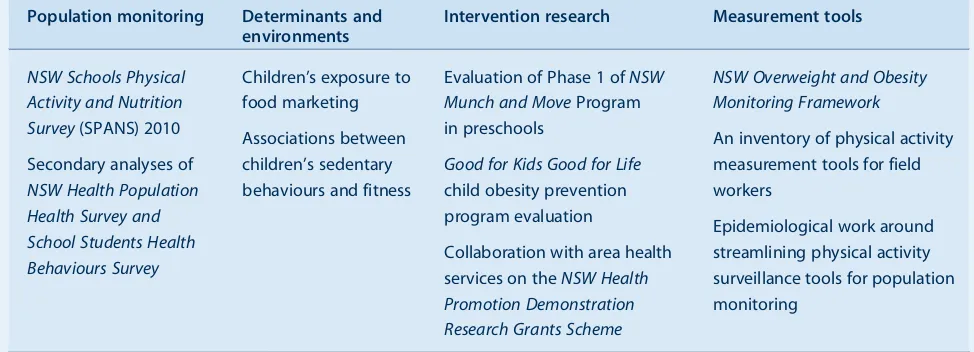
After an open tender process in June 2008, the NSW Department of Health committed $4.4 million over 5 years to the School of Public Health at the University of Sydney to establish the Physical Activity, Nutrition and Obesity Research Group (PANORG). Similar to its predecessors, the work of PANORG is organised accord-ing to the followaccord-ing four key buildaccord-ing blocks for gen-erating and reviewing public health evidence:
• population monitoring
• determinants and environments • intervention research
• measurement tools.
Illustrative examples of PANORG’s work in these areas are outlined in Table 1.
In contrast to investigator-driven research groups, PANORG has clear arrangements for regular and frequent communication and exchange with policy makers, including:
• a specified program of policy-relevant research nego-tiated between the research group and funders • two-way communication systems, with a mix of
for-mal (e.g. quarterly reports) and inforfor-mal exchanges • a purposive, planned approach to the dissemination
of research results and products to relevant end user groups.
children’s physical activity and nutrition surveys. The Department managed the stakeholder engagement that informed the development of the survey, while PANORG oversaw survey fieldwork, data analysis and reporting.
This collaboration also extends to PANORG regularly providing expert and technical advice to the Centre for Health Advancement at the NSW Department of Health regarding health issue priorities, strategic policy and program directions and evaluations. Another recent example was the provision of evidence and technical advice that has shaped the development of NSW Imple-mentation Plans and Evaluation and Monitoring frame-works for the Council of Australian Governments’ National Partnership Agreement on Preventative Health. This level of access was only possible due to the close and ongoing relationship between PANORG and the Depart-ment that is protected by mutually agreed contractual obligations. In addition, PANORG collaborates with local area health services’ health promotion strategic planning and research and evaluation activities.
Conclusion
As a government funded university research group, PANORG plays an active role in bridging the gap between evidence, policy and practice in NSW in the areas of physical activity, nutrition and obesity preven-tion. Frequent communication and ongoing collabora-tion between policy makers and researchers contributes to better population health research outcomes in NSW.
Acknowledgments
The authors would like to thank NSW Department of Health and PANORG staff, both past and present, who work tirelessly to close the gap between research and practice.
References
1. Campbell DM, Redman S, Jorm L, Cooke M, Zwi AB, Rychetnik L. Increasing the use of evidence in health policy: practice and views of policy makers and researchers.Aust New Zealand Health Policy2009; 6: 21. doi:10.1186/1743-8462-6-21
2. Bowen S, Zwi A, Sainsbury P. What evidence informs government population health policy? Lessons from early childhood intervention policy in Australia.N S W Public Health Bull2005; 16(11–12): 180–4.
3. National Health and Medical Research Council.National Health and Medical Research Council Strategic Plan 2007–2009.Canberra: NHMRC; 2007.
4. NSW Department of Health. NSW Health Promotion Demonstration Research Grants Scheme Funding Priorities. Available from: http://www.health.nsw.gov.au/publichealth/ healthpromotion/grants/index.asp (Cited 24 May 2010.)
5. Canadian Institutes of Health Research. Health Research Roadmap: Creating innovative research for better health and health care CIHR Strategic Plan: 2009/10–2013/14. Ottawa: CIHR; 2009.
6. Lomas J. Research and evidence-based decision making.Aust N Z J Public Health1997; 21: 439–41. doi:10.1111/j.1467-842X.1997.tb01730.x
7. Langille LL, Crowell SJ, Lyon REF. Six essential roles of health promotion research centres: the Atlantic Canada experience.
Health Promot Int2009; 24(1): 78–87. doi:10.1093/heapro/ dap001
8. World Health Organization. Interventions on diet and physical activity: what works. Summary report. Geneva: WHO; 2009.
9. Scott J, Bowen S. Review of NSW Health funded: Centre for Overweight and Obesity (COO), Centre for Physical Activity (CPAH), and Centre for Public Health Nutrition (CPHN). Unpublished Report; 2007.
Table 1. Examples of Physical Activity, Nutrition and Obesity Research Group research across key building blocks
for evidence creation
Population monitoring Determinants and
environments
Intervention research Measurement tools
NSW Schools Physical Activity and Nutrition Survey(SPANS) 2010 Secondary analyses of
NSW Health Population Health Survey and School Students Health Behaviours Survey
Children’s exposure to food marketing Associations between children’s sedentary behaviours and fitness
Evaluation of Phase 1 ofNSW Munch and MoveProgram in preschools
Good for Kids Good for Life
child obesity prevention program evaluation
Collaboration with area health services on theNSW Health Promotion Demonstration Research Grants Scheme
NSW Overweight and Obesity Monitoring Framework
An inventory of physical activity measurement tools for field workers
The
45 and Up Study
: fostering population
health research in NSW
Emily Banks
A,B,D, Louisa Jorm
A,Cand
Sonia Wutzke
AA
The Sax Institute B
National Centre for Epidemiology and Population Health, Australian National University
C
School of Medicine, The University of Western Sydney D
Corresponding author. Email: [email protected]
Excellent, forward-looking population health research requires good ideas, skilled people and high quality
infrastructure. The45 and Up Studywas developed to
enhance population health research in New South Wales
(NSW).1 Since its inception in 2003, it has grown to
become the largest cohort study of its kind in the South-ern Hemisphere, with more than 50 research projects
underway using45 and Up Studydata. It is a
collabora-tive research resource managed by The Sax Institute in collaboration with major partner the Cancer Council NSW and partners: the National Heart Foundation of
Australia (NSW Division); NSW Health; beyondblue:
the national depression initiative; Ageing, Disability and Home Care, Department of Human Services NSW; and UnitingCare Ageing.
A shared large-scale data resource, with extensive data linkage
The45 and Up Study is a large-scale cohort study that includes 266 848 NSW men and women aged 45 years and over. From February 2006 to December 2009, participants sampled from the Medicare Australia enrol-ment database joined the study by completing a baseline questionnaire and giving signed consent for follow-up through repeat questionnaires and linkage of their data
to multiple health-related databases,1including data on
hospitalisations, cancer registrations, deaths, medica-tions, primary health care and aged care. Researchers
can also use the45 and Up Studyas a framework for more
detailed data collection and intervention studies, known as sub-studies. Following a period of exclusive use by study investigators, sub-study data are contributed to the
central45 and Up Studypool of data.
At the time of writing, the45 and Up Studyand linkage
resources available to researchers consist of:
• baseline questionnaire data (questionnaires can be viewed at www.45andUp.org.au)
• linked data on health and service use • sub-study data, as they become available.
Additional large-scale data will be added over time, including a 5-year follow-up questionnaire for the whole cohort, detailed data on social and economic factors requested from the first 100 000 participants, and enhanced data collection relating to diet.
Researchers apply to use the data from the study through the 45 and Up Study Coordinating Centre, supported by an independent Access Committee. Projects that are in the public interest, meet the appropriate scientific quality and feasibility standards, and have approval from rele-vant data custodians and human research ethics commit-tees, are given access to data. The charges to research groups depend on the complexity and scale of each project and whether or not their institution has paid for
an ongoing licence to access data from the45 and Up
Study.
How does the45 and Up Studyfoster better
population health research in NSW?
The45 and Up Studyrepresents a pooling of resources to facilitate research. It fosters better population health research in NSW by:
• Encouraging large-scale research. Large-scale cohort studies provide prospective data on a wide range of exposures in relation to a wide range of outcomes and are recognised internationally as a sound basis for high quality research.
• Reducing the need for primary data collection.The
45 and Up Studyimproves the efficiency and timeliness of research by allowing researchers to focus on data analysis, interpretation and writing up, rather than data collection and securing funding for data collection. • Improving the targeting of new data collection.
Researchers can use the45 and Up Studyas a sampling
frame for identifying participants with specific char-acteristics who can be recruited into sub-studies. • Providing a focus for collaboration.The high profile
of the study and its strong communication with a large network of collaborating researchers means that it acts as a focus for forming new research collaborations, and attracting new researchers from a wide range of disciplines.
• Increasing the competitiveness of funding
can build on the existing infrastructure and can achieve more substantial outcomes more quickly and at reduced cost, compared to projects requiring
extensivede novodata collection.
• Providing data that is of direct relevance to health
services provision and hence policy agencies.The study has ongoing linkage to key health datasets through the Centre for Health Record Linkage, as well as the potential for ad hoc linkages to other service data. This presents opportunities for enhan-cing routinely collected health service data, and health services research, through the addition of rich person-specific information on key confounding and mediat-ing factors such as socioeconomic status and risk behaviours.
• Providing research infrastructure that is
sustain-able and grows in value over time.The research value of the study will increase exponentially as additional events accrue and additional data are collected.
Research to date in the45 and Up Study
More than 70 projects have been approved to use45 and
Up Studydata and over 50 are underway, spanning a wide range of disciplines, health conditions and research
groups (see www.45andUp.org.au for details). Seven sub-studies collecting additional data on participants
are underway. At June 2010, the45 and Up Studyhad
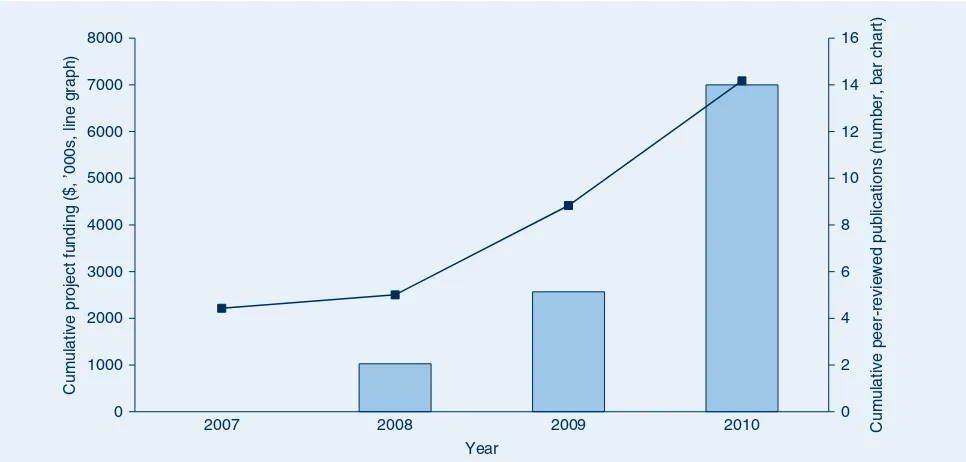
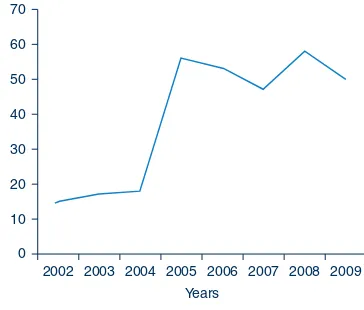
cost a total of around $7 million to establish and run. In addition to this, over $7 million in project-specific funding has been received to date for research using
45 and Up Study data (Figure 1). Despite completion of data entry as recently as early 2010, a total of 14 peer-reviewed papers are either published or in press (Figure 1). These papers provide insights into: breast-feeding and diabetes; sleep and health; early retirement due to illness; cancer screening; and obesity.
Conclusion
The45 and Up Studyprovides infrastructure for a wide range of public health research projects in NSW. Many of these projects and collaborations would not have been possible in the absence of this large-scale infrastructure.
Reference
1. 45 and Up Study Collaborators. Cohort profile: the 45 and Up Study.Int J Epidemiol2008; 37(5): 941–7. doi:10.1093/ije/ dym184
10 12 14 16
5000 6000 7000 8000
0 2 4 6 8
0 1000 2000 3000 4000
2007 2008 2009 2010 Cumulative peer-reviewed publications (number, bar chart)
Cumulative project funding ($, ’000s, line graph)
Year
Figure 1. The45 and Up Study: cumulative funding for projects and peer-reviewed publications.
The Centre for Health Record Linkage: fostering
population health research in NSW
Katie A. Irvine
A,Cand Lee K. Taylor
BA
Centre for Health Record Linkage, Cancer Institute NSW B
Centre for Epidemiology and Research, NSW Department of Health
C
Corresponding author. Email: Katie.Irvine@cancerinstitute. org.au
The Centre for Health Record Linkage (CHeReL) was established in July 2006 with the mission:
To create and sustain a record linkage infrastructure for the health and human services sector, and provide access to these resources to bona fide researchers and health planners and policy makers.
The benefits of researcher access to record linkage
infra-structure are well recognised.1,2Linkage transforms data
that are collected on a routine basis as part of health care into a powerful resource for research. Linked data can be used to investigate the safety and quality of health care, the effectiveness of prevention and screening programs, and the patterns, costs and outcomes of health care for people with specific conditions such as diabetes, cancer and heart failure. Linkage of health data with data from other agencies – such as education, aged care and community services – can be used for research in the social sciences and to study the broader outcomes of ill health and disability.
Use of the CHeReL’s linkage services has increased steadily over time. To date more than 120 linkage projects using data from the health, education, human services, justice and transport sectors have been com-pleted. These include:
• follow-up of cohorts of people with rare conditions or outcomes reported through population health datasets
(e.g. infective endocarditis,3childhood cancer4)
• morbidity and mortality associated with infectious
diseases (e.g. Hepatitis C,5influenza)
• follow-up of researcher-supplied cohorts to obtain information on service utilisation or health-related
outcomes (e.g. 45 and Up Study,6 the Australian
Longitudinal Study on Women’s Health and the
Australian HIV Observational Database7)
• case control studies of cancer screening behaviour and outcomes
• validation of the accuracy of screening tests by link-age with outcome information (e.g. antenatal serum
screening and pregnancy outcomes8)
• incidence of diseases and conditions by the identifica-tion of first-time events (e.g. first admissions for stroke and heart failure)
• reporting of outcomes of health care adjusted for co-morbidity using historically linked data (e.g. out-comes for stroke care in New South Wales (NSW) hospitals)
• studies of health care safety, utilisation and costs (e.g.
adverse events in hospital, cancer patterns of care9)
• validation studies of the accuracy of information held in population health datasets
• improved ascertainment of health information (e.g. Aboriginality, diagnoses) using multiple data sources.
Using probabilistic linkage software,10the CHeReL has
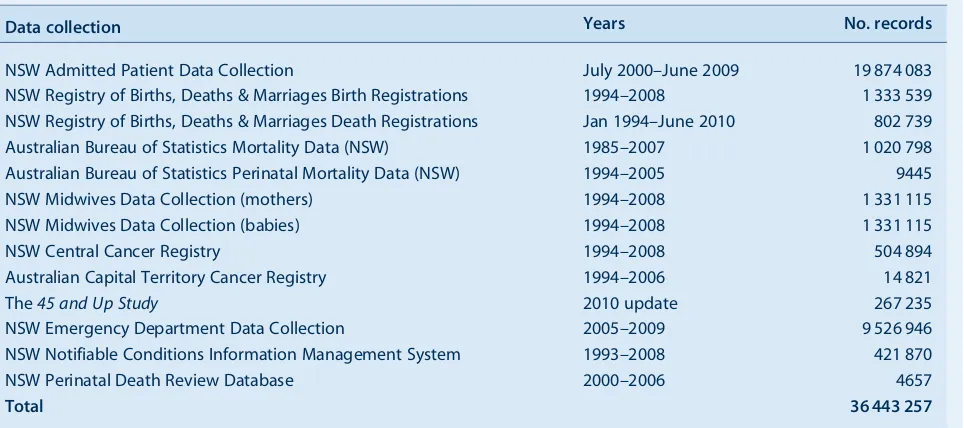
created a Master Linkage Key of records from population health datasets commonly used by researchers (Table 1). The Master Linkage Key currently includes over 36 million records relating to about 8 million people. Large amounts of historical data can be accessed for research while avoiding the prohibitive cost and time of creating one-off links for individual projects or establish-ingde novolongitudinal studies. To the extent that these datasets provide coverage of complete populations the outputs of record linkage studies avoid some of the potential biases associated with unrepresentative or incom-plete samples compared with traditional study designs.
The CHeReL also fosters high quality research by: • participating in the Population Health Research
Net-work11which has been established under the National
Collaborative Research Infrastructure Strategy12 to
provide Australian researchers with access to linkable non-identified data from a diverse range of health datasets, across jurisdictions and sectors
• providing a formal introduction to the CHeReL’s linkage methods in a short course on the analysis of linked data through the University of Sydney • providing support for the NSW Health Data Linkage
Special Interest Group, which meets 3–4 times per year • providing advice to researchers on the design,
feasi-bility, cost and process of linkage studies.
de-identified linked health records.13This approach to data governance has been strongly supported by organi-sations that are custodians of health records, human research ethics committees, and the community. By providing a mechanism for researchers to access non-identified linked data, the CHeReL enables ethically approved research in the public interest to be carried out without consent, minimising bias and allowing researchers to access data on whole populations.
Conclusion
The CHeReL has become core infrastructure for health and health services research in NSW. Further information on the CHeReL is available from: www.cherel.org.au.
Acknowledgments
We gratefully acknowledge the funding and in-kind contributions of the NSW Department of Health and the Cancer Institute NSW as owners of the CHeReL; the Cancer Institute NSW as host organisation for the CHeReL; and the funding support of past and present CHeReL Member Organisations: ACT Health, Clin-ical Excellence Commission, the Sax Institute, the University of Newcastle, the University of New South Wales, the University of Sydney and the University of Western Sydney.
References
1. Roos LL, Menec V, Currie RJ. Policy analysis in an information-rich environment.Soc Sci Med2004; 58(11): 2231–41. doi:10.1016/j.socscimed.2003.08.008
2. Holman CDJ, Bass AJ, Rosman DL, Smith MB, Semmens JB, Glasson EJ et al. A decade of data linkage in Western Australia: strategic design, applications and benefits of the WA data linkage system.Aust Health Rev2008; 32(4): 766–77. doi:10.1071/AH080766
3. Sy RW, Kritharides L. Health care exposure and age in infective endocarditis: results of a contemporary population-based profile of 1,536 patients in Australia.Eur Heart J2010; 31(15): 1890–7. doi:10.1093/eurheartj/ehq110
4. Stavrou EP, Baker DF, Bishop JF. Maternal smoking during pregnancy and childhood cancer in New South Wales: a record linkage investigation.Cancer Causes Control2009; 20(9): 1551–8. doi:10.1007/s10552-009-9400-5
5. Gidding H, Amin J, Dore GJ, Ward K, Law M. Hospital related morbidity in people first notified with Hepatitis C:
a population-based record linkage study in New South Wales, Australia.J Hepatol2010; 53(1): 43–9. doi:10.1016/ j.jhep.2010.01.036
6. Jorm LR, Walter SR, Lujic S, Byles JE, Kendig HL. Home and community care services. A major opportunity for preventive health care.BMC Geriatr2010; 10: 26. doi:10.1186/1471-2318-10-26
7. Falster K, Wand H, Donovan B, Anderson J, Nolan D, Watson K et al. Hospitalisations in a cohort of HIV patients in Australia, 1999-2007.AIDS2010; 24(9): 1329–39. doi:10.1097/QAD.0b013e328339e245
8. Lain SJ, Algert CS, Tasevski V, Morris JM, Roberts CL. Record linkage to obtain birth outcomes for the evaluation of screening biomarkers in pregnancy: a feasibility study.BMC Med Res Methodol2009; 9: 48. doi:10.1186/1471-2288-9-48
9. Stavrou EP, Smith GS, Baker DF. Surgical Outcomes Associated with Oesophagectomy in New South Wales: An Investigation of Hospital Volume.J Gastrointest Surg2010; 14(6): 951–7. doi:10.1007/s11605-010-1198-7
10. Open Source ChoiceMaker Technology. Available from: http://oscmt.sourceforge.net (Cited 14 December 2010.)
11. Population Health Research Network. Available from: www.phrn.org.au (Cited 14 December 2010.)
12. Australian Research Council and Sargent M. National Collaborative Research Infrastructure Strategy. Canberra: Australian Research Council; 2006. Available from: http:// ncris.innovation.gov.au/Pages/SRARI.aspx#Roadmap (Cited 1 August 2010.)
13. Kelman CW, Bass AJ, Holman CDJ. Research use of health data—a best practice protocol.Aust N Z J Public Health2002; 26(3): 251–5. doi:10.1111/j.1467-842X.2002.tb00682.x
Table 1. The Centre for Health Record Linkage Master Linkage Key, 30 November 2010
Data collection Years No. records
NSW Admitted Patient Data Collection July 2000–June 2009 19 874 083 NSW Registry of Births, Deaths & Marriages Birth Registrations 1994–2008 1 333 539 NSW Registry of Births, Deaths & Marriages Death Registrations Jan 1994–June 2010 802 739 Australian Bureau of Statistics Mortality Data (NSW) 1985–2007 1 020 798 Australian Bureau of Statistics Perinatal Mortality Data (NSW) 1994–2005 9445 NSW Midwives Data Collection (mothers) 1994–2008 1 331 115 NSW Midwives Data Collection (babies) 1994–2008 1 331 115
NSW Central Cancer Registry 1994–2008 504 894
Australian Capital Territory Cancer Registry 1994–2006 14 821
The45 and Up Study 2010 update 267 235
NSW Emergency Department Data Collection 2005–2009 9 526 946 NSW Notifiable Conditions Information Management System 1993–2008 421 870
NSW Perinatal Death Review Database 2000–2006 4657
Ensuring the policy relevance of population
health research: experiences from the
Drug Policy Modelling Program
Alison Ritter
National Drug and Alcohol Research Centre, The University of New South Wales
Email: [email protected]
Abstract: Illicit drugs are an important public health concern. A unique approach to tackling this problem is represented in the work of the Drug Policy Modelling Program which aims to improve evidence-informed policy by reducing the gap between research and policy. There are three elements to the Drug Policy Modelling Program: generating new knowledge; translating evidence into information of relevance for decision makers; and studying policy processes. Key aspects include the use of computer modelling as a trans-lational tool and the focus on understanding policy processes such as the role of media and politics, important in contextualising the research-policy nexus. Other features of the Drug Policy Model-ling Program approach include engagement of diverse disciplines, and government researcher partnerships.
Governments across Australia currently invest large amounts of funding in combating drug and alcohol use and their associated harms. In 2004–05 this was estimated to be $5 billion per annum (state and federal
govern-ments).1Yet the extent to which state and federal
govern-ments use research to determine the most appropriate policy options, and introduce policy reform, has been
subject to critique.2,3
Indeed, the gulf between the world of alcohol and drug
research and the world of policy making is large.4The Drug
Policy Modelling Program aims to reduce the gap between the world of alcohol and drug research and the world of policy through three intersecting elements: (1) generating new knowledge; (2) translating research evidence into
information of relevance for decision makers; and (3) studying policy processes. While many Australian research-ers engage independently in each of these activities (although largely focused on the first of the three), the Drug Policy Modelling Program sees all three elements as essen-tial to achieve evidence-informed policy. Additionally, the integration and combination of the three elements is
required.5 While translation of research evidence into
policy has been an important recent focus of health research, the majority of the work has concentrated on improving the
dissemination of research6and providing support to policy
makers to improve their uptake of research evidence.7The
Drug Policy Modelling Program supersedes these tradi-tional foci – it is neither dissemination nor uptake alone, but addresses applied research questions of relevance to deci-sion makers, integrates new research evidence with research on public policy and political processes, and develops alternate methodologies to translate evidence.
This paper describes the three elements of the Drug Policy Modelling Program and provides brief examples of the work. Achieving change in policy can take many years,
with 17 years cited as an average.8 The Drug Policy
Modelling Program (the Program) is less than 10 years old and hence a full assessment of its impact on policy is premature. Nonetheless, the principles and examples of work provided herein highlight the approach.
The Drug Policy Modelling Program
advance opportunities for mutual learning; commissioned research may also lead to an investigator-driven grant application and vice versa.
Despite a strong applied and practical focus – working with governments on problems and issues as they arise – the location of the Program within the National Drug and Alcohol Research Centre at the University of New South Wales (NSW) provides essential connection with scholarly endeavour. The risk of strongly applied, government-focused research is that it can reduce the opportunity and incentive to publish in peer-reviewed journals; the uni-versity auspice encourages peer-reviewed publication and ensures that work meets academic standards. In addition, to be regarded as ‘expert’ and called upon by governments to assist with policy decision making requires an estab-lished academic profile.
Another feature of the Program is the multidisciplinary nature of the team. It includes psychology, criminology, public health, epidemiology, economics, systems appro-aches, political science and health economics. Working across disciplines has a number of challenges, including different ‘world views’, methodological differences and mundane but important issues such as different disciplin-ary norms around authorship. Tackling a complex problem such as illicit drugs requires such a multidisciplinary approach. Most public health problems can no longer be seen as merely health issues: the environment, sociocul-tural influences, economics and regulation, for example, all provide insights into heath behaviours and new policy solutions. Additionally, there is also the law enforcement element for illicit drugs.
The three elements of the Program
Generating new knowledge
Generation of new knowledge is critical but much research in the drug field is largely marginal to the interests of policy makers. For example, the majority of alcohol and
tobacco research is descriptive epidemiology9 which,
while important, does not readily translate to policy or funding options. The challenge is to conduct best practice science on research questions of relevance and meaning to decision makers, and to focus on gaps in knowledge. Within illicit drugs policy, the largest gap is in the evidence base for law enforcement. A comprehensive and systema-tic search revealed 167 studies published on drug law
enforcement10 which compares poorly to the thousands
of published papers on drug treatment.
In redressing this gap, the Program has concentrated on developing a better evidence base regarding the effective-ness of drug law enforcement interventions (Griffith University, Prof Lorraine Mazerolle). This work has included systematic reviews as well as experimental trials
of drug law enforcement intervention.11–13 The Program
has also seed funded the first cohort study of street-based injecting drug users (Burnet Institute, A/Prof Paul Dietze).
Strong collaboration with government is essential in brid-ging the divide between research and policy in the conduct of research. Collaborative research has been undertaken with a number of governments across Australia including the ACT Department of Health, NSW Department of Health, NSW Police and Australian Federal Police. These research projects have commenced with discussions and negotiations regarding important research questions and knowledge gaps. The identification of research questions in collaboration with government then leads to a negotia-tion regarding appropriate research methods and access to data. The final reports are then provided to government along with other types of dissemination, such as presenta-tions and briefings.
Translating research evidence
There are many barriers to the adoption of research into the
policy process.14–18Proposed solutions have been
exten-sively documented in the above references and in others.
Rather than focus on disseminationper se, the Program has
concentrated on the active translation from data or science into meaningful information that has value and is readily understood by decision makers. For example, statistical significance testing can be translated into the numbers needed to be treated to achieve a change in population outcomes. In the drug policy work, the primary translation tool of the Program has been computer modelling. Com-pute