Vol. 2 (2012) No. 1 ISSN: 2088-5334 Abs var indu faci We pre plat assi app Key A (sin sen com sen info neig W of sev and com tran low I WS pre Sec WS plat the
# Thai N
stract— Recent iety of applic ustry automat ilitate developi first present t sent a compar tform develope ist researchers propriate platfo ywords— Wirel
A WSN is ge nk) and tens, nsor nodes. W mputation, and nse the phys
ormation, and ghboring node Within the las
the most rese eral hardware d implemented mputationally
nsceivers, cap w cost come in In this paper SNs. This pa sents the hard ction III surve SNs and pre tforms. Sectio perspectives
A Com
Th
Nguyen Univer* Ha N
tly, Wireless S cations, includ tion, military, ing WSN appl the hardware rison of these ers and hardw s working in t form for their p
less sensor net
I. INTRO enerally comp , hundreds, o With the integ
d wireless com sical phenom d share the pro
es.
st decade, hard earched areas e platforms fo d. Hardware d
efficient low pable storage n contradiction
r, we present aper is organ dware architec
eys some ava esents a com on IV presents
s of hardwa
mparativ
W
hang Vu Ch
rsity of InformaNoi University o E-mail: c
Sensor Networ ding building security, and h ications. In thi architecture o hardware pla ware platform u
his area to ap purposes. tworks; wireles
ODUCTION posed of a c or perhaps th
ration of info mmunication, menon, (pre-)p
ocessed inform
dware design s in scientific or WSNs hav design is still power proce area, long lif n with each ot t the hardwa nized as foll cture of a wire ailable hardw mparison of
s some recom are platform
ve Study
Wireless
hien
#, Hung
tion and Comm E-mailof Science and chanhung@mai
rks (WSNs) at monitoring, e health-care. O is paper, we p of a wireless se atforms. Finall users. The auth ppreciate the d
ss sensor node
entralized sta housands of ormation sens these devices process the mation with t
for WSNs is c community ve been propo a critical issu essors, low po fe, small size ther.
are platforms lows. Section eless sensor n
are platforms these hardw mmendations f
developers
y on Ha
Sensor
Nguyen Ch
munication Tech l: thangvc@tnuTechnology, 1 D il.hut.edu.vn, th
ttract a great environment c Over the years, provide a comp ensor node. W ly we present hors hope that diversity of pla
; hardware pla
ation tiny sing, s can raw their one and osed ue as ower and for n II node. s for ware from and har Sec T con A. T cap ant nod com mic
ardware
Networ
han
*, Thanh
hnology, Quyet u.edu.vnDai Co Viet Ro [email protected]
deal of resear control, wild-l we have seen prehensive rev
e then survey some recomm t making inform atforms availa
atforms for wi
rdware platfor ction V.
II.
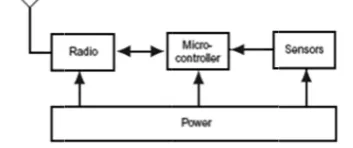
The hardware nsists of four m
Fig. 1 Har
Communicati This gives th pabilities. It enna. Of the de, the radio mponent. Com
crocontroller
Platform
rks
Nguyen Hu
Thang Street, Toad, Ha Noi, Vie hut.edu.vn
ch attention, a ife habitat mo a variety of h iew of existing the major har mendations from
mation about e able to them an
reless sensor n
rm users. Fina
HARDWARE A A WIRELESS e architecture main compone
rdware architectu
ion Device he wireless se
is typically hardware com o is usually mpared to th
or the sensor
ms for
uu
*Thai Nguyen, V
iet Nam
and are envisi monitoring, for hardware platf g hardware pla
rdware platfor m the perspec existing hardw and to help the
networks.
ally, we concl
ARCHITECTUR S SENSOR NOD e of a wirel ents, as shown
ure of a wireless s
ensor node it a radio tran mponents of
the most p he power con
rs, the radio
Viet Nam
ioned to suppo rest fire detec
forms for WSN atforms for W rms for WSNs ctives of hardw ware platforms
em select the m
lude this pape
RE OF DE
less sensor n n in Fig. 1.
sensor node
ts communica nsceiver with a wireless se power-consum nsumption of
transceiver o
use requ B. T the is hard actu con nod gen mic is ru C. T the env wir com sen D. A elec nod pow batt hard wir lith W dep mod Tab pop The can sign be c usa end A. T cap com be sen infr use 1 Mic Cro mic pro the
s ten times as uired for mod
Microcontrol This gives the
software of t a microproce dware for co uators, and r nstraints, the des are much neral purpose
crocontroller h un at a clock s Set of Sensors These give the physical w vironment. Th reless sensor mplex such a nsor, ultrasonic
Power Source A wireless se ctronics need de needs a pow wer source for
teries are cur dware and reless sensor n ium cell batte
III.AVAI
While the p pending on th dules have b ble I and Tabl pular platform e timeline for n be observed nificantly. Ho classified into age. Next, we d and high-end Low-End Pla The low-end p pabilities in mmunication.
deployed in nsing tasks rastructure. T
d in developin 1) Mica Fam ca, Mica2, M ossbow [1]. Ea crocontrollers
grammable fl Mica family
s much power dulating and de
ller
e wireless sen the wireless s essor with b onnecting exte adio transceiv
microcontrol smaller than PCs. Typic has a few kilo speed of a few s
e wireless sen world. Senso he sensors a
node range as temperature
c range device
e
ensor node i d power. The wer source. B r today’s wire rrently the mo
proper ener node can have eries.
ILABLE HARD WIRELESS SE particular sen e application, been develope le II summariz ms that were de these platform d, the capabi owever, in gen o two based on
overview the d platforms. atforms platforms are terms of These platfor large numbe as well as The following
ng communica mily: The Mic MicaZ, and IRI ach node is eq with a speed lash. While th of nodes hav
r. This is due emodulating t
nsor node its sensor node. A built-in memo ernal devices vers. Due to llers used in n the micropr cally, a wirel obytes of on-c w megahertz.
nsor node a wa ors are used and actuators from very e sensor, hum e.
is driven by erefore, every Batteries are t eless sensor no
ost common. rgy-manageme a lifetime of
WARE PLATFO ENSOR NETWO nsor types v , a limited nu ed to aid res zes the major esigned over t ms is also sho lities of thes neral, the exist n both their ca ese existing p
characterized processing, rms are usua ers in a WSN s providing g platforms h
ation protocol ca family of IS nodes and quipped with d of 4–16MHz he microcontro ve been equip
to the proces the radio signa
behavior. It r A microcontro ory, timers,
such as sens cost and po wireless sen rocessors used less sensor n chip memory
ay to interact w d to sense s attached t
simple to v mid sensor, l
electronics, y wireless sen
he most comm odes. Lithium
With low-po ent software years on stand
ORMS FOR ORKS
vary significa umber of wire search in WS characteristic the past few y own in Fig. 6 e platforms v ting platforms apabilities and platforms as l
d by their lim memory, ally envisioned
N to accomp a connecti have been mo
ls recently. nodes consis
are produced 8-bit Atmel A z and 128 KB ollers are sim pped with a w
ssing al. runs oller and sors, ower nsor d in node and with the to a very light and nsor mon cell ower e, a dard antly eless SNs. cs of years. . As vary s can d the low-mited and d to plish ivity ostly st of d by AVR B of milar, wide ran 433 equ kbp equ ope has mem a 5 boa F plat sho tran sen con is m The the sen ext pro 2 plat Cro Sky W hav mic
nge of transce 3MHz transce uipped with ps. On the ot uipped with IE erate at 2.4GH s limited mem
mory (512 KB 1-pin connect ards and progr Fig. 2 highlig tform, the M ows the micr nsceiver, and nsors or actua nsisting of two mounted on th
e system uses board. The b nsors or actuat ension connec ototyping syste
2) TelosB/Tm tform has be ossbow and T y board is sho
While the tran ve larger R
crocontroller
eivers. The M iver at 40 kbp a 315/433/86 ther hand, th EEE 802.15.4 Hz with 250 mory in terms B). Moreover, tor that is use ramming boar ghts the comp
icaZ board fr rocontroller, d an extensio
ators. The po o AAA cell b he flip side of s an external a board does no
tors can be att ctor. This allo em for a wide
Fig. 2 A M
mote: An arch een adopted mote Sky mo wn in Fig. 3.
Fig. 3 A Tm
nsceiver is ke RAM since
with 10 KB
Mica node in ps, while the M 68/916MHz t he MicaZ and 4 compliant tra
kbps data rat s of RAM (4 , each version ed to connect rds to the mote ponents of a from Crossbow
the power s on connector ower source i batteries. The f the board an
antenna attach ot contain any
tached to the b ows the board e range of diff
MicaZ board
hitecture simi for the Tel otes from Sent
mote Sky board
ept intact, Telo an 8MHz RAM is us
ncludes a 916 Mica2 platfor transceiver at d IRIS nodes ansceivers, w te. Each platf –8 KB) and n is equipped w
additional se e.
typical hardw w Technology source, the r
r for connec is a battery p
radio transce nd cannot be s hed to the sid y sensors. Inst board through d to be used ferent applicat
lar to the Mi osB motes f tilla [2]. A Tm
TelosB/Tmote platforms are integrated with several sensors including light, IR, humidity, and temperature as well as a USB connector, which eliminates the need for additional sensor or programming boards. Moreover, 6- and 10-pin connectors are included for additional sensors.
3) Eyes and EyesIFX v2: The Eyes platform has been designed as a result of a 3-year European project and is similar to the TelosB/Tmote architectures. A 16-bit microcontroller with 60 KB of program memory and 2 KB data memory is used in EYES [3]. Moreover, the following sensors are embedded with the mote: compass, accelerometer, and temperature, light, and pressure sensors. The EYES platform includes the TR1001 transceiver, which supports transmission rates up to 115.2 kbps. The platform also includes an RS232 serial interface for programming.
EyesIFXv2 [4] is a sensor node developed by Infineon [5] for the Energy-efficient self organizing and collaborative wireless sensor networks project EYES. Infineon has combined EYES baseband hardware with a number of optimized peripheral sets to create a series of chips aimed at specific automotive, industrial and consumer applications. An EyesIFXv2 board is shown in Fig. 4. As other sensor boards (e.g., T-Mote), EyesIFXv2 nodes are equipped with an ultra-low power MSP430F1611 microcontroller by Texas Instruments, combined with a transceiver from Infineon and a USB interface. Some sensors and digital outputs are present on the board.
Fig. 4 An EyesIFX v2 board
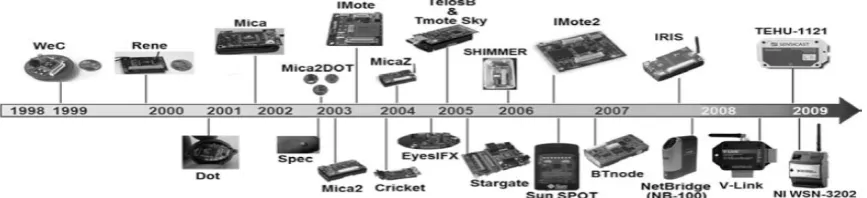
In addition to these platforms, several low-end platforms have been developed with similar capabilities as listed in Table I and shown in Fig. 6. An important trend to note is the appearance of proprietary platforms from the industry such as V-Link [6], TEHU [7], and the National Instruments motes [8] in recent years.
The low-end platforms are used for sensing tasks in WSNs and they provide a connectivity infrastructure through multi-hop networking. These nodes are generally equipped with low-power microcontrollers and transceivers to decrease the cost and energy consumption. As a result, they are used in large numbers in the deployment of WSNs. It can be observed that wireless sensor platforms generally employ the Industrial, Scientific, and Medical (ISM) bands, which offer license-free communication in most countries. More specifically, most recent platforms include the CC2420 transceiver, which operates in the 2.4GHz band and is compatible with the IEEE 802.15.4 standard. This standardization provides heterogeneous deployments of WSNs, where various platforms are used in a network.
B. High-End Platforms
In addition to sensing, local processing, and multi-hop communication, WSNs require additional functionalities that cannot be efficiently carried out by the low-end platforms. High-level tasks such as network management require higher processing power and memory compared to the capabilities of these platforms. Moreover, the integration of WSNs with existing networking infrastructure requires multiple communication techniques to be integrated through gateway modules. Furthermore, in networks where processing or storage hubs are integrated with sensor nodes, higher capacity nodes are required. To address these requirements, high-end platforms have been developed for WSNs.
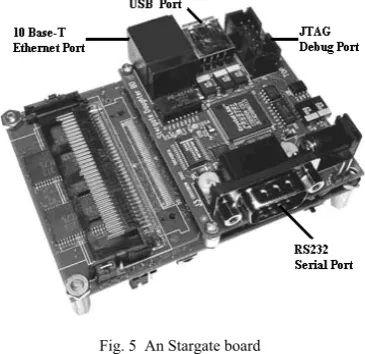
1) Stargate: The Stargate board[9] is a high-performance
processing platform designed for sensing, signal processing, control, and sensor network management. Stargate is based on Intel’s PXA-255 Xscale 400MHz RISC processor, which is the same processor found in many handheld computers including the Compaq IPAQ and the Dell Axim. Stargate has 32MB of flash memory, 64MB of SDRAM, and an onboard connector for Crossbow’s Mica family motes as well as PCMCIA Bluetooth or IEEE 802.11 cards. Hence, it can work as a wireless gateway and computational hub for in-network processing algorithms. When connected with a webcam or other capturing device, it can function as a medium-resolution multimedia sensor. Fig.5 illustrates an Stargate board.
Fig. 5 An Stargate board
Stargate NetBridge [10] was developed as a successor to Stargate and is based on the Intel IXP420 XScale processor running at 266MHz. It features one wired Ethernet and two USB 2.0 ports and is equipped with 8MB of program flash, 32MB of RAM, and a 2GB USB 2.0 system disk, where the Linux operating system is run. Using the USB ports, a sensor node can be connected for gateway functionalities.
Fig. 6 Timeline for the hardware platforms for WSNs
TABLEI
COMPARISON OF LOW-END PLATFORMS
Platform Microcontroller/Processor Radio Transceiver Centre Frequency Operating System
Mica2 [13] ATMega 128L, 8bit,128KB program memory, 4KB SRAM Chipcon CC1000 315/433/868/916 MHz TinyOS, SOS, Mantis
Mica2 Dot
[13] program memory, 4KB SRAM ATMega 128L, 8bit, 128KB Chipcon CC1000 315/433/868/916 MHz TinyOS, SOS, Mantis
MicaZ [13] program memory, 4KB SRAM ATMega 128L, 8bit , 128KB Chipcon CC2420 2.4 GHz
TinyOS, SOS, Mantis, Nano-PK, RETOS,
LiteOS
IRIS [13] program memory, 8KB SRAM ATmega 1281, 8bit, 128KB Atmel AT86RF230 2.4 GHz TinyOS, LiteOS
Cricket
[14] program memory, 4KB SRAM ATmega 128L, 8bit , 128KB Chipcon CC1000 433MHz TinyOS
Eyes [3] MSP430F149, 16bit, 60KB program memory, 2KB SRAM RFM TR1001 868 MHz TinyOS, PEEROS
EyesIFX
v1 [15] MSP430F149, 16bit, 60KB program memory, 2KB SRAM Infineon TDA5250 868 MHz TinyOS
EyesIFX v2 [4]
MSP430F1611, 16bit, 48KB
program memory, 10KB RAM Infineon TDA5250 868 MHz TinyOS
BTnode [16]
ATmega 128L, 8bit , 128KB program memory, 4KB SRAM
Chipcon CC1000 and Bluetooth radio
433 – 915MHz and
2.4GHz TinyOS
Telos B
[17] TI MSP430F1611, 16bit, 48KB program memory, 10KB RAM Chipcon CC2420 2.4 GHz Contiki, TinyOS, SOS, RETOS
Tmote Sky[18]
TI MSP430F1611, 16bit, 48KB prog
ram memory, 10KB RAM Chipcon CC2420 2.4 GHz
Contiki, TinyOS, SOS, RETOS Sun SPOT
[19] AT91SAM9G20 processor, 32bit, 64KB ROM, 2x16KB SRAM Chipcon CC2420 2.4 GHz N/A
Shimmer [20]
TI MSP430 F1611, 16bit, 48KB program memory, 10KB RAM
Chipcon CC2420
and Bluetooth radio 2.4 GHz TinyOS
V-Link [6] Not specified IEEE 802.15.4 compliant RF transceiver 2.4 GHz Not specified
TEHU-1121 [7] Not specified IEEE 802.15.4 compliant RF transceiver 2.4 GHz Not specified
NI
WSN-3202 [8] Not specified
IEEE 802.15.4 compliant
RF transceiver 2.4 GHz Not specified
TABLEII
COMPARISON OF HIGH-END PLATFORMS
Platform Processor Memory Mote/Board Connectors Operating System
Stargate [9] Processor, 400MHz Intel PXA255 64MB SDRAM, 32MB Flash
PCMCIA and compact flash connector, 51-pin expansion Connector for Mica2 Motes;
Ethernet, RS232 Serial, JTAG, USB Connector via 51-pin Daughter Card Interface
Embedded Linux
Netbridge
NB-100 [10] Intel IXP420 Xscale Processor, 266MHz 32MB RAM, 8MB Flash, 2GB USB Flash Disk Mica2, MicaZ, IRIS, Telos Connector Ethernet, USB connector Debian Linux
Imote [11] ARM7 processor, 12MHz 64KB SRAM, 512KB Flash I2C, UART, USB, JTAG connector TinyOS
Imote2 [12]
Marvell PXA271 Xscale Processor, 13
– 416MHz
256KB SRAM, 32MB SDRAM, 32MB Flash
Memory
Integrated 802.15.4 radio, support for external radio through SDIO, and UART; USB client and host, 2xSPI, 3xUART, Camera, I2C, I2S,
GPIO, AC97 connector
The second generation of Intel motes, Imote2 [12], is built around a new low-power 32-bit PXA271 XScale processor at 13–416 MHz, which enables DSP operations for storage or compression, and an IEEE 802.15.4 ChipCon CC2420 radio. It has large on-board RAM and flash memories (32MB), additional support for alternate radios, and a variety of high-speed I/O to connect digital sensors or cameras. Its size is also very limited, 36 mm × 48 mm × 9 mm, and it can run TinyOS, SOS and Linux operating system.
IV.RECOMMENDATIONS
This section presents some recommendations from the perspectives of hardware platform developers and hardware platform users.
A. Developers’ Perspective
Several issues need to be improved in terms of hardware platforms for WSNs. Perhaps the most important issues in order to increase popular use and production are size and cost. In order to disseminate this kind of technology, cost is an important factor, given that one WSN can use hundreds of sensors, making every little increase in price have an exponential effect on the total price.
The boom in the use of wireless sensor networks has caused different chip manufacturers to develop new circuits adequately integrated for these types of applications. This fact is quite relevant and will make it possible in the near future for the development of wireless applications to increase considerably. The future development of this technology will integrate more functions and reduce the size. In this regard, the contribution from silicon manufacturers will be very important for reducing price and size.
New encapsulation formats and mono-chip solutions can help to reduce size with better production quality. Custom solutions or FPGA solutions can also help pave the way. With these two factors, more general uses will be available to meet customer needs.
Another important point is that the hardware should have the capacity to work with very small voltages and very small power consumption, in order to reduce the size of the batteries and to prolong their life. However, power consumption cannot be reduced only by using lower voltage; a better design of the MAC components, hardware, and software must also be implemented.
Reducing consumption consists of two issues: extending the WSN applications while reducing the price of the final solution. More battery changes are needed if consumption is high, which will have a direct effect on the final price. Reducing consumption by half means reducing the number of battery changes by half, which implies savings in both maintenance and batteries.
B. Users’ Perspective
Application requirement is another important consideration in selecting an appropriate hardware platform. Users should understand application needs such as: microcontroller, frequency, bit rate, operating system support. Understanding application needs will help users select the most appropriate platform for their purposes (refer to Table I and Table II).
For large-scale applications, an important consideration is the cost factor, which impacts the choice of hardware platforms. There are many different hardware platforms to develop a WSN application. Users must therefore evaluate developing cost of their application to select the most appropriate hardware platform for their application.
V. CONCLUSIONS
In this paper, we presented an in-depth critical survey of a number of existing hardware platforms for WSNs. The contributions of our work are two-fold. First, we provide a comprehensive review of existing hardware platforms for WSNs. Second, we present some recommendations from the perspectives of hardware platform developers and hardware platform users. We hope that making information about these hardware platforms will assist researchers working in this area to appreciate the diversity of hardware platforms available to them and to help them select the most appropriate hardware platform for their purposes.
REFERENCES
[1] Crossbow technology. [Online]. Available: http://xbow.com [2] Sentilla. [Online]. Available:
http://www.sentilla.com/moteiv-transition.html
[3] L. F. W. van Hoesel, S. O. Dulman, P. J. M. Havinga, and H. J. Kip, “Design of a low-power testbed for wireless sensor networks and verification,” Technical report, University of Twente, 2003.
[4] The EyesIFX platform. [Online]. Available: www.tinyos.net/ttx-02-2005/platforms/ttx2005-eyesIFX.ppt
[5] Infineon. [Online]. Available:
http://www.infineon.com/cms/en/product/index.html [6] V-Link. [Online]. Available:
http://www.microstrain.com/product_datasheets/2400_v-link_ datasheet.pdf
[7] TEHU – 1121. [Online]. Available:
http://www.adaptive-wireless.co.uk/wp-content/uploads /TEHU_1121_ver1_2011-Adaptive.pdf
[8] National Instruments. [Online]. Available: http://www.ni.com/wsn/ [9] Stargate. [Online]. Available:
http://bullseye.xbow.com:81/Products/Product_pdf_files/Wireless_p df/Stargate_Datasheet.pdf
[10] Stargate NetBridge. [Online]. Available:
http://www.hoskin.qc.ca/uploadpdf/Instrumentation/CrossBow/hoski n_NB100_47e010f295856.pdf
[11] Imote. [Online]. Available:
http://webs.cs.berkeley.edu/retreat-1-03/slides/imote-nest-q103-03-dist.pdf
[12] Imote2. [Online]. Available:
http://wsn.cse.wustl.edu/images/e/e3/Imote2_Datasheet.pdf [13] MPR-MIB Users Manual. [Online]. Available:
http://www.cs.ucsb.edu/~nchohan/docs/moteManual.pdf [14] Cricket. [Online]. Available: http://cricket.csail.mit.edu/ [15] EyesIFX v1. [Online]. Available:
http://www.snm.ethz.ch/Projects/EyesIFXv1 [16] BTnode. [Online]. Available:
http://www.btnode.ethz.ch/Documentation/ BTnodeRev3HardwareReference [17] TelosB. [Online]. Available:
http://www.willow.co.uk/TelosB_Datasheet.pdf [18] Tmote Sky. [Online]. Available:
http://www.bandwavetech.com/download/tmote-sky-datasheet.pdf [19] Sun SPOT. [Online]. Available:
http://www.sunspotworld.com/docs/Yellow/eSPOT8ds.pdf