ISSN: 0976-3031
Research Article
ERGONOMIC EVALUATION OF POSITIONS, POSTURES AND WORK METHODS USING
ERGOAPP SOFTWARE
Ernesto Ramírez Cárdenas
1., Arnulfo Aurelio Naranjo Flores
2., Mauricio López Acosta
3.,
Jesús Enrique Sánchez Padilla
4., Roberto Limón Ulloa
5and Arlene Duarte Rubio
61-5
Department of Industrial Engineering, Technological Institute of Sonora, Sonora, México
6Industrial Engineering Student, Technological Institute of Sonora, Sonora, México
DOI: http://dx.doi.org/10.24327/ijrsr.2018.0911.2894
ARTICLE INFO ABSTRACT
The aim of the study was to reduce the ergonomic risk factors associated with cumulative traumatic disorders to which workers are exposed in a manufacturing company, in order to prevent accidents and illnesses. They were used the following methods and techniques: DMAIC (Define, Measure, Analyze, Improve, Control), BRIEF/BEST ergonomic methods of Humantech, evaluation of loads lifting of the National Institute of Safety and Health at Work (INHST) and the equation guide revised of the National Institute of Safety and Health (NIOSH). Results indicated high risk levels when lifting and carrying objects in different activities. Risk was eliminated by means of introducing cranes in the operation, to create training programs in manual materials handling and by the establishment of regular medical reviews in order to create a culture of prevention. In conclusion, the study allowed the worker to reduce the effort, fatigue and human errors in performing his work and validate the Ergoapp Software.
INTRODUCTION
Improving quality, productivity and competitiveness are requirements for organizations in an increasingly global world. Competitiveness has become a very powerful strategic weapon, many companies seek to increase their sales, lower their costs and improve their image, but few are able to achieve tangible results (Gutierrez, 2014). The continuous improvement that some companies are adopting today to achieve operational and service excellence are a consequence of increased competition, internationalization and an economic situation that makes consumers more demanding about the cost of what they buy. Therefore, firms feel the need to adjust their management strategies and continuously improve performance in all areas by keeping up with competitors or, if possible, by surpassing them (Melton, 2005).
In the production area it is generally where the added value of a company is obtained; its design and the way in which it is managed can have repercussions in a greater or lesser productivity and consequently in a greater or less benefit for the company. In production is where the different activities that must be carried out to obtain a product are constituted, organized and administered, and includes both the people who are going to perform the tasks as the materials, machines,
facilities and even the context in which the work is going to be carried out (Meyers, & Stephens, 2006).). For Cuatrecasas (2009) the analysis of the production system is of strategic importance for the company.
Ramírez (1999) states that in the era of globalization the success of a company does not depend on its productivity, but on the competitiveness that it is able to achieve, being understood as competitiveness the ability of the company to sell its products in a market where there are other similar and to sustain those customers in the time. According to Mercado (1998) the production area requires satisfying the competitive needs of the companies according to their strategy and the situation that it faces.
Some authors such as Chase and Jacob (2013) point out that some years ago the area of production of companies was not considered a source of competitive advantage, but that their activities were limited to reducing costs and improving the use of workforce. Its role was not considered from a strategic point of view. Over time this consideration has changed largely because of the strong competition from Japanese companies and other world-class companies that set high benchmarks in the areas of quality and productivity.
International Journal of
Recent Scientific
Research
International Journal of Recent Scientific Research
Vol. 9, Issue, 11(C), pp. 29617-29625, November, 2018
Copyright © Ernesto Ramírez Cárdenas et al, 2018, this is an open-access article distributed under the terms of the Creative Commons Attribution License, which permits unrestricted use, distribution and reproduction in any medium, provided the original work is properly cited.
DOI: 10.24327/IJRSR
CODEN: IJRSFP (USA)
Article History:
Received 13th August, 2018
Received in revised form 11th
September, 2018
Accepted 8th October, 2018
Published online 28th November, 2018
Key Words:
Ernesto Ramírez Cárdenas et al., Ergonomic Evaluation of Positions, Postures And Work Methods Using Ergoapp Software
In any organization of manufacture, the system of production usually determines the competitive advantage of one company over another. What makes an organization more productive is not only due to its high level of infrastructure, technology, good logistics and operations planning, or other aspects of management; what really sets an advantage is the way things are done. Within this approach the transformation processes of companies have had to rethink their strategies, to be able to compete within the new standards; being of the most important: the quality and conformity of the product, delivery times, low costs and the use of resources, among others (Leandro, not dated).
Lean Manufacturing and the Toyota Production System (TPS) are usually defined as a complete set of techniques to reduce and then eliminate waste. TPS is often used interchangeably with the terms lean manufacturing and lean production. For technical reasons herein, these terms shall be used interchangeably. It is called lean because in the end, the process can be executed: using less material, requiring less investment, using less inventory, consuming less space and using less people (Wilson, 2015). The goal of lean manufacturing is to eliminate all waste that does not add value to the product, service or process. These wastes are those in which the client is not willing to pay for them (Belohlavek, 2006).
The lean manufacturing trend was born as such from a publication by James Womack in his book "The Machine That Changed the World," published in 1990. The text is a description of how the Toyota business works, starting from the Product development, to production and delivery (Womack and Jones, 2007). For Socconini (2007), lean manufacturing is a continuous and systematic process of identifying and eliminating waste or excess, understanding as excesses all that activity that does not add value.
Socconini (2008), recommends that to understand what a waste is first we must understand which are the activities that add value. He describes activities that add value as "those that directly produce a change that the customer wants, to the degree that he is willing to pay for that effort". Understood this, waste will then be "any other effort made in the company that is not absolutely essential to add value to the product or service as required by the customer". For Villaseñor and Galindo (2008) waste is "all those activities that do not add value in the processes of companies". Understanding by added value all the part of the process where the inputs are transformed into products or services that the customer expects. In order to summarize the waste is everything that does not transform the product or service into something that the customer expects and that would pay for it, i.e. everything that does not add value to the final product is waste.
Womack & Jones (2003), argue that there is a solution to combat all waste: lean thinking. This provides a method for specifying value, aligning value-creating actions according to optimal sequence, carrying out these activities without interruption whenever someone requests them and performing them in a way increasingly efficient. In other words, it is lean because it provides a way to do more and more with less (less human effort, less equipment, less time and less space), while getting closer and closer to offering customers exactly what they want. Lean thinking also provides a more satisfying way
of working by offering immediate feedback from efforts to turn muda into value.
Definition of Ergonomics
According to Niebel (2001), the term "Ergonomics" comes from a Greek word, and is related to the norms that regulate the human factor; as mentioned above comes from Greek words that are "ergos", which means work, and "nomos", meaning laws, so literally means "laws of labor".
In the words of another author, Chapanis (1996), ergonomics is the discipline that studies the man in work activity, to understand the cognitive, physical and social commitments necessary for the attainment of economic, quality, safety and efficiency of a production system; whose objective is to transform this situation, improving the conditions of work and preserving the health of the worker without affecting the company's economic objectives. While the society of ergonomists of Mexico A.C. (SEMAC) (2001) states that ergonomics in human factors is the scientific discipline related to the knowledge of the interaction between the human being and other elements of a system, and the profession that applies the theory, principles, data and methods to design seeking to optimize human well-being and the implementation of the global system.
Farrer, Minaya, Niño, & Ruiz (1994) define ergonomics as the applied multidisciplinary science whose purpose is the adaptation of artificial products, systems and environments to the characteristics, limitations, and needs of their users, to optimize their efficiency, safety and comfort. For Salvendy (1997) ergonomics is the scientific discipline concerned with the interaction between humans and artifacts and the design of systems where men participate. This is confirmed by Niebel and Freivalds (2001) when mentioning that ergonomics is the design of the workplace, tools, equipment and environment so that they fit the human operator. Kroemer, Kroemer, & Kroemer-Elbert (2001) define it as the application of scientific principles, methods and data from a variety of disciplines for the development of systems engineering in which the person plays a significant role.
The most accepted definition of Human Factors & Ergonomics is provided by the International Ergonomics Association (IEA), which states it as: scientific discipline concerned with the understanding of interactions among humans and other elements of a system, and the profession that applies theory, principles, data and methods to design in order to optimize human well-being and overall performance system (IEA, 2013). The Human Factors & Ergonomics Society adopted the definition of ergonomics used by the IEA.
Together, all of the above definitions relate ergonomics as a discipline that provides tools and equipment to fit the operator in order to increase comfort and safety at workstations, and also considers that people are more important than objects and productive processes.
Scope of ergonomics
application, in the conceptualization phase. A second view would capture the idea that, in reality, this should be an eminently prescriptive discipline, which should give project managers the limits of user action in order to adapt artificial realizations to human limitations. Finally, in a third approach, a little more ambitious than the previous ones, it would understand this science as an interdisciplinary field of study where problems are discussed as to what to project and how to articulate the sequence of possible user interactions with the product, with the services, or even with other users.
In other ways, a brief reflection on the scope of ergonomics could contemplate the following three sections:
Objectives of ergonomics
The objective pursued in ergonomics is to improve the "quality of life" of the user in his interaction with a machine-tool, this objective is concretized to the reduction of risks, and consequently the increase of well - being of the users; the work of ergonomics is not only focused on the identification of risk factors; but proposes possible solutions economically feasible and operationally effective. According to the Society of Ergonomists of Mexico A.C. (2001) also seeks the following objectives such as reducing injuries and illnesses, reducing costs for disabilities and compensation, increasing productivity, quality, safety and improving conditions and quality of life at work.
Ergonomics has been a relevant topic in recent years, as it arose because of the design and operational problems presented by technological advances in the last century. It is difficult to speak of job evaluation outside the perspective of the recent changes in the industrialized world, since the nature of the activities and the conditions in which they develop have evolved remarkably during these last years. Faced with this, the evaluation of the workplace within the workplace offers advantages that can be reflected in many different ways: productivity and quality, reliability, job satisfaction, personal development and safety and health.
According to Chapanis (1996), the objectives of ergonomics are as follows:
1. Basic operational objectives a. Reduce errors
b. Increase security
c. Improve system performance
2. Objectives related to reliability, maintenance, availability and support to integrated logistics
a. Increase reliability b. Improve maintenance
c. Reduce personnel requirements d. Reduce training requirements
3. Objectives affecting users and operators a. Improve work environment
b. Reduce fatigue and physical stress c. Increase human comfort
d. Reduce boredom and monotony e. Increase ease of use
f. Increase user acceptance
g. Increase aesthetic appearance 4. Other objectives
a. Reduce time and equipment losses b. Increase production economy
Ergonomics has two goals: safety and productivity. The main purpose of ergonomics is the design of systems for them to be productive, safe and also comfortable and enjoyable. He himself comments that the purpose of design activities is to relate systems, jobs, products and environments to people's physical and mental abilities and limitations. Systems should be designed so that people can use them intuitively without requiring training or special education (Helander, 1995). Cumulative Traumatic Disorders
The term Cumulative Traumatic Disorders (CTDs), also called Musculoskeletal Disorders, includes a set of lesions and symptoms affecting the musculoskeletal system and its associated structures, i.e., bones, muscles, joints, tendons, ligaments, nerves and blood vessels (Junta de Andalucía Secretariat of Employment, 2013). They develop as a long-term result of repeated physical stresses that have a wearing effect on the affected body parts. The major groups of CTDs are those that affect the lower back (lumbar zone) and the upper limbs. The most common symptom of all is localized pain and, as a consequence of it, functional impotence (Junta de Andalucía Secretaría de Empleo, 2013).
Specific hand / wrist injuries
The Secretary of Labor Health Comisiones Obreras Castilla y León (2008) says that there are several injuries that are generated by forced postures and repetitiveness, to mention a few:
Tendinitis:It is an inflammation of a tendon due, among other causes, to that it is repeatedly in tension, bent, in contact with a hard surface or subjected to vibrations. As a consequence of these actions the tendon widens and becomes irregular. See Figure 1.
Figure 1 Tendinitis
Reference: Clinica ADAM, 2014.
Ernesto Ramírez Cárdenas et al., Ergonomic Evaluation of Positions, Postures And Work Methods Using Ergoapp Software
long and short extensor tendon of the thumb due to forced displacements of the cubital and radial.
Figure 2 Tenosynovitis
Reference: MDHealthResouce, 2012.
Carpal tunnel syndrome: It is caused by compression of the median nerve in the carpal tunnel of the wrist, through which the median nerve, the flexor tendons of the fingers and blood vessels pass. If the tendon sheath swells, the tunnel opening is reduced by pressing the median nerve. See Figure 3. Symptoms are pain, numbness, tingling, and numbness of the part of the hand: the palmar face of the thumb, index, middle and ring; And on the dorsal side, the ulnar side of the thumb and the two thirds distal to the middle and annular index. It occurs as a consequence of the tasks performed in the workplace that involve sustained forced postures, repeated efforts or movements and prolonged or maintained supports.
Figure 3 Carpal tunnel síndrome.
Reference: Medline plus, 2010.
Specific trauma to the shoulder and neck
Rotator cuff tendonitis: The rotator cuff is formed by four tendons that attach to the shoulder joint. See Figure 4. Disorders appear in jobs where the elbows must be elevated or in activities where the tendons or the subacromial sac are tense. It is associated with repeated actions of lifting and reaching with and without load, and with continued use of the arm in abduction or flexion.
Figure 4 Rotator cuff tendonitis.
Reference: http://orthoinfo.aaos.org/topic.cfm?topic=a00064
Thoracic or costoclavicular syndrome: Appears by compression of the nerves and blood vessels between the neck and the shoulder. It can be caused by repeated range movements over the shoulder. See Figure 5.
Figure 5 Thoracic or costoclavicular syndrome.
Stress cervical syndrome: It is caused by repeated tensions of the levator scapula and of the muscle fibers of the trapezius in the neck area. See figure 6. It appears when performing work above the level of the head repeated or sustained, or when the neck is maintained in flexion.
Symptomatology of Cumulative Traumatic Disorders
Symptoms related to the appearance of musculoskeletal disorders include muscle and / or joint pain, tingling sensation, loss of strength and decreased sensitivity. In the appearance of the disorders originated by overexertion, forced postures and repetitive movements can be distinguished three stages:
1. Appearance of pain and tiredness during the working hours, improving outside this, during the night and weekends.
2. Beginning of symptoms at the beginning of the workday, without disappearing at night, altering sleep and decreasing work capacity.
3. Persistence of symptoms during rest, making it difficult to perform tasks, even the most trivial ones (Secr de Salud Laboral Comisiones Obreras Castilla y León, 2008).
The benefit for reduction of accidents or diseases is the most mentioned in the interventions carried out by labor ergonomists, but in most cases it is not quantified. One of the common measures to quantify this benefit is the reduction of time lost by accidents, injuries and occupational diseases. If the reduction of time lost by the cost of labor per unit of time is multiplied, the economic benefit is determined. One of the important factors affecting workers is the manual lifting of loads, which according to the European Agency for Safety and Health at Work (2008) considers lifting, laying, pushing, pulling, transport and move loads, as the main causes of musculoskeletal disorders.
Gil & Sandoval (2013), in an investigation carried out in Sonora in coordination with the Mexican Social Security Institute (IMSS) in Ciudad Obregón, established that the payments derived by days of incapacity and partial permanent incapacities in the period
generated by musculoskeletal disorders amounted to about 15 million pesos in only three cities in the state. Of the same information, 272 certified cases of CTDs and 283 occupational diseases were identified only in 2012.
Among the companies on the list are the so-called manufacturing companies located in the secondary sector for the use of machinery, automated processes and for transforming the raw material into products for consumption. It is precisely in this type of company that the occurrence of work accidents has been observed, whose specific cases are mostly injuries and low back pain due to the characteristics of the workplace (see Figure 7).
A B Figure 7
Symptomatology of Cumulative Traumatic Disorders
Symptoms related to the appearance of musculoskeletal disorders include muscle and / or joint pain, tingling sensation, sensitivity. In the appearance of the disorders originated by overexertion, forced postures and repetitive movements can be distinguished three stages:
Appearance of pain and tiredness during the working hours, improving outside this, during the night and at the Beginning of symptoms at the beginning of the workday, without disappearing at night, altering sleep Persistence of symptoms during rest, making it difficult to perform tasks, even the most trivial ones (Secretaria de Salud Laboral Comisiones Obreras Castilla y León,
The benefit for reduction of accidents or diseases is the most mentioned in the interventions carried out by labor ergonomists, but in most cases it is not quantified. One of the asures to quantify this benefit is the reduction of time lost by accidents, injuries and occupational diseases. If the reduction of time lost by the cost of labor per unit of time is multiplied, the economic benefit is determined. One of the tors affecting workers is the manual lifting of loads, which according to the European Agency for Safety and Health at Work (2008) considers lifting, laying, pushing, pulling, transport and move loads, as the main causes of
& Sandoval (2013), in an investigation carried out in Sonora in coordination with the Mexican Social Security Institute (IMSS) in Ciudad Obregón, established that the payments derived by days of incapacity and partial permanent incapacities in the period 2010-2012 generated by musculoskeletal disorders amounted to about 15 million pesos in only three cities in the state. Of the same information, 272 certified cases of CTDs and 283 occupational diseases were identified
called manufacturing companies located in the secondary sector for the use of machinery, automated processes and for transforming the raw material into products for consumption. It is precisely in this type of company that e of work accidents has been observed, whose specific cases are mostly injuries and low back pain due to the characteristics
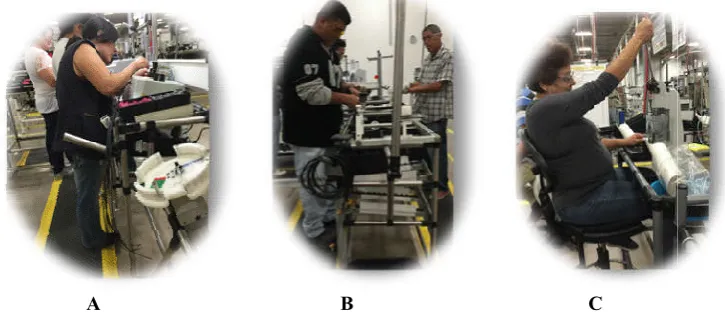
As can be seen in the previous figures, there are obvious incorrect positions that the operator adopts because of the design of his station and you can see clearly the problems of height of the tables (A and B) and the lifting of objects over the tops of the shoulders (C) which makes them prone to accidents. This condition must be addressed through an ergonomic analysis requiring a thorough knowledge of the anatomical, physiological and biomechanical aspects as well as the physical risk factors.
In this context, all companies are exposed to cumulative traumatic disorders, but each o
that is acquired by the following research question: What actions will the assembler factories companies undertake to reduce the ergonomic risk factors related to CTDs and the presentation of work diseases?
Objective
Propose improvements to eliminate or reduce risk factors related to cumulative traumatic disorders to which workers are exposed in order to prevent occupational diseases, safeguard their integrity and to promote efficiency in their work.
Research Method
In order to meet the objective, the DMAIC methodology (Gutiérrez, 2013) will be implemented, referring to the use of Humantech's ergonomic evaluation procedures: Humantech BRIEF / BEST, the National Institute of Occupational Safety and Health (INSHT) and the revis
Institute of Safety and Health (NIOSH). The steps to follow are described below.
Define the type of ergonomic problem present in the company under study. Here it was necessary to develop and apply surveys as well as consult inj
define which position has the highest risk or damages to workers with respect to the activity performed.
Recognize activities carried out by workers. out this step, first the visual recognition was made
place where things happen" (gemba), that is to say, the manufacturing area, followed by a tour in the company of a production manager on the part of the company, who explained in detail the process that follows for the elaboration of the product and the activities of the operators.
A B C
Figure 7 The studied workstations of the assembler factory.
As can be seen in the previous figures, there are obvious that the operator adopts because of the design of his station and you can see clearly the problems of height of the tables (A and B) and the lifting of objects over the tops of the shoulders (C) which makes them prone to accidents. ddressed through an ergonomic analysis requiring a thorough knowledge of the anatomical, physiological and biomechanical aspects as well as the physical
In this context, all companies are exposed to cumulative traumatic disorders, but each one depends on the prevention that is acquired by the following research question: What actions will the assembler factories companies undertake to reduce the ergonomic risk factors related to CTDs and the presentation of work diseases?
improvements to eliminate or reduce risk factors related to cumulative traumatic disorders to which workers are exposed in order to prevent occupational diseases, safeguard their integrity and to promote efficiency in their work.
to meet the objective, the DMAIC methodology (Gutiérrez, 2013) will be implemented, referring to the use of Humantech's ergonomic evaluation procedures: Humantech BRIEF / BEST, the National Institute of Occupational Safety and Health (INSHT) and the revised equation of the National Institute of Safety and Health (NIOSH). The steps to follow are
Define the type of ergonomic problem present in the company Here it was necessary to develop and apply surveys as well as consult injury records in order to be able to define which position has the highest risk or damages to workers with respect to the activity performed.
Recognize activities carried out by workers. In order to carry out this step, first the visual recognition was made in the "real place where things happen" (gemba), that is to say, the manufacturing area, followed by a tour in the company of a production manager on the part of the company, who explained in detail the process that follows for the elaboration of the
Ernesto Ramírez Cárdenas et al., Ergonomic Evaluation of Positions, Postures And Work Methods Using Ergoapp Software
As a next step, data on injuries and diseases occurred in the period 2010-2013 were collected and stratified.
Measure the problem in the area under study. Once the problem was defined, a checklist was applied with the intention of identifying each risk factor present in the activity such as: bad postures, repetitions, environmental factors and tool management.
The next step was the use of the BRIEF /BEST (Baseline Risk Identification of Ergonomic Factors/ Brief Exposure Scoring Technique) method to know the current state of injuries in the operators through a semaphorization of the affected parts of the body, so that photographs were taken of the positions adopted by the workers at the time of manual handling of loads. The measurements and weights of the current workstations were also taken into consideration through the INSHT methods and the NIOSH Revised Equation.
Analyze the causes of the problem and propose ideas for improvement. In this stage, the preparation begins before the solution of the problem, identifying the root causes, in order to understand how the problem is generated and confirm the causes with data, then proposing ideas for improvement through analysis techniques such as the diagram of Ishikawa. Improve and verify results. Here improvement activities were carried out, ranging from the analysis of costs related to the handling of loads, the change of operations and the identification of the level of risk when making the improvements. In this section, the BRIEF / BEST method was applied again to determine the level of risk by means of the semaphorization after making the improvements to know if the problem was reduced.
Control the lifting activity of loads. In this last stage, a training course was given to the operating personnel through a brief meeting before starting the workday where the manual handling of loads is announced, the lifting of heavy corrugations is simulated and a dynamic is made with the operators in order to understand the information that is provided them.
RESULTS OF THE ANALYSIS
For the definition of the problem and / or recognition of the activities, a trip was made with the production manager, identifying the activities carried out by the workers during the production of the product. The process is shown in the diagram in Figure 8.
Figure 8 Diagram of activities in manufacturing companies.
The process begins with the supply of material to the molding machine from which the handle, platform, spacer, knife and
protector are obtained, which come to assembly, the operator joins the parts having as a product the complete rake. Then he set them in the conveyor belt, until arriving at the station 2 where, in order to make it work, it is necessary to place in the roll holder a roll containing bags where the rakes are wrapped and which is brought from the supermarket by the material supplier. Finally, the packaging operator puts it in boxes, seals it and accommodates it on the pallet of finished product. When the survey was carried out, the records related to cases of injuries by gender, part of the injured body, work accidents according to the type of injury and the injured body were obtained from fiscal years 2011-2012 and 2012-2013. In the 85 lesions detected: 68% occurrence is female and 32% male; Hand and back are the parts that most present cases (see Figure 4A); and wounds have the highest number of incidences with 34 cases, followed by 24 cases of low back pain, which is our focus of attention for the subject under study.
With the information obtained from the records of injuries in the company and brainstorming with those involved, the following current situation and description of the problem was established.
In fiscal year 2013 there were seven back pains and 37 work accidents, of which eight are assigned to overexertion.
There are rolls for pocketing the rakes weighing up to 26 kg which represent a high risk factor for the operator.
According to INSHT loads greater than 3 kg can cause injury if not handled correctly.
STPS NOM 006 mentions that loads of up to 50 kg can be handled by a male operator.
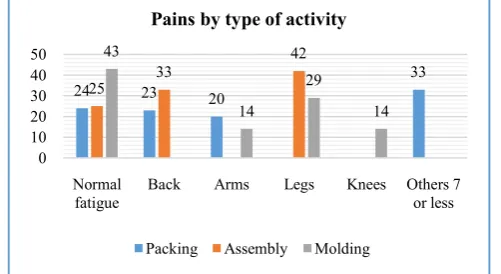
After being informed of the current situation, 91 workers from the packing area, 41 from assembly and 26 from molding were surveyed to establish the specific area prone to greater risk in their activities and the results can be seen in Figure 9. Packing presented a greater number of pains by type of activity, obtaining 24% of normal fatigue, 23% back, 20% pain in arms and others with 7 or less (hands, feet, neck, heel). In the assembly, 25% of normal fatigue, 33% of back pain and 42% of leg pain were obtained. In the case of molding, normal fatigue is 43%, 14% arms, 29% pain in the legs and 14% knee pain.
Figure 9 Pains by type of activity present in the areas of packing, assembly and
molding.
With the graphs presented it is possible to perceive that the percentage of normal fatigue in assembly, packing and molding is below 50%, which represents a focus of attention to be
24 23 20
33 25
33
42 43
14
29
14
0 10 20 30 40 50
Normal fatigue
Back Arms Legs Knees Others 7
or less
Pains by type of activity
treated. In addition to this, with the comments and observations of the operators surveyed, it was possible to conclude that the specific area with the greatest opportunity for improvement are the so-called processes 1 and 2, both belonging to station 2, where in the handling of the rolls which contain the bags for the rakes, people said they have had problems with the weight of these because generally are women who perform this activity.
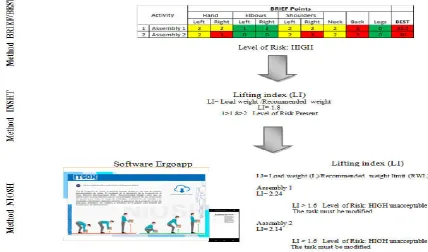
Three methods were used to establish the level of activity risk: BRIEF / BEST, INSHT and NIOSH. The first method is divided into two parts: the Baseline Risk Identification of Ergonomic Factors questionnaire (BRIEF), which evaluates the factors posture, strength, duration and frequency of the task in nine parts of the body: hand / wrist (right, left); elbow (right, left); shoulder (right, left), neck, back and legs and with this the respective semaphorization of the analyzed activity is done. The second part of this method is called Brief Exposure Scoring Technique (BEST). It consists of a conversion of the values obtained in the BRIEF to determine the level of risk (high, medium or low). The second method used was the INSHT, where through a rapid assessment of the task, the risk index is obtained. The third method, the NIOSH equation, calculates the recommended weight limit with six factors: horizontal distance factor (HM), is the distance from the median point of the ankle to the knuckles projected on the floor; Vertical distance (VM), distance between the point of attachment of the load and the ground; Vertical displacement factor (DM), asymmetry angle (AM), rotation performed by manipulating the load; The frequency factor (FM) and the grip factor (CM). The results are shown in Table 1.
In the semaphorization obtained from the application of the BRIEF / BEST method it can be seen that the critical points in assembly 1 are the shoulder and wrist of the right part, this is
because the worker manipulates the roll on that side of his body. The back is also affected by the lack of correct handling techniques. On the other hand, in assembly 2, it can be observed that the most affected part is the back, this is due to the overexertion exerted at the moment of stretching and placing the roll in its location, which represents a high risk factor, a factor that is checked by the application of BEST since both processes represent a HIGH risk level.
The INSHT method yielded a value of level "Present-Low" in both processes, which, according to the method's valuation table, indicates that it is necessary to solve because it is considered a risk very close to being a level "Present-Meaningful". This is due to the fact that the effective mass exceeds considerably the recommended limit mass, being the excessive weight of 11.53 kg in relation to the effective and recommended mass.
The results of NIOSH equation are focused on the analysis using software ergoapp of the lifting of the load represented by the roll and in which the destination is not significant, this means that it is not necessary to give the roll an exact location on the table. Based on the recommendation of a maximum weight of 11 kg, which is below the current weight and when calculating the lifting index, it is concluded that the risk of the task is unacceptable and that it must be modified, since it represents an "acentuated risk". For process 2, moving the roll of the table to the roll holder, the same procedure was performed with the exception that this activity does require a significant destination control, because it is placed in the roll holder.
Once the data have been entered, the method evaluates and recommends a source weight of 14 kg and a target weight of 12 kg, as well as assessing the risk of this activity as unacceptable Table 1 Results of the evaluation of processes 1 and 2 by applying the BRIEF / BEST, INSHT and NIOSH methods with
Ernesto Ramírez Cárdenas et al., Ergonomic Evaluation of Positions, Postures And Work Methods Using Ergoapp Software
and recommending modification in order to avoid any type of injury can cause in a short or long term.
It is important to have knowledge and to be able to apply different methods to make the information more reliable. This is the case previously presented, that when applying the BRIEF / BEST, INSHT and NIOSH, all three conclude that the activities performed by the operator represent a level of high risk, so it is recommended to control it, in order to avoid injuries of musculoskeletal kind in operators.
For the analysis of the causes of the problem and to propose ideas for improvement, a Kaizen event was carried out, where the stations and work risks were evaluated, especially for the manual handling of loads. The kind of incorrect handling of loads that causes the trauma-cumulative injuries were presented (see Figure 10).
Figure 10 Ishikawa diagram manual handling of loads.
The weight, supermarket, layout and reduced space, indicated in red circles, are the main improvement variables presented during the event.
Actions for improvement
As part of the improvement and verification o proposed:
1. Acquisition of a crane for rollers handling
eliminate the manipulation of the load, completely avoiding the risk factor and overexertion, this crane has the characteristic that the clamp can be moved towards any orientation, allowing manipulating the roll with more ease. Another characteristic is that it reaches a height that goes from 30 cm to 170 cm, which is of benefit for rollers that measure 165 cm and supermarkets, as these are four levels ranging from 45 cm to 152 cm of height.
2. Elaboration of triptychs of good techniques of manual handling of loads: A triptych was elaborated for all the workers, where was presented the importance of the correct manual handling of loads and the procedure to carry out the loads in s
maintaining their back straight, keeping the load close to them, avoid turning, among others, since at some point all the operators carry out some lifting, even if it is not part of their activity, such as for coverings of their fellows.
Ergonomic Evaluation of Positions, Postures And Work Methods Using Ergoapp Software
and recommending modification in order to avoid any type of
It is important to have knowledge and to be able to apply different methods to make the information more reliable. This is the case previously presented, that when applying the BRIEF / BEST, INSHT and NIOSH, all three conclude that the performed by the operator represent a level of high risk, so it is recommended to control it, in order to avoid injuries of musculoskeletal kind in operators.
For the analysis of the causes of the problem and to propose ent was carried out, where the stations and work risks were evaluated, especially for the manual handling of loads. The kind of incorrect handling of cumulative injuries were presented
Ishikawa diagram manual handling of loads.
The weight, supermarket, layout and reduced space, indicated in red circles, are the main improvement variables presented
As part of the improvement and verification of results, it was
Acquisition of a crane for rollers handling: it will eliminate the manipulation of the load, completely avoiding the risk factor and overexertion, this crane has the characteristic that the clamp can be moved ation, allowing manipulating the roll with more ease. Another characteristic is that it reaches a height that goes from 30 cm to 170 cm, which is of benefit for rollers that measure 165 cm and supermarkets, as these are four levels ranging from 45 Elaboration of triptychs of good techniques of manual : A triptych was elaborated for all the workers, where was presented the importance of the correct manual handling of loads and the procedure to carry out the loads in six steps: like maintaining their back straight, keeping the load close to them, avoid turning, among others, since at some point all the operators carry out some lifting, even if it is not part of their activity, such as for coverings of
3. Video about manipulation of loads:
developed showing step by step the correct lifting of loads, advice, testimonies of operators who have had an injury due to improper lifting, and finally, an interview with a medical specialist in traumatology who talked about the consequences and sequels that happen after an injury, specifically of lumbalgias. 4. Develop training course on the handling of loads:
Power Point training course was developed for people in the process of induction, in which they were ta about the correct manipulation of loads, the video was presented to them and finally they were given the previously explained triptych.
5. In order to control the load lifting activity, once the improvements were made, the BRIEF / BEST method was applied (see annex), and a table was drawn showing the scores obtained in such method by activity before implementation, and a table with the BRIEF / BEST after applying the improvement (see Table 2).
Table 2 Results of the evaluation of assembly 1 and 2 by applying the BRIEF / BEST method before and after the
improvement.
As shown in Table 2, the results after the implementation of the proposals and improvements are favorable, since the first activity reduced the risk from 32.5 (high level) to 3.75, which represents a low level. In the same way, the second activity was reduced from 30 (high level) to 2.5, also representing a low level.
In the first activity, it can be seen that in hand / wrist there is a point, on the part, due to the thrust of the crane,
operator can get to take a bad posture at the moment of doing this action. In the neck also has a point, by the obstruction of the view of the way of the crane. In the second activity, the shoulders are the only point which is presented; this
the height of the roll holder, where the operator has to keep the arms raised when adjusting the roll in order to use it correctly. Because of the method, it is confirmed that the application of the proposals will completely eliminate the manual manipulation of loads, even it was not necessary to apply the INSHT and NIOSH method by the same elimination of this risk factor.
CONCLUSIONS
It is concluded that the objective proposed at the beginning of the project was fulfilled which was to make and
improvements in the manufacturing process of the manufacturing company to reduce the risk factors related to cumulative traumatic disorders to which the workers are exposed. Now authorities know them and can take action to avoid them.
In the results obtained, it was found that there is a high level of risk when lifting and transporting different types of objects that are used in the workstation 2, as well as that manipulation in
Ergonomic Evaluation of Positions, Postures And Work Methods Using Ergoapp Software
eo about manipulation of loads: A video was developed showing step by step the correct lifting of loads, advice, testimonies of operators who have had an injury due to improper lifting, and finally, an interview with a medical specialist in traumatology o talked about the consequences and sequels that happen after an injury, specifically of lumbalgias. Develop training course on the handling of loads: A Power Point training course was developed for people in the process of induction, in which they were taught about the correct manipulation of loads, the video was presented to them and finally they were given the previously explained triptych.
In order to control the load lifting activity, once the improvements were made, the BRIEF / BEST method (see annex), and a table was drawn showing the scores obtained in such method by activity before implementation, and a table with the BRIEF / BEST after applying the improvement (see
Results of the evaluation of assembly 1 and 2 by ying the BRIEF / BEST method before and after the
improvement.
As shown in Table 2, the results after the implementation of the proposals and improvements are favorable, since the first activity reduced the risk from 32.5 (high level) to 3.75, which represents a low level. In the same way, the second activity was reduced from 30 (high level) to 2.5, also representing a low
In the first activity, it can be seen that in hand / wrist there is a point, on the part, due to the thrust of the crane, in which the operator can get to take a bad posture at the moment of doing this action. In the neck also has a point, by the obstruction of the view of the way of the crane. In the second activity, the shoulders are the only point which is presented; this is due to the height of the roll holder, where the operator has to keep the arms raised when adjusting the roll in order to use it correctly. Because of the method, it is confirmed that the application of the proposals will completely eliminate the manual manipulation of loads, even it was not necessary to apply the INSHT and NIOSH method by the same elimination of this risk
It is concluded that the objective proposed at the beginning of the project was fulfilled which was to make and propose improvements in the manufacturing process of the manufacturing company to reduce the risk factors related to cumulative traumatic disorders to which the workers are exposed. Now authorities know them and can take action to
the work activity is incorrect because everything is done manually. To counteract this: training programs were developed for a correct lifting of the loads in order to instill a culture of prevention; it was proposed to rearrange the supermarkets of rolls, accommodating those of greater weight in the middle, to avoid the risk when bending and lifting the rolls, likewise, to use a special cart when transporting the rolls for long distances; it is recommended to use a hydraulic jack pallet, where the roll stage is placed and adjusted to the average height of the worker, so when they are placed in the supermarket, there is no need to bend and lift them, this being a repetitive activity that could cause injury.
In order for the achievements to be maintained, the talks must be held during the project, where the workers must be instructed before starting the shift on the subject of correct manual handling of loads and the use of personal protective equipment should be continued, in order to create a culture of prevention among workers. Finally, it is of great importance to make a log of the injuries to help the doctor, with the objective of keeping a more descriptive record of the accidents within the company, and to facilitate the manipulation and obtaining the information to be measured.
References
Chapanis A. (1996). Human Factors in Systems Engineering. John Wiley and Sons, Inc. United States of America. Chase,R & Jacobs, R (2013). Administracion de
Operaciones Produccion y Cadena de Suministro 13a ed,. Mc Graw Hill
Cuatrecasas, L. (2009). Advanced process design and flexible production plants. Barcelona: Profit Editorial. European Agency for Safety and Health at Work. (2008).
Retrieved from https://osha.europa.eu/en/publications/e-facts/efact44
European Agency for Safety and Health at Work (2010). Annex to Report: Work- related musculoskeletal disorders - Facts and figures (Luxembourg, Office for Official Publications of the European Communities). Available at: https://osha.europa.eu/en/resources/ tero09009enc-resources/europe.pdf [January 28, 2013]. Farrer F., G. Minaya, J. Child, M. Ruiz (1994). Ergonomics
Manual. Mapfre Editorial. Madrid, Spain. 620 p.
Gil, A., & Sandoval, J. (2014). Caracterización de los Transtornos musculoesqueleticos de tipo laboral en el estado de Sonora. Ciudad Obregón: ITSON.
Gutiérrez Pulido, H., & de la Vara Salazar, R. (2013). Statistical Quality Control and SixSigma. Distrito Federal: Educational Programs S.A. Of C.V.
Helander M. (1995). A guide to the Ergonomics of Manufacturing. Taylor and Francis Inc. United States of America.
IEA-International Ergonomics Association. (2013). Definition of ergonomics, from: http://www.iea.cc, accessed on 15/07/2013.
International Ergonomics Association. 2016. Definition and Domains of Ergonomics. Recuperado el 26 de Junio del 2016 en: http://www.iea.cc/whats/index.html
Kroemer k., H. Kroemer, K. Kroemer - Elbert. (2001). Ergonomics, How to design for ease and efficency. Second Edition. Prentice Hall, Inc. New Jersey, USA. Llaneza, Á. J. (2009.) Ergonomics and Applied Psychology.
Handbook for specialist training. Treceaba ed. Spain: Lex Nova S. A. de CV
Medline Plus (2014) Síndrome del Túnel Carpiano, Recuperado
de:https://www.nlm.nih.gov/medlineplus/spanish/ency/a rticle/000433.htm
Meyers, F., & Stephens, M. (2006). Diseño de instalaciones de manufactura y manejo de materiales. Mexico: Prentice Hall.
Occupational Health and Safety Council of Ontario (2007a ). Musculoskeletal disorders prevention series. PART 2: Resource Manual for the MSD Prevention Guideline for Ontario.
Occupational Health Secretary CCOO. Castile and León. (2008). Musculoskeletal Manual
Niebel B. and Freivalds A. (2001), Industrial Engineering. Métodos, Labour Standards and Design. Alfaomega, Mexico DF
Ramirez Cavassa Cesar (1999). Ergonomics and Productivity. LIMUSA. Mexico.
Salvendy Gabriel (1997). Handbook of Human factors and Ergonomics. A Wiley Interscience Publication.
Socconini, L. (2009), "Lean Manufacting". Mexico: Norma Editions, S.A. de CV
T. Melton, The Benefits of Lean Manufacturing: What Lean Thinking has to Offer the Process Industries. Chemical Engineering Research and Design 83 (2005) 662-673. Villaseñor, C. A., & E., G. C. (2008). Conceptos y reglas de
lean manufacturing (Segunda ed.). Mexico: Limusa. Wilson, L. (2015). How to Implement Lean Manufacturing.
How To Implement Lean Manufacturing, 1.
Womack, James P. and Daniel T. (2005). Lean Thinking: How to use Lean thinking to eliminate waste and create value in the company. Management 2000.
Womack, J. (1991). The machine that changed the world. Harper Collins Publisher.USA.
Womack, J. P. and Jones, D. T. (2005). Lean Consumption, Harvard Business Review, Harvard Business School publication corp., 2005, pp.58.
Womack, J., Jones, D. (2007). Lean solutions: how companies and customers can create value and wealth together. Albania: FBE
How to cite this article:
Ernesto Ramírez Cárdenas et al.2018, Ergonomic Evaluation of Positions, Postures and Work Methods Using Ergoapp Software. Int J Recent Sci Res. 9(11), pp.29617-29625. DOI: http://dx.doi.org/10.24327/ijrsr.2018.0911.2894