118
This work is licensed under Creative Commons Attribution 4.0 International License.
The Effect on the Telecom Industry and Consumers after the Introduction
of Reliance Jio
Aditya Gupta1, Kushagra Raghav2 and Parth Dhakad3
1Student, Department of Finance, Narsee Monjee Institute of Management Studies, INDIA 2
Student, Department of Finance, Narsee Monjee Institute of Management Studies, INDIA 3Student, Department of Finance, Narsee Monjee Institute of Management Studies, INDIA
2Corresponding Author: [email protected]
ABSTRACT
In the world of intense competition amongst all the industries, the telecom industry also does not fail to stay behind. With the belief that the customer is the king, each and every company in India is willing to go to depths and cross lines every day so that they can be that one brand that customers look for. While choosing a Network, one looks for various factors such as Network coverage, the call rates, the internet plan offered and not to forget but the value-added services as well. Satisfying the consumers in each of this aspect is not an easy task. Based on the literature review and after considering the questions we want to answer; the research problem of the research paper is “The Effect on The Consumers and Telecom Industry after the Introduction of Reliance Jio.” The problem mainly focuses on how the telecom industry was before and after Jio, what people believe and perceive about Reliance Jio and what challenges the competitors faced with the introduction of Jio. Based on the research problem, these are some of the objectives of our study,
1. To study the impact of Reliance Jio on the telecom industry, the change in composition of industry, change in market share and the reforms that were undertaken
2. To identify the effect of Jio on common people and consumer behavior
3. To identify the business strategy followed by Jio and its Competitors
The methodology used in the research paper was s Single Cross-Sectional Descriptive Design. With the objective and design, the tool used for analysis were Mean, Standard Deviation to compare and analyze the data, also test like the Z-test and Chi-Square Test were done to Z-test the hypothesis.
Finally, the findings of the research paper concluded that Jio disrupted the market to such a level forcing competitors to exit or merge, amongst the consumers, the respondents were eager to test the new competitor in the market and thus the research witnessed a significant shift in the network from other networks to Jio.
Through our research we recommend that
Consumers should try to shift to Jio, with their very low monthly plans and Huge value-added services offered, which the competitors are still not able to achieve, adds to the success of Jio in India.
Keywords-- Reliance Jio, Telecom Industry, Internet, Network, Digital transformation, Airtel, Vodafone-Idea, Factors Affecting the Satisfaction of Consumers, TRAI (Telecom Regulatory Authority of India), Bloomberg
ACKNOWLEDGEMENT
We would like to thank and express our profound gratitude to those who contribute and assist greatly to the completion of this thesis. Most especially, Dr. Gomathy Thyagarajan, her advice, supervision and feedback which contributed positively to the success of the thesis. As her supervision, her encouragements assisted us to carry out this research study in the right direction.
Finally, we would like to thank each and every respondent of our questionnaire who devoted their time and helped in completion of our thesis, without them the analysis and conclusion would not have been possible.
I.
INTRODUCTION
The Telecommunications Industry within the sector of information and communication technology is made up of all telecommunication companies and internet service providers and plays the crucial role in the evolution of mobile communications and information society. It continues to be at the epicenter for growth, innovation and disruption for virtually any industry. Telecom industry is one of the fastest growing industries in the world and has immense capacity to serve people directly or indirectly. Insights Research has projected that telecommunications services revenue worldwide will grow from $2.2 trillion in 2015 to $2.4 trillion in 2019.
Indian Telecommunications Industry
119
This work is licensed under Creative Commons Attribution 4.0 International License.
growth over the last few years is primarily driven byaffordable tariffs, wider availability, roll out of Mobile Number Portability, expanding 3G and 4G coverage, evolving consumption patterns of subscribers and a conducive regulatory environment.
The Telecommunications Industry is divided into following subsectors:
Infrastructure Equipment
Mobile Virtual Network Operators (MNVO) White Space Spectrum
5G
Telephone service providers Broadband
1.1 About the Industry Industry Scenario
The Indian Mobile Industry is expected to create a total economic value of $217.4 billion by 2020. According to the study by GSMA, smartphones
are expected to account for 2 out of every 3 mobile connections globally, making India the 4th largest smartphone market by 2020. India is expected to lead the growth of smartphone adoption globally with an estimated net addition of 350 million by 2020.
Telecom tower in India is set to boom as its tenancy ratio will increase from 1.95 times in 2016 to 2.9 times by 2020 due to the expansion of 3G and 4G and the onset of 5G technologies.
More than 60 companies have received approval from the Department of Telecommunication in May 2017 to provide MNVO services, the majority of which are focused on Tier 2 and Tier 3 cities.
Total number of Subscriber Identity Module (SIM) connections is expected to reach 1.4 billion by 2020 from 1.1 billion in 2017.
Digital India is expected to create $1 trillion business opportunity by 2020.
Number of internet users in India is expected to reach 829 million by 2021.
Telecom Industry contribution to GDP is expected to reach 8.2% by 2020 from 6.5% in 2017.
Growth Drivers
Growing Demand- Nominal per capita income recorded a CAGR of 10.4% during 2012-17. Increasing Internet Revenues- Mobile value-added
service industry expanded at a CAGR of 29.3% to reach $11.08 billion in 2016.
Increased Equipment Manufacturing- 38 new mobile manufacturing units have been set up in India since September 2015.
Make in India- The government announced Phased Manufacturing Program (PMP) to promote domestic production of mobile handsets.
Bharatnet project- Optical fiber cables laid over 100,000-gram panchayats.
Major Developments in the Recent Past
During the 1st quarter of 2018, India became the world‟s fastest growing market for mobile applications.
Bharti Airtel is planning to launch 6000 new sites and 2000km of optical fiber in Gujarat in 2018-19. As of June 2018, BSNL is expected to launch its
5G services by 2020.
Vodafone India and Idea Cellular have merged into „Vodafone Idea‟ to become India‟s largest telecom company.
Reliance Jio
Mukesh Ambani led Reliance Jio launched its services on September 5, 2016 and changed the dynamics of the industry completely. With triggering price war to low cost 4G handsets, Jio has given several alternatives to customers, creating a neck to neck competition in the industry.
Since its entry in the telecom sector Jio has been creating records and now another report by the Institute of Competitiveness has claimed that Jio‟s launch in India has helped the country in saving around Rs60000 crore annually. The report also claimed that within 6 months Reliance Jio has made India the highest consumer of mobile data in the world. According to the report Jio will help expand India‟s per capita GDP by about 5.65%, keeping other things in the economy constant.
Developments in the Telecom Sector After Jio’s Entry
Ultra-Cheap Data- Before the entry of Jio, data was very expensive, and consumers had to shell out huge amounts for 1 GB of data. Jio‟s launch offer offered free data to consumers at high speed and even after it launched chargeable plans the tariff was very low and so other operators had to eventually follow and bring out new plans. Free Voice Calls- Voice calls were a major
income generator before Jio, but became free when it launched its services. Jio claims that its network presently carries 250 crore minutes a day of calls. Increased consumption of online content- India
saw an exponential rise in the consumption of online content with availability of free data. Jio claims that India‟s consumption went from 20 crore GB data to 120 crore Gb in 6 months after it launched its services.
120
This work is licensed under Creative Commons Attribution 4.0 International License.
services as everyone has access to the company‟s4G network for free.
A record in user acquisition- Jio claimed that its telecom network had garnered 100 million users in less than 6 months of operations. It also said that this growth was faster that even what Facebook and WhatsApp recorded.
Improved broadband Internet Availability- TRAI defines broadband speeds as anything above 512kbps or above. With free internet millions of people got access to high speed 4G services and Jio became the country‟s biggest provider of broadband internet.
Graph 1: Pre-Jio Market Share
(Source: TRAI)
Graph 2: Post Jio Market Share
(Source: TRAI)
1.2 Literature Review
1. Arpit Srivastava, Effect of Jio on Indian Telecom Industry Landscape
The article examined the Introduction of Jio in the telecom industry and how with the introduction of Jio has disrupted the existing landscape in the country. It studies the impacts that the industry is facing like how revenues have been shattered, existing voice and data plans have gone down the drain, margins are narrowing and shrinking and how companies who have been in this industry for decades are bleeding with pilling of license fee The total data usage on the country, too, have risen from 200 million GB a month to 1.5 Billion GB a month becoming the world‟s largest data user. The articles also examine about the introduction of Jio smartphones known as „LYF SMARTPHONES‟ which is a low cost 4G feature phone for the rural class of the country. However, a vital question still remains unanswered – When will Jio Break even considering the 20,000 Crore investment it has made for the country, for India‟s Greatest revolution that it has ever scene.
2. Sonu Singh and Shubham Bhardwaj, March 28, 2017 Objective of the Study
1. To identify the effect of Jio on common people 2. To identify the business strategy behind Jio
Research Design- Exploratory Research
Research Method- Sampling Procedure
Method of Data Collection- Questionnaire
Sample Size- 200
121
This work is licensed under Creative Commons Attribution 4.0 International License.
3. Devina Gupta, Jio Effect: 5 Reasons Why IndianTelecom Industry will Never be Same Again
The article talks about the impact that Jio has made over other telecom industries who now are just trying to survive the phase, with falling revenues and increasing cost of operations, marketing, leading to unsustainable levels of debt. The article talks about how the competitors are reacting, like Airtel acquiring Telenor to synergize its operations and expand its operations in new cities, Vodafone-Idea merger which happened in 2018 due to the sole reason of Reliance Jio.. Completely Jio‟s new strategy made the world believe that ultimately Consumer is the king in the business with only Rs 303 for a year‟s subscription and forcing other companies to reduce their existing prices but failing at it because no matter what they can offer, it is still less than Jio‟s offers.
4. Pawan Kalyani, 20161
The author in this research paper has analyzed the effect seen in the telecom sector in India after the Reliance Jio launch. The Objective of this research paper was to find the effect and awareness about the Jio offer, what were the offerings made by the competitors to protect their market share and what were the strategies were used by Jio to capture the market.The results obtained from the survey questionnaire on “Reliance Jio Effect” show that Jio has made a huge impact on the market as well as the competitors. They have targeted the young generation and the competitors have floated offers to either retain or add new customers. The results clearly show that the customers are aware about the offers floated by Jio and are attracted towards them and that if the competitors do not revise their plans and strategies then Jio will surely capture the market. 5. Akshat Chandergupta2, ET Bureau, Jio’s entry led to $10 billion annual savings for India
The article talks about with the entry of Jio in September, 2016 led to $10 billion in annual savings for India and a surge in the data consumption. Jio with the introduction of its offers have made data accessible and affordable with the average price dropping to only Rs 10 from Rs 152 and thus giving access to a much larger population. It also states that within 6 months of its launch India became the highest mobile data user in the world. With a conservative estimate that every consumer uses 1 Gb a month, we can calculate the gains to the economy by the benefit to all the 350 million internet subscribers also
1 An Empirical study on Reliance Jio Effect, Competitor’s Reaction and Customer Perception on the Jio’s Pre-Launch Offer, Journal of Management Engineering and
Information Technology, Delhi
2 Published in TheEconomicTimes website & the magazine on April 06, 2018
Jio will help expand India‟s per capita GDP by about 5.65%, if everything else is constant in the economy. Jio has completely changed the competition by offering life time free class in an industry has derived more than 75% of its revenue from voice services only. Clearly with all that it has to offer, Reliance Communications shut its wireless business while Aircel shrank in operations, Vodafone to merge with Idea and Bharti Airtel acquiring Telenor India to survive.
6. Noorul Haq, 20173
Telecom Sector is under severe competition with every service provider is trying to come on top by floating attractive plans and using different marketing strategies to lure and retain their customers. The Research paper tends to produce the impact of launching of Reliance Jio in the Indian Telecom Sector on the customers and other market players like Airtel, Idea Cellular, and Vodafone etc. In this research paper the author has analyzed different references and data sources and the overall impact on the market, customers and profitability of the competing companies. This research paper has also analyzed the temporary impact of Jio in the present scenario and also the future prospects to understand the impact purposefully. The objective of this paper is to study and examine the impact of Reliance Jio on the telecom sector in India. The paper is based on secondary data which is sourced from website, online sources and scholarly articles, magazines, books, internet and Ministry of telecommunication.
7. Oxford Analytica Ltd, India
Telecoms market faces massive shakeout4the entry of Reliance Jio in September has shaken the telecom sector in India. Many of the leading providers like Airtel, Vodafone, and Idea Cellular experienced an immediate decline in their market value as the announcements made by Jio caused the market to react in a negative way and so the investors expected the profit margins to decrease due to new competition. The fear of market disruption was fueled by Reliance Jio‟s decision to offer free voice calling for life and free data service for early subscribers. This strategy worked for them and they attracted millions of customers in the first month.
8. B.K. Singhal
Jio Set to Disturb the Waters5 Reliance Jio is believed to change the pecking order in the Indian Telecom market. The objective of this article is to find out whether the launch of Reliance Jio will affect the Telecom Industry
3
Impact of Reliance Jio on the Indian Telecom Industry, International Journal of Engineering and Management Research, Delhi
4
India: Telecoms market faces massive shakeout, 16 November 2016
122
This work is licensed under Creative Commons Attribution 4.0 International License.
hugely or would it only cause some ripples and not lastlong. There have been massive expectations since Reliance Industries acquired a major stake in Infotel Broadband. Reliance Jio aims to become India‟s No 1 Telecom player but the author believes that there are major objectives that Jio may face at the entry level. The introduction of Jio will definitely stir the waters and put pressure on the competitors by stealing some part of their market share but in the short run the impact might not be as huge as it is expected. As a result, it will definitely result in reduction of prices and better offers for the customers. The Author is not sure if Reliance will start with a big bang or will just enter the industry for diversifying its business.
9. D Satyanarayana, Dr K Sambasiva Rao and Dr S Krishnamurthy Naidu,The impact of Reliance Jio on Indian mobile industry, A case study on mergers and acquisitions of idea Vodafone and Airtel – Telenor
The Objective of the paper is to examine the impact of new entrant R-Jio on competitive strategies of rivals in the industry and to analyze the major changes in Indian telecom industry. Indian mobile industry is one of the fastest growing industries in the world. Indians are habituated to touch mobiles within a short span of a time. To strengthen themselves in the industry, Airtel and Idea acquiring Telenor and Vodafone respectively. The impact of this new entrant affects equilibrium in the mobile industry and makes rivals vulnerable that they resort to mergers and acquisitions in Indian mobile network providers. Since the exit barriers are present in the industry, they cannot get out of the industry. The major giants in the industry viz, Airtel and Idea strategically responding in a similar way. To strengthen themselves in the industry, Airtel and Idea acquiring Telenor and Vodafone respectively.
10. Indian telecom industry has been facing a tremendous growth by the entry of JIO (4G)
Its play a Master role in the telecom industry, so customers experiencing the new offers and competitors facing the new challenges how to overcome the challenges given by the JIO in order to retain their revenue making customers. The growth of the Reliance JIO Company depends upon the consumer behavior towards the pricing. The new strategy adopted by the JIO to overcome the challenges in the past Reliance communication lost their market but now, the entry of Reliance changes the past situation in the market environment. But always there will be a competition between the mobile operators; the one who exceeds the customer‟s satisfaction level will be the king of market.
11. Knots around India’s Telecom Ecosystem Anuj Srivas, How Reliance Jio’s Entry Tied Regulatory
The aim of the article is to get to know the regulatory problems faced by JIO network. Six years after acquiring 4G spectrum through a backdoor yet legal
manner, Mukesh Ambani-owned Reliance Jio presented its first regulatory challenge to the authorities and organizations that collectively manage India‟s telecom ecosystem. Reliance Jio kicked off “test trials” of its 4G services from May 2016 by giving out SIM cards to only its employees, and their friends and family. These restrictions slowly loosened as the months went along and by the end of August 2016, the company had anywhere between 2.5 million and three million users without officially launching commercial operations. At one level, industry officials point out that the regulatory dilemmas that Jio‟s entry strategy posed are an indictment of the lobbying capabilities of Airtel. At another other level, however, India‟s telecom department and regulatory authorities unnecessarily dithered when they could have acted.
12. Noorul Haq, SWOT, analysis of Reliance Jio
Reliance Jio Infocomm Limited or Jio as it is popularly known as a mobile network service based on LTE technology owned by the Reliance Industries. The company whose headquarters is in Navi Mumbai offers wireless 4 G network services and has the credit of being the only VoLTE operator in India currently. Jio has the best customer acquisition strategy till date. In the first 170 days, over 100 million subscribers registered themselves making JIO India‟s largest internet provider. Jio currently uses the latest 4 G LTE technology which is one of the world‟s best technologies for the future. Reliance Industries is a credible brand which echoes with Indian sentiments and has high trust amongst customers. The association of Jio with Reliance acts as a core strength. Reliance Jio has a presence in all 22 telecom circles in India and has Shahrukh Khan and Amitabh Bachchan as brand ambassadors.
Reliance Jio also offers a variety of services like movies, games, shopping, chats, and messenger etc. giving the customer a lot of options to choose from.
13. Noorul Haq,Impact of Reliance JIO on the Indian Telecom Industry
123
This work is licensed under Creative Commons Attribution 4.0 International License.
is observed that after entry of Reliance Jio Infocom intelecommunication industry, the economic structure of market is still same, but the level of competition has grown unexpected.
1.3 Hypothesis Statement
1. Null Hypothesis: No effect i.e. people don‟t think Jio
affects the Reliance Share price
Alternate Hypothesis: People believe that Jio affects the Reliance share price.
2. Null Hypothesis: People perceive that there has been no significant impact on data and access to Internet Post Jio
Alternate Hypothesis: People perceive that there has been a significant impact on data and access to Internet Post Jio
3. Null Hypothesis: No effect i.e. people perceive that Jio has not led to a digital transformation in Indian Telecom Industry
Alternate Hypothesis: People perceive that Jio has led to a digital transformation in Indian Telecom Industry
1.4 Research Problem
Through this study we would try to establish the various effects that the telecom industry and its components had to face with the entry of JIO in the industry. We would do this by studying the different changes that occurred in the industry as a whole, the competitors of JIO and the changes in the market composition of the industry. The main objective of our study is to find out the impact that the common people and telecom industry has faced as a whole due to the entrance of Reliance JIO.
1.5 Primary Objective
1. To study the impact of Reliance Jio on the telecom industry, the change in composition of industry, change in market share and the reforms that were undertaken.
2. To identify the effect of Jio on common people and consumer behavior.
1.6 Secondary Objective
1. To identify the business strategy adopted by Jio. 2. Identify the various strategies adopted by the
competitors, exit of companies and actions taken by competitors.
3. To identify the challenges faced by Reliance Jio.
II.
RESEARCH METHODOLOGY
2.1 Research Design
Research design is a plan which guides the data collection and the analysis. The main objective of a research design is to find out the answer to „how‟ you will carry out a research.
A research design can be divided into 3 broad types, based on the type of research that is to be conducted. The 3 types are Descriptive, Exploratory and Causal.
Descriptive design, it is structured and formal in nature, which provides a comprehensive and in-depth
analysis of the situation under the study. Our research mainly revolves around Reliance Jio, we have used a descriptive design for our research.
Moreover, descriptive design can be further divided into 2 types, longitudinal and cross- sectional. Longitudinal studies are the ones which are done with the help of a panel. Data is collected from this group multiple number of times and different time periods on the same variable. On the other and, cross sectional study is the one where data is collected from the population only once during a particular period of time.
Causal Research is a research which attempts to clarify why and how there is a relationship between a phenomenons‟s, since we are studying the impact of Jio on Industry, we try to study what was the cause and the effect of such move. Why every factor faced a change and how Jio impacted the Industry and consumers.
Since our research is conducted at a specific point of time, from a pre-determined section of the population, a cross-sectional research design is used. Since the data is collected only from a single segment of the population, we use Single Cross-sectional descriptive design.
2.2 Sampling Design 2.2.1Sample Population
Since the objective of our study is to analyze the impact of Jio on the common people and the telecom industry, the population mainly comprises of urban people of Mumbai and New Delhi.
2.2.2 Sample Frame
The sampling design used does not require a sampling frame.
2.2.3 Sampling Method
A sampling method is a method of how you collect the data from the population. There are 2 methods under the sampling method known as (a) Probability Method and (b) Non-Probability Method.
Probability method is a method where all the subjects in the population have an equal chance of getting selected for experiment. Whereas, non-probability method is a method in which the individual is not aware whether he will be selected for experiment or not.
The sampling method used here is Non-Probability method since all the respondents does not have an equal chance of being selected.
Non-Probability method can further be classified into 4 types which are (a) Convenience Sampling, (b) Quota Sampling, (c)Judgment Sampling and (d) Snowball Sampling.
124
This work is licensed under Creative Commons Attribution 4.0 International License.
2.3 Data Collection Method2.3.1 Primary Data
Most of the research is based on First-hand information provided by the sample and analysis has been made by the data collected.
2.3.2 Secondary Data
While some objectives require us to analyze and study various published articles, findings and case studies to study the impact of Jio on the telecom Industry which would have not been possible through surveys due to limitation of time and resources.
2.3.2.1 Types of Primary Research
Given that descriptive research is used, the data collection is quantitative in nature as the findings need to be in the form of numbers so at to properly analyze and concluding it.
2.3.2.2 Types of Quantitative Method
A structured Questionnaire in the form of an Online Survey was used to collect primary data directly from the respondents. Survey in the form of an online custom webpage was used.
The specific tool is “Google Forms” which enables every individual to create their own custom structured questionnaire and easily share it online.
2.3.2.3 Types of Secondary Research
The data was collected through external sources specifically Published data particularly the government data published by TRAI (Telecom Regulation Authority of India) and also through published research papers and Case studies available online.
Time period
Due to limitation of time and resources available at our hand the survey was available for the respondents to be filled for a period of one week.
Variables
Dependent Variables: - Jio
Independent Variables:-
1. Market share 2. Telecom Regulations
3. Consumer behaviour and acceptance 4. Access to mobile phones and Internet 2.4 Data Analysis
2.4.1 Descriptive Statistics
Given the objective and design of our research, we will be using descriptive statistics i.e. Mean, Median, mode and Z-test and Chi Square Test to compare and arrive at conclusions
2.4.2 Advanced Statistics
Data analysis for the research will solely be done using Descriptive statistics and will not be using any Advanced Statistical Tool
III.
FINDINGS AND DISCUSSIONS
OBJECTIVE-I
To study the impact of Reliance Jio on the telecom industry, the change in composition of industry, change in market share and the reforms that were undertaken.
Primary Data Analysis
Graph 3: Survey responses of Number of users
(Source: Primary Data/Questionnaire)
With Reliance Jio taking the top spot for the number of users, it can be seen that how people have changed their mobile networks and/or very much motivated to shift to Jio 56% of the sample use Reliance Jio, 27% use Airtel and Vodafone-Idea taking the 3rd spot at 17% with BSNL, TATA, and RCom not taking any position in our sample.
125
This work is licensed under Creative Commons Attribution 4.0 International License.
(Source: Primary Data/Questionnaire)
Out of the total 100 respondents the maximum respondents are of age group 15-20.
56% of the total sample use Reliance Jio while 27% people use Airtel and 17 use Vodafone-Idea while there is no respondent who uses BSNL, Reliance Communication or TATA Docomo.
In the age group of 15-25 maximum people use Jio (57% of the sample) we can say that it has spread a wave amongst the youth who nowadays need maximum data at minimum prices and Jio just offering that.
On the other hand, people of age between 25-50, prefer Bharti Airtel and were resistance to the change and then followed by Jio and no one uses Vodafone-Idea.
Table 1: Descriptive Analysis of Monthly expenditure
(Source: Primary Data/Questionnaire)
From the above table we can conclude that out of the sample, respondents using Reliance Jio tend to spend less that is ranging between 200-600. While Airtel users tend to spend between 400-800+ maximum. This is evident with the plans that Jio offers at very minimal prices.
The average Jio user tends to spend 386 rupees per month while an Airtel user tends to spend on an average of 500 per month and Vodafone-Idea user spends 444 per month
Graph 5: Survey Response of respondents shifting to Jio
(Source: Primary Data/Questionnaire)
47% of the total respondents had shifted to jio at launch while 53% retained their existing mobile network, however we see at later point within 6 months to 2 years more people are shifting to Jio.
Out of those who has shifted we discuss the motivating factor that affects the most in the respondents in the graph below:
Graph 6: Survey Response of Motivation to Shift to Jio
(Source: Primary Data/Questionnaire)
Findings/Analysis
Out of the total respondents, 56 people had shifted to Jio services.
The factor that affected them to make this decision most was Low Call Rates/Tariff which constitutes 48.2% of the total respondents
The second factor which stands at 25% was Network coverage, which the respondents believed had a greater coverage than the existing service providers.
Mean: 1.36
Standard Deviation: 1.28
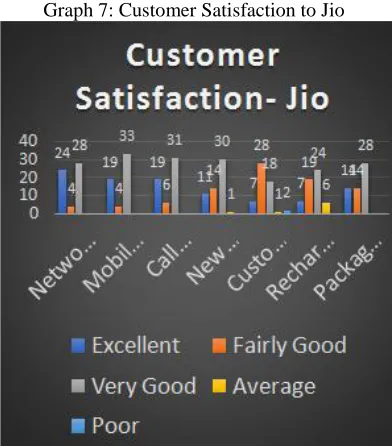
To Analyse the Satisfaction Level of Consumers towards Jio
The following factors were considered while framing the questionnaire as to measure the satisfaction levels of the customers while they use Reliance Jio, the results are of only Reliance Jio ratings.
126
This work is licensed under Creative Commons Attribution 4.0 International License.
Graph 7: Customer Satisfaction to Jio(Source: Primary Data/Questionnaire)
Table 2: Descriptive Analysis of Satisfaction Levels
FACTOR MEAN STD DEV NETWORK 4.36 0.62
MOBILE DATA 4.27 0.59
CALL RATES 4.23 0.63
NEW OFFERS AND SCHEMES
3.91 0.72
CUSTOMER CARE 3.48 0.87
RECAHRGE OUTLETS
3.57 0.85
PACKAGE PRICE 4.00 0.71
(Source: Primary Data/Questionnaire)
Here we conclude that overall Jio users in the sample responded to all the factors as Excellent or Fairly Good or Very Good with only 2 poor ratings for Customer Care and 6 Average ratings for Recharge Outlets.
Jio clearly satisfies its customers as we can see from the findings.
Out of all the factors, Network is the most satisfying factor with a mean of 4.36 and a Standard Dev of only 0.36, followed by Mobile Data with a mean of 4.27
meaning that these 2 factors are the one which customer look for and also are being satisfied by Jio giving them the highest ratings of Excellent and Fairly Good.
However, a point of concern was the factor
Customer Care scoring the least mean of 3.48 meaning
Average Ratings and consumers were not quite satisfied. To Analyse What Customers Perceive About Reliance Jio
Graph 8: Impact of Jio on Reliance Price share
(Source: Primary Data/Questionnaire)
Here we can conclude that 67% of the sample feels that the profitability and performance of Jio affects the Market price of Reliance Industries, being a subsidiary of the Reliance Industries, Jio makes an impact on the share price of Reliance.
67% of the sample believes that share price movements are affected by how Jio performs 23% are inconclusive while 10% of the sample don‟t believe.
We have conducted a Chi- Square Test to test the hypothesis statements, given below:
Do you think Reliance Share price is impacted by the Success and Performance of Reliance Jio? Answer Observed Expected Value O-E (O-E)^2 [(O-E)^2]/E
Yes 67 38.5 28.50 812.25 21.097
No 10 38.5 -28.50 812.25 21.097
Total 77 42.195
67
23
10
0 10 20 30 40 50 60 70 80
Yes
Maybe
No
127
This work is licensed under Creative Commons Attribution 4.0 International License.
Graph 9: Jio impact on Internet Access and Dataconsumption
(Source: Primary Data/Questionnaire)
Mean- 4.19 Std Dev- 0.98
85% of the sample believes that Jio has affected the industry in a way that has completely reduced the Internet Plan prices and by launching its own Lyf Phones it has significantly increased the access to internet with the free internet plan that is provided at launch.
Now with the increased access to internet, the data consumption of the country has also increased significantly, supported by secondary data given below.
With a mean of 4.19, respondents fall between Agree and Strongly Agree with a deviation of only 0.98.
For Z-Test Calculations and testing oh Hypothesis, coding of data has been done:
Graph 10: Jio‟s contribution to Digital Transformation of Telecom
128
This work is licensed under Creative Commons Attribution 4.0 International License.
From the data received from respondents, we canconclude that majority of the sample perceive that Reliance Jio has led to a digital transformation on the industry to some extent.
85% concludes YES
9% are unsure
6% don‟t believe that there has been some transformation.
We conduct a Chi- Square test to test our hypothesis statements:
Options Observed Value Expected Value O-E (O-E)^2 [(O-E)^2]/E
Yes 85 45.5 39.50 1560.25 34.291
No 6 45.5 -39.50 1560.25 34.291
Total 91 68.582
Factors Affecting the Industry
1.Service Quality- Service Quality has a verifiable impact on business performance, customer satisfaction and customer loyalty. The ability of a telecom operator to create and sustain competitive advantage depends upon the high level of service quality provided by the service provider.
2.Network Coverage- Network Coverage is the extent to which a telecommunication service provider provides its network signals all over the nation. Lack of adequate
network coverage and capacity are the leading causes that affect the quality of service and influences customer‟s switching decisions among competitors. Provision of a strong consistent and non- fluctuating signals in all corners of the country results in customer satisfaction which leads to customer loyalty.
3. Call rate/tariff- It is a non-disputable fact that service providers are expected to compete on both price and quality of service especially in a competitive market like India. Offering a high service quality, extensive network coverage at an attractive and affordable rate is necessary to gain a competitive edge.
4. Customer care/service- Customer service includes all the assistance network providers‟ offer to the customers directly or indirectly prior to, during and after purchase. Companies leverage on customer service to gain competitive advantage via retaining existing customers and winning new ones. Quick complaint resolution, friendliness of customer care staff and ease of access to customer care services have a strong influence on a subscriber‟s choice of service provider.
5.Literacy rate- India has a literacy rate of about 74% and hence this dilutes campaign effectiveness of the service providers. The low preference for English limits the adoption of most services since they‟re not available in different languages.
6. Lack of Infrastructure- All weather roads and electricity connections are still not available in many villages across India and hence the service providers cannot really penetrate these areas. Even though India has a population of about 1.3 billion people, the network providers have not been able to reach many of them due to lack of infrastructure and awareness.
129
This work is licensed under Creative Commons Attribution 4.0 International License.
Table 3: Revenue of top Telecom Companies (2015-2018)Years Jio Airtel Voda-Idea Rcom Tata
2015 5,053.10 3,192.91 620.00 2.95
2016 -15.71 5,826.40 2,306.45 658.00 10.46
2017 -31.37 3,196.50 -821.52 -1,286.00 1,230.38
2018 720 1122.6 -4490.6 -23912 -309.31
The Net Profit of companies witnessed a decline just as Jio was launched in the market in September 2016.
While Jio first posted losses but recovered eventually in 2018.
Bharti Airtel profits declined by 45% from 2016 to 2017, while Idea posted losses from 2016 to 2017, Rcom posted losses of 300%.
The fact that Jio just launched in the market, it has completely disrupted the profitability and Strategies which were adopted by its competitors.
Forcing companies like Airtel to acquire Telenor and Vodafone to merge with Idea and Reliance Communications declaring bankruptcy.
Graph 11: Net Profit of companies in Telecom Industry
(Source: Capitaline)
Table 4: Internet Subscriber Base and Market Share of top 10 Service Providers
S.No ISP (Internet Service Providers) No. of Subscribers Share (%)
1 Reliance Jio Infocomm Ltd 252,252,003 45.04
2 Vodafone Idea Limited 140,119,462 25.02
3 Bharti Airtel Ltd. 126,936,427 22.67
4 Bharat Sanchar Nigam Ltd. 28,608,314 5.11
5 Tata Teleservices Limited 3,882,292 0.69
6 Mahanagar Telephone Nigam Ltd. 1,624,065 0.29
7 Atria Convergence Technologies Pvt. Ltd. 1363593 0.24
8 Hathway Cable & Datacom Pvt. Ltd. 766220 0.14
9 You Broadband India Pvt. Ltd. 706543 0.13
10 CSC e-Governance 417540 0.07
Total of Top 10 ISPs 556,676,459 99.4
Others 3,332,288 0.6
Grand Total 560,008,747 100
130
This work is licensed under Creative Commons Attribution 4.0 International License.
With reliance Jio launching in 2016, it has becomethe leader in providing Internet Services and has overtaken Vodafone-Idea and Bharti Airtel to claim the top spot at 45.04%.
Graph 12: Market share of top 10 ISP
(Source: TRAI Reports)
Access service provider-wise market shares in term of wireless subscribers as on 31st August 2016-
Before the Launch of R-Jio
As on 31st October, 2016, the private access service providers held 90.86% market share of the wireless subscribers whereas BSNL and MTNL, the two PSU access service providers, had a market share of only 9.14%. The graphical representation of access service provider-wise market share and net additions in wireless subscriber base are given below:
With Airtel taking the top spot at 25% followed by Vodafone at 20%
Graph 13: Market share of Access service provider- Pre Jio
Source: TRAI Reports)
Access service provider-wise market shares in term of wireless subscribers as on 31st January 2019-
After the launch of R-Jio
As on 31st January, the private access service provider held 89.95% market share of the wireless subscribers whereas BSNL and MTNL, the two PSU access service providers, had a market share of only 10.05%.
With Reliance Jio having 25% of wireless subscribers Pan India and taking the 3rd spot in just roughly 3 years.
Graph 14: Market share of Access service provider- Post Jio
(Source: TRAI Reports)
We can conclude that with the launch of jio there has been a complete shift in the Market share for wireless subscribers with the growth rate of approx. 17%, it is the only company in the industry with a positive growth rate while it is completely sinking the growth rate of its competitors
Service Provider-wise Market Share of Broadband (wired wireless) Services as on 31stAugust 2016- Before the launch of Jio
Graph 15: Market share of service provider of Broadband- Pre Jio
131
This work is licensed under Creative Commons Attribution 4.0 International License.
Service Provider-wise Market Share of Broadband(wired+wireless) Services as on 31st January, 2019- After the launch of Jio
Graph 16: Market share of service provider of Broadband- Post Jio
(Source: TRAI Reports)
The data completely supports the fact that there has been a significant decline in the competitor‟s market share after Jio was launched with Jio now having a share of 53% of the total Broadband services.
These are the main reasons which has led to a shift in the industry while Jio witnessing a tremendous growth and others facing huge losses forcing Vodafone to merge with Idea in 2018 and Bharti Airtel Acquiring Telenor Services in order to increase their revenue and reduce the losses.
Effect of Reliance Jio on Consumers
It‟s been more than 2 years since Jio launched its services and consumers have been absolute winners with tariffs hitting rock bottom and data consumption increasing multi-fold. Even the most conservative estimate shows that due to the entry of Jio the annual savings to the consumers would be to the tune of $10 billion.
When Jio was launched its services were free for all users. This included unlimited data, free calls, videos, Wi-Fi and Jio Apps. In the past 2 years, India has gone through a Telecom revolution and other network operators too have begun offering carry-over of the mobile data and this has opened the market up to vast majority of new internet users.
Even as Jio prepared for launch there was a need to serve a yet untapped market. A handful of companies were providing local language websites and apps and while the intent wasthere, the push was missing. Post Jio, according to Google, 536 million internet users in local Indian languages are set to log in to the internet by 2021.
Reliance Jio held 42.02% share of the internet subscriber base with 212.25 million consumers as of June 2018. This number is expected to reach 400 million by
2020. Its customers use over 1.2 billion GB of data a month, 80% of all data consumed in the country.
Now Jio is more concerned about tapping the segment which cannot afford smartphones by introducing low cost 4G feature phones and if these take off, it will make Jio gain another 150-200 million customers.
Undoubtedly, Jio has brought millions of smiles on the consumers face with free and unmatched data offers but at the same levels have left the competition to rethink their strategies.
Graph 17: Growth of Jio
(Source: TRAI data compiled by Bloomberg)
This image shows that the consumers have whole heartedly accepted Jio and are attracted towards its offers and hence many of them are switching their service operators to Jio as they feel that it provides the best quality of services at an affordable rate.
Graph 18: Total change in Monthly Data consumption
132
This work is licensed under Creative Commons Attribution 4.0 International License.
Graph 19: Cost per Gigabyte in Rupees(Source: Impact of Reliance‟s Entry report, Institute for Competitiveness)
Objective-II
Identify the Various Strategies Adopted by the Competitors, Exit of Companies and Actions Taken by Competitors
Strategies adopted by Competitors after the Introduction of Jio
Graph 20: Profit and Losses of Airtel and Idea
(Source: Bloomberg)
Airtel
Bharti Airtel lost Rs8454.49crore in market value after Mukesh Ambani announced plans for Reliance Jio at RIL‟s 42nd
annual general meeting. After the launch of Jio, the industry entered into a price war and Airtel‟s revenue
fell by about 78%. To fight off competition and increase revenue, Airtel adopted various strategies.
Airtel is in talks with Warburg Pincus to raise as much as $1.5 billion by divesting up to 15% in its holding company for African Operations. This will be followed by a listing that will help the company repay some of its debt and fend off competition in the Indian market. The money raised will help Bharti Airtel pay down some of its Rs95000crore debt. The proceeds will also help bolster the company‟s efforts to stay competitive in the Indian market where it declared its first quarterly loss in contrast with profits in Africa. The company is the midst of a prolonged price war that intensified with the entry of Reliance Jio and which is likely to continue for some time, while its African operation has now more or less stabilized.
Airtel has decided to dump customers who buy recharge plans costing less than Rs35 per month. Airtel charts out this new strategy to take on rival Reliance Jio which brought industry tariffs to rock bottom. The company believes that this will reduce the number of marginal customers, rein in selling, general and administrative expense and help focus attention on improving services to better paying users. Through its minimum recharge plan, Airtel has simplified seven or eight tariffs with minimum recharge plans starting at Rs35. This will also reduce Airtel‟s low-end customer base which the management claims would help improve their ARPU (Average Return per User).
Airtel is also planning to launch 6000 new sites and 2000km of optical fiber in Gujarat.
Airtel has received approval to acquire Telenor India and will receive all of its assets and customers.
A subscriber is a source of revenue, but it is also a cost to the operator. Bharti Airtel is focusing on segments of importance based on their future plans.
Vodafone-Idea
Reliance Jio took the telecom industry by storm immediately after its entry into the market with Idea losing Rs3528.79crore. The share price of Idea fell as much as 11%. These led the telecom operators to change their business model, revenue model and network in use. The leading players in the industry were already facing financial challenges due to high infrastructure costs and a high debt burden, faced more problems when they started losing customers to Jio. To face this onslaught by Jio, the telecom operators went into consolidation mode, acquiring spectrum, small players, infrastructure etc.
133
This work is licensed under Creative Commons Attribution 4.0 International License.
sharing of spectrum and towers which led to a decrease incosts. It also led to a pooling of infrastructure, distribution channels which eventually led to better service quality and customer experience.
Vodafone-Idea‟s strategy to retain its pole position in the industry revolves around simplified tariff plans, faster integration and strengthening its balance sheet. The company will invest in key and profitable areas, focus on controlling costs in non-priority ones, reduce number of Price plans and maintain a minimum low value recharge for subscribers in order to raise their ARPU. The company is also aiming to use big data and analytics to improve ARPU. The company is focusing on expanding 4G as India is not yet 5G ready. The operator which had recently announced its plan to raise Rs25000 crore via equity, has chalked down out a capex plan of Rs33200 crore for the next 2 years which includes Rs27000 crore of fresh capex and Rs6200 crore drawn from synergies largely due to network integration for expanding 4G network to protect its turf from competitors.
The company will not subsidize handsets but will continue to offer bundled offers with multiple handset manufacturers to bring down smartphone price points.
The company will continue to build on the strengths of both its brands, Vodafone and Idea.
Others
It has been extremely difficult for the smaller telcos to survive in the market after Jio‟s launch and many of them have started to diminish.
Aircel and Reliance Communications announced their merger in September 2016 just after Jio launched but it fell apart due to regulatory issues. RCom was trying to ease its heavy debt.
Aircel has now filed for bankruptcy. Reliance Communications had also filed for bankruptcy as it was unable to sell assets to repay its debt, but now the company has reworked its strategy and continues to operate fixed-line communications, data center services, enterprise solutions as well as subsea cable networks under the banner name “The New Reliance Communications”.
In June 2018, BSNL announced that it will launch its 5G services by 2020.
Now, BSNL is on the verge of shutdown with the government considering 3 options-
Closure, which will shut down BSNL and all its operations
Strategic disinvestment, which will allow private players to run the company
Infusion of more funds from the Government of India to sustain operations.
New schemes and plans are being introduced whose motive is to only save money and help BSNL to stand on its own feet.
Tata Teleservices announced on 9 October 2017 that it is planning an exit plan due to heavy losses and debt and will sell its unit to Airtel in a debt free and cash-free deal and Airtel will only pay a part of its unpaid spectrum payment liability.
Aircel announced that in view of the constant licensing and regulatory changes in the last 7-8 years and the hyper competition now prevalent in the telecom industry, they find it extremely difficult and economically unviable to run their business operations and constrained to surrender the licenses.
Reliance Communication‟s main business model was dependent upon the CDMA technology well suited for voice services but not so advanced data services compared to the competition which were on the path of 4G. A lack of flexibility meant the transition from CDMA to GSM was not as smooth and was a setback as reliance continued to lose subscribers to the likes of Vodafone, Idea and Airtel.
Tata Teleservices announced on 9 October, 2017 that it is planning an exit plan due to heavy losses and debt and will sell its unit to Airtel in a debt free and cash-free deal and Airtel will only pay a part of its unpaid spectrum payment liability.
Government Initiatives
The government has fast-tracked reforms in the telecom sector and continues to be proactive in providing room for growth for telecom companies. Some of the other major initiatives taken by the government are as follows:
The Government of India is soon going to come out with a new National Telecom Policy 2018 in lieu of rapid technological advancement in the sector over the past few years. The policy has envisaged attracting investments worth US$ 100 billion in the sector by 2022.
The Department of Information Technology intends to set up over 1 million internet-enabled common service centers across India as per the National e-Governance Plan.
FDI cap in the telecom sector has been increased to 100 per cent from 74 per cent; out of 100 per cent, 49 per cent will be done through automatic route and the rest will be done through the FIPB approval route.
FDI of up to 100 per cent is permitted for infrastructure providers offering dark fiber, electronic mail and voice mail.
The Government of India has introduced Digital India program under which all the sectors such as healthcare, retail, etc. will be connected through internet
Road Ahead
134
This work is licensed under Creative Commons Attribution 4.0 International License.
double by 2021 to 829 million and overall IP traffic isexpected to grow 4-fold at a CAGR of 30 per cent by 2021. The Indian Government is planning to develop 100 smart city projects, where IoT would play a vital role in development of those cities. The National Digital Communications Policy 2018 has envisaged attracting investments worth US$ 100 billion in the telecommunications sector by 2022. The Indian Mobile Value-Added Services (MVAS) industry is expected to grow at a CAGR of 18.3 per cent during the forecast period 2015–2020 and reach US$ 23.8 billion by 2020. App downloads in India are expected to increase to 18.11 billion in 2018F and 37.21 billion in 2022F
Exit Cause: Policy Flip Flop
The telecom industry‟s problems intensified about a year back, when, after a long period of flip-flops in policy, wrong investment decisions and gradual consolidation, the industry was subjected to a sudden shock. The entry of the Mukesh Ambani-led Reliance group into the industry through Reliance Jio unleashed a new wave of competition more intense than ever before.
Reliance Jio had many advantages: a promoter with deep pockets (and, many would say, an ability to
influence policy) driven by an instinct to go for the kill; the benefits of late entry that allowed it to adjust strategy to the fact that technological changes were rendering pure voice channels irrelevant and making data flow supreme; and a market for data that was in its growth phase.
Objective-III
Strategies Followed By Reliance Jio Pricing Strategy Definition
“A pricing strategy considers segments, ability to pay, market conditions, competitor actions, trade margins and input costs, amongst others. It is targeted at the defined customers and against competitors.”
Leadership of JIO in Pricing
The dictionary defines predator as an animal that naturally preys on other. When a firm cuts the price its services it focuses its competitors to lower price. This result leads to falling in price and market share of the competitors. The penetration pricing is the practice charging a low price in order to quickly gain market share.
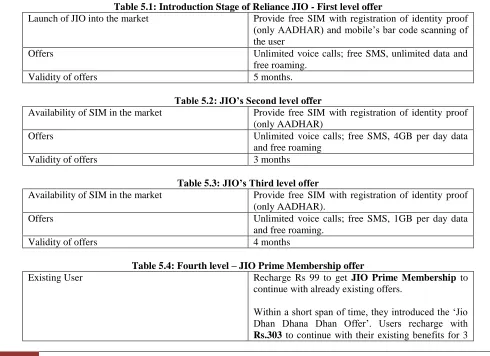
The above said strategy followed by the JIO to acquire the market share and leadership by giving following offers.
Table 5.1: Introduction Stage of Reliance JIO - First level offer
Launch of JIO into the market Provide free SIM with registration of identity proof (only AADHAR) and mobile‟s bar code scanning of the user
Offers Unlimited voice calls; free SMS, unlimited data and
free roaming.
Validity of offers 5 months.
Table 5.2: JIO’s Second level offer
Availability of SIM in the market Provide free SIM with registration of identity proof (only AADHAR)
Offers Unlimited voice calls; free SMS, 4GB per day data
and free roaming
Validity of offers 3 months
Table 5.3: JIO’s Third level offer
Availability of SIM in the market Provide free SIM with registration of identity proof (only AADHAR).
Offers Unlimited voice calls; free SMS, 1GB per day data
and free roaming.
Validity of offers 4 months
Table 5.4: Fourth level – JIO Prime Membership offer
1. Existing User Recharge Rs 99 to get JIO Prime Membership to continue with already existing offers.
Within a short span of time, they introduced the „Jio Dhan Dhana Dhan Offer‟. Users recharge with
135
This work is licensed under Creative Commons Attribution 4.0 International License.
months (90 days)2. New Users A person who wants to buy a new JIO SIM, recharge
Rs.99 to get JIO Prime Membership and become a member of JIO.
To get introduced to „JIO Dhan Dhana Dhan Offer‟, users recharged with Rs.309 to get the services of JIO
Current offers of JIO
Prepaid offers: Rs. 19(200 MB for one day) up to Rs. 9,999 (780 GB for 390 days) with unlimited SMS, free roaming and voice call to all operators also.
Postpaid offers: Rs. 309 (60 GB for two months) to Rs.999 (90GB for 2 months) with unlimited SMS, free roaming and voice call to all operators also.
Objective-IV
Challenges Faced by Reliance Jio
After the launch, a number of issues related to the new services have surfaced which could pose a challenge for Ambani in the days ahead as Jio battles it out with other telecoms
Voice Call Failures
Reliance Jio has been stuck in a dispute with incumbent operators over points of interconnectivity. Jio has accused Bharti Airtel, Vodafone and Idea Cellular of providing insufficient points of interconnectivity leading to call drops. Jio put out data for September 22, 2017 saying over 12 crores out of 15 crore call attempts by its users failed. Of the 6.13 crore call attempts made to Airtel network on September 22, 4.8 crore or 78.4 per cent of the calls failed. The failure on Vodafone network was higher at 84.1 per cent with 3.95 crore call drops out of 4.69 crore calls. Calls to Idea saw 3.36 crore call drops out of 4.39 crore calls made. Bharti Airtel has hit back at Reliance Jio saying network connectivity issues and call drops are due to Jio's own "under-preparedness", insufficient testing efforts and acquiring a large number of customers at the pre-launch stage itself.
Decreased Internet Speed
With addition of users to the Jio network, the speed of Jio's 4G data services has come down drastically after September 5. Now, the internet speed has come down to 6-10 Mbps from 50Mbps during the launch stage. On paper, the difference is huge but in terms of average customer use, even a speed of 8Mbps should work flawlessly. However, the Jio connection faces frequent fluctuations hampering the user experience. Users have also complained about varying speeds despite no change in location.
Buggy Jio Apps
The Reliance Jio apps have not shown consistent performance, but the idea of free content sits pretty well with the Indian audience. The Jio TV app is subjected to
frequent crashes and has a long boot-time, which is also the case with most apps released by Jio. In our experience, the Jio4GVoice is one of the glitchiest Jio apps. The app often fails to load and when it does, the experience is pretty laggy.
Lack of VOLTE Support in Older Phones
All those who don't have VOLTE technology-supported phones cannot make voice calls without the use of Jio4GVoice app which, as mentioned above, seems buggy. This one drawback makes the lucrative free voice-calling feature obsolete for most new consumers. Apart from the VOLTE support, most Indian smartphone users are still stuck with 3G phones. The Jio sims won't benefit them in any way.
Battery Consumption
Reliance Jio has launched its internet services on the 4G band. With not much difference in the rates of 2G or 3G services and 4G connection, new users are inclining towards Jio. The only constraint with 4G services is that they take a toll on the phone's battery, forcing the user to charge it repeatedly. With no 2G or 3G options, the user can't switch to a slower connection to save battery.
Current Problems being Faced by Jio
Jio has garnered for itself a huge customer base. They now need to retain this fan base with attractive offers and discounts.
Jio has made data available to an entire nation at incredibly cheap prices. They'll have to work hard to keep beating the competition.
Jio needs to invest more to upgrade their network coverage, which they already are. ( I have personally observed the company setting up towers in remote locations, offering hope to villages which have been discontinued from the rest of the world)
Unfortunately, a lot of recharges keep failing and this is something that Jio needs to look into. If there are any new product launches, reliable
136
This work is licensed under Creative Commons Attribution 4.0 International License.
IV.
CONCLUSION
The after effects of launch of Jio is like a tsunami, it completely swallows anything that comes in front of it, just like that Jio swallowed every competitor, taking the life out of them, forcing them to move or exit or merge. Data, data in this era is the new Oil. Ancient civilization prospered when there was a river, the modern civilization prospers when there is information available. As rightly said in a speech by Mr. Mukesh Ambani, information will lead to India out of poverty, out of misery thus it is like Oil. With the increase in the data consumption and every human being now relying and getting addicted to internet, Jio has created a perfect opportunity for itself. By enticing free calls for the end users and then tempting the users for free data in the beginning and now cheap data, once the habit is formed it won‟t be difficult for them toretain the consumers.
Jio has already announced its future plans of creating huge libraries of 10 million songs, 6000 movies and 60000 video songs, 1 lakh episodes of TV shows in more than 10 languages. We can derive that in the coming days there can be massive investment in technology driven sectors and entertainment sector with each and every Jio user having access to 4G data with as low as 50 per month and thus Jio is now unstoppable. It is a bull which has been now set free in the industry to offer anything they want at the lowest price.
From all the findings and analysis, we conclude that after the launch of Jio the economic structure of the market is still the same, but the level of competition has grown unexpectedly.
If Jio continues at this pace, it will completely redefine the Telecom sector in India and a new Post Jio era will be formed in the sector where anything and everything is possible.
RECOMMENDATION AND FINDINGS
Introduction
Indian Telecommunications Industry is growing at an exponential rate and is expected to be one of the leading growth drivers of the Indian economy. Reliance Jio has revolutionized the industry and has completely changed the way the industry works.
The most satisfying factor amongst all users of Jio was analyzed as Network and Mobile data. Consumers were not satisfied with the Customer
care that Jio offers, Jio should focus on improving the customer care services that it has to offer. The consumers believe that the performance of Jio
impacts the price movements of Reliance share.
The consumers perceive that Jio has led to a digital transformation in the Indian Telecom Industry Out of the total users of Jio, maximum number of
users of Jio fall in the age gap of 15 to 20, Jio should focus on this age gap as this is the age when teenagers tend to spend more on entertainment and features.
Reliance Jio should now focus more on the rural areas of the country, with the literacy levels improving and the need for advancement arising in rural areas, it is a perfect opportunity for them as more and more people adapt to 4G and use more and more of data
Strategies Adopted by Competitors
Most of the competitors took the way of mergers and acquisition while some went bankrupt and were forced to exit. Competitors had to change their strategies completely and adopt new ones to survive in the market after Jio launched its services. Many competitors have now shut down operations or sold their assets due to the increased competition with only 3 major stakeholders left in the industry.
With the launch of Jio of companies witnessed a decline in their revenues to levels as low as -300% per year.
With greater network coverage and Internet packages, at cheap rates, the consumers should try and experience the Mega fish in the market that is Jio
The average Jio user tends to spend 386 rupees per month while an Airtel user tends to spend on an average of 500 per month and Vodafone-Idea user spends 444 per month, with Jio being the cheapest, it has an upper hand over the industry.
Effect of Reliance Jio on Consumers
Consumers have been the absolute winners after the entry of Reliance Jio with tariffs rates hitting rock bottom and data consumption increasing multi-fold.
LIMITATIONS
The sample size is limited i.e. only to the urban population of mainly Mumbai and Delhi, though the consumption and access to internet and Jio has increased in rural parts of the country also recently. Thus, the results cannot be generalized for the entire population.
The result in conducted in March 2019, therefore the findings may not be relevant to the past when Jio was launched or the future of the Telecom Industry