Westermann, D.T. 1993. Fertility
Management. p. 77-86. In R.C. Rowe (ed.). Potato Health Management, Ch. 9. APS Press, ISBN 0-89054-144-2.
illfiSTER COPY 3°°
Potato Health Management
edited by
Randall C. Rowe
Department of Plant Pathology
Ohio State University, Wooster
Steering Committee
David Curwen
Department of Horticulture University of Wisconsin, MadisonDavid
N.Ferro
Department of Entomology University of Massachusetts, Amherst
Rosemary Loria
Department of Plant Pathology Cornell University, Ithaca, New YorkGary A. Secor
Department of Plant Pathology North Dakota State University, Fargoin cooperation with
The Potato Association of America
9000 >
Potato Health Management
Potato Health Management is an interdisciplinary guide
to complete potato health from seed to storage. Editor Randall C. Rowe and 26 other experts from such disciplines as soil science, weed sci-ence, crop scisci-ence, nema-tology, entomology, and plant pathology present step-by-step advice on raising a healthy potato crop as well as easily understood discussions about the interactions of production practices and pest- and disease-management strategies. Soil management; seed handling and planting; plant nutrition; weed, pest, and disease control; water management; and harvest and storage techniques are all covered in this one holistic guide. Useful in all production regions of North America, Potato
Health Management contains many color photos to assist
in identifying important problems. The book is the second title in the interdisciplinary Plant Health Management Series.
This guide was written especially for:
O Commercial potato growers
O Field consultants and farm advisors
O Extension specialists
O Researchers
O Students
O Professionals in all aspects of the potato industry
Potato Growers
Learn how to produce a health-ier crop using economically viable and environmentally sound methods beginning before planting and continuing after harvest.
Potato Production Advisors
Guide growers toward greater efficiency, profitability, and environmental stewardship through state-of-the-art potato production and crop protection methods. This hard-working reference integrates all the information growers need to manage the whole health of the potato crop and the complete cropping system.
ABOUT THE EDITOR
Randall C. Rowe is
profes-sor of plant pathology at the Ohio Agricultural Research and Develop-ment Center, The Ohio State University, Wooster. For nearly 20 years, he has been involved in research and extension in disease management of potatoes and other crops, with primary emphasis on root diseases. He has extensive experience in disease diagnosis and advising growers and has con-ducted numerous on-farm trials. He has worked with researchers across North America and in several foreign countries to improve the under-standing and practice of potato health manage-ment. Originally from Michigan, Dr. Rowe earned a B.S. degree from Michigan State Uni-versity and a Ph.D. in plant pathology from Ore-gon State University.
CONTRIBUTORS
Ernest E. Banttari, University of Minnesota;
Robin R. Bellinder, Cornell University; Gilles
Boiteau, Agriculture Canada; Robert H. Callihan,
University of Idaho; Richard W. Chase, Michigan State University; David Curwen, University of Wisconsin; Peter J. Ellis, Agriculture Canada;
David N. Ferro, University of Massachusetts;
K. L. Flanders, University of Minnesota; Neil C. Gudmestad, North Dakota State University; Max W. Hammond, Cenex/Land ()lakes Agronomy Company; Larry K. Hiller, Washington State University; Kenneth B. Johnson, Oregon State University; S. M. Paul Khurana, Central Potato Research Institute; Ann E. MacGuldwin, Univer-sity of Wisconsin; Alvin R. Mosley, Oregon State University; Edwin S. Plissey, University of Maine;
Mary L. Powelson, Oregon State University;
E. B. Radcliffe, University of Minnesota; D. W. Ragsdale, University of Minnesota; Randall C. Rowe, Ohio State University; Gary A. Secor,
North Dakota State University; Steven A. Slack,
Cornell University; Robert G. Stevens, Washing-ton State University; Walter R. Stevenson,
University of Wisconsin; Robert E. Thornton,
Washington State University; D. T. Westermann,
U.S. Department of Agriculture
ISBN 0 - 89054- 144- 2
D. T. Westermann
U.S. Department of Agriculture
Agricultural Research Service, Kimberly, Idaho
Fertility Management
A comprehensive strategy for potato health management requires that all essential plant nutrients be available in amounts needed for optimal potato growth and development. Essential nutrients are those required for a normal life cycle and for which no other nutrient can be substituted. Sixteen nutrients are known to be essential for higher plants. These function as major constituents of plant cells or are used in metabolic processes within the plant. Carbon, hydrogen, and oxygen are supplied in water and in the atmosphere. The remaining essential nutrients must be taken up by the roots of the plant from the soil solution or absorbed by the leaves from foliar sprays.
Nutritional Needs
of the Potato Plant
The nutritional requirements of the potato plant change at various stages of crop development. Appropriate fertility man-agement strategies for potato production are based on the different nutritional needs of the crop at each growth stage.
Changes in Nutritional Needs As the Crop Develops
The distribution of dry matter within a potato plant changes at each stage of growth and development (Fig. 9.1). During growth stage I (sprout development), the seed piece is the sole source of energy for growth, because photosynthesis has not yet begun. Soil nutrients are not available to the plant until roots develop.
Photosynthesis begins during growth stage II (vegetative growth) and provides energy for the growth and development of vegetative parts of the plant. Roots actively absorb plant nutrients from the soil during this stage.
The onset of growth stage III (tuber initiation) is controlled by growth-regulating hormones produced in the plant. Before tuber initiation can begin, photosynthesis must supply more carbohydrate (in the form of sucrose) than is needed for the growth of leaves, stems, and roots. Soil moisture and temper-ature, nitrogen nutrition, and plant hormones all affect tuber initiation.
During growth stage IV (tuber bulking), development pro-ceeds in a nearly linear fashion if no growth factor becomes limiting. Tubers become the dominant sink for carbohydrates
and mobile inorganic nutrients. Carbohydrates in the form of sucrose are transported into tubers and converted to starch, which increases the ratio of dry matter to water in the tubers. Environmental and other factors may reduce the plant's ability to supply carbohydrates or inorganic nutrients at sufficient rates for tuber growth. If this occurs, these materials are solubilized in the vegetative parts of the plant and transported to developing tubers, which eventually causes premature senes-cence of the vines. Plants in this condition may be more susceptible to certain diseases, such as early blight and early dying. Late-maturing cultivars may continue some vegetative growth during tuber bulking, but at a slower rate than in growth stage III. Most of the nutrients used by the plant are taken up during growth stage IV, and uptake is nearly complete by the end of this stage.
During growth stage V (maturation), the dry matter content of the tubers reaches a maximum. Nutrients in the tops and roots are solubilized and moved into the tubers, which may accumulate an additional 10-15% of their dry weight during this stage. The portion of nutrients absorbed by the plant that ends up in the tubers at harvest depends upon the mobility of each nutrient within the plant. In the case of highly mobile
Most of the nutrients used by
the plant are taken up during
growth stage IV.
nutrients, such as nitrogen, 90% or more of the total amount taken up by the plant may end up in the tubers at maturity. In the case of relatively immobile nutrients, such as calcium, however, the portion is only 10-20% of the total uptake.
Nutritional Disorders
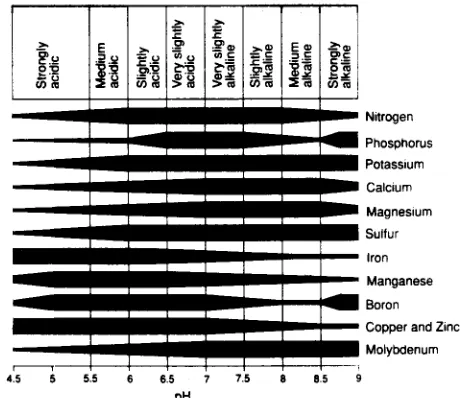
Nutritional disorders can result from deficiencies, excesses (toxicities), and antagonisms between nutrients in the soil or as they are taken up by the plant. Soil pH plays a major role in nutrient availability (Fig. 9.2). At pH 5 and below, problems may be encountered with calcium, magnesium, and molybdenum deficiencies; phosphorus fixation; ammonium, manganese, and aluminum toxicities; and increased leaching of some elements, such as magnesium. At pH 7.5 and above, deficiencies of boron, copper, iron, manganese, and zinc may occur, and phosphorus may be less available, because of the
Growth Stage
JI[
DT
40
20 100
80
20 40 60 80 100 120 140 160
Days After Planting
Fig. 9.1. Dry matter distribution in Russet Burbank, a late-maturing cultivar. Early-maturing cultivars have similar distributions, with their growth stages beginning earlier. Local growing conditions affect the actual timing of growth stages. The growth stages are defined in Figure 1.3.
).. F Q 9_ i
e-co.
E
.2.y
V12 248
= . =
a, 2 2 a) .E,2 4°.v w . 2,-0 L--0 e, co
we, >li >1
a. a) 7 a)
'at
E a) . 25
2 eu
mt ..
2 co
zzl,
sm.
...
...
....
..
...
...
3
NI
..
....-
....
4.5 5 55 6 6.5 7 7.5 8 85 9
pH
Fig. 9.2. Availability of nutrients to plants in relation to soil pH. The widest parts of the bars indicate maximum availability. (Reprinted, by permission, from R. J. Cook and R. J. Veseth, 1991, Wheat Health Management, American Phytopathological Society, St. Paul, MN, as redrawn from C. J. Pratt, 1965, Chemical fertilizers, Scientific American 212 [June]: 62-72)
precipitation of calcium phosphates.
Nutrient deficiencies in potato plants can sometimes be identified from visible symptoms (Box 9.1), but visual diagnoses can be misleading, and diagnosis can be complicated by nonnutritional factors or multiple deficiencies. Symptoms may not be readily apparent as nutritional problems develop, and by the time they are visible it is often too late to make corrections to avoid a loss of tuber yield or quality. Another
problem with visual diagnosis is that symptoms of nutrient disorders are sometimes masked by those due to infection by pathogenic microorganisms, and some disease symptoms resemble those of certain nutrient disorders. More precise and timely identification of nutrient disorders can be obtained from a chemical analysis of plant tissues (see Nutritional Manage-ment Tools, below).
Factors Affecting
Nutritional Needs
Potential Tuber Yield
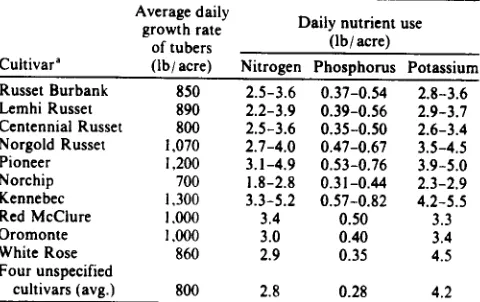
As long as pests and diseases are not limiting factors, adequate nutrition will maximize tuber yield potential within the genetic limitations of the cultivar and the climate in which it is grown. Rates of nitrogen, phosphorus, and potassium uptake for tuber bulking (growth stage IV) in selected cultivars are shown in Table 9.1. These may be adequate for early-maturing cultivars if the plants are large enough to meet the demand for products of photosynthesis. In late-maturing cultivars, such as Russet Burbank, nutrient uptake rates during growth stage IV must be slightly greater than that needed for tuber growth. This is necessary to allow for some new vegetative growth to offset the effects of leaf aging and maintain maximum production of dry matter. Low nutrient concen-trations may reduce the rate of photosynthesis and ultimately result in lower tuber yield if insufficient quantities of the products of photosynthesis are generated during growth stage IV.
Potential tuber yield and appropriate fertilization strategies are affected by the maturity class of the cultivar grown and the length of the growing season. Early-maturing cultivars generally have a shorter growing cycle from planting until the start of maturation. They generally have higher rates of
Nitrogen
Phosphorus Potassium
Calcium
Magnesium
Sulfur
Iron
Manganese
Boron
Copper and Zinc
FERTILITY MANAGEMENT • 79
nutrient uptake during growth stages II and III and hence need adequate preplant fertilization. Late-maturing cultivars may have a greater maximum leaf area and may produce more total dry matter, and their potential tuber yield may thus be greater if healthy leaves remain active long enough.
The potential tuber yield of a late-maturing cultivar also increases as the length of the growing season increases, pro-vided other factors are not limiting. In a 130-day frost-free growing season, growth stage IV may last about 70 days; in a 180-day growing season, it may last 100 days or longer. If the average daily tuber growth rate is 700 pounds per acre, the potential tuber yields in these two growing seasons would be 490 and 700 cwt per acre, respectively. Approximately 70 more pounds of nitrogen per acre would be required for tuber growth in the longer growing season. Proportionally more of the other nutrients would also be needed.
Nutrient Interactions
The plant's response to the application of a specific nutrient depends on the availability of other nutrients. The response to one nutrient is limited if any other nutrient is insufficiently available. This situation can be corrected by identifying the nutrient or nutrients that are limiting and applying the amounts needed to attain the potential yield of the cultivar in the pro-duction area where it is grown.
For example, chloride applications suppress the concentra-tion of nitrate in the petiole. Potassium suppresses magnesium uptake, and vice versa. High amounts of ammonium suppress potassium uptake. Excessive iron induces manganese ciency. Heavy applications of phosphorus induce zinc defi-ciency in soils low in available zinc. Nitrogen and sulfur are related within the plant, because they are essential compo-nents of protein, in a ratio of about 15:1.
These problems can be offset somewhat by the capacity of the plant to make use of nutrients over a wide range of avail-ability in the soil if individual elements are not at deficient or toxic concentrations. In addition, fertile soils have some buffering capacity to supply needed nutrients regardless of what is applied as fertilizer.
Environmental Factors
Soil and air temperatures have a major effect on the early-season growth of potatoes. Low soil temperatures during growth stages I and II reduce rates of root growth and nutrient uptake, especially phosphorus uptake. It is possible to partially compensate for low soil temperatures by using starter
fer-Table 9.1. Tuber growth rates and nutrient use by selected potato cultivars during growth stage IV
Cultivar'
Average daily growth rate
of tubers (lb/ acre)
Daily nutrient use (lb/ acre)
Nitrogen Phosphorus Potassium Russet Burbank 850 2.5-3.6 0.37-0.54 2.8-3.6 Lemhi Russet 890 2.2-3.9 0.39-0.56 2.9-3.7 Centennial Russet 800 2.5-3.6 0.35-0.50 2.6-3.4 Norgold Russet 1,070 2.7-4.0 0.47-0.67 3.5-4.5 Pioneer 1,200 3.1-4.9 0.53-0.76 3.9-5.0 Norchip 700 1.8-2.8 0.31-0.44 2.3-2.9 Kennebec 1,300 3.3-5.2 0.57-0.82 4.2-5.5
Red McClure 1,000 3.4 0.50 3.3
Oromonte 1,000 3.0 0.40 3.4
White Rose 860 2.9 0.35 4.5
Four unspecified
cultivars (avg.) 800 2.8 0.28 4.2 'Russet Burbank, Lemhi Russet, Centennial Russet, Norgold Russet,
Pioneer, Norchip, and Kennebec from Kimberly, Idaho; Red McClure and Oromonte from Colorado; White Rose from California; and four unspecified cultivars from Maine.
Box 9.1
Nutrient Deficiency Symptoms
of Potato Foliage
Nitrogen Entire plants may turn light green. Young leaves remain green; older leaves turn yel-low to light brown and become senescent. Phosphorus Plants are stunted. Leaves are dark green,
and their margins roll upward. Some purpling occurs in pigmented leaves. The severity of leafroll increases as the defi-ciency increases.
Potassium Plants may be stunted. Young leaves develop a crinkly surface, and their mar-gins roll downward. Leaves have slightly black pigmentation. Marginal scorching with necrotic spots may occur on older leaves.
Calcium The youngest mature leaves roll upward and become chlorotic with brown spot-ting. Growing buds may die. In tubers, a brown discoloration develops within the vascular ring before symptoms appear on vegetation.
Magnesium Young mature leaves are affected with interveinal chlorosis and brown spotting, which develop into interveinal scorching and necrosis. Leaves near growing buds remain green.
Sulfur The symptoms are similar to those of nitrogen deficiency, except that chlorosis develops first in young leaves. Affected leaves turn uniformly yellow.
Boron Growing buds die. Plants appear bushy, having shorter internodes. Leaves thicken and roll upward. Leaf tissue darkens and collapses.
Zinc Young leaves are chlorotic, narrow, and upward-cupped and develop tipburn. Other leaf symptoms are green veining, necrotic spotting, blotching, and erect appearance.
Iron Young leaves are yellow to nearly white but not necrotic. Leaf tips and edges remain green the longest. Green veining occurs in leaves.
Manganese Young leaves are affected with interveinal chlorosis and then gray and black fleck-ing and leaf cuppfleck-ing. The flecks eventu-ally develop into small dead patches.
Copper Young leaves develop a pronounced rolling, and then leaf tips wilt and die. Leaves remain green and are of normal size.
Molybdenum Leaves turn yellow or greenish yellow. The symptoms are similar to those of nitrogen deficiency.
tilizers, by banding fertilizers at planting, or by using higher fertilizer application rates. The objective is to provide nutrients sufficient to promote early development of leaf area for optimal light interception and photosynthesis, but not enough to stimu-late excessive vegetative growth. This is important for both maturity types, but particularly for late-maturing cultivars, as relatively high concentrations of available nitrogen during growth stages II and III'tend to delay the onset of linear tuber growth rates in these types.
High soil temperatures can accelerate early plant develop-ment and thus hasten senescence, particularly in early-maturing cultivars. Premature senescence can also result from physio-logical stresses on the plant, caused by high ambient temper-atures, air pollutants, or low soil moisture. Abnormally high temperatures coinciding with high nitrogen status in the plant during growth stage IV can stimulate excessive vegetative growth in late-maturing cultivars. This may limit the growth of tubers or cause problems with tuber quality.
The specific effects of adverse temperatures are difficult to predict, because of the many relationships between various factors affecting plant growth. In general, high nutrient concen-trations in the plant do not relieve plant stresses caused by climatic abnormalities and may intensify their effects.
Soil moisture also has important effects on plant growth and affects some fertility relationships (Chapter 8).
Diseases and Tuber Disorders
The severity of many potato diseases often increases if the plants are also stressed by heat, insufficient amounts of nutri-ents or water, or other adverse environmental factors. Good management of soil fertility and plant nutrition can help to suppress many diseases and minimize their effects on yield. Appropriate applications of nitrogen, phosphorus, and potas-sium, based on analyses of soil and leaf tissue, will help suppress symptoms of potato early dying (Chapter 17) and early blight (Chapter 16). Heavy applications of nitrogen can stimulate excessive vegetative growth, resulting in an extensive plant canopy. The moist microclimate maintained underneath such a canopy promotes the development of aerial stem rot (Chapter 15), Sclerotinia stalk rot (Chapter 17), and tuber diseases associated with wet soils, such as pink rot (Chapter 17).
The severity of many potato
diseases often increases if the
plants are also stressed by heat,
insufficient amounts of
nutri-ents or water, or other adverse
environmental factors.
A nutrition program that allows tubers to reach full maturity before harvest generally helps to minimize losses resulting from tuber disorders and diseases. The specific gravity of tuber tissues is lower in relatively immature tubers harvested because of premature senescence or because normal maturation was prevented. Nutrient deficiencies can cause premature senes-cence, whereas high rates of nitrogen fertilization tend to delay normal maturation, particularly in late-maturing cultivars. Tubers that attain high specific gravity with good fertility management practices also tend to have lower concentrations of reducing sugars, good chip and fry colors, and fewer prob-lems with blackspot bruise and decay. Adequate calcium concentrations in tubers may also help reduce bacterial soft rot in storage. Additional calcium applied to soils in which calcium is limiting may also reduce internal tuber disorders, such as internal brown spot, brown center, and hollow heart.
Good fertilization and nutrient management practices will maximize tuber quality (Chapter 10).
Nutritional Management Tools
Fertility management is an important part of any holistic potato health management program. The goal in managing crop nutrition is to promote uniform and continuous growth of plants and tubers throughout all growth stages. Soil testing and plant tissue testing for nutrient analysis should be used routinely by managers to guide nutritional programs.
Soil Analysis
The relative availability of nutrients in the soil before planting can be measured by soil testing. Soil test data can be used in selecting fertilizers and application rates that are appropriate for the specific needs at a particular planting site. Soil testing can also identify production areas where additional
The goal in managing crop
nutrition is to promote uniform
and continuous growth of plants
and tubers throughout all
growth stages.
fertilizers are not needed, enabling growers to cut expenses and avoid overfertilization and potential environmental pol-lution. Different soil-testing laboratories may use different chemical procedures and may vary in their interpretations of the results and their subsequent recommendations. Labora-tories using procedures developed and calibrated for a specific growing region generally give the best results in that area.
Soil samples submitted for analysis must be representative of the sampled area. It is essential that each field be sampled in such a way that variations within the field are accurately represented. In general, fields should be divided into areas of uniform soil color or texture, cropping history, and fertili-zation or manuring history. One sample should represent no more than 20 acres, even if the soil is uniform. Usually, 10-20 soil cores (0.75 inch in diameter) are randomly taken in a zigzag pattern across the sampled area and then combined to make up a single sample. A sampling depth of 12 inches is adequate for most nutrients, but for analysis of residual nitrogen a second sample should be taken from the 12- to 24-inch profile. Extensive precipitation that causes consider-able leaching following soil sampling can nullify the analysis of residual nitrogen. Managers are encouraged to seek professional help in determining correct sampling procedures for their particular fields. It cannot be overemphasized that an appropriate preplant fertilization program depends on thorough and accurate soil sampling for nutrient analysis in each field.
Fertilizer recommendations are based on soil test results, the potential yield of the chosen cultivar at a particular site, the intended market for the crop, the efficiency of various application methods, the soil texture, and the amount of plant nutrients available from other sources, such as manure or irrigation water. All these variables must be integrated into a single recommendation to fit a particular situation. Individual growers, assisted by professional advice, must ultimately deter-mine their own fertilizer programs.
Plant Tissue Analysis
FERTILITY MANAGEMENT • 81
This method is based on known relationships between nutrient concentrations in plant tissues and the growth rate or yield of the plant at different growth stages. The growth rate is low at low nutrient concentrations but increases considerably at slightly higher concentrations and continues to increase with nutrient concentration until nutrition no longer limits growth (Fig. 9.3). Further increases in nutrient concentrations do not increase the growth rate and may actually reduce it if they reach toxic levels. An appropriate nutrient management program is one that maintains nutrient concentrations in the "sufficient" range during all stages of plant growth, but not in the deficient or the toxic range.
Particular tissues are usually selected for chemical analysis because their nutrient concentrations relate well to the nutri-tional status of the whole plant and are sensitive to changes in the availability of nutrients. In potatoes, the petiole of the fourth leaf from the top of the plant is generally used for chemical analysis (Fig. 9.4). The leaflets are stripped off the petiole and discarded immediately after sampling. Sometimes the entire leaf is used, rather than just the petiole.
Plant samples for tissue analysis must be representative of the sampled field. Approximately 40-50 petioles should be collected from the sampled area, in a pattern similar to that used in collecting soil samples. Areas with different soil types or different cropping and fertilization histories should be sampled separately. Tissue samples should be dried imme-diately at 150° F or kept cool until submitted, because nutrient concentrations may change in moist samples that are stored warm. They should be placed in clean bags or containers in which they cannot be contaminated with any nutrient element. Details on sampling procedures and guidelines for handling tissue samples should be obtained from the plant analysis laboratory where they will be submitted.
Problems encountered in using tissue analysis to monitor nutritional status include selection of the correct leaf for sampling, changes in nutrient concentrations with plant age, recent fertilizer applications, and differences between cultivars. It is very important that tissue samples be taken only from the fourth leaf from the top of the plant. Analysis of samples consistently taken from younger or older leaves gives signifi-cantly different results, which do not represent the actual nutritional status of the plant.
Nutrient concentrations in plant tissues change with the age of the plant. Most nutrients are at their peak concentration in vegetative tissues during tuber initiation (growth stage III), and the concentration usually declines until late maturation (growth stage V) unless additional amounts are applied during
Deficient Sufficient Toxic
Tissue nutrient concentration
—+
Fig. 9.3. Growth or yield of potato plants in relation to the nutrient concentration in plant tissues.
the growth of the crop. Thus, a nutrient concentration that is adequate during growth stage III is generally more than sufficient for growth during growth stage IV. Nitrogen, phosphorus, potassium, copper, zinc, and sulfur decrease in concentration in foliage with increasing plant age, if no addi-tional nutrients are applied, while calcium, magnesium, boron, iron, chloride, and manganese increase in concentration.
A
4th leaf
6
Fig. 9.4. Vegetative shoot (A) and shoot with a floral spike (B). The fourth leaf from the top of the plant is used in tissue analyses to determine the nutrient status of the plant during growth.
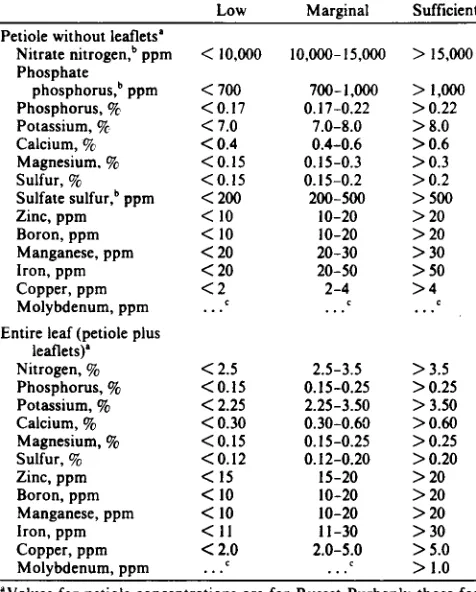
Table 9.2. Suggested ranges of nutrient concentrations in the fourth leaf from the top of the potato plant during growth stage IV
Low Marginal Sufficient Petiole without leaflet?
Nitrate nitrogen, b ppm < 10,000 10,000-15,000 > 15,000 Phosphate
phosphorus, b ppm < 700 700-1,000 > 1,000 Phosphorus, % < 0.17 0.17-0.22 > 0.22 Potassium, % < 7.0 7.0-8.0 > 8.0 Calcium, % < 0.4 0.4-0.6 > 0.6 Magnesium. % < 0.15 0.15-0.3 > 0.3 Sulfur, % <0.15 0.15-0.2 > 0.2 Sulfate sulfur," ppm < 200 200-500 > 500 Zinc, ppm < 10 10-20 > 20 Boron, ppm < 10 10-20 > 20 Manganese, ppm <20 20-30 > 30 Iron, ppm <20 20-50 > 50 Copper, ppm < 2 2-4 > 4 Molybdenum, ppm ...`
Entire leaf (petiole plus leaflets)'
Nitrogen, % < 2.5 2.5-3.5 > 3.5 Phosphorus, % < 0.15 0.15-0.25 > 0.25 Potassium, % < 2.25 2.25-3.50 > 3.50 Calcium, % < 0.30 0.30-0.60 > 0.60 Magnesium, % < 0.15 0.15-0.25 > 0.25 Sulfur, % < 0.12 0.12-0.20 > 0.20 Zinc, ppm < 15 15-20 > 20 Boron, ppm < 10 10-20 > 20 Manganese, ppm < 10 10-20 > 20 Iron, ppm < 11 11-30 > 30 Copper, ppm < 2.0 2.0-5.0 > 5.0 Molybdenum, ppm ... ` > 1.0 'Values for petiole concentrations are for Russet Burbank; those for
the entire leaf are suitable for many cultivars.
Differences in nutrient concentrations in various tissues and changes in these concentrations with the age of the plant reflect differences in the mobility of nutrients within the plant and the balance between the rate of supply and the use of nutrients in various tissues. Thus the nutrient concentrations that are considered sufficient vary from one growth stage to another.
Nutrient concentrations in plant samples taken soon after a fertilizer application are probably not indicative of the true nutritional status of the plant. Within the first few days after a nitrogen application, the petiole nitrate concentration usually reflects a buildup of nitrate within the plant, because the conversion to protein has not yet occurred. The petiole nitrate concentration may also not respond quickly to an application of ammonium if soil nitrification is inhibited by cool, wet soil or a nitrification inhibitor. A high chloride concentration or a heavy application of chloride suppresses the petiole nitrate concentration but not the leaf protein nitrogen concentration.
Table 9.3. Nutrient concentrations in petioles of three potato cultivars relative to the concentration in Russet Burbank (the latter set at 1.00 for each nutrient)'
Nutrient
Norgold
Russet Norchip Kennebec
Nitrate nitrogen 0.88 0.99 0.96
Phosphorus 1.25 0.98 1.32
Potassium 0.98 0.94 1.05
Calcium 0.89 1.19 0.77
Magnesium 0.90 1.43 0.78
Zinc 1.04 0.98 1.19
Manganese 0.85 1.47 1.01
Copper 1.26 1.24 1.25
'Suggested ranges of petiole nutrient concentrations in Russet Burbank are given in Table 9.2.
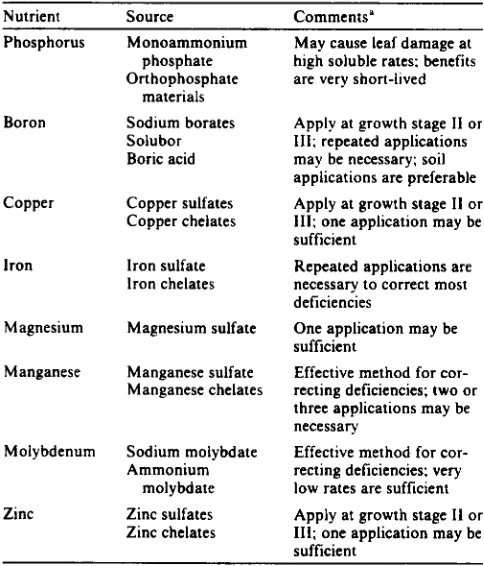
Table 9.4. Fertilizer materials suitable for application as foliar sprays to correct nutrient deficiencies in potato plants
Source Comment?
Monoammonium May cause leaf damage at phosphate high soluble rates; benefits Orthophosphate are very short-lived
materials
Sodium borates Apply at growth stage II or Solubor Ill; repeated applications Boric acid may be necessary; soil
applications are preferable Copper sulfates Apply at growth stage II or Copper chelates III; one application may be
sufficient
Iron sulfate Repeated applications are Iron chelates necessary to correct most
deficiencies
Magnesium sulfate One application may be sufficient
Manganese sulfate Effective method for cor-Manganese chelates recting deficiencies; two or
three applications may be necessary
Sodium molybdate Effective method for cor-Ammonium recting deficiencies; very
molybdate low rates are sufficient Zinc sulfates Apply at growth stage II or Zinc chelates III; one application may be
sufficient
'Foliar sprays are generally not recommended for treatment of nitro-gen, phosphorus, potassium, calcium, or sulfur deficiencies. Consult a local fertilizer or crop advisor for correct application rates before applying any of these materials.
Nutrient concentrations determined soon after foliar sprays have been applied (including some pesticides that contain nutrients) are likely to include external nutrients not yet absorbed by the plant tissues.
Nutrient concentrations in the petiole without leaflets and in the entire leaf (petiole and leaflets) are divided into low, marginal, and sufficient ranges (Table 9.2). These ranges vary for different cultivars (Table 9.3). Deficiency symptoms (Box 9.1) are generally visible or soon develop when concentrations are in the low range. Symptoms are probably not visible when concentrations are in the marginal range, but additional nutrient applications may be needed if a significant portion of the growing season remains. Concentrations in the sufficient range are generally adequate for plant and tuber growth at the time of sampling. Nutritional problems may still develop before the end of the growing season, but these can be detected by later tissue samplings.
Fertilizer Nutrients
and Application Strategies
Crop managers should adopt fertilization practices that effectively utilize their available resources, allow flexibility, and satisfy the nutritional requirements of the crop. The availability of equipment and materials, characteristics of the site, relative costs, personal preference, and convenience are also important factors.
Application Methods
Fertilizer application methods include 1) preplant broad-casting followed by incorporation, 2) banding before or at planting, 3) side-dressing after planting, 4) spraying the foliage during crop growth, and 5) injection into irrigation water. Each method has inherent advantages and disadvantages.
Broadcasting before planting is satisfactory if soil fertility is generally high and no appreciable soil fixation is expected. Soil fixation occurs when nutrients become chemically bound in the soil and unavailable to the plants. Surface-broadcast fertilizers need to be incorporated into the moist layers of the seedbed where roots will be active, but not deeper than 12-18 inches. Preplant application can largely eliminate the need for additional fertilizer during planting, freeing more time for management of the planting operation.
Banding during planting is a common fertilization practice. An efficient and safe band placement is about 2 inches to the side and 2 inches below the seed piece. Sometimes fertilizers are banded preplant during marking-out operations. The bands should be placed close enough to the seed pieces to provide benefits for early growth, but they must not be in direct contact with the seed pieces, or else injury may result.
Side-dressing is used mostly for applying nitrogen during growth stage II, up to 60 days after planting. The later the application, the greater the risk of root pruning during the operation. Side-dressing is generally not recommended for other fertilizer materials, particularly nutrients that stimulate early growth, such as phosphorus.
Spraying liquid nutrients directly onto foliage often brings forth a quicker response from plants than soil applications, and foliar sprays are effective for treating some existing nutrient deficiencies (Table 9.4). This method is also advantageous for elements that are less effective in soil applications because of soil fixation. A surfactant tank-mixed with the nutrient solution usually improves absorption through the leaf surface. The amount of any nutrient that can be applied in a single spray is limited, because concentrated sprays can cause leaf damage.
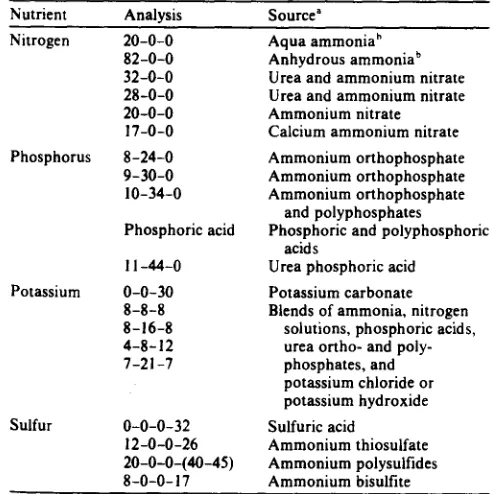
Water-soluble fertilizers (Table 9.5) are commonly applied by injection into irrigation water in some production areas. Nutrient
Phosphorus
Boron
Copper
Iron
Magnesium
Manganese
Molybdenum
FERTILITY MANAGEMENT • 83
This method has the advantage of providing nutrients accord-ing to the needs of the crop and movaccord-ing them partially into the root zone. Careful irrigation management is essential in this method. The uniformity of the fertilizer application is no better than that of the water while the fertilizer is being injected. In addition, irrigation that supplies more water than is lost to evapotranspiration may cause leaching or runoff of applied nutrients, leading to environmental pollution. This technique should only be used on fields where the potential for runoff is low. The irrigation system must be equipped with check valves to prevent contamination of water sources due to back-draining. The compatibility of the fertilizer materials with the irrigation water should be checked, as materials that remain soluble are the most effective. Many liquid fertilizer materials are compatible with each other, but further information about compatibility should be obtained from suppliers or local advisors before any fertilizers are mixed. A strong acid, such as phosphoric or sulfuric acid, should not be combined with a strong base, such as potassium carbonate. When application rates are calculated for specific nutrients, the portion of the crop's nutritional requirements supplied by soluble nutrients already present in the irrigation water itself must be taken into account.
Response to Applied Fertilizer
Many factors can alter the expected response of a potato crop to fertilizer applications. Soil fumigants greatly change the populations of microorganisms in the soil, many of which play roles in nutrient cycling. Some fumigants may retard the biological conversion of ammonium to nitrate or the mineral-ization of nutrients from organic forms in the soil. Tillage practices affect soil compaction and rooting depth, which may influence the response to applied fertilizers. Overirrigation may cause nitrate leaching in sandy soils (Plate IC), whereas the availability of nutrients is reduced if low soil moisture limits growth. A large weed population reduces tuber yield by com-peting for nutrients and water, and plants with significant insect
Table 9.5. Liquid fertilizer materials suitable for application in irrigation water
Nutrient Analysis Source' Nitrogen 20-0-0 Aqua ammonia'
82-0-0 Anhydrous ammonia' 32-0-0 Urea and ammonium nitrate 28-0-0 Urea and ammonium nitrate 20-0-0 Ammonium nitrate 17-0-0 Calcium ammonium nitrate Phosphorus 8-24-0 Ammonium orthophosphate
9-30-0 Ammonium orthophosphate 10-34-0 Ammonium orthophosphate
and polyphosphates
Phosphoric acid Phosphoric and polyphosphoric acids
11-44-0 Urea phosphoric acid Potassium 0-0-30 Potassium carbonate
8-8-8 Blends of ammonia, nitrogen 8-16-8 solutions, phosphoric acids, 4-8-12 urea ortho- and poly-7-21-7 phosphates, and
potassium chloride or potassium hydroxide Sulfur 0-0-0-32 Sulfuric acid
12-0-0-26 Ammonium thiosulfate 20-0-0-(40-45) Ammonium polysulfides 8-0-0-17 Ammonium bisulfite
'Check the compatibility of the fertilizer with the irrigation water before any application is made.
"For surface irrigation only.
damage or disease are generally not able to use applied fer-tilizers as efficiently as healthy plants.
Nitrogen. Most soils need nitrogen applications to produce a profitable yield of potatoes. The common forms of fertilizer nitrogen are nitrate, urea, and ammonium. Plants can use either nitrate or ammonium nitrogen.
Soil fumigants greatly change
the populations of
microorgan-isms in the soil, many of which
play roles in nutrient cycling.
Nitrogen fertilizers are most efficiently used in split appli-cations, with one-third to two-thirds of the total requirement side-dressed after plant emergence or applied by irrigation in several smaller applications. Dry nitrogen fertilizers may also be successfully top-dressed by aircraft during plant growth if the application is followed by either rainfall or sprinkler irrigation. Ammonia may volatilize from urea under some conditions if the material is not watered in soon after application.
Potato crops intended for early harvest require less nitrogen. The entire nitrogen requirement for early-maturing cultivars can be applied preplant if losses due to leaching are expected to remain low during growth stages I and II. For late-maturing cultivars, application of the total nitrogen requirement at planting is not recommended, because it tends to delay early tuber development.
Several precautions should be taken in planning nitrogen applications. High rates of banded urea or diammonium phos-phate can cause ammonia toxicity, particularly in calcareous alkaline soils. If these materials are placed with the seed pieces at planting, not more than 150 pounds per acre should be used. A much higher rate can be used if these fertilizers are banded at least 2 inches from the seed pieces. The total salt index of the fertilizer mix should also be considered. Nitrogen applications 1.5-2 times higher than recommended rates can stimulate excessive foliar growth, leading to delayed tuber maturity, lower specific gravity, and increased problems with tuber quality (Chapter 10). Nitrate forms of nitrogen are subject to leaching before plant uptake, particularly in coarse-textured soils (Chapter 8 and Box 9.2).
Nitrogen fertilizers are
most efficiently used in split
applications, with one-third to
two-thirds of the total
require-ment applied after plant
emergence.
Nitrogen is particularly suitable for application by sprinkler irrigation. Several liquid nitrogen fertilizers can be applied by this method (Table 9.5), and nitrogen is also a component of most other liquid fertilizers containing phosphorus, potas-sium, and sulfur that are applied by sprinklers. This method increases the total efficiency of the fertilizer while maintaining or even increasing tuber yield and quality. Sprinkler application of nitrogen should not begin before the end of growth stage III. Until then the root system is generally not sufficiently developed to capture most nitrogen applied by this method, and thus the nutrients may be leached below the root zone.
Box 9.2
A Checklist of Practices
for Avoiding Nitrate Leaching
Nitrate nitrogen is readily leached by rainfall or irrigation, especially in coarse-textured soils. Leaching decreases the efficiency of nitrogen fertilizer applica-tions, increases fertilizer expenses, and may lead to contamination of surface waters and groundwater. To avoid applying nitrogen in excess of the plant's needs and to avoid the loss of nitrates due to leaching, the following practices should be part of any nitrogen management program:
• Conduct soil tests to determine preplant fertiliza-tion rates.
• Make split applications of nitrogen.
• Make fertilizer applications as close as possible to the actual time of plant demand for nitrogen. • Conduct petiole tissue analysis for nitrate nitrogen
to evaluate the need for applications during crop growth.
• Allow the petiole nitrate nitrogen concentration to drop below 10,000 parts per million by the end of growth stage IV.
• Schedule irrigations according to crop water use and soil characteristics. Do not overirrigate.
• Plant a winter cover crop after the potato harvest to capture residual nitrogen in the soil.
1' it t 40 40 40
Nitrogen
applications
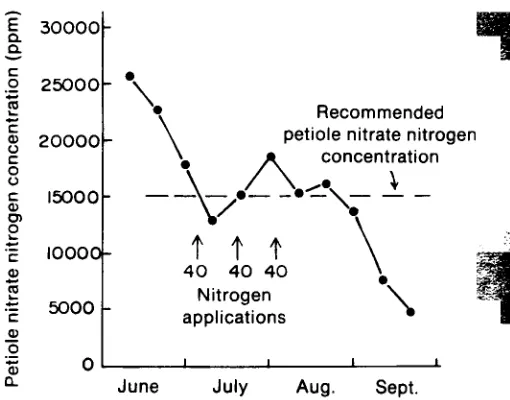
(growth stage IV). This maintains the petiole nitrate concen-tration in the desired range (Fig. 9.5). Repeated application of more than 40 pounds per acre is not recommended, because it stimulates excessive vegetative growth. An average Russet Burbank crop requires about 3 pounds of nitrogen per acre every day to maintain a daily growth rate of 700 pounds of tubers per acre. An application of 40 pounds per acre is sufficient for only about 10 days if the nitrogen uptake efficiency of the plant is 75%. The number of applications needed depends upon the length of growth stage IV.
It may be necessary to apply nitrogen with every irrigation in areas where the crop must be irrigated quite often, such as fields with coarse-textured soils or environments with high evapotranspiration. A drawback of this practice is that it tends to stimulate more vegetative growth than needed, which may aggravate some diseases, particularly if the petiole nitrate concentration is kept above 20,000 parts per million. To reduce this problem, only enough nitrogen should be applied to replace that taken up by the crop since the last application.
To enhance tuber maturity at harvest, the petiole nitrate concentration should be allowed to drop below 10,000 parts per million by the end of growth stage IV. Nitrogen should not be applied within 4-6 weeks of vine killing. Applications late in growth stage IV and in growth stage V do not increase tuber yield and may reduce tuber quality, skin maturity, and the storability of the crop (Chapter 6).
Anhydrous ammonia and aqua ammonia should not be applied by sprinkler irrigation because of potentially high losses due to volatilization. Volatilization is also a problem in
apply-ing these materials by surface irrigation if the pH of the water is high. These materials may also cause calcium to precipitate and increase the sodium hazard in some irrigation water. The addition of acidic materials, such as sulfuric acid, generally corrects this problem.
Most other liquid nitrogen materials may be successfully applied by surface irrigation if precautions are taken to avoid runoff. In general, injection of the fertilizer into the irrigation system should be started after the water is partway across the field and should be completed by the time it begins to leave the field.
Ammonium forms of nitrogen may not be immediately available for plant uptake, because they are held by the soil in the irrigation furrow until they are converted to nitrate. As an alternative, growers using surface irrigation could consider banding the entire nitrogen requirement at planting or side-dressing it later.
Phosphorus. Phosphorus fertilization is needed in many soils for a profitable yield of potatoes. This nutrient contributes to early crop development and tuberization and enhances tuber maturation. It is not readily leached, but phosphorus fertilizer should always be incorporated into the soil to prevent loss in runoff water, especially if soil erosion is likely to occur.
The total phosphorus fertilizer requirement may be broad-cast in the fall or in the spring before planting. It may also be banded at planting, to the side of and slightly below the seed piece. Banding gives the highest efficiency in phosphorus-fixing soils. The fertilization rate may generally be reduced by as much as 30% by banding, compared with broadcasting, if soil tests show low phosphorus concentrations. The avail-ability and uptake of phosphorus may be increased by banding with fertilizers containing ammonium.
Liquid and dry sources of phosphorus are equally effective for potato production. A phosphorus starter fertilizer low in ammonium (such as monoammonium phosphate, 11-48-0) may be beneficial, particularly if it is placed about 1 inch above the seed pieces at planting and applied at a rate of up to 100 pounds per acre.
Potatoes respond to phosphorus applied through sprinkler irrigation if the fertilizer materials (Table 9.5) are compatible with the irrigation water and the plants have enough roots near the soil surface. Phosphorus applied by sprinklers pene-trates only about 2 inches into the soil. Maximum penetration
30000
25000
Recommended
petiole nitrate nitrogen
A concentration
9/ \_...
July Aug. Sept.
Fig. 9.5. Petiole nitrate concentration in Russet Burbank. Arrows represent points during the growing season when nitrogen was applied (at the rate of 40 pounds per acre) through a sprinkler irrigation system.
E
0
a)
0
0
0
a>
co
0
0 a)
20000
1500 0
1000
5000
Box 9.3
Compatibility
of Phosphorus Fertilizer
with Irrigation Water
The compatibility of phosphorus fertilizer with irrigation water should always be determined before application by sprinkler irrigation is attempted. The effectiveness of this method is reduced if a precipitate forms before the water reaches the soil surface. Deposits may also form around and on sprinkler heads and nozzles, reducing their effectiveness or plugging them.
Compatibility can be tested by adding the appro-priate amount of fertilizer solution to a gallon of fresh irrigation water. For hand lines, wheel lines, or solid-set irrigation, the amount of fertilizer solution (in teaspoons) to add to 1 gallon of water is calculated as follows:
0.0283 X F x=
WXtXP
where
x= amount of fertilizer solution (tsp) per gallon of
irrigation water
F= fertilizer application rate (P2O5 , lb/ acre) W= water application rate (in./hr)
t= period of time during which the fertilizer is
injected (hr)
P= fertilizer concentration (P 2O5 , lb/ gal)
For center-pivot irrigation systems, the calculation is
0.0283 X F
x=
DXP
where D= depth of water applied (in./ acre).
If a fine white precipitate forms after the solution is thoroughly mixed, a smaller amount of fertilizer should be applied, or the injection time should be lengthened. In either case, the compatibility should be retested.
Irrigation water having a high pH or high calcium and magnesium content may be partially acidified to increase its compatibility with phosphorus fertilizer. The final pH should be kept above 5.0 to prevent corrosion damage to the irrigation system. The pH may be lowered by the use of an acidic liquid fertilizer, such as urea phosphoric acid or phosphoric acid, as a phosphorus source.
FERTILITY MANAGEMENT •
85
occurs when the soil surface is wet before the application. The concentration of phosphorus in petioles usually increases within 10-14 days after application.
Conditions necessary for successful application of phos-phorus with irrigation water include 1) an active root system in the upper 2 inches of soil under a full plant canopy, identified by small white roots visible on or immediately below the soil surface under the canopy, 2) a fertilizer material that is com-patible with the irrigation water (Box 9.3), and 3) applying the fertilizer before a phosphorus deficiency develops. Nor-mally this practice is not recommended unless plant analysis shows that phosphorus will become limiting before the end of growth stage IV. If the irrigation water is not compatible or if surface irrigation is being used, supplemental phosphorus must be applied in foliar sprays (Table 9.4).
Potassium. Potassium fertilizer requirements for potatoes vary considerably in different soils. This nutrient influences both yield and tuber quality, including specific gravity, susceptibility to blackspot bruise, after-cooking darkening, reducing sugar content, chip fry color, and storage quality. Potassium chloride, particularly at high rates of application, usually results in lower tuber specific gravity than potassium sulfate. This problem is reduced as the interval between application and planting is increased.
Banding increases the effectiveness of potassium fertilizers in soils where significant fixation occurs. Because of potential problems with salt toxicity, however, potassium fertilizer should not be banded at planting at rates exceeding 300 pounds of K205 per acre. High rates should be split between broadcast and banded applications. Fall broadcast applications can be effective but are not recommended on sandy soils in areas with winter rainfall, because of potential leaching. In irrigated production, the potassium content of the irrigation water should be considered when fertilization requirements are calculated.
Several liquid potassium fertilizers are available for appli-cation by sprinkler irrigation (Table 9.5). In general, however, potassium should only be applied during crop growth if a deficiency is likely to occur before the end of growth stage IV. It is immobile in soil and can only be absorbed by active, healthy roots near the soil surface. It is also required in relatively large amounts, with uptake rates similar to those for nitrogen (Table 9.1). In addition, potassium fertilizers have relatively low analyses. All these factors tend to reduce the effectiveness of irrigation systems in supplying the potassium required during tuber growth.
Calcium and Magnesium. Supplemental applications of calcium and magnesium are needed for potato production in some acid soils, to provide needed calcium and raise the soil pH (Chapter 2). The increase in soil pH may also improve phosphorus uptake by the plant. If the magnesium content of the soil is low, dolomitic lime should be used. Soils in which common scab is a problem, however, should be held below pH 5.5 (Chapter 17). Calcium sulfate or magnesium sulfate can be used without raising the soil pH. Calcium nitrate can be applied if both nitrogen and calcium are needed.
Most calcium and magnesium fertilizers should be applied before or at planting. Magnesium sulfate may be applied as a foliar spray or added to fertilizer mixes. Calcium applied to foliage is not translocated to developing tubers. The immo-bility of calcium in soil and within the plant and potential problems with its compatibility with irrigation water limit the effectiveness of sprinkler-applied calcium.
Sulfur. Application of sulfur is usually needed for potatoes where the soil or irrigation water is naturally low in this nutrient or where it has not accumulated from previous applications. Many pesticides and some fertilizers (ammonium sulfate and potassium sulfate) contain significant amounts of sulfur.
Sulfur is applied as a sulfate or as elemental sulfur. The
sulfate form is readily available for plant uptake, while elemental sulfur must be oxidized to sulfate before being taken up by the plant. The soil pH may be lowered by the oxidation of elemental sulfur. Sulfates are susceptible to leaching from soil.
Several problems are associated with injecting sulfuric acid into irrigation water because of the difficulty in handling this material and the resulting excessively low pH of the water.
Micronutrients. Certain micronutrients must be supplied for
potato production in some soils. Zinc and manganese may be needed in calcareous alkaline soils. Banding fertilizers con-taining ammonium may help correct some micronutrient deficiencies in calcareous soils. Some fungicides contain significant amounts of certain micronutrients and can be sig-nificant sources of these if the micronutrients are absorbed by the plant. For example, mancozeb is a source of zinc, and copper fungicides supply that element.
Copper may be needed in peat and muck soils but is usually sufficient in mineral soils. Boron may be needed where soils or irrigation waters are naturally low in that element. Most soils do not require an application of iron for potatoes. Chloride and molybdenum are generally not deficient in soils used for potato production.