THE MAGIC OF THE LAST PLANNER
®SYSTEM
FOR NIGERIAN CONSTRUCTION
Emmanuel Itodo Daniel1, Christine Pasquire2 and Oko John Ameh3 ABSTRACT
Extremely poor economic performance of the Nigerian construction industry suggests that non-value adding activities are prevalent, which result not only in the reduction of contractors’ profit margin but economic loss for the country in general. This study analyses non-value adding activities in Nigerian construction sites. The research seeks to establish potential antidotes within the Last Planner® System (LPS) and reveal the elements of the LPS which could be abstracted into Nigerian construction to improve performance. It was found that these elements form the theoretical basis for developing a lean approach that was labelled Last Planner® thinking.
The research design comprises mixed quantitative cross-sectional survey and qualitative-exploratory approaches. Registered contractors and construction professionals in academia who are based in Lagos metropolis, Nigeria, form the population for the study. The instrument for data collection was survey questionnaire and semi-structured open ended interview. Forty questionnaire and three interview responses were analysed using descriptive statistics. The study reveal various incidences and contributory factors to non-adding value activities, with long approval process been the most prevalent and the identified solution embedded in Last Planner practices. It also identified current practices that indicate Last Planner System practices.
The study concludes that Last Planner thinking has the potential for minimising non-value adding activities and proposed that Last Planner thinking should be developed as a precursor framework to ensure that participants are already thinking in a way that aids the implementation of the Last Planner System. The study provides evidence that the developed framework built more confidence in the organisation for continuous improvement.
KEYWORDS
Last Planner System, Last Planner thinking, non-value adding activities, construction sites, Nigeria.
INTRODUCTION
The Construction industry has been identified as one of the industries that generate a high level of waste during its operations. In fact, non-value adding activities (NVA)
1 PhD Research Student, Centre for Lean Projects, School of Architecture, Design and Built;
Environment, Nottingham Trent University, UK [email protected]
2 Professor, School of Architecture, Design and Built Environment, and Centre for Lean Projects,
Nottingham Trent University, Nottingham NG1 4BU, United Kingdom, Phone +44 11584 882859, [email protected]
in the construction process such as waiting time, material handling, over production, inventories, re-work and movement of workers all constitute waste which forms about 30% of construction cost (Koskela, 2000,). This additional cost reduces contractors’ gain, and with the numerous competitors in the industry, contractors are been pressed to search for alternate ways to better their opportunities on every project. In view of this, Koskela, (2000) suggested that advanced construction methods that encourage improved coordination of the construction flow process, analyses and minimises waste (non-value adding activities), while also maximising values for the end users should be explored.
Lean construction is a production philosophy that encourages value maximisation and waste minimisation in construction. The Lean Construction Institute (LCI) defines lean construction “as a production management-based approach to project delivery”. The approach is aimed at reducing waste in all forms from the construction process through conscious improvement of the work process to add value to the end users (Koskela, 2000; Pasquire and Conolly, 2002). To accomplish these, techniques such as “Just-In-Time” (JIT), and the “Last Planner System” among others are used. However, among these techniques the Last Planner System (LPS) is the most advanced and widely used in the construction industry with positive impact which seems like magic (Ballard, 2000, McGraw Hill Report, 2013)..
The LPS developed by Ballard and Howell focuses on reducing workflow uncertainty which was identified as a missing component in the traditional project management kit (Ballard and Howell, 2003). The ‘magic’ with the LPS is indeed countless. According to Thomas, et al (2002), Ballard and Howell, (2003), Salem et al (2006), the technique has potential to minimise uncertainty in the production process; thus making project programmes more certain, while also creating a flow in the production process. It was reported that the LPS not only increases the awareness of non-lean practitioners on lean but also has the highest level of future adoption due to its present benefits (McGraw Hill Report, 2013). The effects of its application on construction projects attest to this. For instance, the Neenan Company in the USA reduced its project time and costs by up to 30% by using these principles to improve workflow and facilitate a prompt approach to deviation from schedules (Egan, 1998). Similarly, Pacific Contracting of San Francisco also increased their annual turnover by 20% (Egan, 1998).
Although this system has been implemented in the United States, United Kingdom, Chile, Denmark, Indonesia, Brazil, and Peru among others with good outcomes (Ballard and Howell, 2003), it is still alien in the Nigeria construction industry with a low level of knowledge and implementation (Oladiran, 2008, Ahaikwo et al, 2012). Also, in Nigeria, NVA has been assumed to affect construction industry performance but the effect is not known due to little or no attention from researchers or contractors.
NIGERIA CONSTRUCTION INDUSTRY AND NON-VALUE ADDING ACTIVITIES
The Nigeria construction industry plays a vital role in meeting the need of the nations’ infrastructural and economic development. About 70% of the nation’s capital investment goes into the construction industry annually (Dantata, 2008). However, its contribution to the nation gross domestic product (GDP) has been on the decline over the past three decades. In fact, in 2011, it was precisely 4.1% (Oluwasekeyi 2011). This decline has been attributed to numerous ills faced by the industry which include: wastage on site, not adopting new construction techniques, project abandonment, delay in project execution, poor quality work and low productivity, cost and time overrun, lack of coordination, and corruption among others, (Ajayi, et al. 2010; Adamu and Abdulhamid, 2012; Ameh and Daniel, 2013).
Past researches in Nigeria focus more on material wastage, (Ajayi, et al, 2010; Ameh and Daniel 2013). But such narrow and myopic view about waste has been criticised by lean construction researchers (Koskela, 2000). Considering the strategic position of the Nigeria construction industry as the topmost country among the emerging markets, all wheels must be set rolling to improve the sector’s performance. It has been predicted that by 2025 65% of all construction activities will take place in the emerging market (PwC Real Estate, 2014)
NON-VALUE ADDING ACTIVITIES IN CONSTRUCTION
APPLICATION OF LEAN PRINCIPLES IN CONSTRUCTION
The applications of lean principles in construction processes have received some levels of acceptance over the years as revealed by lean construction researches (Ballard and Howell 2003; Ballard et al, 2009). Although this is not without oppositions as some believe that lean principles are from the manufacturing industry and should not be applied directly in construction (Howell and Ballard, 1998). However lean construction researchers have maintained that both the construction and manufacturing industry are similar since they both produce product and services in addition to their sole aims of delivering value to their customers (Salem et al 2006.). According to Chee et al, (2009) the Toyota production system (TPS) has good application in the industry. For instance the application of the continuous improvement concept of TPS in construction process could entail; having weekly meetings, investigating why planned task is not completed, rejecting defective works, coordination meeting with subcontractors, use of lean construction techniques among others. Other TPS concepts such as top management commitment and the total quality concept could also be applied in construction to promote acceptance of suggestions and feedback from subcontractors. This implies that TPS principles have direct application in construction processes on site. More importantly, these principles have their applications in quality control and effective production planning and control on site. According to Koskela, (2000) construction projects are complex with many uncertainties which could lead to inefficiency. Effective planning and control are therefore the best approach in mitigating these uncertainties (Howell and Ballard, 1998). Planning defines the criteria for success while control causes an event to conform to plan (Ballard and Howell, 1998). To achieve this, an advanced planning tool such as the Last Planner System that relates project scheduling with planning has been suggested (Ballard and Howell, 2003).
THE MAGIC OF THE LAST PLANNER® SYSTEM
in construction, the system also aids collaborative planning and team working. This implies that practical observation of Last Planner principles on site will be of great benefit to contractors and all construction professionals inclusively. According to Mossman, (2012) the Last Planner System helps in creating overriding improvement in project programme predictions, productivity, reduces project time and site accidents, increases profit, while giving due consideration for employee satisfaction. For instance through the application of the Last Planner System BAA UK, achieved 30% improvement in reconstruction time for airport runways and also developed a more predictable programme (Gil and Ward, 2011; Mossman, 2012). Furthermore, Koskela, (2000) assert that NVA can be minimized through effective planning and control using production control principles of the Last Planner System. All these demonstrate the potentials of the Last Planner System in stabilizing and eliminating efficiencies from the construction process.
LAST PLANNER® THINKING DEFINED
The concept of Last Planner thinking can be viewed as the underlining principles of the Last Planner System used in project planning and control. The Last Planner System has been implemented on many construction projects with good outputs, (Mossman, 2012), however, lean construction researchers have argued that implementing the system presents various challenges due to organisational culture and technological factors among others (Hamzeh and Bergstrom, 2010). In view of this, it was suggested that an implementation framework that encourages team work and continuous improvement should be developed within the organisation, which will help in better implementing the Last Planner System (Hamzeh and Bergstrom, 2010). Hamzeh and Bergstrom, (2010); Mossman, (2012), argued that such a framework must be embedded in the organisation, as anything contrary to this, might make employees to view the entire implementation of the Last Planner System as another managerial tool that will soon go into extinction. Hamzeh and Bergstrom, (2010) opined that the right framework to use in implementing the Last Planner System is to prepare the employee to develop the sense of willingness to learn from working together for continuous improvement. Last Planner thinking could therefore include organisational practices such as having meeting with contractors and subcontractors, reviewing sequence of planned work weekly or daily, rejecting defective works, receiving suggestions from employees and developing a system to monitor quality among others. Although the organisation may not enjoy the full benefits, but it could serve as a good framework for the implementation of the Last Planner System which could further reduce non-value activities on construction sites.
RESEARCH METHODOLOGY
Information and data for the study were obtained via questionnaire survey and semi-structured open ended interviews. The semi-structured open ended interview was combined with the questionnaire survey to obtain a detailed response from the respondents and to minimise bias to the study which is common with the questionnaire survey. Naoum, (2013) argued that, though questionnaire surveys provide opportunity to reach more respondents, it could also force respondents to choose from available alternatives which may not be a true reflection of their opinion. The survey instrument was divided into four major sections. The first section sought to know respondents background information to justify the credibility of the responses. Section two sought to know the frequency of occurrence of fifteen non-value adding activities identified from literature review of Koskela, (2000); Alwi, (2002); Ralph and Iyagba, (2012). Also, the respondents were required to rate fourteen contributory factors to non-value activities in section three. In the last section, the frequency of use of seventeen identified Last Planner practices on construction sites was ranked. All these were ranked using a five point Likert scale with 5 been the highest value.
The questionnaires were administered via email to construction manager, project managers, quantity surveyors, site managers, and construction professionals in the academia. The population for the study was further stratified by organisational affiliations (contracting and academia) and simple random sampling was subsequently employed. A total of seventy five (75) questionnaires were distributed and only forty responses were received. This represents an aggregate response rate of 53%. Three (3) respondents participated in the open ended structured interview. The analysis of the responses and results are presented as follows. It is worth to note that this finding is limited to Lagos metropolis alone, thus it may not be readily generalised for the entire Nigerian construction industry. However, Lagos has been considered as reflection of the Nigerian construction industry, since most construction companies have their head or branches offices in Lagos.
RESULTS AND DISCUSSIONS
Respondents’ organisation background
The detail of the respondents showed that 82.5% are from contracting organisations while 17.5% are from the academia. This shows that the response is not limited to the construction site professionals alone but also brings to bear current academic knowledge of researchers on non-value adding activities and Last Planner practices. Furthermore, since the majority of the respondents are from contracting organisations, they should be able to provide reliable data for the study considering that non-value adding activities and any means to minimise them will be of interest to them. In terms of respondents experience in Nigeria construction industry, the result showed that 70% have over 5 years of experience. This implies that the respondents have sufficient construction experience in Nigeria, thus, information obtained on non-value adding activities can be adequately relied upon.
Incidence of non-value adding activities on construction sites in Nigeria
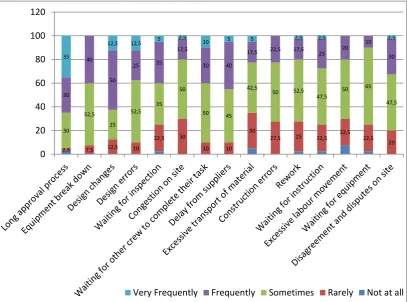
Nigeria. This finding confirms the assumption, upon which this study is based; that non-value adding activities are prevalent on almost every construction sites in Nigeria. However, the frequency of their occurrence varies. These are; long approval process with 35% response, design changes and design errors with 12.5% each, and waiting for other crew to complete their task with 10% response. These findings agrees with previous study such as Alwi, (2002), Zhao and Chua, (2003), Ralph and Iyagba, (2012) where waiting for instruction, design changes, design errors and waiting for other crews among others were identified as non-value adding activities that occur on site. This frequent re-occurrence of long approval process as a non-value adding activity on construction site in Nigeria as shown in figure 1 could be attributed to the high level of bureaucracy, corruption, and lack of transparency in contract process. This argument is further supported by the findings of Olusegun et al, (2011) that lack of transparency and under payment of consultants are among the causes of corruption in Nigeria construction industry.
The impact of these five top ranked non-value adding activities on project performance in Nigeria cannot be overemphasized. For instance, Adamu and Abdulhamid, (2012) argued that the low profit margin currently experienced by contactors in the Nigeria construction could be due to the presence of non-value adding activities in the production process and called for the use of more lean approaches in execution of construction project. According to (Ralph and Iyagba, 2012) these NVA cause delays which is a major contributory factor to cost and time overrun of construction projects in Nigeria and further dents the image of the construction industry.
Figure 1: Analysis of incidence of non-value adding activities on construction sites
2,5 7,5 12,5 10
22,5 30
10 10 30
27,5 25 22,5 22,5 22,5 20 30
52,5 25
52,5 35
50
50 45 42,5
50 52,5 47,5
50 65 47,5 30
40 50
25 35 17,5
30 40
17,5 22,5 17,5 25 20 10
30 35
12,5 12,5 5 2,5 10 5 5 2,5 2,5 2,5
0 20 40 60 80 100 120
Rank order of contributory factors to non-value adding activities on sites
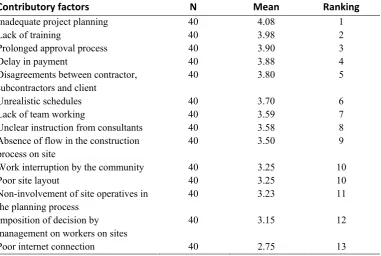
The result of the analysis in Table 1 identified nine factors that have high contribution to non-value adding activities on construction sites. Furthermore, the view of the respondents in this study, on inadequate planning been the topmost factor contributing to the occurrence of non-value adding activities has shown that the antidote to non-value adding activities could be Last Planner System and Last Planner thinking. This is because the Last Planner System is one of the developed lean construction tools that help in project planning and control by removing uncertainty and creating flow in the production process (Ballard and Howell, 2003) equally important is the fact that lack of training ranks second among the factors. Although, this may not be the case in other developed countries, but in Nigeria the use of unqualified site operatives mostly in the bid to reduce cost is a common occurrence. The consequence of using such operatives on site, without the requisite training shows up in the replete of construction errors and rework on site thus, constituting non-value adding activities. According to Lekan and Munta, (2008), the number of trained and qualified artisan in Nigeria construction industry is on the decline.
Table 1: Ranked order of contributory factors to non-value adding activities on sites
Contributory factors N Mean Ranking
Inadequate project planning 40 4.08 1
Lack of training 40 3.98 2
Prolonged approval process 40 3.90 3
Delay in payment 40 3.88 4
Disagreements between contractor, subcontractors and client
40 3.80 5
Unrealistic schedules 40 3.70 6
Lack of team working 40 3.59 7
Unclear instruction from consultants 40 3.58 8
Absence of flow in the construction process on site
40 3.50 9
Work interruption by the community 40 3.25 10
Poor site layout 40 3.25 10
Non-involvement of site operatives in the planning process
40 3.23 11
Imposition of decision by management on workers on sites
40 3.15 12
Poor internet connection 40 2.75 13
complex relationships among project team members at all levels for optimal delivery of the project outcomes. In addition, the analysis reveals twelve other current practices that indicate Last Planner thinking which are sometimes adopted by the respondents. Although these practices are not observed or adopted regularly on construction sites now, the study has shown that such practices already exist within the construction processes on site in Nigeria. This will serve as a good platform or framework for the implementation of the Last Planner System on construction sites in Nigeria. According to Hamzeh and Bergstrom, (2010) for better implementation of the Last Planner System, a framework that encourages team working and continuous improvement should be developed by the organisation.
Figure 2: Current practices that indicate Last Planner thinking on construction sites
Furthermore, the study reveals two Last Planner thinking practices that are rarely adopted in the Nigeria construction industry. These are developing schedules that works backward and involvement of non-management staff in decision-making. The danger with such approach is that the management may not be able to gain the commitment of the site operatives. Ballard, (2000), argued that in order for site operative to make reliable promise and become committed to perform it, they must be involved in the planning and decision-making process.
Interview Results on non-value adding activities and Last Planner practices The analysis of the interview result reveals the following measures that can minimise the occurrence of non-value adding activities; putting into practice what is planned, training and education, planning and scheduling of work, constant review of work and creation of coordinating unit within the organisation. All the respondents interviewed strongly believed that effective planning, team working and training could minimise the incidence of non-value adding activities. It can thus be argued that the suggested
means for minimising non-value activities are all imbedded in Last Planner principles. According to Koskela, (2000) non-value adding activities can be reduced through systematic planning approach such as allowing work to commence at optimal conditions, reducing task variability risk, emphasizing continuous improvement.
Also, the respondents’ believed that the implementation of the Last Planner could help contractors in improving their profit margin. This could be true since the actual implementation of the Last Planner principles could help in minimising non-value adding activities that may affect contractors’ profit. According Mossman, (2012) the Last Planner reveals problems early, as such, problems that could lead to cost and time overrun can be identified and addressed early thus, averting any overrun that might occur in the future. More interestingly, all the interviewees strongly believed that, implementing the Last Planner will aid effective planning and build clients’ confidence in the project team. However, the respondents were of the opinion that the lack of willingness to accept change by Nigerian which has been termed as the “Nigeria construction culture” could slow the implementation of the Last Planner System.
CONCLUSIONS
The aim of this study was to examine how non-value adding activities manifest on construction sites in Nigeria and to show whether Last Planner practices could be adopted to minimise its occurrence. From the findings, the consensus by Nigeria construction industry professionals is that non-value adding activities are prevalent in construction process which they believe reduces contractors profit margin and manifest in various forms with long approval process, design changes, design error, and waiting for other crew to complete their task as the most prevalent. The study reveals inadequate project planning, use of unqualified workers and lack of training as the overriding contributory factors to non-value adding activities.
Although the study observed that there are current practices that indicate Last Planner thinking, which could assist in the implementation of the Last Planner System, but with the study identifying the lack of involvement of non-management staff in decision making by contractors, in addition to “Nigeria construction culture” of not accepting change among other things, could delay the implementation of the Last Planner System.
But on a positive note, majority of the contractors and construction professionals strongly believe there are benefits in implementing the Last Planner, which they identified to include; reduction in cost and time, overrun, improved contractors’ profit margin, reduced non-value adding activities, and building client confidence on the project team. This could mean a high prospect for implementing the Last Planner System in Nigeria construction industry
The study proposed that Last Planner thinking should be adopted as a precursor framework for implementing the Last Planner System, as evidences from this investigation shows that such a framework could build more confidence in the organisation for continuous improvement and help in improving organisational culture towards wasteful practices on sites. With such framework been full developed in an organisation, the implementation of the Last Planner System could be enhanced.
REFERENCES
Adamu, S., and Abdulhamid, R. A., (2012). Lean Construction Techniques Implementation in Nigeria Construction Industry. Canadian Journal on Environment, Construction and Civil Engineering (3) 4 Pp.186-192
Ahiakwo, O., Oloke, D., Suresh, S., and Khatib, J. A., (2012). Critical Review of the Potential for the Implementation of Lean in the Nigerian Building Industry. Proceedings of the 4th West Africa Built Environment Research (WABER) Conference, Abuja, Nigeria Pp.133-146.
Ajayi, O.M, Ogunsanmi, O.E., Ajayi, K.A., and Ofili, M, (2010) Factors Affecting the Performance of Contractors’ on Construction Projects in Lagos State, Nigeria,
Proceedings of the Construction, Building and Real Estate Research Conference of the Royal Institution of Chartered Surveyors,
Alwi, S., Hampson, K.D., and Mohamed, S.A., (2002). Non Value-adding activities in Australian Construction Projects. Proceedings of International Conference on Advancement in Design, Construction, Construction Management and Maintenance of Building Structure, Bali.Pp.20-34
Ameh, O.J and Daniel, E.I, (2013). "Professionals’ views of material wastage on construction sites and cost overruns." Organization, Technology and Management in Construction, An International Journal 5(1)2013 pp.747-752
Ballard, G., and Howell, G. A., (2003). An Update on Last Planner [online]. Lean Construction Institute. Available at: http://www.leanconstruction.dk/media/16974/An%20 Update%20on%20Last%20Planner.pdf [Accessed: 10/02/2013]
Ballard, G., Hammond, J., and Nickerson, R. (2009). Production Control Principles.
Proceedings of the 17th Annual Conference of the International Group for Lean Construction, 15-17th July, 2009, Taipei, Taiwan.
Ballard, H. G. (2000). The Last Planner System of Production Control. [online] Doctoral
dissertation, the University of Birmingham. Available at:
http://wvvw.leanconstruction.org/pdf/ballard2000-dissertation.pdf
Bouma, G.D, (2000). The research process. 4th edn. London, Oxford UK: Oxford University Press
Chee, T. M., Raphael, B., and Pheng, L. S. (2009). Lean Construction Principles and their Practice in Singapore. Construction Information Quarterly, 11(1),
Dantata, S.A., (2008). General Overview of the Nigerian Construction Industry. M.Sc. Thesis in Massachusetts Institute of Technology, Cambridge, USA.
Egan, J., (1998). Rethinking Construction [online] Available at:
http://www.constructingexcellence.org.uk/pdf/rethinking%20construction/rethinking_con struction_report.pdf [Accessed: 10/2/2014]
Gil, N. and Ward, D. (2011). Centre for Infrastructure Development Technical Report No. 1 Manchester Business School, the University of Manchester CID [online] Available at: https://research.mbs.ac.uk/infrastructure/Portals/0/docs/Leadership%20in%2 0Megaprojects%20and%20Production%20Management%20Lessons%20from%20the%2
Hamzeh, F., and Bergstrom, E. (2010). The Lean Transformation: A Framework for Successful Implementation of the Last PlannerTM System in Construction. In International Proceedings of the 46th Annual Conference. Associated Schools of Construction.
Howell, G., and Ballard, G. (1998). Implementing Lean Construction: Understanding and Action. Proceedings of the 6th Annual Conference of International Group for Lean Construction. Guaraja, Brazil.
Koskela, L. (2000). An Exploration Towards a Production Theory and its Application to Construction.[online] PhD Dissertation, VTT Technical Research Centre of Finland. Available at: https://aaltodoc.aalto.fi/bitstream/handle/123456789/2150/isbn9 51385566X.pdf?sequence=1 [Accessed: 15/01/2014]
Lekan, S., and Munta, A. F., (2008). Traditional Apprenticeship System of Labour Supply fsor Housing Production in Saki, South western, Nigeria. Ethiopian Journal of Environmental Studies and Management Vol.1
McGraw Hill Construction Smart Market Report, (2013). Lean Construction: Leveraging Collaboration and Advanced Practice to increase Project Efficiency[Online]. Available at: http://bradleybim.com/2013/11/24/download-mcgraw-hill-lean-construction-bim-report-2013/[Accessed: 16/12/2013]
Mossman, A., (2012). Last Planner: Collaborative Conversations for Predictable Design and
Construction [online]. Available at:
http://www.academia.edu/1267793/Last_Planner_collaborative_conversations_for_predic table_design_and_construction_delivery. Accessed: 12/02/2014
Naoum, S.G., (2013). Dissertation Research and Writing for Construction Students. Oxford, UK: Routledge
Oladiran J., (2008). Lean-in-Nigerian Construction: State, Barriers, Strategies and “Go- to-Gemba” Approach. Proceedings 16th Annual Conference of the International Group for Lean Construction
Oluwakiyesi, T., (2011). Construction Industry Report: Haven of Opportunities. [Online] Available at: http://www.proshareng.com/admin/upload/reports/VetivResearchC onstructioSectorReportMay2011.pdf [Accessed: 2/1/2014]
Olusegun, A. E, and Benson, O.A., Esther, A.I, and Michael, A. O., (2011). Corruption in the Construction Industry of Nigeria: Causes and Solutions. Journal of Emerging Trends in Economics and Management Sciences (JETEMS) 2 (3)
Pasquire, C.L. and Connolly, G.E., (2002). Leaner Construction through off-site Manufacturing. Proceedings of the 10th Annual Conference of the International Group for Lean Construction. Pp.163-176.
PwC, 2014. Real Estate 2020 Building the Future [online] Available at : [https://www.pwc.com/en_IM/IM/publications/assets/pwc_real_estate_2020_building_th e_future.pdf[Accessed: 02/02/2014]
Ralph, A. O., and Iyagba, R. (2012). Factors Affecting Contractor Performance: A Comparative Study of Non Value-Adding Activities in Nigeria and Indonesia. Journal of Emerging Trends in Economics and Management Science 3 (5).
Salem, O., Solomon, J., Genaidy, A., and Minkarah, I. (2006). Lean Construction: From Theory to Implementation. Journal of management in engineering,
Thomas, H. R., Horman, M. J., De Souza, U. E. L., and Zavrski, I. (2002). Reducing Variability to Improve Performance as a Lean Construction Principle. Journal of Construction Engineering and management, 128(2)
Zamina, D., and Pasquire, C., (2012). The Last Planner System Insights [online]. The Report of Lean Master of Class at, Nottingham Trent University .