The Thirty-Third AAAI Conference on Artificial Intelligence (AAAI-19)
LabelForest: Non-Parametric Semi-Supervised Learning for Activity Recognition
Yuchao Ma, Hassan Ghasemzadeh
School of Electrical Engineering & Computer Science Washington State University, Pullman WA, 99164, USA{yuchao.ma, hassan.ghasemzadeh}@wsu.edu
Abstract
Activity recognition is central to many motion analysis ap-plications ranging from health assessment to gaming. How-ever, the need for obtaining sufficiently large amounts of la-beled data has limited the development of personalized activ-ity recognition models. Semi-supervised learning has tradi-tionally been a promising approach in many application do-mains to alleviate reliance on large amounts of labeled data by learning the label information from a small set of seed labels. Nonetheless, existing approaches perform poorly in highly dynamic settings, such as wearable systems, because some algorithms rely on predefined hyper-parameters or dis-tribution models that needs to be tuned for each user or con-text. To address these challenges, we introduceLabelForest1, a novel non-parametric semi-supervised learning framework for activity recognition. LabelForest has two algorithms at its core: (1) a spanning forest algorithm for sample selection and label inference; and (2) a silhouette-based filtering method to finalize label augmentation for machine learning model train-ing. Our thorough analysis on three human activity datasets demonstrate that LabelForest achieves a labeling accuracy of 90.1% in presence of a skewed label distribution in the seed data. Compared to self-training and other sequential learning algorithms, LabelForest achieves up to56.9% and175.3% improvement in the accuracy on balanced and unbalanced seed data, respectively.
1
Introduction
Due to the dynamic nature of human movements and the extreme diversity in data across various users and system settings, developing personalized activity recognition mod-els on mobile sensor systems has remained challenging to date (Yao et al. 2016). In particular, two major limitations of existing machine learning algorithms for activity recog-nition include (1) the need for adequate labeled training data to achieve high accuracy levels (Longstaff, Reddy, and Es-trin 2010); and (2) the lack of flexibility and robustness on diverse data sources.
One promising research direction that attempts to address the first limitation is to combine active learning with semi-supervised learning techniques (Zhu, Lafferty, and
Ghahra-Copyright c2019, Association for the Advancement of Artificial Intelligence (www.aaai.org). All rights reserved.
1
Software package of LabelForest and sample data are made publicly available at https://github.com/y-max/LabelForest.
mani 2003). The former takes advantage of the pervasive na-ture of mobile applications to interact with the user for sen-sor data labeling. The latter performs label inference from small amounts of initially labeled data samples, henceforth referred to as“seed”, to train a machine learning model for automated activity recognition.
Although semi-supervised learning techniques reduce the demand for manual annotations, the limitation imposed due to data diversity remains unsolved. In fact, many semi-supervised learning algorithms attempt to fit in a generative model with a presumed data distribution, or use predefined hyper-parameters as thresholds in data exploration, which relies ona prioriknowledge about the dataset (Berton and de Andrade Lopes 2015). As a result, these algorithms per-form poorly on diverse data sources. In addition, new chal-lenges arise for personalized activity recognition in practice. For example, because it is unlikely to observe all user activ-ities at the same pace, the desired semi-supervised learning algorithms need to be robust to unbalanced seed data with skewed label distribution.
To address the aforementioned challenges, we present the development and validation of LabelForest, a non-parametric and robust semi-supervised learning framework to train personalized activity recognition models. It im-proves the performance of downstream machine learning model through an augmentation approach, which expands the training set by selecting and labeling a subset of avail-able data samples based on an automatic tradeoff between pairwise similarity and accumulative dissimilarity. The ex-perimental results show that, given only one seed data sam-ple per activity, the machine learning model trained with a labeled dataset augmented by LabelForest can achieve an accuracy more than71.9%on three activity datasets; and it remains an accuracy more than73.1%when the seed data have highly skewed label distribution.
2
Related Work
labeled data has been identified as a major barrier to user-centric applications (Zakim and Schwab 2015). An encour-aging approach to address this challenge is utilizing semi-supervised learning techniques (Chapelle, Scholkopf, and Zien 2009; Ando and Zhang 2005).
Self-training is a straightforward method in semi-supervised learning to perform label augmentation using standard machine learning algorithms. It first trains a weak model with the seed data samples, and then iteratively labels and selects some unlabeled data samples using a confidence measure, to expand the existing training set and re-train the model correspondingly (Cardoso and Moreira 2016). One limitation of self-training is that if a mislabeled data sample is added to the training set in an early stage, the error is prop-agated through subsequent iterations (Tanha, van Someren, and Afsarmanesh 2017).
Another commonly-used strategy is to apply clustering algorithms on both labeled and unlabeled data samples, so the labels are assigned according to the cluster membership (Zhu 2005). Sequentialk-means (Ackerman and Dasgupta 2014; Dias and Cortinhal 2008) is a popular example in this category, by setting the seed data samples as the initial center of the clusters, and gradually adding an unlabeled data sam-ple to its closest cluster. A major limitation of this approach is the sensitivity to outliers, such that the performance varies significantly depending on the input data (Olukanmi and Twala 2017).
Probabilistic models have been used for semi-supervised learning, by fitting data samples with certain assumption about the marginal distribution (Ghazvininejad et al. 2011; Belkin, Niyogi, and Sindhwani 2006). However, the use of unlabeled data samples can adversely impact the perfor-mance of the algorithm, if the assumption about the data distribution is not consistent with the truth (Zhu 2005). In particular, we note that the diversity, complexity, and dy-namic nature of human movements introduce vast uncer-tainty in the data gathered by wearable sensors (Rokni and Ghasemzadeh 2017), and such uncertainty makes it infeasi-ble to assume a proper distribution of unknown activity data collected from a specific setting.
Another approach performs label propagation on a graph representation of all the data samples, which is usually constructed using -Neighborhood (-NB) or k -Nearest-Neighbor (k-NN) algorithm (Yao et al. 2016). Because both-NB andk-NN are sensitive to the choice of hyper-parameters (andk) (Berton and de Andrade Lopes 2015), they require prior knowledge about the data to ensure the validity of the constructed graph. Although a proper graph construction is more important than choosing a label prop-agation method, less attention has been paid to the former than that of the latter (Zhu 2005).
We introduce a graph-based learning framework that aug-ments labeled dataset through a non-parametric spanning forest construction approach. It does not make prior assump-tions on the data distribution, neither require any pre-defined threshold/parameter for neighborhood exploration. As a re-sult, it can improve the performance of machine learning models in a data-driven manner.
3
Problem Statement
This section first defines a sample selection problem in the context of semi-supervised learning for activity recognition, and then presents a graph modeling of this problem and transforms the problem into a spanning forest construction problem. Without loss of generality, we assume that only one seed data sample is given initially for each activity class.
Problem Definition
Due to the dynamic nature of human activities observed with wearable sensing devices, the dataset often contains signifi-cant amount of uncertainty and noise, and hence, not all the data samples are informative for activity monitoring. There-fore, LabelForest attempts to select a subset of unlabeled data samples that are substantially similar to the seed data samples, to create a precise training set for model genera-tion.
Problem 3.1(Sample Selection). LetX ∈ X be a dataset of k-dimensional variables, and a symmetric functiond :
X×X 7→R+defined onX indicates the pairwise dissim-ilarity onX. LetXQ ⊂Xbe a set ofM data samples with
distinct labels, andxi ∈ XQis initialized as a cluster Ci,
i ∈ [1, M]. The objective of this problem is to select data samples from{X\XQ}to expand theM disjoint clusters,
such that for anyxa ∈ Ci,xb ∈ Cj andCi 6= Cj, there
existsxc ∈Ciandd(xa, xc)≤d(xa, xb).
Graph Modeling
We introduce a graph representation of the data samples to efficiently assess the similarity using thetreeandspanning forestdata structures.
Definition 3.1. LetG = (V, E) be a complete graph de-rived from a datasetX, where a vertexvi ∈V represents a
data samplexi ∈X, and an edgee(vi, vj)has the weight
w(eij)∈R+computed by a distance functiond(xi, xj). A
connected subgraph T onGis said to be a treeif it con-tains no cycles. A set [T1,· · ·, TN] onGis called a span-ning forest, if the vertex set of these trees satisfiesV(T1)
∪ · · · ∪V(TN) =V andV(Ti)∩V(Tj) =∅for alli6=j.
The construction of [T1,· · ·, TN] also suggests a clustering
C={C1,· · · , CN}onX, whereCi=V(Ti)fori∈[1, N].
Based on the above definition, we can rewrite the Prob-lem 3.1 with the objective of growing a spanning forest on G, given a vertex setQ⊂V with initial labels that are asso-ciated with the seed data samples{XQ, YQ}.
Problem 3.2 (Spanning Forest Construction). Let G = (V, E)be a complete graph, where Q ⊂ V is a set ofM vertices and each vertexqi ∈ Qis considered as the root
of the treeTi,i∈[1, M]. This problem aims to construct a
spanning forestF = {T1, . . . , TN} onG, whereN ≤ M
and F satisfies three conditions: (1) for anyqi ∈ V(Ti),
qj ∈V(Tj)andqi6=qj, there isTi 6=Tj; (2) for anyva ∈
V(Ti),vb∈V(Tj)andTi 6=Tj, there exists avc ∈V(Ti)
andw(eac)≤w(eab); and (3) ifV(Tk)∩Q=∅, thenTkis
a single-vertex tree.
two vertices are close to each other on the graph, they are likely to have the same output (i.e., activity label in our case) (Subramanya and Talukdar 2014). Therefore, the spanning forest in the Problem 3.2 presents a natural solution for la-bel inference where the lala-bel of the root is shared with all vertices in the same tree.
4
LabelForest Framework Design
LabelForest enhances the performance of machine learn-ing models through two major steps: (1) construct a desir-able spanning forest as described in the Problem 3.2 using a greedy spanning forest algorithm introduced in Section 4; and (2) further select highly confident data samples for in-clusion in the final training set through a silhouette-based filtering algorithm elaborated in Section 4.
Figure 1: LabelForest framework for personalized activity recognition with limited labels.
Figure 1 shows the workflow using LabelForest for activ-ity recognition on wearable sensor devices. Sensor signals are collected and processed to generate data samples in the form of feature vectors. A few annotations of user activities are provided and attached to the corresponding data samples. LabelForest is then applied on a graph representation of sen-sor data for label augmentation. Finally, a machine learning model is trained in a supervised manner to carry out activity recognition for future data samples.
Spanning Forest Construction
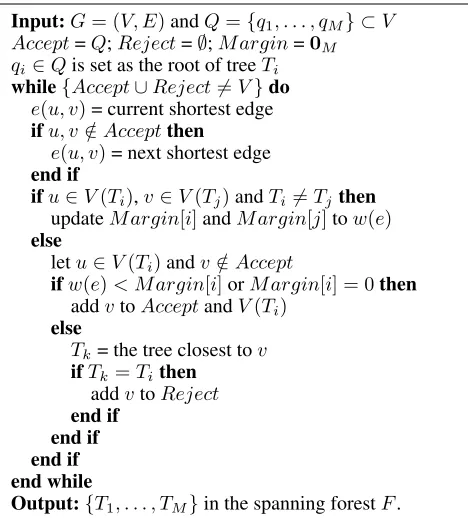
We design a greedy spanning forest algorithm (GSF) that grows trees rooted by the vertices with initial labels (i.e., seed data samples), and terminates the growth when two trees are about to collide. This algorithm iteratively explores unlabeled data samples represented as vertices, while avoid-ing the noise introduced by less informative data samples in proximity of the decision boundaries. As a result, this algo-rithm addresses the Problem 3.2 in a heuristic way, by greed-ily visiting an unlabeled vertex from a labeled one through an edge that constitutes the smallest weight in each iteration. In Algorithm 1, the input is a complete graphGwith a vertex setQ ⊂ V representing the seed data samples, and the output isM labeled trees corresponding toM distinct labels forQ. The Euclidean distance is used to measure the weight/distance of each edgew(e). We exploit an automatic
Algorithm 1Greedy Spanning Forest
Input:G= (V, E)andQ={q1, . . . , qM} ⊂V
Accept=Q;Reject=∅;M argin=0M
qi∈Qis set as the root of treeTi
while{Accept∪Reject6=V}do e(u, v)= current shortest edge ifu, v /∈Acceptthen
e(u, v)= next shortest edge end if
ifu∈V(Ti),v∈V(Tj)andTi6=Tjthen
updateM argin[i]andM argin[j]tow(e)
else
letu∈V(Ti)andv /∈Accept
ifw(e)< M argin[i]orM argin[i] = 0then addvtoAcceptandV(Ti)
else
Tk= the tree closest tov
ifTk=Tithen
addvtoReject end if
end if end if end while
Output:{T1, . . . , TM}in the spanning forestF.
boundary detection strategy using the concept ofconflicting edge, to estimate themarginof each labeled tree and avoid adding vertices that are less similar to the root due to the accumulative distance.
Definition 4.1(Conflicting Edge). LetTiandTjbe two
dis-joint trees on the graphG, and their roots have two different labels initially. An edgee= (u, w)is said to be aconflicting edgebetweenTiandTjifu∈V(Ti)andw∈V(Tj).
Definition 4.2(Margin). If an edgeeis a conflicting edge between two treesTi andTj, its weightw(e)∈ R+ is said to be themarginofTiandTj.
Figure 2: An example of spanning forest construction. Unla-beled vertices are numbered by the visiting order during the spanning process. The shortest edge under examination on each graph is shown as a bold black line. A conflicting edge detected in the process is shown as a bold red line.
that is currently under examination, andTiis a labeled tree
rooted by a vertexqi ∈Qwith an initial label. There are five
possible scenarios for the edgeeas follows.
1. Ifu ∈ V(Ti), then eforms a cycle and thereby be re-moved.
2. Ifu∈ V(Tj)andTi 6=Tj, theneis a conflicting edge,
and hence, the margin ofTiandTjis updated according
tow(e)(e.g.,e(4,7)in Figure 2(a)).
3. If the margin ofTiis0or larger thanw(e), then adduto
V(Ti).
4. Ifw(e)is not smaller than the margin ofTi, and the
dis-tance betweenuand the center ofTiis smaller than that
of other labeled trees, thenuis left as a single-vertex tree (e.g., vertex12in Figure 2(c)).
5. Ifw(e)is not smaller than the margin ofTi, but the
dis-tance betweenuand the center of another labeled treeTk
is smaller than that ofTi, then skip making decision for
u(e.g., vertex10in Figure. 2(b)).
The intuition behind the4th and5th criteria is to take into account both thepairwise similaritybetween an unassigned vertex and its closest assigned vertex, and theaccumulative dissimilaritybetween that unassigned vertex and the center of labeled trees, which is updated once a new vertex is added into the tree. One thing to note is, a vertex been skipped by the 5th criteria will be re-examined in a later iteration through a different edge. If that edge connects to a labeled tree with the closest center, then this vertex will be added to that labeled tree in the end (e.g., vertex10in Figure 2(d)), or left as a single-vertex tree based on the4th criteria. Be-cause there are finite number of edges on the graph, this al-gorithm is guaranteed to stop when all the vertices have been assigned to a labeled tree, or rejected from the addition.
Termination of Growth One important property of greedy spanning tree algorithm is to identify those vertices sufficiently similar to the seed data samples in a data-driven manner. This is realized from two aspects: (1) greedily grow-ing a labeled tree through the shortest edge in each iteration, to ensure the intra-similarity within the vertex set of each tree; and (2) terminating the growth of two trees if a con-flicting edge between them is detected, to restrict the accu-mulative distance along the path from the center to any leaf in the tree. The first aspect has been embodied in the initial condition of the algorithm, and we hereby prove the second aspect is guaranteed according to the algorithm design.
Lemma 4.1. If a conflicting edge ec is detected between
treesTiandTjin the greedy spanning forest algorithm, both
TiandTjstop growing.
Proof. Letec= (u, v)be a conflicting edge, whereuandv
belong to two disjoint treesTiandTjcorrespondingly, then
the margin ofTiandTj is set tow(ec). In a later iteration,
edgeeis the shortest edge among all the edges with at least one endpoint belonging to a labeled tree. Ifeis adjacent to a vertex inV(Ti)orV(Tj), then there must bew(e)> w(ec); otherwise,eshould be identified as the shortest edge prior to ecin previous iteration, which contradicts the statement that
eis examined afterechas been detected. Therefore,
accord-ing to the criterion ofw(e)< w(ec)for adding new vertex to a labeled tree, no more vertex can be added toV(Ti)or
V(Tj)once a conflicting edge has been detected.
Sample Filtering
We propose a silhouette-based filtering algorithm operat-ing on the clusters/forest{C1, . . . , CM}constructed by the
greedy spanning forest algorithm. The purpose of this step is to perform an automated sample selection for reliable label augmentation.
Silhouette is a popular method widely used for clustering interpretation and validation. It measures the intra-similarity within each cluster versus the inter-dissimilarity between two disjoint clusters (Rousseeuw 1987; Ansari et al. 2011). Given a data samplexiin a clusterCi, its silhouette value is
estimated as follows.
s(xi) =
inter(xi)−intra(xi)
max{inter(xi), intra(xi)} ∈[−1,1] (1)
whereinter(xi)denotes the average dissimilarity between xiand other data samples inCi, andintra(xi)denotes the
minimum of the average dissimilarity betweenxi and data
samples in each cluster other thanCi.
Similar to the distance measurement used in the forest spanning, the Euclidean distance is also used to measure the dissimilarity between data samples. According to Eq.1, a higher positive silhouette value indicates a more confident clustering assignment of the data sample, and hence, it is preferred in the sample selection. Algorithm 2 presents the logical flow of our sample filtering process, which aims to remove less confident clustering assignments from the pre-vious step.
Algorithm 2Silhouette-based Filtering
Input:C={C1, . . . , CM}andQ={q1, . . . , qM}
Center[i] =µ(Ci),qi∈Ci,i∈[1, M]
Base[i] =max{s(qi),0}forCi
forxi∈ {Ci\Q}do
computes(xi)using data inCenter∪Q
ifs(xi)< Base[i]then removexifromCi
updateCenter[i]
end if end for
Output:ClustersC0={C1, . . . , CM}
To avoid the use of fixed threshould, Algorithm 2 first computes the silhouettes(qi)of the seed data sampleqiin
the clusterCi, so that the baseline for sample filtering is the
maximum of {s(qi),0}. In the case of only one seed data sample available in one label, the center of the clusterµ(Ci)
clustersC0 have more reliable assignement with low intra-dissimilarity and high inter-intra-dissimilarity. The output of this step is a labeled training set ready for model generation to perform activity recognition.
5
Experiment and Results
We conducted comprehensive analyses to evaluate the per-formance of LabelForest using three datasets, including (1) HART (Anguita et al. 2013; Reyes-Ortiz et al. 2016) con-tains motion sensor data of6daily activities collected from
30subjects, and the average size of individual data collected from one subject is347; (2)SmartSockcontains accelerom-eter and stretch sensor data of12activities collected from12
subjects, and the average size of individual data is397; (3) Phone(Stisen et al. 2015) contains accelerometer data of6
activities collected from9subjects using a variety of smart-phones, and the average size of individual data gathered by one specific smartphone is1526.
Validation Methodology
Two tasks were designed to evaluate the performance of La-belForest, namely selective labeling and activity recogni-tion. The first task was to select and label some unlabeled data samples given a few seed data samples. We adopted five metrics to evaluate the performance for this task, and the precision and recall were averaged over all the class la-bels.
• labeling rate: the percentage of data samples been la-beled, which reflects the capability of data exploration.
• precision: the ratio of true positive to the sum of true pos-itive and false pospos-itive.
• recall: the ratio of true positive to the sum of true positive and false negative on the data samples been labeled.
• f1 score: the weighted sum of precision and recall follow-ing the equation below.
f1 = 2×precision×recall
precision+recall
• labeling accuracy: the rate of true positive on the data samples been labeled.
The second task was to train a machine learning model us-ing the labeled dataset obtained previously, to estimate the corresponding labels of a separate test set. We empirically chose SVM algorithm to train the classification model for activity recognition, because it achieved better performance across the three datasets comparing to several popular ma-chine learning algorithms. The correct labeling rate on the test set was used to measure the classification accuracy.
Comparison Approaches
Many semi-supervised learning approaches usek-NN or -NB algorithms to construct a similarity-based graph for la-bel inference (Chapelle and Zien 2005). In our experiment, we compared LabelForest against these two algorithms and other learning approaches utilizing the self-training strategy, as listed below.
• k-NN: a number ofk∈Znearest neighbors of each seed data sample were selected and assigned the same label accordingly.
• -NB: any unlabeled data sample within a given distance ∈Rto a seed data sample was selected and assigned the same label accordingly.
• Sequential k-means: the seed data samples formed an initial clustering according to their labels, and each un-labeled data sample was un-labeled by comparing its dis-tance to the center of each cluster, which was updated after adding a newly labeled data sample.
• Naive ML: A machine learning (ML) model was first trained with the seed data samples, and then updated by re-training with the data samples labeled using the pre-vious model. Three classic machine learning algorithms were tested in the naive approach to provide the baseline performance, including the decision tree (DT), logistic re-gression (LR) and linear support vector machine (SVM).
• Upper ML: the upper bound accuracy of selective la-beling is100% by default. The upper bound accuracy of activity recognition was estimated by training a machine learning model using the true labels of the training set.
Results of Selective Labeling
Figure 3: Results of selective labeling given one labeled data sample for each activity class.
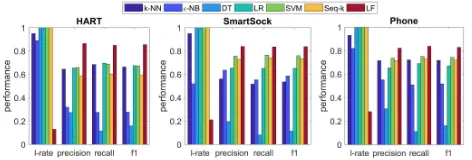
Labeling Results Comparison Figure 3 shows the per-formance of the algorithms for selective labeling given only one seed data sample for each activity class, where “Seq-k” refers to sequentialk-means algorithm and “LF” denotes the proposed framework, LabelForest.
Three machine learning algorithms and sequential k -means algorithm assign the labels to all the unlabeled data samples, thereby having the labeling rate of1. On the con-trary, LabelForest gives the priority to the quality of label-ing results over the quantity, through an automatic tradeoff without any pre-defined parameter. Although the labeling rate of LabelForest is lower than that of other compared ap-proaches, the precision and recall of LabelForest averaging over all the activity classes is the highest, with an f1 score of
0.86,0.84and0.83on the three datasets, respectively.
Figure 4: Labeling accuracy with an increasing number of seed data samples per label.
As the number of seed data samples increases, the label-ing accuracy of most algorithms improve accordlabel-ingly, which is attributed to a better labeling model learned from a more informative dataset. However,k-NN and-NB algorithms show the fluctuations in their performance, mainly because of the randomly selected parameter values. Overall speak-ing, LabelForest not only achieves the highest labeling accu-racy (more than 88.8% in all the test cases), but also shows a steady improvement along with the increasing number of seed data samples, with an accuracy increase of 7.2%, 8.3% and 9.8% on the three datasets respectively.
Results of Activity Recognition
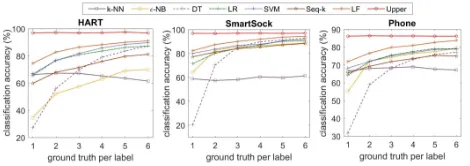
The second task of our experiment is activity recognition using the augmented training set obtained in previous task. The baseline performance is computed by training the model with seed data samples alone, and then testing it on a sepa-rate test set. Figure 5 shows the results of activity recognition with an evenly growing number of seed data samples.
Figure 5: Accuracy of activity recognition with increasing number of seed data samples.
The upper bound is computed as mentioned in Section 5, and the overall accuracy appears to be significantly lower on thePhonedataset than that of the other two datasets, where the average accuracy is 86.3% for thePhonedataset, 97.1% for theHARTdataset and 96.9% for theSmartSockdataset. It indicates the diversity of human activity data caused by the differences in individual movement patterns and sensing systems.
Overall speaking, the performance of LabelForest is the closest to the upper bound performance comparing to other tested algorithms. The classification accuracy of LabelForest increases from 74.6% to 91.1% on theHARTdataset, from 82.3% to 94.4% on theSmartSockdataset, and from 71.9% to 83.8% on thePhone dataset, along with the increase in the number of seed data samples.
Impact of Unbalanced Seed Dataset
In the previous experiment, the number of seed data sam-ples increased evenly for all the activity classes. However in practice, it is more likely to observe uneven numbers of seed data samples for different activities. To validate the robust-ness of LabelForest given a seed dataset with skewed label distribution, we obtain an unbalanced seed dataset by adding more seed data samples in only one randomly picked label, while maintaining the number of seed data samples to one for the other labels in the validation.
Labeling with Skewed Input We first compare the per-formance of each algorithm for selective labeling given bal-anced and unbalbal-anced seed dataset, as shown in Figure 6, where “balanced L2” means each activity class has2 data samples in the seed dataset, and “unbalanced L8” means, in the seed dataset, one random activity class has8data sam-ples and the others have only 1 data sample for each. We choose these two cases for comparison because the total size of the seed dataset is similar.
Figure 6: Performance of selective labeling with balanced and unbalanced seed datasets.
In general, almost all the algorithms show a decline in the labeling accuracy given unbalanced seed dataset, but the performance of LabelForest has a less significant change comparing to other algorithms, with an accuracy decrease of
3.6% averaging over the three datasets. This result demon-strates the robustness of LabelForest in presence of a skewed label distribution in the seed dataset. In addition, LabelFor-est also achieves the bLabelFor-est labeling performance in the case of unbalanced seed dataset, with an accuracy of92.2%,88.5% and89.8% on the three datasets respectively.
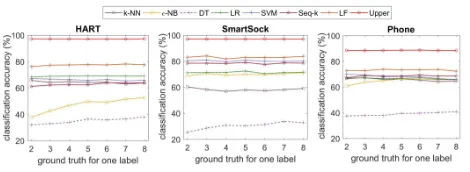
Activity Recognition with Skewed Input We further evaluate the performance of the machine learning model trained with the augmented training set, when the seed dataset has an increasing degree of the skewness, which is simulated by gradually increasing the number of seed data samples for only one activity class but remaining only one data sample for the other activity classes. The results are shown in Figure 7.
Figure 7: Accuracy of activity recognition with the increas-ing skewness in the seed dataset.
improvement in the performance of the machine learning model through training set augmentation, and the classifi-cation accuracy is77.3%on the first dataset,83.0%on the second dataset and73.1%on the third dataset.
Impact of Sample Filtering
As presented in Section 4, LabelForest consists of two major steps, the first one performs a greedy spanning forest (GSF) algorithm to explore the data samples similar to the seed data samples, and the second step uses a silhouette-based filtering algorithm to finalize the newly labeled data samples based on the first step. To validate the effectiveness of these two steps, we compare the performance of LabelForest on the HARTdataset with and without applying the second step of sample filtering.
(a) Comparison with balanced seed dataset
(b) Comparison with highly unbalanced seed dataset.
Figure 8: Performance comparison of LabelForest with and without applying sample filtering.
Figure 8 shows the comparison results given balanced (Figure 8a) and unbalanced (Figure 8b) seed datasets, where “GSF” refers to the case of using greedy spanning forest al-gorithm alone, and “LF” refers to the case of performing the LabelForest framework completely. The motivation of sam-ple filtering is to further improve the quality of the newly labeled data samples by trading the labeling rate for the pre-cision, which is reflected in the two bar plots in Figure 8. Given balanced seed dataset with one seed data sample for each activity class, the labeling rate of LF is16.6%as that
of GSF, but the precision of LF is15.4%higher than that of GSF. In the case of unbalanced seed dataset with8seed data samples for only one activity class, the labeling rate of LF is18.8%as that of GSF, while the precision of LF is17.5%
higher than that of GSF. As a result, although the labeled dataset obtained after sample filtering is smaller in size than that of GSF, the higher precision of the former results in a more accurate machine learning model for activity recogni-tion, as shown in the rightmost plots in Figure 8.
6
Conclusions and Future Work
The dynamic nature of human movements requires the un-derlying computational algorithm to be robust to handle the diversity of individual data distributions. In practice, collect-ing sufficiently large amounts of labeled traincollect-ing data is time consuming and expensive. Therefore, it is desirable to au-tonomously construct a large training dataset using an ini-tially small labeled dataset.
In this study, we designed and developed an autonomous label augmentation framework for semi-supervised learning, called LabelForest, to obtain effective activity recognition models in wearable sensing systems. Our approach learns from a small set of seed data with initial activity labels, and develops novel graph-based sample selection and label in-ference algorithm coupled with a silhouette-based filtering strategy. The experimental results demonstrated the robust-ness of LabelForest with a labeling accuracy of 90.1% on average.
Many semi-supervised learning algorithms use a label propagation method on the constructed graph to assign la-bels to unlabeled data samples. Because our graph construc-tion aims to obtain a spanning forest by giving a higher priority to the labeling precision over the labeling rate, the resulting graph is naturally a disconnected graph. There-fore, existing label inference/propagation algorithms cannot be applied directly on the graph obtained by LabelForest. If there is large overlap between data samples of two dif-ferent classes, a conflicting edge will be easily detected in an early stage during forest spanning, which terminates the growth of the two trees/clusters consequently. As a result, a small amount of data samples will be labeled in this case. An interesting future work that we plan to pursue is to refine our graph construction algorithm, such that the existing la-bel propagation algorithms can be directly applied for lala-bel inference.
7
Acknowledgments
This work was supported in part by the United States Na-tional Science Foundation, under grant CNS-1750679. Any opinions, findings, conclusions, or recommendations ex-pressed in this material are those of the authors and do not necessarily reflect the views of the funding organizations.
References
Ackerman, M., and Dasgupta, S. 2014. Incremental cluster-ing: The case for extra clusters. CoRRabs/1406.6398. Ando, R. K., and Zhang, T. 2005. A framework for learning predictive structures from multiple tasks and unlabeled data. J. Mach. Learn. Res.6:1817–1853.
Anguita, D.; Ghio, A.; Oneto, L.; Parra, X.; and Reyes-Ortiz, J. L. 2013. A public domain dataset for human activity recognition using smartphones. InESANN.
Ansari, Z. A.; Azeem, M. F.; Ahmed, W.; and Babu, A. V. 2011. Quantitative evaluation of performance and validity indices for clustering the web navigational sessions. CoRR abs/1507.03340.
Belkin, M.; Niyogi, P.; and Sindhwani, V. 2006. Manifold regularization: A geometric framework for learning from la-beled and unlala-beled examples.J. Mach. Learn. Res.7:2399– 2434.
Berton, L., and de Andrade Lopes, A. 2015. Graph con-struction for semi-supervised learning. InProceedings of the Twenty-Fourth International Joint Conference on Artifi-cial Intelligence, IJCAI’15.
Cardoso, H. L., and Moreira, J. M. 2016. Human activity recognition by means of online semi-supervised learning. In 2016 17th IEEE International Conference on Mobile Data Management (MDM), volume 2, 75–77.
Chapelle, O., and Zien, A. 2005. Semi-supervised classifi-cation by low density separation. InAISTATS 2005, 57–64. Max-Planck-Gesellschaft.
Chapelle, O.; Scholkopf, B.; and Zien, A. 2009. Semi-supervised learning (chapelle, o. et al., eds.; 2006)[book re-views]. IEEE Transactions on Neural Networks20(3):542– 542.
Dias, J. G., and Cortinhal, M. J. 2008. The skm algorithm: A k-means algorithm for clustering sequential data. In Geffner, H.; Prada, R.; Machado Alexandre, I.; and David, N., eds., Advances in Artificial Intelligence – IBERAMIA 2008, 173– 182. Berlin, Heidelberg: Springer Berlin Heidelberg. Ghazvininejad, M.; Rabiee, H. R.; Pourdamghani, N.; and Khanipour, P. 2011. Hmm based semi-supervised learning for activity recognition. InProceedings of the 2011 Interna-tional Workshop on Situation Activity & Goal Aware-ness, SAGAware ’11, 95–100. New York, NY, USA: ACM. Kwapisz, J. R.; Weiss, G. M.; and Moore, S. A. 2011. Ac-tivity recognition using cell phone accelerometers. ACM SigKDD Explorations Newsletter12(2):74–82.
Longstaff, B.; Reddy, S.; and Estrin, D. 2010. Improving activity classification for health applications on mobile de-vices using active and semi-supervised learning. In 2010
4th International Conference on Pervasive Computing Tech-nologies for Healthcare, 1–7.
Mannini, A.; Rosenberger, M.; Haskell, W. L.; Sabatini, A. M.; and Intille, S. S. 2017. Activity recognition in youth using single accelerometer placed at wrist or ankle. Medicine and science in sports and exercise49(4):801. Olukanmi, P. O., and Twala, B. 2017. Sensitivity analysis of an outlier-aware k-means clustering algorithm. In2017 Pat-tern Recognition Association of South Africa and Robotics and Mechatronics (PRASA-RobMech), 68–73.
Reyes-Ortiz, J.-L.; Oneto, L.; Sam`a, A.; Parra, X.; and An-guita, D. 2016. Transition-aware human activity recognition using smartphones. Neurocomput.171(C):754–767. Rokni, S. A., and Ghasemzadeh, H. 2017. Synchronous dynamic view learning: A framework for autonomous train-ing of activity recognition models ustrain-ing wearable sensors. In2017 16th ACM/IEEE International Conference on Infor-mation Processing in Sensor Networks (IPSN), 79–90. Rousseeuw, P. 1987. Silhouettes: A graphical aid to the interpretation and validation of cluster analysis. J. Comput. Appl. Math.20(1):53–65.
Stisen, A.; Blunck, H.; Bhattacharya, S.; Prentow, T. S.; Kjærgaard, M. B.; Dey, A.; Sonne, T.; and Jensen, M. M. 2015. Smart devices are different: Assessing and mitigating-mobile sensing heterogeneities for activity recognition. In Proceedings of the 13th ACM Conference on Embedded Net-worked Sensor Systems, SenSys ’15, 127–140. New York, NY, USA: ACM.
Subramanya, A., and Talukdar, P. P. 2014. Graph-Based Semi-Supervised Learning. Morgan & Claypool Publishers. Tanha, J.; van Someren, M.; and Afsarmanesh, H. 2017. Semi-supervised self-training for decision tree classifiers. International Journal of Machine Learning and Cybernet-ics8(1):355–370.
Yao, L.; Nie, F.; Sheng, Q. Z.; Gu, T.; Li, X.; and Wang, S. 2016. Learning from less for better: Semi-supervised activity recognition via shared structure discovery. In Pro-ceedings of the 2016 ACM International Joint Conference on Pervasive and Ubiquitous Computing, UbiComp ’16, 13–24. New York, NY, USA: ACM.
Zakim, D., and Schwab, M. 2015. Data collection as a bar-rier to personalized medicine. Trends in pharmacological sciences36.
Zhu, X.; Lafferty, J.; and Ghahramani, Z. 2003. Combining active learning and semi-supervised learning using gaussian fields and harmonic functions. InICML 2003 workshop on The Continuum from Labeled to Unlabeled Data in Machine Learning and Data Mining, 58–65.